9 Best Automated Support Ticket Systems in 2026
Manual ticket management scales your support costs alongside your revenue — but the right automated support ticket system breaks that cycle by resolving tickets, not just routing them. This guide ranks the 9 best platforms of 2026, evaluated on AI capability, integration depth, scalability, ease of setup, and pricing transparency.
 Grant CooperFounder14 min read
Manual ticket management doesn't just slow your team down. It creates a compounding problem: the more customers you add, the more tickets pile up, the more agents you need, and the more your support costs grow in lockstep with your revenue. A true automated support ticket system breaks that cycle by resolving tickets, not just routing them.
The tools in this list range from AI-native platforms built to resolve tickets autonomously to established helpdesks with robust automation layers added over time. If you're evaluating options, it's worth understanding how traditional helpdesks compare to modern AI support platforms before committing to a direction.
To build this list, we evaluated each platform across five criteria: AI capability (resolution, not just routing), integration depth, scalability, ease of setup, and pricing transparency. Here are the top automated support ticket systems worth considering in 2026.
1. Halo AI
Best for: B2B SaaS teams that want AI agents resolving tickets autonomously, not just triaging them.
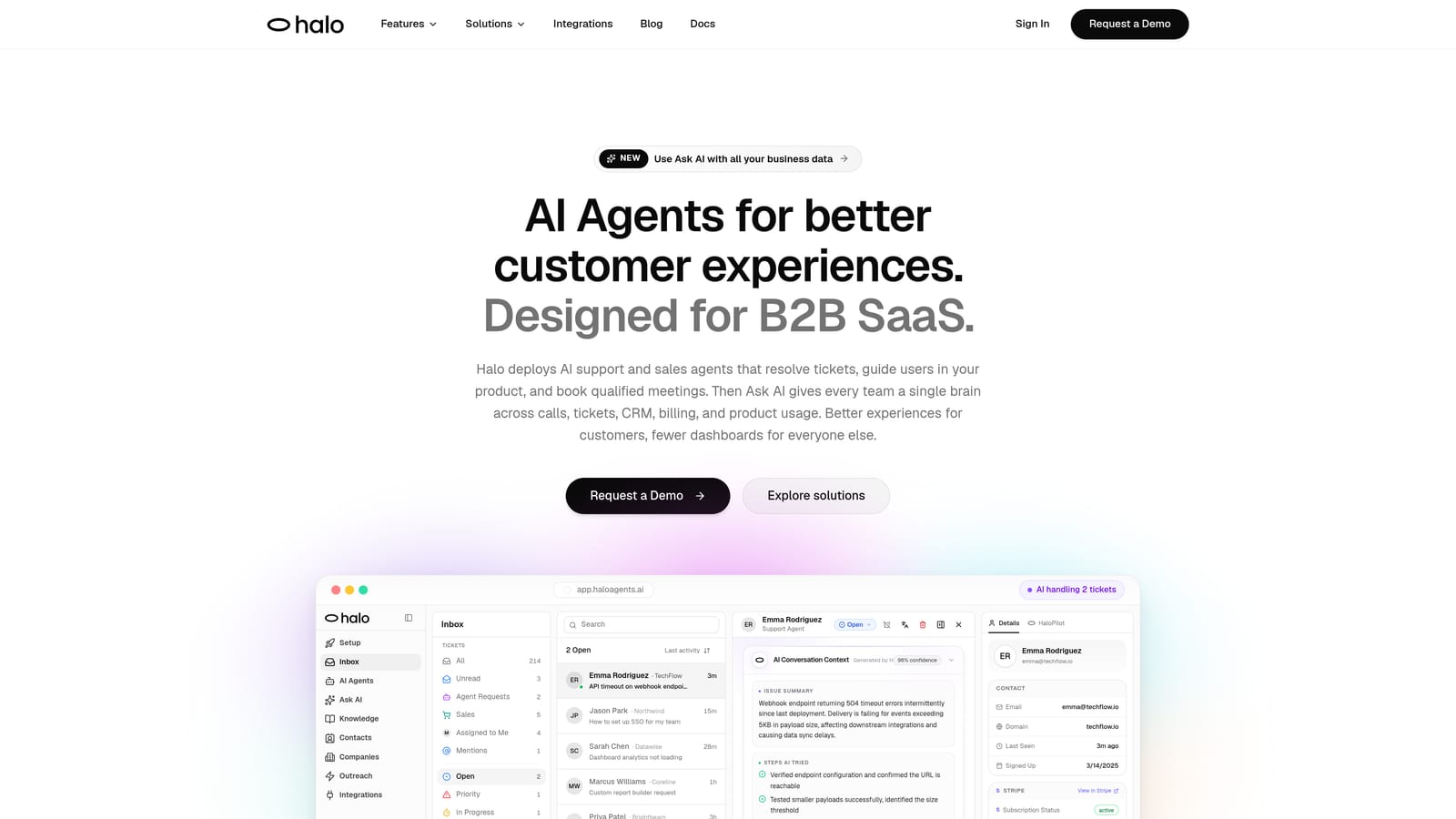
Halo AI is an AI-native customer support platform that deploys intelligent agents to resolve tickets, guide users through your product with page-aware context, auto-create bug reports, and surface business intelligence from every support interaction.
Where This Tool Shines
Most support tools automate the handoff. Halo automates the resolution. Its AI agents don't just classify incoming tickets and assign them to a human queue. They read the ticket, understand the user's in-product context, and close the loop autonomously for a meaningful share of inbound requests. When an issue genuinely requires human judgment, it escalates cleanly to a live agent.
The page-aware chat widget is a standout capability. The AI sees what the user sees inside your product, including which page they're on and what they've interacted with, enabling contextual guidance rather than generic responses. Combined with a smart inbox that surfaces customer health signals, revenue anomalies, and churn indicators, Halo turns your support channel into a source of business intelligence rather than just a cost center.
Key Features
Page-Aware AI Agents: The AI understands the user's in-product context, seeing what they see, to deliver guidance that's relevant to their exact situation rather than a generic knowledge base answer.
Autonomous Ticket Resolution: AI agents resolve tickets end-to-end with smart escalation to live agents when complexity warrants human involvement.
Auto Bug Ticket Creation: Confirmed bugs are automatically routed to engineering via Linear integration, removing the manual handoff between support and development.
Smart Inbox with Business Intelligence: The inbox surfaces customer health signals, revenue anomalies, and churn indicators derived from support conversations, giving leadership visibility beyond CSAT scores.
Continuous Learning: Every resolved interaction improves the AI's future performance, meaning the system gets smarter with your specific product and customer base over time.
Deep Integration Stack: Native connections to Linear, Slack, HubSpot, Intercom, Stripe, Zoom, PandaDoc, and Fathom connect support data across your entire business stack.
Best For
B2B SaaS companies and product teams that are scaling customer bases without wanting to scale headcount proportionally. Particularly strong for teams already using HubSpot, Linear, or Intercom who want support data flowing into their existing systems automatically.
Pricing
Demo-first model with custom pricing based on your team's needs. Visit haloagents.ai to request a demo and get current pricing details directly from the team.
2. Zendesk
Best for: Large support teams that need enterprise-grade automation, omnichannel coverage, and a massive integration ecosystem.
Zendesk is one of the most established helpdesk platforms on the market, offering deep automation through triggers, macros, and routing rules, with AI capabilities layered across its Suite plans.

Where This Tool Shines
Zendesk's strength is its maturity. The trigger and macro system is one of the most flexible in the industry, letting operations teams build sophisticated routing logic without writing code. For organizations with complex support workflows, multiple channels, and large agent teams, Zendesk provides a reliable, battle-tested foundation.
The AI layer, built in partnership with OpenAI, adds suggested replies, intelligent triage, and automated routing on top of that foundation. It's worth noting that this AI functions more as an assistant to agents than an autonomous resolver. Teams evaluating Zendesk should factor in that complexity and cost tend to grow together as customization increases.
Key Features
Advanced Automation Rules: Triggers, macros, and SLA policies give operations teams granular control over ticket routing and escalation logic.
Zendesk AI: Suggested replies, intelligent triage, and routing recommendations powered by AI across Suite plans.
Omnichannel Support: Email, chat, voice, social, and messaging channels unified in a single workspace.
App Marketplace: Hundreds of integrations available for connecting Zendesk to your existing tech stack.
Reporting and Analytics: Robust dashboards for ticket volume, agent performance, SLA compliance, and customer satisfaction.
Best For
Enterprise support organizations with dedicated operations teams to manage configuration and ongoing maintenance. Less ideal for lean teams that need fast setup or autonomous AI resolution out of the box.
Pricing
Suite Team starts at approximately $55/agent/month. Verify current pricing at zendesk.com/pricing before making a decision.
3. Freshdesk
Best for: Growing teams that want multi-channel helpdesk capabilities with built-in AI at a competitive price point.
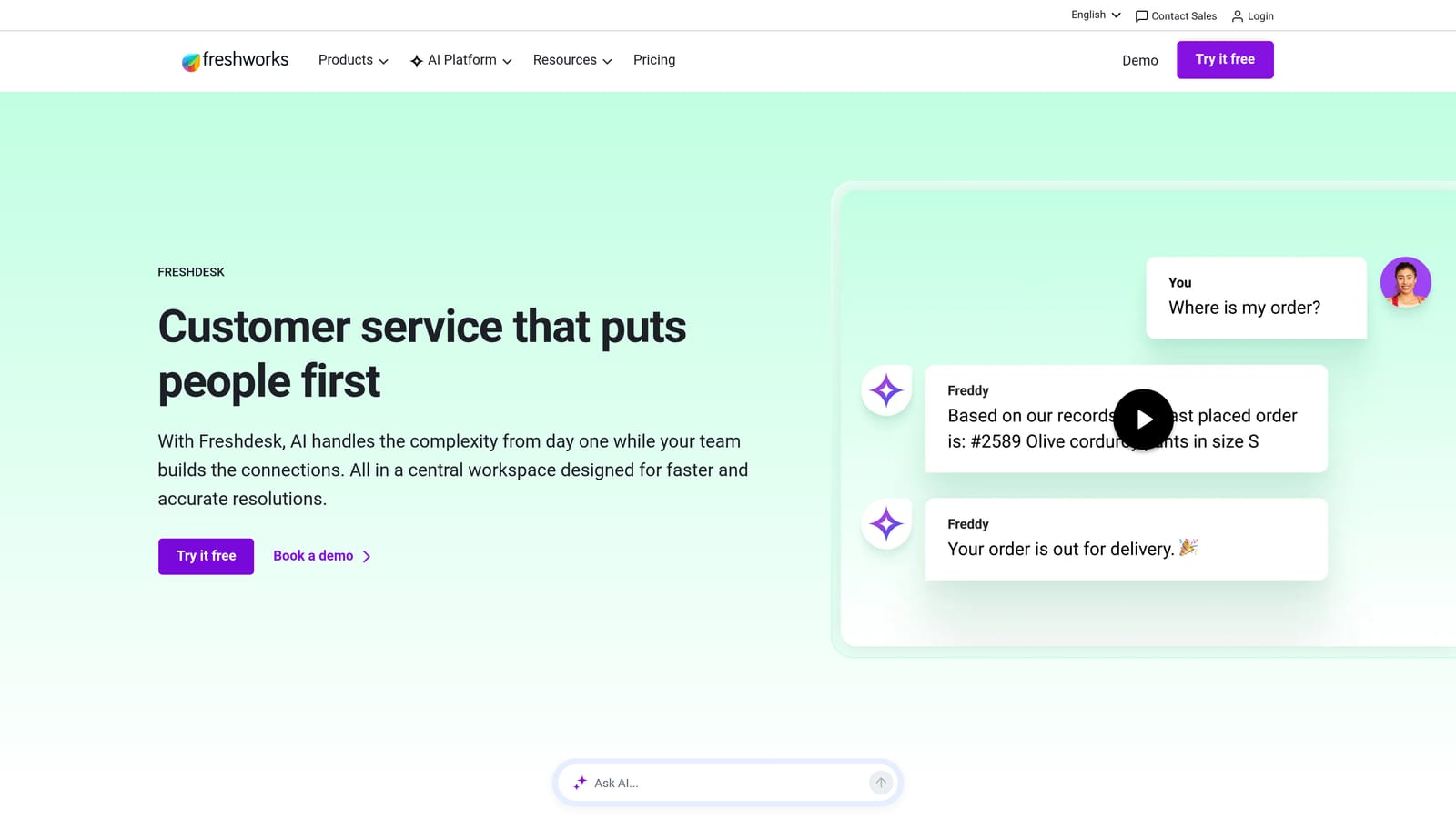
Freshdesk is a widely used helpdesk platform with Freddy AI built in for automated triage, suggested responses, and self-service deflection, offered at pricing that makes it accessible for teams at various stages.
Where This Tool Shines
Freshdesk hits a practical middle ground: more AI capability than a basic ticketing system, more affordable than enterprise platforms, and easier to set up than Zendesk for most teams. Freddy AI handles ticket classification and suggested responses well, and the self-service bot can deflect a meaningful portion of repetitive inbound queries.
The free plan makes it a genuine option for small teams that need structure without upfront investment. As teams grow, the paid tiers introduce more automation depth, though teams with complex AI resolution requirements may eventually find themselves looking at more AI-native options.
Key Features
Freddy AI: Automated ticket classification, suggested responses, and a self-service bot for common query deflection.
Multi-Channel Inbox: Email, chat, phone, and social media support consolidated in one place.
Scenario Automations: Pre-built automation sequences for repetitive workflow tasks, reducing manual agent steps.
Collision Detection: Prevents two agents from simultaneously working on and responding to the same ticket.
Free Plan: Available for small teams with core helpdesk functionality included at no cost.
Best For
Small to mid-sized support teams looking for a well-rounded helpdesk with AI assistance at a price point that scales reasonably. Strong choice for teams migrating off spreadsheets or basic email inboxes.
Pricing
Free plan available; paid plans start at approximately $15/agent/month. Verify current tiers at freshdesk.com/pricing.
4. Intercom
Best for: Product-led growth companies that prioritize conversational, in-app support and proactive customer engagement.
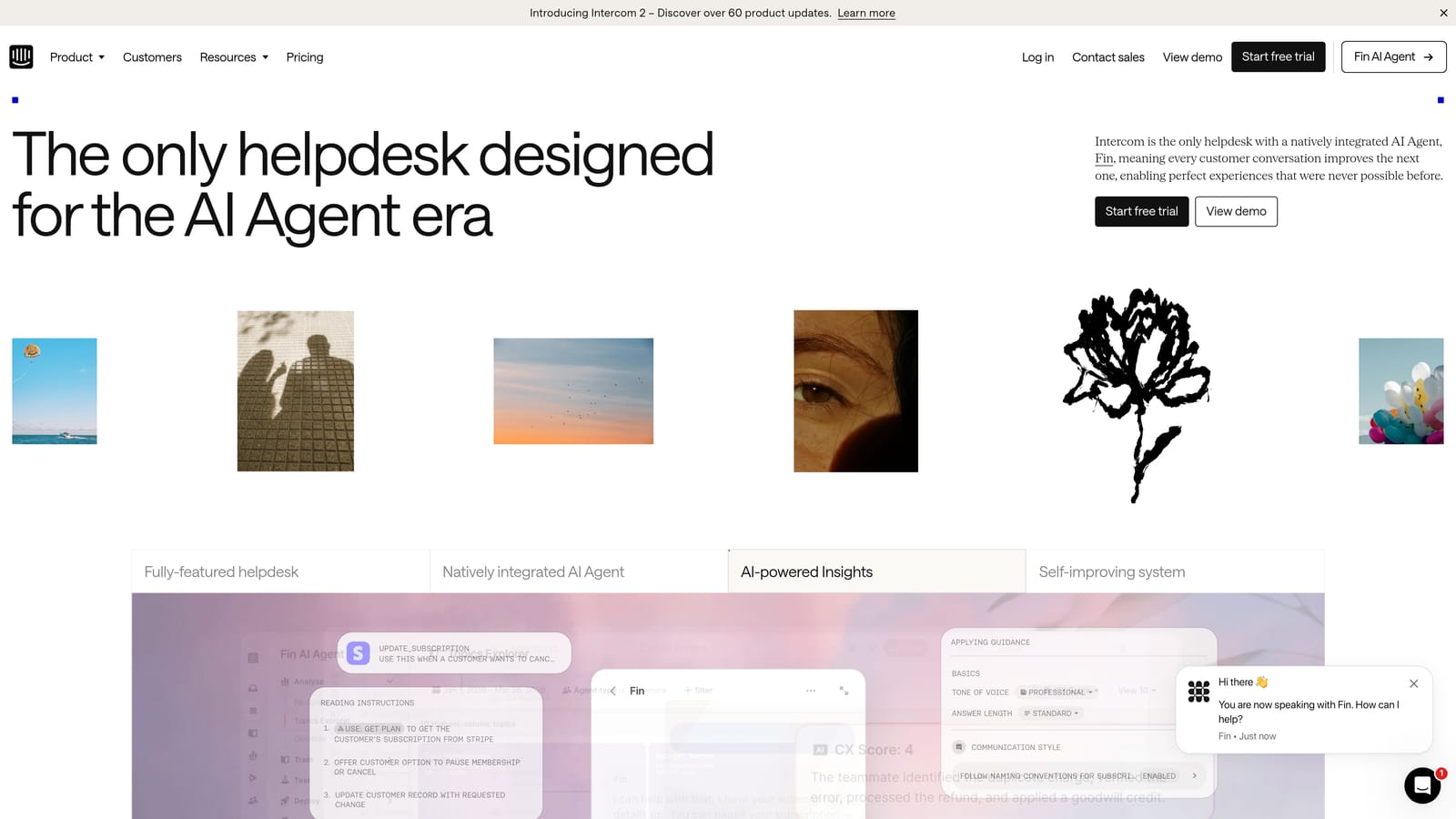
Intercom is a conversational support platform with its Fin AI Agent at the core, designed to handle inbound queries autonomously through conversation before a traditional ticket is ever created.
Where This Tool Shines
Intercom's approach to support starts with conversation, not ticket creation. Fin AI Agent engages users in natural dialogue, resolves common questions autonomously, and only escalates to a human or formal ticket when the query genuinely requires it. For product-led companies with high volumes of repetitive how-to questions, this conversational-first model can significantly reduce the tickets that reach your team.
The proactive support capabilities, including product tours and targeted in-app messages, also set Intercom apart from pure helpdesk tools. It's worth noting that Intercom's pricing can scale quickly with usage volume, so teams should model costs carefully at higher conversation volumes.
Key Features
Fin AI Agent: Autonomous resolution of common support queries through natural conversation, with escalation to human agents when needed.
In-App Messaging and Product Tours: Proactive support that reaches users in context, before they need to file a ticket.
Ticket Workflow Automation: Routing rules and workflow automation for tickets that do require human handling.
Customer Data Platform: Rich customer data context for personalized support experiences at every interaction.
AI Performance Reporting: Visibility into Fin resolution rates alongside traditional agent performance metrics.
Best For
SaaS companies with product-led growth motions, high volumes of repetitive in-app queries, and teams that value proactive support over reactive ticket management. Note that Halo AI also integrates with Intercom for teams wanting to layer additional AI capabilities.
Pricing
Pricing varies significantly by usage and plan tier. Verify current pricing at intercom.com/pricing and model costs against your expected conversation volume.
5. HubSpot Service Hub
Best for: Teams already invested in HubSpot's CRM who want support tickets connected directly to contact, company, and deal records.
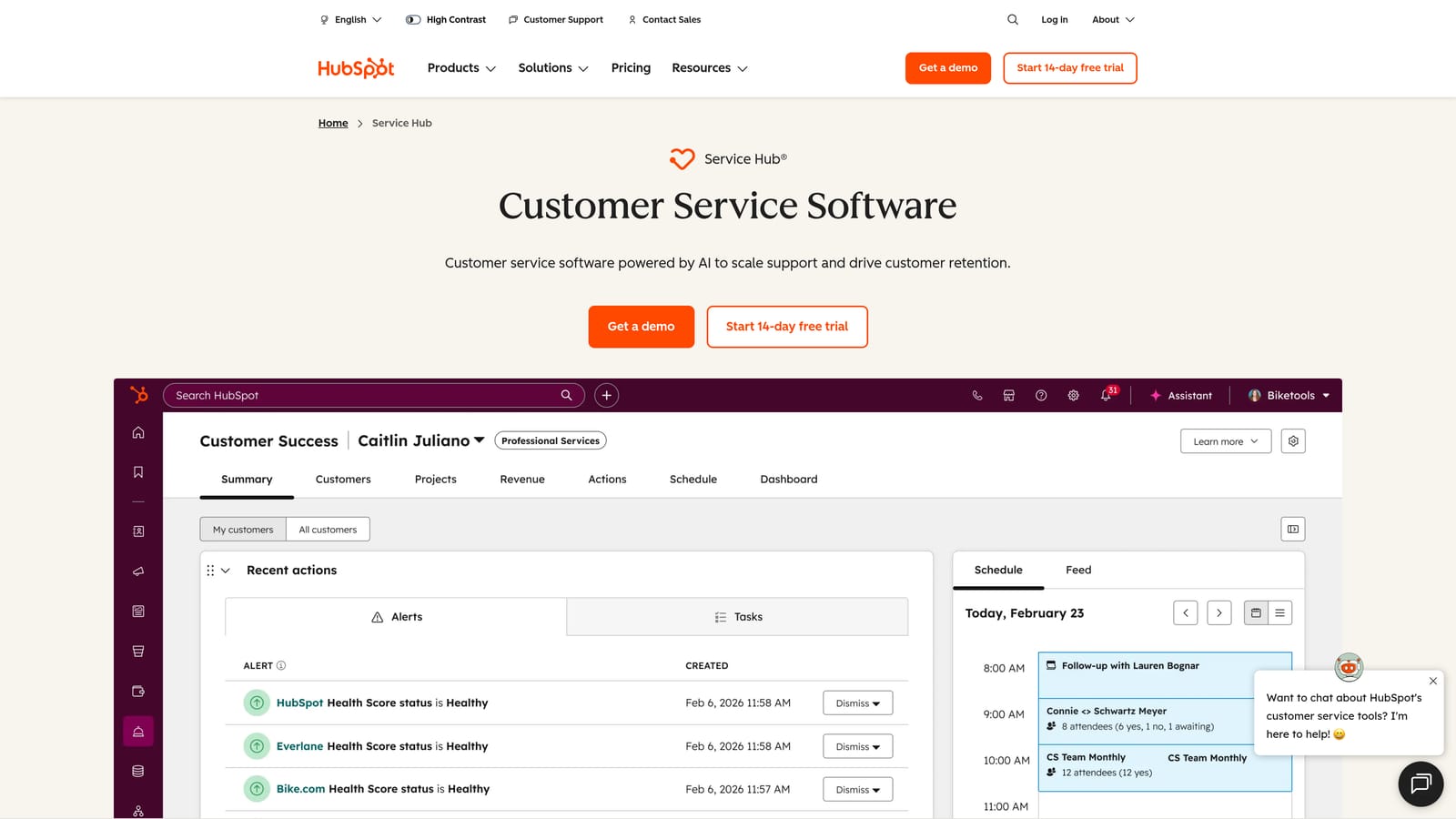
HubSpot Service Hub is a helpdesk built natively inside the HubSpot CRM, where every support ticket is a CRM object with full customer context attached from the moment it's created.
Where This Tool Shines
The core value proposition of Service Hub is context. When a ticket comes in, your agent already sees the contact's full history: their deal stage, recent marketing emails, previous support interactions, and company health. For teams where support and sales share responsibility for customer outcomes, this unified view is genuinely valuable and difficult to replicate with bolt-on integrations.
Workflow automation is shared across HubSpot's hubs, meaning a support ticket can trigger a sales follow-up or a marketing sequence without any manual handoff. Teams not already in the HubSpot ecosystem should weigh the cost of the broader platform against the value of that integration depth.
Key Features
Tickets as CRM Objects: Every ticket is natively linked to contact, company, and deal records for full customer context without manual lookups.
Shared Workflow Automation: Automation rules work across Marketing Hub, Sales Hub, and Service Hub for cross-functional workflows.
AI-Assisted Replies: AI reply suggestions and conversation summaries to help agents respond faster and more consistently.
Knowledge Base Builder: Self-service portal with a knowledge base that can deflect common questions before they become tickets.
Customer Feedback Surveys: NPS, CSAT, and CES surveys built in natively, with results tied directly to contact records.
Best For
Companies already using HubSpot for CRM, marketing, or sales who want to unify their customer data without adding another disconnected tool. Also a strong fit for teams where support agents need deal and revenue context to prioritize responses.
Pricing
Starter from approximately $15/month; Professional tier required for advanced automation features. Verify current pricing at hubspot.com/pricing.
6. Help Scout
Best for: Teams that prioritize customer experience quality and want support interactions to feel human, not transactional.
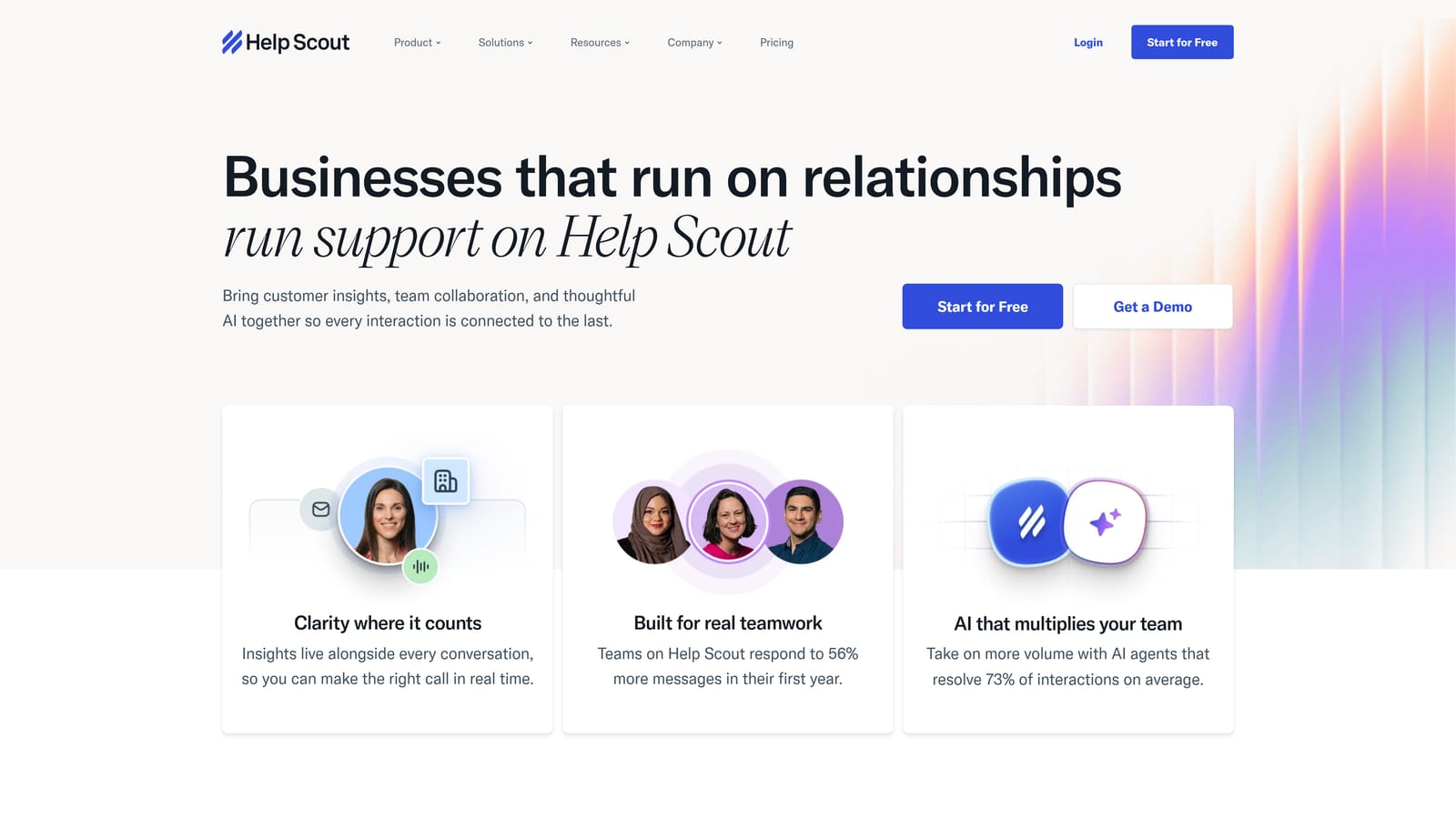
Help Scout is an email-first support platform that deliberately removes ticket numbers from customer-facing interactions, keeping the experience feeling like a genuine conversation rather than a support queue.
Where This Tool Shines
Help Scout's philosophy is that customers shouldn't feel like ticket numbers. The email-style interface means customers receive responses that look and feel like emails, with no ticket IDs, no case numbers, and no friction. For brands where customer experience quality is a differentiator, this matters more than it might seem on a feature comparison spreadsheet.
The AI features, including AI Summarize for catching up on long threads, AI Drafts for faster responses, and suggested replies, are well-integrated without feeling bolted on. The Beacon widget extends this experience into your product for in-app chat and help documentation access.
Key Features
Email-Style Interface: Customers never see ticket numbers or support queue language, keeping interactions feeling personal and conversational.
Beacon Widget: In-app widget for chat, help documentation, and proactive messaging without requiring customers to leave your product.
AI Drafts and Summarize: AI-generated reply drafts and thread summaries to help agents respond faster without sacrificing quality.
Workflow Automation: Automated tagging, assignment, and follow-up rules for keeping inboxes organized without manual effort.
Collision Detection and Internal Notes: Prevents duplicate responses and keeps internal team communication attached to the right conversation thread.
Best For
Customer-centric teams where brand voice and experience quality are priorities. Particularly well-suited for companies in industries where relationship quality matters, such as professional services, fintech, or high-touch SaaS.
Pricing
Standard plan from approximately $22/user/month. Verify current pricing at helpscout.com/pricing.
7. Zoho Desk
Best for: Teams inside the Zoho ecosystem looking for a full-featured helpdesk with strong AI capabilities at highly competitive pricing.
Zoho Desk is a full-featured helpdesk tightly integrated with the broader Zoho suite, featuring Zia AI for sentiment analysis, anomaly detection, and automated responses across all support channels.
Where This Tool Shines
Zoho Desk punches above its price point. Zia AI handles sentiment analysis, auto-tagging, anomaly detection, and suggested responses in a way that rivals tools at significantly higher price tiers. The Blueprint feature for structured workflow automation is particularly strong for teams with defined, multi-step support processes that need consistent execution.
For organizations already using Zoho CRM, Zoho Books, or other Zoho products, the native integration depth creates a unified customer data environment that's difficult to achieve with disconnected tools. The free plan also makes it accessible for very small teams starting out.
Key Features
Zia AI: Sentiment analysis, auto-tagging, anomaly detection, and suggested responses built into the core platform.
Blueprint Workflow Automation: Structured, multi-step workflow automation for support processes that require consistent, sequential execution.
Native Zoho CRM Integration: Full customer context from Zoho CRM available directly within ticket views.
Multi-Channel Coverage: Email, chat, phone, social media, and web forms managed in a unified inbox.
Competitive Pricing: Free plan available with paid tiers starting at pricing that significantly undercuts most competitors at comparable feature sets.
Best For
Small to mid-sized teams inside the Zoho ecosystem, budget-conscious organizations that need strong AI features without enterprise pricing, and teams with structured, process-heavy support workflows.
Pricing
Free plan available; paid plans from approximately $7/agent/month. Verify current tiers at zoho.com/desk/pricing.
8. Jira Service Management
Best for: Technical and IT teams that need support tickets to connect directly with development work in Jira Software.
Jira Service Management is Atlassian's ITSM-focused service desk platform, purpose-built for technical support teams where the line between a customer issue and an engineering task is often thin.
Where This Tool Shines
The native link between support requests and Jira Software issues is the defining capability here. When a customer reports a bug or a service disruption, that ticket can be connected directly to the engineering task addressing it, giving support agents real-time visibility into resolution status without chasing developers in Slack. For technical support teams, this eliminates a significant amount of internal coordination overhead.
Change management, incident management, and asset management workflows are built in natively, making Jira Service Management a genuine ITSM platform rather than a helpdesk with ITSM features added as an afterthought. Teams outside of technical support contexts may find the interface and configuration overhead more than they need.
Key Features
Native Jira Issue Linking: Support requests connect directly to Jira Software development tasks for real-time resolution visibility across teams.
Automation Rules: Routing, SLA tracking, and escalation automation built into the platform's core workflow engine.
Atlassian Intelligence AI: Summarization and smart suggestions powered by Atlassian's AI layer across plan tiers.
Change and Incident Management: Built-in workflows for managing service changes and incidents at the ITSM level.
Asset and Configuration Management: Track and manage infrastructure assets alongside service requests for full ITSM coverage.
Best For
IT support teams, technical support organizations, and engineering-adjacent teams where support tickets regularly need to become development tasks. Less suited for customer-facing support in non-technical contexts.
Pricing
Free for up to 3 agents; Standard from approximately $17.65/agent/month. Verify current pricing at atlassian.com/software/jira/service-management/pricing.
9. Tidio
Best for: Small teams and e-commerce businesses that need fast deployment of AI-powered chat support with minimal configuration.
Tidio is a lightweight support platform featuring the Lyro AI chatbot for autonomous query resolution, designed for fast deployment without requiring technical resources or dedicated IT support.
Where This Tool Shines
Tidio's primary advantage is speed to value. Teams can get Lyro AI handling common support questions within hours of setup, not weeks. For small businesses and e-commerce teams that don't have a dedicated support operations function, that low barrier to entry is genuinely meaningful.
Lyro AI handles a solid range of common queries autonomously and falls back to live chat or ticket creation when it can't resolve something. The e-commerce integrations with Shopify and WooCommerce make it a natural fit for online retail support. Teams with complex B2B workflows, deep integration requirements, or enterprise-scale ticket volumes will likely find Tidio's feature set limiting as they grow.
Key Features
Lyro AI Chatbot: Autonomous handling of common support questions with natural fallback to live chat or ticket creation for unresolved queries.
Live Chat with Ticket Fallback: Seamless transition from live chat to ticket creation when agents are unavailable.
Quick Setup: Designed for deployment without technical resources, getting teams operational in hours rather than days.
E-Commerce Integrations: Native connections to Shopify and WooCommerce for order-related support queries.
Free Plan: Core functionality available at no cost, with Lyro AI available as an add-on based on conversation volume.
Best For
Small teams, e-commerce businesses, and early-stage companies that need AI-powered chat support deployed quickly without dedicated IT or operations resources. Not the right fit for complex enterprise support environments.
Pricing
Free plan available; Lyro AI pricing varies by conversation volume. Verify current pricing at tidio.com/pricing.
Which Tool Is Right for Your Team
The right choice depends less on feature lists and more on where your team sits today and where you're heading. Here's a quick-reference view by use case.
If you want AI that resolves tickets, not just routes them: Halo AI is the clearest choice for B2B SaaS teams. Its page-aware AI agents, autonomous resolution, and business intelligence layer are built for this specific outcome from the ground up, not added on top of a legacy helpdesk architecture.
If you need enterprise-grade helpdesk infrastructure: Zendesk remains the benchmark for large support organizations with complex routing requirements, omnichannel coverage needs, and dedicated operations teams to manage configuration.
If budget is the primary constraint: Zoho Desk offers the strongest combination of AI features and low per-seat pricing. Freshdesk's free plan is worth considering for very small teams just getting started.
If you're already in a specific ecosystem: HubSpot Service Hub makes sense if your team lives in HubSpot CRM. Jira Service Management is the natural choice for IT and technical support teams already using Atlassian tools. Tidio fits e-commerce teams on Shopify or WooCommerce.
If customer experience quality is a brand differentiator: Help Scout's email-first approach keeps interactions feeling human in a way that ticket-number-driven systems often don't.
The broader trend worth watching is the shift from ticket routing to ticket resolution. Many platforms on this list automate the assignment and triage steps well. Fewer genuinely close tickets without human involvement. As that capability gap widens, it's becoming the primary evaluation criterion for B2B SaaS teams thinking about support at scale.
Your support team shouldn't scale linearly with your customer base. Let AI agents handle routine tickets, guide users through your product, and surface business intelligence while your team focuses on complex issues that need a human touch. See Halo in action and discover how continuous learning transforms every interaction into smarter, faster support. You can also explore the full customer support solution to see how Halo fits into your existing stack.