9 Best Automated Technical Support Tools in 2026
Discover the 9 best automated technical support tools in 2026, evaluated on AI capability, integration depth, and deployment ease for B2B SaaS teams. From AI-first platforms to legacy helpdesk automation, this guide helps technical support teams reduce ticket volume, improve response times, and scale efficiently without proportionally growing headcount.
 Grant CooperFounder12 min read
Technical support teams are under more pressure than ever. Ticket volumes grow, user expectations rise, and hiring more agents doesn't scale indefinitely. Automated technical support tools change that equation, handling repetitive queries, routing complex issues, and giving your team the intelligence to work smarter.
But not all automation is created equal. Some tools bolt automation onto legacy helpdesk systems. Others are built AI-first from the ground up. Some focus narrowly on chat; others extend into bug tracking, business intelligence, and cross-system integrations.
Here are the top automated technical support tools available in 2026, evaluated on AI capability, integration depth, ease of deployment, and value for B2B SaaS teams.
1. Halo AI
Best for: B2B SaaS teams wanting AI-first autonomous support with deep product and business intelligence.
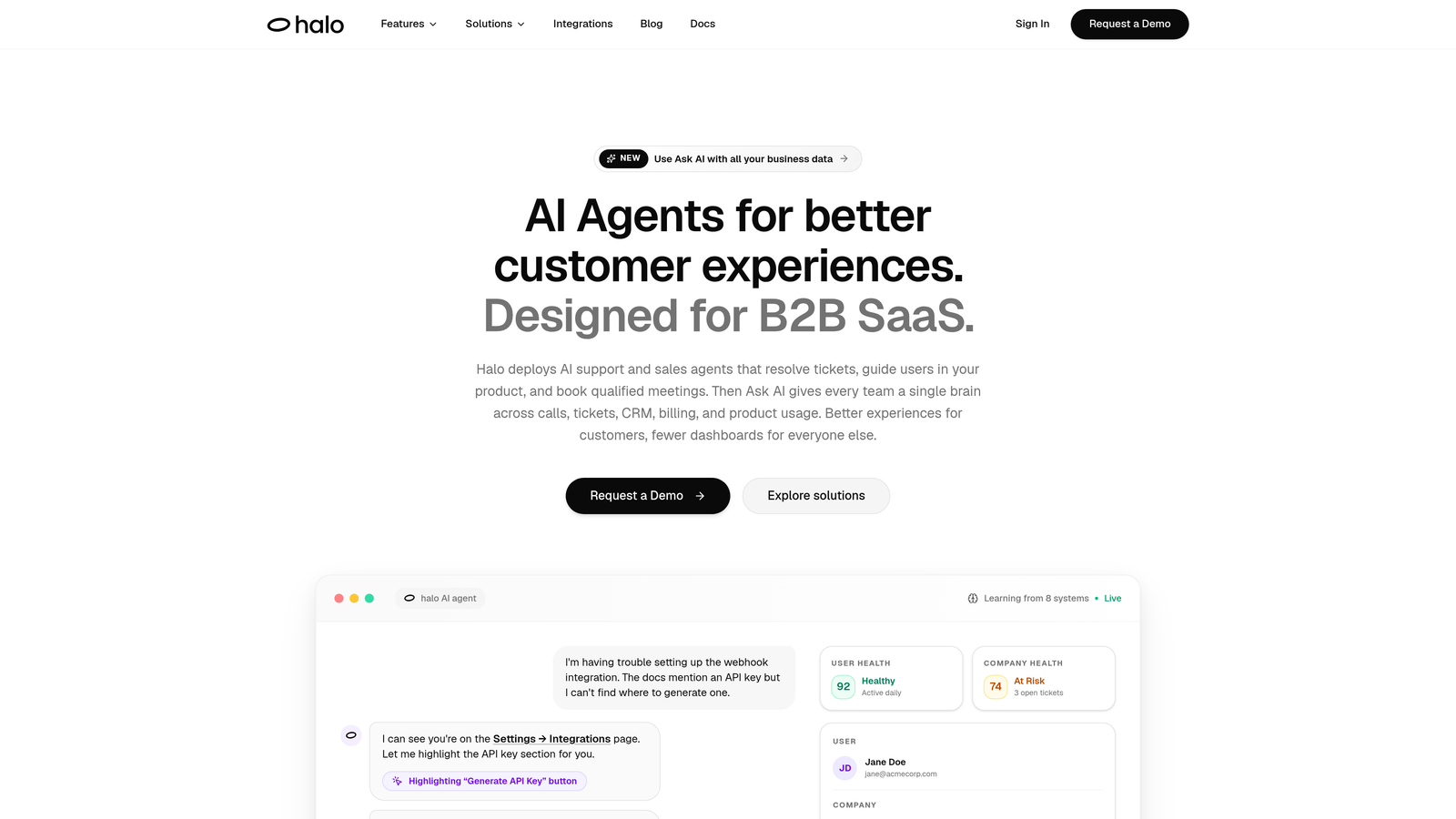
Halo AI is an AI-native customer support platform that resolves tickets, guides users through your product, and surfaces business intelligence signals — all from a single connected system.
Where This Tool Shines
What separates Halo from most support tools is its page-aware context. The AI agent actually sees what the user sees: which page they're on, what they've already tried, and what's likely tripping them up. That context produces more relevant, accurate resolutions rather than generic answers pulled from a static knowledge base.
Beyond resolving tickets, Halo turns support interactions into business intelligence. Its smart inbox surfaces customer health signals, revenue anomalies, and product friction patterns — so your support function stops being a cost center and starts informing product roadmap and customer success decisions.
Key Features
Page-Aware Chat Widget: The AI sees the user's current screen context and provides visual UI guidance tailored to exactly where they are in your product.
Autonomous Ticket Resolution: Handles routine and multi-step technical queries independently, with intelligent live agent handoff when complexity warrants a human.
Auto Bug Ticket Creation: Automatically generates and routes bug reports to Linear or connected engineering tools, closing the loop between support and product teams without manual triage.
Smart Inbox with Business Intelligence: Goes beyond deflection metrics to deliver customer health scoring, anomaly detection, and revenue signals directly in the support workflow.
Full-Stack Integrations: Connects natively to Slack, HubSpot, Intercom, Stripe, Zoom, PandaDoc, Fathom, and Linear — covering the entire B2B SaaS operational stack.
Best For
Product-led growth companies and B2B SaaS teams that want support automation built around their product experience rather than bolted onto a generic helpdesk. Particularly strong for teams where support data should feed directly into product, engineering, and revenue workflows.
Pricing
Contact for pricing. Full details available at haloagents.ai.
2. Zendesk AI
Best for: Enterprise teams already invested in the Zendesk ecosystem who want AI layered into existing workflows.
Zendesk AI is the AI capability layer built natively into the Zendesk Suite, covering intelligent triage, agent copilot, and self-service automation.
Where This Tool Shines
If your team already lives in Zendesk, the AI features activate without a separate deployment or platform migration. The agent copilot surfaces suggested responses and next-best-action guidance in real time, which can meaningfully reduce handle time for experienced agents dealing with high ticket volume.
The trade-off is architectural. Zendesk AI is additive to an existing ticketing infrastructure rather than AI-first by design. For teams where Zendesk is already the system of record, that's a feature. For teams starting fresh, it may mean inheriting legacy constraints.
Key Features
Intelligent Triage and Routing: Automatically classifies and routes tickets based on detected intent and sentiment, reducing manual sorting overhead.
Agent Copilot: Provides suggested responses, macro recommendations, and next-best-action guidance to agents handling live tickets.
AI-Powered Self-Service Bots: Deflects common queries before they reach the queue using conversational automation built on your help content.
Native Integration: Built directly into Zendesk Suite — no additional deployment, no separate vendor relationship to manage.
Best For
Mid-market and enterprise support teams already operating on Zendesk who want to add AI intelligence without changing their core platform. Less compelling for teams evaluating their helpdesk from scratch.
Pricing
Included in Zendesk Suite plans; Suite Team starts at approximately $55 per agent per month. Verify current pricing at zendesk.com.
3. Intercom Fin
Best for: SaaS companies using Intercom as their primary customer communication layer who want LLM-powered resolution in-product.
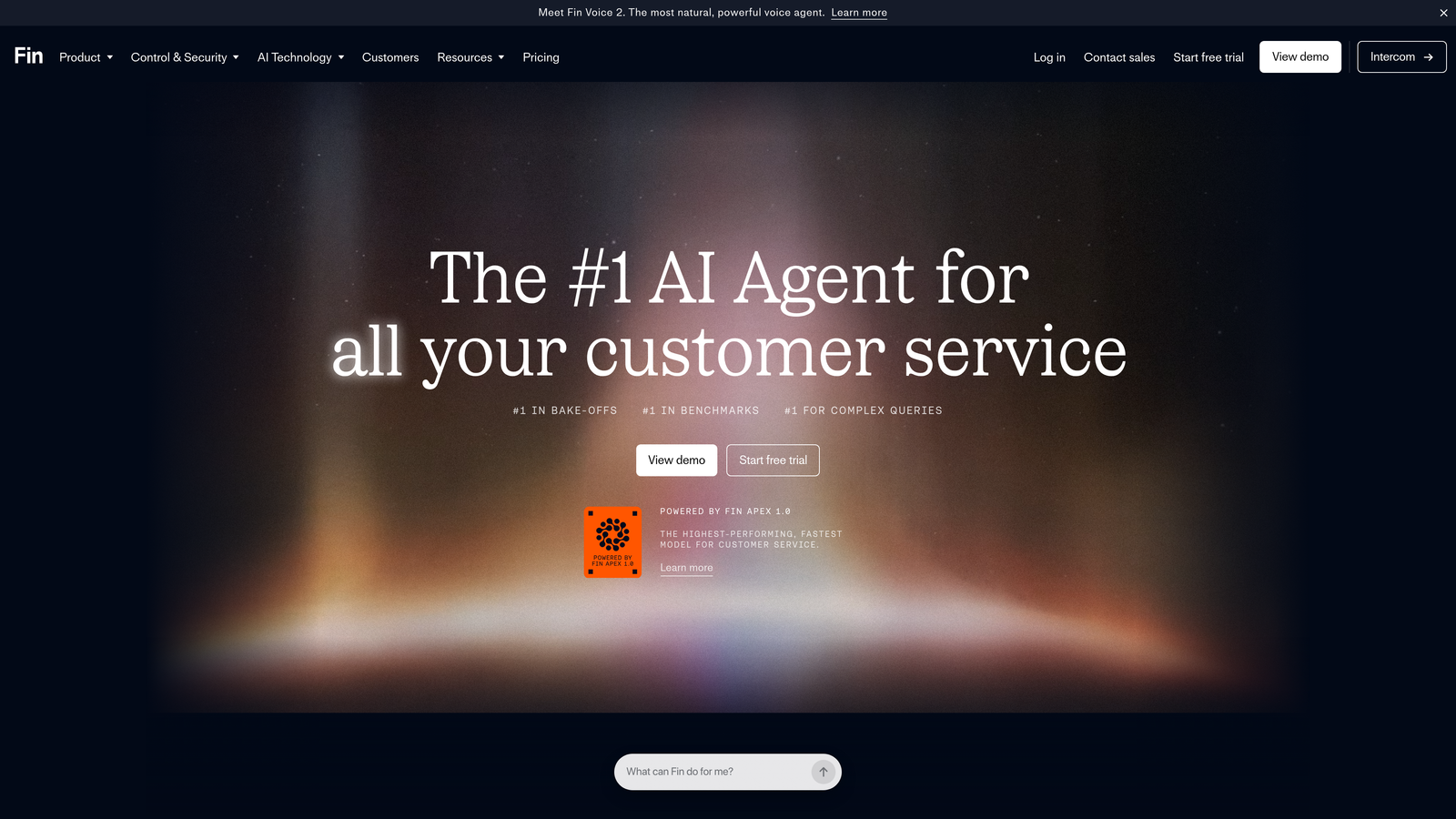
Intercom Fin is Intercom's AI agent powered by large language models, designed to resolve customer queries using your existing help content and hand off seamlessly to human agents within the Intercom messenger.
Where This Tool Shines
Fin's conversational quality stands out. Because it's built on LLM technology and trained against your help center content, it handles nuanced follow-up questions more naturally than rule-based bots. The in-product messenger experience is also familiar to SaaS users, which reduces friction at the moment of query.
The handoff experience is a genuine strength. When Fin escalates to a human agent, it preserves the full conversation context, so agents don't need to ask customers to repeat themselves — a frustration point that erodes trust in many automated support flows.
Key Features
LLM-Powered Resolution: Resolves queries using your existing help center content with natural, contextual responses rather than keyword matching.
Seamless Human Handoff: Escalates to live agents with full conversation context intact, preserving continuity for the customer.
In-Product Messenger UX: Operates within the Intercom messenger interface that many SaaS users already recognize and trust.
Multi-Language Support: Handles queries across languages with customizable tone settings to match your brand voice.
Best For
SaaS teams already using Intercom for customer messaging who want to add AI resolution without switching platforms. Strong for companies where conversational quality and handoff experience are top priorities.
Pricing
Fin charges per resolution. Verify current pricing at intercom.com.
4. Freshdesk Freddy AI
Best for: SMB teams on Freshdesk who want to add AI automation across self-service, agent assist, and analytics without changing platforms.
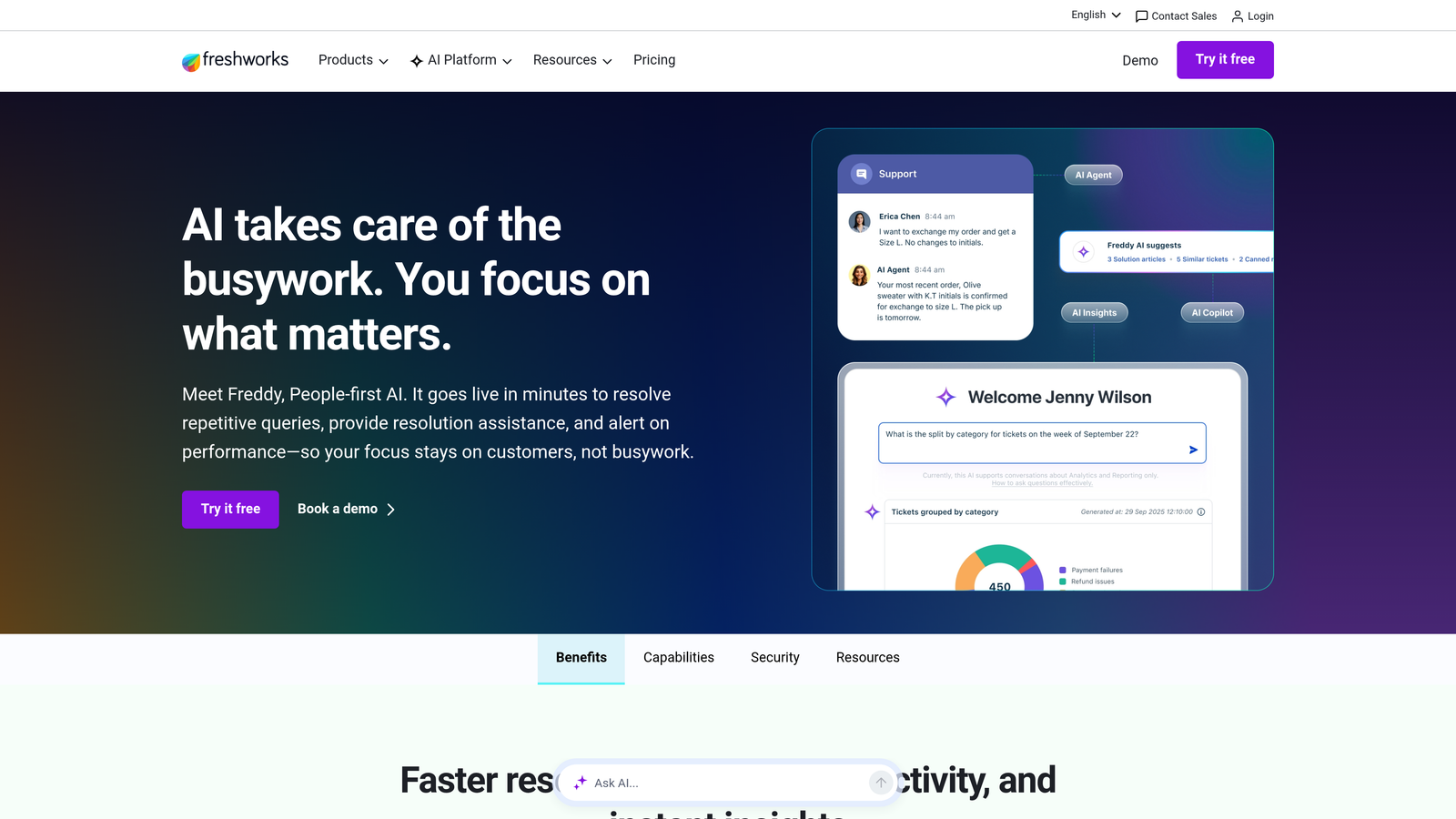
Freshdesk Freddy AI is Freshworks' AI layer for Freshdesk, bundled across three distinct capability tiers covering customer-facing automation, agent assistance, and analytics.
Where This Tool Shines
Freddy's three-layer structure is thoughtfully organized. Freddy Self Service handles customer-facing deflection. Freddy Copilot assists agents in real time with suggestions and summarization. Freddy Insights surfaces trends and anomalies in support data. Each layer addresses a different part of the support workflow, which makes it easier to adopt incrementally rather than all at once.
For SMB teams already on Freshdesk, the value is clear: meaningful AI capabilities without a platform migration or a new vendor relationship. The integration is native, which reduces deployment complexity significantly.
Key Features
Freddy Self Service: Customer-facing bot that handles deflection and resolution using your knowledge base content.
Freddy Copilot: Real-time agent assist with response suggestions, ticket summarization, and workflow guidance.
Freddy Insights: AI-driven analytics that surface support trends, volume anomalies, and performance patterns.
Native Freshdesk Integration: Activates directly within your existing Freshdesk environment with no separate platform required.
Best For
Small to mid-sized support teams operating on Freshdesk who want to layer in AI capabilities incrementally. Less suited for teams seeking a standalone AI-first architecture or deep cross-system integrations beyond the Freshworks ecosystem.
Pricing
Freddy AI is available as an add-on on paid Freshdesk plans. Verify current tiers at freshworks.com.
5. Tidio Lyro
Best for: Startups and lean support teams needing fast, no-code AI setup on a budget-friendly plan.
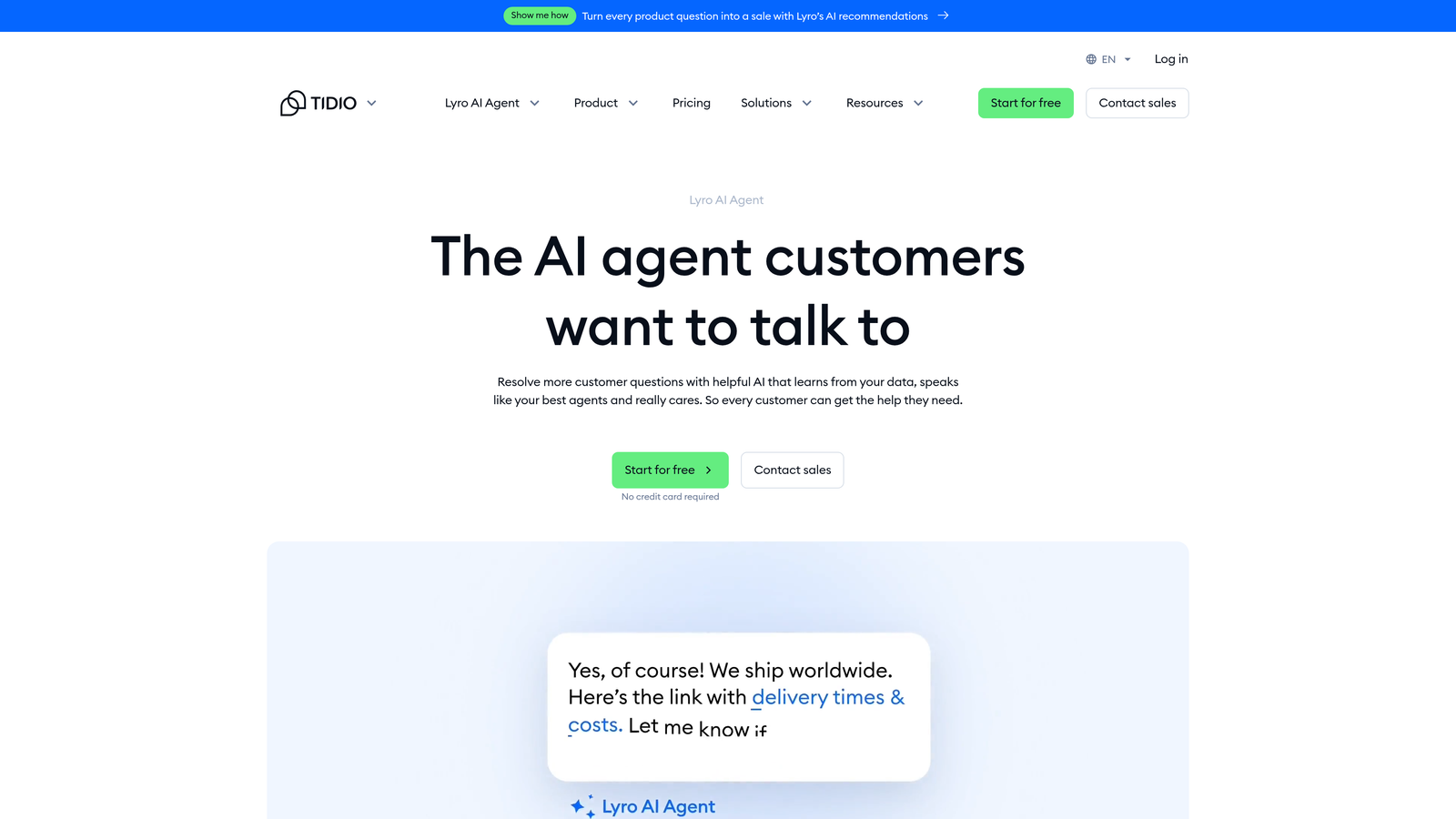
Tidio Lyro is Tidio's conversational AI agent designed for smaller SaaS and e-commerce teams, offering a quick path from zero to live AI support without technical configuration.
Where This Tool Shines
Lyro's setup speed is its headline advantage. Using your existing FAQ or help content, it can be live in minutes rather than days. For a startup with a small support team and a growing user base, that time-to-value matters more than enterprise-grade customization options.
The automatic escalation to live chat is clean and reliable, which matters when the AI hits the edge of its knowledge. Customers get a smooth handoff rather than a dead end, which protects the support experience even when automation falls short.
Key Features
No-Code Setup: Configures using existing FAQ or help content with no developer involvement required — live in minutes.
Conversational AI: Natural language understanding for handling common support queries without keyword-based triggers.
Automatic Escalation: Routes to live chat agents when queries exceed the AI's confidence threshold, with a smooth handoff experience.
Accessible Pricing: Structured for startups and small teams rather than enterprise budgets.
Best For
Early-stage startups and small support teams looking for a fast, affordable entry into AI-powered support. Not the right fit for complex enterprise workflows, deep integrations, or teams that need business intelligence beyond basic deflection metrics.
Pricing
Lyro is available on paid Tidio plans. Verify current pricing at tidio.com.
6. Forethought AI
Best for: Enterprise teams needing platform-agnostic AI triage and agent assist across multiple helpdesk systems.
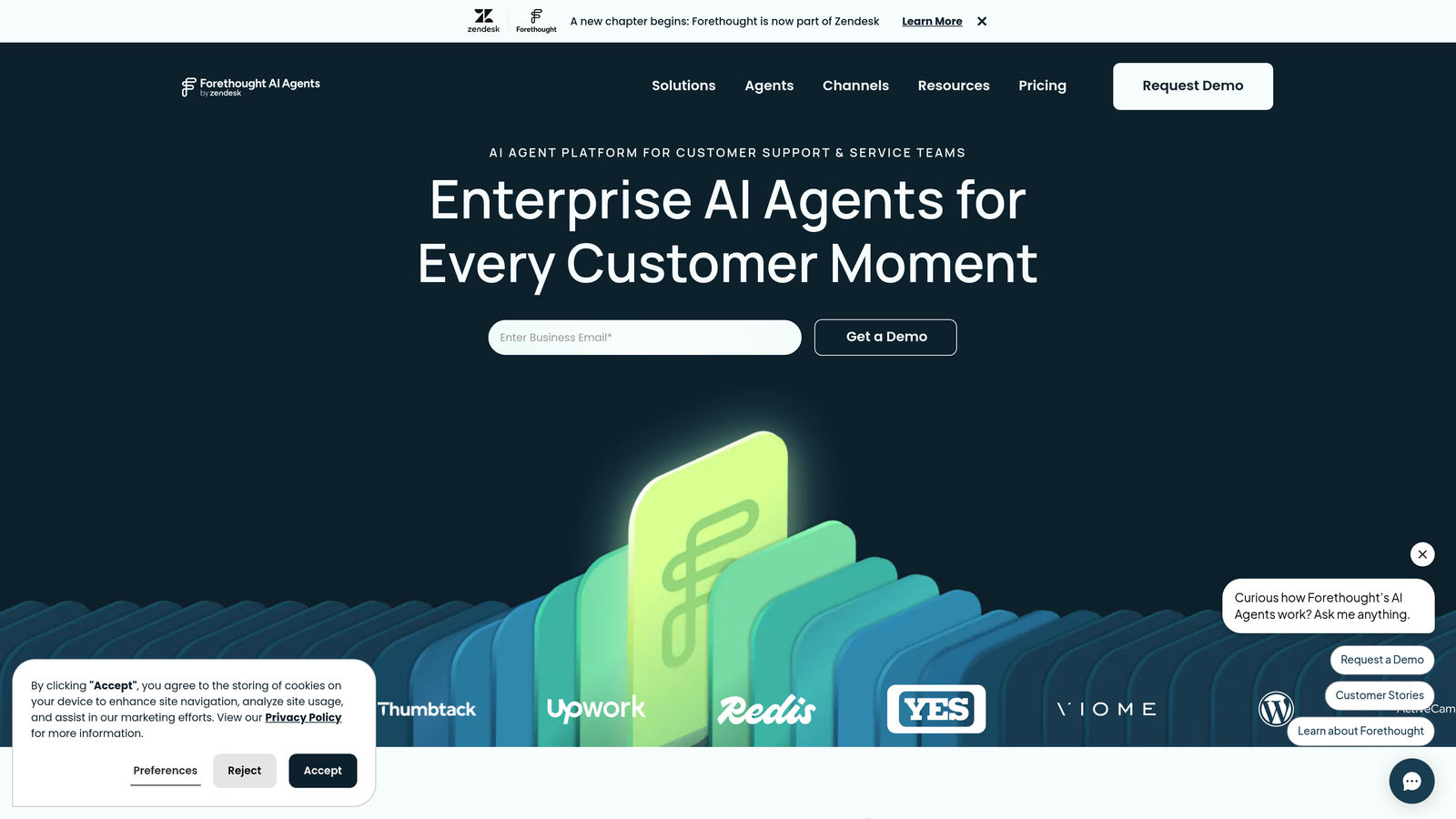
Forethought AI is a specialized AI layer for enterprise support operations, providing intelligent triage, routing, and agent assist across Zendesk, Salesforce Service Cloud, ServiceNow, and other major platforms.
Where This Tool Shines
Forethought's platform-agnostic design is genuinely rare in this space. Most AI support tools are tied to a specific helpdesk. Forethought sits above the infrastructure layer, which means enterprise teams running multiple helpdesk platforms or mid-migration between systems can apply consistent AI intelligence without being locked into a single vendor's AI roadmap.
The triage and routing quality is a core strength. Forethought handles complex multi-step ticket handling with workflow automation that goes beyond simple keyword routing, making it well-suited for support operations with nuanced escalation logic.
Key Features
Platform-Agnostic AI Triage: Works across Zendesk, Salesforce Service Cloud, ServiceNow, and more — no platform lock-in.
Agent Assist: Surfaces suggested responses pulled from your knowledge base in real time as agents work tickets.
Priority Routing: Classifies and routes tickets intelligently based on intent, urgency, and customer context.
Workflow Automation: Handles complex multi-step ticket handling scenarios that exceed simple rule-based routing.
Best For
Enterprise support teams running multiple helpdesk platforms or those who need AI intelligence that doesn't depend on a single vendor's ecosystem. Strong for organizations with complex routing logic and high ticket volumes across multiple channels.
Pricing
Enterprise pricing — contact Forethought directly for a quote at forethought.ai.
7. Kustomer
Best for: High-volume support operations where unified customer history context is critical to resolution quality.
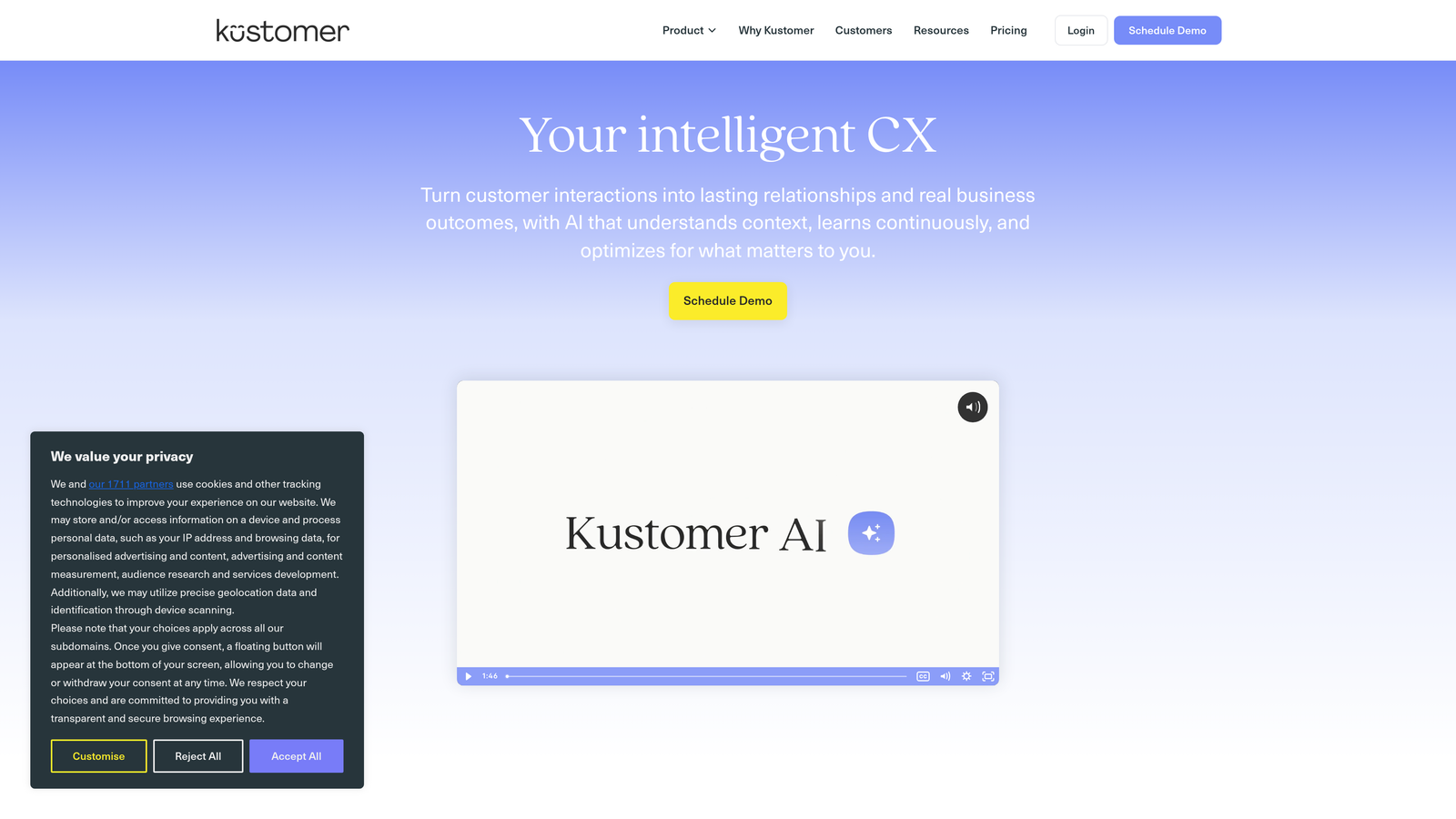
Kustomer is a CRM-native customer service platform that combines unified customer timelines with AI-powered automation, built for operations where knowing the full customer history shapes every support interaction.
Where This Tool Shines
The unified customer timeline is Kustomer's defining feature. Every interaction, order, billing event, and prior support conversation is visible in a single view. When AI routes a ticket or an agent picks up an escalation, they're working with complete context rather than a fragmented ticket history. This matters most in high-volume operations where agents handle many customers daily and can't manually reconstruct context each time.
The AI automation layer sits on top of this CRM foundation, which means routing decisions and automated responses are informed by actual customer behavior and history rather than just the content of the current message.
Key Features
Unified Customer Timeline: All interactions, orders, and history consolidated in a single view for every customer.
AI-Powered Routing and Automation: Routing logic informed by CRM data, not just ticket content.
Omnichannel Support: Handles email, chat, social, and voice from a single platform without context fragmentation.
Customizable Workflows: Flexible workflow builder for complex support operations with non-standard escalation paths.
Best For
High-volume customer service operations where customer history context drives resolution quality. Strong for teams where support, CRM, and operations are tightly coupled. Less optimized for teams that primarily need lightweight, product-embedded AI chat.
Pricing
Enterprise tier starts at approximately $89 per agent per month. Verify current pricing at kustomer.com.
8. Drift (Salesloft)
Best for: Revenue teams where inbound technical support and sales pipeline signals overlap.
Drift is a conversational AI platform that handles inbound technical queries while simultaneously identifying intent signals relevant to renewal, expansion, and pipeline — now operating as part of the Salesloft platform.
Where This Tool Shines
Drift occupies a unique position: it's genuinely useful for support while being equally useful for revenue teams. When a customer asks a technical question, Drift can resolve it via AI while also flagging whether that customer is showing expansion intent or renewal risk. That dual-purpose intelligence is valuable for B2B SaaS companies where support and account management are closely linked.
The integration with Salesloft means that routing logic can extend beyond support queues into account executive workflows, meeting booking, and revenue pipeline. For teams where the support-to-sales handoff matters, this is a meaningful differentiator.
Key Features
Conversational AI with Intent Detection: Handles support queries while identifying expansion, renewal, and pipeline signals in real time.
Smart Routing: Routes conversations to the right destination — support agent, account executive, or automated resolution — based on detected intent.
Salesloft Integration: Connects support workflows directly to revenue team workflows for seamless handoffs.
Meeting Booking and Qualification: Built-in scheduling and qualification flows embedded directly in the chat experience.
Best For
B2B SaaS companies where support and revenue teams are closely aligned and inbound conversations need to serve both functions. Less suited for pure support operations that don't need revenue workflow integration.
Pricing
Contact Drift/Salesloft for current pricing at drift.com.
9. Capacity
Best for: Internal IT and employee-facing helpdesk teams automating knowledge base queries and IT workflows at scale.
Capacity is an AI-powered helpdesk automation platform focused on internal support, handling IT queries, HR requests, and knowledge base lookups for employee-facing operations rather than customer-facing ones.
Where This Tool Shines
Most tools on this list are built for external customer support. Capacity fills a different need: internal technical support at scale. IT teams handling employee queries about software access, system issues, and HR processes face many of the same automation challenges as customer support teams, and Capacity is purpose-built for that context.
The workflow builder is particularly strong for IT use cases, handling multi-step approval flows, access request routing, and escalation paths that are common in internal helpdesk environments but rarely addressed well by customer-facing tools.
Key Features
Knowledge Base Automation: AI-powered Q&A that answers employee queries using your internal documentation and IT knowledge base.
Workflow Builder: Automates IT ticket workflows, approvals, and routing without manual intervention.
Internal Tool Integrations: Connects to HRIS systems, IT infrastructure tools, and internal platforms used by operations and HR teams.
Escalation with Context: Hands off to human IT agents with full conversation context when queries require human resolution.
Best For
IT departments and internal operations teams looking to reduce manual helpdesk load through AI automation. Not designed for customer-facing support, so teams looking for external-facing resolution should look elsewhere on this list.
Pricing
Contact Capacity for pricing at capacity.com.
Which Tool Is Right for Your Team
The right choice depends less on feature checklists and more on where you're starting from and what you need support automation to do beyond basic deflection.
Here's a quick way to orient your decision:
AI-first autonomous resolution for B2B SaaS: Halo AI. Built from the ground up for this use case, with page-aware context, business intelligence, and full-stack integrations.
Already on Zendesk and want AI layered in: Zendesk AI. The native integration means no migration overhead, and the agent copilot delivers immediate value for high-volume teams.
In-app conversational support on Intercom: Intercom Fin. Strong LLM-powered resolution and a handoff experience that preserves conversation context cleanly.
SMB team on Freshdesk: Freddy AI. Three capability layers covering self-service, agent assist, and analytics — all without leaving the Freshdesk environment.
Lean startup budget, fast setup: Tidio Lyro. No-code configuration, accessible pricing, and a live AI agent in minutes rather than weeks.
Enterprise multi-platform triage: Forethought. Platform-agnostic AI intelligence that works across Zendesk, Salesforce, ServiceNow, and more.
CRM-native high-volume operations: Kustomer. Unified customer timelines combined with AI routing for operations where history context drives resolution quality.
Revenue-support crossover: Drift. Handles technical queries while surfacing intent signals for renewal, expansion, and pipeline routing.
Internal IT helpdesk: Capacity. Purpose-built for employee-facing support with strong workflow automation for IT and HR use cases.
Before committing to any platform, ask three questions: Does this tool learn from every interaction, or does it require constant manual tuning? Does it connect to the systems your team already uses? And critically, does it give you intelligence beyond deflection rates?
Your support team shouldn't scale linearly with your customer base. Let AI agents handle routine tickets, guide users through your product, and surface business intelligence while your team focuses on complex issues that need a human touch. See Halo in action and discover how continuous learning transforms every interaction into smarter, faster support.