9 Best Automated Ticket Resolution Platforms in 2026
Discover the 9 best automated ticket resolution platforms of 2026, evaluated across AI sophistication, integration depth, and resolution rates to help support teams eliminate repetitive tickets, deliver instant customer answers, and scale without adding headcount.
 Matt PattoliFounder14 min read
Support teams are drowning. Repetitive tickets pile up, customers expect instant answers, and hiring more agents only kicks the problem down the road. Automated ticket resolution platforms have emerged as the modern answer: AI-powered systems that can understand, triage, and resolve support tickets without a human touching them.
The category has matured well beyond simple chatbot deflection. Today's leading platforms measure success by resolution rate, not deflection rate. They integrate deeply with your existing stack, learn from every interaction, and increasingly surface business intelligence that goes far beyond support metrics.
Choosing the right platform isn't straightforward. The best fit depends on your existing infrastructure, the complexity of your tickets, your growth trajectory, and how much autonomous operation you're comfortable with. To help you navigate the options, we evaluated platforms across AI sophistication, integration depth, ease of deployment, pricing transparency, and real-world resolution capabilities.
If you're still exploring the broader landscape, our guides on automated customer support and AI helpdesk software provide useful context before diving into specific tools.
Here are the top automated ticket resolution platforms worth considering in 2026.
1. Halo AI
Best for: B2B SaaS teams wanting AI-first ticket resolution with built-in business intelligence
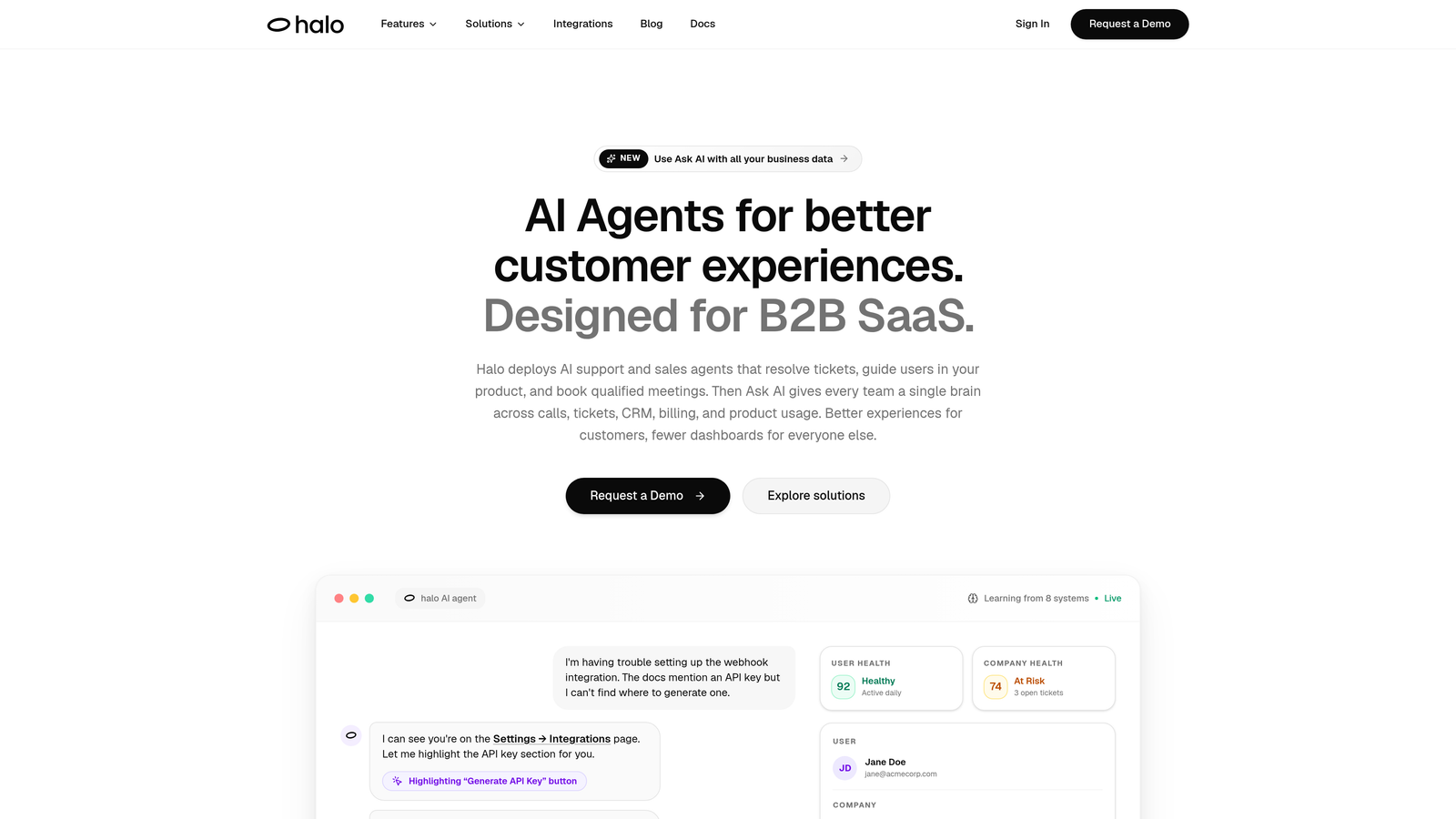
Halo AI is an AI-first customer support platform that deploys autonomous agents to resolve tickets, guide users with page-aware context, and surface business intelligence from every interaction.
Where This Tool Shines
What separates Halo from most platforms on this list is its architecture. Rather than bolting AI onto an existing helpdesk, Halo was built AI-first from the ground up. Its agents don't just respond to tickets; they understand the context of what a user is doing inside your product at the moment they reach out.
That page-aware capability is genuinely different. When a user asks a question, Halo's chat widget sees what they see, providing visual UI guidance rather than generic text answers. Combined with continuous learning across every resolved interaction, the system gets measurably smarter over time without manual retraining.
Key Features
Page-Aware Chat Widget: Understands the user's current location inside your product and delivers contextual, visual UI guidance rather than generic help content.
Autonomous AI Agents: Resolve tickets end-to-end with continuous learning, improving resolution accuracy with every interaction without requiring manual updates.
Auto Bug Ticket Creation: Automatically generates bug reports and routes them directly to Linear and other engineering tools when support conversations reveal product issues.
Smart Inbox with Business Intelligence: Goes beyond support metrics to surface customer health signals, revenue intelligence, and anomaly detection from ticket data.
Deep Integration Stack: Connects natively with Slack, HubSpot, Intercom, Stripe, Zoom, PandaDoc, and Fathom, making it a genuine hub rather than an isolated tool.
Best For
Halo is best suited for B2B SaaS companies and product teams that want more than ticket deflection. If your team is using Zendesk, Freshdesk, or Intercom and feeling limited by bolt-on AI, or if you want support data to inform product decisions and customer health monitoring, Halo's architecture is built for that ambition.
Pricing
Contact for pricing. Halo offers tailored plans based on ticket volume and feature needs, which allows for flexibility across different team sizes and use cases.
2. Zendesk AI
Best for: Enterprise teams already invested in the Zendesk ecosystem
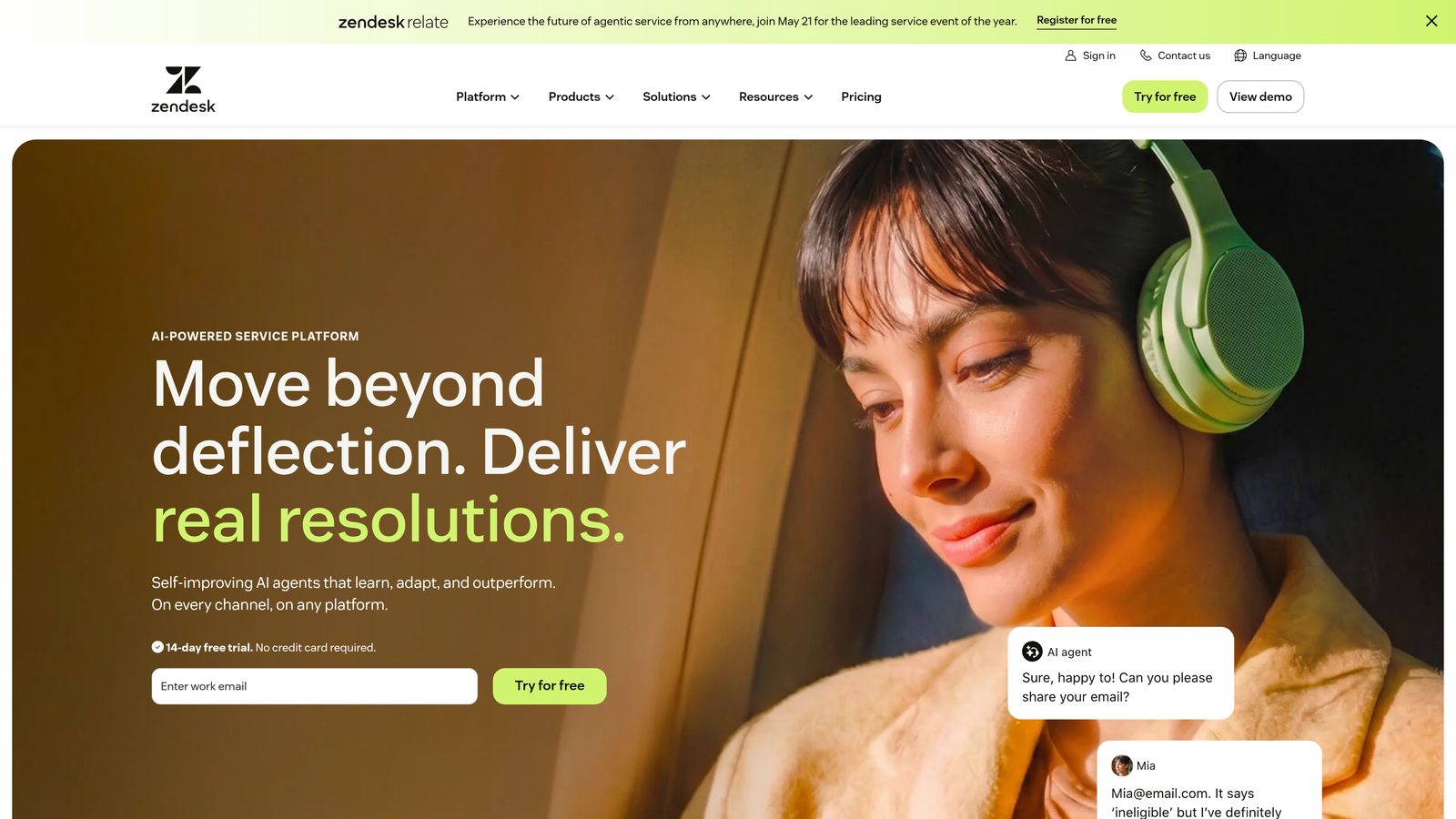
Zendesk AI is an automation layer built natively into the Zendesk Suite, offering AI agents, intelligent triage, and automated resolution for organizations that have built their support operations around Zendesk.
Where This Tool Shines
If your team lives in Zendesk, the AI layer is a natural extension rather than a new tool to adopt. The AI agents come pre-trained on a large volume of real customer service interactions, which means they arrive with useful baseline knowledge rather than starting from scratch.
The intelligent triage capabilities are particularly strong, automatically classifying tickets by intent, language, and sentiment before routing them. For large support organizations managing high ticket volumes across multiple channels, this automation alone can meaningfully reduce the manual overhead on tier-one agents.
Key Features
Pre-Trained AI Agents: Built on a large dataset of real customer service interactions, reducing cold-start issues common with custom-trained models.
Intelligent Triage: Automatically classifies tickets by intent, language, and sentiment to route them to the right agent or resolution path.
Generative AI Reply Suggestions: Surfaces draft replies and relevant knowledge base articles for agents handling tickets that require human attention.
Native Suite Integration: Works seamlessly across Zendesk Support, Guide, Chat, and Talk without additional configuration.
AI Performance Analytics: Tracks resolution rates, deflection, and AI performance metrics within Zendesk's existing reporting infrastructure.
Best For
Enterprise and mid-market teams already on Zendesk Suite Professional or above who want to activate AI without migrating to a new platform. Less compelling for teams not already in the Zendesk ecosystem, where the platform cost may be harder to justify.
Pricing
AI features are available on Suite Professional and above. An Advanced AI add-on is available at additional cost per agent per month; contact Zendesk for current rates.
3. Intercom Fin
Best for: Product-led growth companies using Intercom for in-app support
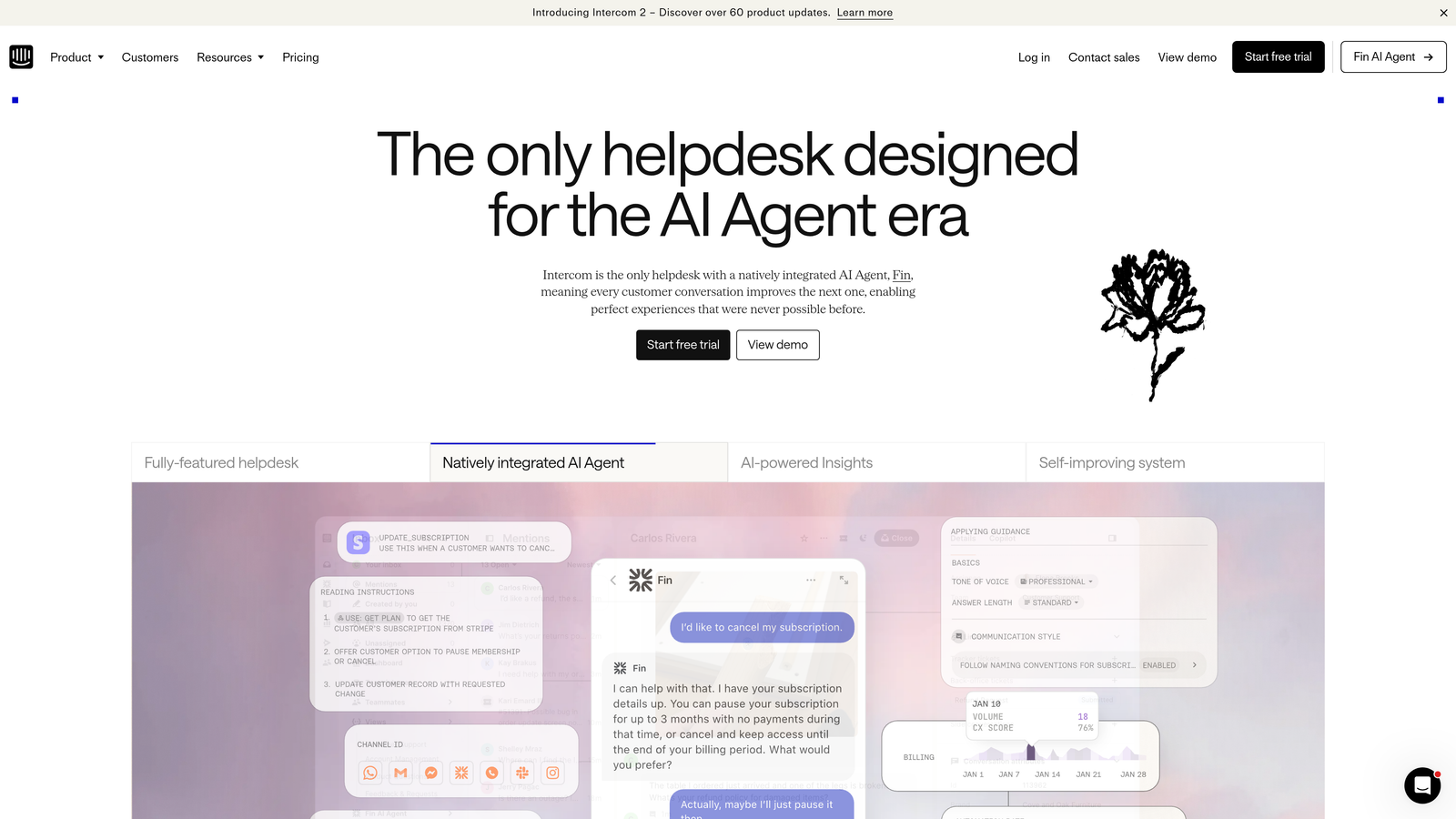
Intercom Fin is Intercom's dedicated AI agent, designed to resolve support questions using a company's existing help center content and conversation history directly within the Intercom messenger.
Where This Tool Shines
Fin's biggest advantage is how naturally it fits into the Intercom experience. For teams already using Intercom for in-app messaging, activation is low-friction: Fin reads your existing help center articles and starts resolving questions without extensive setup. The handoff to human agents is smooth, with full conversation context preserved so agents aren't starting blind.
The per-resolution pricing model is worth noting. For teams with predictable ticket patterns, it creates a direct cost-to-value relationship, though it can become expensive if resolution volumes scale faster than anticipated.
Key Features
Knowledge-Grounded AI Agent: Answers questions using existing help center articles and past conversation data, making setup fast for teams with solid documentation.
Seamless Human Handoff: Transfers to live agents with full conversation context intact, avoiding the frustrating repetition customers often experience with chatbot handoffs.
Multi-Channel Support: Operates across chat, email, and in-app messaging from a single configuration.
No-Code Custom Workflows: Allows teams to configure custom AI answers and conversation flows without engineering involvement.
Built-In Resolution Reporting: Tracks resolution rate, handoff rate, and CSAT directly within Intercom's reporting suite.
Best For
PLG SaaS companies and consumer apps already using Intercom who want to add autonomous resolution without switching platforms. Teams without existing Intercom investment will need to factor in platform costs alongside Fin's per-resolution pricing.
Pricing
Fin is charged per resolution as an add-on. Intercom plans start at $39 per seat per month, with Fin pricing dependent on resolution volume.
4. Freshdesk Freddy AI
Best for: Budget-conscious mid-market teams wanting AI without enterprise pricing
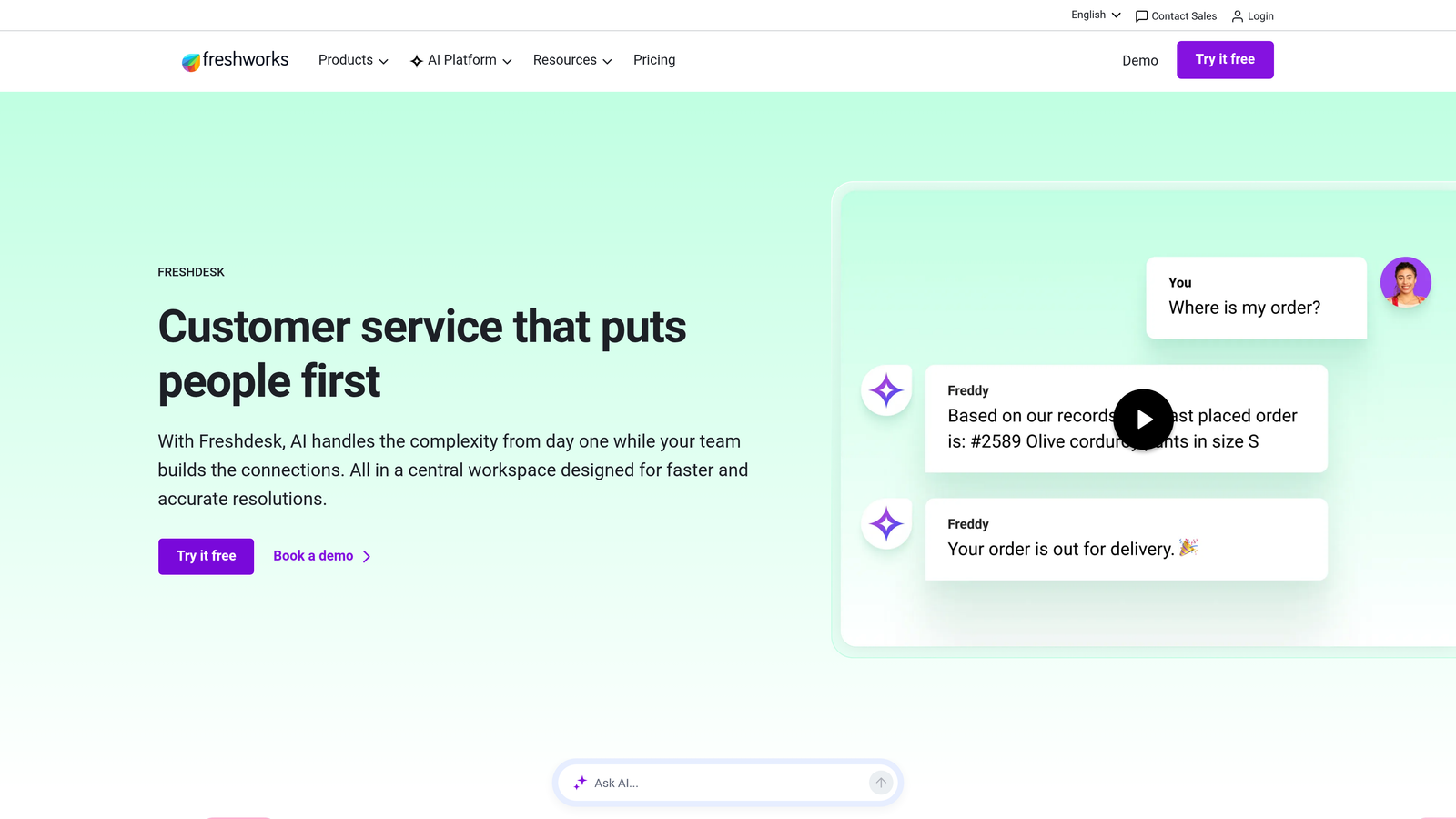
Freshdesk Freddy AI is Freshworks' embedded AI engine, providing autonomous ticket resolution, auto-triage, and agent assist capabilities within one of the more accessible helpdesk platforms on the market.
Where This Tool Shines
Freshdesk's strength has always been delivering solid functionality at a price point that mid-market teams can actually afford. Freddy AI extends that value proposition into automation, offering both a customer-facing AI agent and an agent-assist layer for tickets that need human handling.
The cross-product AI is worth highlighting if your organization uses multiple Freshworks products. Freddy spans Freshdesk, Freshservice, and Freshsales, which means teams using Freshworks for both support and CRM get a unified AI layer rather than managing separate tools.
Key Features
Freddy AI Agent: Handles customer-facing ticket resolution autonomously, drawing on help content and past interactions to answer common questions.
Freddy Copilot: Provides agents with reply suggestions, conversation summarization, and draft assistance for tickets requiring human attention.
Auto-Triage and Routing: Classifies tickets by intent and priority, routing them automatically to reduce manual queue management.
Cross-Product AI: Consistent AI capabilities across Freshdesk, Freshservice, and Freshsales for teams using the broader Freshworks suite.
Accessible Pricing Tiers: AI features are available at price points accessible to mid-market teams, not just enterprise buyers.
Best For
Mid-market B2B and B2C teams that need solid AI-powered ticket resolution without enterprise price tags. Particularly compelling for organizations already using other Freshworks products who want to consolidate their AI investment.
Pricing
A free tier is available for basic use. The Pro plan starts at $49 per agent per month, with Freddy AI features included at higher tiers.
5. Ada
Best for: High-volume enterprise teams needing multilingual, multi-channel AI resolution
Ada is an enterprise-grade AI agent platform purpose-built for automated customer service resolution across web, mobile, social, and messaging channels at scale.
Where This Tool Shines
Ada is built for organizations where support volume is large, channels are many, and compliance requirements are non-negotiable. Its AI agent is designed around resolution rather than deflection, with reasoning capabilities that handle more complex queries than typical rule-based chatbots.
The multilingual support across 50-plus languages out of the box is a genuine differentiator for global enterprises. Combined with enterprise security controls including SOC 2 compliance and HIPAA eligibility, Ada serves industries where data handling requirements would disqualify many other platforms.
Key Features
Resolution-Focused AI Agent: Built with reasoning capabilities designed to resolve tickets rather than simply deflect them to human agents.
No-Code Customization: Non-technical teams can build and modify AI agent behavior through a visual interface without engineering support.
Multilingual Support: Handles customer interactions in 50-plus languages natively, without requiring separate configurations per language.
CRM and Helpdesk Integrations: Connects with Salesforce, Zendesk, and other major platforms, making it an overlay that works within existing workflows.
Enterprise Compliance Controls: SOC 2 certified and HIPAA-eligible, serving regulated industries with confidence.
Best For
Large enterprises with high ticket volumes, global customer bases, and compliance requirements. Ada is less suited for small or mid-market teams where the enterprise pricing model and implementation complexity may outweigh the benefits.
Pricing
Custom enterprise pricing based on volume and channels. Contact Ada directly for a quote.
6. Forethought
Best for: Teams wanting AI resolution without migrating off their existing helpdesk
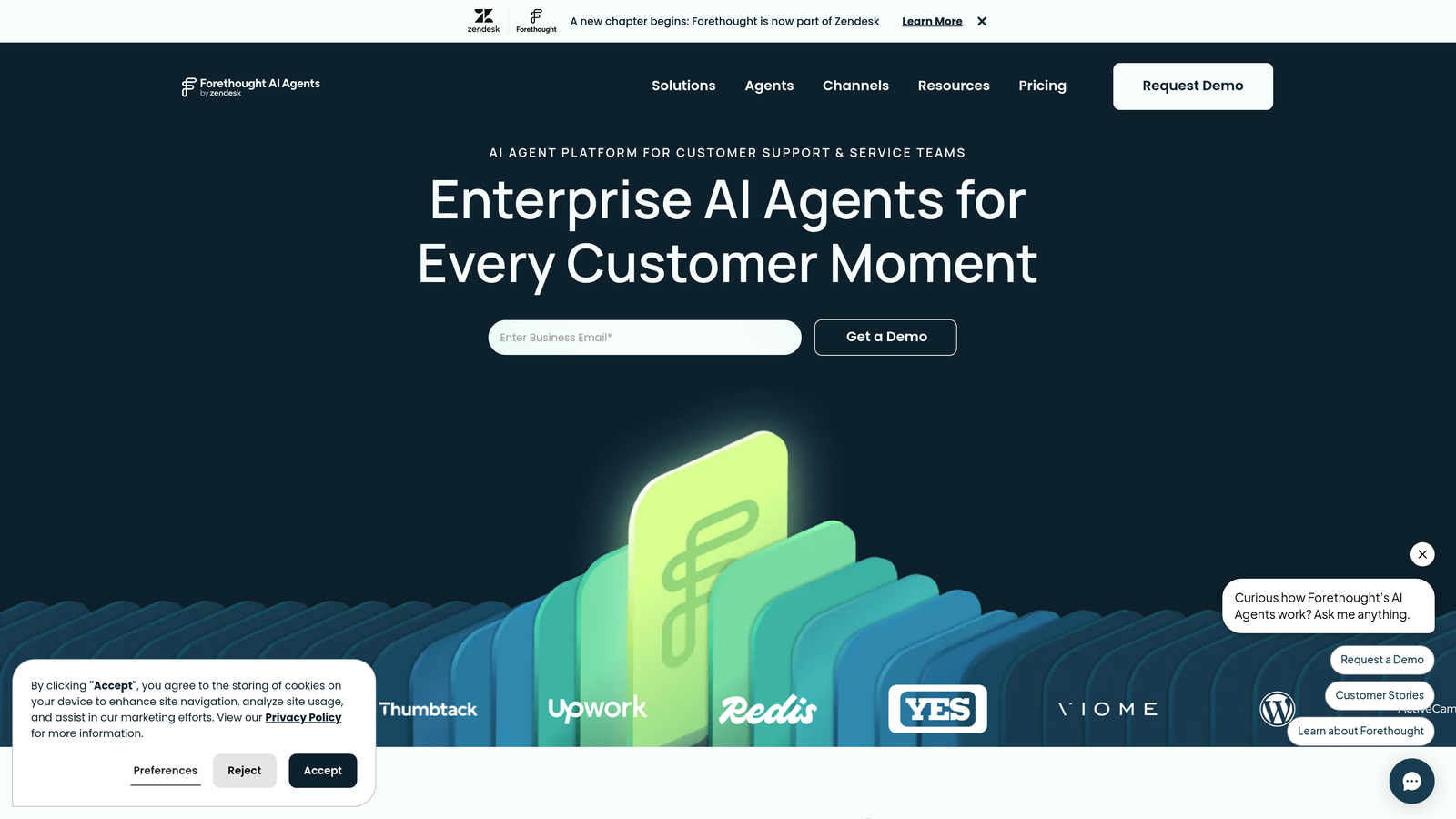
Forethought is an AI platform that layers intelligent triage, autonomous resolution, and agent assist on top of existing helpdesk systems, designed specifically for teams that don't want a full platform migration.
Where This Tool Shines
Forethought's overlay architecture is its defining characteristic. Rather than replacing Zendesk, Salesforce Service Cloud, or similar platforms, it sits on top of them and injects AI capabilities into existing workflows. For teams with significant investment in their current helpdesk, this approach preserves that investment while adding meaningful automation.
The SupportGPT-powered engine handles both customer-facing resolution and agent-assist scenarios, meaning the same platform serves both fully automated tickets and those that require human handling with AI support.
Key Features
SupportGPT-Powered Resolution: Resolves tickets autonomously and assists human agents within existing helpdesk interfaces.
Intelligent Triage: Auto-categorizes and routes tickets by intent and urgency without manual rule configuration.
Overlay Architecture: Works directly on top of Zendesk, Salesforce Service Cloud, and other major helpdesks without requiring migration.
AI Knowledge Suggestions: Surfaces relevant knowledge base content for agents handling complex tickets that require human judgment.
Deflection and Cost Analytics: Tracks deflection rates, resolution rates, and estimated cost savings through a dedicated analytics dashboard.
Best For
Support operations teams that are locked into or deeply invested in an existing helpdesk and want to add AI resolution without the disruption of a platform switch. Ideal for Zendesk and Salesforce Service Cloud shops specifically.
Pricing
Custom pricing based on ticket volume and modules selected. Contact Forethought for a quote.
7. Tidio
Best for: Small businesses and e-commerce teams needing affordable, quick-to-deploy AI resolution
Tidio is an accessible AI chatbot and live chat platform featuring Lyro AI, designed for small businesses and e-commerce teams that need simple, effective automated ticket resolution without technical complexity.
Where This Tool Shines
Tidio makes a strong case for teams that need to get up and running fast. The combination of a visual conversation flow builder and Lyro AI means non-technical users can configure meaningful automation without writing a line of code. Setup is measured in hours rather than weeks.
The e-commerce integrations with Shopify, WooCommerce, and BigCommerce make Tidio a natural fit for online retailers who need to handle common questions about orders, shipping, and returns automatically, without hiring additional support staff.
Key Features
Lyro AI Chatbot: Resolves common customer questions using knowledge base content, handling routine inquiries without human involvement.
Visual Flow Builder: Drag-and-drop conversation design that allows non-technical teams to build and modify chatbot workflows.
Unified Chat and AI Widget: Combines live chat and AI chatbot in a single widget, allowing smooth transitions between automated and human support.
E-Commerce Integrations: Native connections to Shopify, WooCommerce, and BigCommerce for order-related automation.
Minimal Setup Requirements: Designed for quick deployment with no technical expertise required.
Best For
Small businesses, e-commerce stores, and early-stage startups that need affordable automated resolution without enterprise complexity. Teams expecting high ticket volumes or needing deep CRM integration will likely outgrow Tidio's capabilities.
Pricing
A free plan is available for basic use. The Lyro AI add-on starts at $39 per month for up to 50 conversations, with higher tiers available for greater volume.
8. Cognigy
Best for: Enterprise contact centers needing voice and digital AI agents with deep customization
Cognigy is an enterprise conversational AI platform built for contact centers, supporting both voice and digital AI agents with LLM orchestration, advanced conversation design, and robust compliance controls.
Where This Tool Shines
Cognigy operates at a different level of complexity than most platforms on this list. Its LLM orchestration layer allows enterprises to combine multiple AI models within a single deployment, giving teams flexibility to use the best model for each type of interaction rather than being locked into a single provider's capabilities.
The voice AI capability is a genuine differentiator for contact centers that handle significant phone volume alongside digital channels. Most platforms in this space are digital-first; Cognigy treats voice as a first-class channel with the same sophistication applied to chat and email.
Key Features
Omnichannel AI Agents: Handles voice, chat, email, and messaging through a unified platform with consistent AI behavior across channels.
LLM Orchestration: Combines multiple large language models within a single deployment for optimal performance across different interaction types.
Enterprise Security and Compliance: Supports on-premise deployment options alongside cloud, with controls suited for highly regulated industries.
Contact Center Platform Integrations: Pre-built integrations with Genesys, NICE, Avaya, and other major contact center infrastructure providers.
Visual Conversation Design Studio: Advanced flow editor for designing complex, branching conversation logic without requiring developer involvement for every change.
Best For
Large enterprise contact centers with complex omnichannel requirements, significant voice volume, and compliance needs that require on-premise or private cloud deployment options. The implementation complexity and pricing make it unsuitable for smaller teams.
Pricing
Enterprise pricing based on deployment scope and channels. Contact Cognigy directly for a custom quote.
9. DevRev
Best for: Engineering-led organizations wanting to connect support resolution to product development
DevRev is an AI-native platform that unifies customer support and product development, linking ticket resolution directly to engineering workflows and using support data to inform product roadmap decisions.
Where This Tool Shines
DevRev addresses a problem most support platforms ignore entirely: the gap between what customers report and what engineering teams know about. When a support ticket reveals a product bug or a recurring friction point, DevRev automatically links that ticket to the relevant product issue and engineering sprint rather than leaving it to die in a support queue.
This makes DevRev particularly valuable for product-led companies where the feedback loop between customers and developers is a competitive advantage. Support data becomes product intelligence in a way that doesn't require manual tagging, exporting, or cross-team coordination.
Key Features
AI-Powered Ticket Resolution: Handles autonomous ticket resolution with automatic linking to relevant product issues and code changes.
Unified Support-Engineering Workspace: Bridges customer-facing support and internal product development in a single platform, reducing handoff friction.
Turing AI Bot: Handles autonomous ticket handling and knowledge retrieval, surfacing relevant information from both support history and product documentation.
Product Analytics from Support Data: Derives product insights from support interactions to help teams prioritize roadmap decisions based on real customer pain points.
Native Issue Tracking: Connects customer tickets directly to engineering sprints and issue tracking without requiring separate integrations.
Best For
Developer-centric organizations, product-led SaaS companies, and engineering teams that want support data to directly inform product decisions. Less suited for traditional support-only use cases where the product-engineering integration isn't a priority.
Pricing
A free tier is available for small teams. Paid plans start at $19.99 per user per month, making it one of the more accessible options for growing teams.
Which Platform Is Right for Your Team?
The right automated ticket resolution platform depends on three things: what you're already running, how much autonomous operation you want, and where you expect to be in 18 months. Here's a quick orientation.
Halo AI is the strongest choice for B2B SaaS teams that want AI-first intelligence, page-aware context, and business intelligence beyond support metrics. If you're outgrowing bolt-on AI in your current helpdesk, it's the platform built for exactly that transition.
Zendesk AI makes sense for enterprise teams deeply invested in the Zendesk ecosystem who want to activate AI without introducing new vendors. Intercom Fin is the natural fit for PLG companies already using Intercom for in-app engagement.
Freshdesk Freddy AI delivers solid resolution capabilities at a price point mid-market teams can actually budget for. Ada serves high-volume enterprise operations with multilingual requirements and compliance constraints.
Forethought is purpose-built for teams that want AI resolution without migrating off Zendesk or Salesforce Service Cloud. Tidio is the right starting point for SMBs and e-commerce teams that need something working this week. Cognigy is the enterprise contact center choice for organizations running significant voice volume. DevRev is the platform for engineering-led organizations where the support-to-product feedback loop is a strategic priority.
Before committing, evaluate integration requirements carefully, understand the pricing model (per-seat, per-resolution, or per-conversation can look very different at scale), and think honestly about how much autonomous operation your team is ready to trust.
Our guides on chatbot software comparison and AI support agents can help you go deeper on specific evaluation criteria.
Your support team shouldn't scale linearly with your customer base. Let AI agents handle routine tickets, guide users through your product, and surface business intelligence while your team focuses on complex issues that need a human touch. See Halo in action and discover how continuous learning transforms every interaction into smarter, faster support.