9 Best Tools for Automated Ticket Resolution vs Manual Support in 2026
This guide compares the 9 best tools for automated ticket resolution vs manual support in 2026, evaluating each platform on resolution capability, integration depth, and human-AI handoff quality. Whether you're adopting your first AI support tool or replacing a legacy helpdesk, it helps B2B teams find the right balance of automation and human judgment for their specific scale and complexity.
 Matt PattoliFounder13 min read
For years, the debate between automated ticket resolution and manual support has shaped how B2B teams build their customer experience. The real question isn't which approach wins: it's which tools give you the right balance of automation and human judgment for your specific volume, complexity, and team size.
Today's AI-powered platforms have moved well beyond simple chatbots. They resolve tickets autonomously, escalate intelligently, and surface business insights that manual workflows simply can't generate at scale. The challenge is that the market now spans a wide spectrum, from fully autonomous AI agents to hybrid platforms that layer automation onto existing helpdesk workflows.
This guide covers the top tools across that entire spectrum. Tools are evaluated on resolution capability, integration depth, ease of deployment, and how well they handle the handoff between automated and human support. Whether you're evaluating your first AI support tool or looking to replace a legacy setup, this comparison will help you match the right platform to your operation.
1. Halo AI
Best for: B2B SaaS teams that want fully autonomous ticket resolution with deep product and business stack integration.
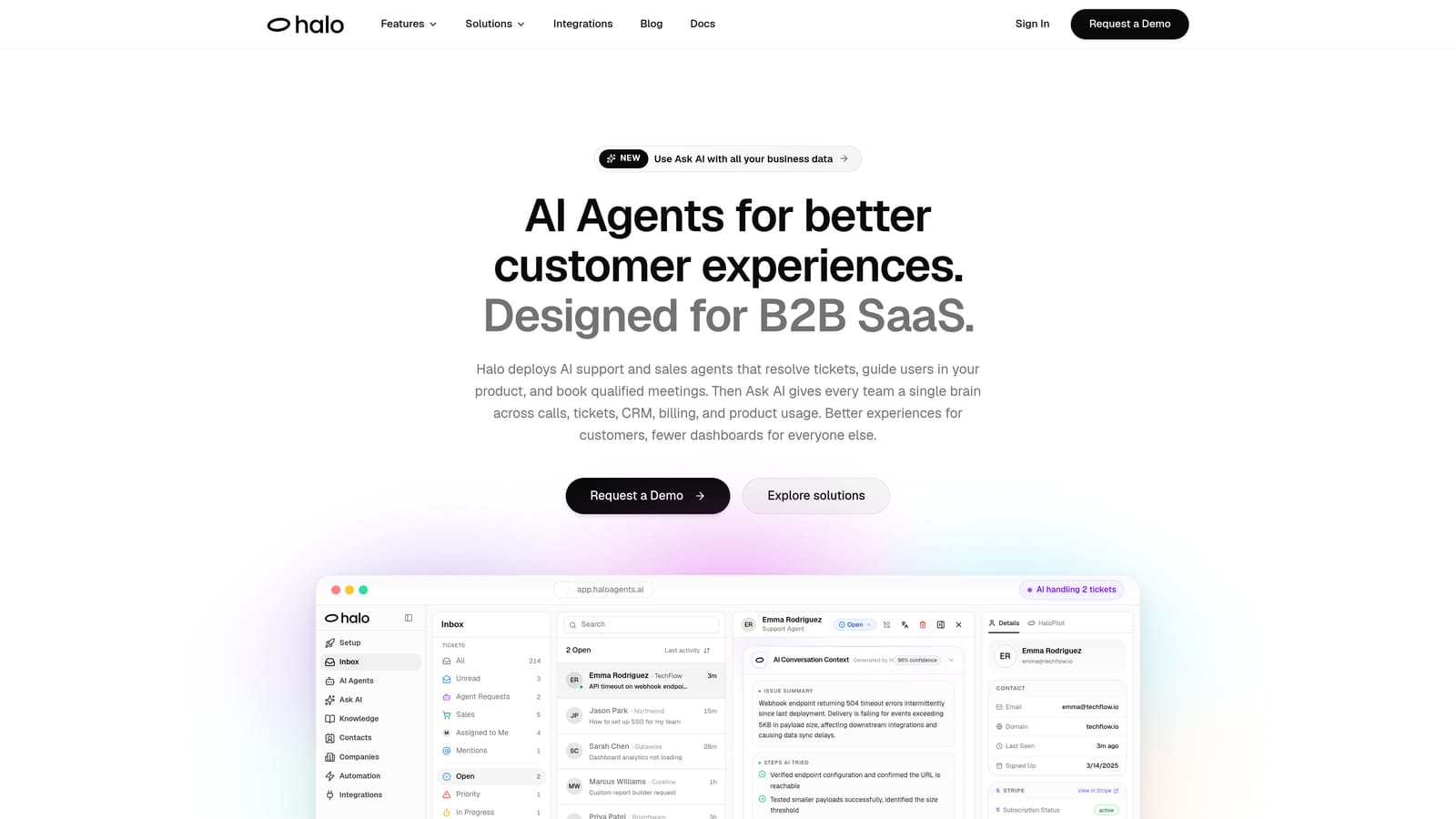
Halo AI is an AI-first customer support platform that deploys autonomous agents for end-to-end ticket resolution, page-aware chat guidance, and business intelligence analytics.
Where This Tool Shines
What separates Halo from most AI support tools is its architecture. Rather than bolting AI onto an existing helpdesk, Halo is built AI-first from the ground up. That distinction matters: the system learns from every interaction, continuously improving resolution logic rather than relying on static rule sets.
The page-aware chat widget is a genuinely differentiated capability. The AI sees what the user is currently looking at inside your product, enabling it to provide contextual UI guidance rather than generic text responses. For SaaS teams where "how do I do X in the product?" is a common ticket category, this changes the quality of automated resolution significantly.
Key Features
Autonomous AI Agents: Resolve tickets end-to-end without agent involvement, learning from every interaction to improve over time.
Page-Aware Chat Widget: The AI sees the user's current product view and delivers contextual UI guidance, not just templated answers.
Smart Inbox with Business Intelligence: Surfaces customer health signals, revenue intelligence, and anomaly detection alongside standard support metrics.
Auto Bug Ticket Creation: Automatically generates and routes bug tickets to Linear or connected project management tools when issues are detected.
Live Agent Handoff: Escalates complex issues to human agents with full conversation context preserved, so agents never start from scratch.
Broad Integration Stack: Connects natively with Slack, HubSpot, Intercom, Stripe, Zoom, PandaDoc, and Fathom.
Best For
B2B SaaS companies that need autonomous ticket resolution at scale without proportionally growing their support headcount. Particularly well-suited to product-led growth teams where in-product guidance and bug detection are as important as traditional support resolution.
Pricing
Contact Halo AI directly for pricing. Given the platform's enterprise integration depth and AI-first architecture, pricing is customized based on volume and use case.
2. Intercom
Best for: Teams already using Intercom for sales and onboarding who want to extend the same platform into autonomous support resolution.
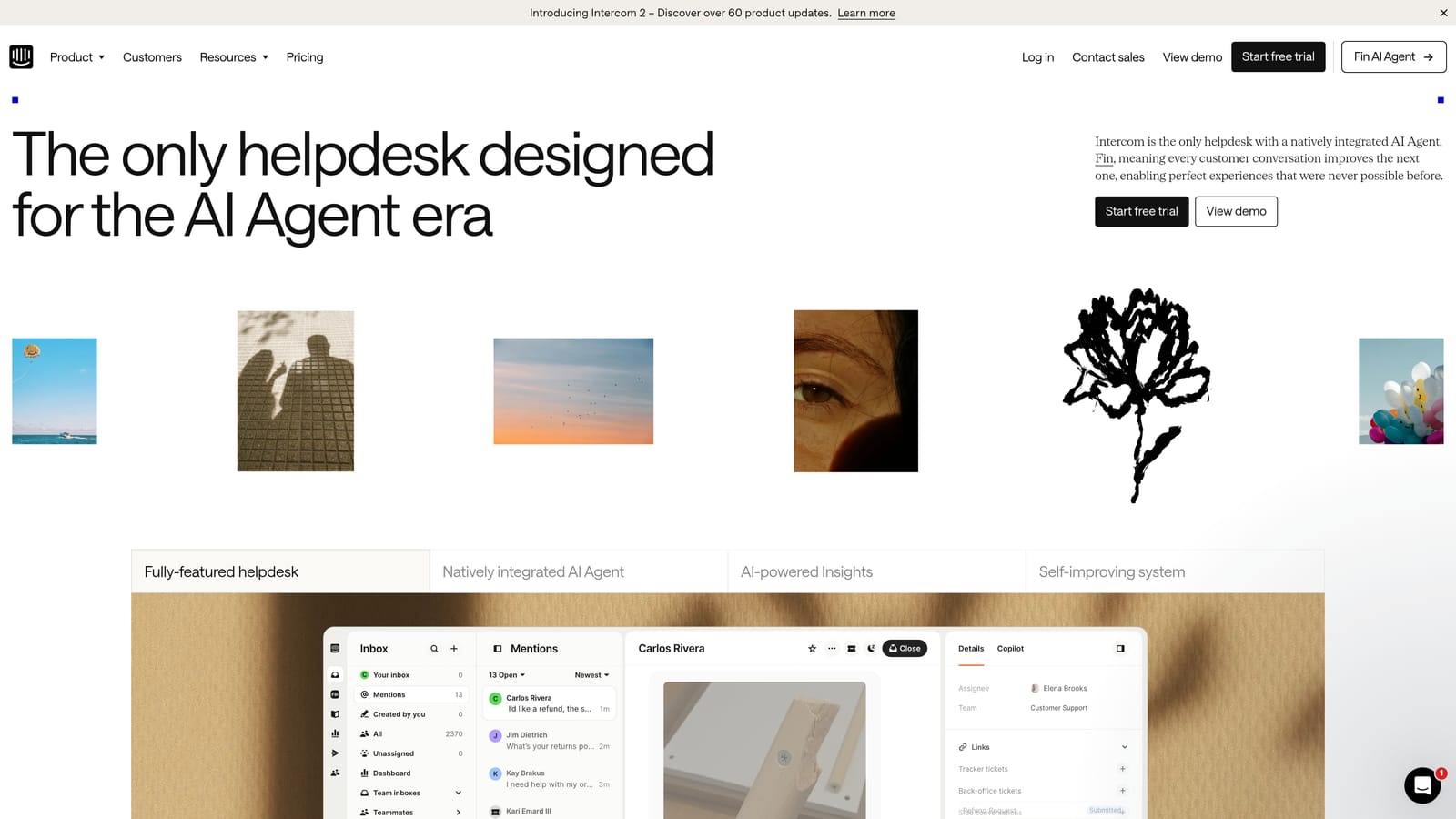
Intercom is a mature customer messaging platform with Fin AI agent for autonomous ticket resolution built into a broad ecosystem covering sales, onboarding, and support.
Where This Tool Shines
Intercom's strength is ecosystem consolidation. If your team is already using Intercom for product tours, onboarding sequences, and proactive messaging, adding Fin AI for ticket resolution keeps everything in one platform. The unified inbox spans chat, email, and in-app messaging, which reduces the operational overhead of managing multiple tools.
Fin AI handles common queries autonomously before routing to human agents, and the AI Copilot feature assists live agents during conversations with suggested responses and context. For teams that want automation with a familiar interface, Intercom is a natural fit.
Key Features
Fin AI Agent: Handles common customer queries autonomously before escalating to human agents when needed.
AI Copilot: Assists live agents during conversations with real-time suggestions, reducing handle time on complex tickets.
Unified Inbox: Aggregates chat, email, and in-app messaging into a single agent workspace.
Workflows Builder: Visual automation builder for ticket routing, escalation logic, and conditional workflows without code.
App Marketplace: 400+ integrations covering CRM, billing, analytics, and productivity tools.
Best For
Teams that want a single platform for customer messaging across the full lifecycle, from acquisition through support. Most effective for organizations already invested in the Intercom ecosystem rather than those evaluating it purely as a support automation tool.
Pricing
Starts at $29 per seat per month. Fin AI resolution is billed separately per resolved conversation, so costs scale with automation volume.
3. Zendesk
Best for: Enterprise teams with complex routing logic, SLA requirements, and compliance infrastructure needs.
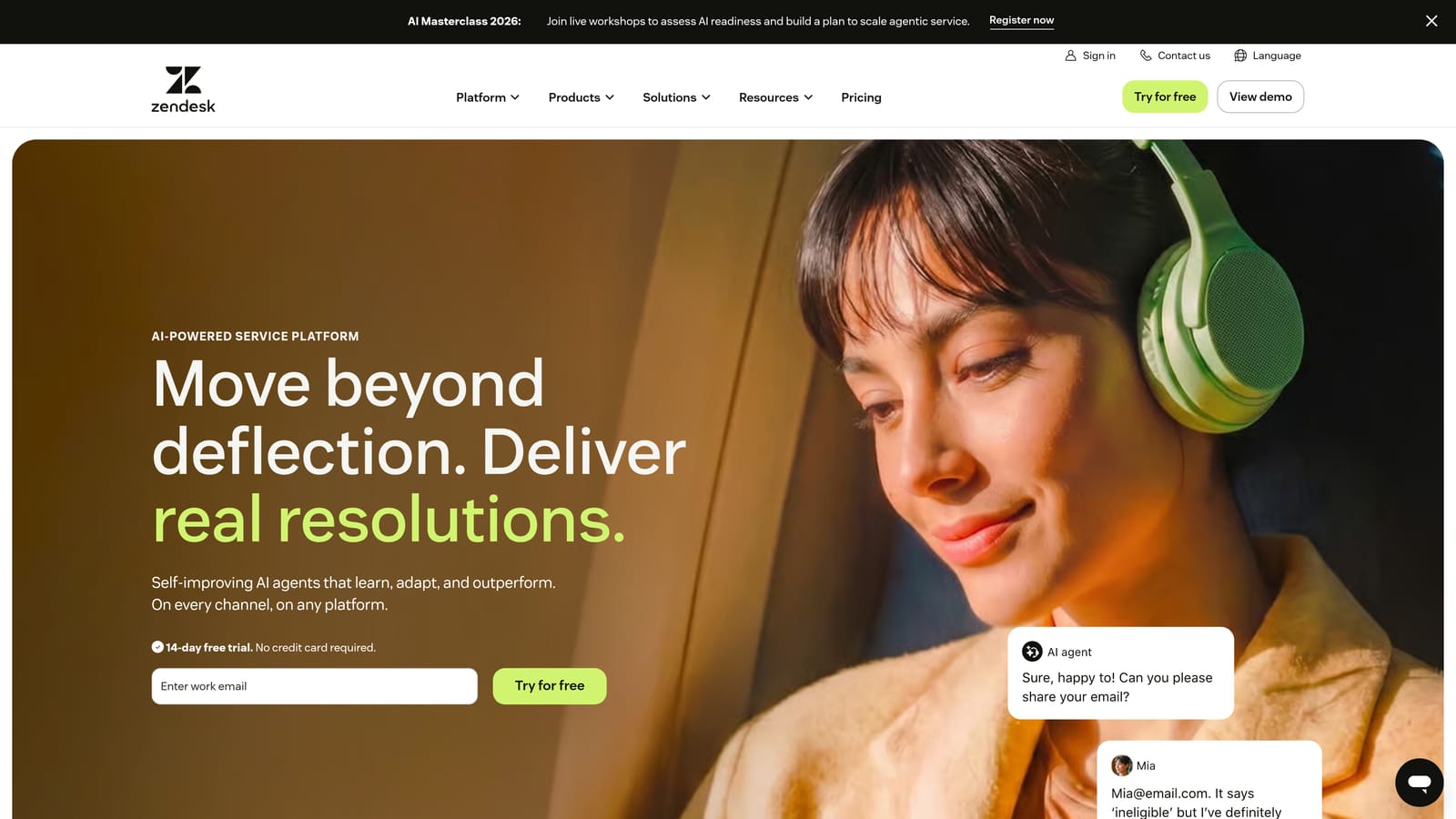
Zendesk is the dominant enterprise helpdesk platform with AI Agents for automated resolution, advanced routing, SLA management, and compliance-ready infrastructure.
Where This Tool Shines
Zendesk's AI Agents have evolved significantly from the earlier Answer Bot iteration. They now handle automated ticket deflection across chat, email, and messaging channels with considerably more sophistication. For enterprise organizations with high ticket volumes and strict SLA obligations, Zendesk's combination of automation and operational controls is hard to match.
The platform's generative AI capabilities extend to agent reply suggestions and ticket summarization, which accelerates human agent performance on tickets that do require manual handling. The tradeoff is configuration investment: Zendesk's power comes with meaningful setup complexity.
Key Features
AI Agents: Automated ticket deflection across chat, email, and messaging with improved natural language understanding.
Advanced Routing and SLA Management: Sophisticated rules engine for complex enterprise support operations with multi-tier escalation paths.
Generative AI for Agents: Reply suggestions, ticket summarization, and tone adjustment tools for human agents.
Robust Analytics Suite: Comprehensive reporting on team performance, resolution rates, and customer satisfaction.
Marketplace Depth: 1,500+ integrations covering virtually every enterprise tool category.
Best For
Mid-market to enterprise organizations with established support operations, compliance requirements, and the technical resources to configure and maintain a sophisticated platform. Less suited to teams that need fast deployment with minimal setup.
Pricing
Suite plans start at $55 per agent per month. AI add-ons are priced separately, so total cost of ownership scales with the features activated.
4. Freshdesk
Best for: SMB and mid-market teams that want capable AI automation without enterprise-level pricing or complexity.
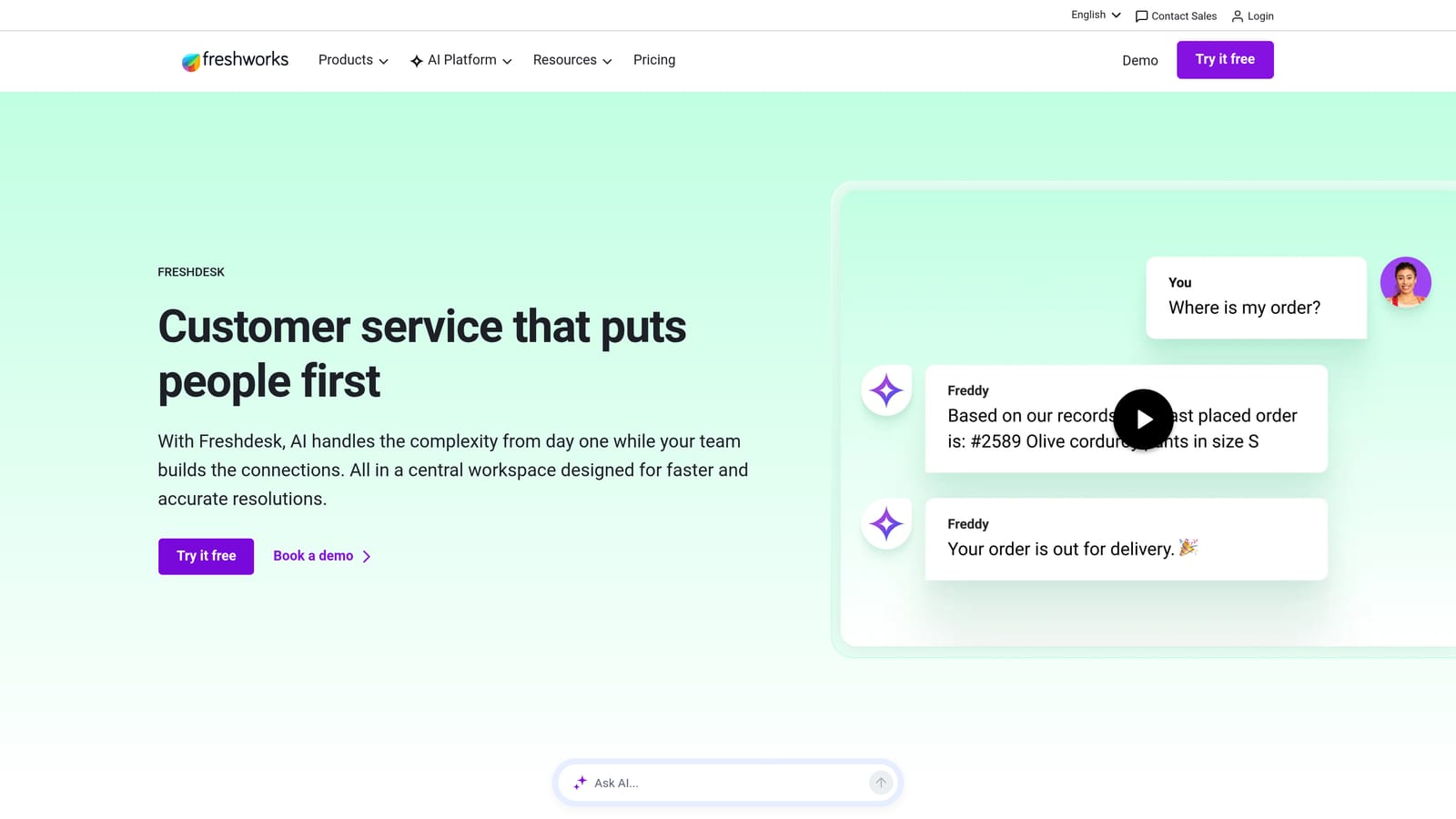
Freshdesk is a helpdesk platform with Freddy AI across self-service, agent assist, and analytics, offering competitive pricing relative to enterprise alternatives.
Where This Tool Shines
Freshdesk's Freddy AI suite covers three distinct use cases: Freddy Self Service handles automated resolution and deflection, Freddy Copilot assists human agents with response drafting and summarization, and Freddy Insights generates analytics and recommendations from support data. This layered approach lets teams activate automation progressively rather than committing to a single deployment model.
For teams that find Zendesk's pricing prohibitive but need more than basic ticketing, Freshdesk occupies a compelling middle ground. The omnichannel coverage across email, chat, phone, and social is solid for the price point.
Key Features
Freddy Self Service: Automated resolution bot that deflects common queries using your knowledge base before routing to agents.
Freddy Copilot: AI-assisted response drafting and ticket summarization for human agents handling complex issues.
Freddy Insights: AI-generated analytics and recommendations to identify support trends and improvement opportunities.
Omnichannel Ticketing: Unified inbox covering email, chat, phone, and social media channels.
Automation Rules: Flexible routing, tagging, and escalation rules for high-volume ticket management.
Best For
Growing SMB and mid-market teams that need reliable AI automation without the complexity or cost of enterprise platforms. Also a strong option for teams transitioning from manual support who want to introduce automation incrementally.
Pricing
Free plan available for small teams. Paid plans start at $15 per agent per month, making it one of the more accessible options on this list.
5. Tidio
Best for: Small teams and e-commerce businesses that need fast deployment and accessible AI chat automation.
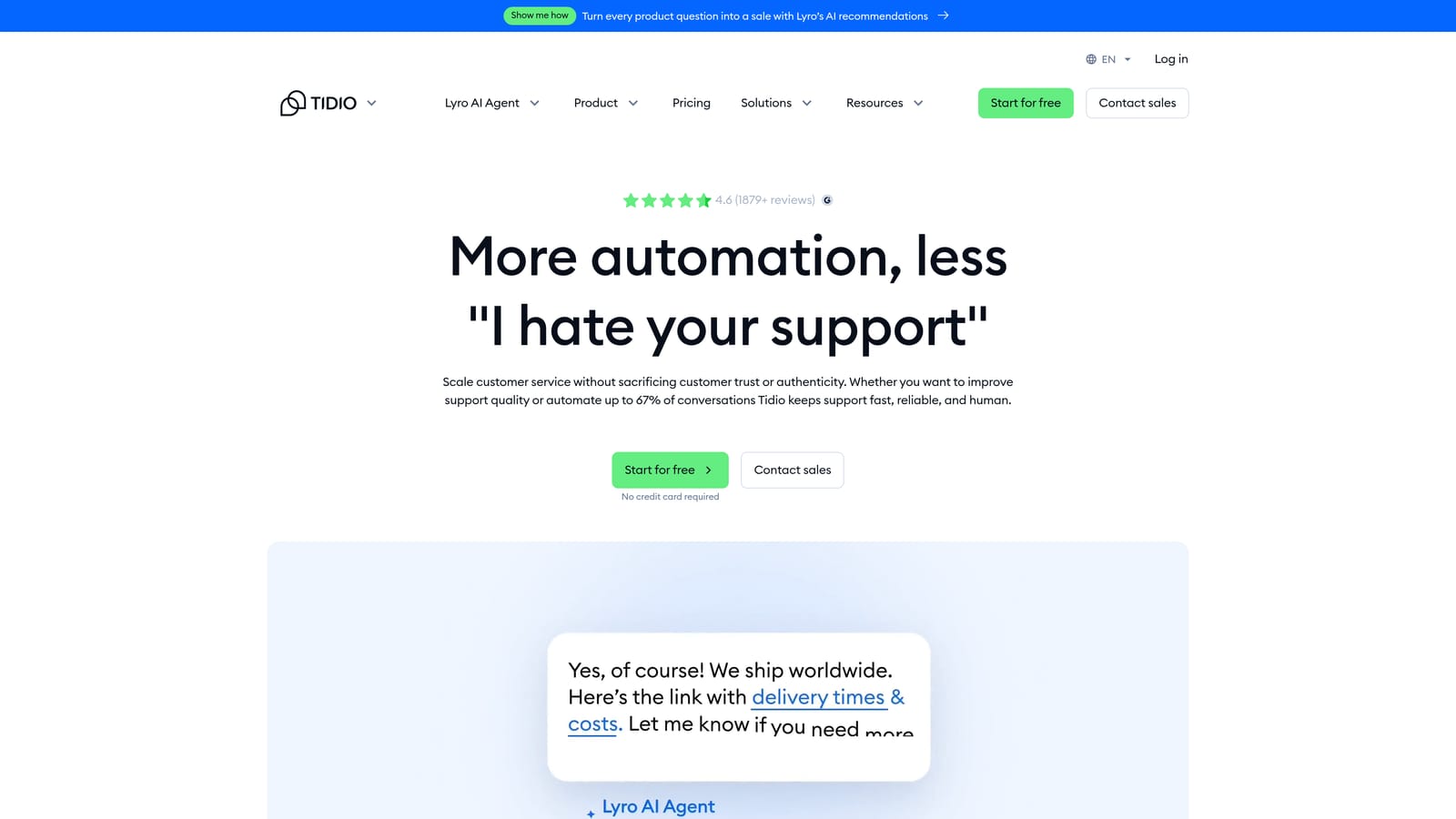
Tidio is a fast-deploy AI chat platform with Lyro AI for conversational ticket resolution and a visual flow builder for automation.
Where This Tool Shines
Tidio's primary advantage is speed to value. The platform is designed for teams that need functional AI chat automation running quickly, without dedicated technical resources. Lyro AI pulls from your existing knowledge base to handle conversational resolution, and the visual chatbot builder lets non-technical team members create and modify automation flows without writing code.
The live chat component allows agents to take over automated conversations instantly when needed, which provides a safety net for teams that are new to AI-assisted support. For small SaaS teams or e-commerce businesses with predictable query patterns, Tidio covers a lot of ground at an accessible price.
Key Features
Lyro AI: Conversational AI agent that resolves queries autonomously using your existing knowledge base content.
Visual Flow Builder: No-code chatbot builder for creating custom automation sequences and escalation paths.
Instant Agent Takeover: Live agents can seamlessly take over automated conversations without disrupting the customer experience.
E-commerce Integrations: Native connections with Shopify and WooCommerce for order-related query automation.
Behavior-Triggered Automation: Visitor tracking that triggers proactive chat based on user behavior and page activity.
Best For
Small teams, e-commerce businesses, and early-stage SaaS companies that need functional AI chat automation without significant setup investment. Less suited to complex B2B support workflows with deep integration requirements.
Pricing
Free plan available. Lyro AI plans start at $29 per month, making it one of the most accessible entry points for conversational AI automation.
6. Help Scout
Best for: Teams where relationship quality and customer experience are the primary metrics, not deflection rate.
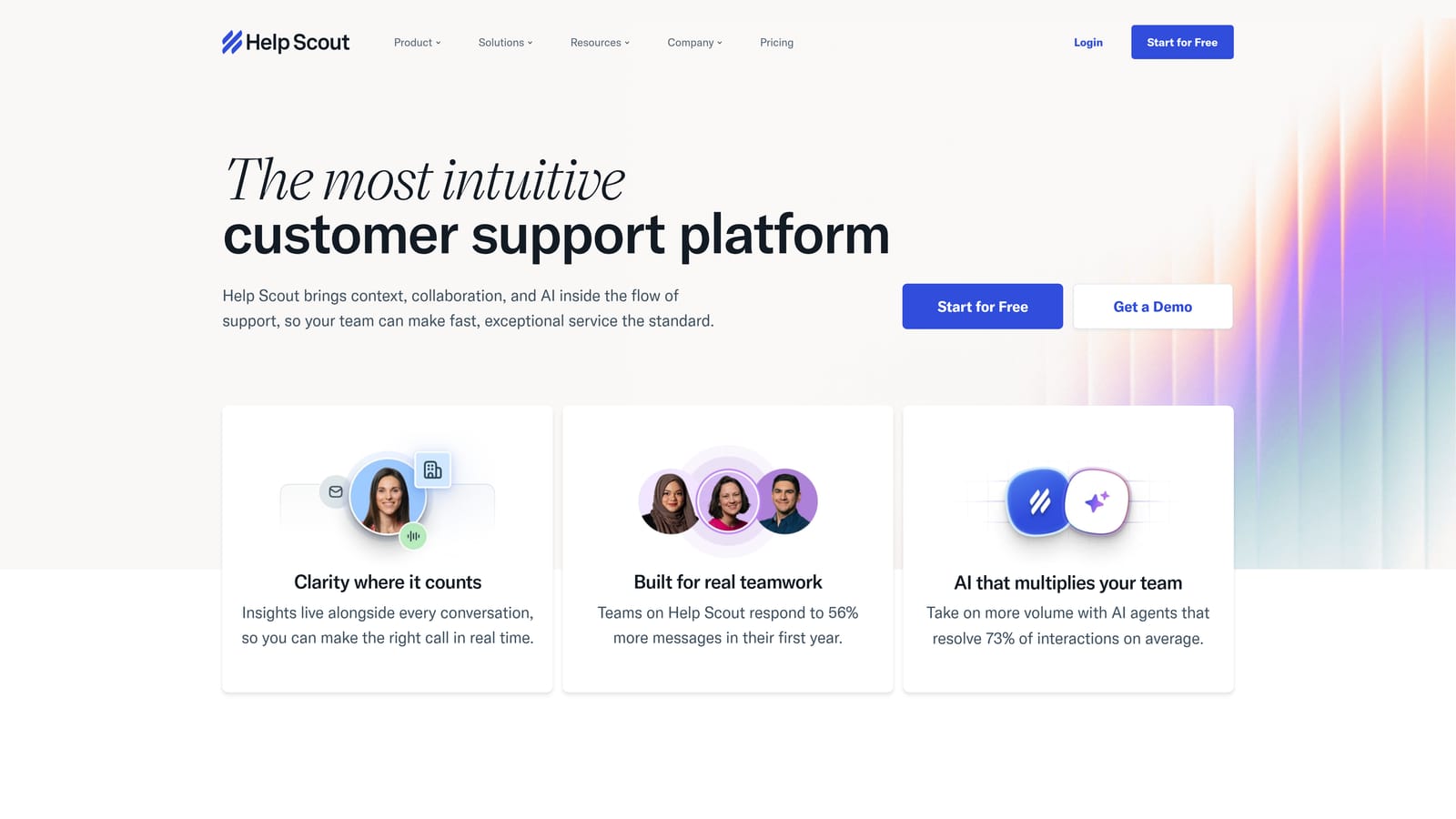
Help Scout is a human-first shared inbox platform with AI features designed to make agents faster rather than replace them.
Where This Tool Shines
Help Scout occupies a deliberate position on the manual end of the automation spectrum. Its AI features, including Summarize, Assist, and Drafts, are explicitly designed to augment human agents rather than automate them out of the workflow. For teams where a personal, relationship-driven support experience is a competitive differentiator, this philosophy translates into a product that feels coherent rather than compromised.
The shared inbox with collision detection prevents duplicate responses, and the Docs knowledge base with AI-powered search supports self-service without pushing customers toward a bot-first experience. If your support philosophy centers on human connection, Help Scout is built around the same principle.
Key Features
AI Summarize: Generates instant conversation summaries so agents can quickly understand context before replying.
AI Assist: Tone adjustment and reply drafting within the inbox to help agents respond faster and more consistently.
Shared Inbox with Collision Detection: Prevents multiple agents from working the same ticket simultaneously.
Docs Knowledge Base: Self-service documentation with AI-powered search to help customers find answers independently.
Customer Happiness Reporting: Performance reporting focused on satisfaction and team efficiency rather than automation metrics.
Best For
High-touch B2B teams, professional services firms, and any organization where support quality and relationship depth matter more than deflection volume. Not the right choice for teams primarily evaluating tools on automation rate.
Pricing
Starts at $50 per month for up to 3 users, with per-user pricing for larger teams.
7. Kustomer
Best for: High-volume support operations that need full customer context to power intelligent AI automation.
Kustomer is a CRM-native support platform combining a unified customer timeline with AI-driven workflow automation.
Where This Tool Shines
Kustomer's core differentiator is its CRM-native architecture. Rather than pulling customer data from a separate CRM, every interaction across every channel is aggregated into a single customer timeline. This gives KustomerIQ, the platform's AI layer, full context across the customer's entire history when making routing, resolution, and escalation decisions.
For high-volume operations where customer history directly informs resolution logic, this context richness meaningfully improves automation accuracy. Teams handling complex, multi-touch support journeys benefit most from Kustomer's workflow automation engine with conditional logic built around real customer data.
Key Features
Unified Customer Timeline: Every interaction across all channels aggregated into a single chronological view per customer.
KustomerIQ: AI layer handling intelligent routing, suggested replies, and automated resolution using full customer context.
Omnichannel Support: Email, chat, voice, SMS, and social media covered within a single platform.
Workflow Automation Engine: Conditional logic builder for complex support journeys with branching escalation paths.
Built-in CRM: Eliminates the need for a separate customer data platform, reducing integration complexity and data sync issues.
Best For
Mid-market to enterprise teams with high ticket volumes and complex customer relationships where historical context is critical to resolution quality. Also suited to organizations looking to consolidate their support platform and CRM into a single system.
Pricing
Starts at $89 per user per month, positioning it at the higher end of the mid-market range.
8. Gorgias
Best for: E-commerce brands running on Shopify, WooCommerce, or Magento that need AI auto-resolution of order and shipping queries.
Gorgias is an e-commerce-specific helpdesk with deep native integrations that enable AI auto-resolution of transactional queries using live store data.
Where This Tool Shines
Gorgias is purpose-built for e-commerce, and that focus shows in its integration depth. The AI auto-responder pulls live order data directly from Shopify, WooCommerce, or Magento to resolve order status, return, and shipping queries without agent involvement. For e-commerce brands where these query types represent a large portion of support volume, the automation potential is substantial.
The revenue statistics feature links support interactions to conversion and retention impact, giving support teams visibility into the business value of their work. For B2B SaaS teams, Gorgias is less relevant, but for e-commerce operations it's one of the most purpose-fit tools available.
Key Features
AI Auto-Responder: Pulls live order data to resolve transactional queries about order status, returns, and shipping without agent involvement.
Native E-commerce Integrations: Deep connections with Shopify, WooCommerce, and Magento with sidebar customer and order data.
Revenue Statistics: Links support interactions to conversion and retention metrics to quantify support's business impact.
Macros and Rules: High-volume repetitive ticket automation for common query patterns.
Omnichannel Inbox: Email, chat, social media, and SMS covered in a single agent workspace.
Best For
E-commerce brands with significant transactional support volume. Particularly effective for Shopify-native businesses where order, return, and shipping queries represent the majority of support tickets. Not well-suited to SaaS or service-based support use cases.
Pricing
Starts at $10 per month for up to 50 tickets, with pricing scaling by ticket volume rather than per-seat, which suits high-volume e-commerce operations.
9. Front
Best for: Account management teams that blend client communication and support across multiple channels.
Front is an omnichannel shared inbox platform spanning email, SMS, WhatsApp, and social, suited to teams with hybrid support and client communication responsibilities.
Where This Tool Shines
Front sits at the intersection of support platform and team communication tool. Its shared inbox model covers a broader channel set than most helpdesks, including SMS, WhatsApp, and social alongside email, which makes it well-suited to account management teams that handle client communication and support through the same workflows.
The AI features, including Drafts and Summarize, follow the augmentation model: they make human agents faster rather than replacing them. For teams where the relationship between agent and customer is long-term and high-value, Front's collaborative threading and internal comment features support that dynamic well.
Key Features
AI Drafts: Generates reply suggestions from conversation context and connected knowledge base content.
AI Summarize: Provides quick context summaries on long conversation threads before agents respond.
Shared Inbox with Collaboration: Tagging, assignment, and internal comment threading for team coordination on complex conversations.
Broad Omnichannel Coverage: Email, SMS, WhatsApp, social media, and voice within a single workspace.
Automation Rules: Routing, SLA alerts, and tagging automation for inbox management.
Best For
Account management and customer success teams that handle both proactive client communication and reactive support across multiple channels. Less suited to high-volume support operations that need deep automation or autonomous ticket resolution.
Pricing
Starts at $19 per seat per month, making it accessible for smaller account management teams.
Which Tool Matches Your Support Operation
The automated versus manual support debate has largely been replaced by a more practical question: how much autonomy does your operation actually need, and where does human judgment remain irreplaceable?
Here's a quick way to think about it by use case:
Scaling B2B SaaS teams that need autonomous resolution, in-product guidance, and business intelligence beyond basic support metrics should look at Halo AI first. The AI-first architecture and page-aware context are built for exactly this scenario.
Enterprise teams with complex routing, SLA obligations, and compliance requirements will find Zendesk's depth and marketplace breadth hard to match, particularly if they already have the technical resources to configure it properly.
Mid-market teams looking for capable automation without enterprise pricing should evaluate Freshdesk or Intercom depending on whether they want a standalone helpdesk or a broader messaging ecosystem.
High-touch teams where relationship quality is the primary metric should consider Help Scout or Front, both of which use AI to make human agents faster rather than to replace them.
E-commerce brands with high transactional support volume will find Gorgias's native store integrations and AI auto-responder the most purpose-fit solution available.
The right tool isn't necessarily the one with the highest automation rate. It's the one that resolves the right tickets automatically, escalates intelligently, and gives your team the context to handle everything else well.
Your support team shouldn't scale linearly with your customer base. Let AI agents handle routine tickets, guide users through your product, and surface business intelligence while your team focuses on complex issues that need a human touch. See Halo in action and discover how continuous learning transforms every interaction into smarter, faster support.