9 Best Automated Ticket Systems Compared for 2026
This automated ticket system comparison evaluates nine leading platforms — from AI-native agents like Halo AI to enterprise helpdesks — across automation depth, integration breadth, learning capabilities, and total cost of ownership, helping support teams find the right fit for their needs in 2026.
 Grant CooperFounder12 min read
If your support team is still manually triaging, routing, and resolving every ticket, you're leaving efficiency and customer satisfaction on the table. Automated ticket systems have evolved well beyond simple rule-based routing. Today's best platforms use AI to resolve tickets autonomously, surface business intelligence, and integrate across your entire tech stack.
But with dozens of options on the market, the differences between platforms matter enormously. Some bolt AI onto legacy helpdesk infrastructure. Others are built AI-first from the ground up. Some excel at high-volume consumer support; others are purpose-built for B2B SaaS teams.
This comparison covers nine automated ticket systems across the spectrum, from AI-native agents to enterprise helpdesks, evaluated on automation depth, integration breadth, learning capabilities, and total cost of ownership. Here are the top tools worth considering in 2026.
1. Halo AI
Best for: B2B SaaS teams that need autonomous ticket resolution and business intelligence from support interactions.
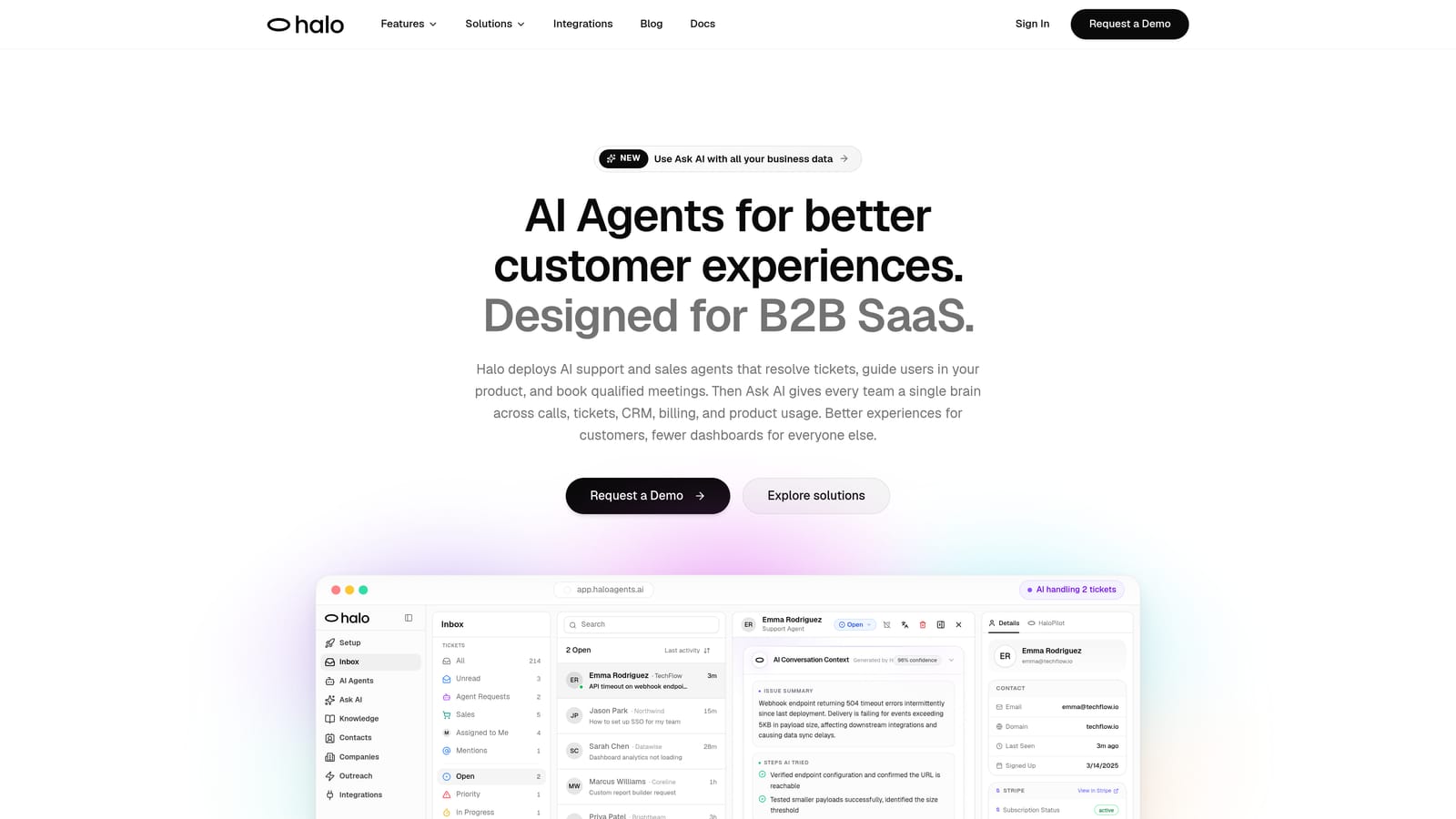
Halo AI is an AI-first customer support platform purpose-built for B2B SaaS teams who want genuine automation, not just assisted workflows.
Where This Tool Shines
What separates Halo from most platforms on this list is its architecture. Rather than layering AI onto a legacy helpdesk, Halo is built AI-first from the ground up. Its agents don't just suggest responses; they resolve tickets autonomously, learning from every interaction to get smarter over time.
The page-aware chat widget is a standout capability. Halo's agent sees what your user sees in-product, providing contextual visual guidance rather than generic scripted answers. Pair that with a smart inbox that surfaces churn signals, revenue anomalies, and customer health indicators, and you have a support platform that contributes to business intelligence, not just ticket closure rates.
Key Features
Autonomous AI Agents: Resolve tickets end-to-end without human intervention, with continuous learning from every resolved interaction.
Page-Aware Chat Widget: Contextual guidance that understands what the user is viewing in your product, enabling precise visual walkthroughs.
Smart Inbox with Business Intelligence: Surfaces churn signals, revenue anomalies, and customer health data from support conversations.
Auto Bug Ticket Creation: Automatically generates bug reports in Linear and other dev tools when product issues are detected.
Live Agent Handoff: Seamlessly escalates complex issues to human agents with full conversation context preserved.
Deep Integration Stack: Connects natively with Linear, Slack, HubSpot, Intercom, Stripe, Zoom, PandaDoc, and Fathom.
Best For
B2B SaaS teams scaling support without scaling headcount. Particularly strong for product-led growth companies where in-product guidance, bug tracking, and customer health signals are as important as ticket resolution speed.
Pricing
Contact Halo AI directly for pricing. Given the AI-first architecture and B2B SaaS focus, pricing is tailored to team size and usage. Verify current plans at haloagents.ai.
2. Zendesk
Best for: Large enterprise support teams needing a mature, highly configurable helpdesk with extensive integrations.
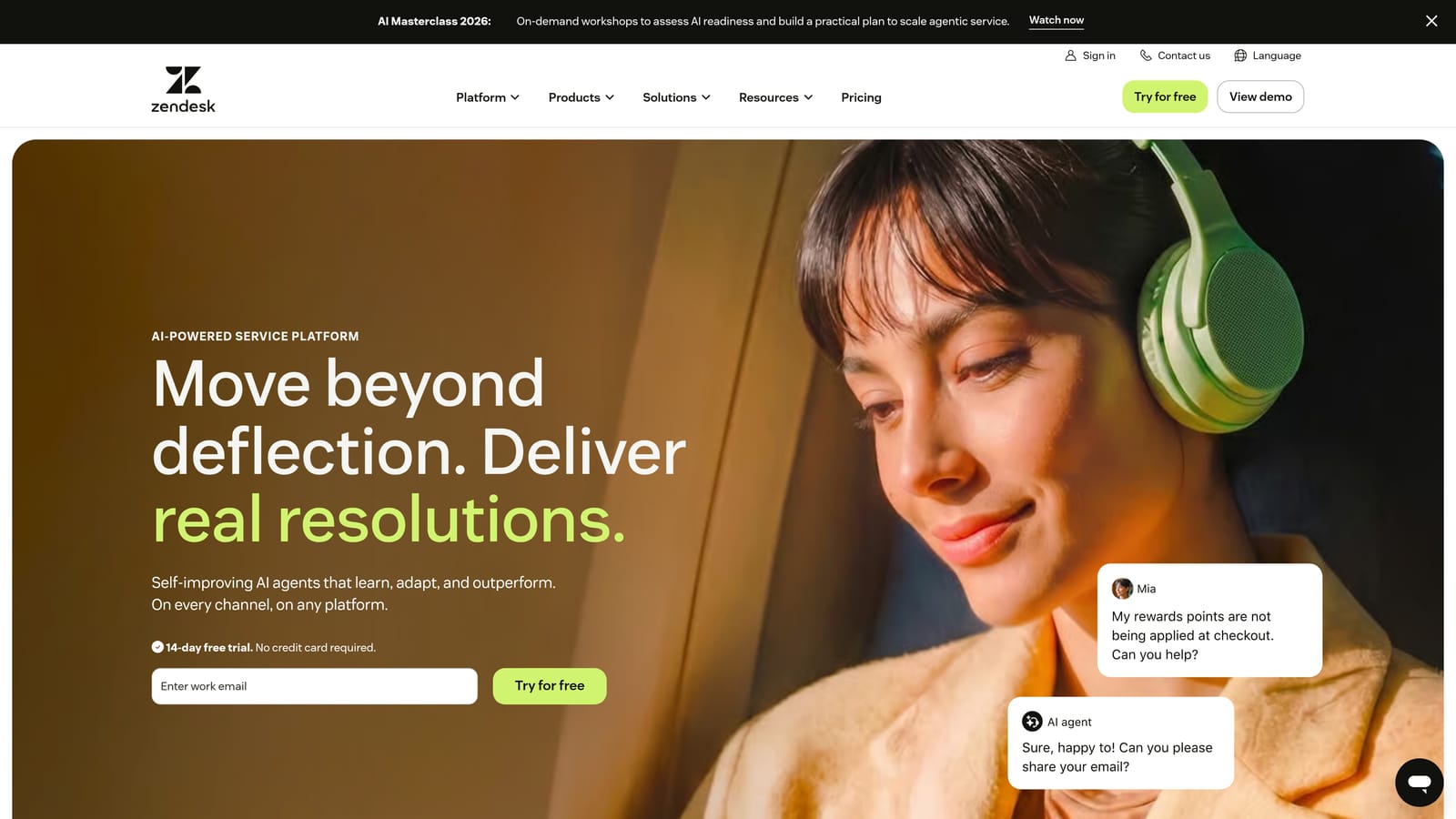
Zendesk is one of the most established names in customer support, offering a broad feature set built on years of enterprise adoption.
Where This Tool Shines
Zendesk's strength is its ecosystem. With thousands of marketplace integrations and a deeply configurable workflow engine, it can be shaped to fit almost any support operation. For large teams with complex routing requirements, that flexibility is genuinely valuable.
Its AI capabilities, powered by an OpenAI partnership, include ticket triage, auto-tagging, and suggested responses. These are useful additions, though they feel more like enhancements to an existing workflow than a fundamental rethinking of how support works. Teams that need enterprise-grade reporting and compliance will find Zendesk well-equipped.
Key Features
AI-Powered Triage: Automated ticket tagging, routing, and suggested agent responses to speed up resolution.
Marketplace Ecosystem: Thousands of third-party integrations covering CRM, analytics, e-commerce, and more.
Advanced Reporting: Customizable dashboards and analytics for tracking SLAs, CSAT, and team performance.
Omnichannel Support: Unified inbox handling email, chat, voice, and social channels.
Workflow Automation: Triggers, macros, and automations for rule-based ticket handling at scale.
Best For
Enterprise support organizations with large agent teams, complex routing logic, and a need for extensive third-party integrations. Less ideal for lean SaaS teams looking for autonomous AI resolution without significant configuration overhead.
Pricing
Suite plans start at approximately $55 per agent per month. Costs can scale significantly at enterprise tiers. Verify current pricing directly with Zendesk.
3. Freshdesk
Best for: SMBs and growing teams wanting omnichannel support with AI assistance at competitive price points.
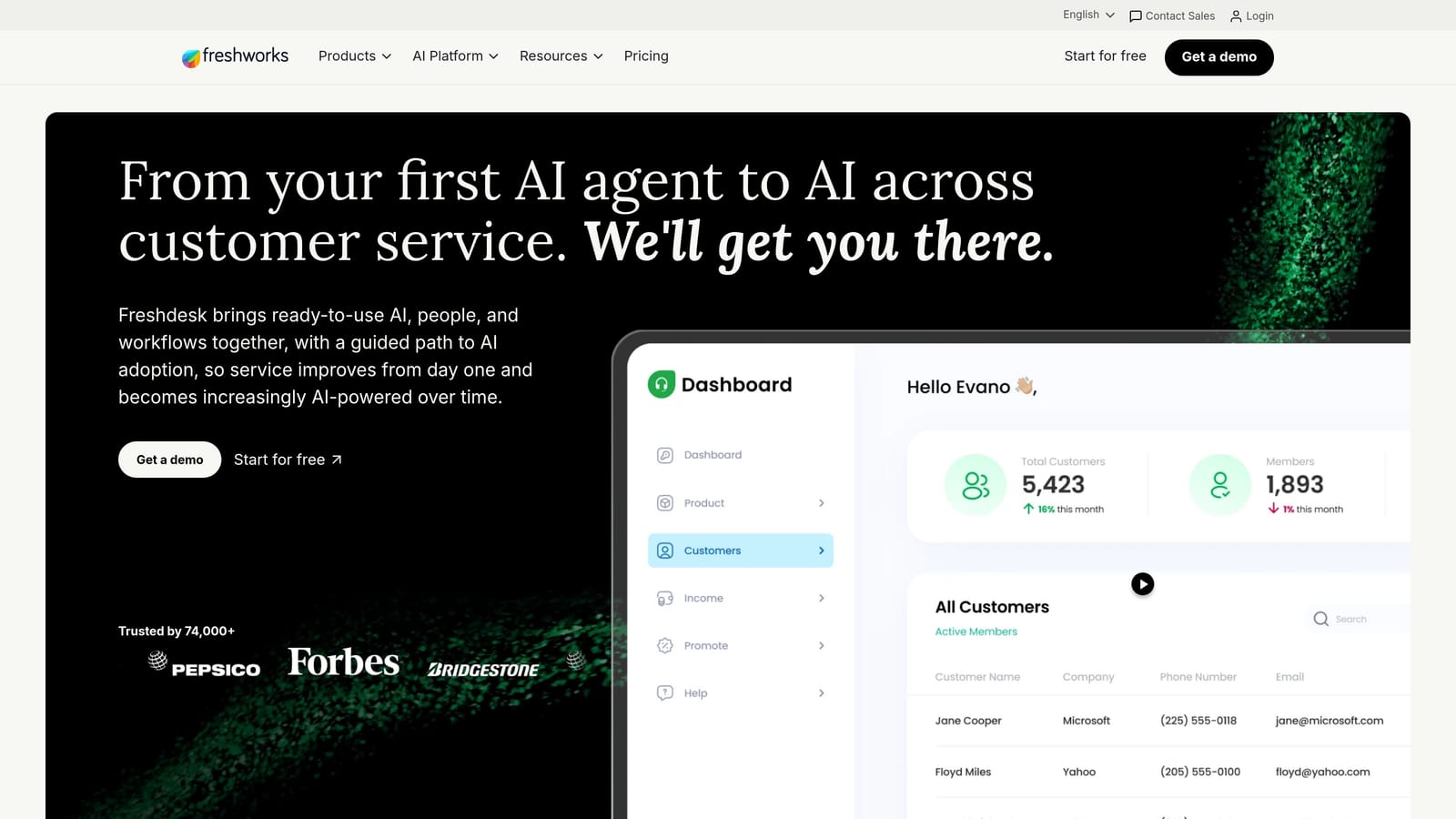
Freshdesk is Freshworks' helpdesk solution, combining multi-channel support with Freddy AI for automated triage and response suggestions.
Where This Tool Shines
Freshdesk punches above its price point. Freddy AI handles auto-triage, sentiment analysis, and response suggestions, which meaningfully reduces agent workload even on lower-tier plans. The omnichannel inbox is genuinely unified, pulling in email, chat, phone, and social without requiring complex configuration.
For teams on a budget who still want AI-assisted support, Freshdesk offers a practical middle ground. It's not as autonomous as AI-native platforms, but it's significantly more capable than basic helpdesks at similar price points.
Key Features
Freddy AI: Handles auto-triage, sentiment analysis, and draft response suggestions to accelerate agent workflows.
Omnichannel Inbox: Consolidates email, chat, phone, and social support into a single unified view.
Scenario Automations: Multi-step workflow automations triggered by ticket conditions.
SLA Management: Built-in SLA policies with escalation rules and breach notifications.
Free Tier: Available for small teams, making it accessible for early-stage companies.
Best For
SMBs and mid-market teams that need solid omnichannel support with AI assistance but aren't ready for enterprise-level investment. Also a good fit for teams evaluating AI features before committing to a more specialized platform.
Pricing
Free tier available for small teams. Paid plans start at approximately $15 per agent per month. Verify current tiers directly with Freshdesk.
4. Intercom
Best for: SaaS and product-led growth companies wanting AI-first in-product support and proactive messaging.
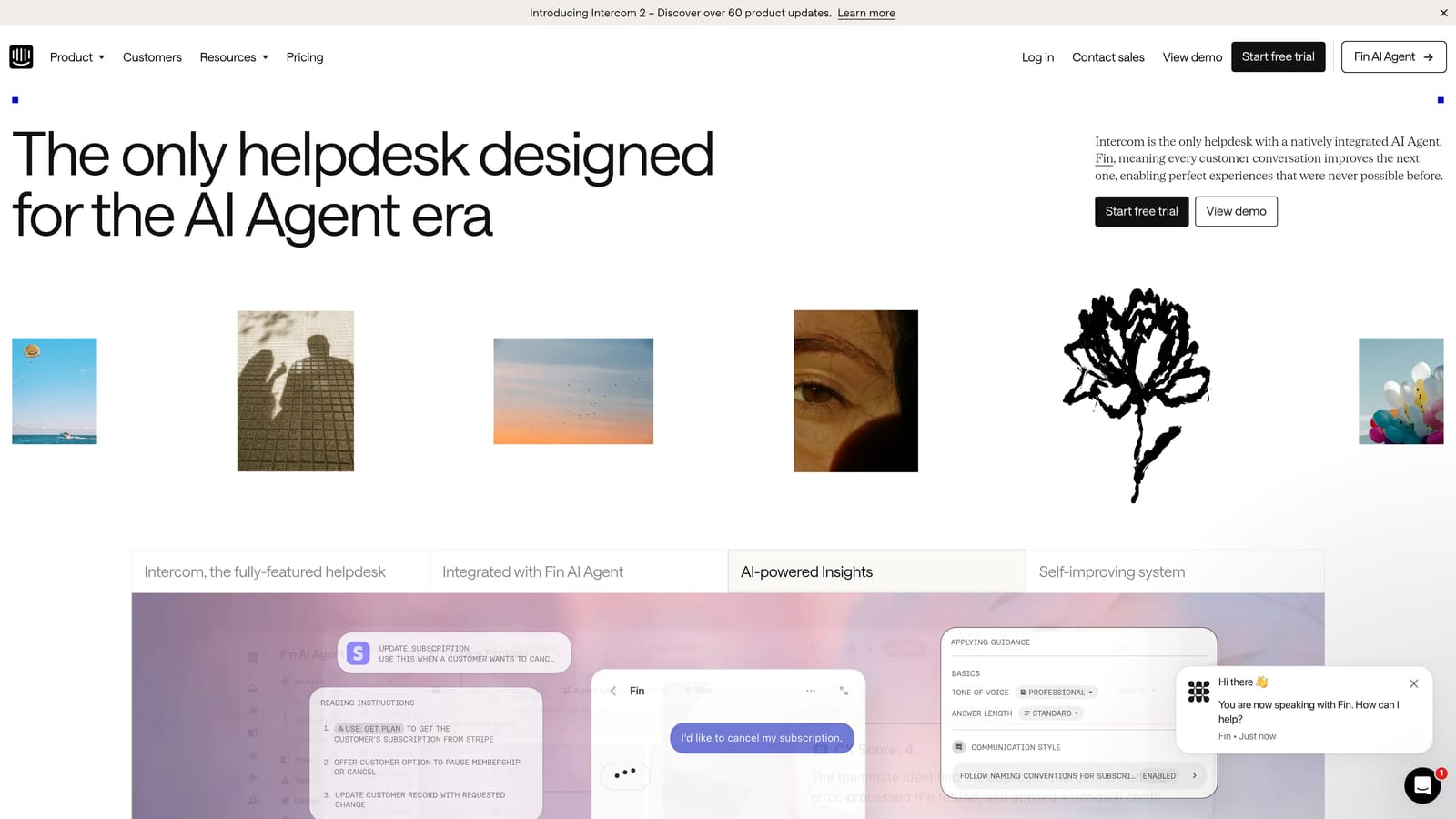
Intercom has evolved from a customer messaging tool into a full AI-first customer service platform, with its Fin AI agent at the center.
Where This Tool Shines
Fin, Intercom's AI agent, is built on large language models and can autonomously resolve a meaningful portion of incoming queries using your knowledge base and product documentation. For SaaS companies with well-maintained documentation, this can significantly reduce ticket volume without adding headcount.
Intercom's proactive messaging capabilities are also a differentiator. Rather than waiting for customers to raise tickets, it enables in-product outreach based on user behavior, which fits well with product-led growth motions. The unified inbox combining chat, email, and in-app messages keeps context centralized.
Key Features
Fin AI Agent: Autonomously resolves customer queries using your knowledge base, with LLM-powered understanding.
Proactive In-Product Messaging: Behavior-triggered outreach to engage users before they encounter friction.
Unified Inbox: Combines chat, email, and in-app messages in one interface.
Conversation Routing: Automated workflow routing based on query type, user segment, or priority.
PLG Integrations: Strong connections with product analytics and growth tools popular in SaaS environments.
Best For
SaaS and product-led growth companies that want AI-powered autonomous resolution alongside proactive in-product messaging. Pricing scales with usage, so it's worth modeling costs carefully as conversation volume grows.
Pricing
Starts at approximately $39 per month for small teams. Scales significantly with usage and feature tiers. Verify current pricing with Intercom directly.
5. HubSpot Service Hub
Best for: Teams already using HubSpot CRM who want support tightly integrated with sales and marketing data.
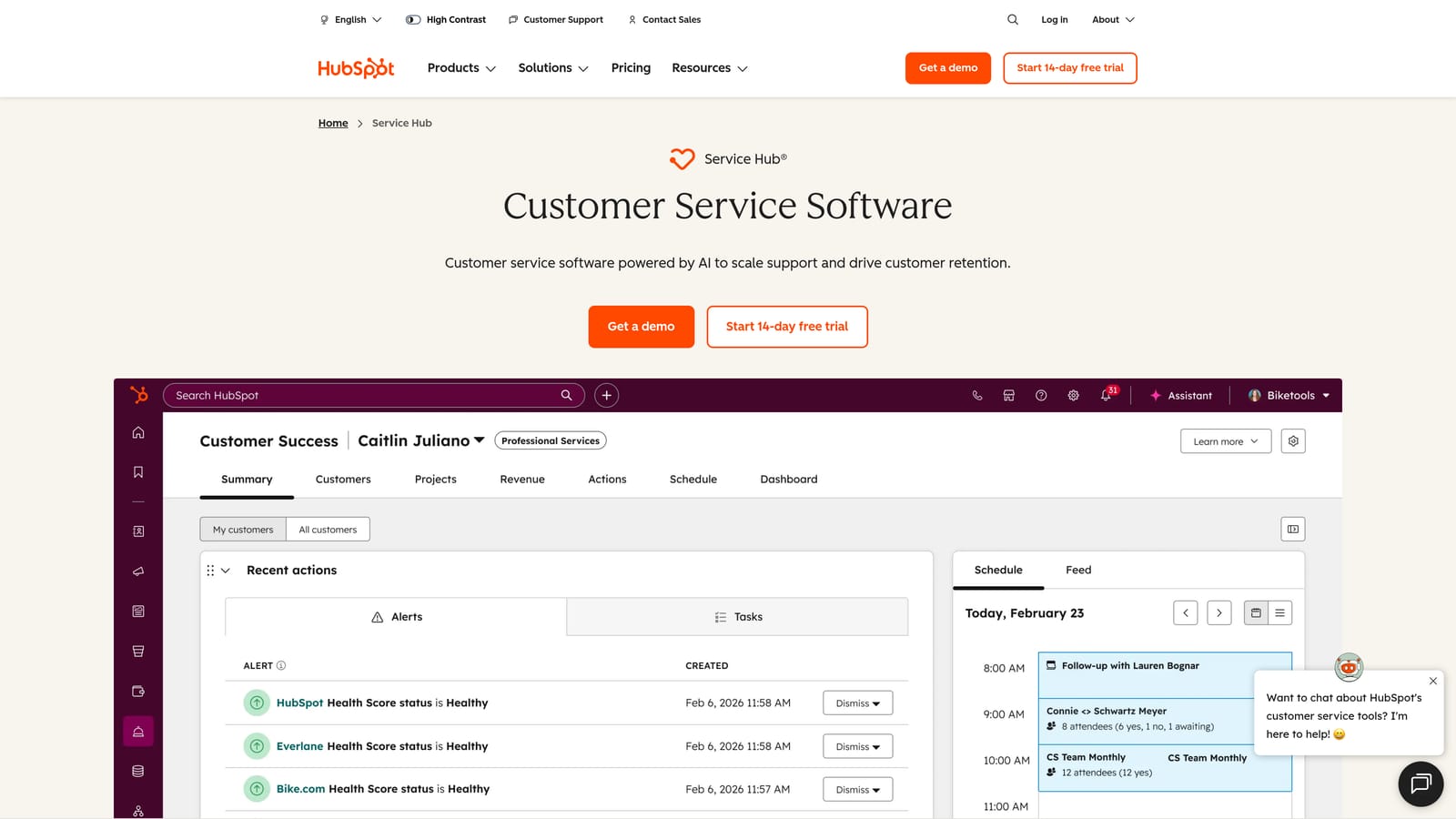
HubSpot Service Hub is HubSpot's native customer service module, offering ticketing and AI features within the broader HubSpot ecosystem.
Where This Tool Shines
If your team already lives in HubSpot, Service Hub removes a major pain point: context fragmentation. Every support ticket connects to a unified customer timeline that includes sales conversations, marketing touchpoints, and deal history. This is genuinely powerful for revenue-aligned support teams that need to understand a customer's full relationship before responding.
AI features include conversation summaries and suggested responses, which help agents move faster without sacrificing quality. It's not the deepest automation platform on this list, but for HubSpot-native teams, the integration value often outweighs the automation gap.
Key Features
Native CRM Integration: Full unified customer timeline connecting support, sales, and marketing interactions.
AI Conversation Summaries: Automatic summaries of long conversations to help agents get up to speed quickly.
Knowledge Base and Customer Portal: Self-service resources with a branded customer portal.
SLA Tracking: Built-in SLA management with reporting on response and resolution times.
Shared Inbox: Team collaboration tools with assignment, notes, and collision detection.
Best For
Revenue-aligned support teams and companies already using HubSpot for CRM, sales, or marketing. Less compelling as a standalone support platform for teams without an existing HubSpot investment.
Pricing
Free tier available. Starter plans begin at approximately $15 per month. Higher tiers unlock more advanced automation and reporting. Verify current pricing with HubSpot.
6. Help Scout
Best for: Small teams and startups that want human-feeling support with simple AI assistance and no steep learning curve.
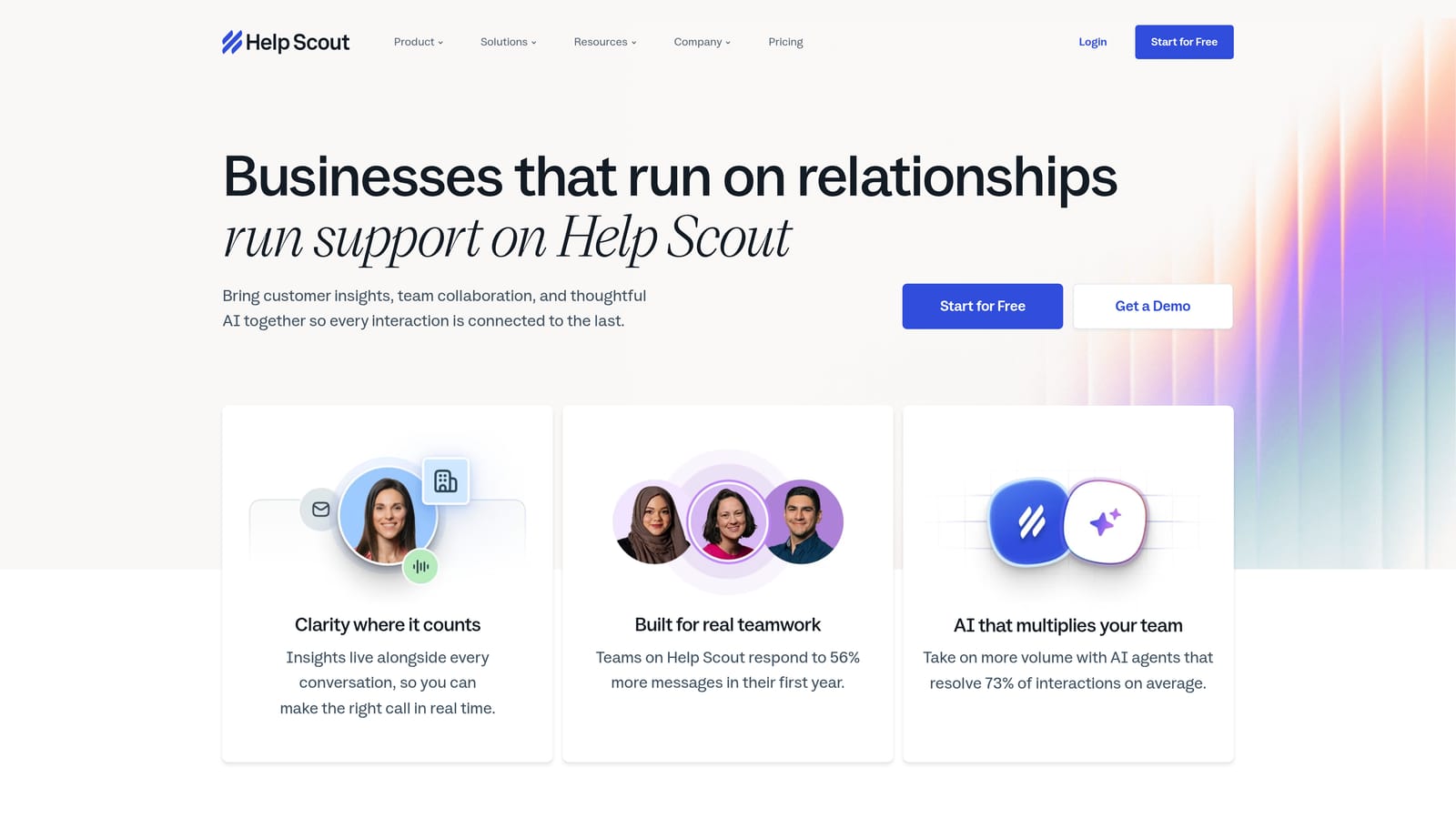
Help Scout is a shared inbox and help desk platform designed around simplicity, with AI features that enhance agent speed without adding complexity.
Where This Tool Shines
Help Scout's philosophy is refreshingly clear: support should feel human. The shared inbox model is intuitive enough that teams can get productive within hours of setup. Collision detection prevents two agents from replying to the same ticket, a small feature that saves significant awkwardness at scale.
The AI Summarize and Assist features help agents draft faster responses and catch up on long threads without reading every message. For small teams where every agent handles a wide variety of issues, that kind of assistance is practical and genuinely useful. The built-in Docs knowledge base also reduces repetitive ticket volume.
Key Features
AI Summarize: Condenses long conversation threads into quick summaries for faster agent context.
AI Assist: Draft response suggestions to help agents write faster without losing their voice.
Shared Inbox with Collision Detection: Prevents duplicate replies and keeps team coordination smooth.
Built-in Knowledge Base (Docs): Create and manage self-service articles directly within Help Scout.
Customer Satisfaction Ratings: Simple CSAT collection after ticket resolution.
Best For
Small teams, startups, and companies that prioritize simplicity and a human support experience over deep automation. Not the right fit for teams needing autonomous AI resolution or complex multi-channel routing.
Pricing
Plans start at approximately $20 per user per month. Verify current pricing directly with Help Scout.
7. Zoho Desk
Best for: Teams already using Zoho's business suite who want a context-aware helpdesk with AI-powered anomaly detection.
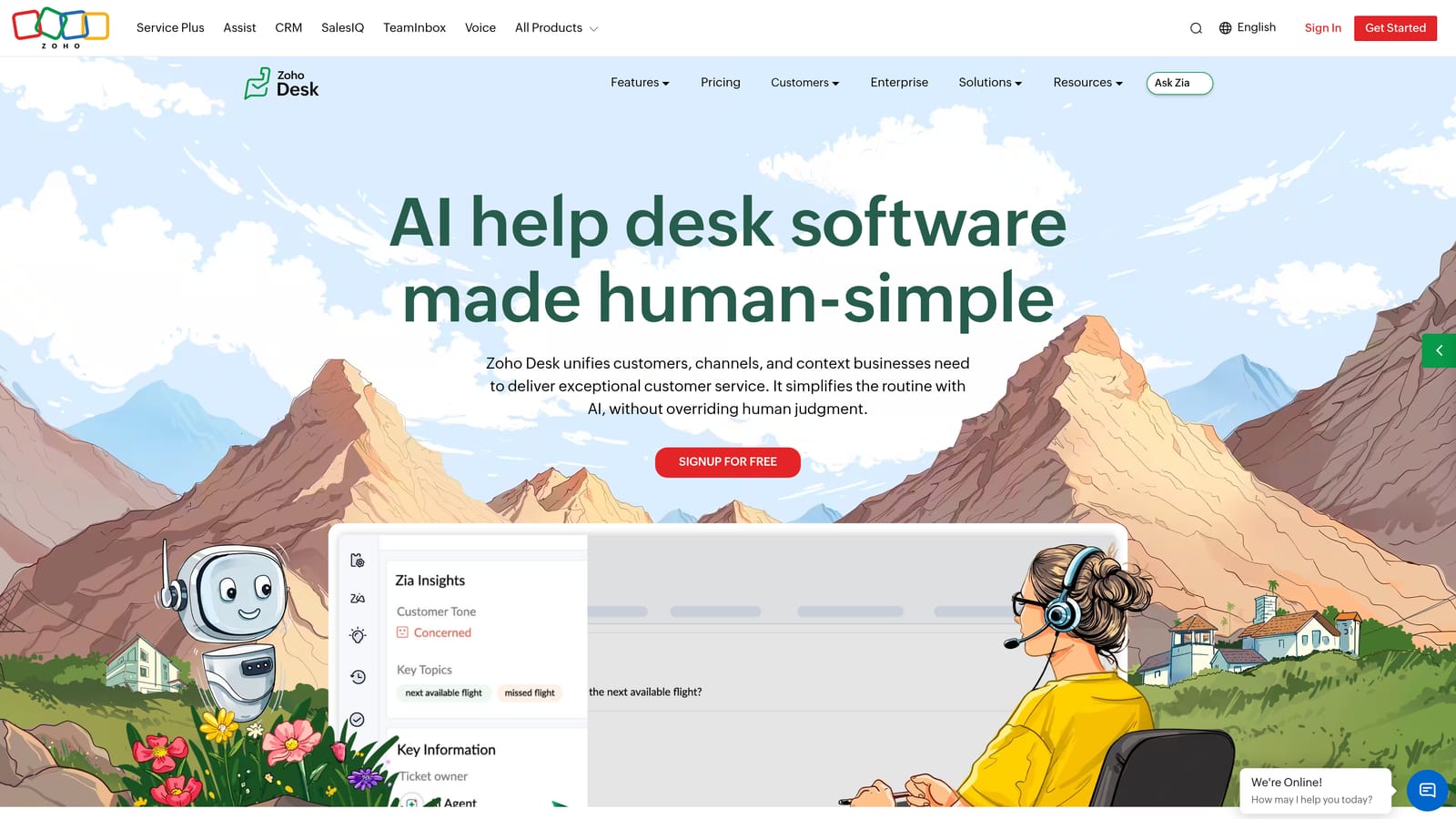
Zoho Desk is Zoho's helpdesk platform, featuring Zia AI for intelligent support automation and deep integration across the Zoho ecosystem.
Where This Tool Shines
Zia, Zoho's AI engine, brings some genuinely useful capabilities to support workflows: sentiment analysis on incoming tickets, anomaly detection for unusual ticket volume spikes, and auto-tagging to keep queues organized. For teams that want AI insights without rebuilding their entire stack, Zia provides meaningful value at a competitive price.
The deeper draw for many teams is the Zoho ecosystem. If you're already using Zoho CRM, Zoho Analytics, or other Zoho products, Desk integrates natively without the middleware complexity that cross-platform integrations often require.
Key Features
Zia AI: Sentiment analysis, anomaly detection, and auto-tagging to keep ticket queues organized and prioritized.
Zoho CRM Integration: Native connection to Zoho CRM for unified customer context across sales and support.
Blueprint Workflow Automation: Visual workflow builder for creating multi-step process automations.
Multi-Channel Support: Email, chat, social, and phone channels in one inbox.
Competitive Pricing with Free Tier: Accessible entry point for teams evaluating AI-assisted helpdesks.
Best For
Teams already invested in the Zoho business suite, or price-sensitive teams that want AI-assisted support without enterprise-level spend. Less compelling for teams outside the Zoho ecosystem.
Pricing
Free tier available. Paid plans start at approximately $14 per agent per month. Verify current tiers with Zoho directly.
8. ServiceNow Customer Service Management
Best for: Large enterprises where customer service and IT service management overlap and require deep workflow configurability.
ServiceNow Customer Service Management is an enterprise-grade platform built on ServiceNow's ITSM foundation, offering powerful workflow automation and compliance controls.
Where This Tool Shines
ServiceNow CSM is built for organizations where "support" and "IT operations" are deeply intertwined. Its workflow automation engine is among the most configurable available, capable of handling complex multi-department processes that would overwhelm lighter helpdesk platforms. Compliance controls and security features meet the requirements of heavily regulated industries.
The tradeoff is implementation complexity. ServiceNow CSM typically requires significant configuration effort and dedicated technical resources to deploy effectively. It's not a platform you spin up in a week. For enterprises where those capabilities are genuinely needed, however, the depth is hard to match.
Key Features
Enterprise Workflow Automation: Deeply configurable multi-step workflows across departments and service lines.
ITSM and CSM Integration: Unified platform connecting customer service with IT service management processes.
AI Case Routing: Intelligent routing and resolution suggestions based on case history and knowledge base.
Compliance and Security Controls: Enterprise-grade access controls, audit trails, and regulatory compliance features.
Self-Service Portals: Branded customer portals with knowledge management and case tracking.
Best For
Large enterprises in regulated industries where customer service intersects with IT operations, compliance requirements are strict, and workflow complexity demands a highly configurable platform. Not suited for SMBs or teams without dedicated implementation resources.
Pricing
Enterprise pricing with custom quotes required. Contact ServiceNow directly for current pricing based on your organization's needs.
9. Tidio
Best for: Small businesses and e-commerce operators wanting fast AI chatbot deployment with minimal setup complexity.
Tidio is a lightweight platform combining live chat, the Lyro AI chatbot, and basic ticketing, popular with small businesses that need quick AI deployment without enterprise complexity.
Where This Tool Shines
Speed of deployment is Tidio's headline advantage. Teams can have a working AI chatbot live within hours, not weeks. Lyro, Tidio's AI agent, handles common queries autonomously using your existing content, which meaningfully reduces the volume hitting your live support queue.
For e-commerce operators in particular, Tidio's native integrations with Shopify and WooCommerce make it easy to connect support with order data. It's not built for complex B2B support workflows, but for the audience it targets, it delivers solid value at an accessible price point.
Key Features
Lyro AI Chatbot: Automated query resolution using your knowledge content, with natural language understanding.
Fast Live Chat Setup: Quick deployment with minimal technical configuration required.
E-Commerce Integrations: Native connections with Shopify and WooCommerce for order-aware support.
Basic Ticket Management: Simple inbox and ticket tracking for teams with lower complexity needs.
Affordable Entry Point: Free tier available with paid plans at accessible price points for small teams.
Best For
Small businesses, e-commerce operators, and early-stage startups that need fast AI chatbot deployment and basic ticketing without the overhead of enterprise platforms. Not the right fit for complex B2B SaaS support workflows.
Pricing
Free tier available. Paid plans start at approximately $29 per month. Verify current pricing directly with Tidio.
Which Platform Fits Your Team?
The right automated ticket system depends less on feature checklists and more on one fundamental question: do you need AI bolted onto a legacy helpdesk, or an AI-native system built for how modern SaaS support actually works?
Here's a quick-reference guide to help you match your situation to the right platform:
B2B SaaS teams scaling without scaling headcount: Halo AI is purpose-built for this scenario. Autonomous resolution, page-aware context, bug ticket automation, and business intelligence signals make it the strongest choice for product-focused teams who need support to contribute beyond ticket closure.
Large enterprise support organizations: Zendesk or ServiceNow CSM, depending on whether IT service management integration is a requirement. Both offer the configurability and compliance controls enterprise teams need, with the understanding that implementation complexity is part of the deal.
SMBs and mid-market teams on a budget: Freshdesk and Zoho Desk both deliver solid AI-assisted support at competitive price points. Zoho is the stronger choice for teams already in the Zoho ecosystem; Freshdesk wins on omnichannel breadth.
SaaS companies with product-led growth motions: Intercom's Fin AI agent and proactive messaging capabilities make it a natural fit, though pricing scales quickly with usage volume.
HubSpot-native revenue teams: Service Hub's CRM integration is hard to replicate elsewhere. If your sales and support teams share customer context daily, the unified timeline alone justifies the choice.
Small teams wanting simplicity: Help Scout keeps things human and easy to manage. Tidio is the fastest path to a working AI chatbot for e-commerce and small business operators.
Your support team shouldn't scale linearly with your customer base. AI agents can handle routine tickets, guide users through your product, and surface business intelligence while your team focuses on complex issues that genuinely need a human touch. See Halo in action and discover how continuous learning transforms every support interaction into smarter, faster resolution.