9 Best Automated Ticket System Pricing Plans Compared in 2026
Comparing automated ticket system pricing across nine leading platforms, this guide breaks down what each plan actually includes, what it costs, and which team sizes and support maturity levels each solution best serves—from free AI-native tools to enterprise helpdesks—helping you avoid overpaying or outgrowing your platform as ticket volume scales.
 Matt PattoliFounder13 min read
Choosing an automated ticketing system is as much a pricing decision as it is a technology one. With plans ranging from free tiers to enterprise contracts that require a sales call, it's easy to overpay for features you don't need, or underbuy and hit walls when volume scales.
This guide cuts through the noise by comparing nine leading automated ticket systems on what actually matters: what you get, what it costs, and who it's built for. Whether you're a lean SaaS team looking to deflect repetitive tickets with AI, or a growing support org that needs deep integrations and business intelligence, there's a meaningful difference between these platforms.
We've organized this list starting with AI-native solutions and working through traditional helpdesks and hybrid tools, so you can match your support maturity level to the right pricing tier. One important note: SaaS pricing changes frequently. Always verify current figures on each vendor's official pricing page before making a decision.
1. Halo AI
Best for: SaaS and B2B teams that want AI agents resolving tickets autonomously, not just assisting agents
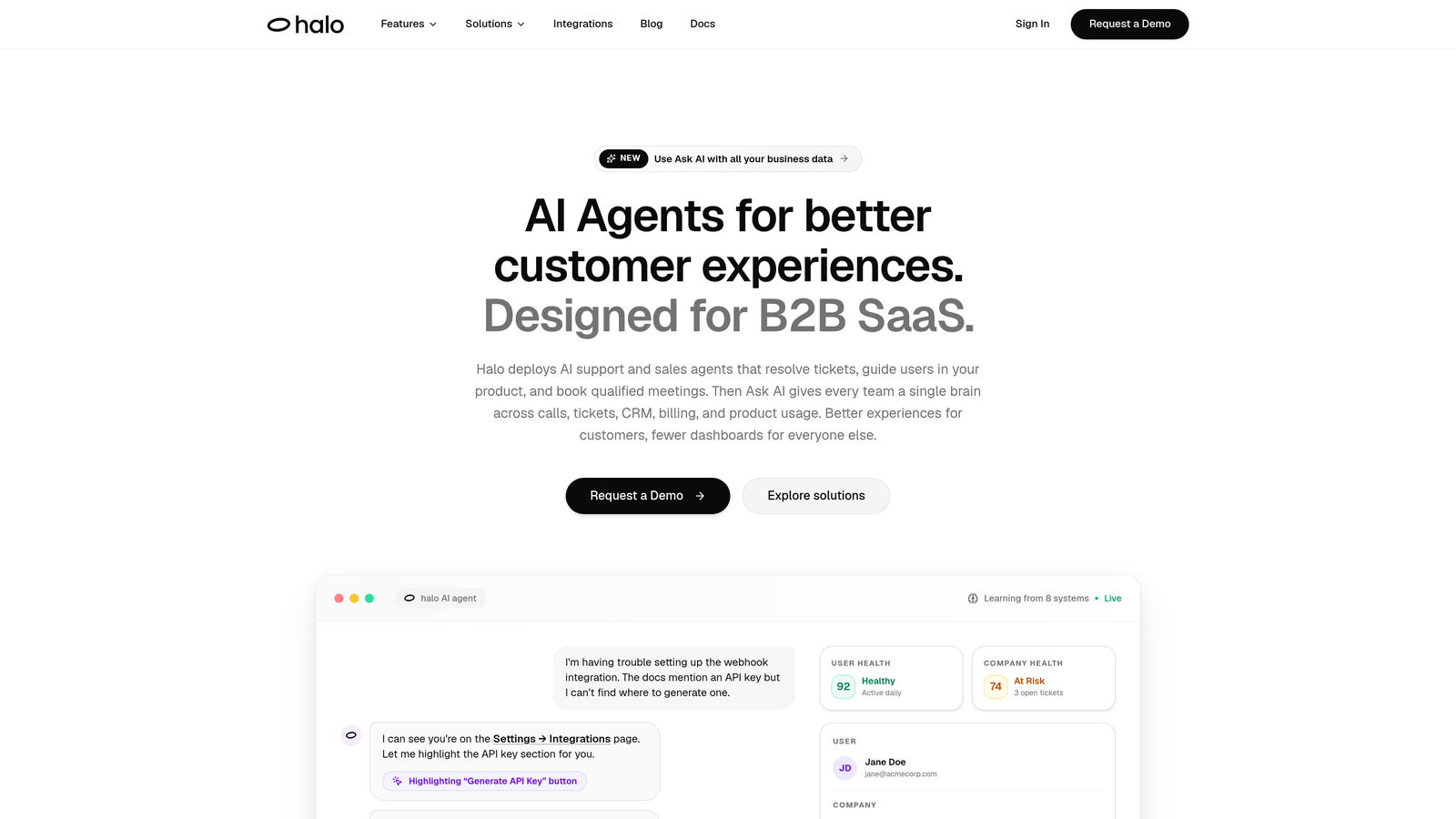
Halo AI is an AI-native customer support platform that deploys intelligent agents to resolve tickets end-to-end, guide users through your product with page-aware context, and surface business intelligence from every interaction.
Where This Tool Shines
The core distinction with Halo AI is architectural. Most helpdesks were built for human agents and later had AI layered on top. Halo was built from the ground up around autonomous AI agents, which means the entire platform is designed around resolution, not just response assistance.
The page-aware chat widget is a standout feature: it understands what screen a user is on and provides contextual UI guidance, not just generic knowledge base answers. Pair that with a smart inbox that surfaces customer health signals, churn indicators, and revenue anomalies, and you're getting business intelligence alongside support operations.
Key Features
Autonomous ticket resolution: AI agents handle tickets end-to-end without requiring a human to review and send every response.
Page-aware context: The chat widget sees what the user sees, enabling precise UI guidance rather than generic documentation links.
Smart inbox with business intelligence: Surfaces customer health signals, revenue anomalies, and churn indicators from support interactions.
Auto bug ticket creation: Automatically routes identified bugs to Linear or your existing engineering workflow.
Live agent handoff: Escalates complex issues to human agents with full conversation context preserved, so nothing gets repeated.
Native integrations: Connects with Slack, HubSpot, Intercom, Stripe, Zoom, PandaDoc, and Fathom without middleware workarounds.
Best For
SaaS companies and B2B product teams that want to scale support without scaling headcount. Particularly well-suited for teams that have outgrown basic helpdesks and want AI that learns from every interaction rather than running static automation rules.
Pricing
Contact haloagents.ai for current pricing. The AI-native architecture ties cost to resolutions and value delivered rather than agent seat count, which can represent a meaningful total cost of ownership advantage over per-seat legacy platforms at scale.
2. Zendesk
Best for: Enterprise and mid-market teams that need a proven, feature-complete helpdesk with extensive integrations
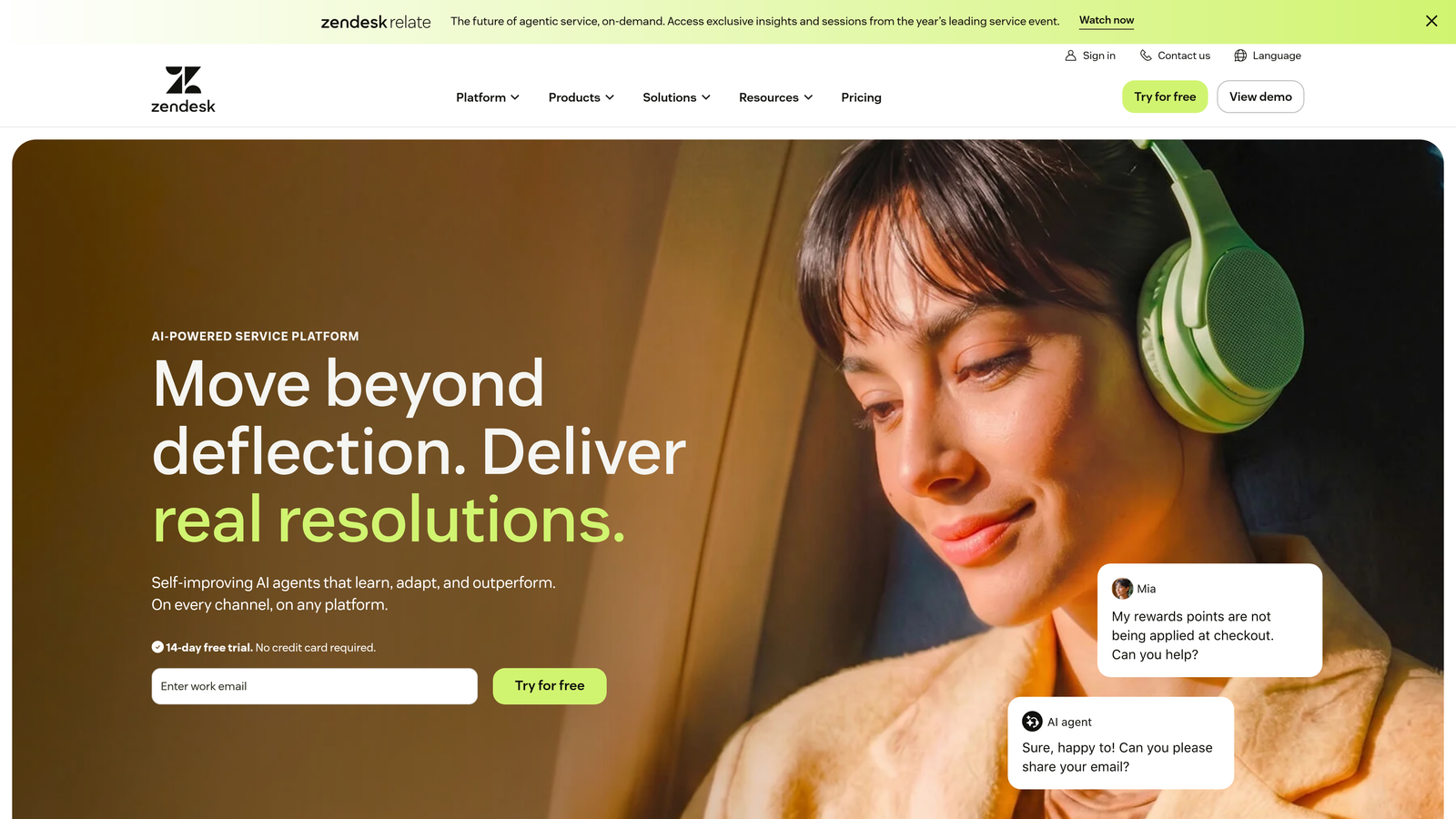
Zendesk is the most established name in helpdesk software, with a mature feature set, an extensive marketplace, and AI capabilities available across its Suite plans.
Where This Tool Shines
Zendesk's strength is breadth. The platform covers virtually every support channel, has over 600 marketplace integrations, and offers enterprise-grade compliance and security controls that regulated industries require. If you need a support platform that can handle complex routing logic, SLA management, and multi-brand operations, Zendesk has the infrastructure for it.
That said, Zendesk's AI capabilities are largely positioned as agent assistance tools rather than fully autonomous resolution. Zendesk AI (powered by OpenAI) helps with triage and suggested responses, but for teams wanting AI to fully own ticket resolution, this is an important distinction to evaluate.
Key Features
Advanced ticketing: Comprehensive routing, SLA management, macros, and triggers for complex support workflows.
Zendesk AI: Intelligent triage, agent assistance, and suggested responses, available on higher tiers or as add-ons.
600+ integrations: One of the largest helpdesk marketplaces available, covering CRM, analytics, and developer tools.
Robust reporting: Advanced analytics and dashboards on higher-tier plans.
Enterprise compliance: Security controls, data residency options, and compliance certifications for regulated industries.
Best For
Mid-market and enterprise teams with established support operations, multiple channels to manage, and a need for deep customization. Less ideal for lean teams who want simplicity or AI-first resolution without significant configuration overhead.
Pricing
Suite Team starts at approximately $55/agent/month billed annually. AI features are available on higher tiers or as add-ons, which can increase total cost meaningfully. Enterprise pricing requires a custom quote. Verify current pricing at zendesk.com/pricing.
3. Freshdesk
Best for: Budget-conscious teams that want a capable helpdesk with AI features that unlock as they grow
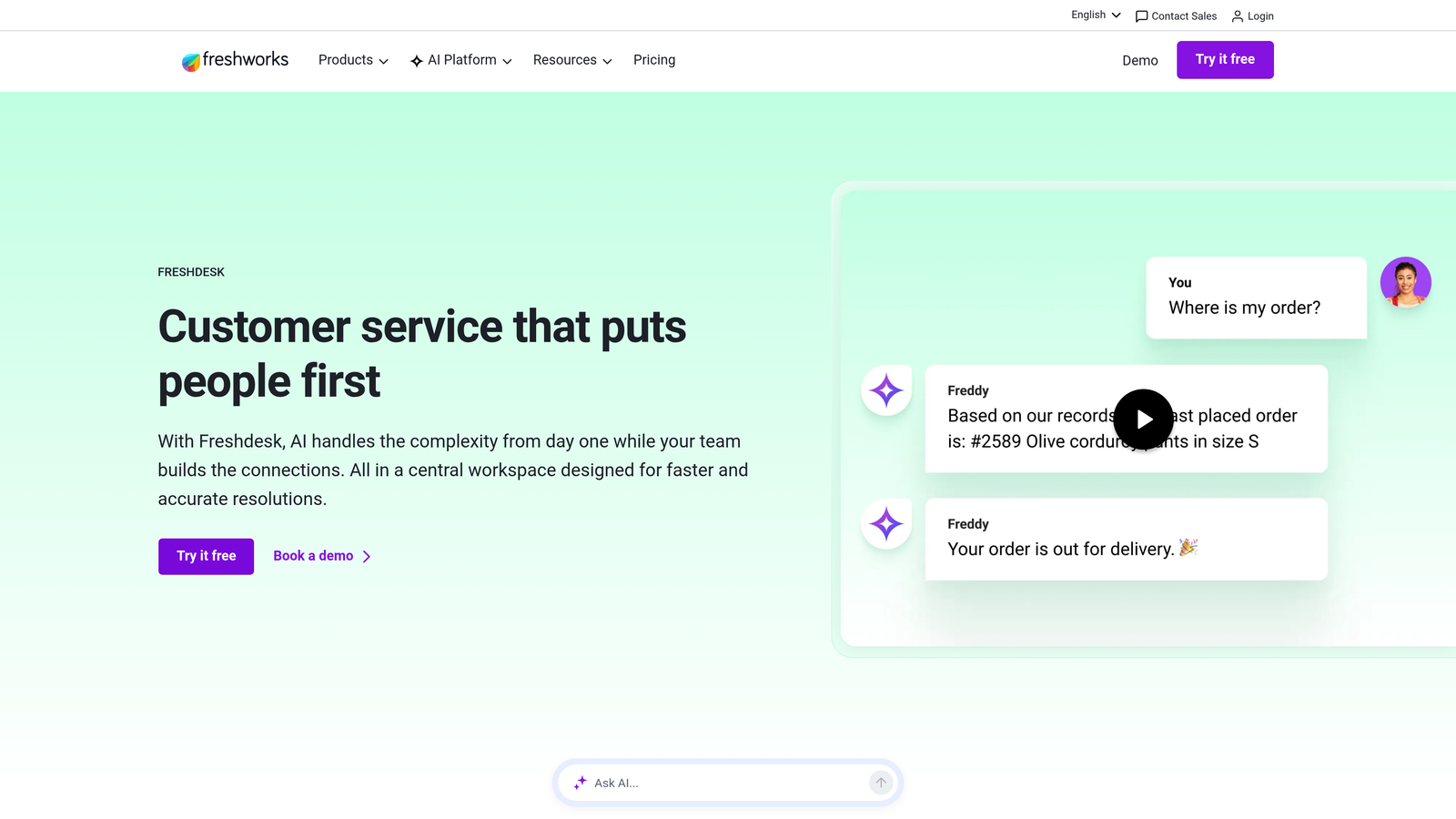
Freshdesk is a widely adopted helpdesk platform known for its accessible pricing, generous free tier, and Freddy AI capabilities that scale with plan level.
Where This Tool Shines
Freshdesk's value proposition is clear: you can start free and grow into AI-powered automation without switching platforms. The free plan is genuinely usable for small teams, not a stripped-down teaser, and the upgrade path is predictable. For teams that don't need AI-native architecture but want automation rules, omnichannel support, and a reasonable price point, Freshdesk delivers solid fundamentals.
The trade-off is that Freddy AI's more capable features, including auto-triage and intelligent self-service, are gated to Pro and Enterprise tiers. Teams on the Growth plan will find AI capabilities limited compared to what's marketed on the homepage.
Key Features
Free plan: Available for up to 2 agents, making it genuinely accessible for very small teams or early-stage startups.
Freddy AI: Auto-triage, suggested responses, and self-service capabilities on higher-tier plans.
Omnichannel support: Email, chat, phone, and social channels managed from a single inbox.
Automation rules: Ticket assignment, escalation workflows, and condition-based routing without custom code.
Marketplace integrations: Connects with popular SaaS tools including CRM, billing, and project management platforms.
Best For
Small to mid-sized businesses that want a reliable, cost-effective helpdesk with a clear upgrade path. Particularly good for teams that are early in their support maturity and not yet ready to invest in AI-native infrastructure.
Pricing
Free plan available. Growth approximately $15/agent/month, Pro approximately $49/agent/month, Enterprise approximately $79/agent/month, all billed annually. Verify current pricing at freshdesk.com/pricing.
4. Intercom
Best for: Product-led growth companies that want to blend proactive messaging with AI-powered ticket resolution
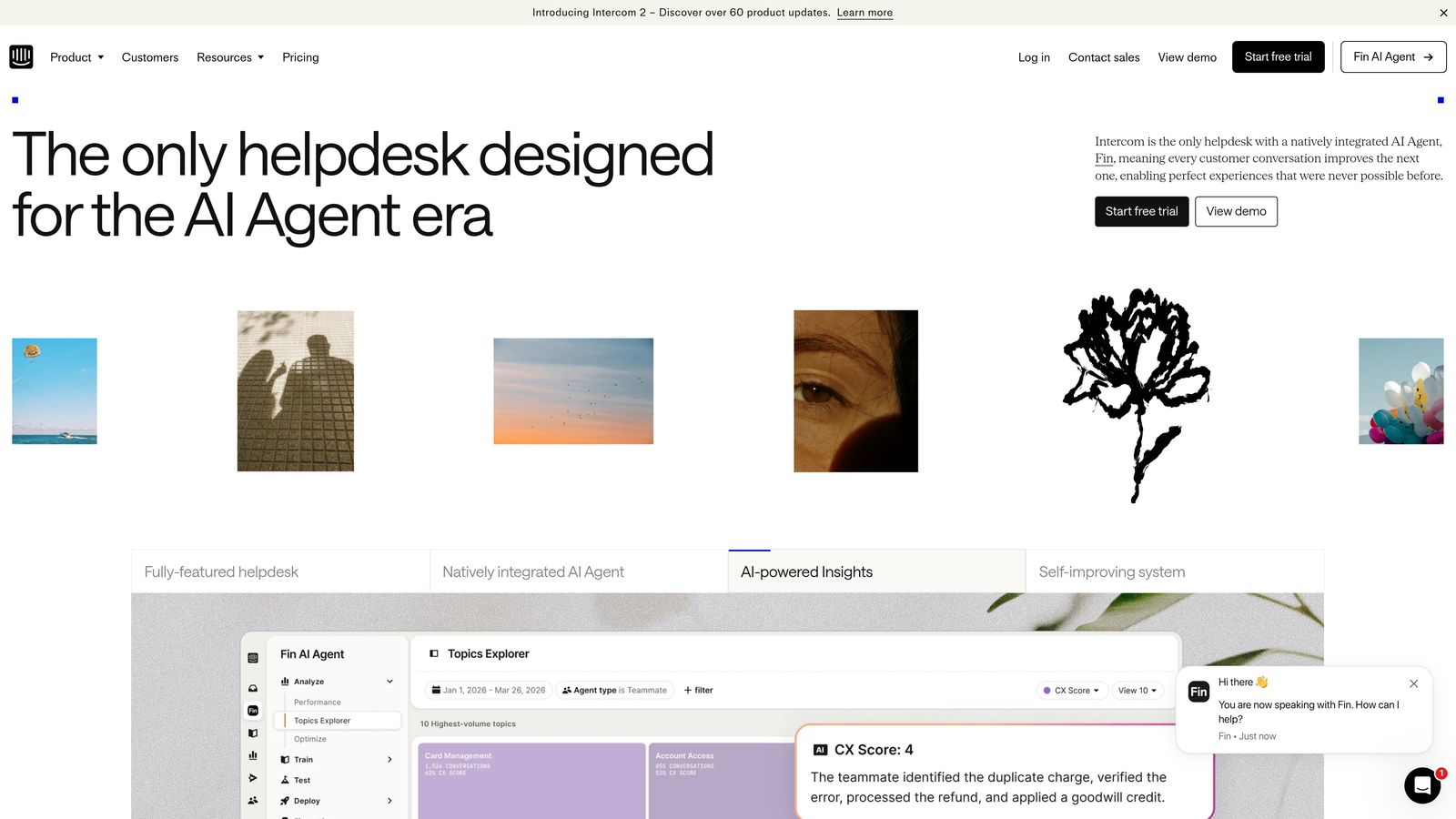
Intercom is a customer communications platform that combines support ticketing with proactive messaging, featuring Fin, its AI agent built for autonomous ticket resolution.
Where This Tool Shines
Intercom's Fin AI Agent is one of the more mature AI resolution products in the market, handling tickets autonomously using your knowledge base and support content. The resolution-based pricing model for Fin is worth understanding: you pay per resolved conversation rather than per agent seat for that component, which aligns cost with actual value delivered.
The platform's strength is in combining support with proactive outbound messaging and product tours. For teams that want to reduce inbound tickets through in-app guidance while also resolving the tickets that do come in, Intercom covers both sides of that equation.
Key Features
Fin AI Agent: Handles tickets autonomously using your knowledge base, with resolution-based pricing for the AI component.
Unified inbox: Combines chat, email, and in-app messaging in a single workspace.
Proactive messaging: Product tours and outbound messages to reduce support volume before tickets are created.
CRM and analytics integrations: Connects with product analytics and CRM tools for fuller customer context.
Customizable workflows: Routing and automation rules for handling ticket escalation and assignment.
Best For
SaaS companies with a product-led growth motion that want both proactive user engagement and AI-powered support resolution. Pricing transparency is lower than some alternatives, so budget for a demo before committing.
Pricing
Platform seat pricing plus Fin AI resolution fees charged per resolved conversation. Full pricing typically requires a demo or quote. Verify current pricing at intercom.com/pricing.
5. HubSpot Service Hub
Best for: Teams already using HubSpot CRM that want support ticketing with full customer context built in
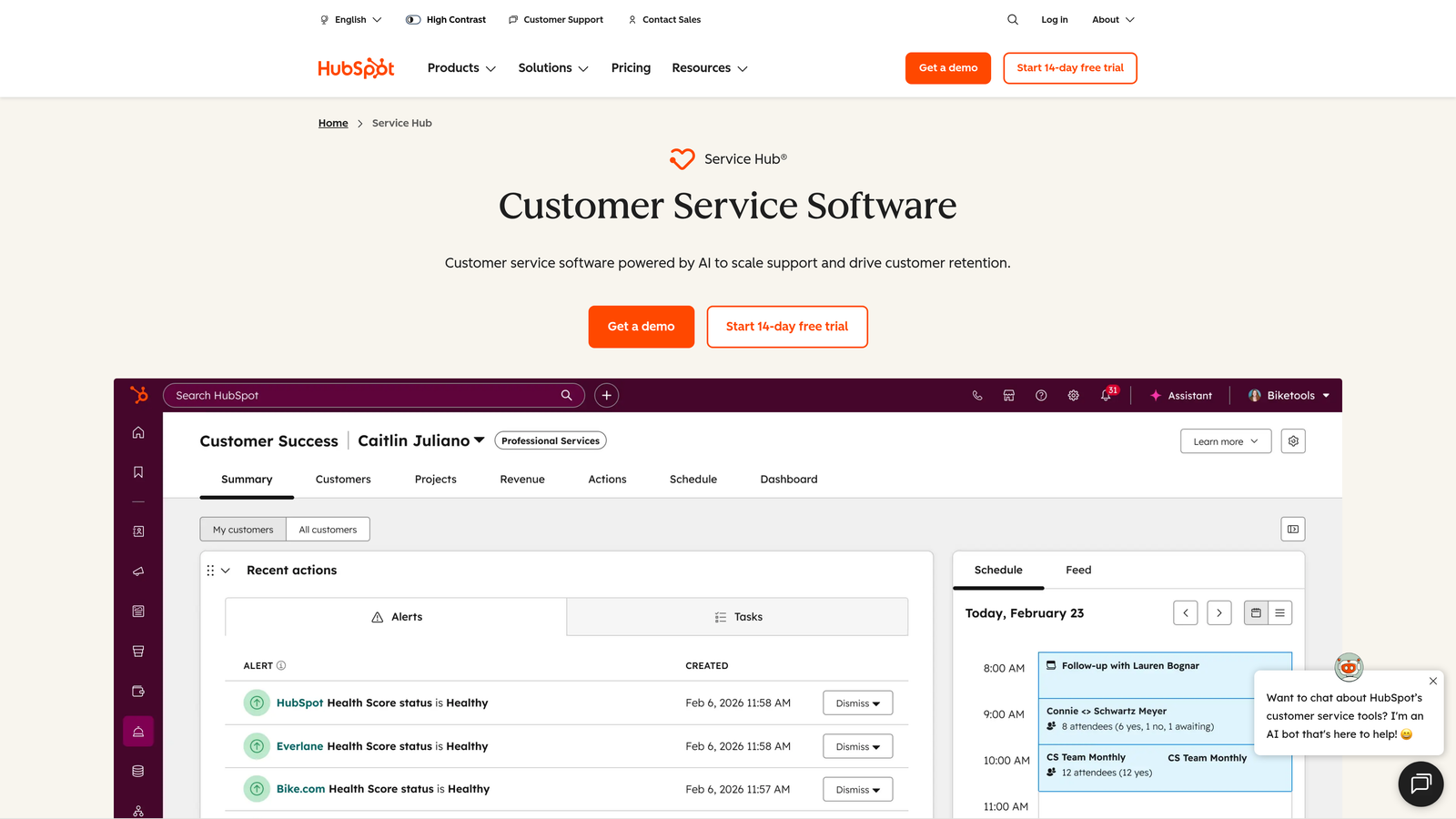
HubSpot Service Hub is HubSpot's customer service product built natively on its CRM, making it ideal for teams that want complete customer context in every support interaction without managing separate integrations.
Where This Tool Shines
The core advantage here is CRM-native context. When a support ticket comes in, agents see the contact's full history: deals, marketing interactions, previous tickets, and lifecycle stage. For teams where support and sales are closely aligned, this eliminates the constant tab-switching between helpdesk and CRM that slows response quality.
The AI-powered chatbot and knowledge base features on Professional and Enterprise plans add genuine automation capability, and built-in NPS, CSAT, and CES surveys make it easier to close the feedback loop without a separate tool.
Key Features
CRM-native ticketing: Every ticket surfaces full contact and deal history without requiring an integration to maintain.
AI chatbot and knowledge base: Available on Professional and Enterprise plans for self-service deflection.
Customer feedback surveys: NPS, CSAT, and CES built into the platform without third-party tools.
SLA management: Escalation workflows and SLA tracking on Professional and above.
Shared inbox: Team collaboration on tickets with internal notes and assignment workflows.
Best For
Companies already invested in the HubSpot ecosystem. The value compounds significantly when sales, marketing, and support all run on HubSpot. Less compelling as a standalone purchase if you're not using HubSpot CRM.
Pricing
Free tier available with basic ticketing. Starter approximately $15/seat/month, Professional approximately $90/seat/month, Enterprise approximately $130/seat/month, billed annually. Verify current pricing at hubspot.com/pricing/service.
6. Zoho Desk
Best for: Cost-conscious teams in the Zoho ecosystem that want AI features without enterprise-level pricing
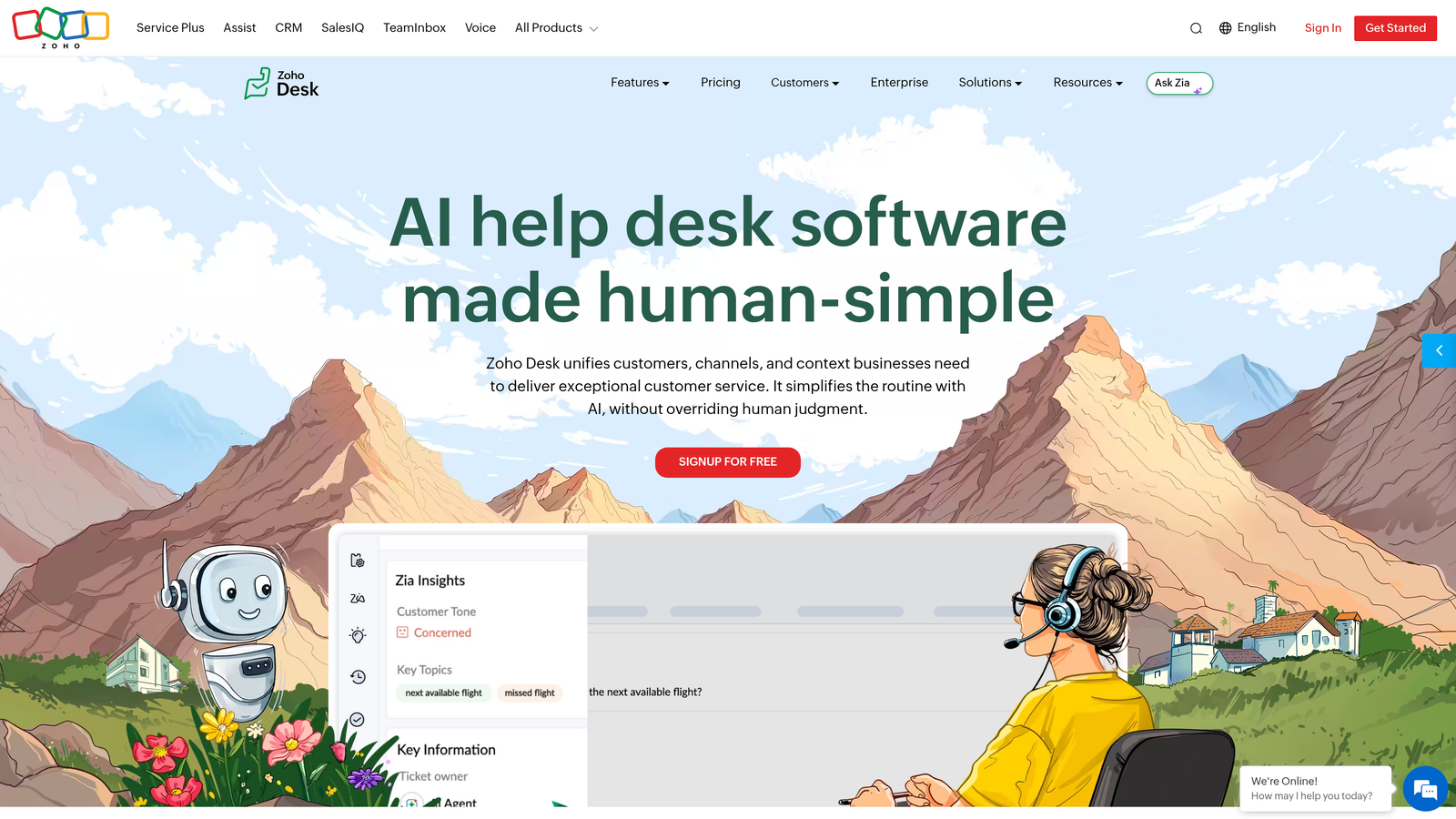
Zoho Desk is a cost-competitive helpdesk platform with Zia, its AI assistant, available on enterprise-tier plans, offering strong value for teams already using Zoho products.
Where This Tool Shines
Zoho Desk's pricing structure is one of the most accessible in this comparison. The free plan supports up to 3 agents, and the paid tiers are priced well below most competitors at equivalent feature levels. For teams in the Zoho ecosystem, the deep integration with Zoho CRM and Zoho Analytics creates a cohesive operational picture without additional integration costs.
Zia AI, available on the Enterprise plan, handles sentiment analysis, ticket tagging, and anomaly alerts. It's not as autonomous as some AI-native platforms, but for teams that primarily need intelligent triage and workflow automation, it covers the essentials.
Key Features
Free plan: Available for up to 3 agents, one of the more generous free tiers in this category.
Zia AI: Sentiment analysis, automatic ticket tagging, and anomaly alerts on the Enterprise tier.
Blueprint workflow automation: Visual workflow builder for consistent, repeatable ticket handling processes.
Multi-channel support: Email, chat, social, and phone managed from a unified interface.
Zoho ecosystem integration: Deep native connections with Zoho CRM, Zoho Analytics, and other Zoho products.
Best For
Small to mid-sized businesses already using Zoho products, or teams that need a capable helpdesk at a lower price point than Zendesk or Freshdesk's higher tiers. Less suited for teams that need AI-native resolution rather than AI-assisted triage.
Pricing
Free plan available. Standard approximately $14/agent/month, Professional approximately $23/agent/month, Enterprise approximately $40/agent/month, billed annually. Verify current pricing at zoho.com/desk/pricing.
7. Help Scout
Best for: Teams that want a clean, human-centered support experience with predictable per-user pricing and no complexity
Help Scout is a straightforward, human-centered support platform built around a shared inbox model, with email-style conversations, transparent pricing, and AI features that assist agents without overwhelming them.
Where This Tool Shines
Help Scout's appeal is simplicity and clarity. There are no ticket IDs, no complex routing configurations to untangle, and no surprise fees for light agents or view-only seats. The shared inbox feels like email, which means onboarding new support team members takes hours rather than days.
The Beacon live chat widget surfaces relevant knowledge base articles before a user even submits a ticket, reducing inbound volume passively. AI Summarize and AI Assist help agents respond faster without requiring a full AI platform overhaul.
Key Features
Email-style shared inbox: Low learning curve for support teams, with conversation threads that feel natural rather than transactional.
Beacon widget: Live chat with proactive knowledge base surfacing to deflect tickets before they're submitted.
AI Summarize and AI Assist: Agent-assist AI for faster, more consistent responses without autonomous resolution.
Customer profiles: Conversation history, notes, and contact data in every interaction.
Transparent per-user pricing: No light-agent tiers or hidden seat categories that inflate your bill.
Best For
Small to mid-sized teams that prioritize simplicity, clean UX, and predictable costs over advanced AI automation. Particularly well-suited for content, media, or service businesses where support interactions are nuanced and human judgment matters most.
Pricing
Standard plan approximately $22/user/month, Plus approximately $44/user/month, billed annually. Verify current pricing at helpscout.com/pricing.
8. Tidio
Best for: Small businesses and e-commerce stores that want AI chatbot capabilities at an accessible entry price
Tidio is a live chat and AI chatbot platform that combines ticketing, Lyro AI agent capabilities, and automation at a price point designed for smaller teams and online stores.
Where This Tool Shines
Tidio occupies an interesting position: it offers genuine AI resolution capability through Lyro at a price point that larger platforms can't match for small teams. Lyro handles conversations autonomously using your support content, and the visual chatbot builder makes it accessible to non-technical users who need to deploy automation without developer help.
The free plan is a real entry point, not just a trial, and the resolution-based pricing for Lyro means you can start small and scale AI usage as volume grows without committing to a large monthly seat cost upfront.
Key Features
Lyro AI agent: Autonomous conversation handling available on accessible pricing tiers, not gated to enterprise plans.
Visual chatbot builder: Pre-built templates and a drag-and-drop interface for non-technical automation setup.
Unified inbox: Live chat, email, and Messenger combined in one workspace.
E-commerce integrations: Native connections with Shopify, WooCommerce, and BigCommerce for order-aware support.
Free plan: Available with limited conversations, providing a genuine no-cost starting point.
Best For
Small businesses, e-commerce stores, and early-stage startups that want AI chatbot capabilities without enterprise pricing. Less suited for B2B SaaS teams that need deep product integrations or business intelligence from support interactions.
Pricing
Free plan available. Lyro AI resolutions are priced per resolution or bundled into paid plans. Tidio+ available for larger teams. Verify current pricing at tidio.com/pricing.
9. Gorgias
Best for: E-commerce brands with high ticket volume that want pricing tied to tickets, not agent headcount
Gorgias is a helpdesk built specifically for e-commerce brands, with deep Shopify integration and a ticket-based pricing model that can be more cost-effective than per-agent seat pricing for high-volume stores.
Where This Tool Shines
The pricing model itself is the differentiator. Most helpdesks charge per agent seat, which means as your support team grows, costs scale linearly. Gorgias charges by ticket volume, which can work in your favor if you're automating a large percentage of tickets and keeping your human team lean.
The Shopify integration is genuinely deep: order data, shipping status, and return history appear directly in the ticket without agents needing to switch tabs. For stores where the majority of tickets are order-related, this context accelerates resolution times significantly.
Key Features
Ticket-based pricing: Pay by ticket volume rather than agent seat count, a meaningful structural difference for high-volume, lean teams.
Deep e-commerce integration: Shopify, WooCommerce, and Magento order data surfaced in every ticket automatically.
Automated order responses: Rules to automatically handle common queries like order status and return requests.
Revenue statistics: Reporting on support's direct impact on sales conversions and revenue.
Macros and rules: Fast, templated responses with conditional logic for consistent handling at scale.
Best For
D2C and e-commerce brands on Shopify or WooCommerce with high ticket volumes and a focus on order-related support. Not a strong fit for SaaS or B2B teams, where the e-commerce-specific features won't translate to value.
Pricing
Starter plan from approximately $10/month for a limited ticket volume, scaling by ticket count. Verify current pricing at gorgias.com/pricing.
Which Tool Fits Your Team
The right automated ticket system isn't the one with the most features. It's the one whose pricing model aligns with how your team actually operates and how your support volume is likely to grow.
Here's a quick breakdown by use case:
AI-native SaaS teams: Halo AI is the strongest fit for B2B and SaaS companies that want AI agents resolving tickets autonomously, not just assisting human agents. The page-aware context, business intelligence layer, and outcome-oriented pricing model set it apart from legacy platforms with AI bolted on.
Enterprise and mid-market: Zendesk remains the default choice for complex, multi-channel operations with compliance requirements and a need for deep customization across a large support org.
Budget-conscious SMBs: Freshdesk and Zoho Desk both offer genuinely capable free plans and affordable upgrade paths. Zoho Desk is particularly compelling for teams already in the Zoho ecosystem.
E-commerce brands: Gorgias is purpose-built for this use case. The ticket-based pricing and Shopify integration create a compelling combination for high-volume D2C stores.
CRM-aligned teams: HubSpot Service Hub is the natural choice if your sales and support teams already run on HubSpot. The CRM-native context is difficult to replicate through integrations alone.
Simplicity-first teams: Help Scout delivers clean, predictable, human-centered support without the complexity tax of enterprise platforms.
Your support team shouldn't scale linearly with your customer base. Let AI agents handle routine tickets, guide users through your product, and surface business intelligence while your team focuses on complex issues that need a human touch. See Halo in action and discover how continuous learning transforms every interaction into smarter, faster support.