9 Best Tools for Automated Ticket Resolution in 2026
This guide breaks down automated vs manual ticket resolution for B2B SaaS teams, then evaluates the 9 best tools of 2026 — from fully autonomous AI agents to hybrid helpdesks — on resolution capability, integration depth, and long-term learning so teams can build a smarter, more scalable support stack.
 Matt PattoliFounder13 min read
Manual ticket resolution made sense when support volumes were manageable. Today, B2B SaaS teams face hundreds, sometimes thousands, of tickets weekly, and human-only workflows simply don't scale. The question isn't whether to automate, but which tools actually deliver autonomous resolution versus just routing tickets faster.
This list focuses on platforms that meaningfully reduce manual workload: AI agents that resolve tickets end-to-end, helpdesks with strong automation layers, and hybrid tools that blend human judgment with machine speed. Each tool is evaluated on resolution capability, integration depth, learning over time, and fit for B2B SaaS teams.
Whether you're running a lean support team at a Series A startup or managing a complex multi-product operation, here are the top tools to help you build a smarter support stack.
1. Halo AI
Best for: B2B SaaS teams wanting fully autonomous ticket resolution with business intelligence
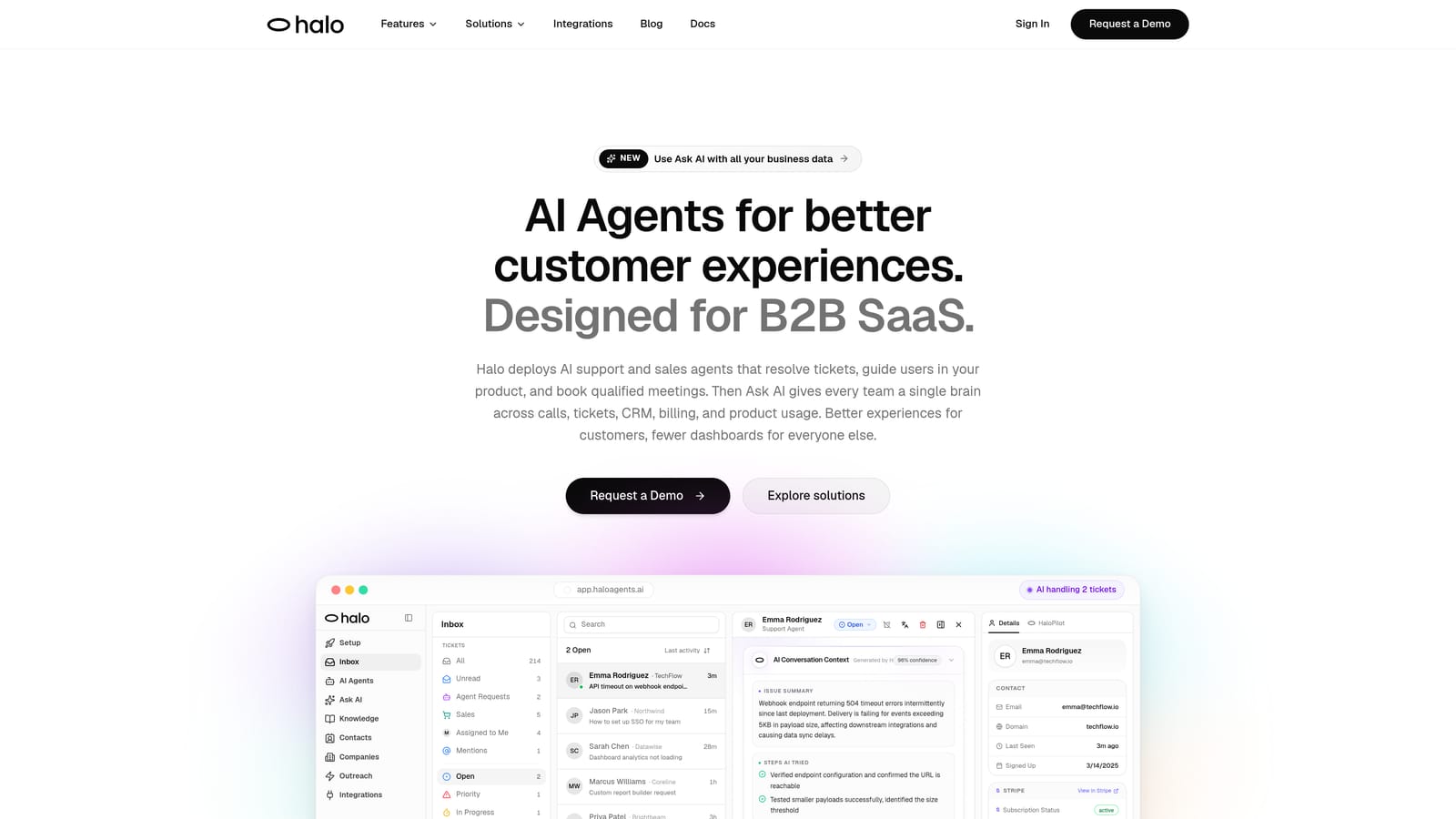
Halo AI is an AI-native customer support platform that deploys autonomous agents to resolve tickets, guide users through your product with page-aware context, and surface business intelligence while learning from every interaction.
Where This Tool Shines
Halo is built from the ground up as an AI-first platform, not a bolt-on automation layer added to a traditional helpdesk. That architectural difference matters: the AI agents don't just suggest responses for humans to approve, they resolve tickets end-to-end without requiring human intervention on routine issues.
What sets Halo apart further is the page-aware context layer. The AI sees what the user sees on-screen, enabling genuinely contextual guidance rather than generic help center lookups. Combine that with a continuous learning loop where every resolved ticket improves future accuracy, and you get a system that gets meaningfully better as your support volume grows.
Key Features
Autonomous AI Agents: Resolve tickets end-to-end without human intervention, handling routine queries at scale.
Page-Aware Chat Widget: The AI understands what page the user is on and what they're seeing, enabling visual, contextual guidance.
Smart Inbox with Business Intelligence: Surfaces customer health signals, revenue anomalies, and trend detection beyond standard ticket metrics.
Auto Bug Ticket Creation: Automatically routes product issues to engineering via Linear integration, closing the loop between support and product teams.
Live Agent Handoff: Escalates complex or high-stakes issues to human agents seamlessly when AI resolution isn't appropriate.
Deep Integrations: Connects to Linear, Slack, HubSpot, Intercom, Stripe, Zoom, PandaDoc, and Fathom, embedding support into your entire business stack.
Best For
SaaS companies at growth stage or beyond that want to significantly reduce manual ticket handling without sacrificing quality. Particularly strong for product-led teams where support, engineering, and customer success workflows intersect and need to stay in sync.
Pricing
Contact for pricing. Halo uses a demo-first sales motion, which lets teams see the platform against their actual use case before committing.
2. Zendesk
Best for: Enterprise teams needing a mature helpdesk with layered AI automation
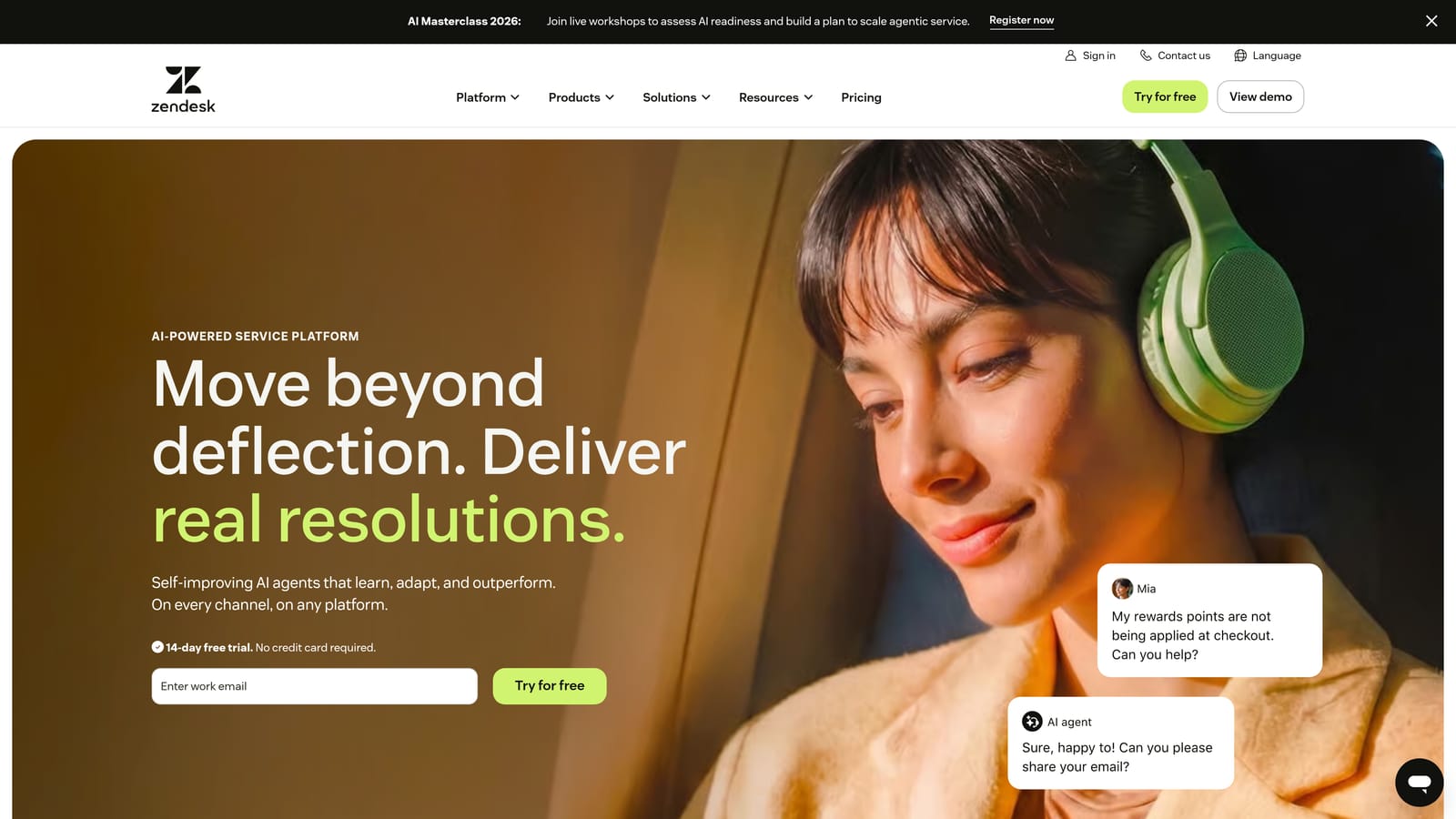
Zendesk is the industry-standard enterprise helpdesk with a mature automation layer and AI Copilot for agent assistance, built for complex multi-team support operations.
Where This Tool Shines
Zendesk's depth is its primary advantage. Decades of workflow development have produced a platform that handles virtually any support configuration: complex SLA structures, multi-brand setups, intricate escalation paths, and a marketplace of over 1,000 integrations. For large organizations with established processes, it's the safe, proven choice.
The AI Copilot and Intelligent Triage features add meaningful automation on top of that foundation. Agents get next-best-action suggestions, tickets get auto-categorized and routed, and rule-based macros handle predictable scenarios. It's not AI-first by architecture, but the automation layer is genuinely capable when configured well.
Key Features
AI Copilot: Provides agent suggestions and next-best-action guidance during live ticket handling.
Intelligent Triage: Automatically categorizes and routes incoming tickets based on content and intent.
Macro and Trigger System: Robust rule-based automation for predictable workflow steps and responses.
1,000+ Marketplace Integrations: Connects to virtually every business tool in the modern stack.
Advanced SLA Management: Granular SLA policies with reporting and breach alerting.
Best For
Enterprise teams with complex, multi-team support operations that need proven infrastructure, extensive integrations, and gradual AI adoption layered onto existing workflows.
Pricing
Suite Team starts at approximately $55 per agent per month. AI features are available on higher tiers; verify current pricing on their website as rates change frequently.
3. Intercom
Best for: SaaS teams wanting conversational AI tightly integrated with product engagement
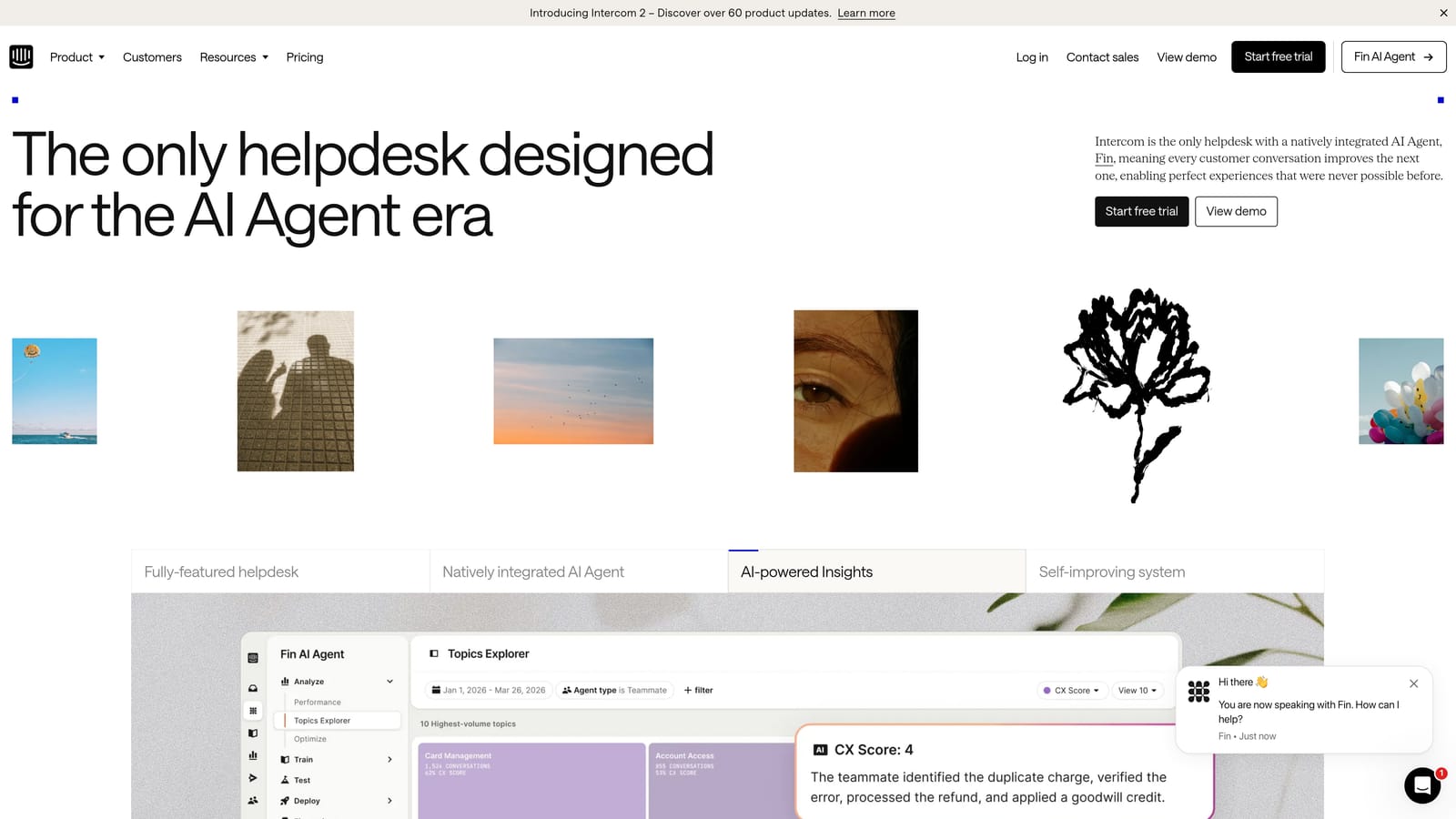
Intercom is a conversation-first support platform featuring Fin AI Agent, an autonomous resolution bot built on large language models that handles queries directly within Intercom's chat interface.
Where This Tool Shines
Fin AI Agent is one of the more capable autonomous resolution products on the market. It works directly from your existing help center content, meaning teams with well-maintained documentation can deploy meaningful automation without extensive training or configuration. The conversational UI keeps interactions feeling natural rather than robotic.
Intercom's broader platform also excels at proactive support: in-app messaging, onboarding flows, and triggered outreach that can deflect tickets before they're even created. For SaaS teams where the product and support experience need to feel unified, Intercom's tight product integration is a genuine differentiator.
Key Features
Fin AI Agent: Autonomous resolution bot that handles tickets and chat queries end-to-end using LLM-based reasoning.
In-App Messaging: Proactive support triggers that reach users in-product before issues escalate to tickets.
Help Center Integration: Fin draws from existing documentation to answer questions without manual training.
Seamless Human Handoff: Routes to live agents when Fin reaches the limits of its resolution capability.
Usage-Based Fin Pricing: Charged per resolution, which aligns cost with actual automation value delivered.
Best For
SaaS teams that want autonomous conversational AI deeply embedded in their product experience, with strong proactive support capabilities alongside reactive ticket resolution.
Pricing
Platform fee plus Fin charged per resolution. At high volumes, the per-resolution model can become significant; contact Intercom for current rates and volume pricing.
4. Freshdesk
Best for: Growing teams wanting solid automation at accessible price points
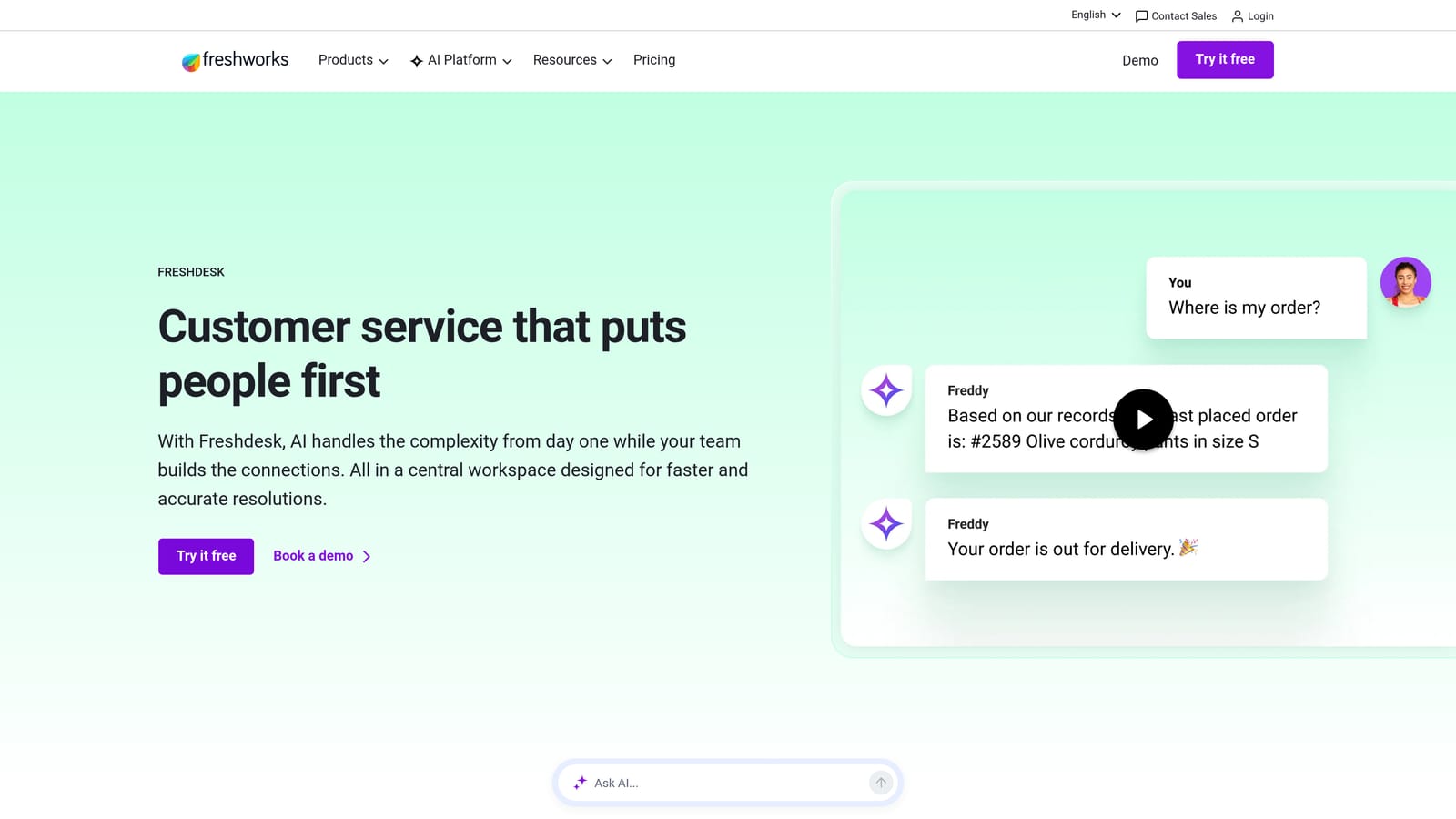
Freshdesk is a mid-market helpdesk with Freddy AI handling automated suggestions, ticket categorization, and self-service deflection at price points accessible to growing teams.
Where This Tool Shines
Freshdesk hits a practical sweet spot for teams that are outgrowing basic email support but aren't ready for enterprise-tier pricing or complexity. The Freddy AI layer covers the most common automation needs: suggesting replies, detecting sentiment, categorizing tickets, and deflecting common queries before they reach an agent.
Collision detection is a particularly useful feature for smaller teams where multiple agents might accidentally work the same ticket simultaneously. The free tier also makes Freshdesk genuinely accessible for early-stage companies testing their first automation workflows.
Key Features
Freddy AI: Handles suggested replies, sentiment detection, and automatic ticket categorization for agents.
Freddy Self Service: Bot-based deflection that answers common questions before a ticket is created.
Collision Detection: Prevents multiple agents from working the same ticket simultaneously.
SLA Policies and Escalation: Built-in SLA management with configurable escalation workflows.
Free Tier: Available for small teams with basic needs, lowering the barrier to entry.
Best For
SMB and mid-market teams that want a capable helpdesk with AI assistance at a price point that doesn't require a large budget. Less suited for teams needing fully autonomous resolution at scale.
Pricing
Free plan available. Paid plans start at approximately $15 per agent per month; verify current pricing on Freshdesk's website.
5. Tidio
Best for: Lean teams needing fast, low-configuration automation wins
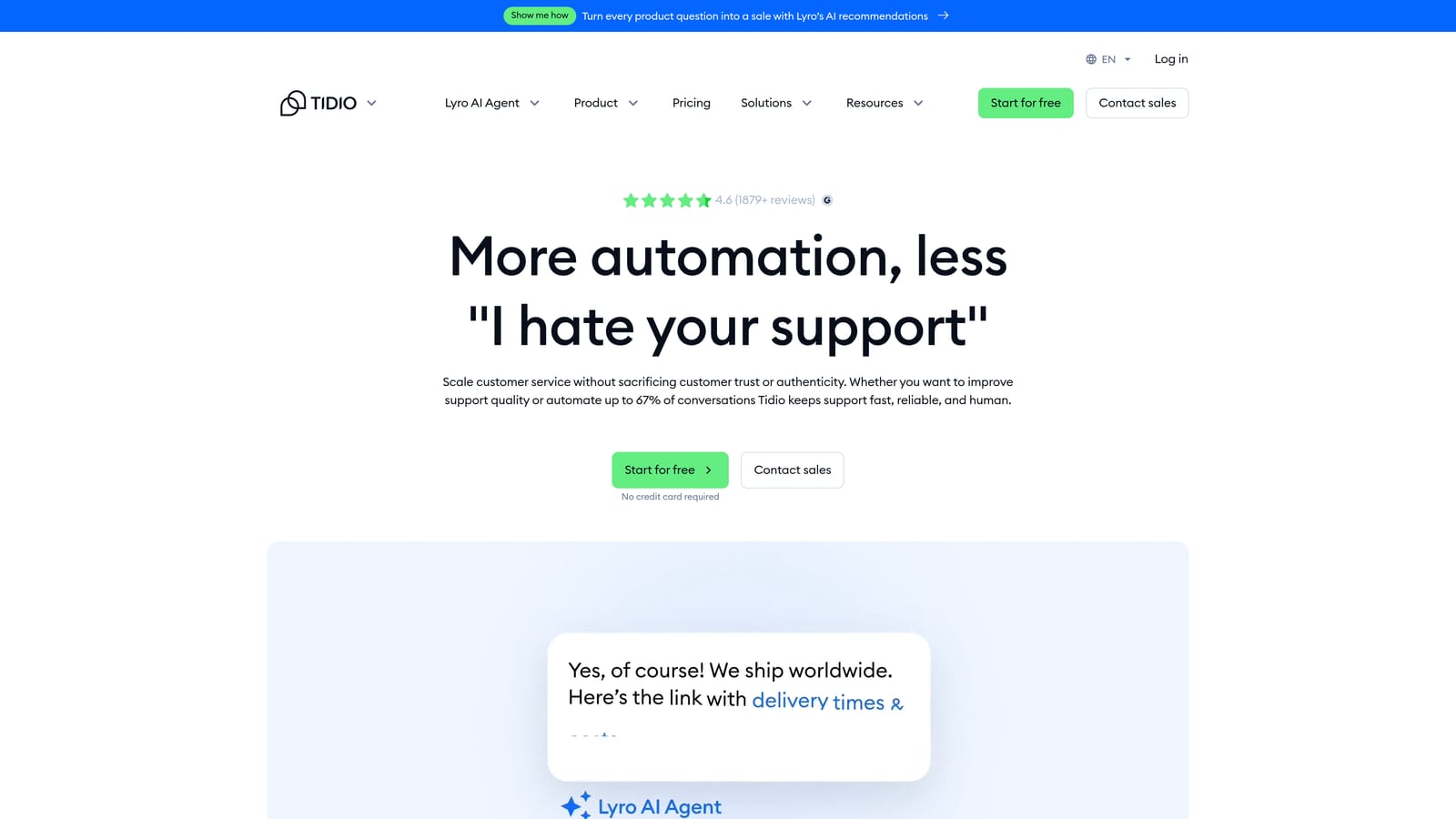
Tidio is a lightweight AI chat platform with Lyro AI agent that resolves common customer queries autonomously, designed for fast deployment with minimal configuration.
Where This Tool Shines
Tidio's primary strength is speed to value. While enterprise platforms can take weeks or months to configure, Lyro can typically be live within hours, trained on your existing support content. For teams that need automation wins quickly without dedicated implementation resources, that deployment speed is a meaningful advantage.
The multichannel inbox covering chat, email, and social also gives smaller teams a consolidated view without the complexity of enterprise omnichannel platforms. It's not the deepest tool on this list, but it delivers reliable automation for high-volume, lower-complexity query patterns.
Key Features
Lyro AI Agent: Trained on your support content for autonomous resolution of common queries.
Fast Deployment: Typically live within hours rather than weeks, with minimal configuration required.
Live Chat Fallback: Routes to human agents when Lyro reaches the limits of its knowledge.
Multichannel Inbox: Unified view across chat, email, and social channels.
Usage-Based Lyro Pricing: Charged per conversation, scaling cost with actual usage.
Best For
Lean teams with high volumes of straightforward, repeatable queries who need automation deployed quickly. Less suited for complex B2B technical support scenarios that require deep context or multi-step resolution.
Pricing
Free plan available. Lyro AI is priced per conversation; check Tidio's website for current tier details.
6. Forethought
Best for: Enterprise teams adding AI to existing helpdesks without platform migration
Forethought is an AI layer that sits on top of existing helpdesks like Zendesk and Salesforce, adding autonomous triage, agent assistance, and resolution capabilities without requiring teams to abandon their current infrastructure.
Where This Tool Shines
Forethought's key proposition is additive: you keep the helpdesk you've already invested in, and layer AI capabilities on top. For enterprise teams with years of workflow configuration, historical data, and agent training baked into a platform like Zendesk, the idea of migrating to a new system is often a non-starter. Forethought removes that barrier.
The three-product structure, Solve for autonomous resolution, Triage for routing, and Assist for real-time agent suggestions, lets teams adopt incrementally. You can start with routing automation and expand to autonomous resolution as confidence in the AI builds, which suits risk-averse enterprise procurement cycles well.
Key Features
Solve: Autonomous resolution for common ticket types without agent involvement.
Triage: AI-powered routing and prioritization that directs tickets to the right team or queue.
Assist: Real-time suggestions for agents handling live tickets, reducing time-to-resolution.
Native Helpdesk Integrations: Works directly with Zendesk, Salesforce, ServiceNow, and other major platforms.
Continuous Learning: Improves from resolved ticket history, adapting to your specific support patterns over time.
Best For
Enterprise teams with significant existing helpdesk investment who want to add AI capabilities without migration. Requires an existing helpdesk, so it adds cost on top of your current platform spend.
Pricing
Enterprise pricing; contact the Forethought sales team for a quote tailored to your volume and use case.
7. Kustomer
Best for: High-volume teams managing support across multiple channels with full customer context
Kustomer is a CRM-native support platform that combines omnichannel ticket management with KIQ AI automation, giving agents full customer context alongside intelligent workflow automation.
Where This Tool Shines
Kustomer's customer timeline is genuinely differentiated. Rather than showing agents an isolated ticket, every interaction arrives with the full history of that customer across every channel: email, chat, social, SMS, voice. For teams where context is everything, that unified view reduces back-and-forth and dramatically speeds up resolution.
The KIQ AI layer handles automated responses and routing on top of that contextual foundation. Where other platforms automate in isolation, Kustomer automates with awareness of who the customer is and what their relationship with your business looks like, which can meaningfully improve the quality of automated responses.
Key Features
Customer Timeline: Full interaction history across all channels in a single view for every ticket.
KIQ AI: Automated responses and intelligent routing informed by customer context and history.
Omnichannel Inbox: Unified management of email, chat, social, SMS, and voice channels.
Workflow Automation: Branching logic for complex escalation and routing scenarios.
Embedded CRM Data: Customer relationship data surfaces directly within each ticket context.
Best For
High-volume support teams managing complex omnichannel operations where customer context drives resolution quality. Can be more than necessary for teams operating on a single channel or with simpler support patterns.
Pricing
Enterprise pricing; contact Kustomer's sales team directly. Typically positioned above mid-market entry points.
8. Help Scout
Best for: Teams that want to stay human-led while reducing repetitive manual work
Help Scout is a human-first support platform that uses AI to assist agents, drafting replies, summarizing threads, and reducing repetitive work, without pushing toward full automation.
Where This Tool Shines
Help Scout occupies a deliberate position in this spectrum: it's not trying to replace agents, it's trying to make them significantly faster and less fatigued. The AI Drafts feature generates suggested replies that agents review and send, preserving human judgment while eliminating the blank-page problem on routine tickets. AI Summarize cuts the time agents spend reading long threads before responding.
The clean, simple UI is worth noting. Help Scout is often chosen by teams that have tried more complex platforms and found the cognitive overhead counterproductive. If your team values agent experience and a product that's easy to actually use, Help Scout delivers that without sacrificing meaningful efficiency gains.
Key Features
AI Drafts: Suggested replies that agents can review, edit, and send, reducing time spent writing from scratch.
AI Summarize: Instant thread summaries that give agents context without reading entire conversation histories.
AI Assist: Tone adjustment and reply refinement tools for polishing agent responses.
Shared Inbox with Collision Detection: Prevents duplicate work and keeps team visibility clean.
Docs Knowledge Base: Built-in documentation tool with search for self-service deflection.
Best For
Teams that prioritize agent experience and human-led support, but want AI to handle the repetitive mechanical parts of ticket work. Not the right fit for teams seeking autonomous resolution at scale.
Pricing
Starts at approximately $20 per user per month. Verify current pricing on Help Scout's website.
9. Gorgias
Best for: Companies with high volumes of data-driven, predictable ticket types
Gorgias is a support platform built around intent-based automation rules that resolve predictable, data-driven ticket types like billing questions, status inquiries, and refund requests without agent involvement.
Where This Tool Shines
Gorgias excels when your ticket volume is dominated by queries that follow clear, repeatable patterns and can be resolved by pulling data from connected systems. A billing question that can be answered by looking up a Stripe record, or a status inquiry answerable from your product database, is exactly the kind of ticket Gorgias handles well with no human touch required.
The intent detection engine classifies incoming tickets automatically, and automation rules fire based on that classification. The key distinction from ML-based tools is that Gorgias rules are configured rather than learned, which means they require setup and ongoing maintenance but also give teams precise control over what gets automated and how.
Key Features
Intent Detection: Automatically classifies incoming tickets by query type and intent.
Automation Rules: Resolve predictable ticket types autonomously based on intent classification and connected data.
Transactional Data Integrations: Deep connections to billing, order, and product data sources for data-driven responses.
Macros and Templates: Agent efficiency tools for ticket types that don't qualify for full automation.
Usage-Based Pricing: Scales with ticket volume rather than agent count.
Best For
Companies with high volumes of transactional, data-driven support queries where the answer lives in a connected system. Less adaptive than ML-based tools for novel or complex query patterns that don't fit predefined rules.
Pricing
Usage-based model priced per ticket. Costs scale with volume, so high-growth teams should model pricing carefully before committing.
Which Tool Is Right for Your Team
The automated vs. manual debate has largely been settled by scale. The real decision now is which flavor of automation fits your team's actual situation.
For B2B SaaS companies at growth stage, a purpose-built AI agent like Halo AI delivers the deepest resolution capability alongside business intelligence that goes well beyond ticket metrics. If you want your support function to surface customer health signals and revenue anomalies, not just close tickets faster, that architecture matters.
For enterprise teams with entrenched workflows and significant helpdesk investment, layering Forethought onto Zendesk may be the faster path to AI value without the disruption of migration. For teams prioritizing agent experience and human warmth with efficiency gains, Help Scout or Freshdesk will feel more comfortable and deliver meaningful time savings without requiring a philosophical shift toward automation.
Intercom's Fin is the strongest choice for SaaS teams where the support and product experience need to feel unified. Gorgias and Kustomer serve specific niches well: transactional query volumes and omnichannel complexity, respectively. Tidio earns its place for teams that need automation deployed fast with minimal resources.
Here's a useful signal to watch: if your support team spends the majority of their time on tickets that follow a predictable pattern, you're leaving significant automation value on the table regardless of which tool you choose. The right platform won't just resolve those tickets faster; it will free your team to focus on the complex, high-stakes issues where human judgment genuinely matters.
Your support team shouldn't scale linearly with your customer base. Let AI agents handle routine tickets, guide users through your product, and surface business intelligence while your team focuses on complex issues that need a human touch. See Halo in action and discover how continuous learning transforms every interaction into smarter, faster support.