9 Best Autonomous Customer Support Software Tools in 2026
This guide evaluates the 9 best autonomous customer support software platforms available in 2026, comparing AI resolution quality, integration depth, and fit for different team sizes. B2B SaaS teams will find clear recommendations for replacing legacy helpdesks or augmenting existing tools like Zendesk and Intercom to resolve complex tickets end-to-end without scaling headcount.
 Grant CooperFounder13 min read
Autonomous customer support software has moved well beyond simple FAQ bots. Today's platforms can resolve complex tickets end-to-end, guide users through product workflows, detect bugs, and escalate intelligently to human agents — all without manual intervention. For B2B SaaS teams managing growing support queues, this shift from reactive ticketing to proactive AI resolution is the difference between scaling headcount and scaling intelligently.
This guide covers the best autonomous customer support platforms available in 2026, evaluated on AI resolution quality, integration depth, learning capabilities, and how well each tool fits different team sizes and use cases. Whether you're replacing a legacy helpdesk, augmenting an existing Zendesk or Intercom setup, or building a support stack from scratch, there's a clear option here for your needs.
1. Halo AI
Best for: B2B SaaS teams wanting genuinely autonomous resolution plus business intelligence from every interaction.
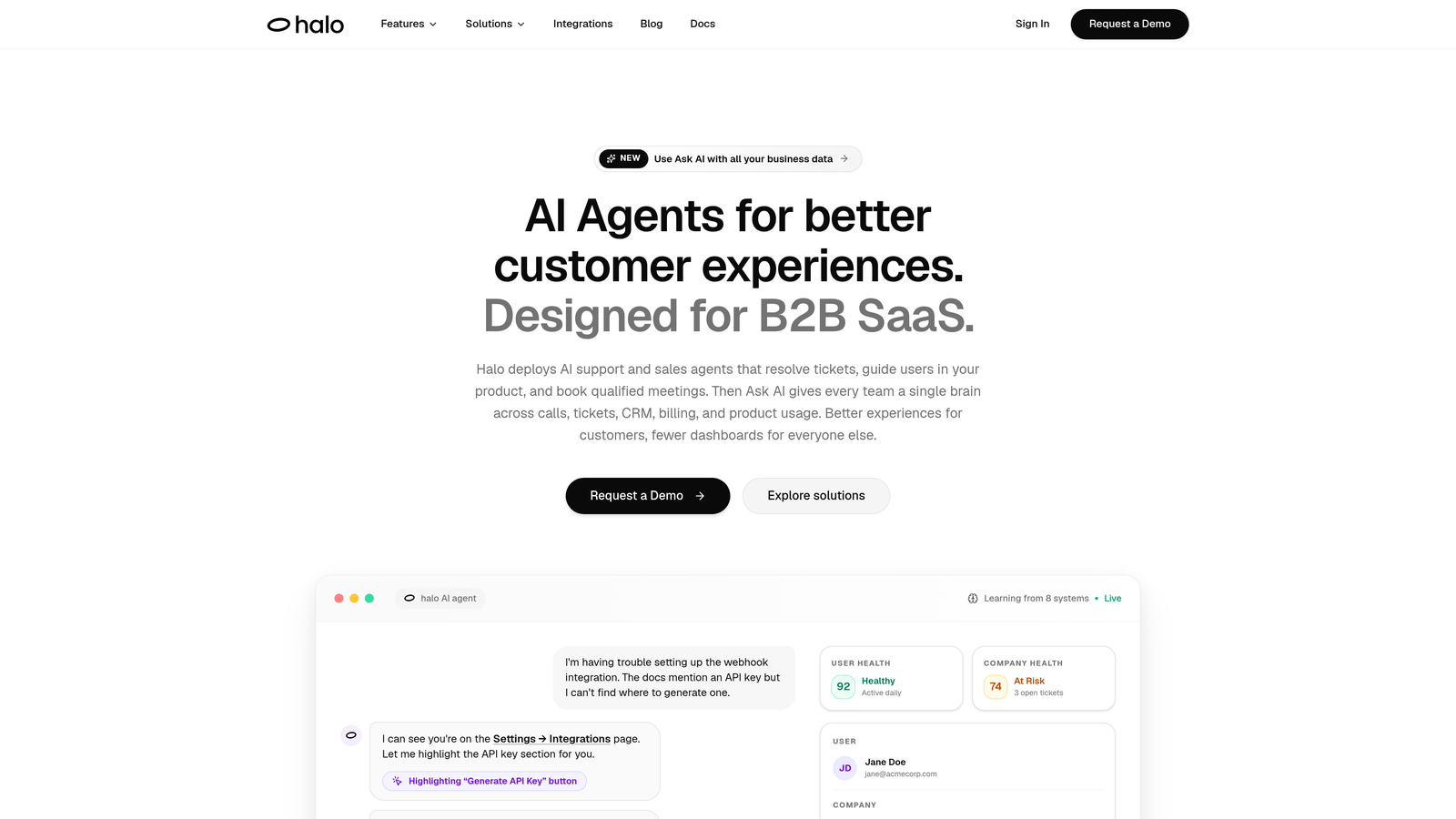
Halo AI is an AI-first autonomous customer support platform built specifically for B2B SaaS teams who need more than ticket deflection.
Where This Tool Shines
What separates Halo from most tools on this list is its architecture. Rather than bolting AI onto an existing helpdesk, Halo is built AI-first from the ground up. That means every component, from ticket resolution to bug detection to human handoff, is designed around autonomous operation rather than retrofitted into a legacy workflow.
The page-aware chat widget is a genuine differentiator. The agent understands what page and state a user is currently on inside your product, enabling contextual visual UI guidance rather than generic help center responses. Pair that with a continuous learning loop where every resolved interaction improves the model, and you have a system that gets meaningfully smarter over time.
Key Features
Page-Aware Context: The chat widget understands what the user is looking at in-product, enabling precise, contextual guidance rather than generic responses.
Continuous Learning: Every resolved ticket feeds back into the model, compounding resolution quality over time without manual retraining.
Smart Inbox with Business Intelligence: Surfaces customer health signals, revenue intelligence, and anomaly detection, turning support data into product and CS strategy insights.
Auto Bug Ticket Creation: Detects recurring issue patterns and automatically creates structured bug reports, connecting support signals directly to your engineering workflow.
Live Agent Handoff: Escalates to human agents with full context preserved, so the customer never has to repeat themselves.
Deep Integration Stack: Connects natively with Linear, Slack, HubSpot, Intercom, Stripe, Zoom, PandaDoc, and Fathom for genuine cross-system autonomy.
Best For
Product-led growth SaaS companies and B2B teams that want autonomous resolution alongside strategic business intelligence. Especially valuable for teams where support data should inform product roadmap, customer success, and revenue retention decisions, not just ticket close rates.
Pricing
Contact for pricing. See haloagents.ai for current plans and to book a demo.
2. Intercom (Fin AI)
Best for: Existing Intercom customers wanting autonomous resolution without changing their support stack.
Intercom Fin is an LLM-powered AI agent that resolves customer queries by reasoning over help content and connected data sources, fully embedded in the Intercom workspace.
Where This Tool Shines
Fin's biggest strength is how naturally it fits into Intercom's existing messenger and inbox experience. If your team already lives in Intercom, adding Fin requires no workflow disruption. The agent reasons across multiple content sources simultaneously rather than matching keywords, which handles nuanced queries more effectively than older bot approaches.
Custom actions are a standout capability. Fin can make API calls mid-conversation, look up order data, check account status, and take actions on behalf of users without handing off to a human agent. That's a meaningful step toward genuine autonomy rather than just smart deflection.
Key Features
Native Intercom Integration: Operates directly within the Intercom messenger and inbox with no separate tool management required.
Custom Actions: Supports API calls and live data lookups during resolution, enabling action-taking rather than just information-giving.
Multi-Source Reasoning: Reasons across help center articles, knowledge bases, and connected data simultaneously for more accurate responses.
Seamless Human Handoff: Escalates within the same Intercom inbox, preserving conversation context for the receiving agent.
Omnichannel Coverage: Handles queries across chat, email, and social channels from a unified workspace.
Best For
Teams already invested in the Intercom platform who want to layer autonomous resolution on top of their existing setup. Less compelling for teams not already on Intercom, since the value is deeply tied to the broader Intercom ecosystem.
Pricing
Fin is an add-on to existing Intercom plans, priced per resolution. See intercom.com for current rates.
3. Zendesk AI
Best for: Large enterprises with complex ticket taxonomies and existing Zendesk infrastructure.
Zendesk AI adds intelligent triage, auto-tagging, autonomous resolution, and Agent Copilot capabilities to Zendesk's enterprise-grade ticketing platform.
Where This Tool Shines
Zendesk AI's strength is governance and scale. For enterprise procurement teams evaluating compliance requirements, audit trails, and reporting depth, Zendesk's AI suite checks boxes that newer AI-native tools often can't match yet. The intelligent triage system is particularly strong for organizations managing large, complex ticket taxonomies where automated routing and classification directly reduces resolution time.
It's worth being precise about what "autonomous" means in the Zendesk context. The Agent Copilot feature assists human agents rather than replacing them, which is valuable but distinct from end-to-end autonomous resolution. Teams evaluating true autonomy should assess the AI agents capability specifically rather than the broader suite.
Key Features
Intelligent Triage: Automated routing and tagging based on ticket content, intent, and historical patterns.
AI Agents: Autonomous ticket resolution for common query types without human involvement.
Agent Copilot: In-context suggestions, response drafting, and ticket summarization to accelerate human agent performance on complex issues.
Advanced Reporting: Enterprise-grade analytics and compliance tooling suited to regulated industries and complex governance requirements.
Broad Integration Ecosystem: Connects with CRM, e-commerce, and ITSM platforms across a wide partner network.
Best For
Large enterprises with significant existing Zendesk investment, complex ticket routing requirements, and procurement teams that need enterprise-grade compliance and governance documentation.
Pricing
AI features are add-ons to Zendesk Suite plans. Costs can escalate at scale, so evaluate total cost carefully. See zendesk.com for current pricing tiers.
4. Freshdesk Freddy AI
Best for: SMB and mid-market teams wanting AI-powered support without enterprise-level contracts.
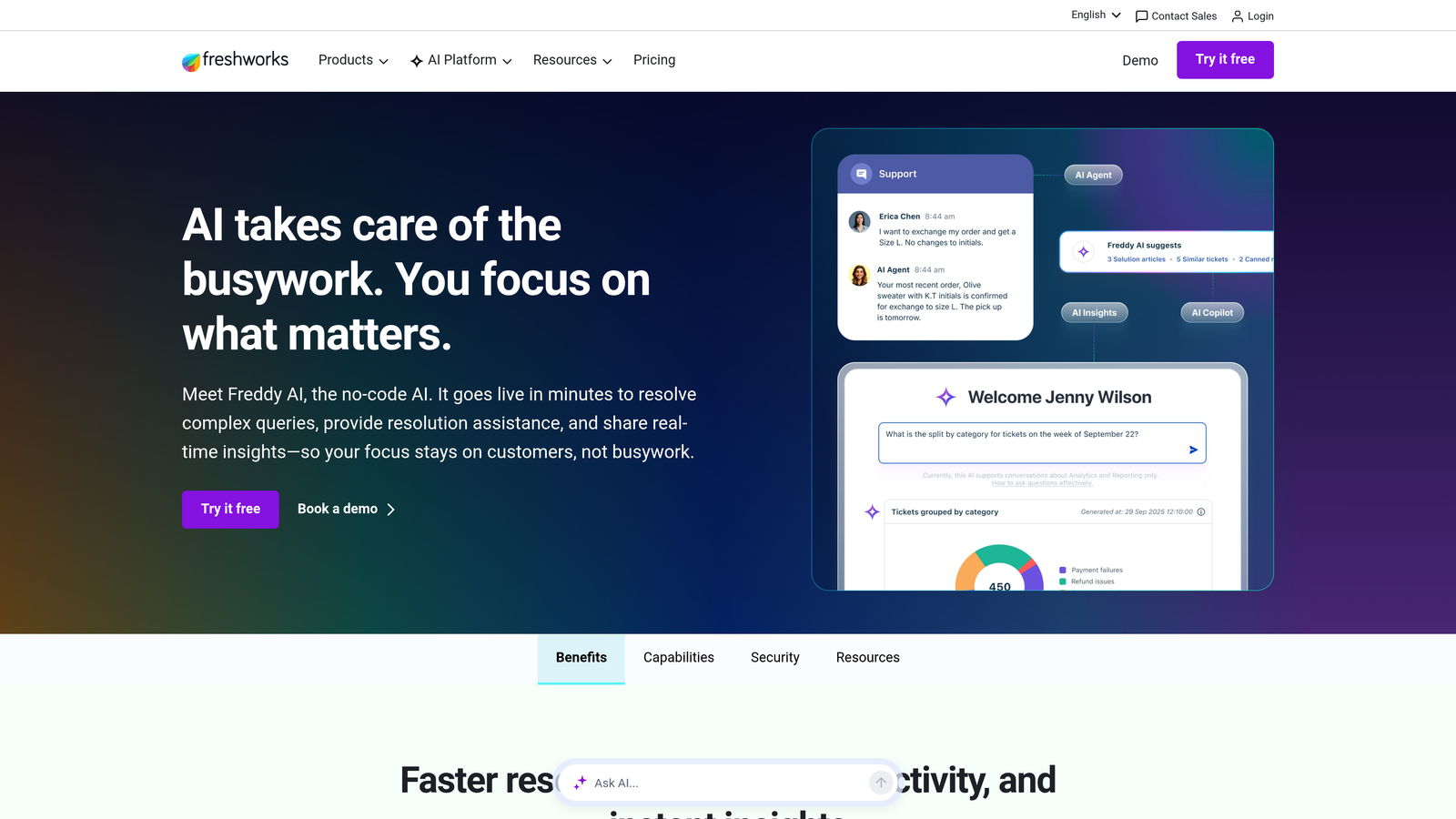
Freshdesk Freddy AI is Freshworks' AI layer spanning its customer support suite, covering autonomous self-service, agent assistance, and intelligent analytics across multiple channels.
Where This Tool Shines
Freddy AI's value proposition is accessible AI across the full support stack. Where Zendesk AI can become expensive at scale and Intercom's Fin is tightly coupled to the Intercom platform, Freddy AI offers comparable AI capabilities at pricing that works for growing teams without enterprise budgets.
The integration with Freshsales CRM is a genuine differentiator for teams that want support and sales data in the same system. When a support interaction surfaces a churn risk or an upsell opportunity, that signal flows directly into the CRM rather than staying siloed in the support tool.
Key Features
Freddy Self Service: Autonomous chat and email resolution for common queries without agent involvement.
Freddy Copilot: In-context agent assistance, response suggestions, and summarization for complex tickets requiring human handling.
Freddy Insights: AI-driven analytics surfacing support trends, team performance patterns, and knowledge base gaps.
Omnichannel Coverage: Unified handling across email, chat, phone, and social from a single platform.
Freshsales CRM Integration: Native alignment between support interactions and sales data for revenue-aware support teams.
Best For
SMB and mid-market teams that want a full AI-powered support suite without committing to enterprise pricing. Also well-suited to teams where support-to-sales alignment is a priority and a shared CRM is valuable.
Pricing
Freddy AI features are available across Freshdesk Growth, Pro, and Enterprise plans. See freshworks.com for current pricing.
5. Tidio
Best for: Small businesses and e-commerce teams wanting fast deployment and accessible pricing.
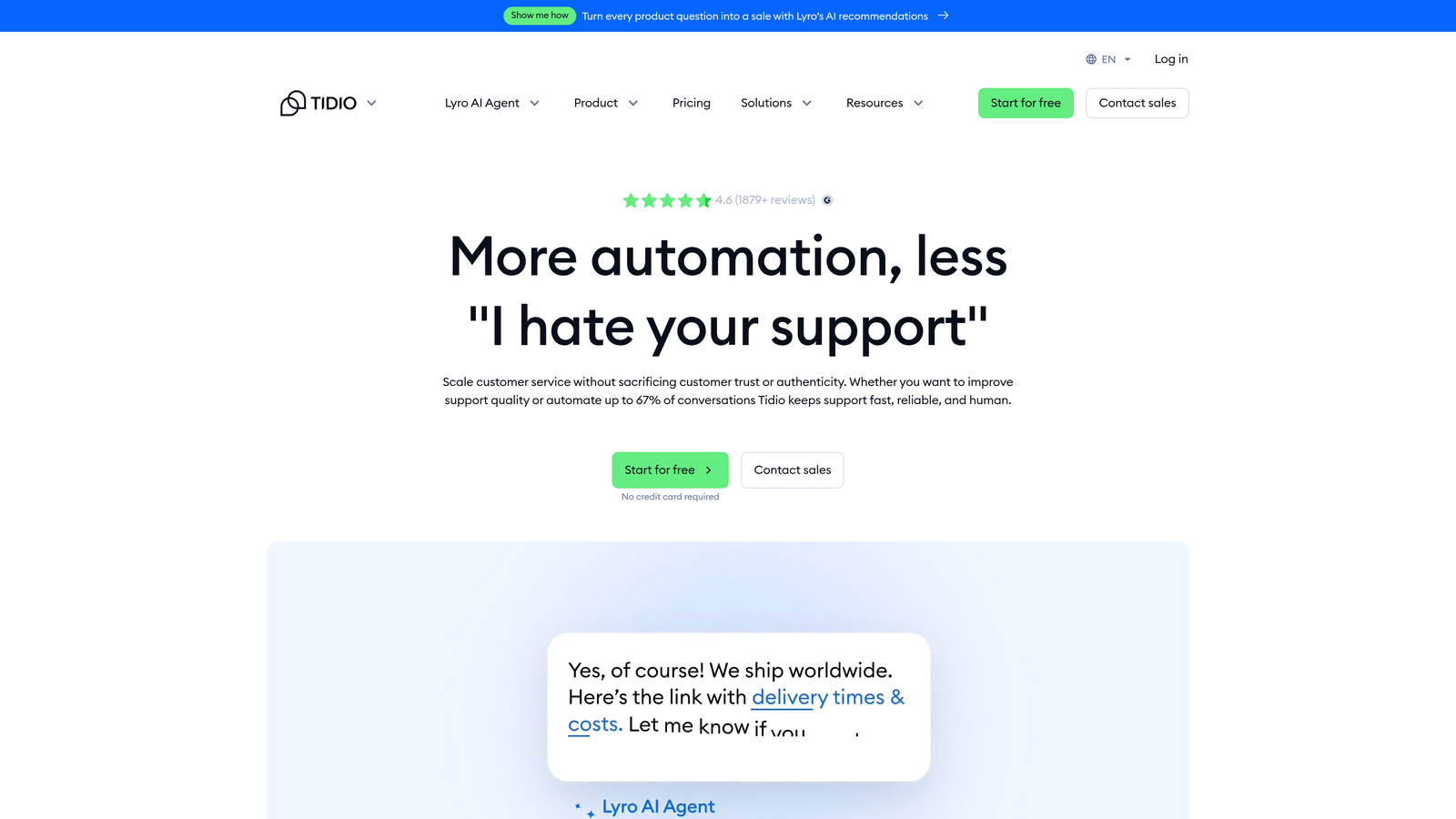
Tidio is a customer support platform built for SMBs and e-commerce teams, featuring Lyro, an AI agent designed for quick deployment and autonomous resolution of common customer queries.
Where This Tool Shines
Tidio's standout quality is speed to value. Teams can go live with Lyro quickly without heavy configuration, engineering resources, or lengthy onboarding. For small teams that need autonomous support running now rather than after a multi-month implementation, that matters considerably.
The native e-commerce integrations are a meaningful advantage for Shopify and WooCommerce merchants. Lyro can handle order status queries, return requests, and product questions using live store data, which covers a large portion of typical e-commerce support volume autonomously.
Key Features
Lyro AI Agent: Autonomous query resolution trained on your support content, handling common questions without human involvement.
Fast Deployment: Go-live without heavy engineering requirements or lengthy configuration processes.
E-Commerce Integrations: Native connections with Shopify, WooCommerce, and other major e-commerce platforms for order and product data access.
Live Chat Fallback: Smooth handoff to human agents when Lyro reaches the limits of its resolution capability.
Accessible Pricing: Free plan available with paid tiers suited to small and growing teams.
Best For
Small businesses, e-commerce merchants, and teams with straightforward support needs who want autonomous resolution running quickly without significant technical investment. Less suited to complex B2B SaaS support scenarios with multi-step technical troubleshooting requirements.
Pricing
Free plan available. Paid plans start at SMB-friendly rates. See tidio.com for current pricing tiers.
6. Ada
Best for: Global enterprises needing multilingual autonomous resolution with complex conditional logic.
Ada is an enterprise-grade no-code AI agent builder with a reasoning engine designed for complex, multi-step autonomous resolutions across global deployments.

Where This Tool Shines
Ada's Reasoning Engine is built for complexity. Where many AI support tools handle straightforward queries well but struggle with conditional, multi-step resolution flows, Ada's no-code approach lets support teams configure sophisticated logic without requiring engineering resources. That's a significant operational advantage for teams managing complex products or service tiers.
Multilingual capability is where Ada genuinely stands apart from most competitors. For global enterprises operating across multiple languages and regions, the quality and breadth of Ada's language support is a primary reason teams choose it over alternatives.
Key Features
No-Code Reasoning Engine: Build complex conditional resolution flows without engineering involvement, enabling support ops teams to own the configuration.
Multilingual Support: Strong language coverage for global deployments across telco, fintech, and retail organizations.
Helpdesk and CRM Integrations: Connects with major helpdesks and CRM platforms to access customer data during resolution.
High Configurability: Extensive customization options without requiring developer resources for ongoing changes.
Enterprise Security: Compliance and security features suited to regulated industries and enterprise procurement requirements.
Best For
Global enterprises with multilingual support requirements, complex resolution logic, and the budget for an enterprise-tier platform. Less suited to small teams or those wanting quick self-serve setup without a sales process.
Pricing
Enterprise pricing. Contact Ada directly for a quote via ada.cx.
7. Forethought
Best for: Support ops teams augmenting an existing Zendesk, Salesforce, or Freshdesk setup without a platform migration.
Forethought positions as an AI intelligence layer that sits on top of existing helpdesks, adding autonomous deflection, intelligent triage, agent assist, and analytics without requiring teams to change their core platform.
Where This Tool Shines
Forethought's value is additive rather than replacement. For support leaders who have significant investment in Zendesk, Salesforce Service Cloud, or Freshdesk and don't want to migrate, Forethought layers meaningful AI capabilities on top without disrupting existing workflows or data structures.
The Discover module is particularly useful for support ops and knowledge management teams. It surfaces gaps in the knowledge base, identifies resolution patterns, and highlights where ticket volume could be deflected with better self-service content, turning support data into actionable improvement priorities.
Key Features
Triage: Predictive routing and auto-tagging for incoming tickets based on content, intent, and historical patterns.
Solve: Autonomous deflection for common queries before they reach the human queue.
Assist: In-context suggestions, ticket summarization, and sentiment analysis to accelerate human agent performance.
Discover: Analytics surfacing knowledge base gaps, resolution patterns, and deflection opportunities.
Deep Helpdesk Integrations: Native integration with Zendesk, Salesforce Service Cloud, and Freshdesk as primary platforms.
Best For
Support operations leaders optimizing existing team performance on established helpdesk platforms. Not the right choice for teams looking to move away from their current helpdesk or wanting a standalone autonomous support platform.
Pricing
Contact Forethought for pricing. See forethought.ai for details.
8. Kustomer
Best for: High-volume consumer brands needing full customer context in every support interaction.
Kustomer is a CRM-native omnichannel support platform with AI-powered autonomous resolution, built for consumer brands managing high interaction volumes across multiple channels.
Where This Tool Shines
Kustomer's CRM-native architecture means every support interaction happens with complete customer context visible: full purchase history, previous conversations, subscription status, and behavioral data all in a unified timeline view. For consumer brands where support context directly affects resolution quality, this eliminates the constant context-switching that plagues agents using separate CRM and helpdesk tools.
The omnichannel breadth is also notable. Kustomer handles email, chat, SMS, social, and voice from a single platform, which matters for consumer brands whose customers contact them across whichever channel is most convenient in the moment.
Key Features
Customer Timeline View: Aggregates all interactions, purchases, and data points into a unified view for every customer record.
AI-Powered Autonomous Resolution: Handles common chat queries autonomously with suggested responses for human agents on complex issues.
Omnichannel Coverage: Unified handling across email, chat, SMS, social, and voice from a single platform.
Workflow Automation: Automates repetitive support processes and routing rules to reduce manual operations overhead.
CRM-Native Architecture: Deep customer context built into every interaction rather than pulled from a separate system.
Best For
High-volume consumer brands, DTC companies, and subscription businesses where full customer context and omnichannel coverage are primary requirements. Less optimized for B2B SaaS support scenarios with complex technical troubleshooting needs.
Pricing
Per-agent pricing model. See kustomer.com for current plan details.
9. Drift (Salesloft)
Best for: B2B revenue teams where support and sales conversations are difficult to separate.
Drift, now part of Salesloft, is a conversational AI platform with roots in sales that has expanded into support, handling inbound queries, qualifying leads, and routing conversations based on intent.
Where This Tool Shines
Drift occupies a unique position on this list: it's genuinely useful at the intersection of support and sales rather than being a pure support tool. For B2B companies where inbound conversations are often ambiguous between a support request and a sales opportunity, Drift's intent-based routing ensures conversations reach the right team without manual triage.
The Salesloft integration gives revenue teams a unified view of how conversations move from initial query through to opportunity, which is valuable for companies measuring the revenue impact of support interactions alongside traditional support metrics.
Key Features
Intent-Based Routing: Classifies inbound conversations as support or sales intent and routes accordingly without manual intervention.
AI Query Handling: Resolves common inbound queries autonomously before escalating to human agents or sales reps.
Lead Qualification: Qualifies inbound leads during support conversations, capturing revenue opportunities that would otherwise be missed.
Salesloft Integration: Unified revenue team view connecting support conversations to pipeline and opportunity data.
Playbook Automation: Configurable conversation flows for different visitor segments, intents, and routing scenarios.
Best For
B2B companies where the line between support and sales is blurry, and revenue teams that want a single platform for inbound conversation management. Teams looking for deep, dedicated support resolution capabilities will find more depth in the purpose-built support tools on this list.
Pricing
Contact Salesloft for current Drift pricing. See drift.com for details.
Which Tool Is Right for Your Team?
The right autonomous customer support platform depends on where you are, what you're building, and what you need AI to actually do, not just assist with.
Here's a quick breakdown by use case:
AI-first B2B SaaS teams: Halo AI is the strongest fit for teams that want genuine end-to-end autonomy, page-aware context, and business intelligence layered on top of support data. It's built for the way modern SaaS support actually works.
Existing Zendesk customers: Zendesk AI is the natural extension if you're deeply invested in the platform and need enterprise governance alongside AI capabilities.
Cost-conscious growing teams: Freshdesk Freddy AI delivers solid AI coverage at accessible pricing, with the added benefit of CRM alignment through Freshsales.
Small businesses and e-commerce: Tidio's Lyro gets you autonomous resolution running quickly with native Shopify and WooCommerce integrations and SMB-friendly pricing.
Global enterprises with multilingual needs: Ada's reasoning engine and language coverage make it the enterprise choice for complex, multi-region deployments.
Teams augmenting existing helpdesks: Forethought adds AI intelligence without requiring a platform migration, ideal for Zendesk and Salesforce users who want to optimize rather than replace.
High-volume consumer brands: Kustomer's CRM-native architecture and omnichannel breadth serve DTC and subscription brands better than most pure support tools.
Revenue-support hybrid teams: Drift's intent-based routing and Salesloft integration make it the right call when sales and support conversations overlap significantly.
Your support team shouldn't scale linearly with your customer base. Let AI agents handle routine tickets, guide users through your product, and surface business intelligence while your team focuses on complex issues that need a human touch. See Halo in action and discover how continuous learning transforms every interaction into smarter, faster support.