9 Best Autonomous Support Agent Platforms in 2026
This guide ranks the 9 best autonomous support agent platforms of 2026, evaluating each across resolution autonomy, learning loop quality, integration depth, context awareness, and human handoff quality. It's built for B2B SaaS and product-led growth teams that need to scale support intelligently — without scaling headcount.
 Matt PattoliFounder13 min read
Customer support is no longer a headcount problem. It's an intelligence problem. The teams winning in 2026 aren't hiring faster — they're deploying autonomous AI agents that resolve tickets, guide users through products, and surface business signals without a human touching every conversation.
But there's a meaningful difference between a basic chatbot that deflects FAQs and a true autonomous support agent platform that learns, integrates, and improves with every interaction. If you're evaluating options for a B2B SaaS team, a product-led growth company, or a support org that needs to scale without scaling headcount, this list is for you.
We evaluated these platforms across five dimensions: resolution autonomy, learning loop quality, integration depth, context awareness, and handoff quality when a human needs to step in. If you're coming from a traditional helpdesk background, it's also worth reading our comparison of Zendesk versus modern AI support platforms before diving in. And if you want to see what an AI-first approach looks like in practice, Halo AI's customer support solution is a strong reference point.
1. Halo AI
Best for: B2B SaaS teams wanting an AI-first platform with deep product context and business intelligence.
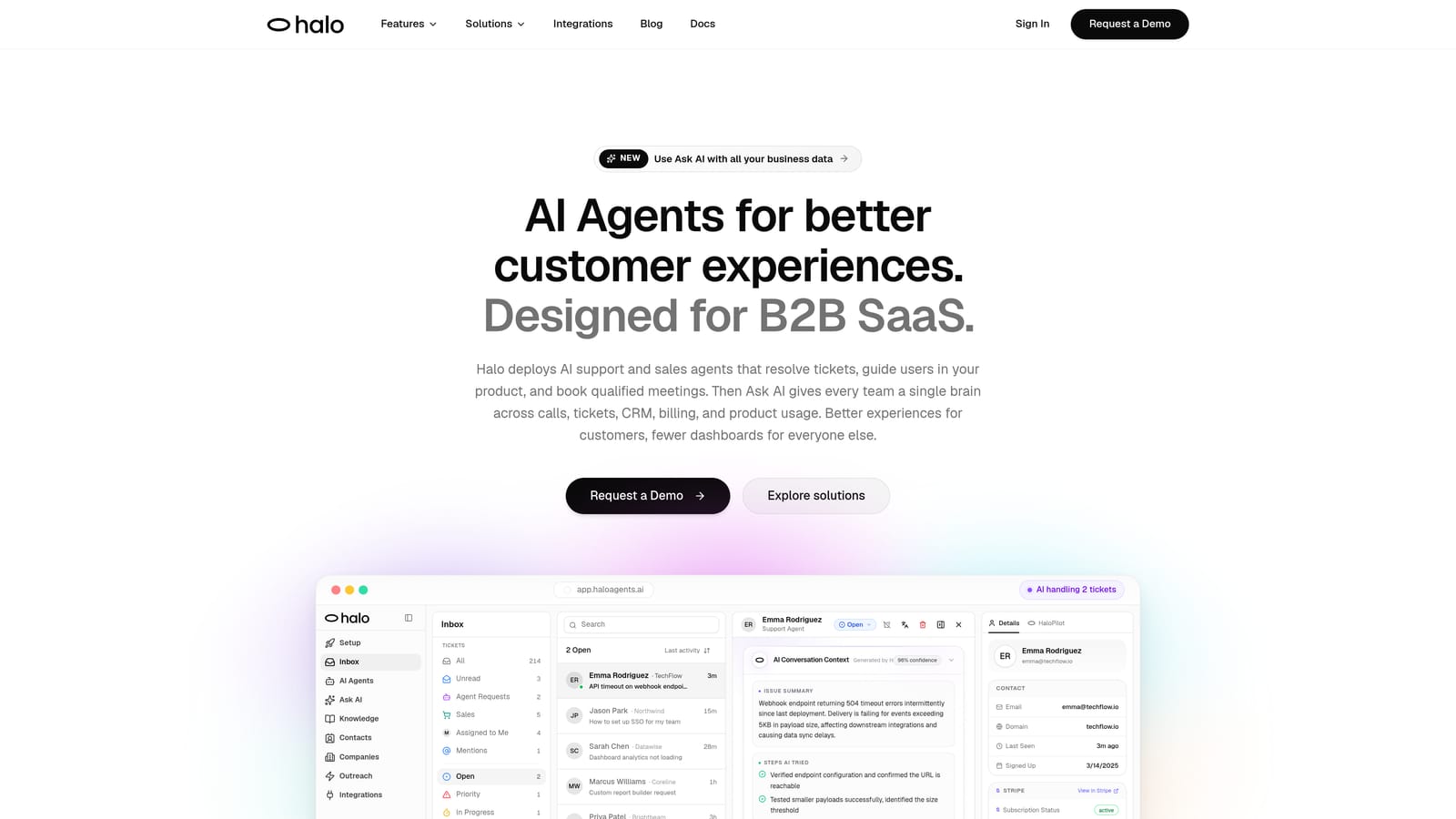
Halo AI is an autonomous support agent platform built from the ground up for B2B SaaS, not retrofitted onto a legacy ticketing system.
Where This Tool Shines
Halo's standout capability is its page-aware chat widget. Unlike most support tools that only know what a user typed, Halo sees the user's current screen state, meaning its AI agents can provide contextual guidance based on exactly where someone is in your product. That's a meaningful leap beyond keyword matching.
Beyond support resolution, Halo surfaces business intelligence that most support platforms ignore entirely. Its smart inbox flags customer health signals and revenue anomalies, turning your support queue into a source of product and commercial insight. The continuous learning loop means every resolved interaction makes the next one faster and smarter.
Key Features
Page-Aware Chat Widget: Sees the user's current screen state to deliver contextual, in-product guidance rather than generic responses.
Autonomous Ticket Resolution: AI agents resolve tickets end-to-end, with continuous learning from every interaction to improve accuracy over time.
Auto Bug Ticket Creation: Automatically generates and routes bug reports directly to Linear, removing manual triage from the engineering handoff process.
Smart Inbox with Business Intelligence: Surfaces customer health signals and revenue anomalies beyond standard support metrics, giving teams commercial visibility.
Live Agent Handoff: Escalates to human agents with full conversation context preserved, so customers never have to repeat themselves.
Integration Ecosystem: Connects natively to Linear, Slack, HubSpot, Intercom, Stripe, Zoom, PandaDoc, and Fathom, covering the full B2B SaaS stack.
Best For
B2B SaaS product teams and support leaders who want AI-first architecture rather than an add-on layer. Particularly strong for companies where product context matters, where engineering and support workflows overlap, and where business intelligence from support interactions has strategic value.
Pricing
Custom plans based on team size and usage. Contact Halo directly at haloagents.ai for a tailored quote.
2. Intercom Fin
Best for: Teams already using Intercom who want AI deflection without adding a new vendor.
Intercom Fin is Intercom's native AI agent, powered by large language models and deeply embedded in the Intercom messenger ecosystem.
Where This Tool Shines
Fin's biggest advantage is how naturally it fits into an existing Intercom setup. If your team already lives in the Intercom inbox, Fin extends that experience with AI resolution without requiring a separate platform, new workflows, or a migration project. Setup is relatively fast because Fin trains on your existing help center content.
The usage-based pricing model is worth noting: you pay per resolved conversation, which aligns costs directly with value delivered. For teams with predictable support volumes, this makes budgeting straightforward.
Key Features
Native Intercom Integration: Works seamlessly within the Intercom messenger, inbox, and help center without additional configuration overhead.
LLM-Powered Responses: Generates answers trained on your existing help content, reducing setup time significantly.
Usage-Based Pricing: Charged per AI-resolved conversation, tying cost directly to deflection outcomes.
In-Thread Human Handoff: Escalates to a live agent within the same Intercom thread, keeping the conversation continuous for the customer.
Multi-Language Support: Handles conversations across multiple languages without separate configuration.
Best For
Companies already invested in the Intercom ecosystem who want to add autonomous resolution without switching platforms. Less suited to teams using other helpdesks or those needing deep product-context awareness beyond what Intercom's infrastructure provides.
Pricing
Usage-based, charged per AI resolution. Check intercom.com/fin for current rates as pricing tiers are updated regularly.
3. Zendesk AI
Best for: Large enterprises already running Zendesk who want AI capabilities layered onto existing infrastructure.
Zendesk AI adds intelligent triage, autonomous agent capabilities, and agent assist features on top of Zendesk's enterprise-grade ticketing foundation.
Where This Tool Shines
Zendesk AI's strength is its enterprise security posture and compliance tooling. For organizations in regulated industries or with strict data governance requirements, Zendesk's established infrastructure provides a level of trust that newer AI-native platforms are still building toward.
The Agent Copilot feature is genuinely useful for human agents, offering suggested replies and next-best-action guidance that speeds up resolution without fully removing the human. For teams not ready to go fully autonomous, this hybrid model is a practical middle ground.
Key Features
Intelligent Triage: Automatically detects intent, sentiment, and language to route tickets to the right queue or agent.
AI Agents: Handles automated ticket resolution for common query types without human intervention.
Agent Copilot: Provides suggested replies and next-best-action recommendations to speed up human agent workflows.
Enterprise Security: Strong compliance tooling and data governance features suited to regulated industries.
SLA Integration: AI capabilities connect directly to Zendesk's existing SLA management and workflow rules.
Best For
Large organizations with significant existing Zendesk investments, complex compliance requirements, and support teams that need human-assist features alongside autonomous resolution. The AI is layered onto a traditional ticketing model rather than architecturally autonomous from the start.
Pricing
AI features are available on Suite plans; specific pricing varies by tier. Check zendesk.com for current plan details.
4. Freshdesk Freddy AI
Best for: Teams using the Freshworks suite who want unified AI across support, sales, and ITSM.
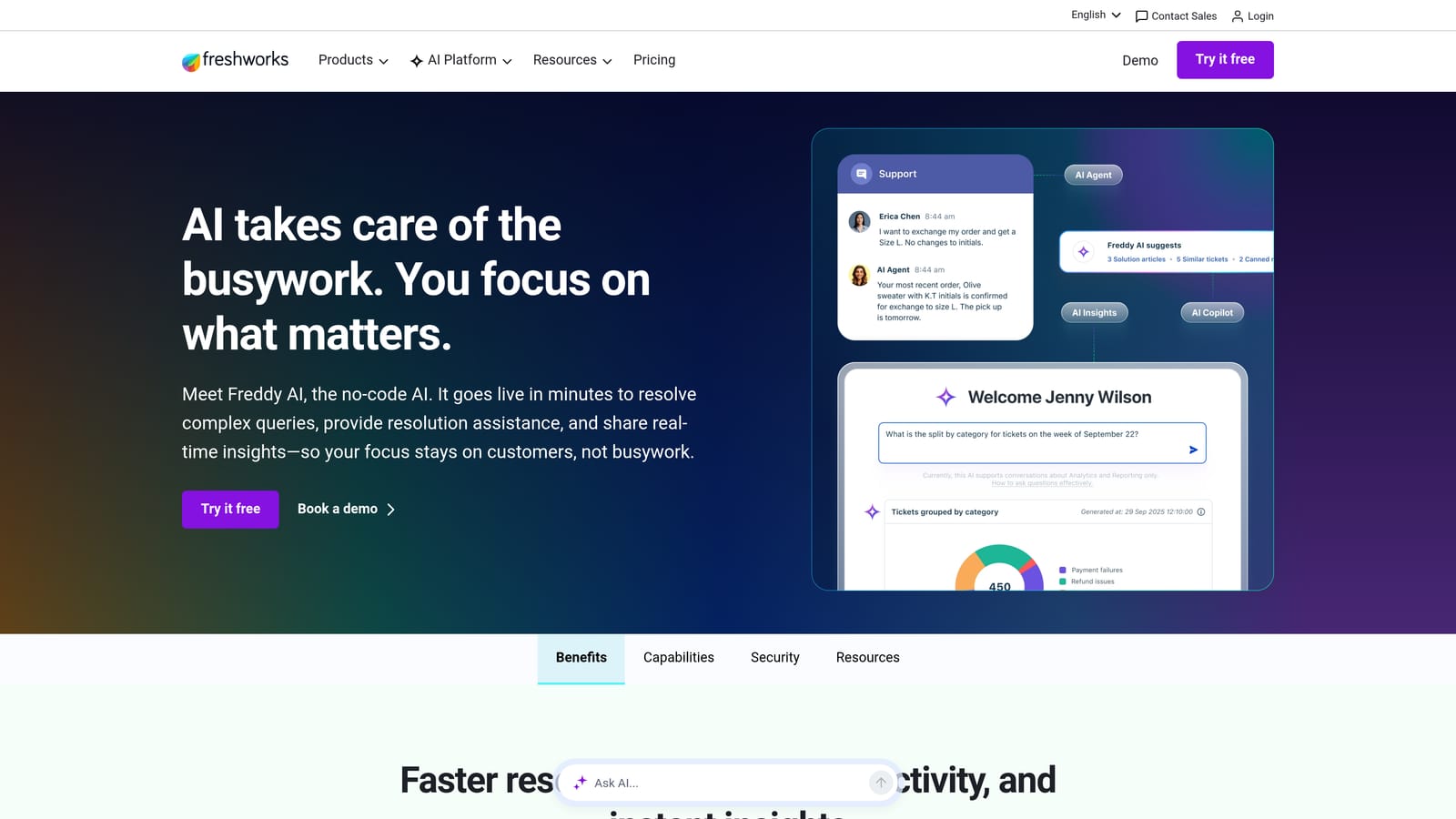
Freshdesk Freddy AI is Freshworks' AI brand spanning self-service deflection, agent assist, and analytics across the full Freshworks product family.
Where This Tool Shines
Freddy's biggest advantage is cross-suite context. If your team uses Freshsales for CRM or Freshservice for ITSM alongside Freshdesk, Freddy can draw on data across all three products. That unified context makes AI responses more relevant and routing decisions more informed than what's possible with a standalone support tool.
The SMB-accessible pricing tiers also make Freddy a realistic option for growing teams that aren't ready for enterprise-level commitments. You can start with basic deflection and layer in Copilot features as your needs evolve.
Key Features
Freddy Self Service: Autonomous chat deflection that handles common queries without agent involvement.
Freddy Copilot: Provides agent suggestions, auto-summarization, and reply drafting to accelerate human agent workflows.
Freddy Insights: AI-driven analytics across the support queue to surface trends and performance gaps.
Cross-Suite Context: Draws on data from Freshsales CRM and Freshservice ITSM for richer AI responses when used together.
Tiered Pricing: SMB-accessible entry points with add-on options as teams scale.
Best For
Teams already using Freshdesk, Freshsales, or Freshservice who want AI capabilities that span their entire Freshworks investment. Also a strong option for SMBs looking for accessible pricing without sacrificing core AI functionality.
Pricing
Freddy Self Service is included in select Freshdesk plans; Copilot is available as an add-on. Check freshworks.com for current tier details.
5. Forethought
Best for: Teams wanting AI triage and routing intelligence without migrating their existing helpdesk.
Forethought is an AI support platform designed to sit on top of your existing helpdesk, adding intelligence without requiring you to rip and replace.
Where This Tool Shines
Forethought's core value proposition is additive AI: it layers triage intelligence, sentiment-driven routing, and workflow automation onto Zendesk, Salesforce Service Cloud, and ServiceNow without disrupting your current setup. For teams with significant helpdesk investments and no appetite for migration, this is a compelling approach.
The sentiment detection capability is particularly useful for priority routing. Rather than routing by keyword or ticket category alone, Forethought can identify frustrated or high-risk customers and elevate those conversations accordingly, which can meaningfully improve the experience for the customers who need it most.
Key Features
Helpdesk-Agnostic Triage: AI intent classification and routing layered onto Zendesk, Salesforce, and ServiceNow without migration.
Sentiment Detection: Identifies customer frustration or urgency signals to prioritize routing decisions.
Workflow Automation: Reduces manual ticket handling through automated routing and tagging rules.
Knowledge Retrieval for Agent Assist: Surfaces relevant knowledge base content to human agents during live interactions.
No Migration Required: Integrates with existing helpdesk infrastructure rather than replacing it.
Best For
Support teams with existing Zendesk, Salesforce, or ServiceNow investments who want to add AI intelligence without a platform migration. Forethought is more focused on making human agents faster and smarter than on fully autonomous resolution end-to-end.
Pricing
Custom pricing based on volume and helpdesk. Contact forethought.ai for a quote tailored to your setup.
6. Ada
Best for: Consumer-facing enterprises needing multilingual AI agents across multiple digital channels.
Ada is a no-code AI agent builder with strong multilingual capabilities and broad channel coverage, widely adopted by enterprises in telecom, fintech, and e-commerce.
Where This Tool Shines
Ada's no-code builder is genuinely accessible to non-technical teams. Support operations managers and CX leaders can build, deploy, and iterate on AI agent flows without engineering involvement, which significantly reduces time-to-deployment and ongoing maintenance overhead.
The multilingual capability is a real differentiator for global businesses. Ada handles conversations across languages without requiring separate agent configurations per market, which makes it practical for enterprises serving diverse customer bases across regions.
Key Features
No-Code Agent Builder: Allows non-technical teams to build and deploy AI agent flows without engineering resources.
Multilingual Support: Handles conversations across multiple languages without separate per-market configurations.
Broad Channel Coverage: Deploys across web, mobile, and messaging channels from a single platform.
Pre-Built Integrations: Connects to major CRMs and helpdesks out of the box.
Containment Rate Reporting: Conversation analytics focused on deflection and containment metrics.
Best For
Consumer-facing enterprises in telecom, fintech, or e-commerce with global customer bases and multilingual support needs. Less suited to technical B2B SaaS support where deep product-context awareness and engineering workflow integration matter more than channel breadth.
Pricing
Custom enterprise pricing. Contact ada.cx for a tailored quote based on volume and channel requirements.
7. Tidio Lyro
Best for: Startups and small teams that need autonomous AI support on a modest budget.
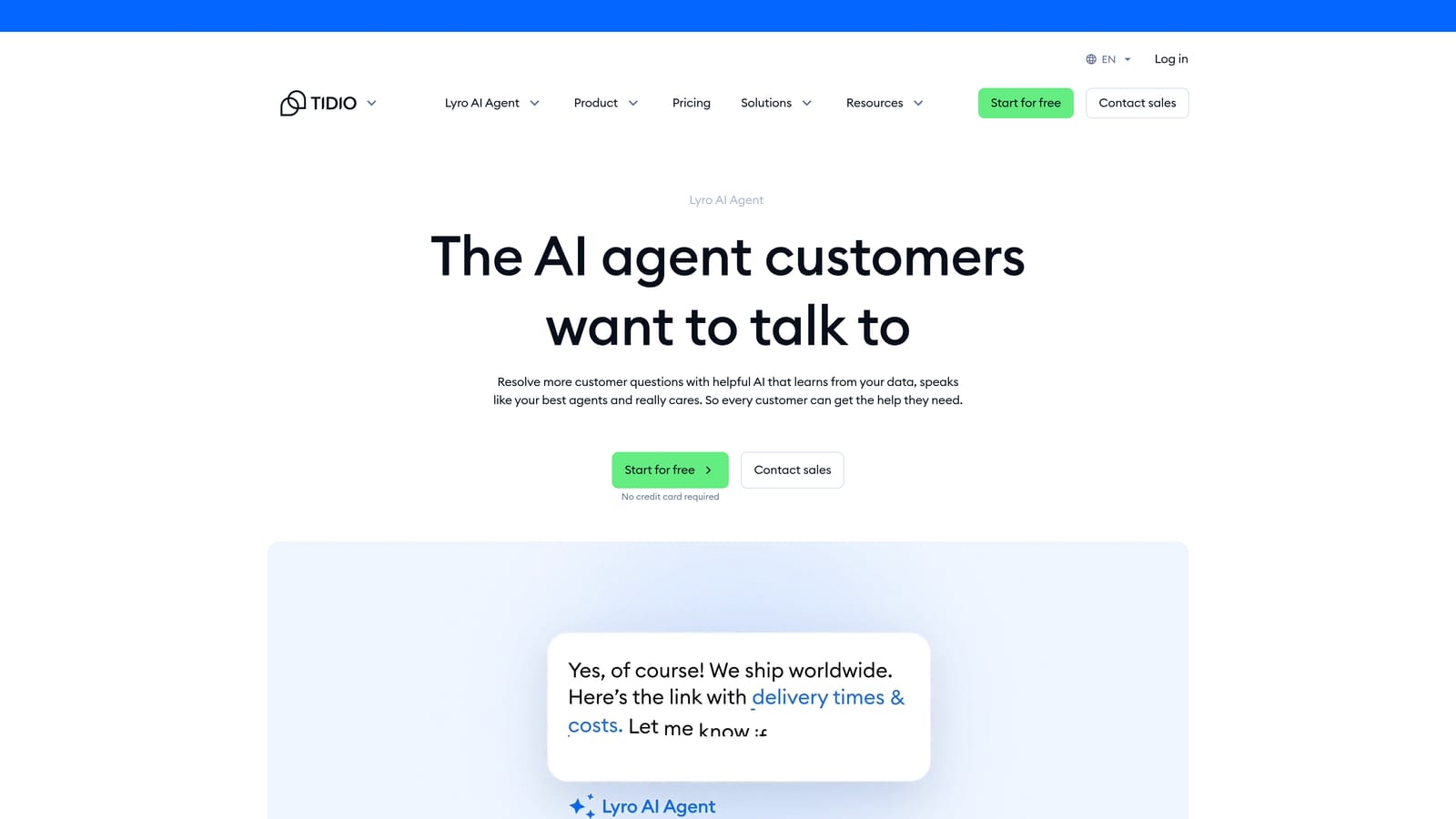
Tidio Lyro is Tidio's conversational AI product, trained on your help content to handle common queries autonomously with a fast, accessible setup process.
Where This Tool Shines
Lyro's strongest attribute is time-to-value. You point it at your existing help center content, and it starts handling routine queries quickly, without a lengthy implementation or a dedicated technical resource. For small teams that need to reduce support load fast, that accessibility is genuinely valuable.
The pricing model is one of the most accessible in the market. At entry-level conversation volumes, Lyro is a realistic option for early-stage startups that can't yet justify enterprise platform costs but still want meaningful AI deflection.
Key Features
Help Content Training: Trains on your existing help center articles for fast setup without manual flow building.
Autonomous Query Handling: Manages routine customer questions conversationally without agent involvement.
Live Chat Fallback: Routes to a human agent when queries exceed the AI's confidence threshold.
Accessible Pricing: Entry-level tiers designed for small teams and startups with modest conversation volumes.
Conversation Analytics Dashboard: Basic reporting on conversation volume, resolution rates, and handoff frequency.
Best For
Startups, SMBs, and small support teams that need fast, affordable AI deflection without complex implementation. Lyro is best for teams with relatively standard query types; its learning loop and integration depth are less sophisticated than enterprise platforms.
Pricing
Lyro starts from approximately $29/month and scales with conversation volume. Check tidio.com for current pricing as tiers are updated.
8. Kustomer
Best for: High-volume consumer brands where AI agents need full CRM context from the first message.
Kustomer is a CRM-native customer service platform, owned by Meta, where AI agents operate with access to the full customer record from the moment a conversation starts.
Where This Tool Shines
Kustomer's CRM-first architecture is its defining differentiator. Because the platform is built around customer records rather than tickets, AI agents can reference purchase history, past interactions, loyalty status, and subscription data from the very first message. That context makes automated responses significantly more relevant and personalized than what's possible when AI is bolted onto a ticket-centric system.
The unified conversation timeline, which replaces ticket numbers with a continuous customer history, is also a meaningful UX improvement for high-volume consumer brands where repeat customers are common and relationship continuity matters.
Key Features
CRM-First Architecture: AI agents have full access to customer history, purchase data, and loyalty context from the start of every conversation.
Unified Conversation Timeline: Replaces ticket numbers with a continuous customer record across all channels and interactions.
AI-Powered Routing: Routes conversations based on full customer history, not just the current message content.
High-Volume Handling: Built for the scale demands of DTC, marketplace, and subscription businesses.
Omnichannel Coverage: Supports chat, email, SMS, social, and voice within the same unified platform.
Best For
High-volume consumer brands in DTC, marketplace, or subscription businesses where customer history and purchase context are central to support quality. Less suited to B2B SaaS technical support where product-context awareness and engineering integrations matter more than CRM depth.
Pricing
Enterprise pricing; reported to start around $89/user/month. Verify current rates at kustomer.com as pricing can change.
9. Gladly
Best for: Premium consumer brands where relationship quality is a brand differentiator, not just a cost center.
Gladly is a people-first support platform that replaces ticket-centric models with unified conversation timelines, using AI to assist agents and handle routine queries without sacrificing relationship depth.
Where This Tool Shines
Gladly's philosophy is distinct from most platforms on this list: it treats customers, not tickets, as the central record. Every conversation, regardless of channel or time elapsed, lives in a single continuous timeline per customer. That model makes it significantly easier for agents to provide contextually aware, relationship-driven support.
The People Match routing feature connects customers to the agent best suited to help them based on history, skills, and relationship context. For premium brands where a loyal customer expects to feel recognized, that routing intelligence is a meaningful differentiator from generic queue-based systems.
Key Features
Conversation-Centric Model: Customers, not tickets, are the central record, with a unified timeline across all channels and interactions.
AI-Assisted Responses: Suggests next actions and reply drafts for human agents rather than fully replacing them.
People Match Routing: Connects customers to the best-fit agent based on relationship history and skill matching.
Full Channel Unification: Chat, email, SMS, social, and voice all feed into the same customer timeline.
Relationship-First Design: Platform philosophy prioritizes long-term relationship quality over pure deflection metrics.
Best For
Premium consumer brands in luxury retail, travel, and subscription services where relationship quality is a genuine brand differentiator. Gladly leans toward human-assisted AI rather than full autonomy, making it a better fit for brands where the human touch is intentional, not a fallback.
Pricing
Custom enterprise pricing. Contact gladly.com for a quote based on team size and channel requirements.
Which Platform Is Right for Your Team?
The right autonomous support agent platform depends heavily on where you're starting from and what you're optimizing for. Here's a quick orientation by use case.
AI-first B2B SaaS teams: Halo AI is the strongest fit. Page-aware context, continuous learning, auto bug ticket creation, and business intelligence signals make it purpose-built for product-led companies that need more than deflection.
Intercom-native teams: Fin is the path of least resistance. If you're already paying for Intercom, adding Fin requires no new vendor relationship and keeps everything in one thread.
Enterprise Zendesk shops: Zendesk AI extends your existing investment with triage intelligence and Agent Copilot without requiring migration.
Freshworks ecosystem users: Freddy AI gives you cross-suite context across support, CRM, and ITSM in a single AI layer.
Helpdesk-agnostic deflection: Forethought adds intelligence on top of whatever you're running without requiring a platform switch.
Global multilingual coverage: Ada's no-code builder and multi-language support make it the practical choice for consumer-facing enterprises with diverse regional markets.
SMB and startup budgets: Tidio Lyro delivers accessible AI deflection with fast setup and pricing that fits early-stage constraints.
CRM-native consumer support: Kustomer gives AI agents the full customer record from message one, which is hard to replicate with a ticket-centric system.
Relationship-first premium brands: Gladly's people-centric model and People Match routing are built for brands where the human connection is part of the product experience.
When evaluating any platform, prioritize three things above all else: the quality of the learning loop (does it actually get smarter?), integration depth (does it connect to your full stack, not just your helpdesk?), and handoff quality (when a human needs to step in, does the context transfer completely?). Those three factors separate platforms that deliver compounding value from those that plateau quickly.
Your support team shouldn't scale linearly with your customer base. Let AI agents handle routine tickets, guide users through your product, and surface business intelligence while your team focuses on complex issues that need a human touch. See Halo in action and discover how continuous learning transforms every interaction into smarter, faster support.