9 Best B2B Customer Support Solutions in 2026
This guide evaluates the 9 best B2B customer support solutions in 2026, comparing AI-powered platforms, CRM integrations, and enterprise SLA capabilities to help businesses find the right fit. Whether you're a lean startup or a large enterprise managing complex multi-product support, these tools are assessed on automation, scalability, and compatibility with both product-led and sales-led B2B teams.
 Grant CooperFounder13 min read
B2B customer support is a different beast than B2C. Your customers are businesses with complex workflows, multiple stakeholders, and zero tolerance for slow resolutions. A missed ticket or a clunky support experience doesn't just frustrate a user — it puts a contract at risk.
The good news: the B2B support tooling landscape has matured significantly. Whether you need AI-powered ticket resolution, deep CRM integrations, or enterprise-grade SLAs, there's a solution built for your stack and your scale.
We evaluated each tool on automation capabilities, integration depth, scalability, and fit for product-led or sales-led B2B teams. Whether you're a lean startup that can't afford to grow headcount with ticket volume, or an enterprise team managing complex multi-product support, you'll find the right fit here.
1. Halo AI
Best for: B2B SaaS teams that want AI-first autonomous support without scaling headcount
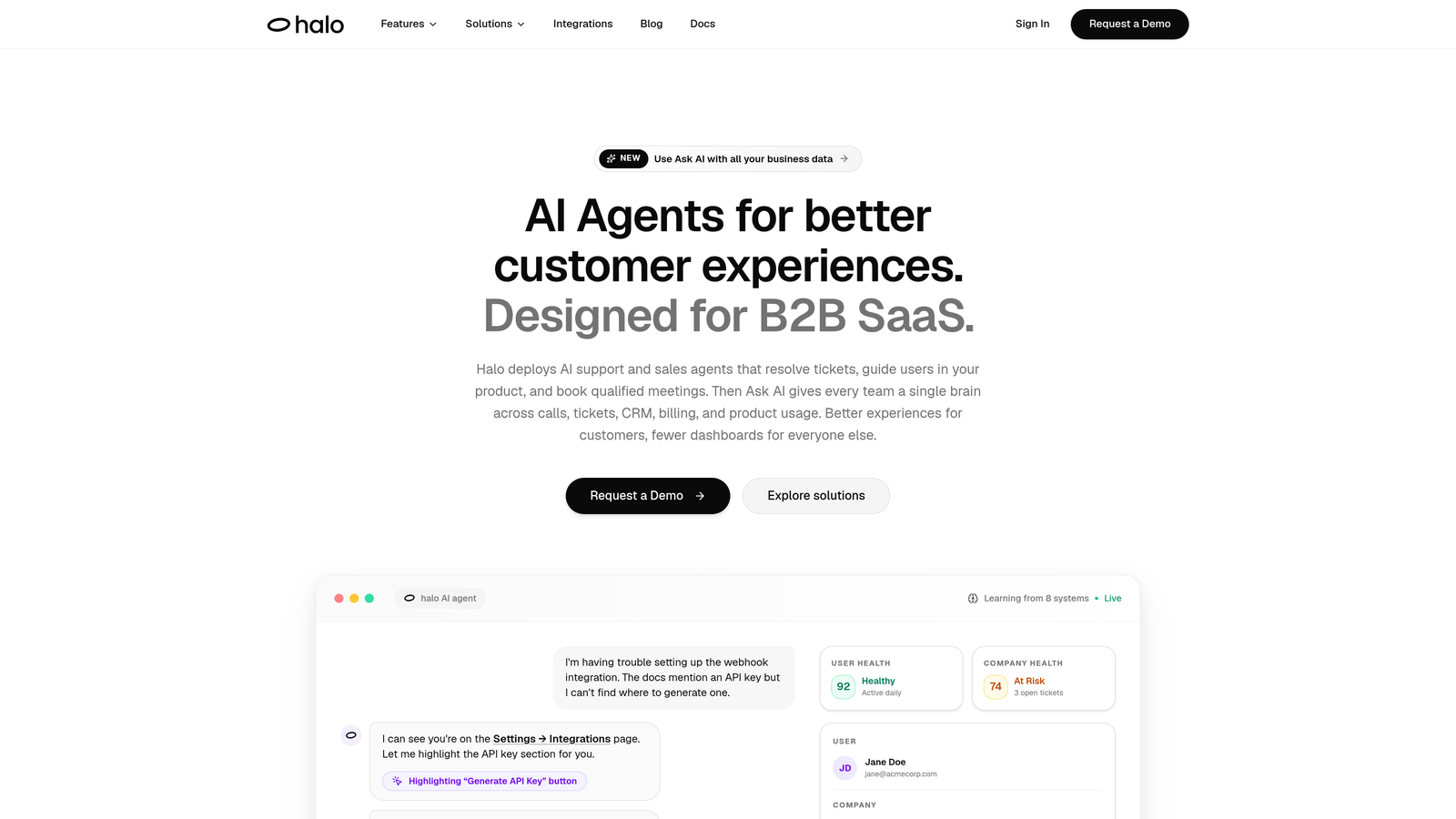
Halo AI is an AI-first customer support platform that deploys autonomous agents to resolve tickets, guide users through your product, and surface business intelligence signals.
Where This Tool Shines
Most support tools treat AI as a feature bolted onto a legacy helpdesk. Halo is built the other way around: the AI agents are the core product. That distinction matters more than it sounds. When AI is central to the architecture rather than an add-on, it learns continuously, improves with every interaction, and handles resolution autonomously rather than just suggesting responses for a human to copy-paste.
The page-aware chat widget is one of the more genuinely differentiated features in this space. The AI can see which page a user is on and provide contextual, visual guidance — the kind of situational awareness that usually requires a live agent. Pair that with a smart inbox that surfaces customer health signals, anomaly detection, and revenue intelligence, and you have a support tool that also functions as a business intelligence layer.
Key Features
Autonomous AI Agents: Intelligently resolve support tickets end-to-end, learning from every interaction to improve accuracy over time.
Page-Aware Chat Widget: Sees what users see in real time, enabling contextual visual guidance without a human agent in the loop.
Smart Inbox with Business Intelligence: Surfaces customer health signals, anomaly detection, and revenue intelligence alongside standard support metrics.
Auto Bug Ticket Creation: Automatically routes bug reports to Linear or your existing dev workflow, closing the loop between support and engineering.
Live Agent Handoff: Escalates complex issues to human agents with full context preserved, so customers never have to repeat themselves.
Deep Integrations: Connects with Slack, HubSpot, Intercom, Stripe, Zoom, PandaDoc, Fathom, and more — covering your full business stack.
Best For
Halo is purpose-built for B2B SaaS teams that want AI to handle routine resolution at scale while giving their human agents the context and intelligence to focus on high-stakes interactions. It's particularly well-suited for product-led growth companies where in-product guidance and usage-based context are critical to the support experience.
Pricing
Contact for pricing. A free trial is available at haloagents.ai.
2. Zendesk
Best for: Large B2B enterprises needing mature SLA management and a deep app ecosystem
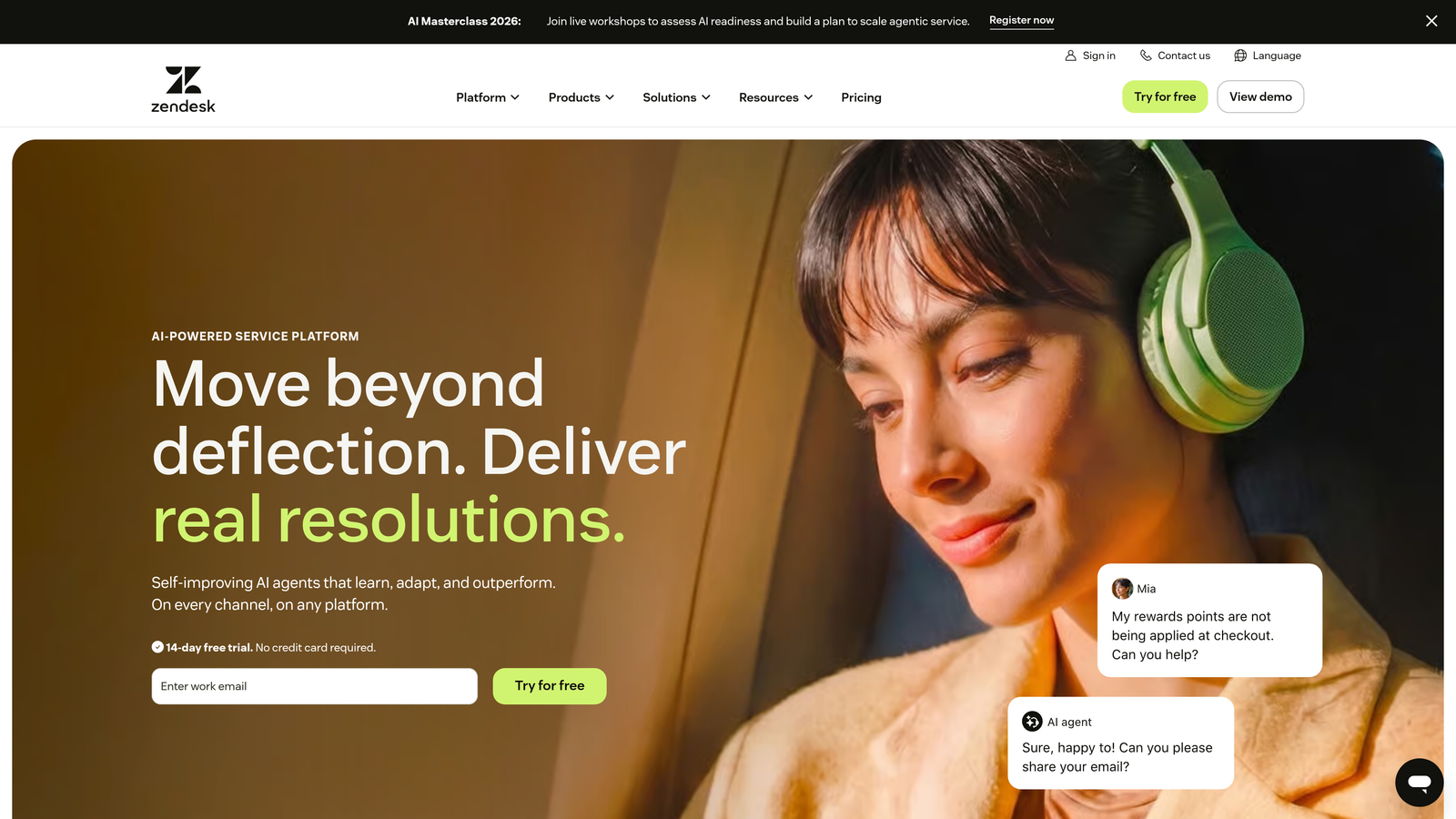
Zendesk is one of the most established enterprise helpdesk platforms, offering advanced ticket routing, SLA management, and a broad marketplace of third-party integrations.
Where This Tool Shines
Zendesk's strength is its maturity. It has been refined over many years into a comprehensive enterprise support platform, and that shows in features like granular SLA configuration, sophisticated escalation workflows, and an app marketplace with hundreds of integrations. For large support teams with dedicated support operations staff, it offers a level of configurability that few competitors match.
Zendesk AI adds intelligent triage and suggested responses to the mix, though it's worth noting that AI capabilities here feel more like enhancements to an existing workflow than a fundamental rethinking of how support works. Teams that need rock-solid enterprise infrastructure and are comfortable investing in setup and administration will find Zendesk a reliable choice.
Key Features
Advanced Ticket Routing: Sophisticated SLA management, escalation rules, and priority-based routing for complex support operations.
Zendesk AI: Intelligent triage, suggested responses, and automation to reduce manual handling on high-volume queues.
Extensive App Marketplace: Hundreds of third-party integrations covering CRM, billing, analytics, and more.
Omnichannel Support: Unified inbox across email, chat, voice, and social channels.
Enterprise Reporting: Robust analytics and custom dashboards for support operations teams.
Best For
Large B2B support teams with dedicated support ops staff who need enterprise-grade SLA management, deep configurability, and a proven platform with broad integration coverage. Less ideal for lean teams without the resources to manage a complex implementation.
Pricing
Suite plans start at approximately $55 per agent per month (billed annually). Enterprise pricing is available on request and scales significantly with usage and features.
3. Intercom
Best for: Product-led SaaS companies wanting conversational, in-app support with customer usage context
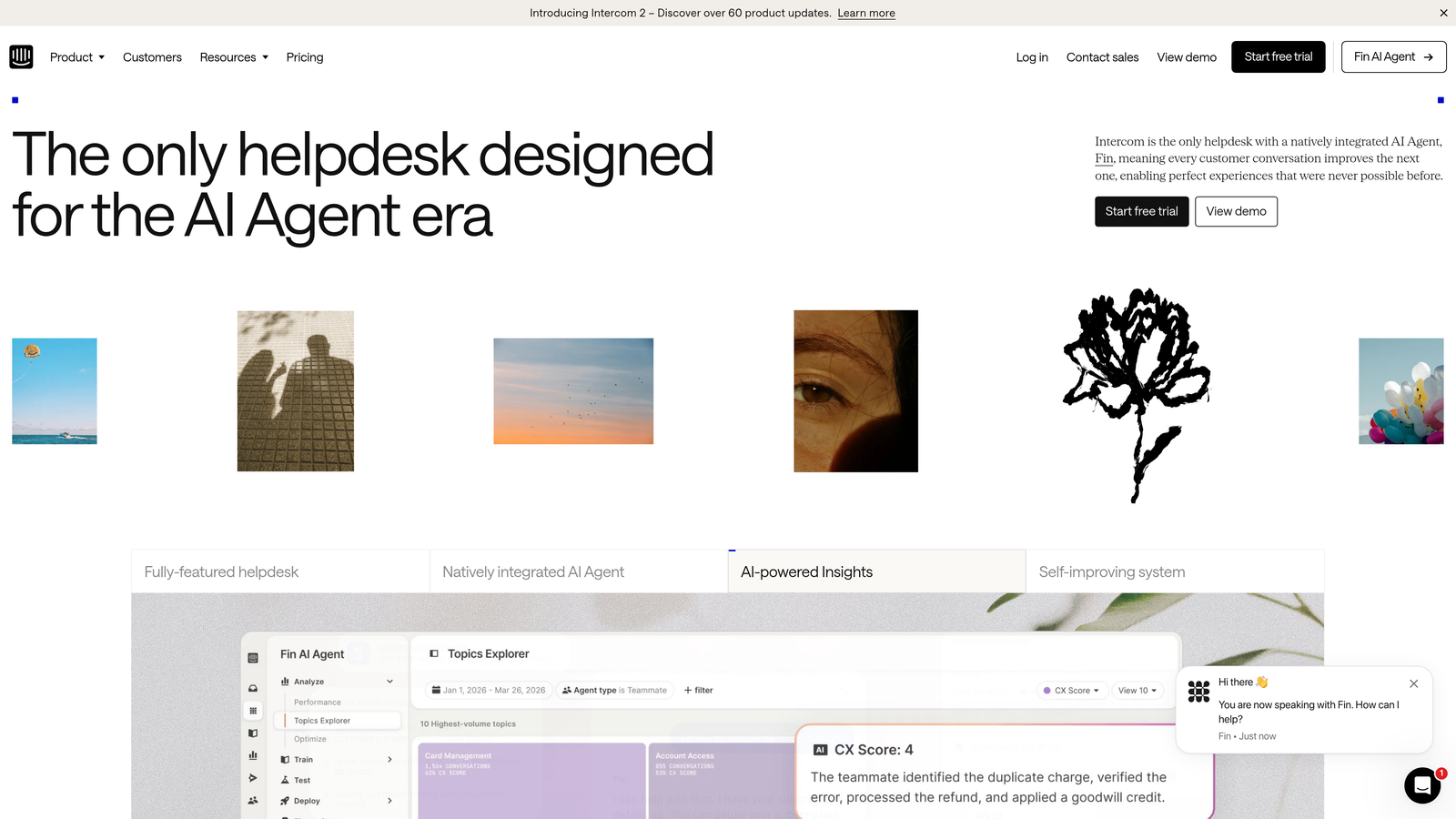
Intercom is a conversational support platform that combines in-app messaging, AI agents, and customer data to deliver context-rich B2B support experiences.
Where This Tool Shines
Intercom's real differentiator is the tight connection between product usage data and support context. For SaaS companies with a product-led growth motion, this matters: your support agents can see how a customer is using the product, what plan they're on, and what they've done recently — all within the conversation view. That context makes for faster, more relevant resolutions.
Fin, Intercom's AI agent, handles automated chat resolution using your knowledge base and can resolve a meaningful portion of common queries without human involvement. The platform also includes onboarding product tours and proactive messaging, making it useful beyond pure reactive support.
Key Features
Fin AI Agent: Automated chat resolution powered by your knowledge base, handling common queries without agent involvement.
In-App Messaging and Product Tours: Proactive support and onboarding flows delivered directly inside your product.
Customer Data Platform: Usage-based segmentation and behavioral data surfaced in every conversation.
Shared Inbox: Conversation routing, assignment rules, and team collaboration tools for support teams.
CRM Integrations: Native connections with Salesforce, HubSpot, Stripe, and other major SaaS tools.
Best For
SaaS companies with a product-led growth model where in-product messaging, usage context, and proactive onboarding support are central to the customer experience. Pricing has historically been a friction point for smaller teams, so it's worth evaluating total cost carefully.
Pricing
Essential plan starts at approximately $39 per seat per month. Fin AI usage is billed separately per resolution, which can affect total cost depending on volume.
4. Freshdesk
Best for: Growing B2B teams that need omnichannel helpdesk capabilities at an accessible price point
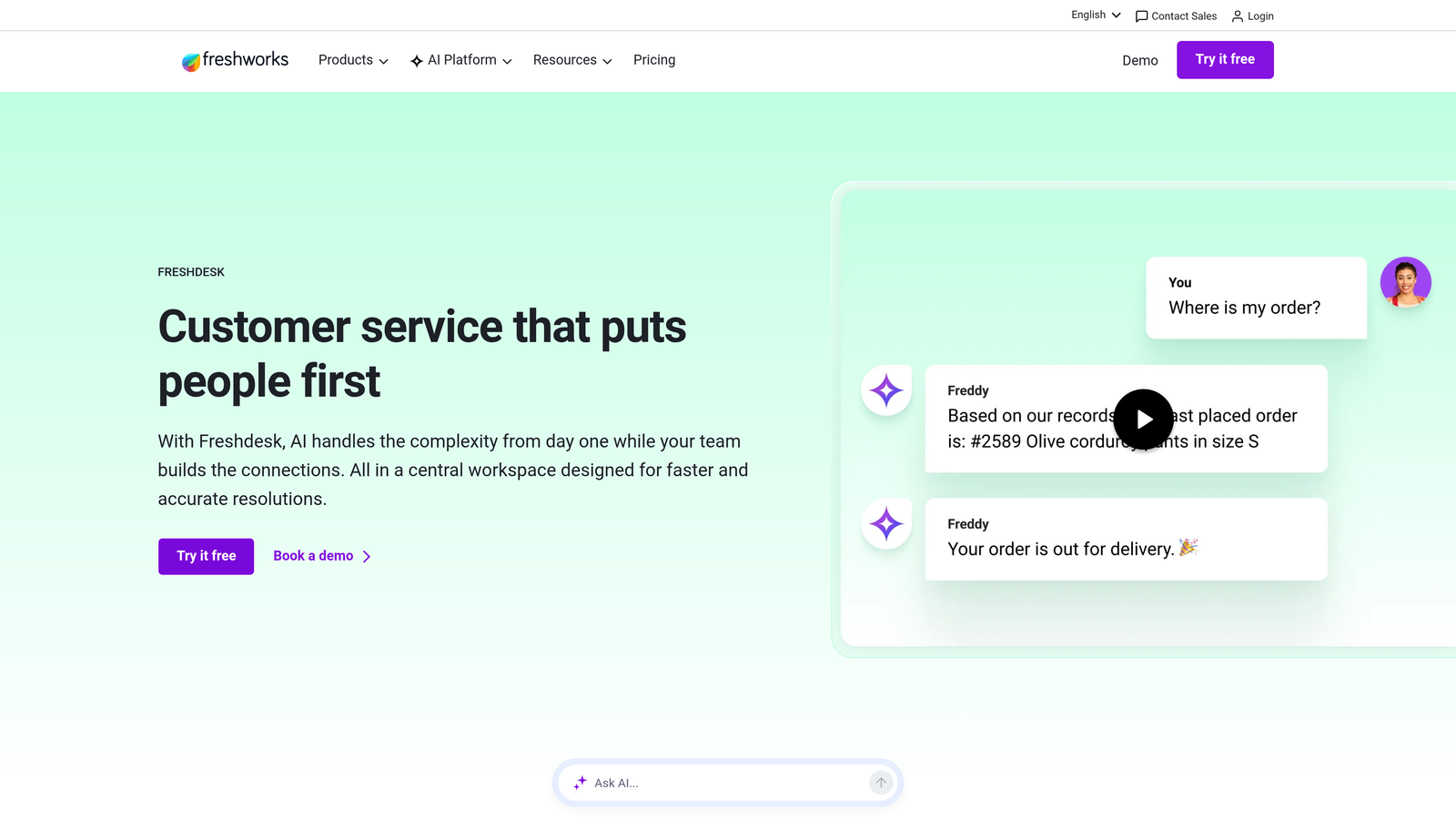
Freshdesk is an omnichannel helpdesk by Freshworks with AI-powered automation, a generous free tier, and strong value for teams scaling their support operations.
Where This Tool Shines
Freshdesk occupies a smart position in the market: it delivers a feature set that competes with more expensive platforms, at a price point that makes it accessible to earlier-stage B2B teams. The free plan is genuinely usable for small teams, and the paid tiers offer meaningful automation and AI capabilities without requiring enterprise-level investment.
Freddy AI handles ticket summarization, suggested responses, and sentiment analysis — useful for teams that want to reduce manual workload without fully automating resolution. The broader Freshworks ecosystem (Freshsales CRM, Freshservice ITSM) is worth noting if you're looking for a more unified platform across sales, IT, and support.
Key Features
Freddy AI: Ticket summarization, suggested responses, and sentiment analysis to assist agents and reduce handling time.
Omnichannel Ticketing: Unified inbox across email, chat, phone, and social media channels.
Collision Detection: Prevents duplicate agent responses by showing when another agent is already working on a ticket.
Free Plan: Functional free tier for small teams, making it accessible for early-stage B2B companies.
Freshworks Ecosystem: Integrates with Freshsales CRM, Freshservice, and other Freshworks products for broader platform coverage.
Best For
Growing B2B support teams that need solid omnichannel helpdesk functionality without the cost or complexity of enterprise platforms. Also a strong choice for teams already using or evaluating other Freshworks products.
Pricing
Free plan available. Growth plan starts at approximately $15 per agent per month (billed annually).
5. Salesforce Service Cloud
Best for: Large B2B enterprises with complex account structures already running on Salesforce CRM
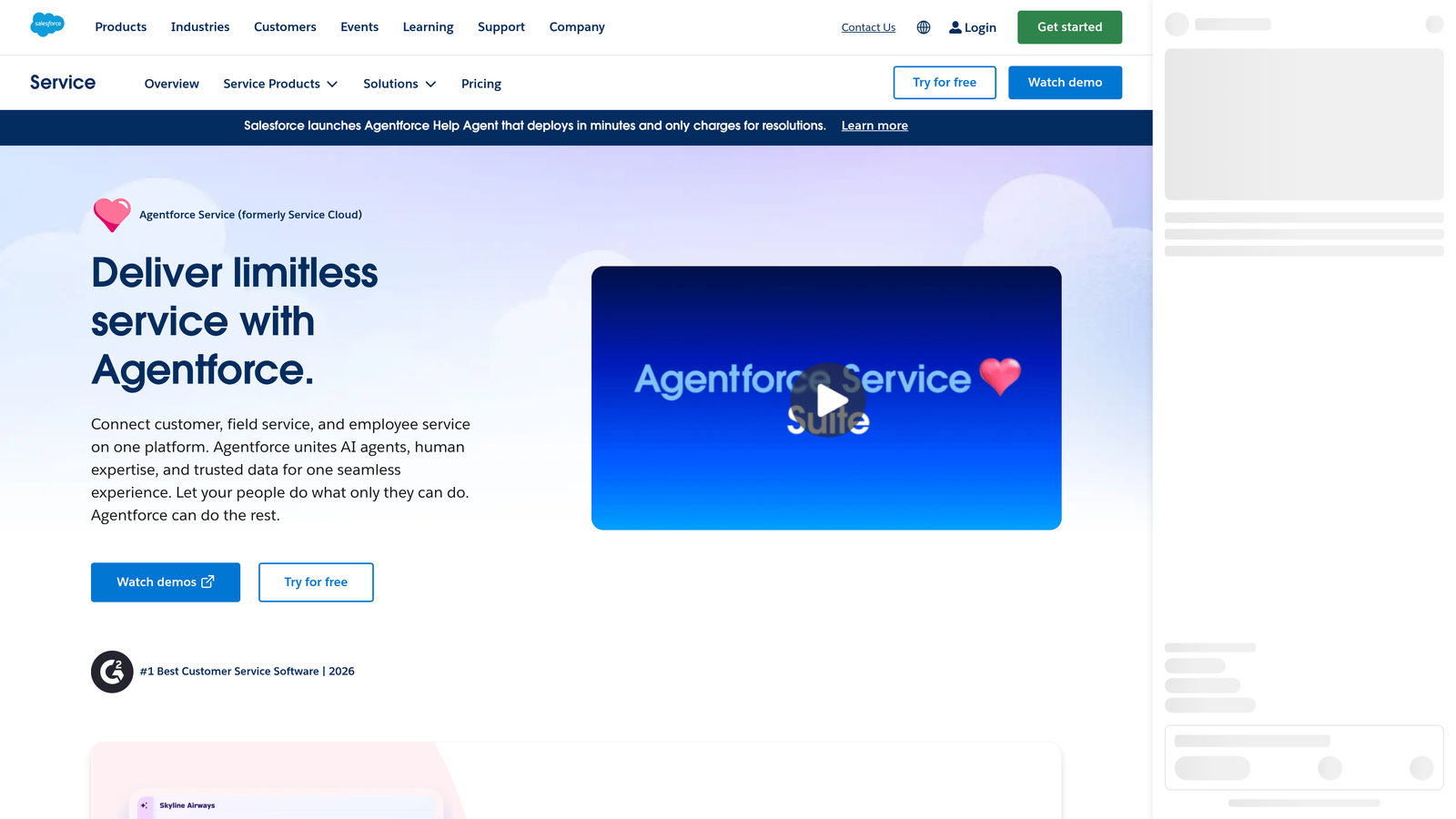
Salesforce Service Cloud is an enterprise case management and customer service platform natively integrated with Salesforce CRM, featuring Einstein AI for intelligent support operations.
Where This Tool Shines
If your organization runs on Salesforce, Service Cloud is the natural support extension. The native CRM integration means support agents have full visibility into a customer's account history, open opportunities, and sales interactions without switching tools or relying on manual data syncs. For complex B2B accounts where support and sales are deeply intertwined, that context can be the difference between a quick resolution and a frustrating runaround.
Einstein AI adds case classification, routing recommendations, and next-best-action suggestions. The platform is highly customizable through Flow automation and the AppExchange marketplace, though that flexibility comes with significant implementation complexity. Expect to invest in dedicated Salesforce administration resources.
Key Features
Native Salesforce CRM Integration: Full account, opportunity, and contact context surfaced directly in the support interface.
Einstein AI: Case classification, routing recommendations, and next-best-action guidance for support agents.
Omni-Channel Routing: Intelligent routing across voice, chat, email, and field service channels.
Knowledge Management: Article creation and AI-powered recommendations to support self-service and agent efficiency.
Flow Automation and AppExchange: Highly customizable workflows and a broad marketplace of third-party integrations.
Best For
Large B2B organizations where support agents need deep visibility into CRM account data and where Salesforce is already the system of record. High implementation cost and complexity make it less suitable for teams without dedicated Salesforce admin resources.
Pricing
Starter Suite from approximately $25 per user per month. Enterprise plans are significantly higher — contact Salesforce directly for full pricing details.
6. HubSpot Service Hub
Best for: B2B teams already invested in the HubSpot ecosystem who want support unified with sales and marketing data
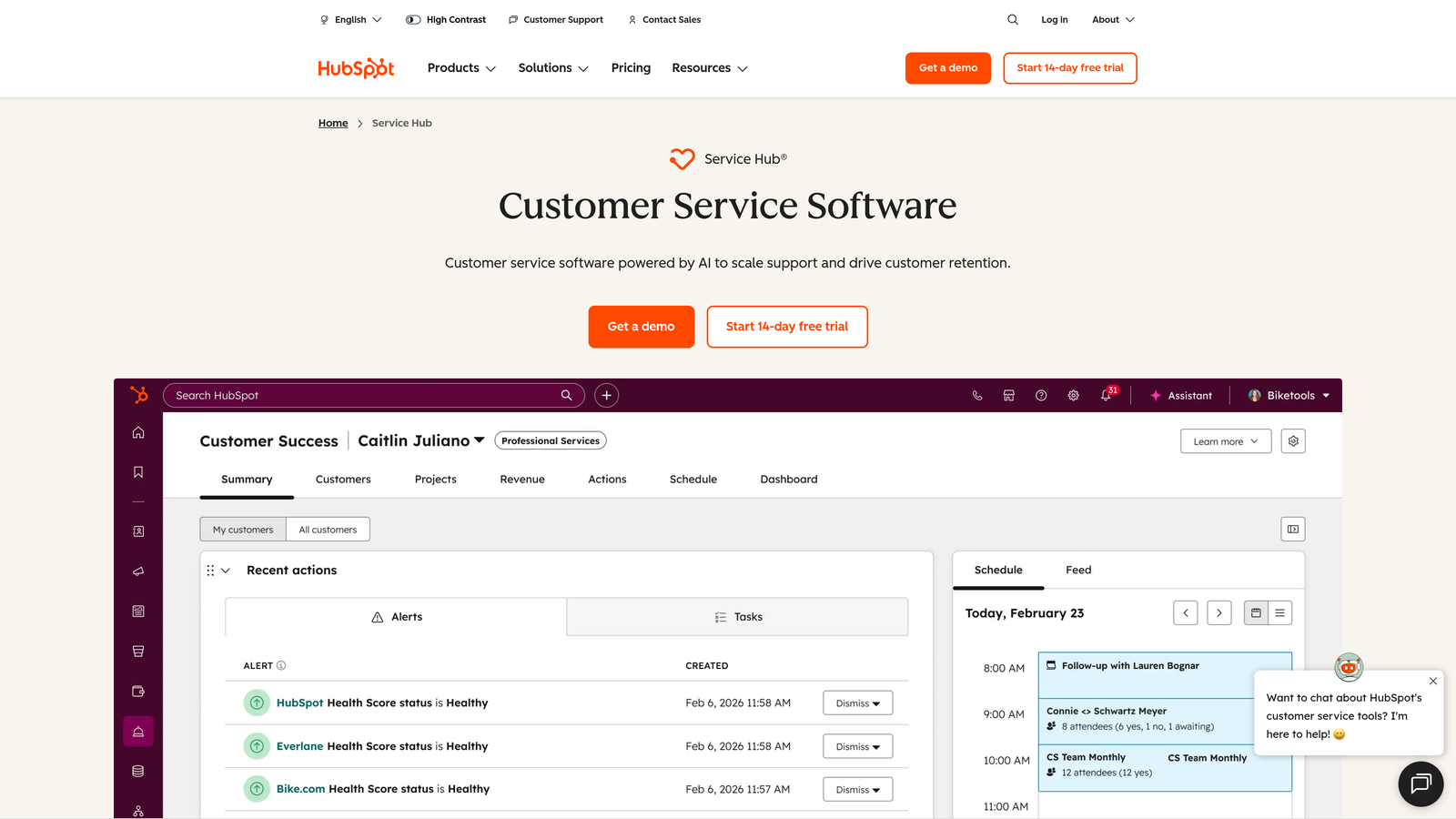
HubSpot Service Hub is customer service software built into the HubSpot CRM platform, unifying support ticketing with sales and marketing contact data.
Where This Tool Shines
The core value proposition of Service Hub is context: every support interaction is automatically logged on the HubSpot contact and company timeline, alongside marketing touches and sales activity. For B2B teams where the same contact might be a prospect, a customer, and a support requester, that unified view eliminates the data silos that slow resolution and frustrate customers.
The platform covers the essentials well: ticketing, live chat, a knowledge base, and customer feedback tools including NPS, CSAT, and CES surveys. Reporting ties support activity to pipeline and revenue data, which is useful for teams that need to demonstrate the business impact of support quality.
Key Features
CRM-Unified Ticketing: Every ticket logged on the HubSpot contact and company timeline with full sales and marketing history.
Live Chat and HubSpot AI: Built-in chat with AI-assisted responses and chatbot builder.
Knowledge Base and Customer Portal: Self-service tools for customers to find answers and manage their own requests.
Customer Feedback Surveys: NPS, CSAT, and CES surveys built into the platform with CRM-linked reporting.
Revenue-Tied Reporting: Support metrics connected to pipeline and revenue data for business-level visibility.
Best For
B2B teams already using HubSpot for sales and marketing who want a unified platform rather than a separate support tool. Less compelling as a standalone choice if you're not in the HubSpot ecosystem.
Pricing
Free tools available. Starter from approximately $15 per seat per month. Professional from approximately $90 per seat per month.
7. Gorgias
Best for: B2B companies with order-based or transactional support workflows and ecommerce platform dependencies
Gorgias is a support platform with deep ecommerce integrations, allowing agents to view and manage orders directly from the support interface.
Where This Tool Shines
Gorgias is built for teams where support and commerce are inseparable. The Shopify, Magento, and BigCommerce integrations go beyond surface-level data pulls: agents can view order details, issue refunds, and modify orders without leaving the support ticket. For B2B companies with transactional or order-based support workflows, this eliminates a significant amount of context-switching.
The platform's automation rules are commerce-data-aware, meaning you can trigger responses and actions based on order status, customer tags, or purchase history. Revenue-based support metrics — including support-driven revenue and conversion tracking — are a differentiating feature for teams that want to connect support activity to commercial outcomes.
Key Features
Deep Ecommerce Integrations: View and edit Shopify, Magento, and BigCommerce orders directly within support tickets.
Commerce-Aware Automation: Automation rules triggered by order status, customer tags, and purchase history.
Revenue-Based Metrics: Support-driven revenue and conversion tracking to connect support activity to commercial outcomes.
Omnichannel Inbox: Unified inbox across email, chat, social media, and SMS.
AI Agent: Automated responses to common commerce-related queries.
Best For
B2B companies with ecommerce or order-management-heavy support workflows, particularly those running on Shopify or Magento. Less suited for pure SaaS support environments without transactional order data.
Pricing
Starter plan from approximately $10 per month for up to 3 agents. Pricing scales by ticket volume at higher tiers.
8. Help Scout
Best for: Smaller B2B teams that prioritize relationship quality and simplicity over automation scale
Help Scout is a shared inbox and support platform designed for teams that want a clean, relationship-driven support experience without heavy automation overhead.
Where This Tool Shines
Help Scout's design philosophy is refreshingly deliberate: it's not trying to automate everything. The interface feels more like email than a ticketing system, which means agents can onboard quickly and customers receive responses that feel personal rather than templated. For B2B teams where relationship quality matters as much as resolution speed, that's a meaningful differentiator.
Docs (the built-in knowledge base) and Beacon (the embeddable in-app widget) round out the core product. AI Summarize and AI Assist features have been added to help agents work faster without fundamentally changing the human-centered approach. It's a tool that knows what it is and serves that use case well.
Key Features
Shared Inbox: Clean, email-like interface that reduces agent onboarding time and keeps conversations feeling personal.
Docs: Built-in knowledge base for customer self-service, integrated directly with the support workflow.
Beacon: Embeddable widget for in-app help, chat, and knowledge base access.
AI Summarize and AI Assist: Agent-facing AI tools for faster response drafting and conversation summaries.
Customer Profiles: Conversation history, notes, and customer data surfaced alongside every ticket.
Best For
Smaller B2B teams that value simplicity, fast onboarding, and a human touch in their support interactions. Teams expecting heavy automation or complex routing workflows will likely find it limiting at scale.
Pricing
Standard plan from approximately $22 per user per month. Plus plan from approximately $44 per user per month.
9. Tidio
Best for: Startups and small B2B teams that need fast AI chat deployment at an accessible price point
Tidio is a live chat and AI chatbot platform with accessible pricing, fast setup, and Lyro AI for automated customer query resolution.
Where This Tool Shines
Tidio's strength is speed-to-value. The setup is fast, the pricing is accessible, and Lyro AI handles automated resolution of common queries without requiring a lengthy configuration process. For startups or small B2B teams that need AI chat capabilities up and running quickly, it's one of the easiest entry points in the market.
The platform covers live chat, email, and Messenger in a unified inbox, with a visual chatbot builder for teams that want to customize their automation flows. Integrations with Shopify, WordPress, Wix, and major CRMs make it versatile across different tech stacks. It's worth noting that Tidio is better suited for straightforward support environments than complex enterprise B2B scenarios.
Key Features
Lyro AI: Automated resolution of common support questions using your existing knowledge content.
Live Chat with Visitor Monitoring: Real-time chat with visibility into active visitors on your site or product.
Unified Inbox: Email and Messenger alongside live chat in a single interface.
Visual Chatbot Builder: Flow-based editor for building and customizing automation sequences.
Broad Integrations: Connects with Shopify, WordPress, Wix, and major CRM platforms.
Best For
Startups and small B2B teams that need quick AI chat deployment without a heavy implementation process. Less suited for enterprise environments with complex routing, SLA requirements, or deep CRM integration needs.
Pricing
Free plan available. Starter from approximately $29 per month. Lyro AI is available as an add-on priced per conversation.
Which Tool Is Right for Your Team?
The right B2B customer support solution depends heavily on where you are in your growth journey and what your support motion actually looks like. Here's a quick way to think through it.
If you want AI to handle resolution autonomously while surfacing business intelligence signals across your customer base, Halo AI is the purpose-built choice. It's the only platform on this list where the AI agents are the architecture, not an add-on.
For large enterprise teams with dedicated support ops, Zendesk or Salesforce Service Cloud offer the depth and configurability that complex organizations need. Salesforce is the obvious choice if you're already running on their CRM. Intercom is the standout for product-led SaaS teams where in-product context and proactive messaging are central to the support experience.
If budget is a primary constraint, Freshdesk delivers strong omnichannel capabilities at a price point that growing teams can sustain. HubSpot Service Hub is the natural fit if you're already in the HubSpot ecosystem and want support unified with your sales and marketing data. For order-based or ecommerce-adjacent B2B workflows, Gorgias is in a category of its own. Help Scout is the choice for teams that prioritize simplicity and relationship quality. And Tidio gets you AI chat up and running faster than almost anything else on this list.
One principle worth keeping in mind: your support team shouldn't scale linearly with your customer base. The best tools in this space let AI agents handle routine tickets, guide users through your product, and surface business intelligence while your human team focuses on the complex issues that genuinely need judgment and empathy.
If that's the model you're building toward, See Halo in action and discover how continuous learning transforms every interaction into smarter, faster support.