9 Best AI Agent Platforms for Customer Support in 2026
This comprehensive guide evaluates the best AI agent platforms for customer support in 2026, comparing top solutions on autonomous resolution capability, integration depth, and B2B SaaS suitability to help teams move beyond basic chatbots toward truly intelligent, scalable support operations.
 Grant CooperFounder13 min read
The shift from reactive helpdesk ticketing to proactive AI-driven support is well underway. B2B SaaS teams are moving beyond basic chatbots toward platforms that can autonomously resolve tickets, guide users through products, escalate intelligently, and surface business insights — all without scaling headcount.
But not all AI agent platforms are built the same. Some bolt AI onto legacy helpdesk infrastructure. Others are purpose-built for autonomous operation from day one. That difference matters enormously when you're evaluating resolution rates, integration depth, and the quality of insights your support operation generates.
This guide covers the top AI agent platforms available in 2026, evaluated on autonomous resolution capability, integration ecosystem, learning and adaptation, and suitability for B2B SaaS teams. Whether you're replacing Zendesk's bolt-on AI, scaling beyond Intercom's chatbot limits, or building a support operation from scratch, there's a fit here for your team.
For more context on what to look for, see our breakdown of AI support platform features and customer support AI benefits.
1. Halo AI
Best for: B2B SaaS teams that want an AI-first support platform built for autonomous operation from day one.
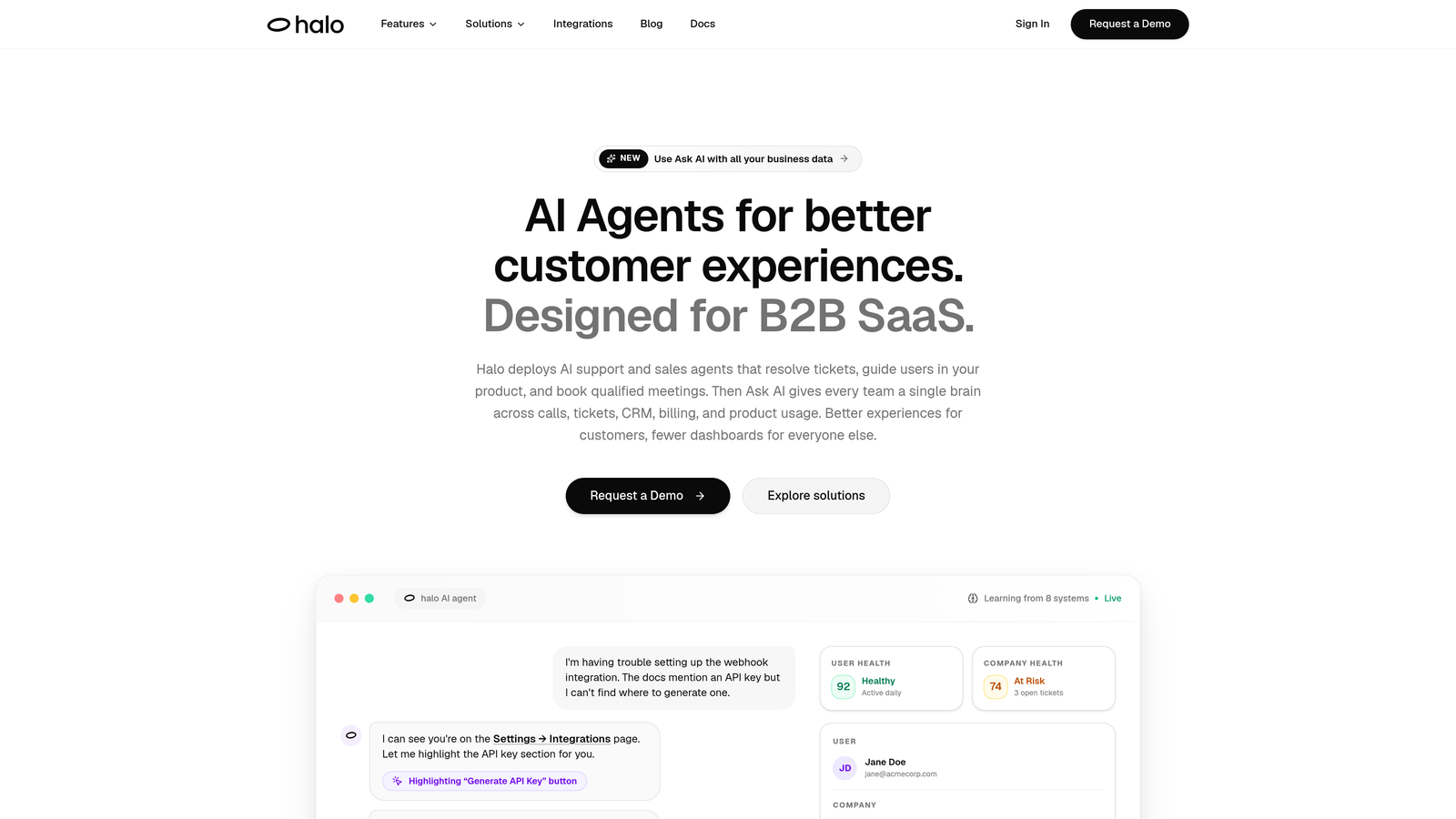
Halo AI is a purpose-built AI customer support platform designed specifically for B2B SaaS teams who need more than a chatbot bolted onto a ticketing system.
Where This Tool Shines
What separates Halo from most platforms on this list is its page-aware architecture. The AI agent actually sees what your user sees, understanding their current location in the product and providing contextual UI guidance rather than generic knowledge base responses. That's a meaningful distinction when your users are asking "how do I do X" while staring at a specific screen.
Halo also goes beyond ticket resolution. It surfaces business intelligence signals from support interactions, including customer health indicators and revenue anomalies, feeding that data back into product and revenue decisions. For product-led SaaS companies, this transforms support from a cost center into an insight engine.
Key Features
Page-Aware Chat Widget: The AI agent understands the user's current product context and delivers targeted, visual UI guidance rather than generic answers.
Autonomous Ticket Resolution: AI agents resolve tickets end-to-end, supported by a smart inbox with built-in business intelligence analytics.
Auto Bug Ticket Creation: Automatically identifies and routes bug reports directly to engineering tools like Linear, removing manual triage from your support team's plate.
Live Agent Handoff: Escalates to human agents with full conversation context preserved, so customers never have to repeat themselves.
Deep Integration Ecosystem: Connects with Linear, Slack, HubSpot, Intercom, Stripe, Zoom, PandaDoc, and Fathom, spanning the full B2B SaaS business stack.
Continuous Learning: Every resolved interaction makes the AI smarter, improving resolution quality over time without manual retraining.
Best For
Product-led SaaS companies that want an AI-first support operation with genuine autonomous resolution, business intelligence output, and integrations across their entire tech stack. Particularly strong for teams that have outgrown basic chatbot tools and want support that actually learns.
Pricing
Contact for pricing. See haloagents.ai for details and to request a demo.
2. Intercom (Fin AI Agent)
Best for: Teams already embedded in the Intercom ecosystem who want AI resolution layered into their existing messaging workflow.
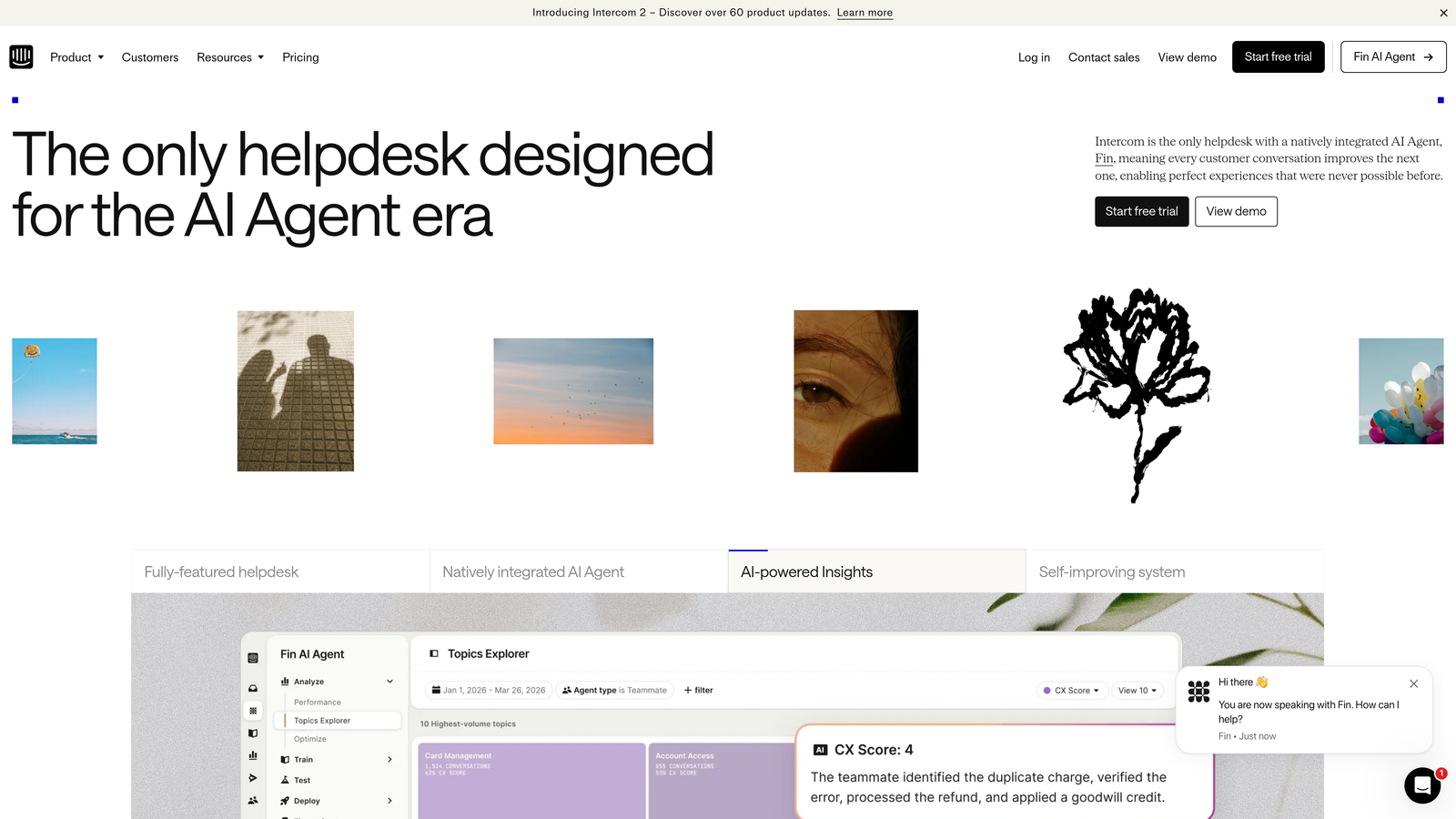
Intercom is a well-established customer messaging platform with Fin, its native AI agent, built directly into the product.
Where This Tool Shines
Fin's biggest advantage is how naturally it fits into Intercom's existing inbox and messaging infrastructure. If your team already lives in Intercom, adding Fin AI Agent is a relatively low-friction upgrade. It handles common questions autonomously using your knowledge base and hands off to human agents within the same interface.
The resolution quality, however, depends heavily on how well-maintained your knowledge base is. Fin is strong at knowledge retrieval and conversation, but teams with thin or disorganized documentation will see limited autonomous resolution rates. It's a capable AI agent within the Intercom ecosystem, though switching away from Intercom later comes with real costs.
Key Features
Fin AI Agent: Handles common support questions autonomously using your existing knowledge base content.
Seamless Human Handoff: Escalates to live agents within the Intercom inbox without disrupting the conversation thread.
Multichannel Coverage: Works across chat, email, and help center channels from a single platform.
Usage-Based Pricing: Charges per AI resolution, which can make costs predictable or unpredictable depending on your volume.
Best For
Teams already using Intercom as their primary support and messaging platform who want to layer in AI resolution without a full platform migration. Less ideal for teams evaluating a fresh stack or those who want AI-first architecture rather than AI added to an existing product.
Pricing
Fin AI Agent is charged per resolution. Base plans start at $29/seat/month. See intercom.com for current pricing details.
3. Zendesk AI Agents
Best for: Enterprise teams with existing Zendesk infrastructure who want AI layered into a mature, compliance-ready ticketing environment.
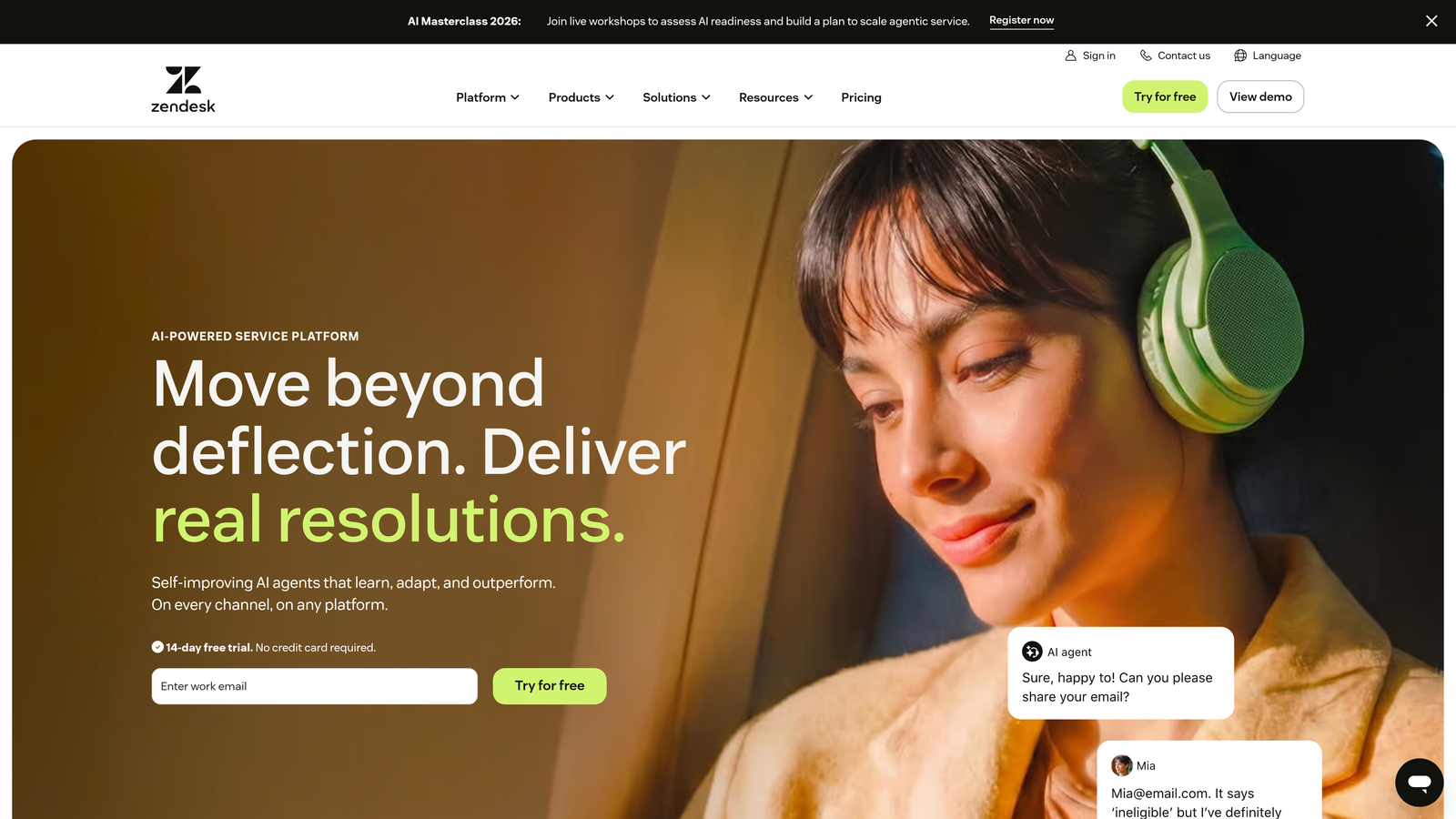
Zendesk has embedded AI agents across its Suite product following its acquisition of Ultimate.ai, making AI a native part of its ticketing, messaging, and self-service layers.
Where This Tool Shines
Zendesk's strength is its depth of ecosystem. If your organization runs on Zendesk, the AI agent integration is relatively seamless, and the enterprise-grade compliance and admin controls are genuinely mature. Intelligent triage and routing work within existing Zendesk workflows, reducing the learning curve for support teams already familiar with the platform.
The honest limitation is that AI still feels like an addition to legacy infrastructure rather than a native capability designed for autonomous operation. Teams evaluating Zendesk AI should weigh its ecosystem depth against the more autonomous resolution capabilities of AI-first platforms.
Key Features
Integrated AI Agents: AI resolution embedded across ticketing, messaging, and self-service within the Zendesk Suite.
Enterprise Compliance: Mature security, compliance, and admin controls suited for regulated industries and large organizations.
Intelligent Triage and Routing: Automatically routes tickets based on intent, sentiment, and urgency within existing Zendesk workflows.
Agent Copilot: Assists human agents in real time with suggested replies and contextual information.
Best For
Large enterprises already running Zendesk as their system of record for support. The switching costs are high in both directions, so this is best for teams committed to the Zendesk ecosystem rather than those evaluating a fresh start.
Pricing
Suite plans start at $55/agent/month. AI features vary by tier. See zendesk.com for current pricing.
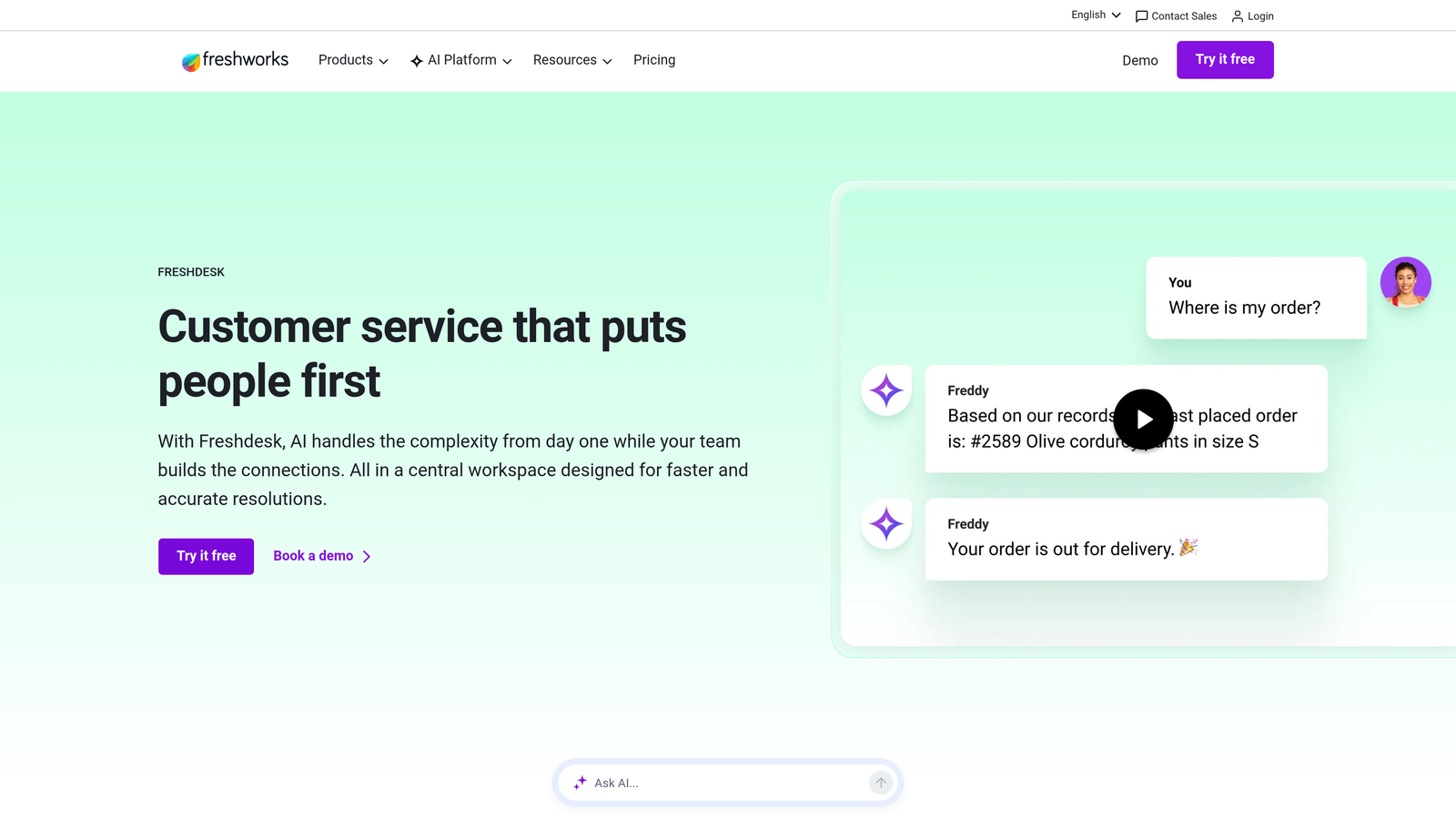
4. Freshdesk Freddy AI
Best for: SMB to mid-market teams on the Freshworks ecosystem looking for accessible AI-assisted support without enterprise pricing.
Freshdesk offers Freddy AI as its intelligence layer spanning ticketing, self-service, and agent assistance across the Freshworks product suite.
Where This Tool Shines
Freddy AI covers three distinct use cases within a single platform: customer-facing autonomous resolution, in-inbox agent assistance, and support analytics. For teams that want AI capabilities without managing multiple vendors, that breadth is genuinely useful. The pricing is also more accessible than Zendesk, making it a reasonable option for growing teams that aren't yet at enterprise scale.
Where Freddy AI is still maturing is in the depth of autonomous resolution compared to dedicated AI-first platforms. It works well within the Freshworks ecosystem but may not satisfy teams with complex B2B workflows that require deep integration across their entire business stack.
Key Features
Freddy Self Service: Handles customer-facing questions autonomously, reducing ticket volume before issues reach human agents.
Freddy Copilot: Provides in-inbox assistance for human agents, including suggested replies and contextual information.
Freddy Insights: Analytics layer for identifying support trends, resolution gaps, and knowledge base opportunities.
Freshdesk-Native Integration: Embedded across Freshdesk's existing ticketing infrastructure without requiring additional configuration.
Best For
SMB and mid-market teams already using or evaluating Freshworks products. A solid choice for teams that want AI-assisted support at accessible pricing, with the understanding that AI capabilities are still expanding relative to dedicated AI-first platforms.
Pricing
Freshdesk plans start at $15/agent/month. Freddy AI features are available on higher tiers. See freshworks.com for current pricing.
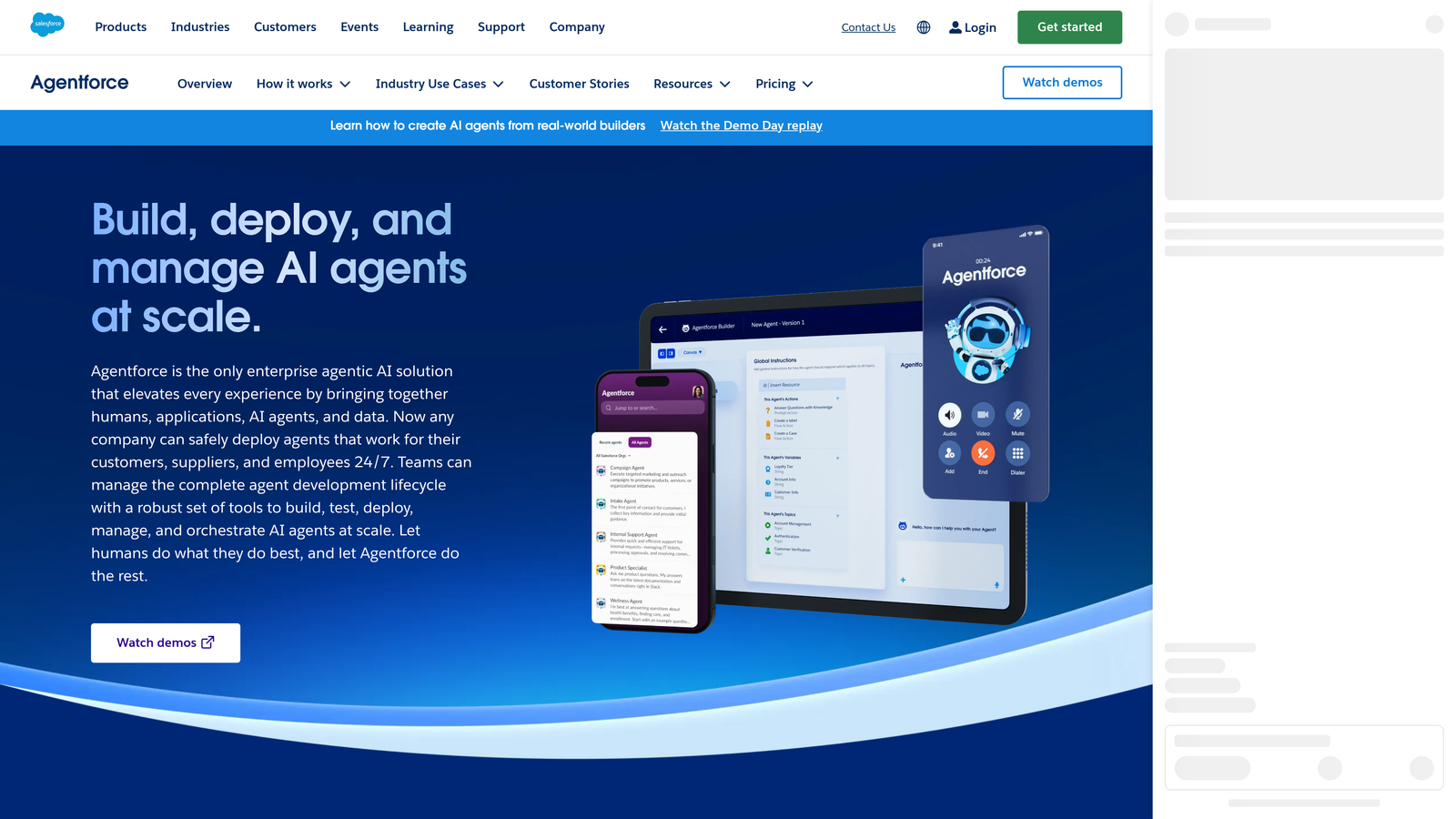
5. Salesforce Agentforce
Best for: Enterprise organizations running Salesforce as their system of record who want AI agents with full CRM context.
Salesforce Agentforce is Salesforce's autonomous AI agent platform, natively integrated with the full Salesforce CRM and Service Cloud ecosystem.
Where This Tool Shines
The core advantage of Agentforce is access to Salesforce's CRM data layer. When an AI agent can see a customer's full lifecycle, including deals, service history, and product usage, the quality of contextual decision-making improves significantly. Agents can take actions across Sales Cloud, Service Cloud, and Marketing Cloud, making Agentforce one of the more genuinely cross-functional AI agent platforms available.
The complexity and cost, however, are real considerations. Agentforce is built for enterprises already running Salesforce as a primary platform. Teams without Salesforce infrastructure will find the implementation overhead substantial, and smaller organizations may find the pricing prohibitive relative to more focused alternatives.
Key Features
Native CRM Data Access: AI agents operate with full Salesforce customer data context, enabling deeply informed autonomous decisions.
Cross-Cloud Actions: Agents can take actions across Sales Cloud, Service Cloud, and Marketing Cloud within a single platform.
Low-Code Agent Builder: Build and configure agents using Salesforce's Flow and Apex infrastructure without deep engineering resources.
Atlas Reasoning Engine: Powers multi-step autonomous decision making for complex support and service scenarios.
Best For
Enterprises already running Salesforce as their primary CRM and service platform. Not recommended for teams without existing Salesforce infrastructure, where the implementation complexity and cost will outweigh the benefits.
Pricing
Pricing varies by edition and usage volume. Contact Salesforce directly for enterprise quotes at salesforce.com/agentforce.
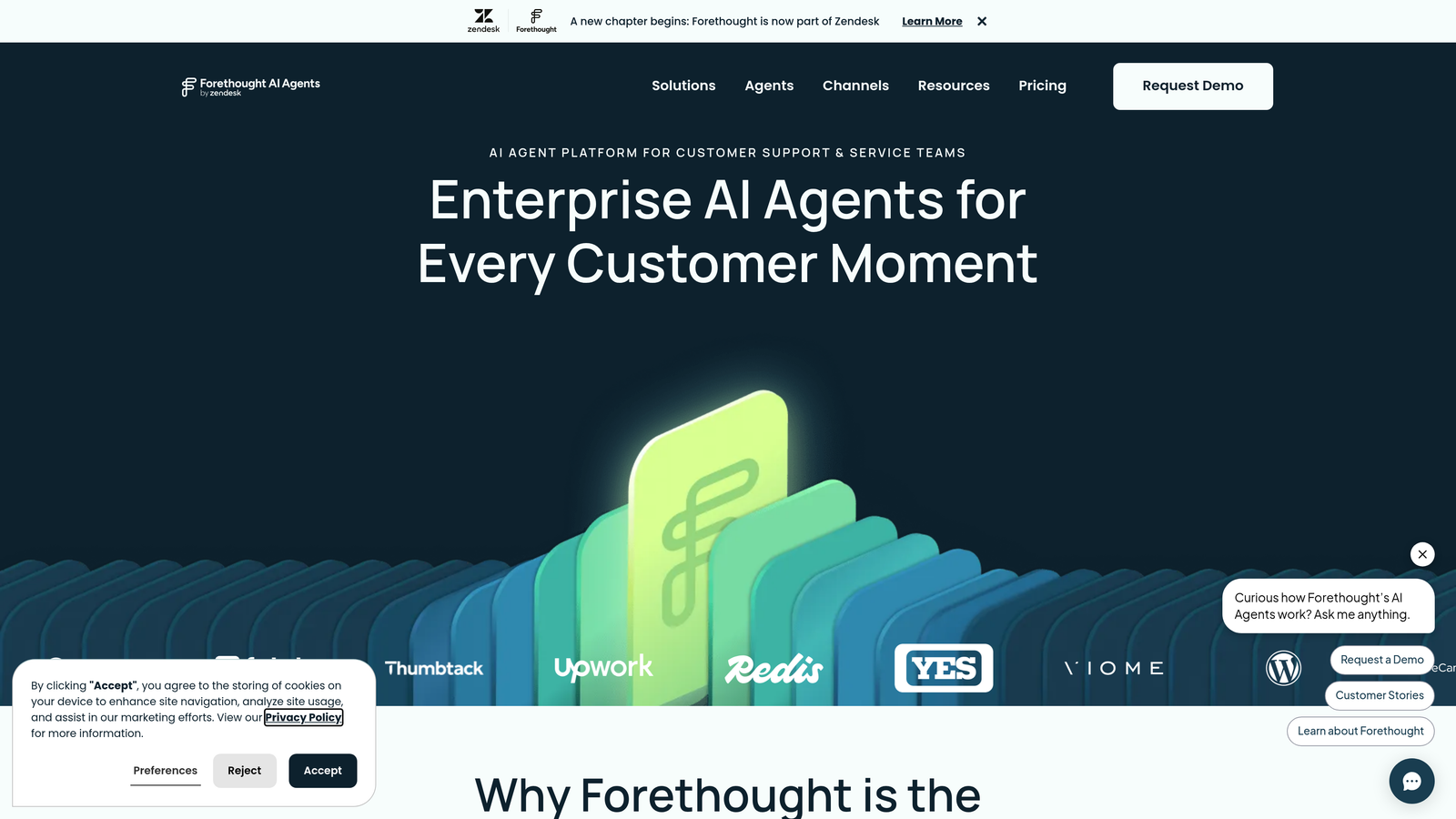
6. Forethought AI
Best for: Teams that want AI-powered triage, routing, and resolution without migrating away from their existing helpdesk platform.
Forethought AI positions itself as an intelligent AI layer that sits on top of existing helpdesk platforms, adding autonomous capabilities without requiring a full platform switch.
Where This Tool Shines
Forethought's key differentiator is its platform-agnostic approach. Rather than asking teams to rip and replace their helpdesk, it layers AI triage, routing, and resolution on top of Zendesk, Salesforce Service Cloud, or Freshdesk. For organizations with significant investment in an existing platform, this reduces migration risk considerably.
The Discover analytics module is a particularly useful addition, identifying resolution gaps and knowledge base opportunities from real ticket data. Teams can use these insights to improve both their AI agent performance and their human support workflows over time.
Key Features
Solve AI Agent: Handles autonomous ticket resolution using existing knowledge base and historical ticket data.
Triage: Intelligent routing and prioritization that directs tickets to the right agent or automated flow based on intent.
Helpdesk Compatibility: Works alongside Zendesk, Salesforce Service Cloud, and Freshdesk without replacing existing infrastructure.
Discover Analytics: Identifies resolution gaps and knowledge base opportunities from real support data.
Best For
Teams committed to their existing helpdesk platform who want to add AI resolution and triage capabilities without a full migration. A pragmatic choice for organizations where platform switching costs are prohibitive.
Pricing
Contact Forethought for pricing. See forethought.ai for details.
7. Ada
Best for: High-volume support operations that need multilingual, omnichannel AI automation with a no-code builder.
Ada is a dedicated AI agent platform designed for organizations handling large volumes of support across multiple channels and languages.
Where This Tool Shines
Ada has evolved significantly from its chatbot origins toward more autonomous agent capabilities. Its no-code builder allows support and operations teams to configure AI agents without engineering resources, which lowers the barrier to meaningful customization. The multilingual support is genuinely strong, making Ada a practical choice for global support operations where language coverage is a primary requirement.
Omnichannel deployment across web, mobile, SMS, and social gives Ada broad reach for teams managing customer interactions across multiple touchpoints. The platform suits both B2B and B2C use cases, though teams with highly complex B2B workflows may find they need deeper integration capabilities than Ada's standard offering provides.
Key Features
No-Code Agent Builder: Configure and customize AI agents without engineering resources, enabling support teams to own the setup process.
Multilingual Support: Handles conversations across a wide range of languages, suitable for global support operations.
Omnichannel Deployment: Deploy AI agents across web, mobile, SMS, and social channels from a single platform.
AI Reasoning Engine: Handles complex, multi-turn conversations that require contextual understanding across multiple exchanges.
Best For
Organizations with high support volume, multilingual requirements, or omnichannel needs that want a dedicated AI agent platform with accessible configuration. Strong for both B2B and B2C teams at scale.
Pricing
Contact Ada for pricing. See ada.cx for details.
8. Kustomer
Best for: Teams that want CRM-native AI agents powered by a unified customer history without the complexity of Salesforce.
Kustomer is a CRM-native customer service platform, owned by Meta, with AI agents built on a unified customer data layer.
Where This Tool Shines
Kustomer's unified customer timeline is its defining feature. Every interaction, order, and conversation is consolidated in one place, and AI agents use that full context when handling support requests. This is particularly valuable for teams where customer history directly influences how support should be handled, such as subscription businesses or high-touch B2B accounts.
Compared to Salesforce, Kustomer offers CRM depth with less implementation overhead, though it's still a more complex platform than lightweight AI-first tools. The omnichannel coverage across email, chat, social, and voice is solid, and the workflow automation capabilities handle complex support processes well.
Key Features
Unified Customer Timeline: Consolidates all interactions, orders, and conversations into a single view that powers AI decision-making.
CRM-Native AI Agents: AI agents operate with full customer context from the CRM layer, enabling more informed autonomous responses.
Omnichannel Support: Handles customer interactions across email, chat, social, and voice from one platform.
Workflow Automation: Supports complex support process automation beyond basic ticket routing and resolution.
Best For
Teams that need CRM-depth AI agents without the complexity or cost of Salesforce. Particularly strong for subscription businesses and teams where customer history is central to support quality.
Pricing
Plans start at $89/agent/month. See kustomer.com for current pricing.
9. Tidio (Lyro AI)
Best for: Early-stage SaaS teams and SMBs that want accessible AI-powered support without enterprise pricing or complexity.
Tidio combines live chat and AI in one accessible platform, with Lyro AI handling autonomous conversation resolution for smaller teams.
Where This Tool Shines
Tidio's primary strength is accessibility. Lyro AI handles common customer questions autonomously without requiring manual flow building or extensive configuration, which makes it genuinely usable for small teams without dedicated support operations staff. The setup is fast, and the combination of live chat and AI in one interface reduces the tooling complexity for early-stage teams.
The honest tradeoff is depth. Lyro AI works well for common, repeatable questions but isn't designed for the complex, multi-step B2B workflows that larger SaaS teams require. Teams that start with Tidio often find themselves evaluating more capable platforms as their support operation matures and ticket complexity increases.
Key Features
Lyro AI: Handles common customer questions autonomously without manual flow configuration, reducing setup time significantly.
Live Chat and AI in One Platform: Combines human and AI support in a single interface with straightforward setup.
SMB-Friendly Integrations: Connects with Shopify, WordPress, and common SMB tools out of the box.
Accessible Pricing: Entry-level pricing makes AI-powered support viable for teams with limited budgets.
Best For
Early-stage SaaS teams, SMBs, and e-commerce businesses that want to automate common support questions without enterprise complexity or cost. A strong starting point, with the expectation that growing teams may need to upgrade as their support needs evolve.
Pricing
Free plan available. Lyro AI starts from $29/month. See tidio.com for current pricing.
Which Platform Is Right for Your Team?
The right AI agent platform depends less on feature lists and more on where you are in your support journey and what infrastructure you're already running.
If you're an enterprise committed to Salesforce, Agentforce gives you AI agents with unmatched CRM context. If your team lives in Zendesk or Freshdesk and a platform migration isn't on the table, Forethought AI is a practical way to add intelligence without starting over. For teams embedded in Intercom, Fin AI Agent is the natural extension.
For early-stage teams with limited budgets, Tidio's Lyro AI offers a low-cost entry point that gets you moving quickly, even if you'll likely outgrow it.
But if you're a B2B SaaS team evaluating a fresh stack, or you've hit the ceiling of what a bolt-on AI layer can deliver, the distinction between AI-augmented helpdesks and AI-first platforms becomes critical. Platforms like Halo AI were built from the ground up for autonomous operation: page-aware context, continuous learning, business intelligence output, and integrations across your entire business stack rather than just your ticketing system.
Your support team shouldn't scale linearly with your customer base. Let AI agents handle routine tickets, guide users through your product, and surface business intelligence while your team focuses on complex issues that need a human touch. See Halo in action and discover how continuous learning transforms every interaction into smarter, faster support.