9 Best AI Chatbots for Customer Service in 2026
This guide evaluates nine purpose-built AI chatbots for customer service on resolution quality, integration depth, and scalability, helping support teams find the best AI chatbot for customer service whether they're managing a lean SaaS operation or high-volume helpdesk. Each solution goes beyond basic FAQ handling to offer autonomous ticket resolution, seamless agent handoffs, and actionable business intelligence.
 Matt PattoliFounder13 min read
Choosing the right AI chatbot for customer service is no longer just about answering FAQs. Today's best tools resolve tickets autonomously, guide users through complex workflows, hand off to live agents seamlessly, and surface business intelligence your support team can actually act on.
This guide covers nine AI chatbots built specifically for customer service, not general-purpose assistants repurposed for support. Each tool was evaluated on resolution quality, integration depth, learning capabilities, and how well it scales without inflating headcount.
Whether you're running a lean SaaS support team, managing a high-volume helpdesk, or trying to reduce ticket backlog without sacrificing customer experience, there's a solution here for your situation.
1. Halo AI
Best for: B2B SaaS teams that need autonomous ticket resolution and operational business intelligence.
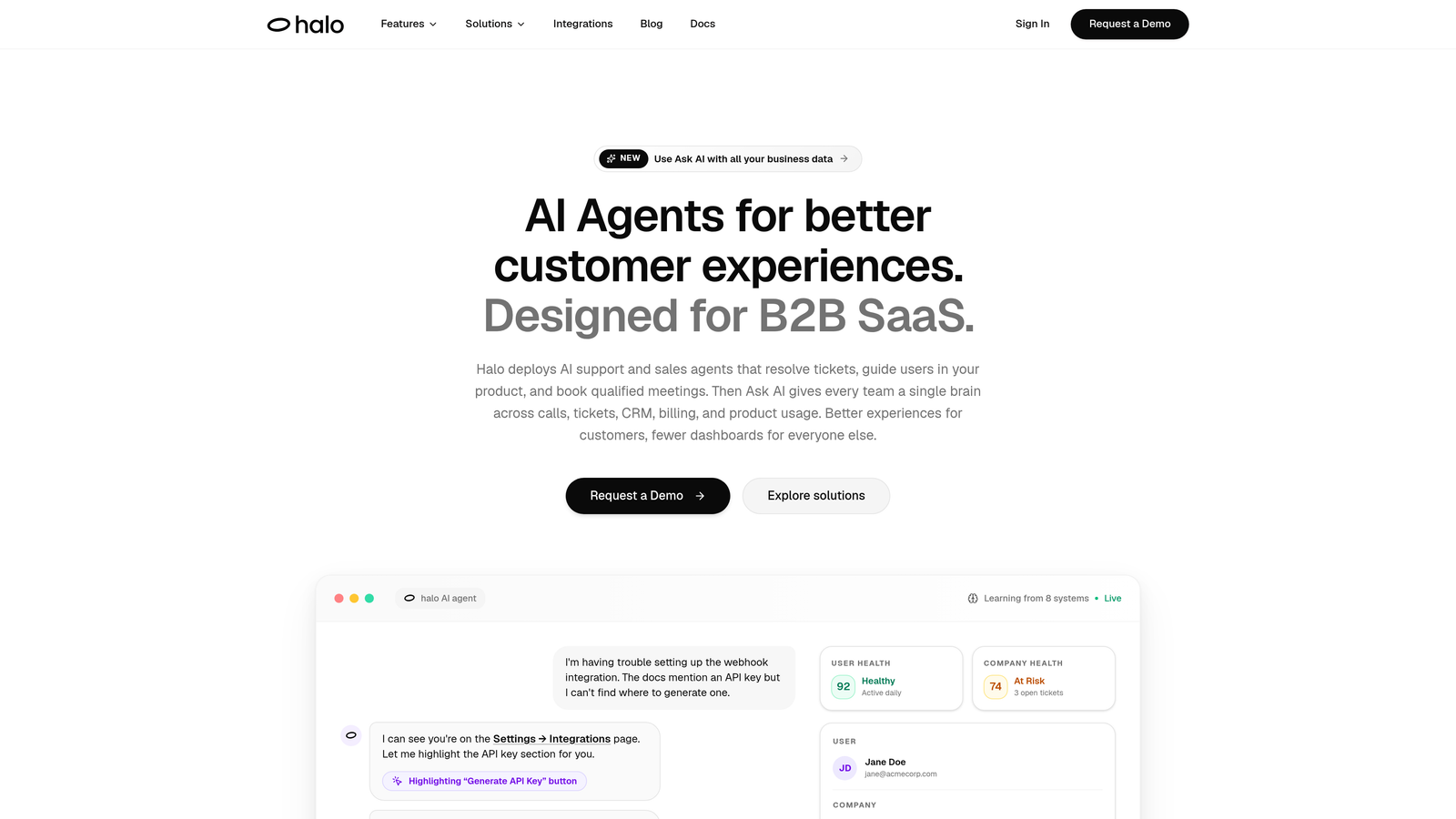
Halo AI is an AI-first customer support platform that deploys intelligent agents to resolve tickets, guide users through your product, and surface actionable business intelligence — all while learning continuously from every interaction.
Where This Tool Shines
What separates Halo from most tools on this list is its page-aware context. The chat widget actually sees what your user sees, allowing it to provide visual UI guidance rather than generic help center links. That's a meaningful difference when your users are stuck mid-workflow and need immediate, contextual assistance.
Beyond resolution, Halo's smart inbox surfaces customer health signals, revenue anomalies, and trend detection — turning your support queue into a source of business intelligence. For SaaS teams where churn signals often appear in support conversations first, this is genuinely useful rather than just a dashboard feature.
Key Features
Page-Aware Chat Widget: The AI sees the user's current page and UI state, enabling precise visual guidance rather than generic instructions.
Autonomous Ticket Resolution: AI agents handle tickets end-to-end, with continuous learning from past interactions improving resolution quality over time.
Auto Bug Ticket Creation: Product issues are automatically detected and routed as bug tickets directly to engineering tools like Linear, closing the loop between support and product.
Smart Inbox with Business Intelligence: Surfaces customer health signals, revenue anomalies, and emerging trends from within your support data.
Live Agent Handoff: Complex issues escalate to human agents with full conversation context preserved, so nothing gets repeated.
Integration Depth: Connects with Slack, HubSpot, Intercom, Stripe, Zoom, PandaDoc, and Fathom out of the box.
Best For
B2B SaaS companies that want more than deflection from their support AI. Halo is particularly well-suited for product-led growth teams where support, product feedback, and customer health are tightly interconnected. If you need your support layer to feed intelligence back into the business, this is worth a close look.
Pricing
Contact Halo AI for pricing. Given its AI-first architecture and business intelligence capabilities, it's positioned for teams with meaningful support volume and complexity.
2. Intercom Fin
Best for: Teams already using Intercom who want native AI resolution without a separate tool.
Intercom Fin is Intercom's dedicated AI agent, built to resolve support conversations natively within the Intercom Messenger using large language models trained on your support content.
Where This Tool Shines
Fin's biggest advantage is how naturally it fits into an existing Intercom setup. There's no separate platform to manage, no complex integration to configure. If your team already lives in Intercom, Fin activates within the environment your agents already know.
The conversation quality is strong. Fin uses LLMs trained on your help center and support documentation, which means its responses tend to be contextually accurate rather than generic. The consumption-based pricing model is also worth noting: you pay per resolution rather than per seat, which can work in your favor if you have variable support volume.
Key Features
LLM-Powered Resolution: Trained on your help center and support docs for contextually accurate, natural responses.
Native Messenger Integration: Works directly within Intercom's Messenger with no separate setup required.
Consumption-Based Pricing: Pay per resolution rather than per seat, aligning cost with actual value delivered.
Smooth Human Handoff: Escalates to live agents within the same conversation thread, preserving full context.
Multilingual Support: Handles conversations in multiple languages out of the box.
Best For
Teams already invested in Intercom's ecosystem. If you're not on Intercom, the value proposition weakens considerably since Fin is designed to complement the broader Intercom platform rather than stand alone.
Pricing
Approximately $0.99 per resolution plus your existing Intercom plan. Verify current pricing directly with Intercom, as consumption-based models can vary.
3. Zendesk AI Agents
Best for: Enterprise support teams with established Zendesk infrastructure looking to automate at scale.
Zendesk AI Agents is Zendesk's AI layer across its Suite platform, offering autonomous ticket resolution, intelligent triage, and agent-assist capabilities for large support operations.
Where This Tool Shines
Zendesk AI's strength is breadth. It operates across email, chat, voice, and social channels within a single suite, making it practical for enterprise teams that manage high-volume, omnichannel support. The intelligent triage and routing capabilities are particularly mature, having been refined across a large customer base over several years.
Agent Copilot is a standout feature for teams that aren't ready for full automation. It surfaces suggested replies and next-best-action guidance to human agents, improving consistency and speed without removing the human from the loop entirely.
Key Features
AI Agents: Automated end-to-end ticket resolution across channels without agent involvement for eligible queries.
Intelligent Triage and Routing: Automatically categorizes and routes incoming tickets based on intent, sentiment, and priority.
Agent Copilot: Provides suggested replies, summaries, and next-best-action recommendations for live agents.
Deep Suite Integration: Works natively across Zendesk's email, chat, voice, and social channels.
Advanced Analytics and QA: AI-powered quality assurance and reporting tools built into the platform.
Best For
Enterprise support teams with significant Zendesk investment and the operational complexity to justify the platform's depth. Less compelling for smaller teams or those not already in the Zendesk ecosystem.
Pricing
Included in higher Suite tiers; Suite plans start around $55 per agent per month with AI features available at elevated tiers. Verify current pricing with Zendesk directly.
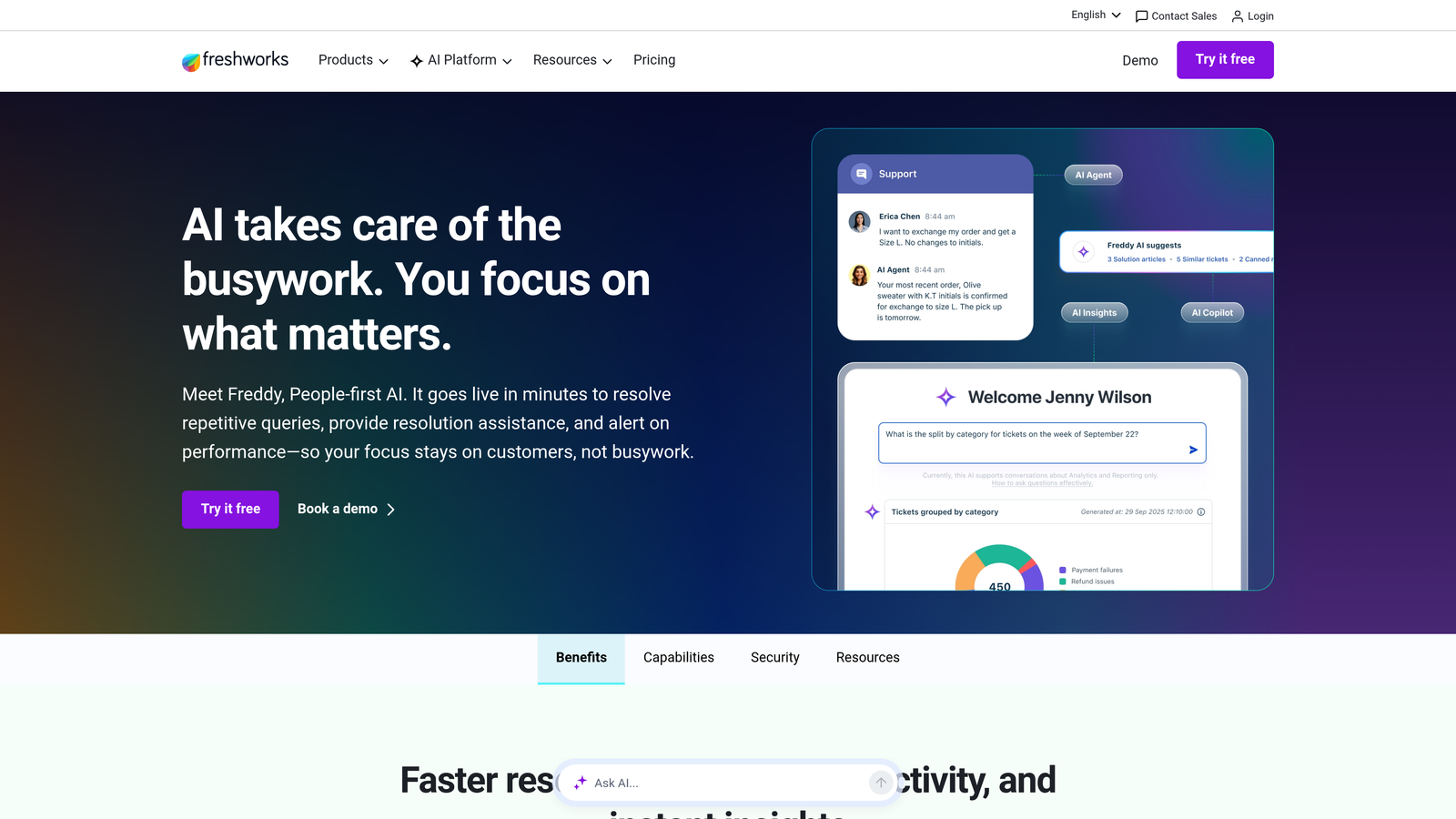
4. Freshdesk Freddy AI
Best for: Growing SMB and mid-market teams that want AI-powered support at accessible price points.
Freshdesk Freddy AI is Freshworks' AI platform embedded across Freshdesk, offering self-service bots, agent assist, and AI-generated analytics without the enterprise price tag.
Where This Tool Shines
Freddy AI is modular in a way that lets teams adopt AI incrementally. You can start with Freddy Self Service for basic bot deflection, layer in Freddy Copilot for agent productivity, and add Freddy Insights for analytics as your needs grow. This staged approach suits teams that aren't ready to go all-in on autonomous resolution immediately.
The no-code bot builder is genuinely accessible. Teams without technical resources can configure custom conversation flows without developer involvement, which accelerates time to value for resource-constrained support organizations.
Key Features
Freddy Self Service: AI bot that handles common queries without agent involvement, deployable via the no-code builder.
Freddy Copilot: Real-time suggestions, response summaries, and assistance for live agents during active conversations.
Freddy Insights: AI-generated analytics, trend detection, and performance reporting built into the dashboard.
No-Code Bot Builder: Visual flow builder for creating custom conversation paths without engineering resources.
Cross-Product Integration: Works across Freshdesk, Freshchat, and Freshservice within the Freshworks ecosystem.
Best For
SMB and mid-market teams looking for meaningful AI capabilities without enterprise pricing. Also a strong fit for teams already using multiple Freshworks products who want a unified AI layer.
Pricing
Freshdesk offers a free plan; paid plans start around $15 per agent per month with Freddy AI add-ons priced separately. Verify current pricing with Freshworks before committing.
5. Tidio
Best for: Small businesses and e-commerce brands that need fast AI chatbot deployment without technical complexity.
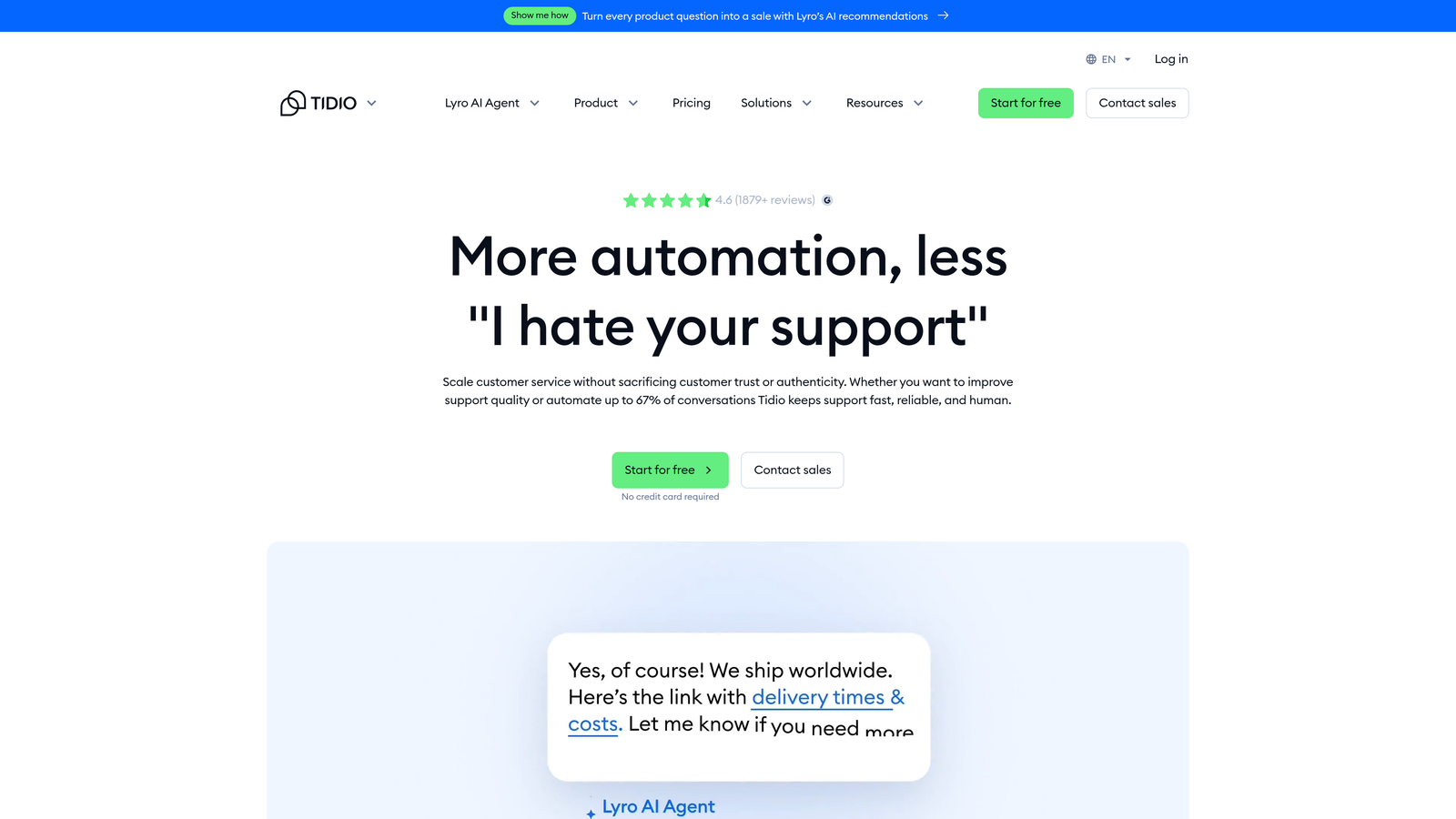
Tidio is a live chat and AI chatbot platform featuring Lyro, an LLM-powered AI agent designed for rapid deployment and accessible pricing.
Where This Tool Shines
Tidio's core advantage is speed to value. The visual chatbot builder, pre-built templates, and native Shopify and WooCommerce integrations mean an e-commerce team can have an AI chatbot handling customer queries within hours, not weeks. For small teams without dedicated technical resources, that matters.
Lyro, Tidio's AI agent, handles conversational support queries trained on your existing support content. It's not the most sophisticated resolution engine on this list, but for the volume and complexity typical of small business support, it covers a lot of ground effectively.
Key Features
Lyro AI: LLM-powered conversational agent trained on your support content for natural, accurate responses.
Visual Chatbot Builder: Drag-and-drop builder with pre-built templates for fast deployment without coding.
E-Commerce Integrations: Native Shopify and WooCommerce integrations for order status, returns, and product queries.
Unified Inbox: Live chat, email, and social messaging managed from a single inbox.
Accessible Pricing: Free plan available with paid AI tiers designed for small team budgets.
Best For
Small businesses, Shopify merchants, and e-commerce brands with moderate support volume. Less suited for complex B2B support scenarios or teams needing deep CRM and business tool integrations.
Pricing
Free plan available; Lyro AI starts around $29 per month. Verify current pricing on the Tidio website before purchasing.
6. Drift (Salesloft)
Best for: B2B teams where customer support and sales qualification happen in the same conversation.
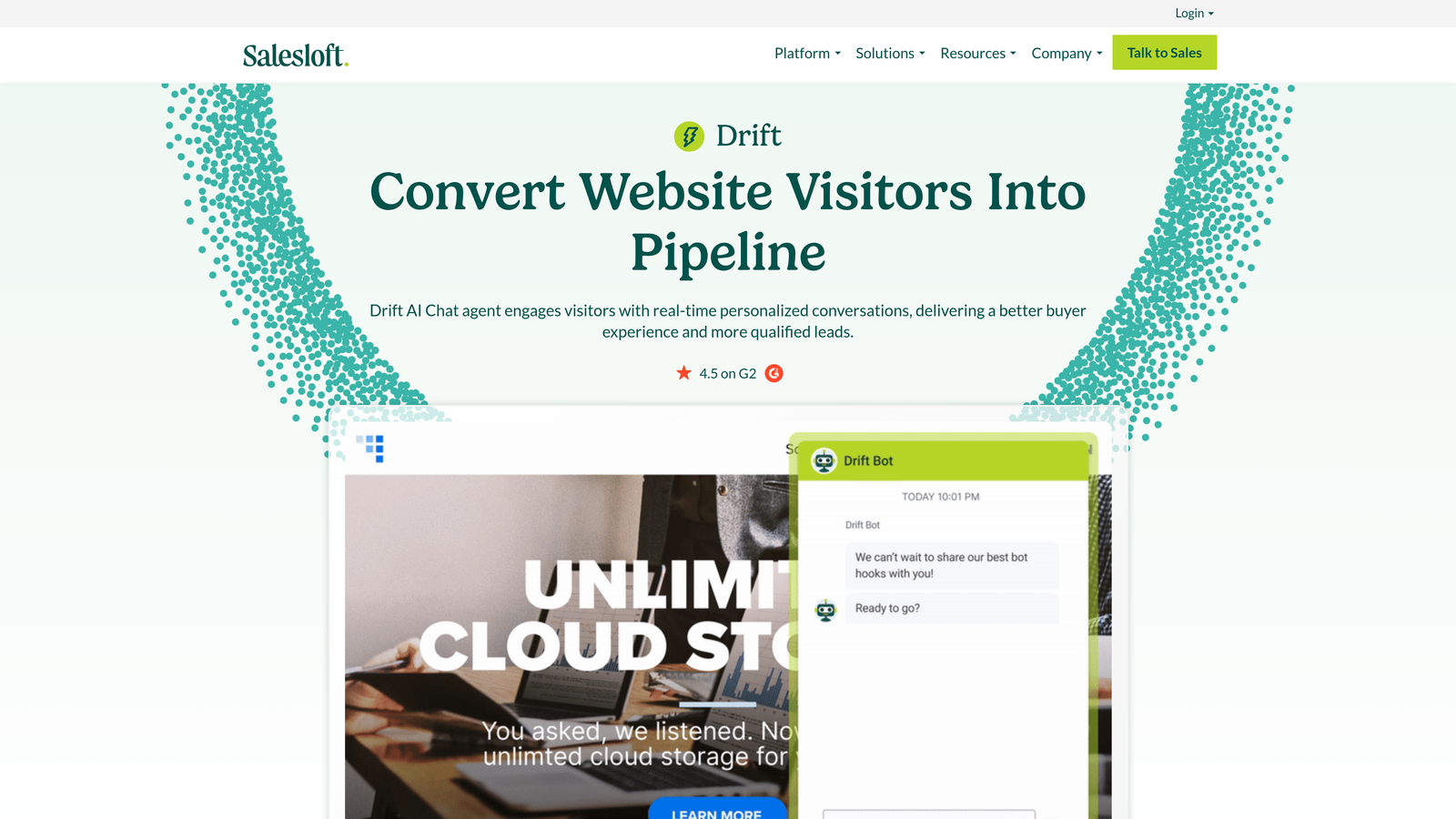
Drift, now part of Salesloft, is a conversational platform that blends AI-powered support with sales qualification, designed for revenue-focused B2B teams.
Where This Tool Shines
Drift occupies a unique position on this list: it's less a pure support tool and more a revenue-and-support hybrid. For B2B companies where a prospect's first conversation might be a support question that turns into a sales opportunity, Drift's ability to handle both motions in a single platform is genuinely useful.
The meeting booking and routing functionality built directly into conversation flows is a standout. Instead of routing support queries to a queue, Drift can route qualified buyers to a sales rep's calendar in the same interaction. That's a workflow most pure-play support tools can't replicate.
Key Features
Dual-Purpose AI: Handles inbound support queries and sales qualification within the same conversation interface.
Meeting Booking and Routing: Books sales meetings and routes qualified prospects directly from chat conversations.
Buyer Intent Signals: Real-time signals that help sales teams identify and prioritize high-intent website visitors.
CRM Integrations: Native integration with Salesforce, HubSpot, and major CRM platforms.
Personalized Playbooks: Audience-segmented conversation flows tailored by visitor type, account size, or intent.
Best For
B2B companies with overlapping support and revenue motions, particularly those where customer-facing conversations directly influence pipeline. Less suitable for teams focused purely on support resolution efficiency.
Pricing
Premium pricing; contact Salesloft/Drift directly for a current quote, as pricing varies significantly by company size and feature requirements.
7. Kustomer
Best for: D2C and subscription brands that need a unified customer history view across every support channel.
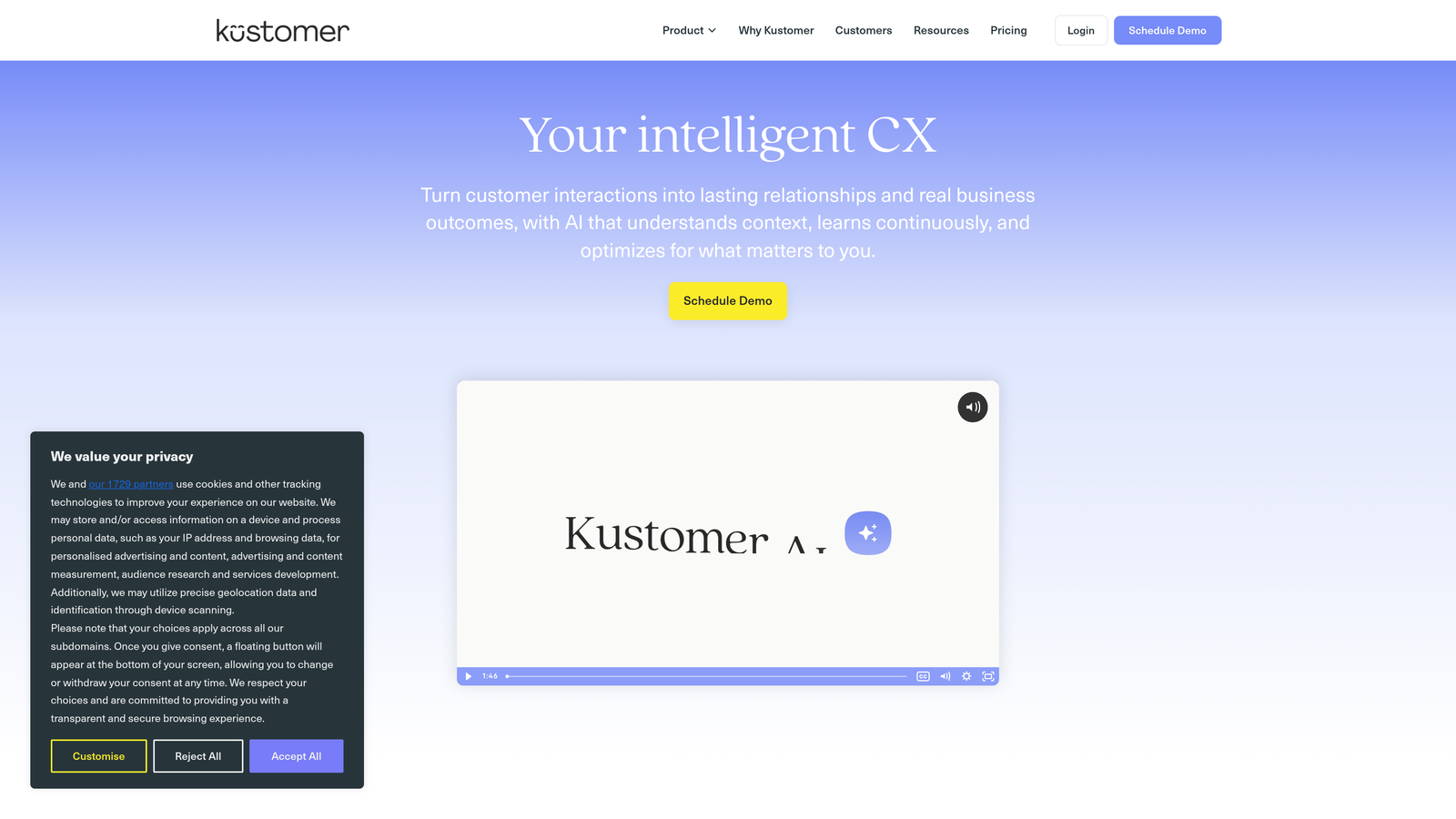
Kustomer is a CRM-first customer service platform with AI automation layered on top, known for its unified customer timeline that gives both agents and AI complete context on every interaction.
Where This Tool Shines
Kustomer's unified timeline is the feature that genuinely differentiates it. Rather than siloed tickets, every interaction across email, chat, voice, SMS, and social appears in a single chronological view tied to the customer record. For brands with complex customer histories, this context transforms both AI resolution quality and agent effectiveness.
The AI capabilities sit on top of this rich data foundation, which means routing decisions, suggested replies, and conversation summaries are informed by a more complete picture of the customer than most platforms can access. That depth is particularly valuable for subscription businesses where customer lifetime value and history matter.
Key Features
Unified Customer Timeline: Full interaction history across every channel in a single, chronological customer view.
AI-Powered Routing and Suggestions: Intelligent routing, suggested replies, and conversation summaries informed by complete customer context.
Omnichannel Support: Email, chat, voice, SMS, and social managed from a single platform.
Workflow Automation: Configurable automation for repetitive support processes and escalation paths.
Strong D2C Fit: Built for brands with complex customer data, subscription models, and high-volume transactional support.
Best For
D2C brands, subscription businesses, and retailers with complex customer histories and omnichannel support needs. Enterprise pricing makes it less accessible for smaller teams.
Pricing
Enterprise pricing starting around $89 per agent per month. Verify current pricing with Kustomer directly, as enterprise contracts often include custom terms.
8. Chatbase
Best for: Technical teams and developers who want full control over AI chatbot behavior and training data.
Chatbase is a developer-friendly platform for building custom AI chatbots trained on your own data, including PDFs, URLs, Notion pages, and Google Docs, with granular control over behavior and deployment.
Where This Tool Shines
Chatbase is the most DIY option on this list, and that's precisely its value for the right team. If you have specific training data, a defined AI persona, and technical resources to configure integrations, Chatbase gives you a level of customization that out-of-the-box platforms simply can't match.
The ability to train on diverse data sources — not just a help center but internal documentation, product specs, PDFs, and live URLs — means the AI can be genuinely knowledgeable about niche or complex topics. For product teams building support into their own applications via API, this flexibility is a significant advantage.
Key Features
Custom Training Data: Train AI on PDFs, URLs, Notion, Google Docs, and other proprietary data sources.
Embeddable Widget: Deploy a chat widget on any website without platform lock-in.
API Access: Full API for building custom integrations and embedding AI into existing workflows or products.
Adjustable AI Persona: Configure tone, response boundaries, and personality to match your brand voice.
Conversation Analytics: Dashboard for reviewing conversations and identifying gaps in AI knowledge or coverage.
Best For
Product teams, developers, and technical founders who want to build a highly customized AI support experience. Less suitable for non-technical teams looking for a plug-and-play solution with minimal configuration.
Pricing
Free plan available; paid plans start around $19 per month. Verify current pricing on the Chatbase website, as plans and limits change regularly.
9. Zoho SalesIQ
Best for: Teams standardized on the Zoho ecosystem looking for deeply integrated live chat and AI chatbot capabilities.
Zoho SalesIQ is Zoho's live chat and AI chatbot product, offering tight integration with Zoho CRM and Zoho Desk alongside competitive pricing for teams already within the Zoho stack.
Where This Tool Shines
SalesIQ's value is almost entirely a function of your existing tech stack. If your team runs on Zoho CRM, Zoho Desk, and Zoho Analytics, SalesIQ integrates natively in ways that third-party tools simply can't replicate without custom configuration. The data flows cleanly, the context carries across products, and the pricing stays within a predictable Zoho budget.
Zobot, SalesIQ's AI bot builder, offers both no-code and code-based options — a practical middle ground for teams with mixed technical capabilities. Visitor tracking and proactive chat triggers add a layer of engagement that goes beyond reactive support.
Key Features
Zobot AI Builder: No-code and code-based bot builder supporting both simple flows and complex custom logic.
Native Zoho Integration: Deep integration with Zoho CRM, Zoho Desk, and Zoho Analytics without third-party connectors.
Visitor Tracking: Real-time visitor behavior tracking with proactive chat triggers based on page activity.
Mobile SDK: In-app support capabilities for mobile applications via native SDK.
Competitive Pricing: Among the most affordable options on this list, especially within an existing Zoho subscription.
Best For
Teams already standardized on Zoho products. Outside the Zoho ecosystem, SalesIQ's integration advantages largely disappear, making other options on this list more compelling for non-Zoho teams.
Pricing
Free plan available; paid plans start around $7 per operator per month. Verify current pricing with Zoho, as bundled Zoho One pricing may offer better value for multi-product users.
Which Tool Is Right for Your Team
The right AI chatbot for customer service depends less on feature lists and more on where your team is today and what you need it to do tomorrow.
For B2B SaaS teams that need genuine autonomous resolution, business intelligence from support data, and an AI that improves with every interaction, Halo AI is the strongest starting point. Its page-aware context and smart inbox capabilities go beyond what most support tools offer, making it particularly valuable for product-led teams where support and customer health are closely connected.
If you're already deeply invested in Intercom, Zendesk, or Freshdesk, evaluate their native AI options first. Intercom Fin, Zendesk AI Agents, and Freshdesk Freddy AI all offer meaningful resolution capabilities within ecosystems you've already built workflows around. Switching platforms has a real cost, and the native options have matured considerably.
Small businesses and e-commerce teams will find Tidio the fastest path to value. The deployment friction is low, the Shopify integration is solid, and the pricing doesn't require a budget conversation. For Zoho-standardized teams, SalesIQ offers comparable ease within that ecosystem.
Drift makes sense if your support and sales motions overlap significantly. Kustomer is worth the investment for D2C and subscription brands with complex customer histories. Chatbase is the right call when you need maximum control over AI behavior and have the technical resources to configure it properly.
Your support team shouldn't scale linearly with your customer base. Let AI agents handle routine tickets, guide users through your product, and surface business intelligence while your team focuses on complex issues that need a human touch. See Halo in action and discover how continuous learning transforms every interaction into smarter, faster support.