9 Best AI Chatbots for SaaS in 2026
This guide evaluates the 9 best AI chatbots for SaaS in 2026, focusing on tools built for complex technical conversations, CRM integrations, and intelligent escalation rather than generic web chat. Each chatbot is assessed on AI capability, SaaS-relevant integrations, deployment ease, and support for both self-serve users and seamless human handoff.
 Grant CooperFounder14 min read
Choosing the right AI chatbot for your SaaS product isn't just about deflecting tickets. It's about creating support experiences that retain customers, surface product insights, and scale without ballooning headcount. The problem is that most chatbot tools were built for e-commerce or generic web chat, not the nuanced, technical conversations SaaS users actually need.
Features like context-aware guidance, CRM integrations, and intelligent escalation matter far more than a slick widget. This list focuses specifically on AI chatbots built for (or well-suited to) SaaS environments: tools that handle complex product questions, integrate with your existing stack, and give your team actionable intelligence.
We've evaluated each tool on depth of AI capability, SaaS-relevant integrations, ease of deployment, and how well it supports both self-serve users and human handoff. Whether you're a lean startup or a scaling B2B platform, there's a right fit here.
1. Halo AI
Best for: SaaS teams wanting AI-first architecture with page-aware context and cross-stack business intelligence.
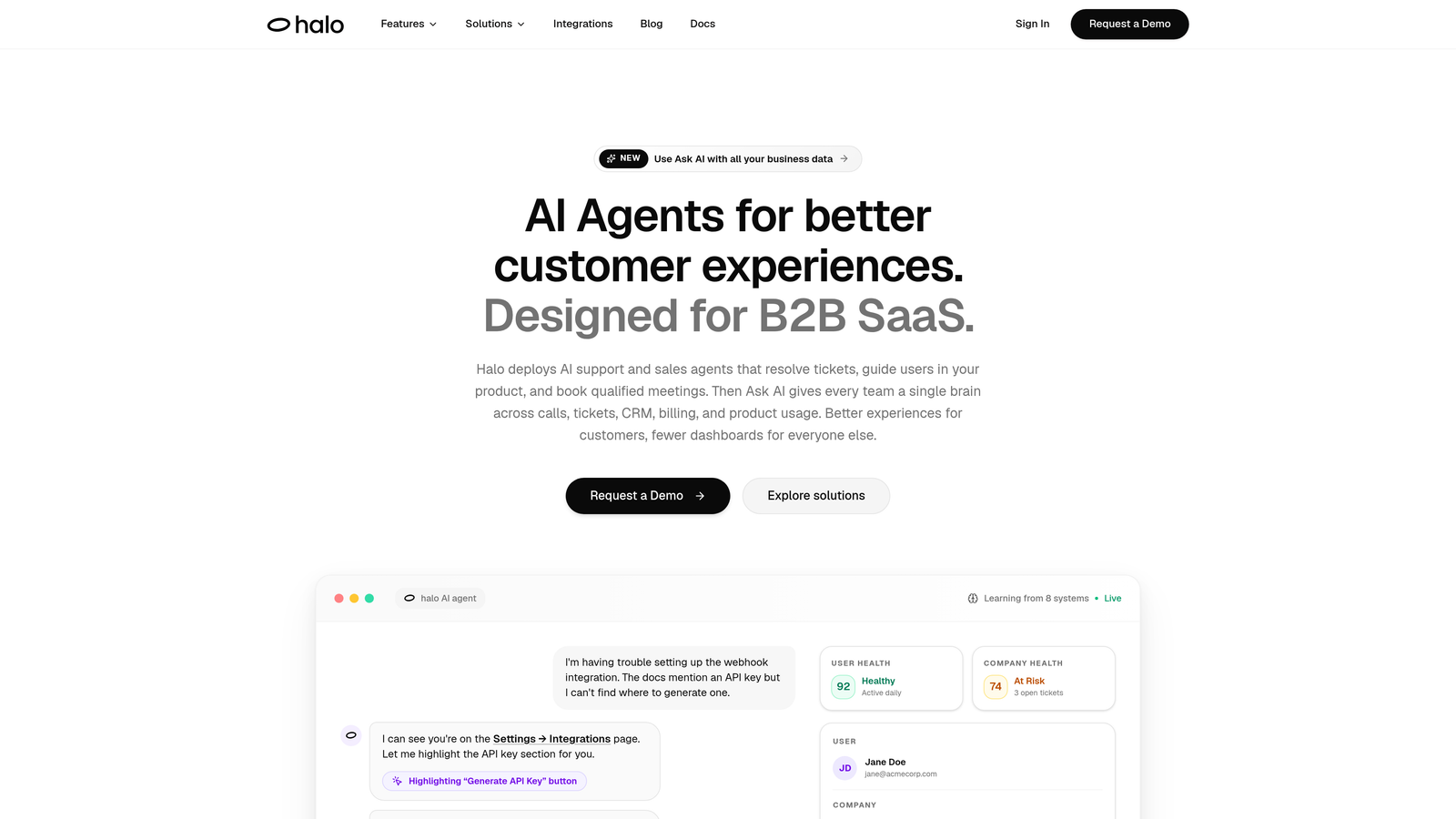
Halo AI is an AI-first customer support platform purpose-built for SaaS teams that need more than a basic chatbot.
Where This Tool Shines
Most AI chatbots are bolted onto existing helpdesks as an afterthought. Halo AI was designed from the ground up with AI at its core, which changes what's possible. The standout capability is its page-aware chat widget: it sees exactly what your user sees in the product and can provide visual UI guidance specific to that context. That's a meaningful difference when your users are asking "how do I do X" while staring at a specific screen.
Beyond resolution, Halo surfaces business intelligence that most support tools simply don't offer. Its smart inbox analyzes conversations for customer health signals, anomaly detection, and revenue intelligence, turning your support queue into a strategic data source. It also learns continuously from every resolved interaction, which means the system gets smarter over time without manual retraining.
Key Features
Page-Aware Chat Widget: Understands the user's current location in your product and delivers contextually relevant guidance, including visual UI walkthroughs.
Intelligent Ticket Resolution: Resolves support tickets autonomously using continuous learning from past interactions, improving accuracy with every conversation.
Auto Bug Ticket Creation: Automatically identifies and routes bug reports to Linear or your preferred project management tool without requiring manual triage.
Smart Inbox with Business Intelligence: Surfaces customer health signals, revenue intelligence, and anomaly detection directly from support data.
Live Agent Handoff: Escalates to human agents with full conversation context preserved, so customers never have to repeat themselves.
Deep Integrations: Connects natively with Linear, Slack, HubSpot, Intercom, Stripe, Zoom, PandaDoc, and Fathom.
Best For
SaaS product teams and B2B companies that want an AI-first support layer with genuine business intelligence capabilities. Particularly well-suited to teams using a mix of tools (CRM, project management, billing) who need their support platform to connect the dots across their entire stack.
Pricing
Contact for pricing via haloagents.ai. A demo is available to explore the full platform before committing.
2. Intercom Fin
Best for: Teams already invested in Intercom who want AI resolution without switching platforms.
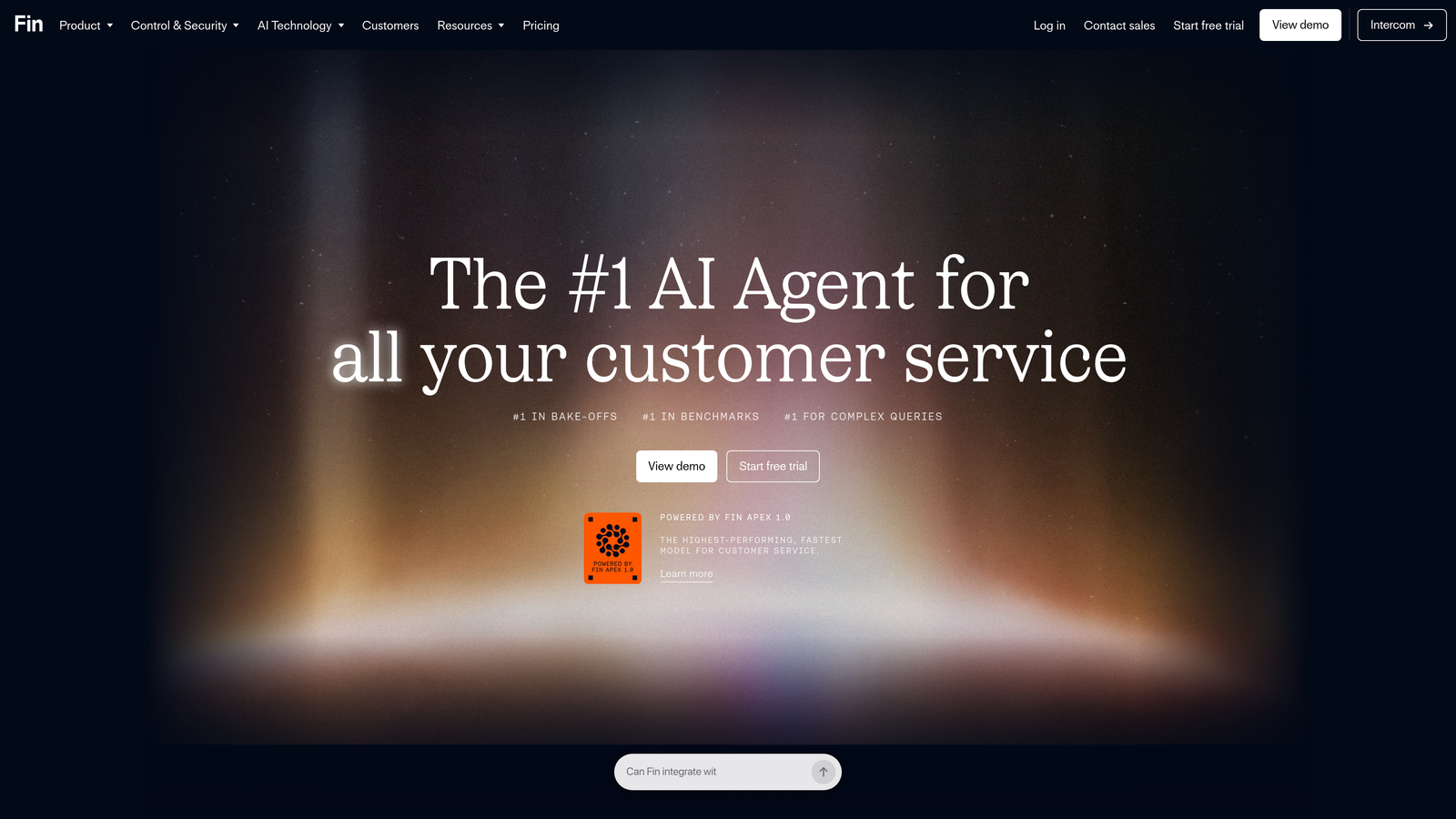
Intercom Fin is Intercom's native AI resolution bot, powered by large language models, that answers support questions directly from your help center content.
Where This Tool Shines
If your team is already running on Intercom, Fin is the lowest-friction path to AI-powered resolution. It draws answers from your existing help center articles without requiring you to retrain a model or rebuild your knowledge base. The handoff experience is particularly smooth: when Fin can't resolve something, it escalates within the same Intercom thread so the customer experience stays seamless.
Fin performs best on products with well-documented help content. The quality of its answers scales directly with the quality and coverage of your knowledge base, which is both its strength (no black box) and its ceiling (gaps in docs mean gaps in resolution).
Key Features
LLM-Powered Answers: Generates accurate, conversational responses drawn from your existing help center articles rather than rigid decision trees.
Seamless Human Handoff: Escalates to live agents within the same Intercom conversation thread, preserving full context.
Resolution-Based Pricing: You pay for what gets resolved, which aligns costs with actual value delivered.
Multilingual Support: Handles conversations in multiple languages, useful for global SaaS products.
Native Intercom Integration: Works within Intercom's full customer communications platform without additional setup or middleware.
Best For
SaaS companies already using Intercom as their primary support and messaging platform. Less compelling if you're not already in the Intercom ecosystem, since the value is tightly coupled to that infrastructure.
Pricing
Resolution-based pricing model layered on top of an existing Intercom subscription. Verify current rates at intercom.com, as pricing structures evolve frequently.
3. Zendesk AI
Best for: High-volume enterprise support teams running on Zendesk Suite who need AI across the full ticket lifecycle.
Zendesk AI is Zendesk's built-in AI layer, offering automated resolution, intelligent triage, and an agent copilot across its Suite.
Where This Tool Shines
Zendesk AI's strength is breadth. It touches every part of the support workflow: autonomous resolution on the customer-facing side, intelligent triage and routing in the middle, and suggested replies plus next-best-action prompts for human agents. For enterprises processing thousands of tickets a week, having AI assist at every stage compounds efficiency gains quickly.
The agent copilot feature is particularly useful for SaaS teams with complex products. It surfaces relevant context and suggested responses in real time, helping newer agents handle technical questions more confidently without escalating unnecessarily.
Key Features
AI Agents: Handles automated ticket resolution at scale using your knowledge base and historical ticket data.
Intelligent Triage and Routing: Classifies incoming tickets by intent and sentiment, routing them to the right team or agent automatically.
Agent Copilot: Provides suggested replies, ticket summaries, and next-best-action guidance to human agents in real time.
Zendesk Ecosystem Integrations: Pre-built connections across the full Zendesk Suite including Guide, Talk, and Explore.
Advanced Analytics and QA: Tracks resolution rates, CSAT, and quality assurance metrics with AI-assisted review.
Best For
Mid-market to enterprise SaaS companies already running on Zendesk Suite. If you're not on Zendesk, the switching cost makes this less attractive as a standalone AI solution.
Pricing
AI features are included in higher-tier Zendesk Suite plans, with AI agent capabilities also available as add-ons. Verify current tier inclusions at zendesk.com.
4. Freshdesk Freddy AI
Best for: SMB and mid-market SaaS teams on Freshdesk wanting a full AI suite without enterprise-level pricing.
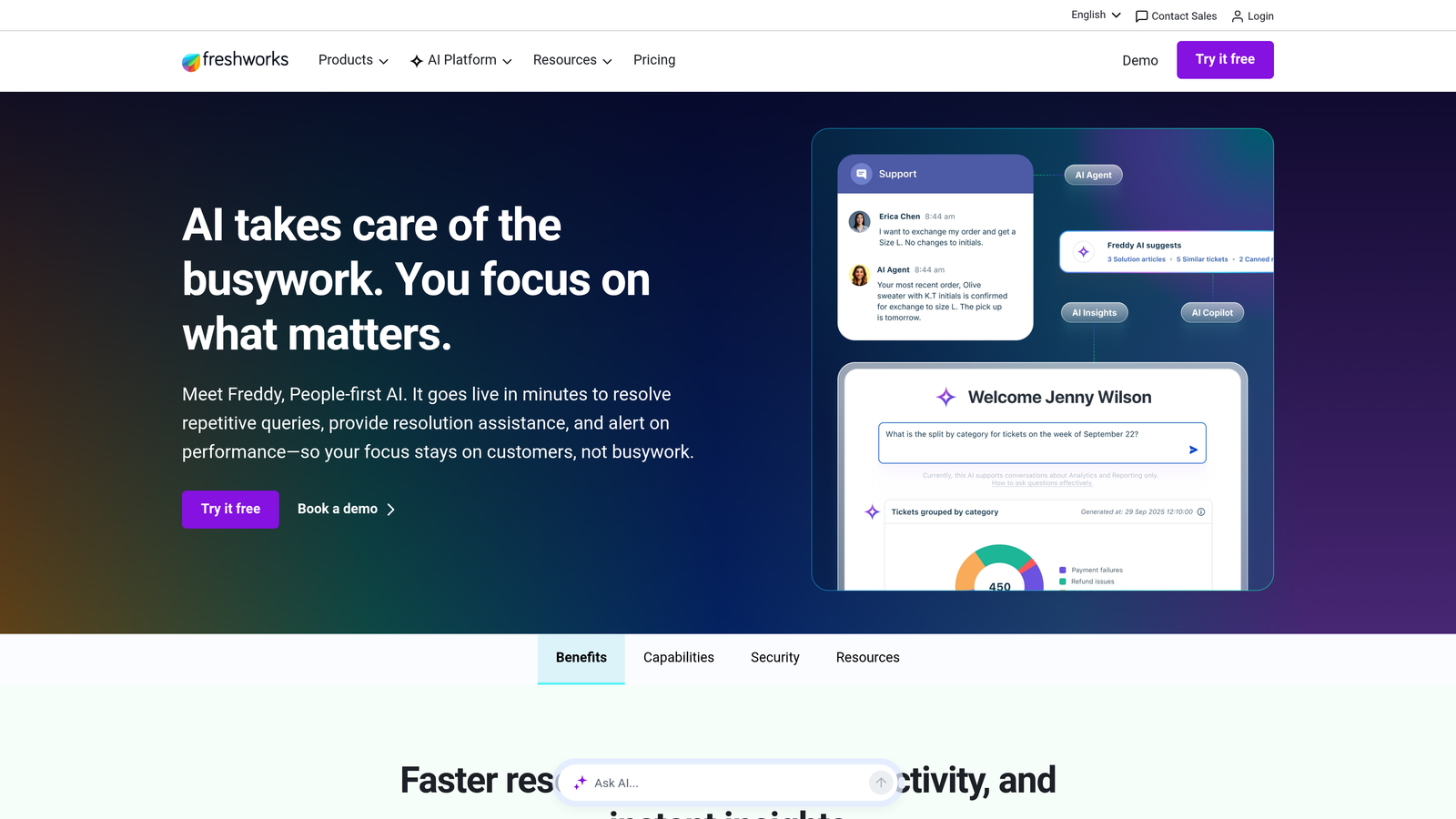
Freshdesk Freddy AI is Freshworks' AI suite combining a self-service chatbot, agent copilot, and AI-powered analytics under one brand.
Where This Tool Shines
Freddy AI covers three distinct layers: customer-facing resolution through Freddy Self Service, agent-assist through Freddy Copilot, and operational intelligence through Freddy Insights. That full-stack coverage at accessible pricing tiers makes it a strong option for growing SaaS teams that aren't ready for enterprise-level spend.
Freddy Insights is worth highlighting specifically. Its anomaly detection capability flags unusual patterns in your support volume or customer behavior, which gives SaaS teams an early warning system for product issues or onboarding friction before they escalate.
Key Features
Freddy Self Service: Customer-facing chatbot that autonomously resolves common questions using your help content.
Freddy Copilot: Agent assist with suggested replies, ticket summarization, and tone adjustment to speed up human resolution.
Freddy Insights: AI-powered analytics with anomaly detection and proactive recommendations for support workflow optimization.
Native Freshworks Ecosystem: Deep integration across Freshdesk, Freshsales, and the broader Freshworks stack.
Accessible Pricing Tiers: Structured to be viable for smaller teams, not just enterprise budgets.
Best For
SMB to mid-market SaaS companies using Freshdesk who want AI across the full support workflow without migrating platforms. Also a good fit for teams that value built-in analytics alongside resolution capability.
Pricing
Freddy Copilot is available as an add-on from approximately $29 per agent per month. Verify current rates and tier inclusions at freshworks.com before committing.
5. Drift
Best for: B2B SaaS teams where inbound sales and support conversations happen through the same channel.
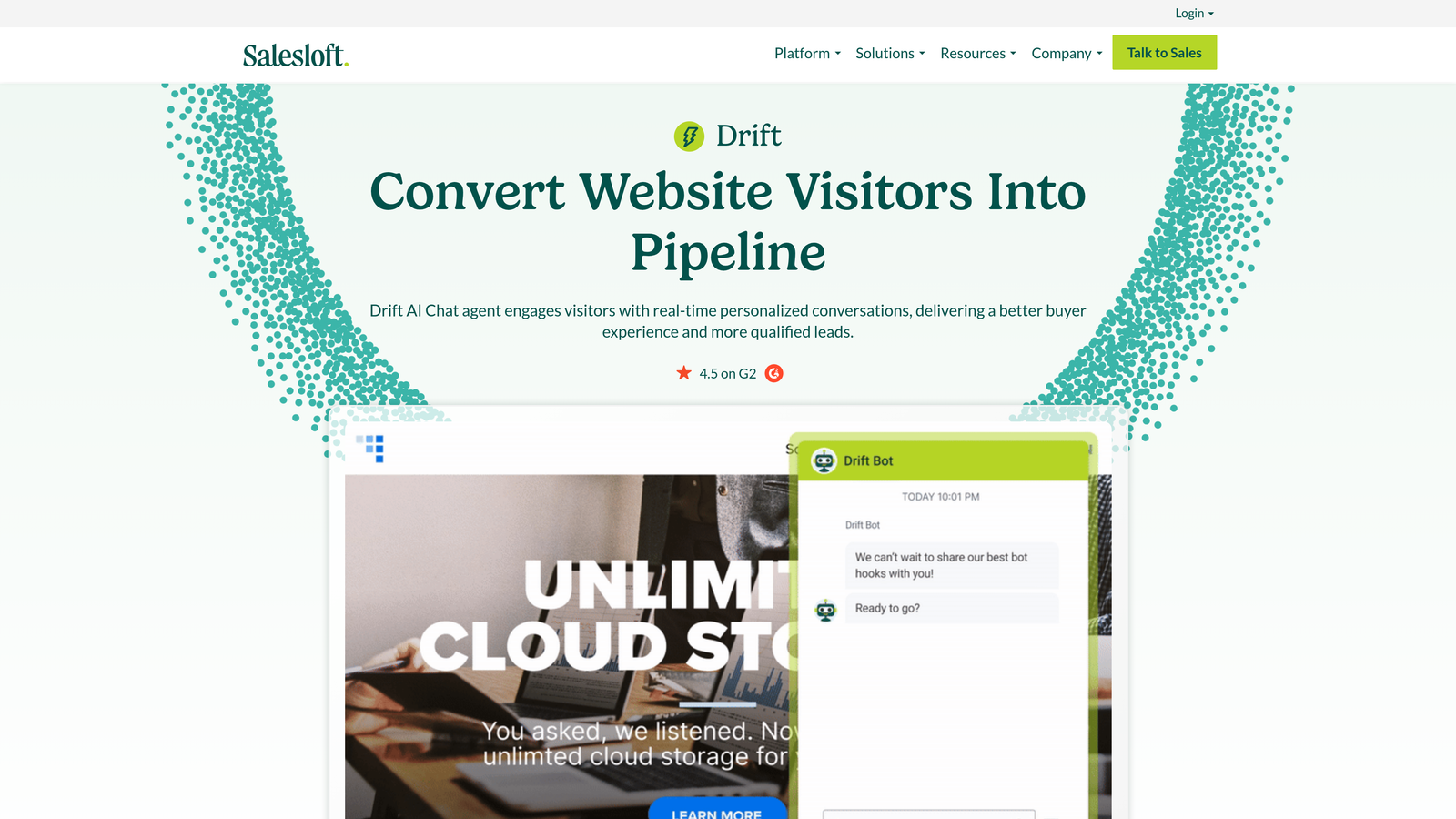
Drift (now part of Salesloft) is a conversational platform that uses AI to handle both inbound sales qualification and support queries from a single chat widget.
Where This Tool Shines
Drift occupies a unique position in this list: it's not purely a support tool. For B2B SaaS companies where prospects and existing customers both land on the same website and ask questions through the same widget, Drift's ability to route conversations intelligently between sales and support workflows is genuinely useful. The AI can qualify a lead, book a demo, and handle a billing question within the same interface.
The playbook-based automation is mature and flexible. Teams can build sophisticated conversation flows that handle common support scenarios while simultaneously nurturing pipeline, without requiring two separate tools or two separate widgets on the page.
Key Features
Unified Sales and Support AI: Handles both inbound lead qualification and support resolution from a single chat interface.
Meeting Scheduling: Books demos and sales calls directly within the chat flow, routing to the right rep automatically.
Playbook Automation: Configurable conversation flows for common support and sales scenarios without heavy coding.
CRM Integrations: Deep connections with Salesforce and HubSpot for pipeline tracking and customer context.
Real-Time Agent Takeover: Allows sales or support reps to join high-value conversations live.
Best For
B2B SaaS companies with significant inbound traffic where sales and support needs overlap. Less ideal for pure-play support automation where you don't need the sales layer.
Pricing
Enterprise pricing model; contact Drift's sales team for current rates. Pricing has historically been positioned at the higher end of the market.
6. Tidio
Best for: Early-stage SaaS teams or budget-conscious companies needing fast AI chatbot deployment with minimal setup.
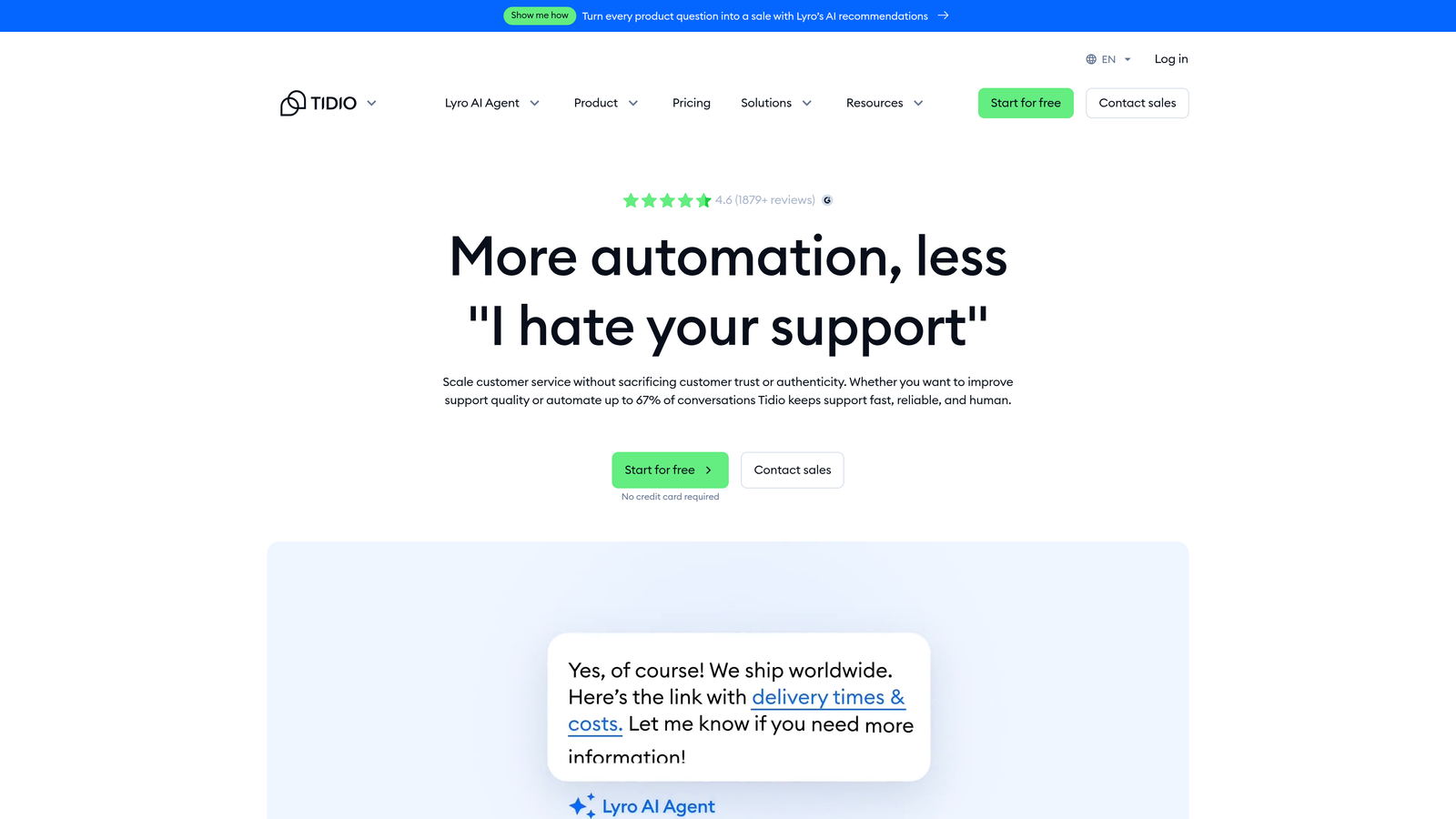
Tidio offers Lyro, its AI agent designed to autonomously handle support conversations using your existing help content, known for fast setup and accessible pricing.
Where This Tool Shines
Tidio's core appeal is speed to value. You can have Lyro trained on your support content and deployed as an embedded widget in a matter of hours, not weeks. For early-stage SaaS teams that need AI-assisted support without a lengthy implementation project, that time-to-deployment advantage is meaningful.
The no-code flow builder also makes it easy for non-technical team members to create custom conversation paths for specific scenarios, like onboarding sequences or common troubleshooting flows, without engineering involvement.
Key Features
Lyro AI Agent: Trains on your support content and handles common questions autonomously without manual flow-building for every scenario.
No-Code Flow Builder: Visual builder for creating custom conversation paths and automated sequences without coding.
Live Chat with Takeover: Seamless handoff to human agents when Lyro reaches its limits or the user requests a person.
Platform Integrations: Connects with Shopify, WordPress, and a range of SaaS tools, though integration depth is lighter than enterprise alternatives.
Free Tier: Available for teams just getting started, lowering the barrier to testing AI-assisted support.
Best For
Early-stage or bootstrapped SaaS teams, product-led growth companies with straightforward support needs, and anyone who needs to get an AI chatbot live quickly without a complex implementation.
Pricing
Free tier available. Lyro AI starts from approximately $29 per month. Verify current plan details at tidio.com, as pricing and feature inclusions change regularly.
7. Forethought
Best for: Enterprise SaaS teams that need AI capabilities on top of an existing helpdesk without migrating platforms.
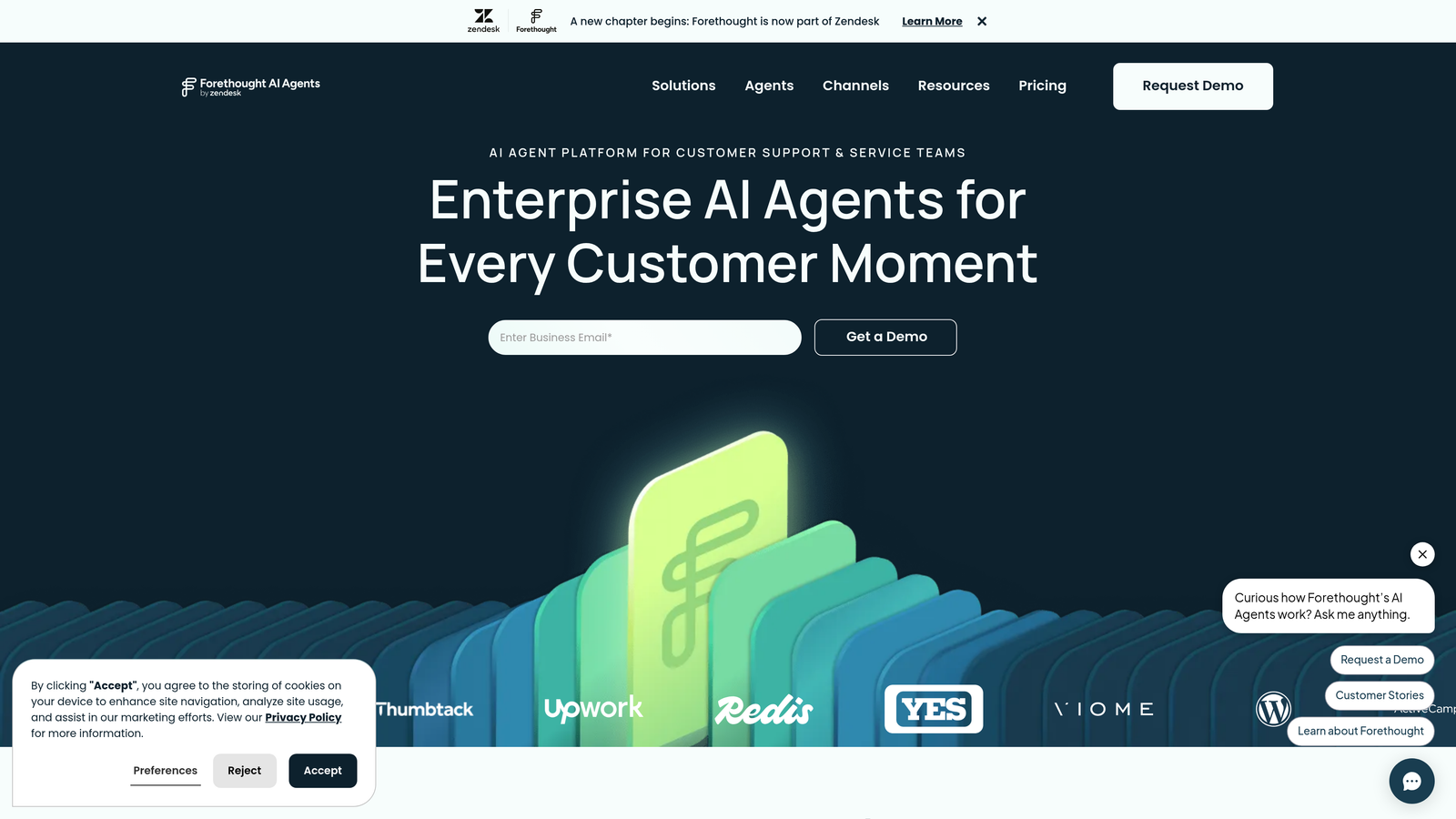
Forethought is a platform-agnostic AI layer that enhances your existing helpdesk with intelligent triage, routing, and resolution.
Where This Tool Shines
Forethought's defining characteristic is that it doesn't require you to replace your helpdesk. It sits on top of Zendesk, Salesforce Service Cloud, Freshdesk, and others, adding AI capability without a platform migration. For enterprise SaaS companies with years of ticket history and deeply embedded helpdesk workflows, that's often the only viable path to AI adoption.
The Discover AI component is particularly valuable for SaaS teams. It analyzes your support workflows to identify inefficiencies, automation opportunities, and patterns that your team might not surface manually. Think of it as an AI consultant reviewing your support operations continuously.
Key Features
Platform-Agnostic AI Layer: Works on top of Zendesk, Salesforce Service Cloud, Freshdesk, and other major helpdesks without replacing them.
Solve AI: Customer-facing autonomous resolution for common support questions.
Assist AI: Agent copilot with contextual suggestions and next-best-action guidance for human agents.
Discover AI: Workflow analytics that identify automation opportunities and inefficiencies in your support operations.
No Migration Required: Preserves existing helpdesk infrastructure, data, and workflows while adding AI on top.
Best For
Enterprise SaaS companies with established helpdesk infrastructure they can't or won't replace, particularly those on Zendesk or Salesforce Service Cloud looking to add AI without a full platform switch.
Pricing
Enterprise pricing; contact Forethought's sales team for current rates. Positioned for mid-market to enterprise budgets.
8. Chatbase
Best for: SaaS teams that need a knowledge-base-trained AI chatbot deployed quickly with minimal technical overhead.
Chatbase lets you build a GPT-powered chatbot by uploading your documentation, PDFs, or URLs, making it one of the fastest paths from zero to deployed AI chatbot.
Where This Tool Shines
Chatbase occupies the lightweight end of this list, and that's not a criticism. For SaaS teams with a solid documentation library that just need an AI interface in front of it, Chatbase removes almost all the friction. Upload your docs, configure the widget, embed it in your product or website, and you're live. The GPT-4 powered responses include source citations, which builds user trust and makes it easy to identify knowledge gaps.
The API access is worth noting for product teams that want to integrate Chatbase responses into custom interfaces or internal tools rather than using the standard embeddable widget.
Key Features
Fast Training on Your Content: Upload docs, PDFs, URLs, or plain text and have a trained chatbot ready in minutes.
Embeddable Widget: Drop into your website or product with minimal code; customizable to match your brand.
API Access: Integrate Chatbase responses into custom interfaces, internal tools, or existing workflows.
GPT-4 Responses with Citations: Answers reference source documents, helping users trust the output and helping teams spot documentation gaps.
Lead Capture and Analytics: Basic conversation analytics and lead capture forms built into the platform.
Best For
SaaS teams with comprehensive documentation who need an AI chatbot deployed quickly and affordably. Less suited to complex action-taking scenarios or teams that need deep CRM and helpdesk integrations.
Pricing
Free tier available. Paid plans start from approximately $19 per month. Verify current plan details at chatbase.co before purchasing.
9. Ada
Best for: Enterprise SaaS companies that need AI agents to take actions, not just answer questions.
Ada is an enterprise-grade no-code AI agent platform that goes beyond answering questions: it can execute tasks like processing account changes, making it suited to complex SaaS support automation.
Where This Tool Shines
Most AI chatbots on this list are fundamentally Q&A tools: they answer questions, resolve tickets, and hand off to humans. Ada goes further. Its action-oriented architecture means the AI agent can actually do things: update account settings, process refunds, modify subscription plans, or trigger workflows in connected systems. For SaaS companies with high volumes of transactional support requests, that capability dramatically changes the automation ceiling.
The no-code builder makes this accessible to customer experience teams without requiring engineering resources for every new automation. Governance and audit trail features make Ada particularly relevant for SaaS companies in regulated industries where AI actions need to be tracked and reviewable.
Key Features
Action-Oriented AI: Executes tasks like account updates, refunds, and subscription changes, not just Q&A responses.
No-Code Agent Builder: Non-technical teams can build and modify AI agent workflows without engineering involvement.
Multilingual Support: Handles conversations across many languages for global SaaS products.
Enterprise Integrations: Deep connections with enterprise CRMs, billing systems, and helpdesks for action execution.
Governance and Compliance: Audit trails, permission controls, and compliance features suited to regulated industries.
Best For
Enterprise SaaS companies with high volumes of transactional support requests (account changes, billing adjustments, subscription modifications) where AI needs to act, not just respond. Also well-suited to regulated industries requiring governance and audit capabilities.
Pricing
Enterprise pricing; contact Ada's sales team for current rates. Positioned for larger organizations with complex automation requirements.
Which Tool Is Right for Your SaaS Team?
The right AI chatbot depends less on which tool has the most features and more on where you are as a company and what your support actually needs to do.
Here's a quick way to think through the decision:
Enterprise teams on Zendesk or Freshdesk: Zendesk AI and Freddy AI are the natural choices. They add AI capability without disrupting your existing infrastructure, and the native integration depth is hard to replicate with third-party tools.
Can't migrate your helpdesk but need AI now: Forethought is built for exactly this scenario. It layers on top of your existing Zendesk, Salesforce, or Freshdesk setup without requiring a platform change.
B2B SaaS with overlapping sales and support traffic: Drift handles both in a single widget, which matters when your prospects and customers land in the same place and ask similar questions.
Early-stage or budget-conscious teams: Tidio and Chatbase both offer free tiers and fast deployment. Tidio is stronger for live chat workflows; Chatbase is better if your primary need is putting AI in front of your documentation.
Enterprise automation with action-taking requirements: Ada is the standout here. If your support team spends significant time on transactional requests that could be automated end-to-end, Ada's action-oriented architecture creates a different category of efficiency.
SaaS teams wanting AI-first architecture with genuine business intelligence: Halo AI is the option built specifically for this. Page-aware context, continuous learning, auto bug ticket creation, and a smart inbox that surfaces customer health signals and revenue intelligence go well beyond what most support chatbots offer. It's not just resolving tickets; it's turning your support layer into a strategic asset.
Your support team shouldn't scale linearly with your customer base. Let AI agents handle routine tickets, guide users through your product, and surface business intelligence while your team focuses on complex issues that need a human touch. See Halo in action and discover how continuous learning transforms every interaction into smarter, faster support.