9 Best AI Customer Service Platforms in 2026
Choosing the best AI customer service platform in 2026 means evaluating solutions that go far beyond basic chatbots—today's top tools autonomously resolve tickets, integrate deeply with existing stacks, and hand off intelligently to human agents. This guide compares nine leading platforms across autonomy, learning capability, and B2B SaaS fit to help support teams scale efficiently without growing headcount.
 Matt PattoliFounder13 min read
AI customer service platforms have moved well beyond simple chatbots. Today's leading solutions resolve tickets autonomously, guide users through complex workflows, surface business intelligence, and hand off seamlessly to human agents when needed. For B2B teams managing growing support volumes without proportionally growing headcount, choosing the right platform is a critical infrastructure decision, not just a tooling preference.
This guide covers the best AI customer service platforms available in 2026, evaluated on autonomy, integration depth, learning capability, and value for B2B SaaS and product teams. Whether you're replacing a legacy helpdesk, augmenting an existing Zendesk setup, or building a support stack from scratch, this list gives you a clear picture of what each platform does best — and who it's built for.
1. Halo AI
Best for: B2B SaaS teams wanting an AI-first platform that learns continuously and integrates deeply
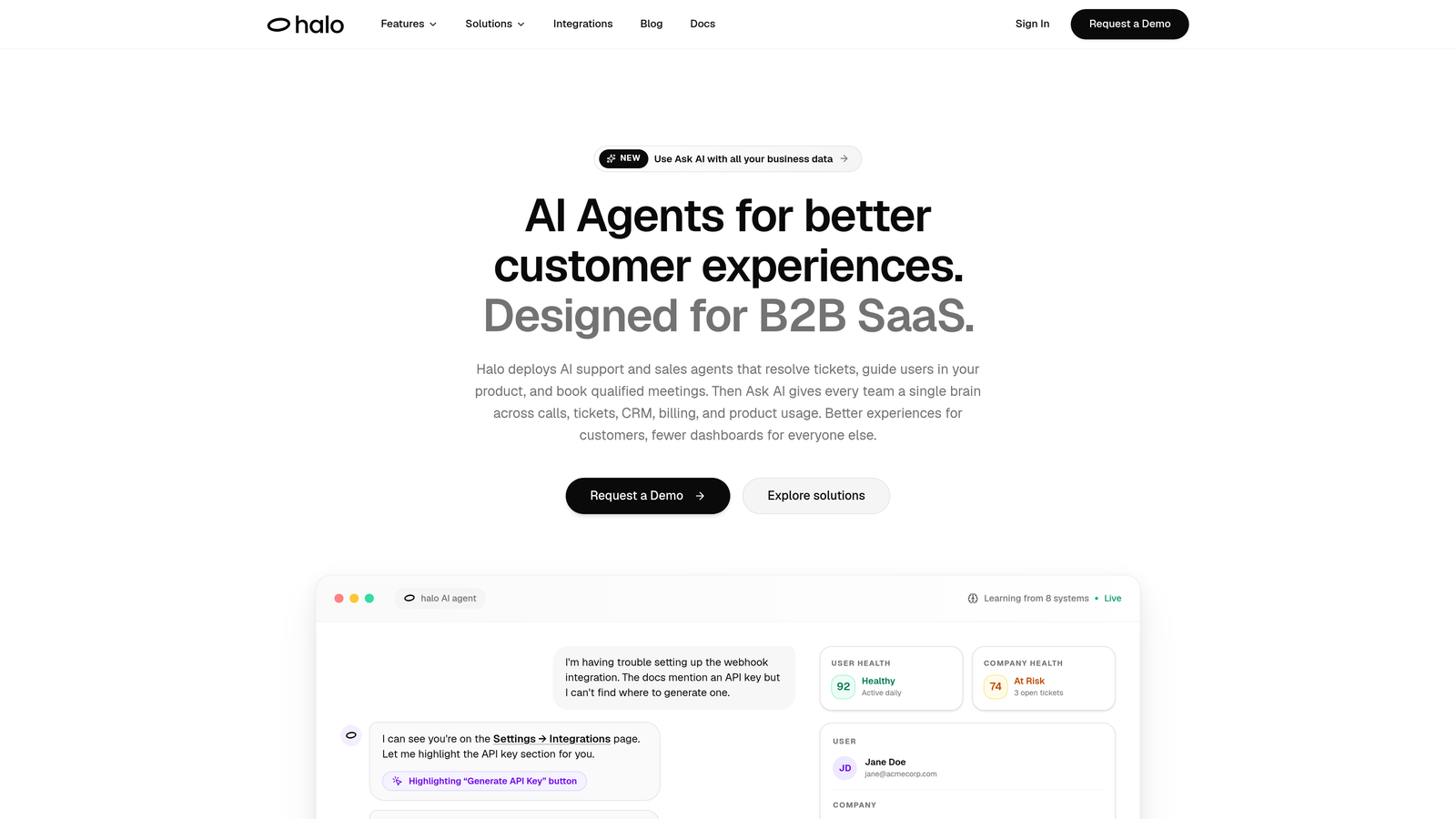
Halo AI is an AI-first customer support platform built specifically for B2B SaaS teams that need autonomous ticket resolution, contextual user guidance, and business intelligence in one place.
Where This Tool Shines
What separates Halo from most platforms on this list is its architecture. It wasn't built by adding AI features onto a legacy helpdesk. It was designed AI-first, which means the intelligence layer runs through everything: ticket resolution, user guidance, bug tracking, and analytics. Every resolved interaction feeds back into the system, making the AI incrementally smarter over time.
The page-aware chat widget is a standout capability. Rather than responding to typed questions in isolation, Halo's widget sees what the user is looking at on-screen and provides guidance that's contextually relevant to that exact moment. For SaaS products with complex workflows, this changes the support experience significantly.
Key Features
Page-Aware Chat Widget: Sees what the user sees on-screen to deliver contextually accurate guidance rather than generic answers.
Autonomous Ticket Resolution: AI agents handle routine tickets end-to-end, with smooth handoff to live agents when complexity warrants it.
Auto Bug Ticket Creation: Automatically generates and routes bug reports to Linear or your preferred project management tool, reducing manual triage work.
Smart Inbox with Business Intelligence: Surfaces customer health signals, revenue anomalies, and support trend detection beyond standard helpdesk reporting.
Deep Integration Stack: Connects natively with Slack, HubSpot, Intercom, Stripe, Zoom, PandaDoc, and Fathom for a fully connected support operation.
Best For
Product teams and B2B SaaS companies that want AI-native support infrastructure rather than a patched-together stack. Particularly valuable for teams where support data should inform product decisions, customer health scoring, and revenue signals.
Pricing
Contact for pricing details at haloagents.ai. Custom pricing based on team size and integration requirements.
2. Intercom
Best for: Mid-market SaaS teams wanting mature omnichannel messaging with autonomous AI resolution
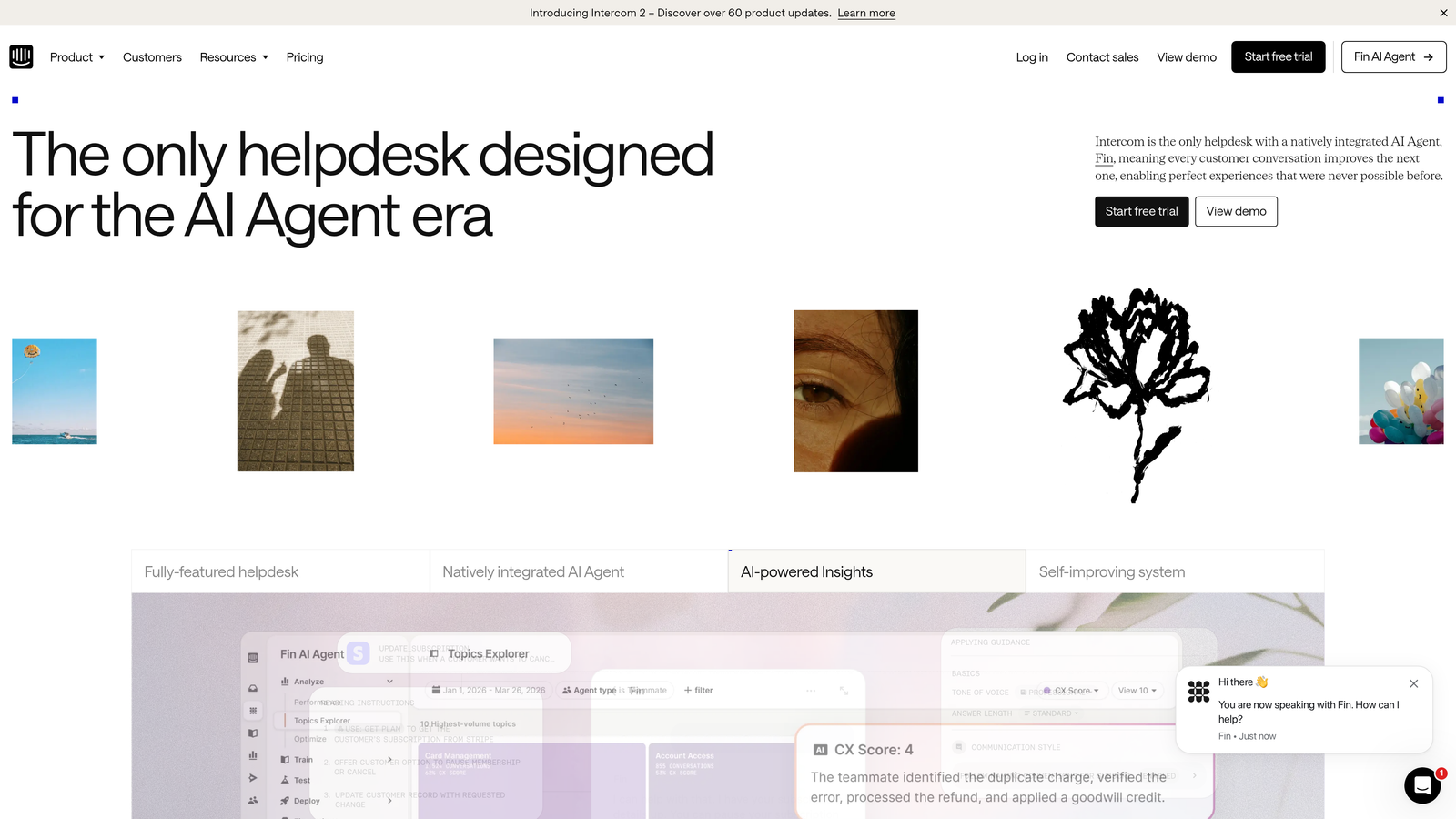
Intercom is a mature customer communications platform featuring Fin, its GPT-4-powered AI agent that resolves support conversations autonomously across chat, email, and in-app channels.
Where This Tool Shines
Intercom has been in the customer messaging space long enough to have built a genuinely polished product. Fin, its AI agent, handles a meaningful portion of incoming conversations without human involvement, and the handoff to live agents when it can't resolve something is smooth and well-designed.
The platform's breadth is also a strength. Teams get in-app messaging, email, live chat, and social channel support under one roof, backed by a large app marketplace for extending functionality. For mid-market SaaS companies that want a single platform handling the full customer communications lifecycle, Intercom is a natural fit.
Key Features
Fin AI Agent: GPT-4-powered autonomous resolution across chat, email, and in-app channels with intelligent human escalation.
Omnichannel Support: Live chat, email, in-app messages, and social channels managed from a unified inbox.
App Marketplace: Hundreds of integrations available for extending Intercom's core functionality.
Conversation Routing and Tagging: Intelligent inbox management with assignment rules, priority routing, and conversation organization.
Resolution-Based Pricing: Available alongside traditional seat pricing, allowing teams to align cost with actual AI output.
Best For
Mid-market SaaS companies that want a proven, full-featured platform with strong in-app messaging capabilities and a large integration ecosystem. Less ideal for teams that need deep business intelligence beyond support metrics.
Pricing
Starts at approximately $39 per seat per month. Fin AI resolution-based pricing is available separately, allowing teams to pay per resolved conversation rather than per seat.
3. Zendesk AI
Best for: Enterprise teams already invested in the Zendesk ecosystem wanting embedded AI across existing workflows
Zendesk AI layers intelligent triage, agent copilot, macro suggestions, and self-service automation across the Zendesk Suite for enterprise teams with established Zendesk infrastructure.
Where This Tool Shines
If your team is already running Zendesk, the AI capabilities layer on without requiring a migration or significant workflow disruption. Intelligent triage automatically routes tickets to the right team, the agent copilot drafts responses and suggests next actions, and AI-generated macro suggestions help agents work faster without starting from scratch.
Zendesk's enterprise-grade compliance and security posture is also a genuine differentiator for larger organizations. Audit controls, data residency options, and SOC 2 compliance make it a defensible choice in regulated industries or large procurement processes.
Key Features
AI-Powered Triage: Intelligent ticket routing and prioritization based on content, intent, and historical patterns.
Agent Copilot: Response drafting assistance and suggested next actions to accelerate agent productivity.
AI-Generated Macros and Knowledge Suggestions: Surfaces relevant macros and knowledge base articles based on ticket context.
Advanced Analytics: Comprehensive reporting across support operations with customizable dashboards.
Enterprise Compliance Controls: Audit logs, data residency, and security certifications suited for regulated environments.
Best For
Enterprise support teams already running Zendesk Suite who want AI capabilities without switching platforms. Less compelling for teams starting fresh who want an AI-native architecture from the ground up.
Pricing
Suite plans start at approximately $55 per agent per month. Advanced AI features are available as an add-on at additional cost beyond the base Suite pricing.
4. Freshdesk Freddy AI
Best for: SMBs and growing teams wanting affordable AI across self-service, agent assist, and analytics
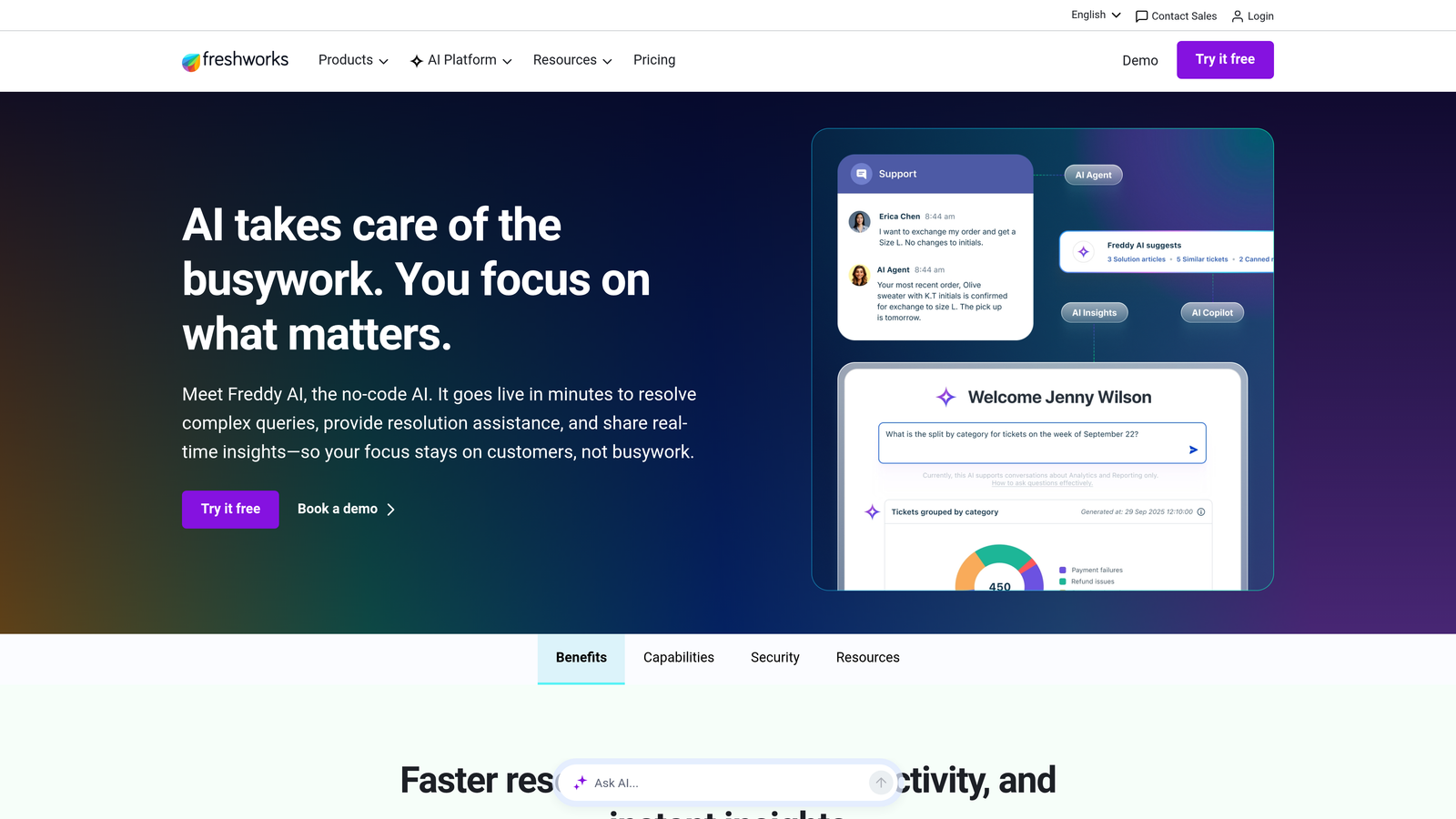
Freshdesk Freddy AI is Freshworks' AI layer spanning customer-facing bots, agent assist, and analytics, built into Freshdesk and connected to the broader Freshworks ecosystem including CRM and ITSM.
Where This Tool Shines
Freddy AI's three-layer structure covers the support workflow comprehensively: Freddy Self Service handles customer-facing deflection before tickets are created, Freddy Copilot assists agents with drafting and suggestions during resolution, and Freddy Insights surfaces analytics and trend detection for managers. That's a coherent coverage model at a price point that's competitive with enterprise alternatives.
The connection to the broader Freshworks ecosystem is also worth noting. Teams using Freshsales for CRM or Freshservice for IT support get native data sharing across those platforms, reducing the integration overhead that typically comes with stitching together separate tools.
Key Features
Freddy Self Service: Customer-facing AI bot for deflection and self-service resolution before tickets reach agents.
Freddy Copilot: Agent assist for response drafting, knowledge surfacing, and suggested actions during live conversations.
Freddy Insights: AI-driven analytics for trend detection, anomaly identification, and support performance reporting.
Freshworks Ecosystem Integration: Native connectivity with Freshsales CRM and Freshservice ITSM for unified data across business functions.
Competitive Pricing: More affordable entry points relative to enterprise-tier alternatives like Zendesk or Salesforce.
Best For
SMBs and mid-market teams scaling support operations who want AI across the full ticket lifecycle without enterprise-level pricing. Especially strong for teams already using other Freshworks products.
Pricing
Freshdesk plans start at approximately $15 per agent per month. Freddy AI features are available on higher tiers, with pricing scaling based on the specific Freddy capabilities enabled.
5. Salesforce Agentforce
Best for: Enterprises where Salesforce is the system of record and deep CRM integration is non-negotiable
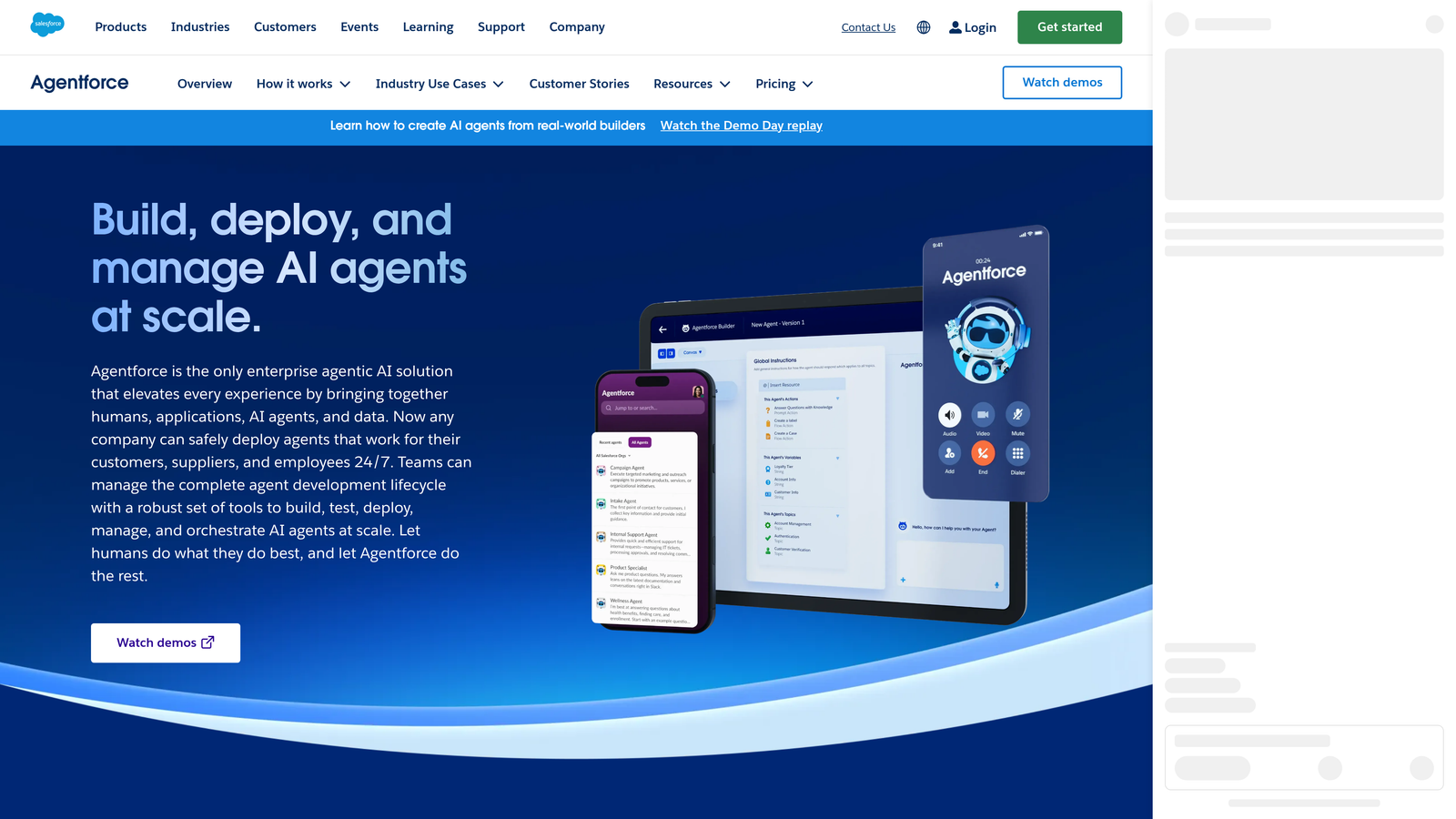
Salesforce Agentforce is Salesforce's autonomous AI agent platform built on Service Cloud and Einstein, enabling enterprises to deploy AI agents with deep CRM data access across multiple customer channels.
Where This Tool Shines
Agentforce's core advantage is data access. Because it operates natively within the Salesforce ecosystem, AI agents can draw on the full breadth of CRM data: account history, deal stage, product usage, and prior case history. That depth of context enables more personalized resolutions than platforms working with support data alone.
The low-code agent builder using natural language instructions lowers the technical barrier for configuring agents, and the Einstein Trust Layer provides enterprise AI governance that large organizations with strict data privacy requirements will appreciate.
Key Features
Autonomous AI Agents: Full access to Salesforce CRM data for highly contextualized, personalized resolutions.
Multi-Channel Orchestration: Unified AI agent deployment across email, chat, voice, and social channels.
Low-Code Agent Builder: Natural language instructions for configuring agent behavior without deep technical expertise.
Cross-Cloud Integration: Deep connectivity with Sales Cloud, Marketing Cloud, and Commerce Cloud for end-to-end customer context.
Einstein Trust Layer: Enterprise AI governance framework for data privacy, auditability, and responsible AI deployment.
Best For
Large enterprises where Salesforce is the primary system of record and where deep CRM-to-support data integration justifies the implementation complexity and cost. Not the right fit for smaller teams or those not already in the Salesforce ecosystem.
Pricing
Custom enterprise pricing. Service Cloud licensing is required as the foundational layer, with Agentforce capabilities priced on top. Expect significant investment relative to mid-market alternatives.
6. Tidio
Best for: Small businesses and e-commerce teams needing affordable, fast-to-deploy AI chat automation
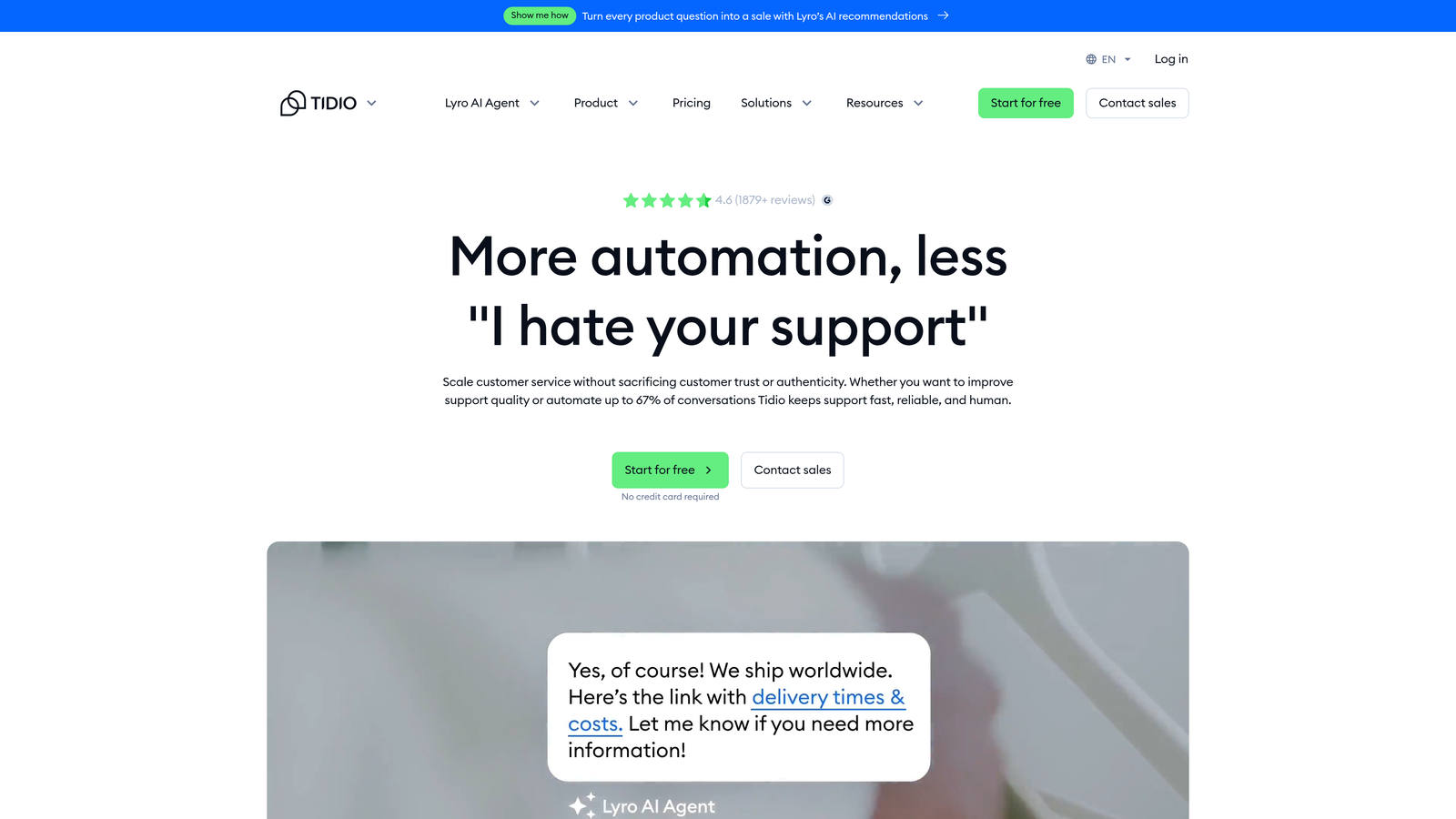
Tidio is an accessible AI customer service platform featuring the Lyro AI chatbot, designed for small businesses and e-commerce teams that need quick setup and affordable automation without technical complexity.
Where This Tool Shines
Tidio's primary strength is accessibility. The Lyro AI chatbot trains on your existing knowledge base content and can be deployed without engineering resources. For small teams that need to deflect common questions and provide basic support coverage outside business hours, Lyro handles that job well at a price point that doesn't require budget approval.
The platform's e-commerce integrations, particularly with Shopify and WooCommerce, make it a natural choice for online stores managing high volumes of order-related inquiries. The no-code chatbot builder with a visual flow editor means non-technical team members can configure and update conversation flows independently.
Key Features
Lyro AI Chatbot: AI trained on your knowledge base to handle common questions autonomously without manual flow configuration.
No-Code Chatbot Builder: Visual flow editor for creating and customizing conversation paths without engineering involvement.
E-Commerce Integrations: Strong native connectivity with Shopify, WooCommerce, and WordPress for order-related support automation.
Live Chat with Agent Takeover: Smooth transition from AI conversations to human agents when needed.
Email and Messenger Support: Multi-channel coverage beyond website chat for broader customer reach.
Best For
Small businesses, e-commerce stores, and startups that need affordable AI chat automation with minimal setup time. Less suited for complex B2B workflows or teams that need deep business intelligence beyond basic support metrics.
Pricing
Free plan available with limited features. Paid plans start at approximately $29 per month, making Tidio one of the most accessible entry points on this list.
7. Kustomer
Best for: High-volume B2C support teams wanting a unified customer timeline with AI automation
Kustomer is a CRM-native customer service platform that unifies conversation history, order data, and AI automation into a single customer timeline, particularly effective for high-volume B2C support operations.
Where This Tool Shines
Kustomer's unified customer timeline is its defining feature. Instead of agents switching between a helpdesk, CRM, and order management system to understand who they're talking to, all of that context lives in one view. AI-powered routing and suggested responses operate on top of that rich data foundation, which improves both automation accuracy and agent efficiency.
For brands managing thousands of daily customer interactions across multiple channels, the workflow automation capabilities help standardize repetitive processes without requiring constant manual intervention. The omnichannel coverage across chat, email, voice, SMS, and social is comprehensive for consumer-facing operations.
Key Features
Unified Customer Timeline: All interaction history, transaction data, and support context consolidated in a single agent view.
AI-Powered Routing and Suggestions: Intelligent ticket assignment, tagging, and suggested responses based on full customer context.
Omnichannel Support: Chat, email, voice, SMS, and social channels managed from a single platform.
Workflow Automation: Rule-based and AI-driven automation for repetitive support tasks and escalation paths.
E-Commerce and Order Management Integrations: Deep connectivity with order data sources for consumer-facing support teams.
Best For
High-volume B2C brands and e-commerce companies that need unified customer context across channels. Less commonly used in pure B2B SaaS environments where CRM depth and order data aren't the primary support drivers.
Pricing
Starts at approximately $89 per agent per month. Enterprise plans are available with custom pricing for larger deployments.
8. Forethought
Best for: Teams wanting AI triage, deflection, and agent assist without migrating their existing helpdesk
Forethought is an AI layer that augments existing helpdesks, including Zendesk, Salesforce Service Cloud, and Freshdesk, with triage, deflection, and agent assist capabilities without requiring a platform migration.
Where This Tool Shines
Forethought solves a specific problem elegantly: teams that want AI capabilities but aren't ready or willing to migrate their helpdesk. Rather than replacing the underlying platform, Forethought sits on top of it and adds intelligence at every stage of the ticket lifecycle. Triage AI routes and prioritizes incoming tickets, Solve AI handles customer-facing deflection, and Assist AI helps agents draft responses and surface relevant knowledge.
The native integrations with Zendesk, Salesforce Service Cloud, and Freshdesk mean implementation is significantly less disruptive than adopting a new platform entirely. For organizations with complex helpdesk configurations they've spent years refining, that's a meaningful consideration.
Key Features
Triage AI: Intelligent routing and prioritization of incoming tickets based on content, urgency, and historical patterns.
Solve AI: Customer-facing deflection and self-service resolution before tickets reach the agent queue.
Assist AI: Agent response drafting and knowledge surfacing during active ticket resolution.
Native Helpdesk Integrations: Works directly within Zendesk, Salesforce Service Cloud, and Freshdesk without requiring workflow migration.
Full Lifecycle Automation: AI-driven workflow automation spanning intake, resolution, and post-resolution processes.
Best For
Support teams on Zendesk, Salesforce, or Freshdesk that want meaningful AI capabilities without the disruption and cost of a full platform migration. Also useful as a bridge solution while evaluating longer-term platform decisions.
Pricing
Custom pricing based on support volume and helpdesk integration. Contact Forethought directly for a quote tailored to your ticket volume and platform configuration.
9. Help Scout
Best for: Small SaaS teams and agencies that want AI assistance without heavy automation or complexity
Help Scout is a human-centered support platform with AI assist features, including AI Summarize, AI Drafts, and AI Answers, designed for small SaaS teams and agencies that want AI assistance without replacing the human element of support.
Where This Tool Shines
Help Scout occupies a distinct position on this list: it's deliberately not trying to automate everything. The AI features are designed to assist agents, not replace them. AI Summarize gives agents instant conversation context when they pick up a ticket. AI Drafts suggests replies based on conversation history. AI Answers handles self-service through the Beacon chat widget for common questions.
The result is a platform that feels approachable and human-first, with AI accelerating agent work rather than operating independently. For teams where support culture and personalization matter as much as efficiency, that philosophy is a genuine differentiator. The interface is also notably cleaner and less overwhelming than enterprise alternatives.
Key Features
AI Summarize: Instant conversation context generated for agents arriving on any ticket, reducing ramp-up time.
AI Drafts: Suggested reply generation based on full conversation history and knowledge base content.
AI Answers: Self-service resolution via the Beacon chat widget for customers seeking quick answers.
Shared Inbox with Collision Detection: Assignment workflows and collision detection prevent duplicate agent responses.
Clean, Low-Complexity Interface: Minimal setup requirements and an approachable UI that teams adopt quickly.
Best For
Small SaaS teams, agencies, and startups that value a human-first support culture and want AI to assist agents rather than operate autonomously. Not the right fit for teams needing high-volume autonomous ticket resolution or deep business intelligence.
Pricing
Starts at approximately $22 per user per month. AI features are included on Standard plans and above, making the value proposition straightforward without hidden add-on costs.
Which Platform Is Right for Your Team
The right AI customer service platform depends less on which tool has the longest feature list and more on where your team sits today and where you're trying to go.
Here's a quick way to think through the decision:
If you're a B2B SaaS team wanting AI-native infrastructure with business intelligence: Halo AI is built for exactly this use case. Page-aware context, continuous learning, and smart inbox signals go beyond what traditional helpdesks offer even with AI add-ons.
If you're mid-market SaaS on a mature messaging platform: Intercom's Fin AI agent delivers strong autonomous resolution with the omnichannel coverage and app marketplace that growing teams rely on.
If you're an enterprise already running Zendesk or Salesforce: Adding AI capabilities to your existing infrastructure through Zendesk AI or Salesforce Agentforce avoids migration costs while incrementally improving agent productivity and automation.
If you're an SMB or e-commerce team with budget constraints: Tidio and Freshdesk Freddy AI offer accessible entry points with solid automation coverage at price points that don't require executive sign-off.
If you want AI benefits without changing your helpdesk: Forethought layers intelligence onto Zendesk, Salesforce, and Freshdesk without requiring you to rebuild your existing configuration.
If your team values human-first support with AI assistance: Help Scout's approach keeps agents at the center while using AI to make them faster and more consistent.
The broader trend worth noting: the gap between AI-native platforms and AI-augmented legacy tools is widening. Platforms built with AI as the foundation, rather than as a feature bolted on later, tend to learn faster, integrate more deeply, and surface intelligence that goes beyond ticket deflection metrics.
Your support team shouldn't scale linearly with your customer base. Let AI agents handle routine tickets, guide users through your product, and surface business intelligence while your team focuses on complex issues that need a human touch. See Halo in action and discover how continuous learning transforms every interaction into smarter, faster support.