9 Best AI Customer Service Software Platforms in 2026
This guide evaluates the 9 best AI customer service software platforms in 2026, comparing tools on autonomous ticket resolution, integration depth, and deployment ease to help businesses choose between AI-native solutions and legacy helpdesk add-ons. Whether you prioritize deflection volume, seamless agent handoffs, or actionable business intelligence, this breakdown identifies which platforms deliver real value beyond basic chatbot functionality.
 Grant CooperFounder14 min read
AI customer service software has moved well beyond basic chatbots. Today's platforms can resolve tickets autonomously, guide users through complex workflows, detect churn signals, and hand off seamlessly to human agents without scaling headcount. But not every tool is built the same way.
Some are bolt-ons to legacy helpdesks. Others are AI-first from the ground up. Some excel at deflection volume; others prioritize business intelligence or deep integrations. The most important architectural distinction in 2026 is whether a platform was designed around AI from day one, or whether AI was layered onto an existing system after the fact. That difference shows up in resolution quality, contextual awareness, and the intelligence surfaced beyond the ticket queue.
This guide covers the top AI customer service software platforms evaluated on autonomous resolution capability, integration depth, ease of deployment, and the intelligence they surface beyond the ticket queue. Whether you're a SaaS product team drowning in support volume or a B2B company looking to replace a patchwork of tools, this list will help you find the right fit.
1. Halo AI
Best for: SaaS and B2B teams that need autonomous ticket resolution with business intelligence built in
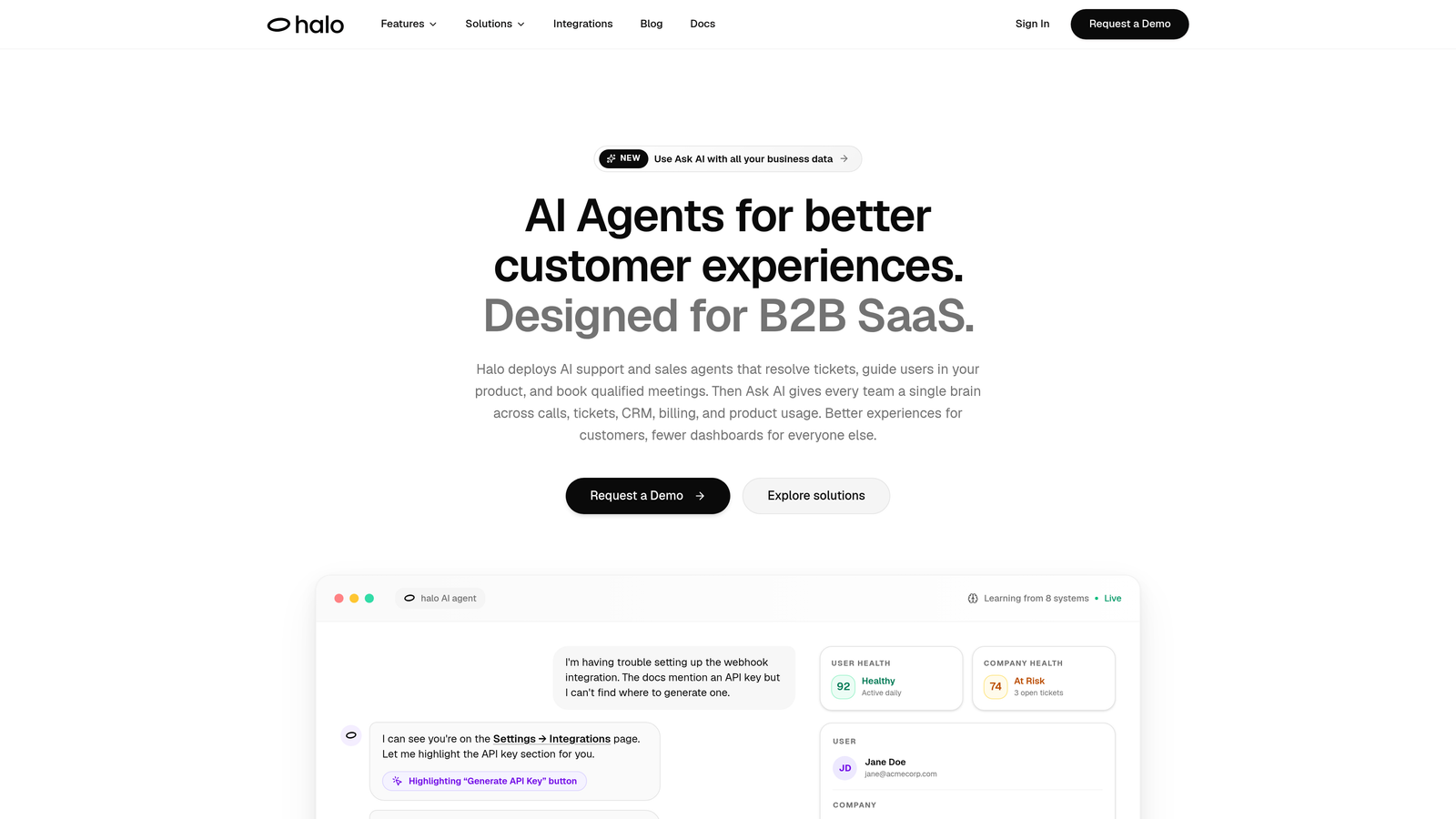
Halo AI is an AI-first customer support platform that deploys autonomous agents to resolve tickets, guide users visually through your product, and surface business intelligence signals while learning continuously from every interaction.
Where This Tool Shines
What separates Halo from most platforms on this list is its architectural starting point. It wasn't built as a helpdesk with AI features added later. The entire system is designed around autonomous resolution, which means the AI isn't just suggesting replies to human agents. It's closing tickets end-to-end, learning from each one, and getting smarter over time.
The page-aware chat widget is a genuinely rare capability. Most chat tools know what page a user is on, but Halo's agent actually sees what the user sees, allowing it to provide visual UI guidance in context. For SaaS products with complex onboarding flows or multi-step workflows, this changes what "support" can actually mean.
Key Features
Autonomous AI Agents: Resolve support tickets end-to-end without human involvement for routine issues, with continuous learning from every resolved interaction.
Page-Aware Chat Widget: The AI sees what the user sees and provides visual UI guidance in context, not just generic help center links.
Smart Inbox with Business Intelligence: Surfaces customer health scoring, churn signals, and revenue anomaly detection directly from support data.
Auto Bug Ticket Creation: Automatically routes bug reports to Linear or Jira with full context captured, eliminating manual handoff between support and engineering.
Live Agent Handoff: Complex issues escalate to human agents with full conversation history preserved so nothing gets repeated.
Deep Integrations: Connects natively with Linear, Slack, HubSpot, Intercom, Stripe, Zoom, PandaDoc, and Fathom.
Best For
SaaS product teams and B2B companies that want more than ticket deflection. Halo is particularly well-suited for teams where support data should be feeding into product decisions, customer success workflows, and revenue signals. If you're still treating support as a cost center, Halo is built to change that framing.
Pricing
Contact for pricing at haloagents.ai. Given the depth of integrations and business intelligence features, pricing is tailored to deployment scope.
2. Intercom (Fin AI)
Best for: SaaS companies already using Intercom that want autonomous AI without switching platforms
Intercom's Fin is an AI agent built into the Intercom messenger that handles customer conversations autonomously and escalates to human agents when needed.
Where This Tool Shines
Fin benefits enormously from Intercom's messenger ecosystem. If your team is already running support through Intercom, deploying Fin is a natural extension rather than a platform migration. The resolution-based pricing model is also a meaningful shift from seat-based licensing, aligning cost more directly with value delivered.
Fin is trained on your help center content and custom knowledge sources, which means setup time is relatively low for teams with well-maintained documentation. The escalation experience is smooth because everything stays within the same conversation thread, preserving context for human agents when they take over.
Key Features
Fin AI Agent: Resolves customer queries directly within the Intercom messenger interface without requiring a separate tool or interface.
Resolution-Based Pricing: Pay per resolved conversation rather than per seat, which can be more cost-effective at scale.
Seamless Escalation: Hands off to human agents within the same conversation thread with full context intact.
Knowledge Source Training: Trained on your help center content and custom knowledge sources for relevant, accurate responses.
Resolution Reporting: Built-in reporting on resolution rates and handoff patterns to track AI performance over time.
Best For
Teams already invested in the Intercom ecosystem. Fin is a strong choice if you want autonomous AI resolution without a platform change. Less compelling if you're not already an Intercom customer, as you'd be adopting the full Intercom stack to access it.
Pricing
Fin AI is priced per resolution; Intercom base plans start around $39/seat/month. Verify current pricing at intercom.com.
3. Zendesk AI
Best for: Large enterprises with complex support operations already running on Zendesk
Zendesk AI layers intelligent triage, routing, agent assist, and self-service automation on top of one of the most established helpdesk platforms in the market.
Where This Tool Shines
Zendesk's strength is the depth of its existing infrastructure. The AI features sit on top of a mature ticketing system, robust reporting, and an extensive marketplace of integrations. For enterprises that have built support operations around Zendesk over years, the AI suite extends what's already working rather than requiring a rebuild.
Agent Copilot is a particularly practical feature for teams that aren't ready to go fully autonomous. It provides real-time suggestions and next-best-action guidance to human agents, improving consistency and speed without removing humans from the loop entirely.
Key Features
AI-Powered Triage and Routing: Intelligent ticket routing based on intent, sentiment, and priority reduces manual sorting for support managers.
Agent Copilot: Provides real-time suggestions and next-best-action guidance for human agents during live interactions.
Self-Service Bots: Deflects common queries before ticket creation, reducing inbound volume for routine issues.
AI-Generated Summaries: Suggested replies and conversation summaries reduce handle time for agents working through high volumes.
QA Automation: Advanced analytics and quality assurance automation across the entire support operation.
Best For
Enterprises with complex, high-volume support operations that are already committed to the Zendesk ecosystem. Less ideal for teams starting fresh who want AI-first architecture rather than AI layered onto an established helpdesk.
Pricing
AI features are available on Suite plans from approximately $115/agent/month. Verify current pricing at zendesk.com.
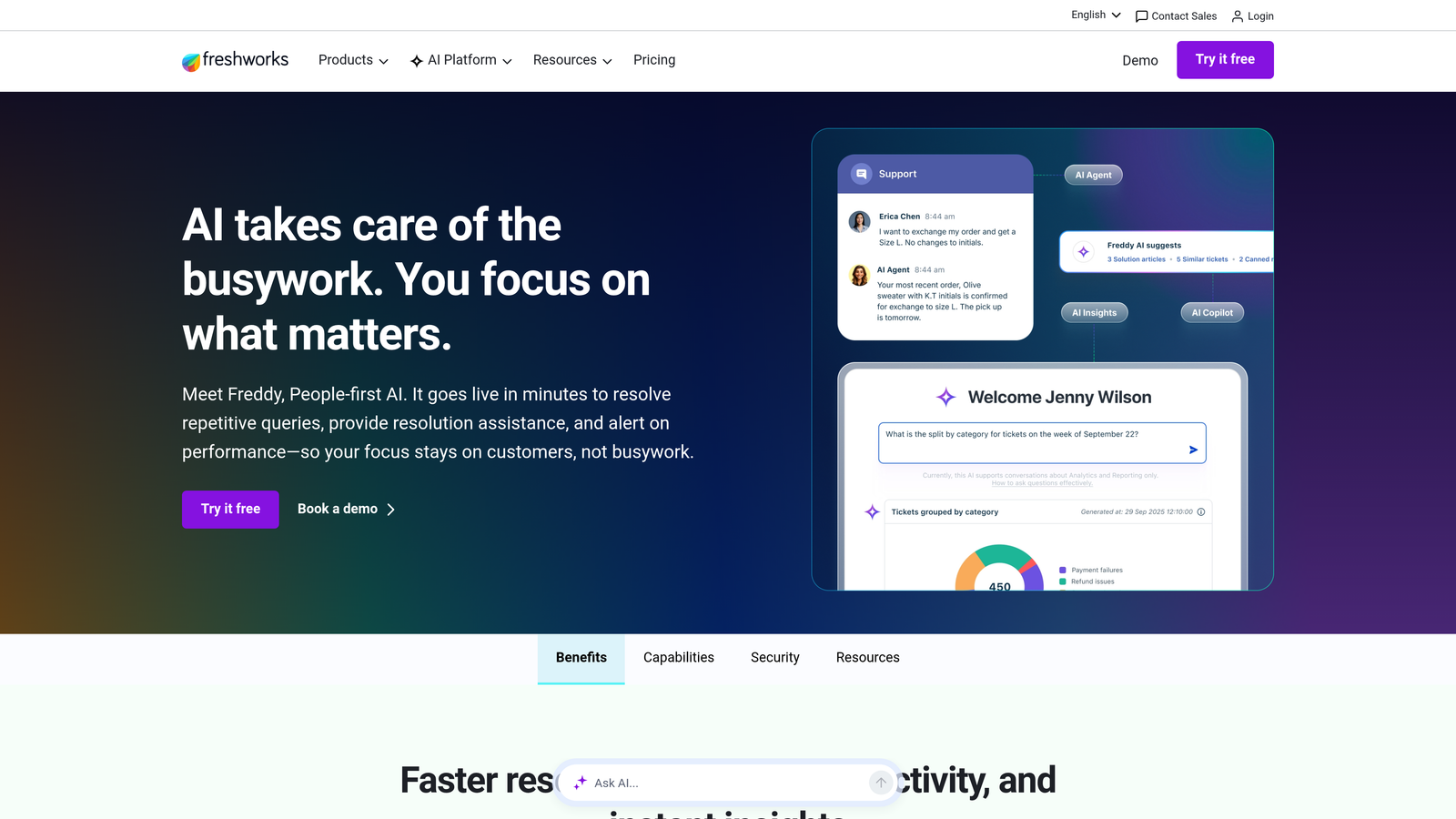
4. Freshdesk (Freddy AI)
Best for: SMBs and mid-market teams that want a full helpdesk suite with AI at accessible pricing
Freshworks' Freddy AI brings self-service automation, agent assist, and analytics intelligence to Freshdesk's helpdesk suite at a price point accessible to growing teams.
Where This Tool Shines
Freddy AI is structured across three distinct layers: Freddy Self Service for customer-facing resolution, Freddy Copilot for agent assistance, and Freddy Insights for management-level analytics. This modular approach means teams can adopt the parts that match their maturity without over-buying.
The pricing is a genuine differentiator relative to Zendesk for comparable AI feature depth. For SMBs that need a full helpdesk suite with meaningful AI capabilities, Freshdesk often delivers strong value without the enterprise-tier price tag.
Key Features
Freddy Self Service: Handles autonomous customer-facing query resolution before tickets are created.
Freddy Copilot: Assists agents with suggested replies, conversation summaries, and knowledge article recommendations.
Freddy Insights: Surfaces trends and anomalies in support data for team leads and support managers.
Omnichannel Support: Covers email, chat, phone, and social channels within a unified inbox.
Competitive Pricing: Meaningfully lower cost than comparable Zendesk tiers for teams evaluating both platforms.
Best For
SMBs and mid-market support teams that want a capable, full-featured helpdesk with AI built in, without the enterprise pricing that comes with Zendesk or Salesforce. Also a strong fit for teams already using other Freshworks products.
Pricing
Freddy AI Copilot add-on from approximately $29/agent/month; base plans start at $15/agent/month. Verify current pricing at freshworks.com.
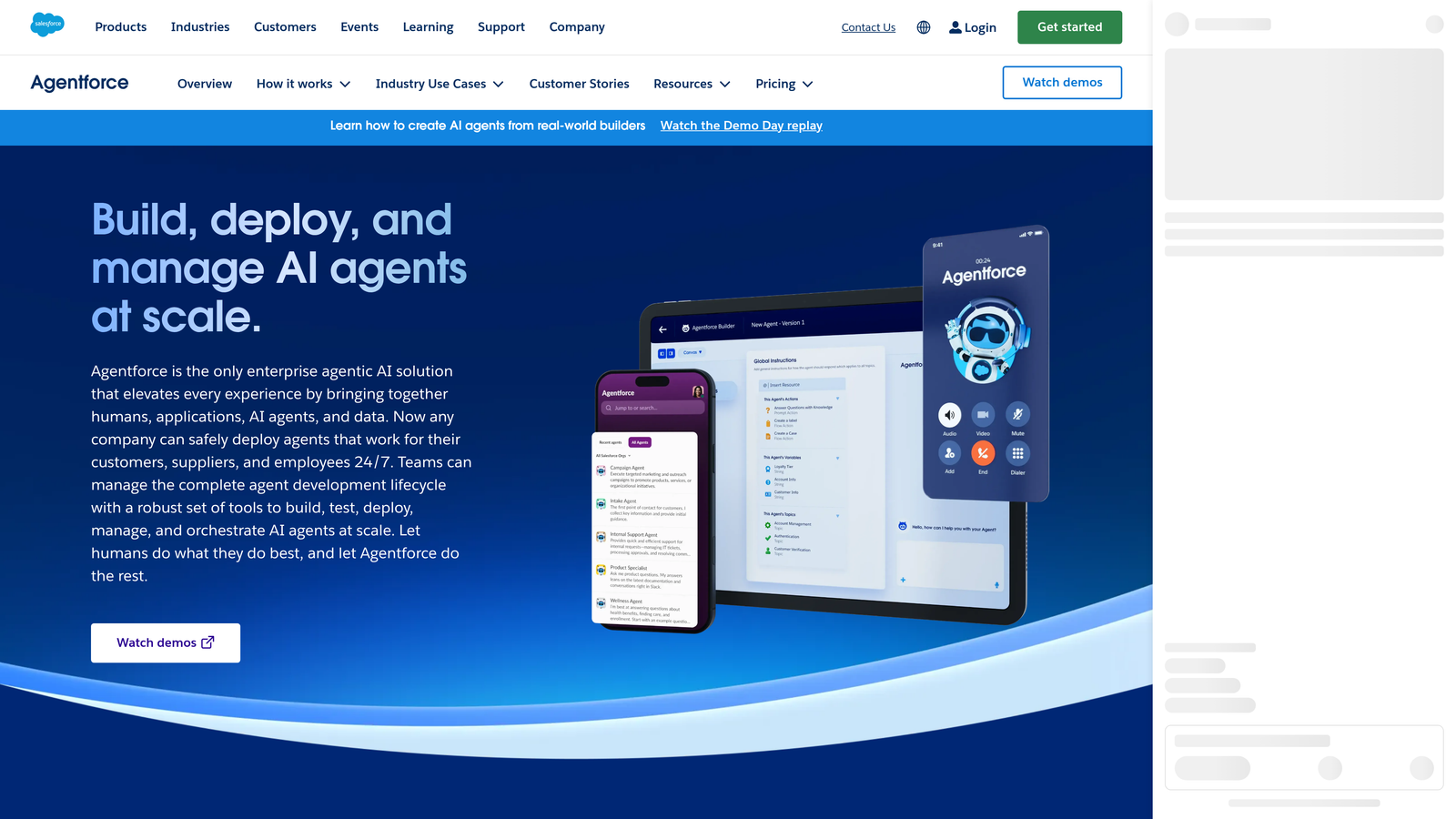
5. Salesforce Agentforce
Best for: Enterprises running service, sales, and support on a unified Salesforce stack
Salesforce Agentforce is an autonomous AI agent platform built natively into the Salesforce ecosystem, enabling enterprises to deploy AI agents across service, sales, and support workflows using their existing CRM data.
Where This Tool Shines
Agentforce's core advantage is access to Salesforce CRM data. When your AI agents know a customer's purchase history, contract value, open opportunities, and past support interactions, the quality of autonomous resolution improves substantially. For enterprises where that data already lives in Salesforce, Agentforce can tap into it without integration overhead.
The low-code agent builder is a practical feature for enterprises that want to configure AI behaviors without extensive engineering resources. The tradeoff is that getting full value from Agentforce requires meaningful Salesforce investment across the stack, which makes it less accessible for teams not already in the ecosystem.
Key Features
CRM-Informed AI Agents: Autonomous agents built on top of Salesforce CRM data for deeply personalized customer interactions.
Low-Code Agent Builder: Configure AI agent behaviors without extensive engineering involvement.
Cross-Cloud Unification: Operates across Service Cloud, Sales Cloud, and Marketing Cloud for cross-functional AI deployment.
Einstein AI Foundation: Strong enterprise security and compliance controls underpinning all AI operations.
Data Cloud Integration: Real-time customer context from Salesforce's Data Cloud for more relevant autonomous responses.
Best For
Large enterprises already running significant operations on Salesforce. If your CRM, service, and sales data all live in Salesforce, Agentforce is the most natural AI layer to add. Teams not already in the Salesforce ecosystem will find the entry cost and complexity substantial.
Pricing
Agentforce pricing varies by deployment and configuration. Contact Salesforce directly for enterprise quotes at salesforce.com.
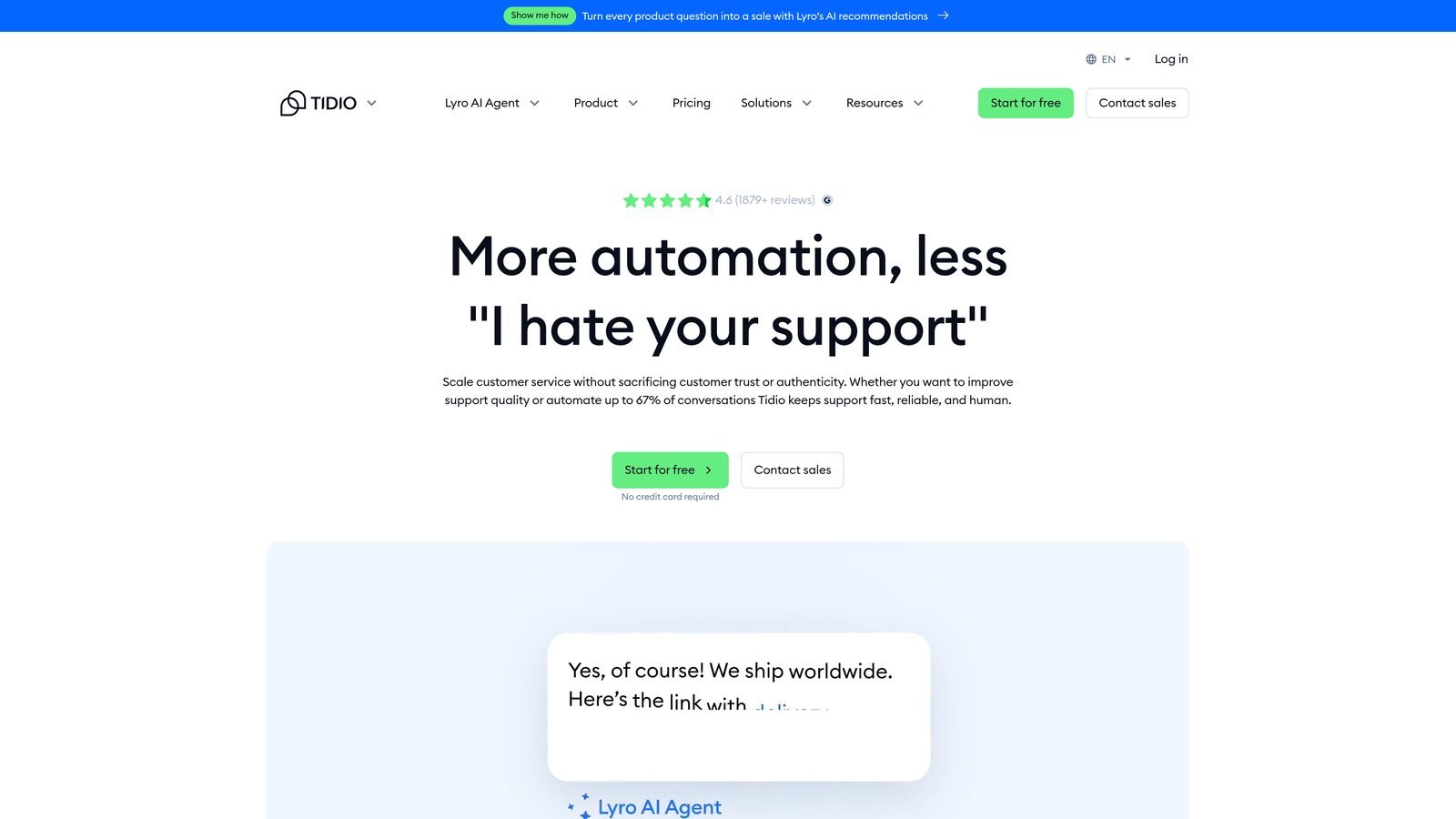
6. Tidio
Best for: E-commerce SMBs on Shopify or WooCommerce needing affordable, easy-to-deploy AI chat
Tidio combines live chat and the Lyro AI chatbot in an easy-to-deploy platform built primarily for e-commerce businesses on Shopify and WooCommerce.
Where This Tool Shines
Tidio's strongest suit is accessibility. For e-commerce teams without dedicated support operations or technical resources, the combination of a visual chatbot flow builder and native Shopify integration means you can be up and running quickly. Lyro handles the repetitive queries that dominate e-commerce support: order status, returns, product questions, shipping updates.
The free tier and affordable paid plans make Tidio a realistic starting point for smaller businesses that need AI-assisted support without a significant upfront investment. It's not designed for complex B2B support operations, but within its target use case it performs reliably.
Key Features
Lyro AI Chatbot: Handles repetitive customer queries with conversational responses trained on your content.
Native E-Commerce Integrations: Shopify and WooCommerce integrations for order status, returns, and product queries out of the box.
Live Chat Fallback: Mobile app for agents handling escalations on the go when AI can't resolve an issue.
Visual Flow Builder: Non-technical teams can build and modify chatbot flows without writing code.
Accessible Pricing: Free tier available with paid plans that scale affordably for small teams.
Best For
E-commerce businesses on Shopify or WooCommerce that need fast, affordable AI chat without the complexity of enterprise platforms. Not well-suited for B2B SaaS companies with complex support needs or multi-system integration requirements.
Pricing
Free plan available; paid plans from approximately $29/month. Verify current pricing at tidio.com.
7. Ada
Best for: Global enterprise brands needing multilingual AI automation with strong governance controls
Ada is an enterprise-grade no-code AI agent platform focused on automated customer service at scale, with strong multilingual capabilities and governance controls for regulated industries.
Where This Tool Shines
Ada's multilingual support is a genuine differentiator. Support for over 100 languages means global support operations can deploy a single AI platform across markets without building separate automation flows for each region. For brands operating across multiple geographies, this reduces operational complexity substantially.
The no-code builder and enterprise governance features make Ada a strong fit for large organizations where non-technical teams need to manage automation, and where compliance or content guardrails are non-negotiable. It layers onto existing helpdesks rather than replacing them, which is either an advantage or a limitation depending on your goals.
Key Features
No-Code Agent Builder: Non-technical teams can create and manage automation flows without engineering support.
100+ Language Support: Comprehensive multilingual capability for global support operations across markets.
Enterprise Governance Controls: Content guardrails, escalation governance, and compliance controls for regulated industries.
Helpdesk Integration Layer: Works alongside Zendesk, Salesforce, and Freshdesk as an AI automation layer.
Containment Analytics: Detailed reporting on containment rates and automation performance to track ROI.
Best For
Large global enterprises in regulated industries that need strong governance, multilingual coverage, and the ability to manage AI automation without engineering resources. Teams looking for an AI-first platform rather than an AI layer over an existing helpdesk may find the architecture limiting.
Pricing
Enterprise pricing; contact Ada directly for a quote at ada.cx.
8. Kustomer
Best for: D2C and subscription businesses where support quality depends on full customer context
Kustomer is a CRM-native customer service platform that unifies every customer interaction into a single timeline, with AI built on top of that rich context for more intelligent support.
Where This Tool Shines
The unified customer timeline is Kustomer's defining feature. Rather than treating each support conversation in isolation, Kustomer aggregates all conversations, purchases, and customer events into one view. When AI or human agents respond, they're working from a complete picture of the customer relationship rather than a single ticket.
For subscription businesses and D2C brands where support quality is closely tied to knowing the customer's history, this context-rich approach produces meaningfully better interactions. The AI routing and auto-responses are more relevant because they're informed by real customer data, not just the content of the current message.
Key Features
Unified Customer Timeline: Aggregates all conversations, purchases, and events into a single customer view for agents and AI alike.
Context-Informed AI Routing: AI-powered routing and auto-responses informed by full customer history rather than just the current query.
Omnichannel Inbox: Email, chat, SMS, social, and voice in one unified interface for agents.
Business Rules Engine: Automates workflows based on customer attributes, purchase history, and behavioral triggers.
Subscription and D2C Fit: Particularly strong for businesses with complex, ongoing customer relationships that need historical context to resolve issues well.
Best For
Subscription businesses, D2C brands, and any company where support quality depends on knowing the full customer history. Less suited for transactional or one-time purchase businesses where deep customer context adds less value.
Pricing
Plans start at approximately $89/agent/month. Verify current pricing at kustomer.com.
9. Drift (Salesloft)
Best for: B2B companies where sales and support conversations overlap in the same inbound flow
Drift, now part of Salesloft, is a conversational AI platform designed for B2B companies where pipeline generation and customer support happen in the same conversation stream.
Where This Tool Shines
Drift occupies a unique position at the intersection of sales and support. In B2B SaaS, inbound conversations often can't be cleanly categorized as "support" or "sales" at the start. A prospect asking a product question and a customer asking a billing question might both arrive through the same chat interface. Drift's AI handles both flows and can route intelligently based on visitor identity, account tier, and behavioral signals.
The Salesloft integration adds a meaningful layer for revenue-focused teams. When a support conversation surfaces an upsell signal or a renewal risk, the handoff to a sales workflow is built into the platform rather than requiring a manual process.
Key Features
Unified Sales and Support AI: Handles lead qualification and support query resolution within the same conversational flow.
Salesloft Integration: Seamless handoff between support and sales workflows when conversations shift in nature.
Targeted Messaging: Messaging and routing based on visitor identity, account tier, and real-time behavioral signals.
Meeting Scheduling: Built-in scheduling within conversations to reduce friction for sales-adjacent support interactions.
Bionic Chatbots: Combines AI automation with human playbooks for complex B2B conversations that need structured handling.
Best For
B2B companies where the boundary between support and sales is genuinely blurry, and where revenue impact from inbound conversations is a priority metric. Less suited for pure support operations where the goal is ticket resolution volume rather than pipeline influence.
Pricing
Premium pricing for enterprise deployments. Contact Drift or Salesloft for current quotes at drift.com.
Which Platform Is Right for Your Team?
The right choice here depends heavily on your architecture preference, your existing stack, and what you want AI to do beyond answering tickets.
If you're a SaaS or B2B team that wants AI-first architecture with business intelligence built in, Halo AI is the most complete option on this list. The combination of autonomous resolution, page-aware context, and smart inbox signals goes well beyond what most platforms surface from support data.
For teams already committed to specific ecosystems, the calculus shifts. Intercom Fin is the natural choice if you're already an Intercom customer. Zendesk AI makes sense for enterprises deeply invested in Zendesk's infrastructure. Agentforce is the logical path if Salesforce is already your system of record. And Freshdesk Freddy delivers strong value for SMBs that want a full suite without enterprise pricing.
For more specialized needs: Ada leads on multilingual coverage and governance. Kustomer is the strongest option when full customer context is the differentiator. Tidio is the most accessible entry point for e-commerce teams on Shopify or WooCommerce. And Drift is the right fit when sales and support genuinely overlap in your inbound flow.
The broader trend worth noting: AI-first architectures are increasingly outperforming bolt-on AI in resolution quality and contextual awareness. If you're evaluating platforms in 2026, that architectural distinction deserves serious weight. A platform built around AI from the ground up will continue to improve in ways that AI features added to legacy systems often can't match.
Your support team shouldn't scale linearly with your customer base. Let AI agents handle routine tickets, guide users through your product, and surface business intelligence while your team focuses on complex issues that need a human touch. See Halo in action and discover how continuous learning transforms every interaction into smarter, faster support.