9 Best AI Customer Service Tools in 2026
This guide evaluates the best AI customer service tools available in 2026, comparing platforms on autonomous ticket resolution, integration depth, and actionable intelligence — helping SaaS startups and enterprise teams alike find the right solution to scale support operations without increasing headcount.
 Matt PattoliFounder14 min read
AI customer service tools have moved well beyond simple chatbots. Today's platforms resolve tickets autonomously, detect customer health signals, route complex issues to the right human, and feed intelligence back into your product roadmap — all without adding headcount. But not every tool is built the same way. Some bolt AI onto legacy helpdesk infrastructure. Others are built AI-first from the ground up. The difference matters enormously when you're trying to scale support without scaling costs.
This list covers the top AI customer service tools available in 2026, evaluated on autonomy, integration depth, ease of deployment, and the quality of intelligence they surface beyond just deflecting tickets. Whether you're running a lean SaaS team or managing enterprise-scale support operations, there's a tool here that fits your stack and your goals.
1. Halo AI
Best for: B2B SaaS teams that want AI-first support with deep product and business context
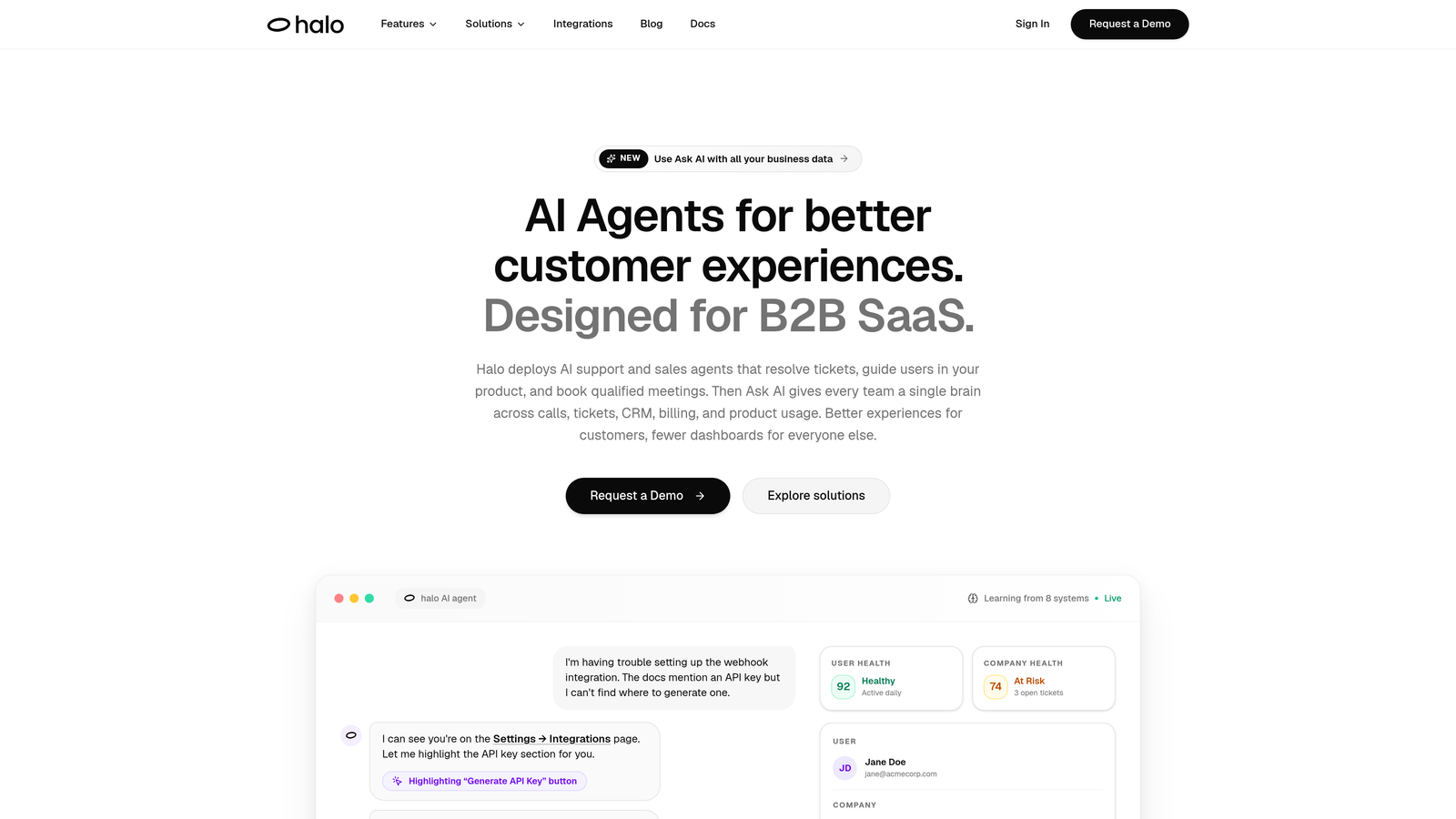
Halo AI is an AI-first customer support platform that deploys intelligent agents to resolve tickets, guide users through your product, and surface business intelligence — all while learning from every interaction.
Where This Tool Shines
What separates Halo from most tools on this list is architecture. Rather than layering AI onto a legacy helpdesk, Halo was built AI-first from the ground up. That distinction shows up in the quality of what it can do: the platform's page-aware chat widget actually sees what your user sees inside your product, allowing it to provide visual UI guidance rather than generic help center links.
Beyond ticket resolution, Halo surfaces business intelligence that most support tools ignore entirely. Customer health signals, revenue intelligence, and anomaly detection give product and success teams a window into what's actually happening across their user base. The auto bug ticket creation feature routes issues directly to Linear or your issue tracker, which is a genuine differentiator for product teams who are tired of manually triaging support noise into engineering backlogs.
Key Features
Page-Aware Chat Widget: Sees the exact product page a user is on and delivers contextual, visual guidance rather than generic answers.
End-to-End Ticket Resolution: AI agents resolve tickets autonomously — not just deflect them — with full conversation context preserved through every step.
Auto Bug Ticket Creation: Automatically identifies and routes bug reports directly to Linear or your preferred issue tracker, removing manual triage from the equation.
Smart Inbox with Business Intelligence: Goes beyond support metrics to surface customer health signals, revenue intelligence, and anomaly detection from support data.
Live Agent Handoff: Escalates complex issues to human agents with full conversation context intact, so nothing gets lost in the handoff.
Broad Integration Stack: Connects natively to Linear, Slack, HubSpot, Intercom, Stripe, Zoom, PandaDoc, and Fathom.
Best For
Halo is best suited for B2B SaaS companies and product teams that need more than ticket deflection. If you want AI that understands your product deeply, feeds insights back to engineering and success teams, and genuinely learns over time, Halo is built for exactly that use case. Less suited for pure e-commerce or teams looking for a simple FAQ bot.
Pricing
Contact for pricing at haloagents.ai. Given the depth of capabilities and integrations, pricing is tailored to team size and use case.
2. Intercom (Fin AI Agent)
Best for: Teams already running Intercom who want native AI resolution without switching platforms
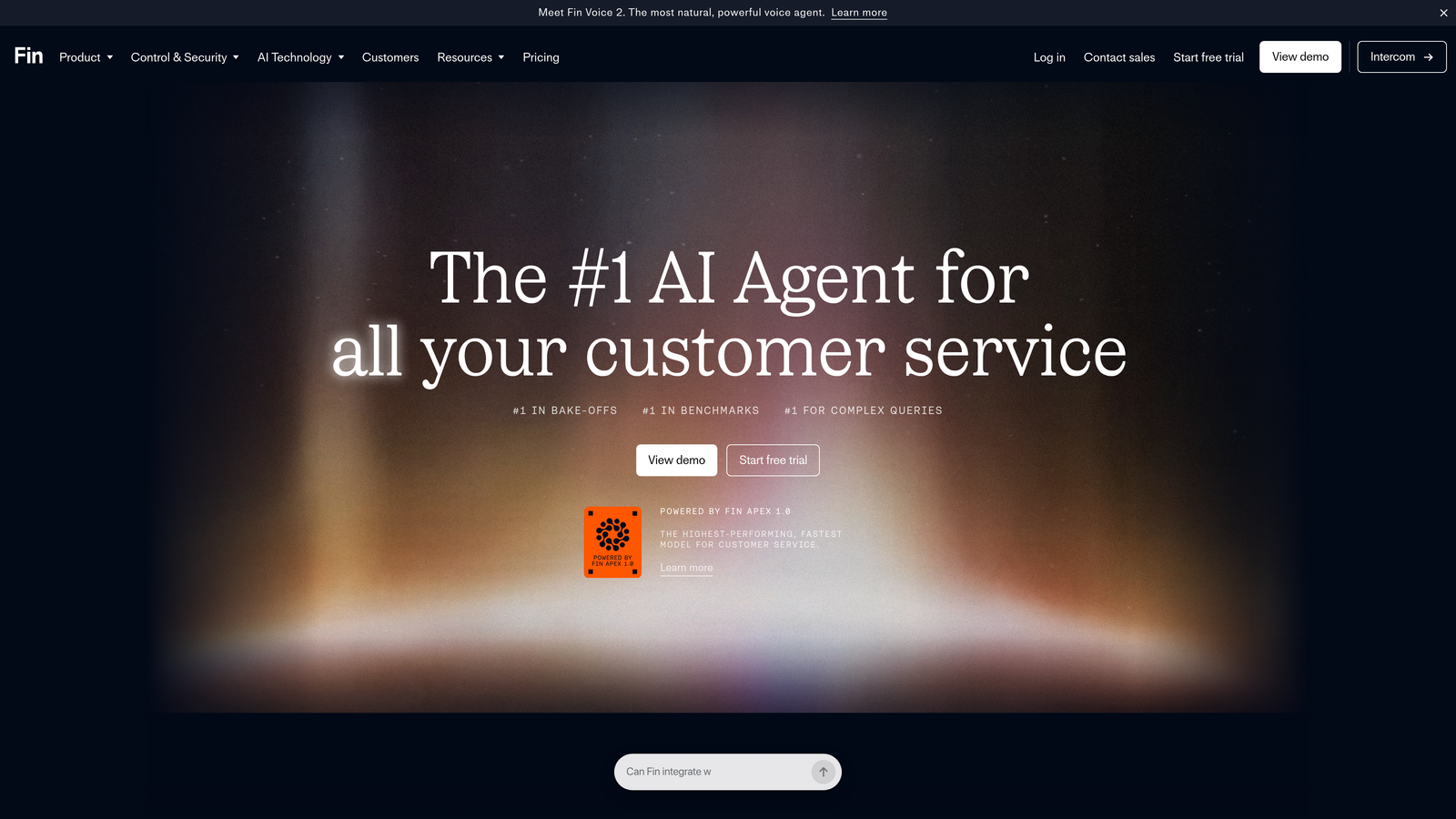
Intercom's Fin is a native AI agent built directly into the Intercom messenger and inbox, offering autonomous resolution for teams already invested in the Intercom ecosystem.
Where This Tool Shines
Fin's biggest advantage is how seamlessly it fits into existing Intercom deployments. If your team already lives in the Intercom inbox, Fin feels like a natural extension rather than a new tool to manage. The multi-step reasoning capabilities introduced in recent versions allow Fin to handle more complex, multi-turn conversations rather than just pattern-matching simple queries.
The knowledge source flexibility is also strong. Fin can pull answers from help centers, PDFs, and multiple content sources simultaneously, which helps it handle a broader range of questions without constant manual updates to a rigid knowledge base.
Key Features
Multi-Step Reasoning: Handles complex, multi-turn conversations rather than relying on simple keyword matching or single-step responses.
Multi-Source Knowledge: Pulls answers from help centers, PDFs, and multiple knowledge repositories in a single resolution flow.
Native Inbox Handoff: Escalates to human agents within the Intercom inbox without context loss or friction.
Usage-Based Pricing: You pay per AI resolution rather than a flat seat fee, which can work in your favor at lower volumes.
Messenger Integration: Works natively within existing Intercom messenger deployments with minimal additional configuration.
Best For
Teams that are already using Intercom as their primary support and communications platform. If you're not already on Intercom, the subscription cost plus AI add-on can be significant. For teams already committed to the Intercom stack, Fin is the most natural path to autonomous resolution.
Pricing
Usage-based pricing on top of an existing Intercom subscription. Check intercom.com for current resolution rates and plan requirements.
3. Zendesk AI
Best for: Enterprise support operations with complex routing needs and large agent teams
Zendesk AI spans the entire Zendesk Suite, from intelligent ticket triage and routing to an agent copilot and autonomous self-service resolution built on mature enterprise helpdesk infrastructure.
Where This Tool Shines
Zendesk's AI layer benefits from being built on top of one of the most established helpdesk platforms in the market. The intelligent triage capabilities are particularly strong: tickets are automatically categorized, prioritized, and routed before a human ever looks at them. For high-volume operations with multiple teams and complex escalation paths, that kind of automated routing has real operational impact.
The agent copilot is a practical tool for teams that can't fully automate but want to accelerate human response times. Suggested replies and real-time knowledge surfacing reduce the time agents spend searching for answers and improve consistency across a large team.
Key Features
Intelligent Triage: Automatically categorizes, prioritizes, and routes incoming tickets based on intent, sentiment, and content.
Agent Copilot: Suggests responses and surfaces relevant knowledge articles to agents in real time during live conversations.
Automated Resolutions: Handles common requests end-to-end without human involvement using self-service AI flows.
AI-Powered QA: Quality assurance tooling and CSAT prediction help managers identify coaching opportunities at scale.
Enterprise Infrastructure: Built on Zendesk's mature helpdesk platform with enterprise-grade security, compliance, and reporting.
Best For
Enterprise teams already on Zendesk Suite, or organizations with complex multi-tier routing requirements and large agent teams. The AI capabilities are most impactful when layered on top of an existing, well-configured Zendesk environment.
Pricing
AI features are included in Suite plans. Check zendesk.com for current Suite tier pricing and AI feature availability by plan.
4. Freshdesk (Freddy AI)
Best for: Growing SMB and mid-market teams that want AI assistance at a more accessible price point
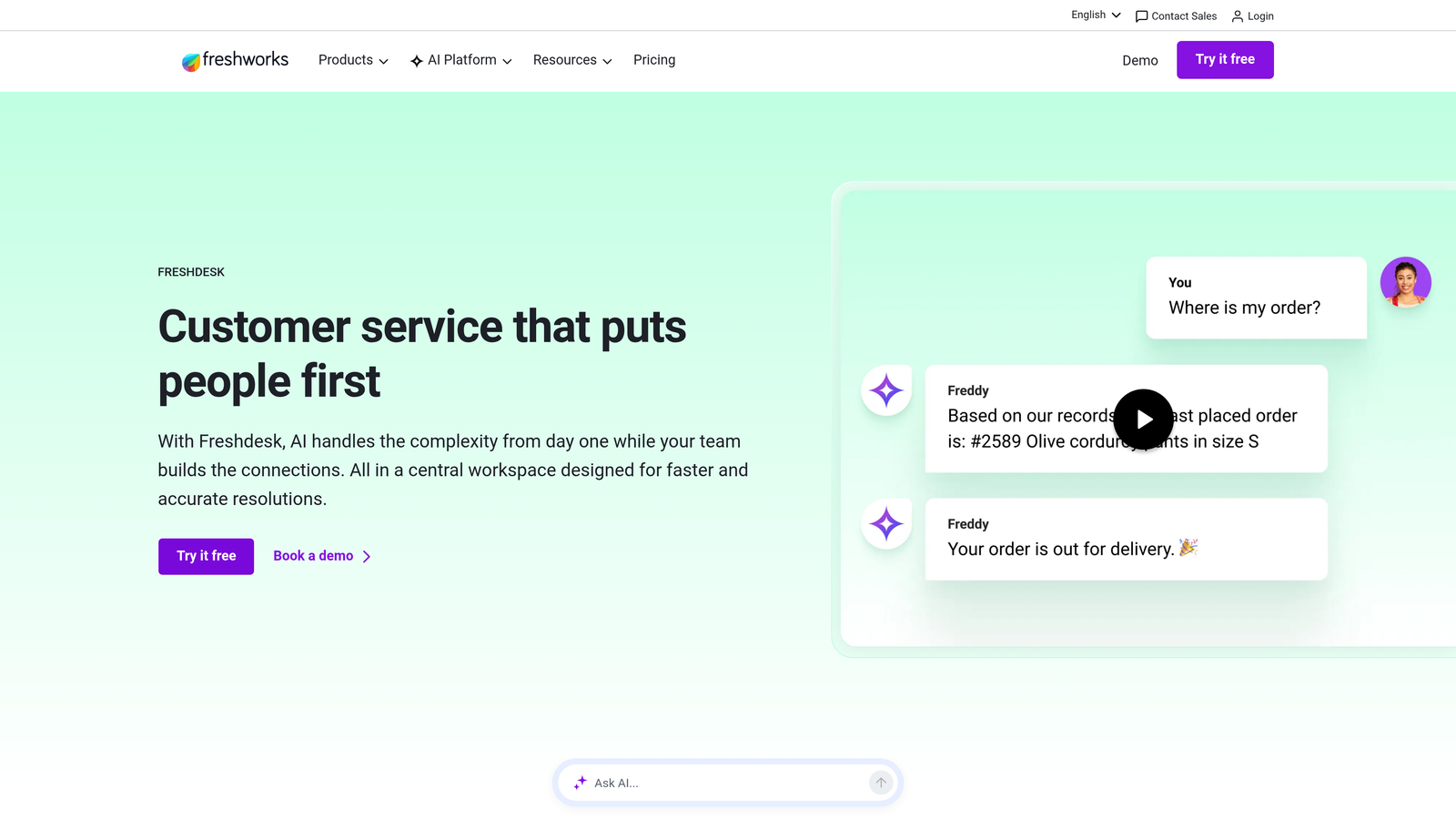
Freshdesk's Freddy AI powers both agent assistance and autonomous self-service across the Freshworks platform, offering a competitive feature set at a price point that works for teams that aren't ready for enterprise-tier spending.
Where This Tool Shines
Freddy's strength is breadth across the Freshworks ecosystem. If your team uses Freshdesk for support, Freshsales for CRM, or Freshservice for ITSM, Freddy's intelligence spans all of it. That cross-product context can be valuable for teams that have consolidated on Freshworks and want AI that understands the full customer picture, not just the support ticket.
Freddy Insights is worth highlighting specifically. It surfaces trends and anomalies in support data in a way that helps team leads and managers make better decisions without needing a dedicated analytics team. For lean operations, that kind of built-in intelligence is genuinely useful.
Key Features
Freddy Copilot: Assists agents with suggested replies, conversation summaries, and next-best-action recommendations during live interactions.
Freddy Self Service: Handles autonomous resolution via chatbot and email for common, repeatable queries.
Cross-Suite Intelligence: AI spans Freshworks' full product suite including CRM and ITSM, not just the helpdesk.
Freddy Insights: Surfaces trends, anomalies, and performance signals in support data without requiring manual reporting.
Accessible Pricing: Lower entry cost compared to Zendesk AI for SMB and mid-market teams with tighter budgets.
Best For
Growing teams on Freshworks who want to add AI capabilities without a significant cost jump. Also strong for organizations already using multiple Freshworks products who want unified AI across their stack.
Pricing
Freddy AI is available as an add-on on Growth plans and above. Check freshworks.com for current Freddy Copilot and Self Service pricing.
5. Tidio
Best for: Small businesses and e-commerce stores that need fast AI deployment with minimal technical setup
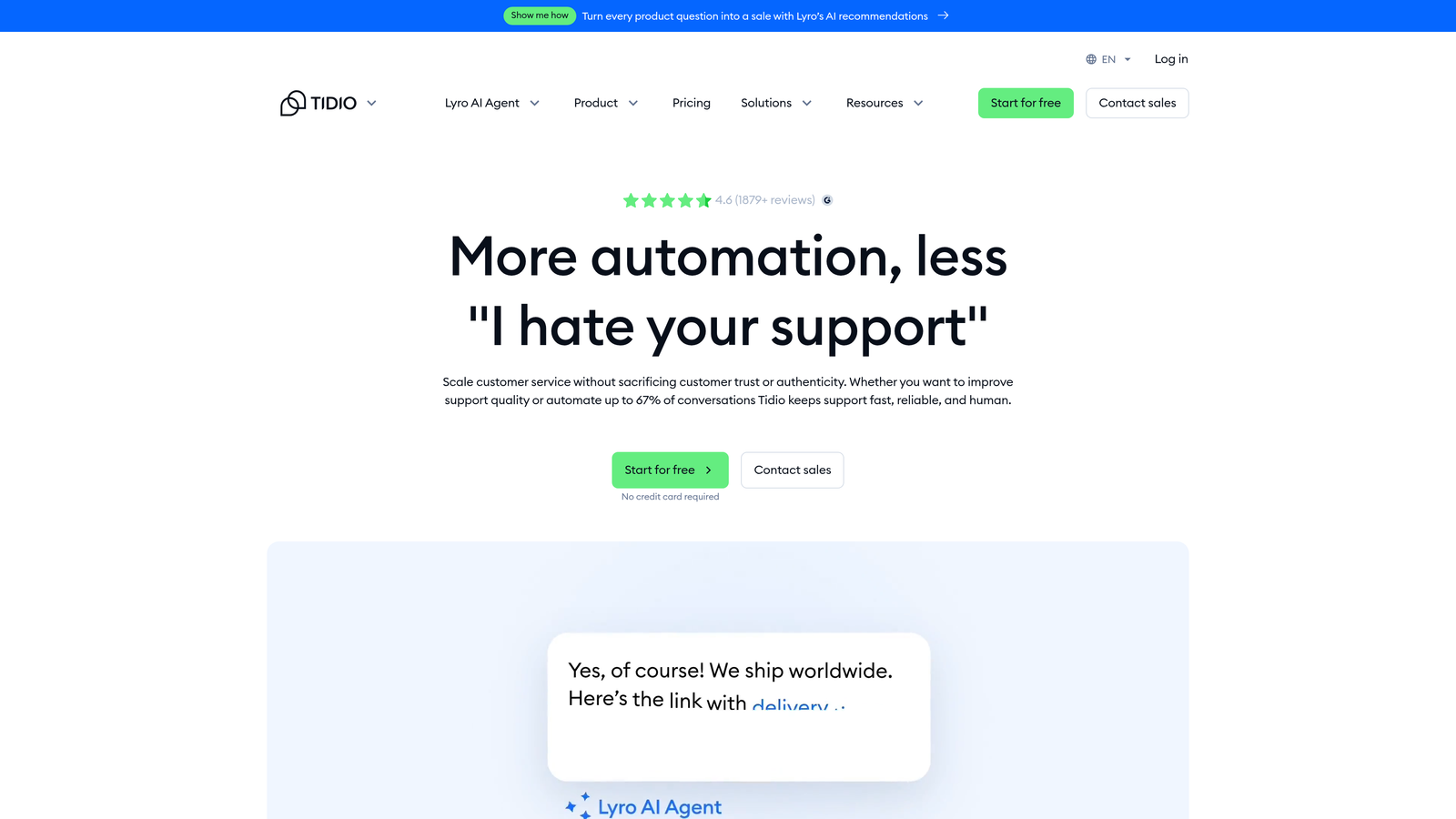
Tidio is a customer service platform built for small businesses and e-commerce, with Lyro as their AI agent product, designed for teams that need to be up and running quickly without engineering resources.
Where This Tool Shines
Speed of deployment is Tidio's standout quality. Most teams can get Lyro live in under an hour, which is a meaningful advantage for small businesses that don't have a dedicated technical team to manage implementation. The setup experience is designed for non-technical users, and the pre-built e-commerce integrations mean Shopify and WooCommerce stores can connect their product catalog and order data without custom development.
The unified inbox covering live chat, email, and social media in one place is practical for small teams wearing multiple hats. Rather than juggling separate tools for each channel, Tidio consolidates everything into one view that's manageable for a team of one or two support staff.
Key Features
Lyro AI Agent: Handles common customer questions autonomously, learning from your existing content to improve over time.
Unified Inbox: Combines live chat, email, and social media channels in a single, manageable interface.
Fast Deployment: Designed for setup in under an hour with no engineering resources required.
E-Commerce Integrations: Pre-built native integrations with Shopify and WooCommerce for order and product context.
Free Tier: An accessible free plan lets small teams get started without upfront commitment.
Best For
Small businesses, DTC brands, and e-commerce stores on Shopify or WooCommerce that need AI-powered chat without a complex implementation. Not the right fit for B2B SaaS teams with complex product support needs or enterprise-scale ticket volumes.
Pricing
Free plan available. Lyro AI starts at published rates — check tidio.com for current plan pricing.
6. Gorgias
Best for: E-commerce and DTC brands with high volumes of order, returns, and shipping inquiries
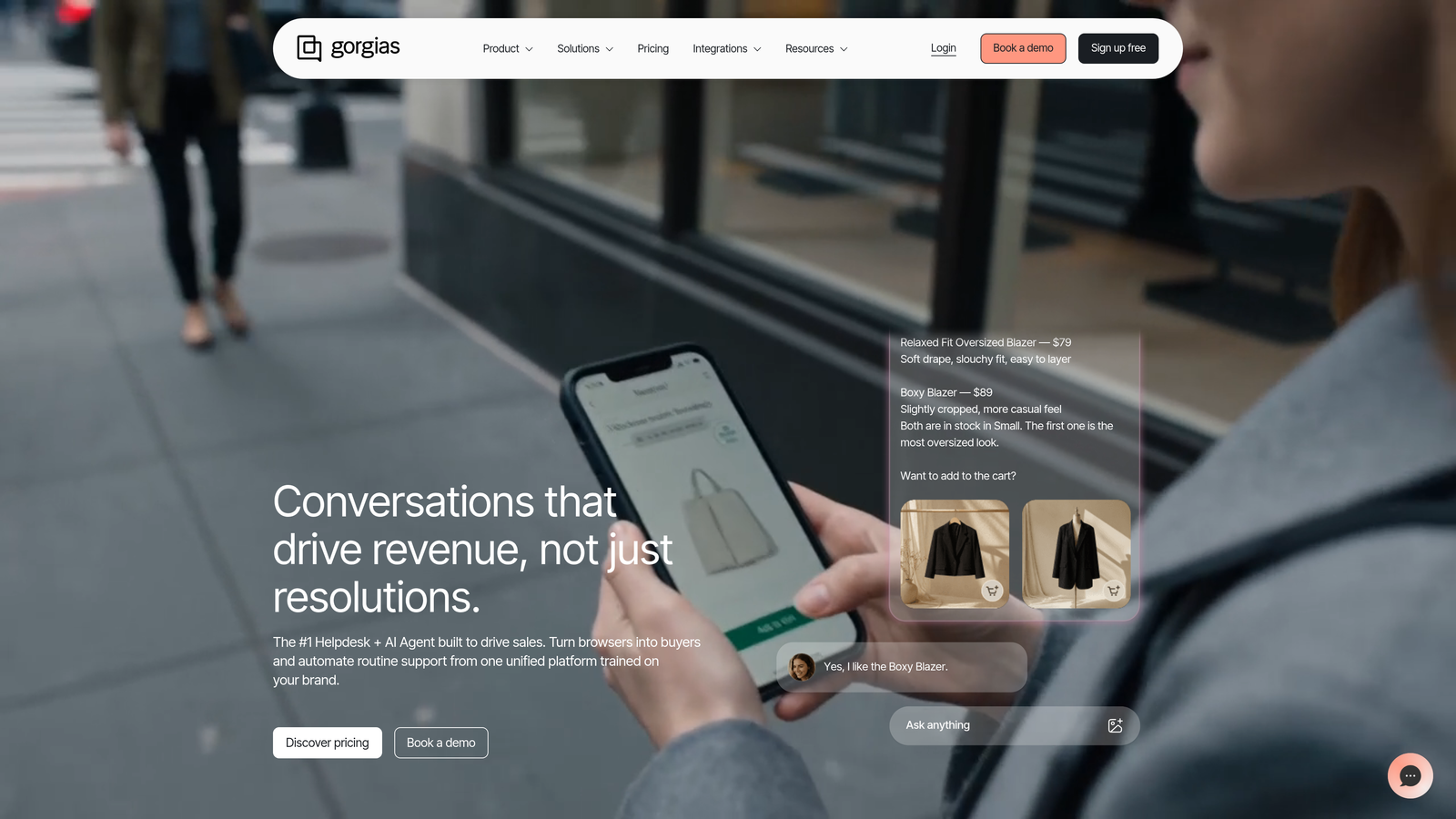
Gorgias is purpose-built for e-commerce customer service, with AI automation specifically designed around order management workflows and deep native integration with Shopify and other major e-commerce platforms.
Where This Tool Shines
Gorgias understands e-commerce operations at a level that general-purpose support tools don't match. The AI auto-responder is trained specifically for order status, returns, and shipping queries — the bread and butter of DTC support queues — and can handle them without any human involvement. That specificity means the automation actually works well out of the box rather than requiring extensive customization.
The revenue statistics feature is a differentiator worth noting. Gorgias tracks the revenue impact of support conversations, helping teams demonstrate that customer service is a growth function, not just a cost center. For e-commerce brands where support interactions often influence purchase decisions, that visibility is valuable.
Key Features
AI Auto-Responder: Automatically handles order status, returns, and shipping queries without human intervention.
E-Commerce Platform Integrations: Deep native integration with Shopify, Magento, and BigCommerce for full order and customer context.
Revenue Statistics: Tracks the revenue impact of support interactions to demonstrate support's contribution to sales.
Macros and Rules Engine: High-volume repetitive ticket automation through a flexible rules and macro system.
Omnichannel Inbox: Covers email, chat, social media, and SMS in a unified interface.
Best For
DTC brands, e-commerce retailers, and Shopify-based businesses with high volumes of transactional support requests. Gorgias is less relevant for B2B SaaS teams whose support needs center on product guidance and technical issues rather than order management.
Pricing
Starts at published per-ticket pricing tiers. Check gorgias.com for current plan options.
7. Salesforce Agentforce
Best for: Enterprises already on Salesforce that need autonomous AI agents with native CRM data access
Salesforce Agentforce is Salesforce's autonomous AI agent platform, bringing AI-driven customer service directly into the Salesforce ecosystem with native access to full CRM data for highly personalized interactions.
Where This Tool Shines
Agentforce's core advantage is data access. Because it's built natively on Salesforce Data Cloud, every AI agent interaction has access to the complete customer record: purchase history, open opportunities, service cases, and relationship data. That context allows for a level of personalization in automated responses that standalone support tools can't match without extensive integration work.
The Atlas Reasoning Engine enables multi-step decision making that goes beyond simple FAQ deflection. For enterprises with complex service workflows spanning multiple teams and systems, Agentforce can orchestrate actions across Service Cloud, Sales Cloud, and other Salesforce products in a single automated flow. The tradeoff is implementation complexity: this is not a quick-deploy tool.
Key Features
Native Data Cloud Integration: Autonomous agents built directly on Salesforce Data Cloud with access to full CRM customer history.
Atlas Reasoning Engine: Multi-step decision making for complex service scenarios that require more than a single-turn resolution.
Configurable Agent Actions: Agents can be configured to take actions across service, sales, and operations workflows within the Salesforce platform.
Cross-Cloud Integration: Deep integration with Service Cloud, Sales Cloud, and Einstein analytics for unified operations.
Personalized Interactions: Full customer history informs every AI interaction, enabling context-aware responses at scale.
Best For
Large enterprises already deeply invested in the Salesforce ecosystem. The implementation complexity and cost make Agentforce a poor fit for smaller teams or those not already on Salesforce. For organizations that are, it's one of the most powerful options available.
Pricing
Usage-based pricing. Contact Salesforce for enterprise quotes or check salesforce.com/agentforce for published rates.
8. Kustomer
Best for: High-volume consumer support teams that need full customer context before every interaction
Kustomer combines a CRM-style unified customer timeline with AI automation, giving support teams complete context on every customer's history across channels before and during AI-handled interactions.
Where This Tool Shines
Kustomer's unified timeline is the foundation everything else is built on. Rather than showing agents a series of disconnected tickets, Kustomer aggregates every interaction, order, and touchpoint into a single chronological view per customer. When AI handles a conversation, it draws on that same rich context, which means automated responses can reference a customer's actual history rather than treating every interaction as if it's the first.
The proactive outreach capabilities are a feature that fewer support platforms offer. Kustomer can trigger outbound messages based on customer behavior signals, allowing support teams to get ahead of issues before they become tickets. For high-volume consumer businesses where reactive support creates bottlenecks, that proactive capability can meaningfully reduce inbound volume.
Key Features
Unified Customer Timeline: Aggregates all interactions, orders, and history into one chronological view per customer across every channel.
Context-Aware AI: AI-powered deflection and routing built on top of rich customer history rather than isolated ticket data.
Omnichannel Support: Covers email, chat, voice, social media, and SMS in a single unified platform.
Intelligent Routing: Assigns conversations to the right agent or AI workflow based on customer context and issue type.
Proactive Outreach: Triggers outbound messages based on customer behavior signals to get ahead of emerging issues.
Best For
High-volume consumer support teams, particularly in retail, subscription, and marketplace businesses where customer history across multiple touchpoints is essential context for every interaction. Less optimized for B2B SaaS teams with lower ticket volumes but higher per-ticket complexity.
Pricing
Enterprise pricing. Contact Kustomer for current rates at kustomer.com.
9. Drift (Salesloft)
Best for: B2B revenue teams where qualifying, routing, and converting conversations matter as much as resolving them
Drift, now part of Salesloft, is a conversational AI platform that blends support and sales automation, built for B2B teams where the line between a support conversation and a sales opportunity is deliberately thin.
Where This Tool Shines
Drift's positioning has always been at the intersection of support and revenue, and the Salesloft acquisition has pushed that further toward the revenue side. The platform excels at identifying high-value accounts in real time and routing them to the right human or automated flow based on intent signals. For B2B companies where website visitors might be existing customers with support needs or new prospects worth engaging, that intelligent routing is a genuine capability.
The Bionic Chatbots approach, which combines AI with human-authored playbooks, gives revenue teams more control over how complex or high-stakes conversations are handled. Rather than fully autonomous AI, Drift lets teams define the guardrails while AI handles the execution, which suits sales-sensitive interactions where brand voice and messaging precision matter.
Key Features
AI-Powered Qualification and Routing: Identifies visitor intent and routes conversations to sales or support based on real-time signals.
Bionic Chatbots: Combines AI capabilities with human-authored playbooks for complex scenarios where full automation isn't appropriate.
Buyer Intent Signals: Surfaces high-value accounts in real time for immediate sales follow-up during active sessions.
In-Chat Meeting Scheduling: Allows prospects and customers to book meetings directly within the chat interface.
Revenue Stack Integrations: Native integrations with Salesforce, HubSpot, Marketo, and Salesloft workflows.
Best For
B2B companies with a revenue team focus, particularly those where inbound chat serves both support and sales functions. If your primary need is pure support ticket resolution, Drift's feature set is weighted toward revenue use cases and may be more than you need.
Pricing
Contact for pricing. See drift.com for current plan information.
Which Tool Is Right for Your Team
The right choice comes down to where you are, what you're building, and how much you want AI to do on its own.
If you're a B2B SaaS team that wants AI-first architecture with genuine product context, business intelligence, and a learning loop that improves with every interaction, Halo AI is built precisely for that. The page-aware context, auto bug ticket creation, and smart inbox set it apart from tools that treat support as an isolated function rather than a signal source for the entire business.
For teams already committed to a specific ecosystem, the native options are strong. Intercom Fin is the natural choice if you're already on Intercom. Zendesk AI fits enterprise teams with complex routing needs. Freshdesk Freddy makes sense for Freshworks users who want AI without jumping to enterprise pricing. Salesforce Agentforce is the right call for large organizations already running on Salesforce who need CRM-native AI agents.
If your support queue is primarily e-commerce, Gorgias and Tidio are both purpose-built for that context. Kustomer fits high-volume consumer support where full customer history is the foundation of every interaction. And if you're a B2B revenue team where support and sales overlap, Drift's conversational AI bridges that gap better than most.
Your support team shouldn't scale linearly with your customer base. Let AI agents handle routine tickets, guide users through your product, and surface business intelligence while your team focuses on complex issues that need a human touch. See Halo in action and discover how continuous learning transforms every interaction into smarter, faster support.