9 Best AI Customer Support Platforms in 2026
Discover the best AI customer support platforms of 2026 with this comprehensive guide evaluating nine solutions on autonomous resolution capability, integration depth, and deployment ease. Whether you're a lean SaaS startup or scaling mid-market team, this breakdown helps you match the right platform to your support needs—so you can grow capacity without growing headcount.
 Matt PattoliFounder14 min read
The support ticket queue never sleeps, but your team does. AI customer support platforms have moved well beyond simple chatbots; today's best solutions resolve tickets autonomously, guide users through complex workflows, and surface business intelligence that helps you catch problems before customers notice them. Whether you're running a lean SaaS startup or scaling a mid-market product team, choosing the right platform determines how fast you can grow support capacity without growing headcount.
This guide covers the best AI customer support platforms available in 2026, evaluated on autonomous resolution capability, integration depth, ease of deployment, and value for B2B teams. We've included platforms ranging from AI-first architectures built for autonomous operation to AI-augmented helpdesks that enhance existing workflows, so you can find the right fit regardless of where you're starting from.
1. Halo AI
Best for: B2B SaaS teams that want AI-first autonomous support with deep product and business stack integration.
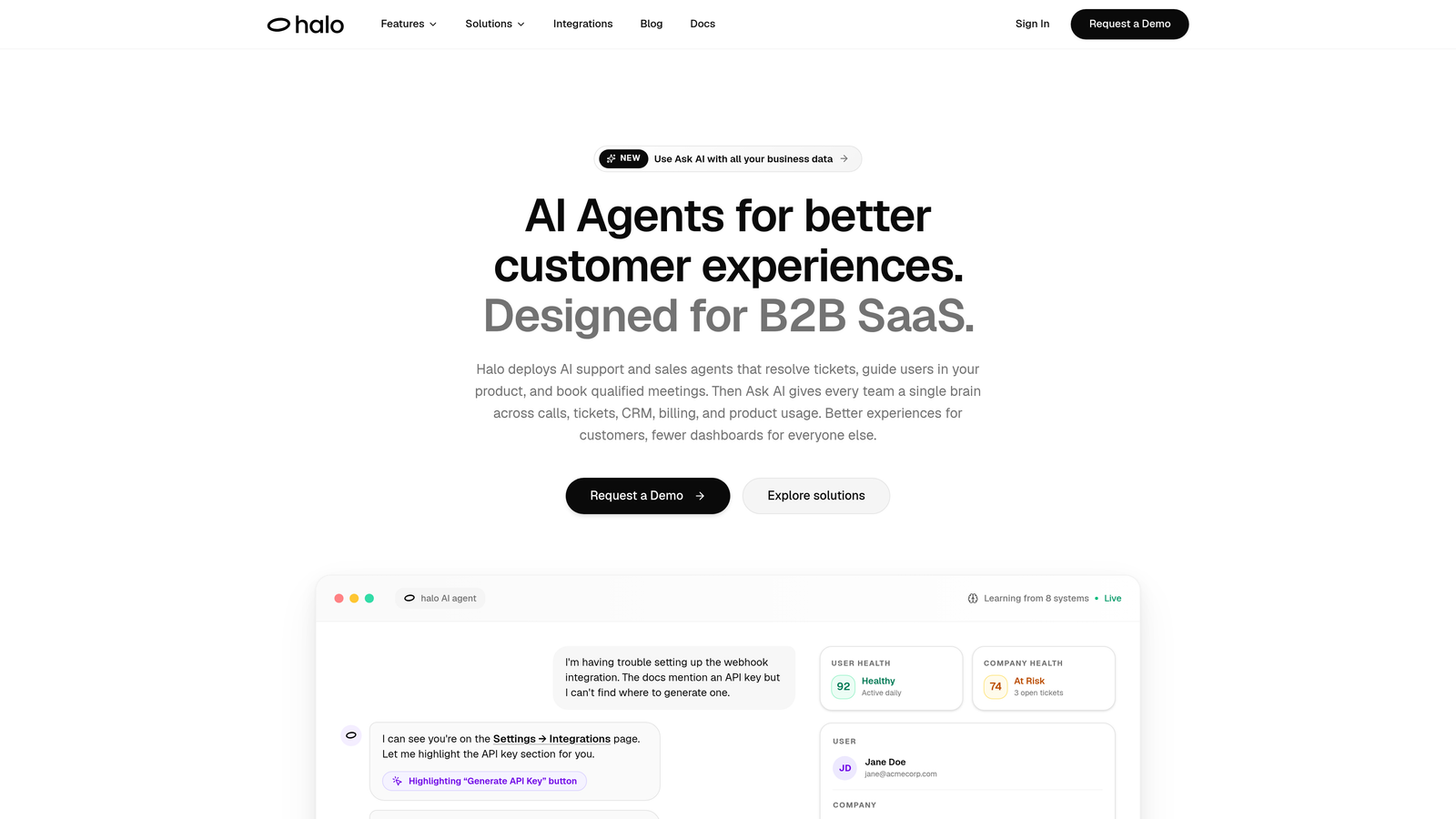
Halo AI is an AI-first customer support platform built specifically for B2B SaaS teams that need more than ticket deflection.
Where This Tool Shines
Most support platforms were built as helpdesks first and had AI added later. Halo was designed from the ground up with autonomous AI agents at the core. That architectural difference shows up in practice: the AI doesn't just suggest replies to agents, it resolves tickets, guides users through your product with visual UI context, and generates bug reports without anyone on your team lifting a finger.
The standout capability is page-aware context. Halo's chat widget sees what the user sees inside your product, meaning the AI can provide step-by-step UI guidance relevant to exactly where the user is stuck. For product-led growth companies, this is a meaningful shift from generic FAQ responses to genuinely useful in-product support. Add a smart inbox that surfaces customer health signals, revenue intelligence, and anomaly detection, and Halo starts functioning less like a support tool and more like a business intelligence layer your support team happens to use.
Key Features
Page-Aware Chat Widget: The AI sees the user's current location in your product and delivers visual UI guidance relevant to that exact context, not generic help center articles.
Autonomous Ticket Resolution: AI agents resolve support tickets end-to-end with continuous learning from every interaction, improving accuracy over time without manual retraining.
Smart Inbox with Business Intelligence: Surfaces customer health signals, revenue intelligence, and anomaly detection directly from support interaction data.
Auto Bug Ticket Creation: Automatically identifies and routes bug reports to Linear or your issue tracker, closing the loop between support and engineering without manual handoff.
Live Agent Handoff: Complex issues escalate to human agents with full conversation context preserved, so customers never have to repeat themselves.
Deep Integration Stack: Native connections to Linear, Slack, HubSpot, Intercom, Stripe, Zoom, PandaDoc, and Fathom, covering the full B2B SaaS operational stack.
Best For
B2B SaaS companies and product teams that want an AI-first architecture rather than an AI-augmented legacy helpdesk. Particularly strong for product-led growth teams where in-product guidance and business intelligence derived from support data are as important as ticket resolution speed.
Pricing
Custom pricing based on your team's needs. Contact Halo directly at haloagents.ai for a demo and pricing details.
2. Intercom
Best for: Teams wanting a mature, full-featured messaging platform with a capable autonomous AI agent layer.
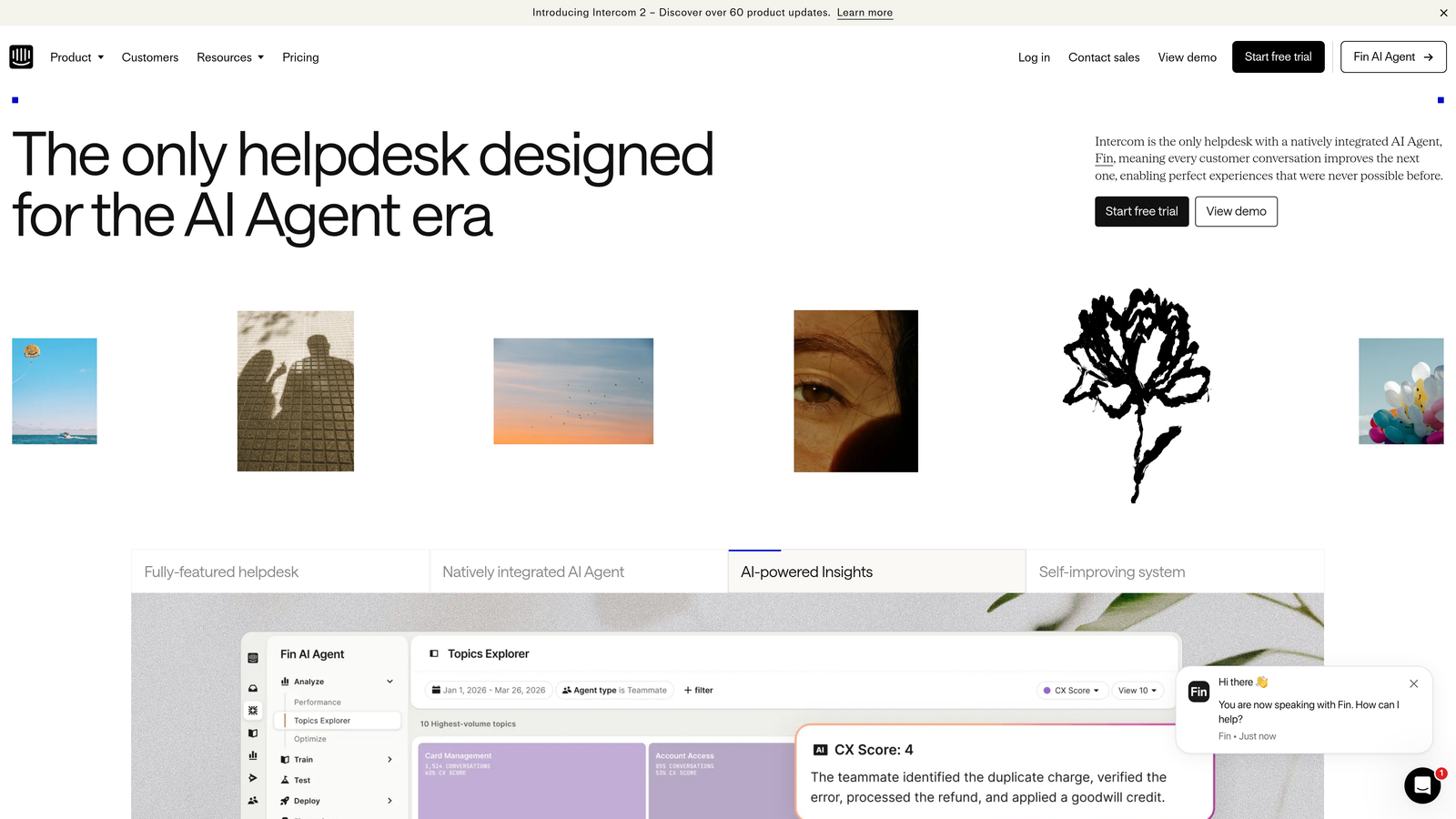
Intercom is a mature customer messaging platform with Fin, its AI agent built on large language models, handling support conversations autonomously across chat, email, and messenger.
Where This Tool Shines
Intercom has been in the customer messaging space long enough to have refined nearly every part of the support workflow. Fin, its AI agent, is trained on your help center content and handles a meaningful share of inbound conversations without human involvement. The platform's strength is breadth: you get a polished inbox, proactive messaging, a help center builder, and an extensive app marketplace all under one roof.
For teams that want a single platform managing the full customer communication lifecycle, not just reactive support, Intercom is a strong fit. The tradeoff is that AI capabilities are layered onto a messaging-first architecture rather than built around autonomous resolution from the start.
Key Features
Fin AI Agent: Autonomous conversation handling built on large language models, trained on your existing help center content for accurate, on-brand responses.
Unified Inbox: All customer channels consolidated into a single inbox for agents managing mixed human and AI-handled conversations.
Proactive Messaging Tools: Outbound messaging and in-app tours for onboarding and engagement, extending the platform beyond reactive support.
AI Conversation Summaries: Automatic summaries and suggested replies to accelerate agent handling of escalated conversations.
App Marketplace: Extensive third-party integrations covering CRMs, analytics, e-commerce, and developer tools.
Best For
Mid-market SaaS and consumer companies that want a proven, full-featured messaging platform with a capable AI agent layer. Strong choice for teams that also need proactive messaging and onboarding tools alongside support.
Pricing
Tiered plans with Fin AI pricing varying by plan and resolution volume. Verify current pricing at intercom.com.
3. Zendesk AI
Best for: Large support teams already on Zendesk Suite that want AI triage, routing, and agent copilot capabilities.
Zendesk AI is the world's most widely deployed helpdesk, now with AI triage, intelligent routing, and an agent copilot built into its Suite and available as add-ons.
Where This Tool Shines
Zendesk's advantage is scale and ecosystem maturity. If you already have hundreds of agents, years of ticket history, and a complex omnichannel workflow built on Zendesk, adding AI capabilities on top of that existing infrastructure is a natural path. The Agent Copilot feature accelerates human agents with suggested replies, ticket summaries, and next-action recommendations without requiring a full workflow overhaul.
Autonomous AI agents for self-service deflection are available, though the platform is most naturally suited to augmenting large human agent teams rather than replacing them. For teams not already on Zendesk, the platform's complexity and pricing can be a barrier to entry.
Key Features
AI Triage and Intelligent Routing: Automatically classifies and routes incoming tickets to the right team or agent based on content and context.
Agent Copilot: Suggests replies, summarizes ticket history, and recommends next actions to help agents resolve issues faster.
Autonomous AI Agents: Self-service deflection agents that handle common questions before they reach the human support queue.
Omnichannel Coverage: Email, chat, voice, and social channels managed within a single platform with unified reporting.
Enterprise Reporting: Deep analytics and customizable dashboards suited for large operations teams tracking SLA compliance and performance.
Best For
Enterprise and mid-market companies with established Zendesk deployments and large agent teams. Less compelling as a greenfield choice for smaller teams that want AI-first architecture from day one.
Pricing
AI features available on higher Suite tiers and as paid add-ons. Verify current pricing at zendesk.com.
4. Freshdesk Freddy AI
Best for: SMB through mid-market teams wanting omnichannel AI support at a more accessible price point than enterprise alternatives.
Freshdesk Freddy AI is Freshdesk's built-in AI layer spanning self-service bots, agent assist, and analytics across its omnichannel helpdesk suite.
Where This Tool Shines
Freddy AI covers three distinct layers: customer-facing deflection, agent assistance, and analytics. That breadth at Freshdesk's pricing tier makes it a compelling option for teams that want meaningful AI capabilities without committing to enterprise-level spend. The Freddy Insights layer is particularly useful for support managers who want AI to surface trends and anomalies in their ticket data without building custom reports.
The platform's omnichannel coverage, email, chat, phone, and social, combined with accessible pricing tiers, makes Freshdesk a practical choice for teams that are growing into AI-powered support rather than starting with it as a core requirement.
Key Features
Freddy Self Service: Customer-facing AI bot that deflects common questions before they generate agent tickets.
Freddy Copilot: Agent assist with suggested replies, ticket summaries, and knowledge base retrieval to speed up human resolution.
Freddy Insights: AI-powered analytics that surfaces trends, anomalies, and automation opportunities from support data.
Omnichannel Coverage: Email, chat, phone, and social channels managed within a single unified helpdesk interface.
Accessible Pricing Tiers: Freddy AI capabilities available across Growth, Pro, and Enterprise plans, making entry-level AI accessible to smaller teams.
Best For
SMB and mid-market teams that need solid omnichannel AI support without enterprise pricing. A good fit for companies already considering Freshdesk as their helpdesk who want AI built in from the start.
Pricing
Freddy AI features available across multiple plan tiers. Verify current pricing at freshdesk.com.
5. Salesforce Agentforce
Best for: Enterprises running Salesforce Service Cloud that need autonomous AI agents with full CRM data access.
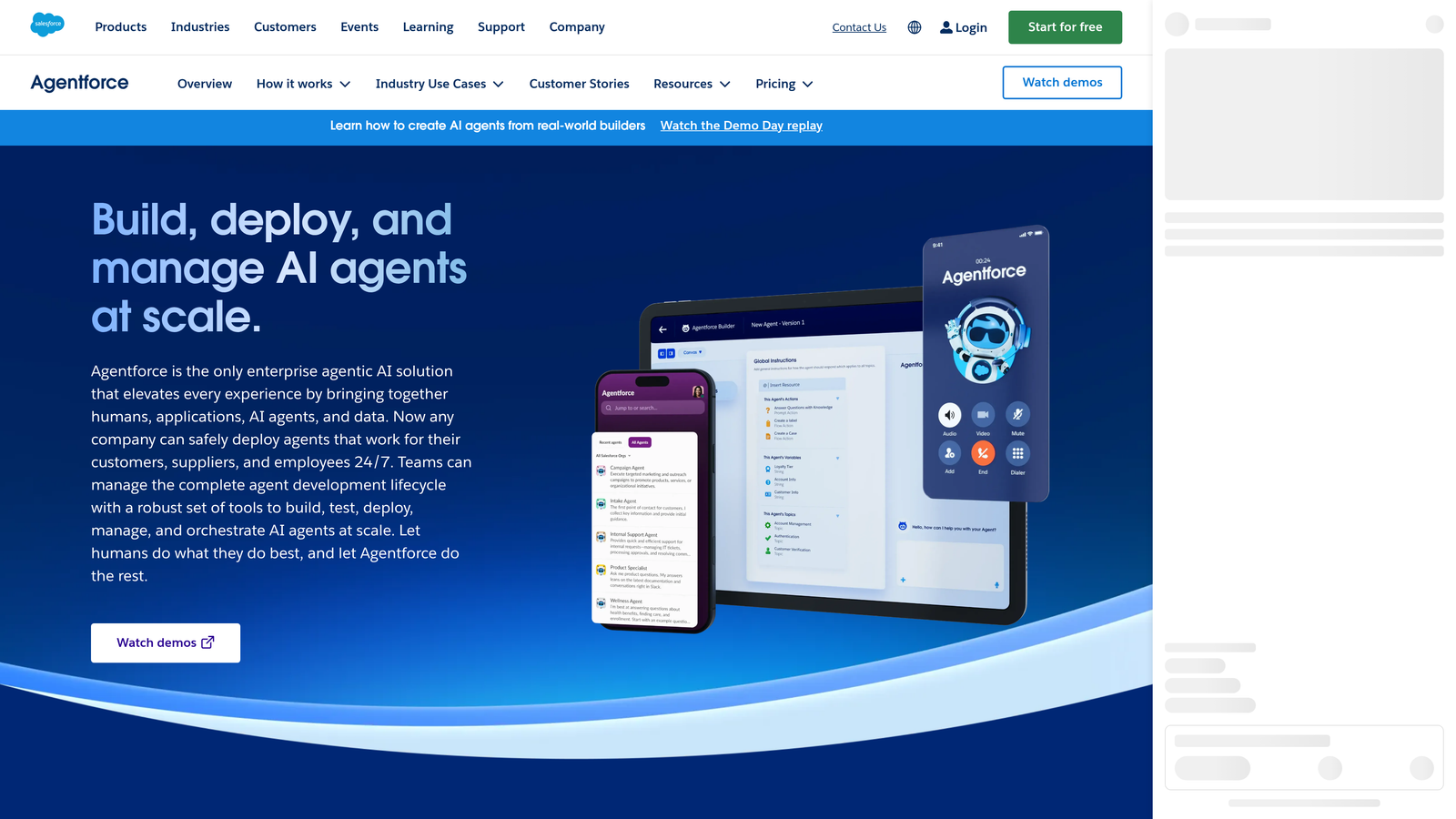
Salesforce Agentforce is Salesforce's autonomous AI agent platform, built natively into Service Cloud with full CRM data access for multi-step action execution across enterprise support workflows.
Where This Tool Shines
Agentforce's defining advantage is CRM context. When an AI agent has access to a customer's full Salesforce record, including purchase history, open opportunities, service history, and account status, it can take genuinely intelligent actions rather than just answering FAQ-style questions. The platform is positioned around multi-step execution: agents don't just respond, they take actions within the Salesforce ecosystem.
The flip side is that Agentforce is deeply tied to the Salesforce ecosystem. Teams not already on Service Cloud face a significant implementation investment before seeing value. For enterprises already running Salesforce as their system of record, however, the depth of integration is difficult to match.
Key Features
Full CRM Context: Autonomous agents operate with access to complete Salesforce customer data, enabling personalized, context-aware responses and actions.
Multi-Step Action Execution: Agents can execute complex workflows within Salesforce, not just surface information but take actions on behalf of customers.
Einstein AI Integration: Deep integration with Salesforce's Einstein AI layer across Service Cloud and Sales Cloud for predictive capabilities.
Pre-Built Agent Templates: Ready-to-deploy templates for common support workflows that reduce configuration time for enterprise teams.
Enterprise Security and Compliance: Built on Salesforce's enterprise-grade infrastructure with the security and compliance controls large organizations require.
Best For
Enterprise organizations already running Salesforce as their primary CRM and Service Cloud as their support infrastructure. Not the right starting point for teams without an existing Salesforce investment.
Pricing
Enterprise pricing with a consumption-based model. Verify current pricing at salesforce.com.
6. Ada
Best for: High-volume support teams that need AI agents capable of taking actions, not just answering questions.
Ada is a dedicated AI agent platform focused on action-oriented automation, built to execute transactions like refunds and account updates via integrations, not just respond to inquiries.
Where This Tool Shines
Ada's differentiation is transactional capability. Many AI support platforms are strong at answering questions but stop short of taking action in backend systems. Ada's agents can process refunds, update account information, check order status, and execute other transactional workflows by connecting to your existing systems. For high-volume consumer-facing operations where a significant share of tickets are transactional rather than informational, this is a meaningful capability gap to close.
The no-code builder makes it possible for non-technical teams to customize AI agent behavior without engineering involvement, which reduces deployment time and ongoing maintenance burden.
Key Features
Action-Oriented AI: Agents can process refunds, update accounts, and check order status autonomously via integrations, going beyond question-answering to transaction execution.
No-Code Builder: Customizable AI agent behavior through a visual interface that doesn't require engineering resources to configure or maintain.
Multilingual Support: Handles customer conversations across multiple languages, suitable for global customer bases.
CRM and Platform Integrations: Connects to major CRMs, e-commerce platforms, and SaaS tools to enable transactional actions within existing systems.
Human Handoff with Context: Escalates to human agents with full conversation context preserved when transactions exceed the AI's configured scope.
Best For
High-volume consumer brands and SaaS companies with a significant share of transactional support requests, particularly those needing multilingual capability and non-technical customization.
Pricing
Custom enterprise pricing. Verify current details at ada.cx.
7. Tidio
Best for: Small businesses and early-stage SaaS teams that need fast deployment with a free tier to start.
Tidio is a fast-to-deploy live chat and AI platform featuring Lyro AI for automated conversations alongside traditional live chat, built for teams without dedicated technical resources.
Where This Tool Shines
Tidio's primary advantage is accessibility. You can be up and running in hours rather than weeks, and the free tier means early-stage teams can start capturing and automating conversations without a budget commitment. Lyro AI, built on Claude, handles natural conversations that feel less robotic than many entry-level chatbots, which matters when you're a small team and the AI is representing your brand without a human backup readily available.
The live chat and AI hybrid model is practical for small teams: the bot handles what it can, and human agents step in when needed without any complex routing configuration. For e-commerce businesses on Shopify or WooCommerce, the native integrations add useful order context to conversations.
Key Features
Lyro AI: Conversational AI chatbot built on Claude for natural, context-aware responses that handle common support queries without scripted flows.
Live Chat and AI Hybrid: Seamless switching between AI-handled and human-handled conversations within a single interface.
Fast Setup: Designed for non-technical teams; deployment typically takes hours rather than weeks.
E-Commerce Integrations: Native connections to Shopify and WooCommerce for order-aware support conversations.
Free Tier: A functional free plan that lets small teams get started without upfront cost commitment.
Best For
Small businesses, early-stage SaaS startups, and e-commerce brands that need fast deployment, accessible pricing, and a low technical barrier to entry. Less suited to complex B2B workflows or enterprise-scale operations.
Pricing
Free tier available; Lyro AI included on paid plans. Verify current plan details at tidio.com.
8. Kustomer
Best for: Subscription and high-touch businesses that need a full customer timeline across every channel to inform AI and agent decisions.
Kustomer is a CRM-native support platform that gives AI agents a complete customer timeline across every channel, making it particularly strong for relationship-driven support models.
Where This Tool Shines
Kustomer's core insight is that support context extends far beyond the current conversation. By surfacing a customer's complete history, every email, chat, SMS, social message, and phone call in a single timeline, it gives both AI and human agents the context they need to resolve issues without asking customers to repeat themselves. For subscription businesses where retention depends on relationship quality, that full-picture view is genuinely valuable.
The AI automation layer handles routing, suggested replies, and self-service interactions using that rich CRM context, which tends to produce more relevant responses than AI operating on conversation data alone.
Key Features
Unified Customer Timeline: Every customer interaction across all channels consolidated into a single chronological view for agents and AI.
AI-Powered Routing and Replies: Intelligent ticket routing and suggested replies informed by full customer history rather than just the current conversation.
Self-Service AI Bot: Customer-facing bot with access to CRM context for more personalized deflection responses.
Omnichannel Coverage: Email, chat, SMS, social, and voice all managed within the unified Kustomer interface.
Subscription and D2C Fit: Purpose-built features and workflow templates suited to subscription businesses and direct-to-consumer brands.
Best For
Subscription businesses, D2C brands, and any company where customer relationship history is central to support quality. Teams that need omnichannel coverage with a CRM-first perspective on every interaction.
Pricing
Per-agent pricing model. Verify current plans at kustomer.com.
9. Forethought
Best for: Teams with existing helpdesk investments who want to layer AI on top without replacing their current infrastructure.
Forethought is an AI layer that enhances existing helpdesks, including Zendesk, Salesforce, Freshdesk, and ServiceNow, with smarter triage, deflection, and agent assist without requiring infrastructure replacement.
Where This Tool Shines
Forethought's positioning is deliberately additive. If your team has years of workflow configuration, agent training, and ticket history invested in an existing helpdesk, ripping it out to adopt an AI-first platform is a significant disruption. Forethought lets you get meaningful AI capabilities, smarter routing, automated deflection, agent copilot, and analytics, without that disruption. The Discover product is particularly useful for identifying which ticket types are the best candidates for automation before you invest in building out those workflows.
The tradeoff is that Forethought's capabilities are bounded by what the underlying helpdesk can do. It enhances rather than transforms, which is exactly what some teams need and a ceiling for others.
Key Features
Triage: Intelligent ticket routing that classifies and directs incoming requests to the right team or agent based on content analysis.
Solve: AI deflection layer that handles common questions before they enter the agent queue, reducing ticket volume without changing helpdesk infrastructure.
Assist: Agent copilot that surfaces suggested responses and relevant knowledge base content during live ticket handling.
Discover: Analytics product that identifies automation opportunities by analyzing ticket patterns and resolution data.
Native Helpdesk Integrations: Purpose-built integrations with Zendesk, Salesforce, Freshdesk, and ServiceNow for seamless layering on existing workflows.
Best For
Mid-market and enterprise teams with established helpdesk investments who want to improve AI capabilities incrementally rather than through a platform migration. Strong fit for organizations where helpdesk replacement is off the table but AI improvement is a priority.
Pricing
Custom enterprise pricing. Verify current details at forethought.ai.
Which Platform Is Right for Your Team
The right AI customer support platform depends less on feature checklists and more on where you're starting from and where you need to go.
If you're a B2B SaaS team that wants an AI-first architecture with page-aware context, business intelligence, and deep product stack integrations, Halo AI is the most purpose-built option on this list. It's designed for teams that want AI to do real work, not just assist humans doing real work.
For enterprises already running Salesforce, Agentforce offers unmatched CRM depth. Teams with large Zendesk deployments will find Zendesk AI the lowest-friction upgrade path. If budget is the primary constraint, Tidio and Freshdesk Freddy AI offer meaningful AI capabilities at accessible price points, with Tidio's free tier making it a genuine starting option for early-stage teams.
Teams not ready to migrate their helpdesk should look at Forethought first. It won't transform your support architecture, but it will make your existing infrastructure meaningfully smarter without the disruption of a platform switch.
The broader trend worth noting: the gap between AI-augmented helpdesks and AI-first platforms is widening. Platforms where AI is a native architecture, not a feature added to a ticketing system, are pulling ahead on autonomous resolution rates, integration depth, and the ability to surface intelligence beyond support metrics.
Your support team shouldn't scale linearly with your customer base. Let AI agents handle routine tickets, guide users through your product, and surface business intelligence while your team focuses on complex issues that need a human touch. See Halo in action and discover how continuous learning transforms every interaction into smarter, faster support.