9 Best AI for Customer Service in 2026
Discover the best AI for customer service in 2026, as this guide evaluates nine top platforms shifting from basic chatbot deflection to agentic resolution—comparing automation depth, integration capabilities, and learning features to help B2B SaaS teams find the right fit, whether they're enhancing an existing Zendesk setup or building a fully autonomous support operation.
 Grant CooperFounder13 min read
The pressure to deliver faster, smarter support without growing headcount is real, and AI is how leading B2B teams are meeting that challenge. But not all customer service AI is built the same. Some are glorified chatbots with scripted flows; others are intelligent agents that resolve tickets, detect bugs, and surface revenue signals in real time.
The dominant shift in 2026 is from chatbot deflection to agentic resolution. Buyers are no longer asking "can the AI answer questions?" They're asking "can it take action, learn from outcomes, and integrate with my entire stack?" That's a very different bar.
This guide covers the top AI tools for customer service in 2026, evaluated on depth of automation, integration breadth, learning capabilities, and suitability for B2B SaaS teams. Whether you're running a lean support team on Zendesk or building a fully autonomous support operation, there's a fit here. We've prioritized tools that go beyond deflection to deliver genuine resolution, and flagged exactly who each tool is best suited for.
1. Halo AI
Best for: B2B SaaS teams that want an AI-first platform built for autonomous resolution and business intelligence.
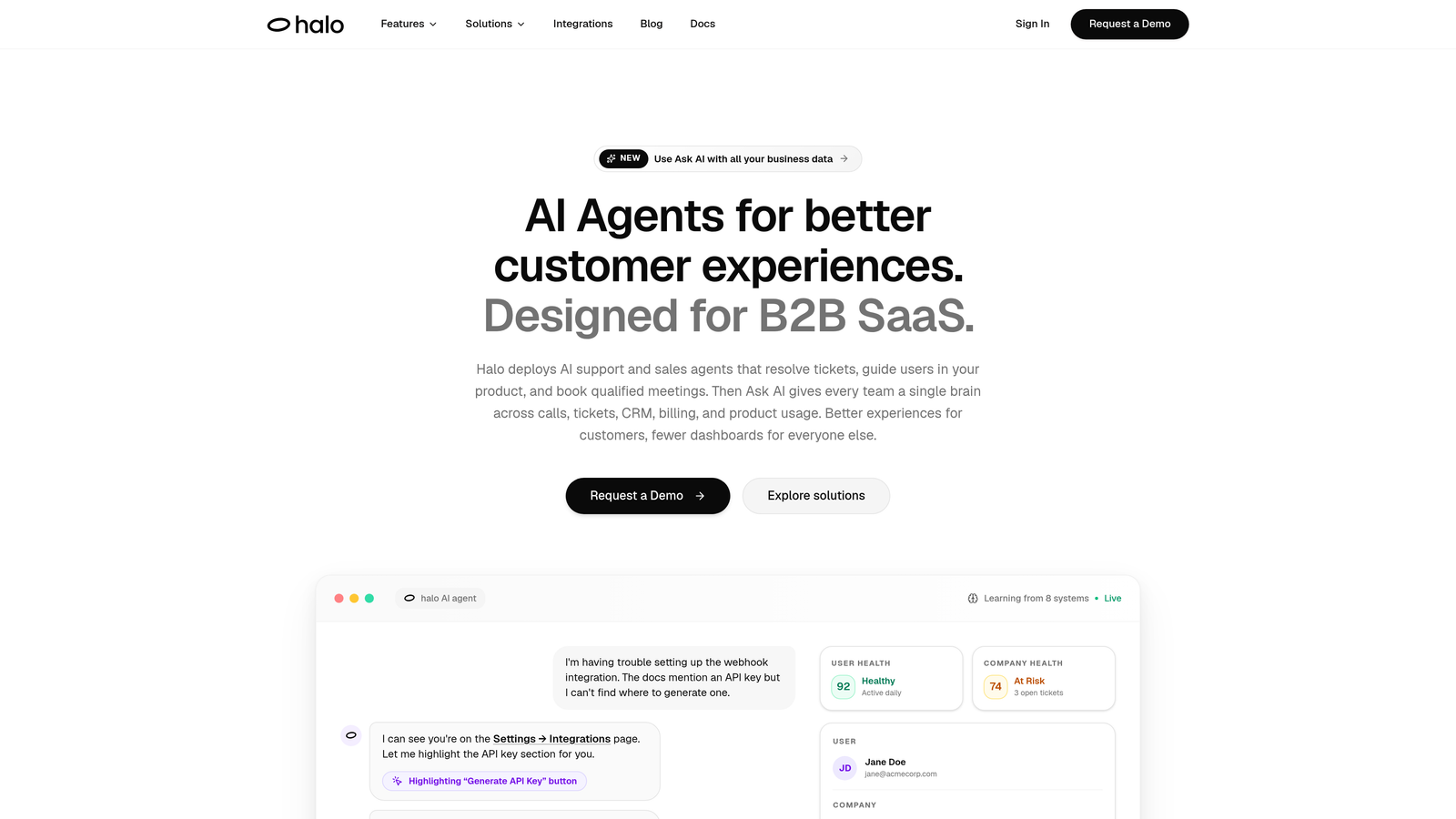
Halo AI is an AI-first customer support platform that resolves tickets, guides users through your product with visual context, and surfaces business intelligence signals across your entire stack.
Where This Tool Shines
What separates Halo from most tools on this list is the architecture. It's not a chatbot layer bolted onto an existing helpdesk. It's built AI-first, which means every feature, from ticket resolution to bug detection, is designed around intelligent automation rather than retrofitted onto a human workflow.
The page-aware chat widget is a genuine differentiator for SaaS teams. Instead of generic responses, Halo sees exactly where the user is in your product and provides contextual, visual UI guidance. That context awareness dramatically improves resolution quality, especially for complex, multi-step product questions that trip up most AI tools.
Key Features
Page-Aware Chat Widget: Sees exactly what the user sees in your product and delivers in-product visual guidance tailored to their current context.
Autonomous Ticket Resolution: AI agents handle tickets end-to-end with smart live agent handoff for issues that genuinely need a human.
Auto Bug Ticket Creation: Automatically generates and routes bug reports to Linear or your preferred project management tool without manual intervention.
Smart Inbox with Business Intelligence: Goes beyond support metrics to surface customer health signals, revenue anomalies, and product usage patterns directly in the inbox.
Deep Integration Stack: Connects natively with Slack, HubSpot, Intercom, Stripe, Zoom, PandaDoc, Fathom, and Linear, covering the full B2B SaaS toolchain.
Continuous Learning Loop: The AI improves with every resolved interaction, meaning resolution quality compounds over time rather than staying static.
Best For
B2B SaaS companies that want AI support to do more than deflect tickets. Halo is particularly strong for product-led teams where support, product intelligence, and revenue signals need to live in the same system. If you're evaluating tools that go beyond support into business intelligence, this is the one to benchmark everything else against.
Pricing
Contact for pricing. See haloagents.ai for current plans and to request a demo.
2. Intercom Fin
Best for: Teams already on Intercom who want native AI resolution without switching platforms.
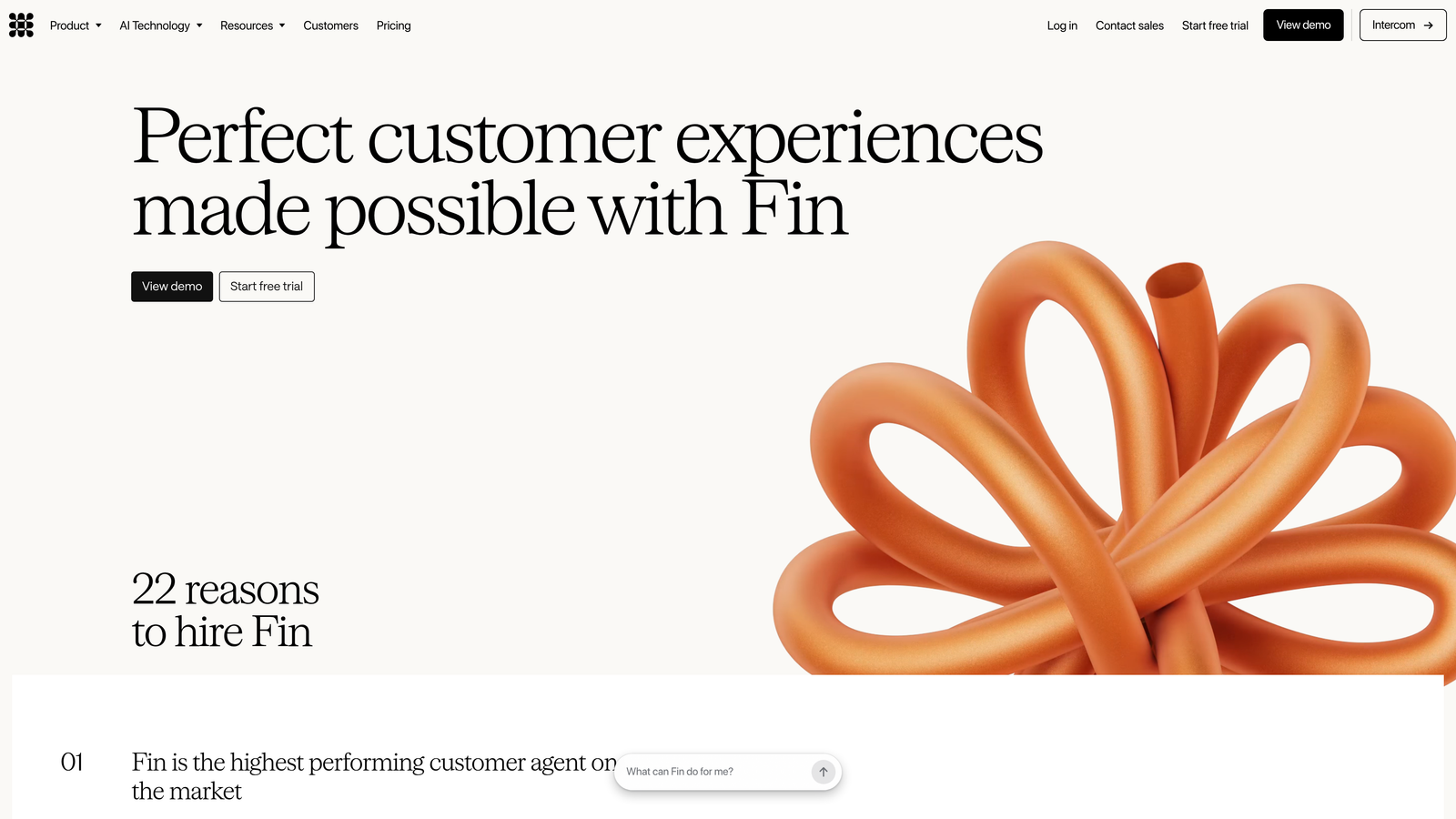
Intercom Fin is Intercom's native AI resolution layer, built directly into the Intercom Messenger experience for seamless deployment.
Where This Tool Shines
Fin's biggest advantage is zero migration friction for existing Intercom customers. It sits inside the Messenger experience your team and customers already use, trained on your help center content with no separate implementation required. For teams that are happy with Intercom's broader platform, Fin is the most natural upgrade path to AI resolution.
The escalation experience is also notably smooth. When Fin can't resolve an issue, the handoff to a human agent happens within the same conversation thread, preserving full context. That continuity matters more than most teams realize until they've experienced choppy handoffs in other tools.
Key Features
LLM-Powered Resolution: Trained on your help center and support content to handle a wide range of queries with natural, accurate responses.
Seamless Human Escalation: Escalates to human agents within the same conversation thread, maintaining full context throughout.
Native Intercom Integration: No separate implementation for existing Intercom customers — Fin activates within your existing setup.
Multi-Language Support: Handles conversations across multiple languages with customizable tone settings.
Best For
Teams already using Intercom as their primary support and messaging platform. Fin is less compelling as a standalone choice if you're not already in the Intercom ecosystem, but for native Intercom users it's the most efficient path to AI resolution.
Pricing
Included in Intercom plans; Fin is also available on usage-based pricing per resolution. See intercom.com for current plan details.
3. Zendesk AI
Best for: Enterprise teams running high-volume support operations on the Zendesk Suite.
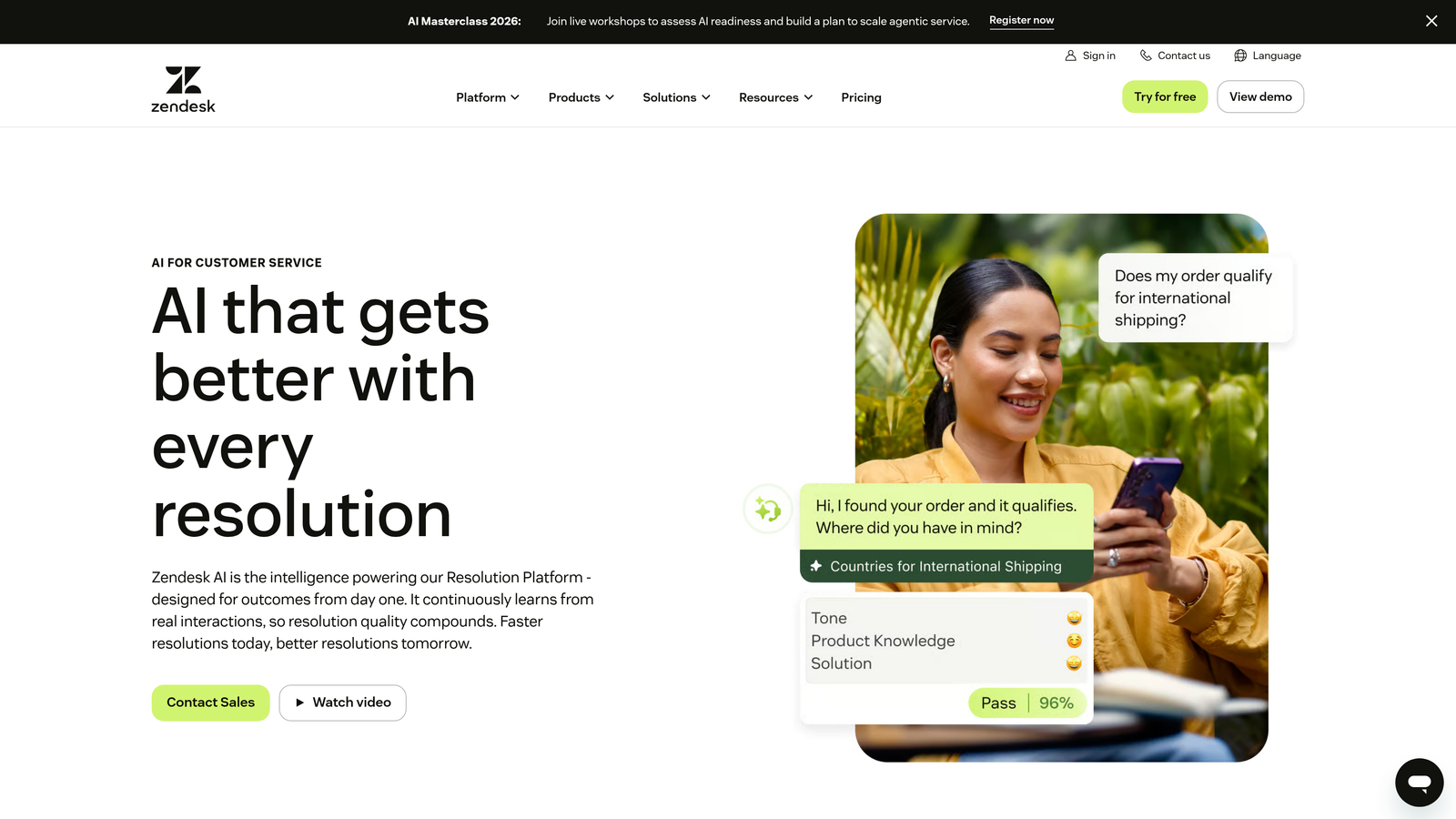
Zendesk AI is a suite of AI capabilities embedded throughout Zendesk, covering triage, routing, agent assist, and autonomous resolution in a single platform.
Where This Tool Shines
Zendesk AI benefits from being embedded in one of the most widely deployed support platforms in the world. For teams already running Zendesk, the AI features activate within existing workflows rather than requiring a parallel system. Intent detection, sentiment analysis, and ticket summarization all work against the data your team already has in Zendesk.
The Copilot feature is particularly useful for agent productivity. Suggested replies, ticket summarization, and next-best-action recommendations reduce the cognitive load on agents handling complex queues, which is where Zendesk's enterprise depth really shows.
Key Features
Intelligent Triage: Detects intent and sentiment on incoming tickets to prioritize and route automatically.
AI Agents: Autonomous bots for self-service resolution across web and messaging channels.
Copilot for Agents: Suggested replies, ticket summarization, and next-best-action recommendations to accelerate human agent workflows.
AI-Enhanced Workflow Automation: Triggers and macros enhanced with AI to handle complex routing and escalation logic.
Best For
Enterprise support teams already invested in the Zendesk Suite who want to layer AI capabilities without changing their core platform. Also a strong fit for teams that need robust agent assist alongside autonomous resolution.
Pricing
AI features available on Zendesk Suite plans; an Advanced AI add-on is available for higher tiers. See zendesk.com for current pricing.
4. Freshdesk Freddy AI
Best for: Growing teams on Freshdesk looking for an affordable, full-featured AI layer across resolution, agent assist, and analytics.
Freshdesk Freddy AI is Freshworks' AI layer spanning customer-facing resolution, agent assist, and support analytics, built natively into the Freshdesk platform.
Where This Tool Shines
Freddy covers three distinct use cases in one package: customer-facing resolution (Freddy Self Service), agent productivity (Freddy Copilot), and leadership analytics (Freddy Insights). That breadth makes it unusually complete for teams that want AI across the entire support operation, not just one layer of it.
Relative to enterprise-tier competitors, Freshdesk Freddy is generally positioned at a more accessible price point, which makes it a compelling option for mid-market teams that want comprehensive AI features without the enterprise contract.
Key Features
Freddy Self Service: Customer-facing AI agent for resolution and FAQ deflection across support channels.
Freddy Copilot: Agent-assist with suggested responses, ticket summarization, and tone adjustment for human agents.
Freddy Insights: AI-driven analytics and recommendations surfaced for support team leaders and managers.
Native Freshdesk Integration: All Freddy features operate natively within Freshdesk with no third-party implementation required.
Best For
Mid-market and growing teams on Freshdesk who want AI across resolution, agent productivity, and analytics without a separate tool. Particularly strong for teams where support leadership wants data-driven recommendations alongside automation.
Pricing
Freddy AI features are tiered across Freshdesk Growth, Pro, and Enterprise plans. See freshworks.com for current pricing details.
5. Tidio Lyro
Best for: SMBs and e-commerce teams that need fast AI deployment with minimal technical setup.
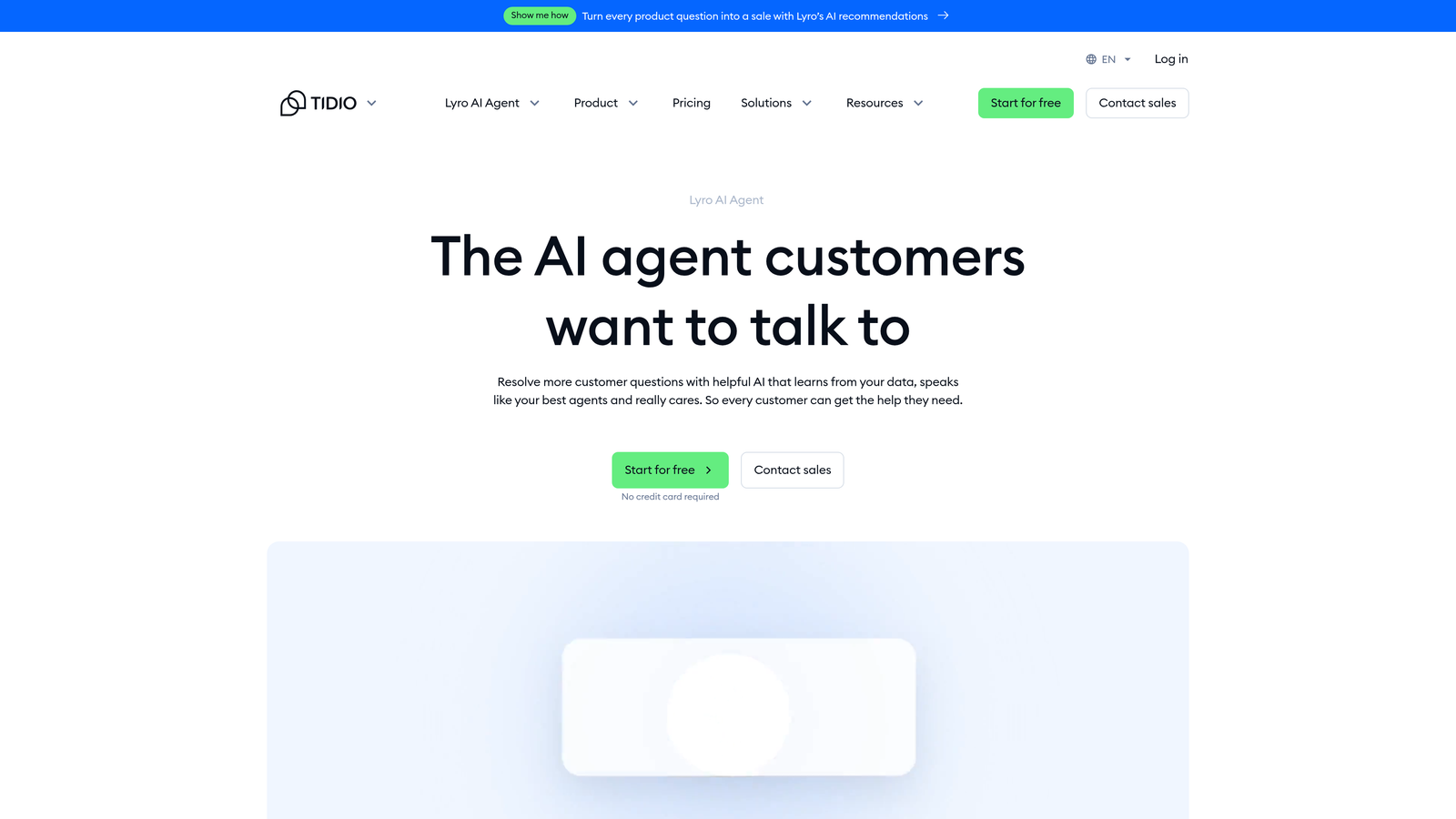
Tidio Lyro is a conversational AI trained on your existing support content, designed for quick deployment with automatic live chat fallback when confidence is low.
Where This Tool Shines
Lyro's standout quality is its deployment speed. Teams can get AI resolution running quickly by pointing it at existing help content, without complex implementation or technical resources. For smaller teams that need AI working now rather than after a lengthy onboarding process, that matters a lot.
The automatic fallback to live chat when AI confidence drops is a sensible safety net that prevents bad experiences from slipping through. It's a practical design choice that reflects the reality of SMB support environments where edge cases are common and brand reputation is on the line.
Key Features
Fast Content Training: Trains on your existing help content with minimal setup, no complex implementation required.
Automatic Live Chat Fallback: Detects low-confidence situations and routes to a human agent automatically.
Common Query Handling: Manages FAQs, order tracking, and repetitive support queries autonomously.
Accessible Pricing: Positioned as an affordable entry point relative to enterprise-tier tools, with pricing that scales by conversation volume.
Best For
SMBs, e-commerce businesses, and early-stage SaaS teams that want AI resolution up and running quickly without a large technical investment. Less suited for complex B2B environments that need deep integrations or advanced business intelligence.
Pricing
Lyro is available on Tidio paid plans with pricing that scales by conversation volume. See tidio.com for current rates.
6. Drift (Salesloft)
Best for: B2B revenue teams where support conversations and sales qualification happen in the same channel.
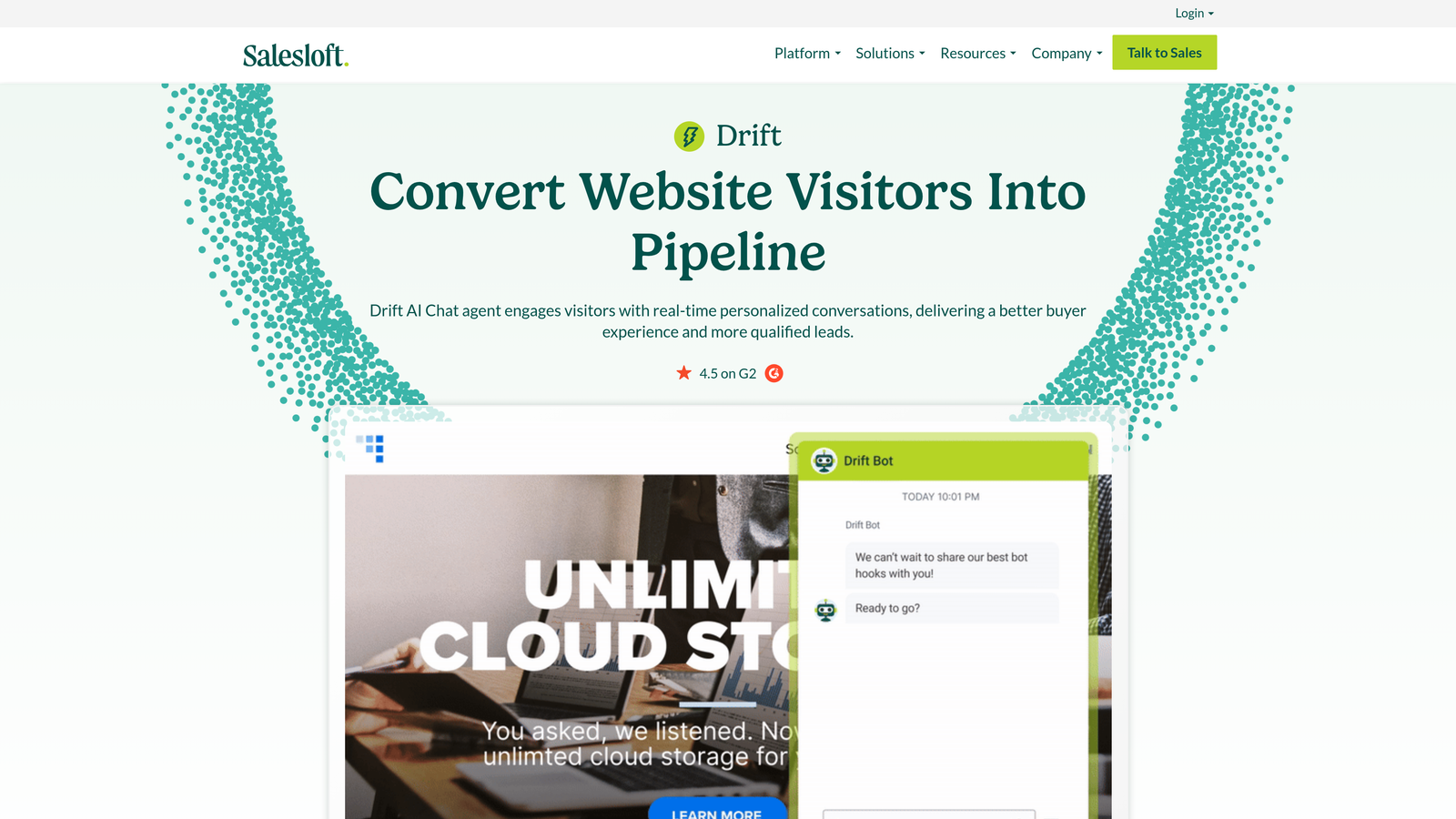
Drift is a conversational AI platform that blends sales qualification and customer support in a single interface, now part of the Salesloft revenue platform.
Where This Tool Shines
Drift occupies a unique position on this list: it's not purely a support tool. It's designed for teams where the line between support and revenue is blurry, handling support queries and qualifying leads within the same conversation. For B2B companies running account-based strategies, that hybrid capability is genuinely useful.
AI-powered meeting scheduling built directly into conversations is a practical differentiator. When a support interaction reveals a sales opportunity or an upsell moment, Drift can route that conversation to a rep and book a meeting without breaking the flow.
Key Features
Hybrid Support and Sales AI: AI chatbots that handle support queries and lead qualification simultaneously within a single conversation.
AI-Powered Meeting Scheduling: Integrates meeting booking directly into conversations without requiring external tools.
Revenue-Focused Routing: Connects high-value prospects directly to sales reps based on intent signals.
CRM Integrations: Connects with Salesforce, HubSpot, and major CRM platforms for full pipeline visibility.
Best For
B2B teams where support and revenue conversations overlap, particularly companies running account-based marketing or PLG motions where a support interaction can quickly become a sales conversation. Note that Drift's product direction continues to evolve under Salesloft ownership.
Pricing
Enterprise-focused with custom packaging. Contact Salesloft/Drift directly for current pricing.
7. Ada
Best for: Enterprise teams that need action-based AI automation across multiple channels with strong governance controls.
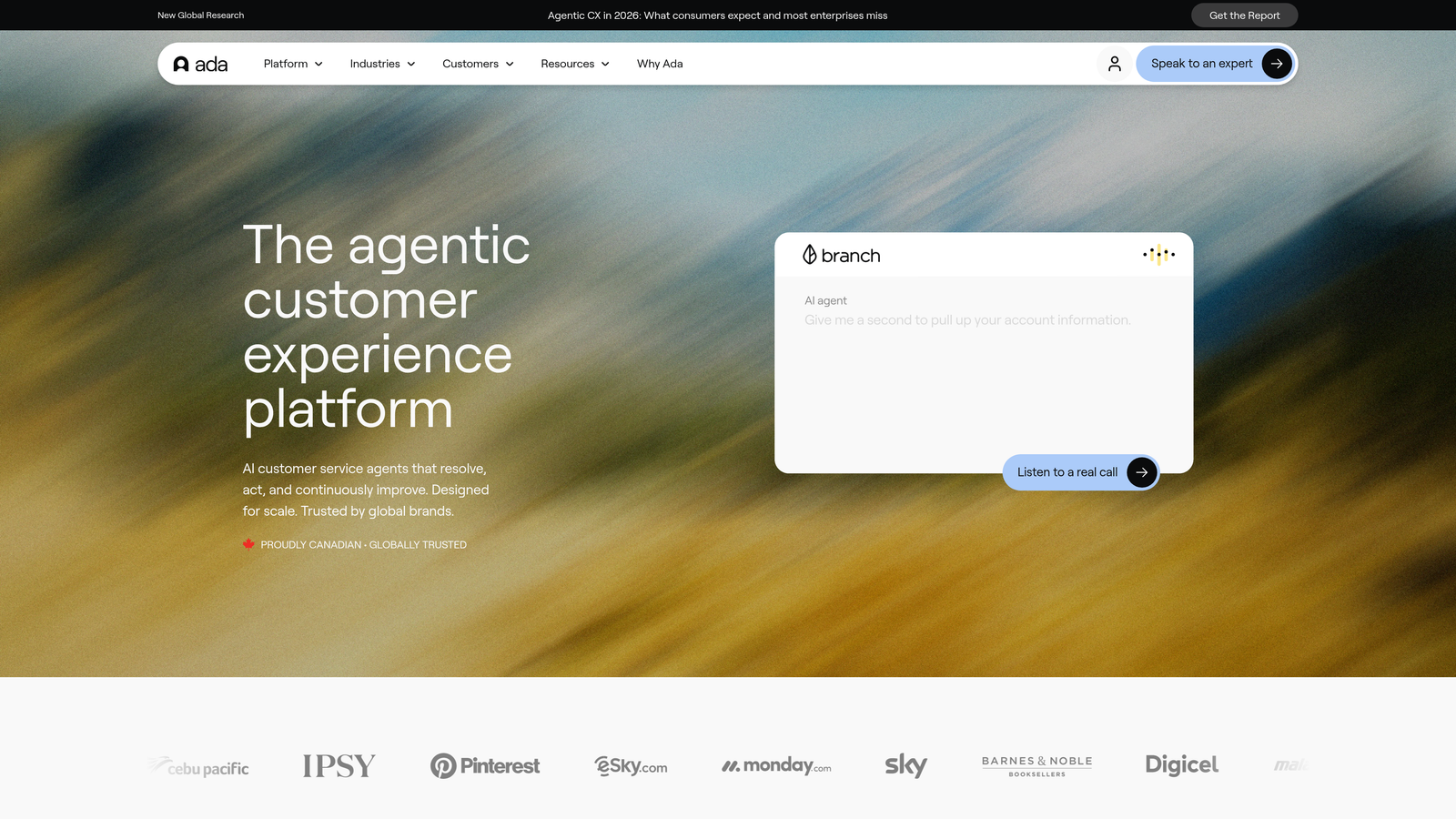
Ada is an enterprise-grade no-code AI automation platform that executes actions across your systems rather than simply answering questions.
Where This Tool Shines
Ada's Reasoning Engine is what sets it apart at the enterprise level. Most AI support tools answer questions. Ada can execute API calls, update records, and trigger workflows, which means it can complete tasks rather than just describe how to complete them. That's a meaningful distinction for complex support environments where resolution often requires system-level actions.
The no-code builder makes it accessible to operations and support teams without engineering dependencies, while the enterprise governance features, including audit trails and compliance controls, satisfy the requirements of larger organizations where accountability is non-negotiable.
Key Features
Action-Based AI: Executes API calls, updates records, and triggers workflows rather than just generating text responses.
No-Code Automation Builder: Creates and manages AI automation flows without engineering resources.
Multi-Channel Deployment: Operates across web, mobile, voice, and social channels from a single platform.
Enterprise Governance: Includes audit trails, compliance controls, and enterprise-grade security features.
Best For
Large enterprises with complex, multi-channel support operations that need AI to take actions across systems, not just answer questions. Strong fit for teams in regulated industries or those with strict compliance requirements.
Pricing
Enterprise pricing with custom quotes. Contact Ada directly at ada.cx for pricing details.
8. Kustomer
Best for: High-volume consumer support teams that need a unified customer timeline with AI-powered routing and automation.
Kustomer is a CRM-native customer service platform with AI-powered routing and resolution built around a unified customer timeline.
Where This Tool Shines
Kustomer's core differentiator is context. The unified customer timeline aggregates every interaction across every channel into a single view, giving both AI and human agents the full history before responding. That context depth makes AI routing and automated responses significantly more accurate because the system knows who the customer is, not just what they're asking.
For high-volume consumer support environments, particularly subscription businesses and DTC brands, that historical context is the difference between generic AI responses and genuinely personalized resolution.
Key Features
Unified Customer Timeline: Aggregates all interactions across channels into a single view for AI and human agents.
AI-Powered Intent Detection and Routing: Routes conversations based on detected intent combined with customer history.
Behavior-Triggered Automation: Triggers automated responses and workflows based on customer behavior and historical patterns.
Multi-Channel Support: Handles high-volume support across email, chat, social, and voice from one platform.
Best For
High-volume consumer support teams, particularly in DTC, retail, and subscription businesses, where customer history and context are critical to resolution quality. Less optimized for B2B SaaS environments where product-specific context matters more than purchase history.
Pricing
Tiered plans available. See kustomer.com for current pricing details.
9. Forethought
Best for: Teams that want AI triage, routing, and agent assist layered on top of an existing helpdesk without replacing it.
Forethought is an AI layer that sits on top of your existing helpdesk, adding triage, routing, and agent assist capabilities without requiring you to migrate your support stack.
Where This Tool Shines
Forethought's value proposition is additive rather than replacement. If your team has significant investment in Zendesk or Salesforce Service Cloud, and you're not ready to migrate, Forethought lets you add meaningful AI capabilities on top of what you already have. That's a pragmatic answer to a real organizational constraint.
The Discover module is underrated. It analyzes your existing ticket data to identify resolution gaps and automation opportunities, essentially telling you where AI can have the most impact before you've even fully deployed it. That kind of upfront intelligence helps teams prioritize implementation and build the business case internally.
Key Features
Solve: Autonomous AI resolution for common, repetitive support queries handled without human intervention.
Triage: AI-powered routing and tagging based on detected intent and urgency to prioritize queues intelligently.
Assist: Agent copilot that surfaces relevant knowledge and suggested replies in real time during live conversations.
Discover: Analytics module that identifies resolution gaps and surfaces automation opportunities from existing ticket data.
Best For
Support teams with existing investment in Zendesk, Salesforce Service Cloud, or similar platforms who want AI augmentation without ripping out their stack. Also strong for teams that want data-driven insight into where automation will have the most impact before committing to full deployment.
Pricing
Contact Forethought for pricing. See forethought.ai for details and to request a demo.
Which Tool Is Right for Your Team?
The right AI for customer service depends less on feature lists and more on where you are in your support maturity and what you're trying to achieve. Here's a quick-reference framework based on the nine tools above.
Startup or SMB on a budget: Start with Tidio Lyro or Freshdesk Freddy AI. Both offer fast deployment, accessible pricing, and enough AI capability to meaningfully reduce ticket volume without a large implementation investment.
Enterprise Zendesk shop: Zendesk AI is the natural fit if you're deeply embedded in the Suite. If you want AI augmentation without disrupting your Zendesk setup, Forethought is worth a close look as a complementary layer.
Native Intercom users: Intercom Fin is the most frictionless upgrade path. No migration, no separate implementation, and the handoff quality is among the best on this list.
B2B revenue teams blending support and sales: Drift remains the most purpose-built tool for teams where a support conversation can quickly become a pipeline conversation.
Enterprise multi-channel with compliance requirements: Ada's action-based AI and governance controls make it the strongest fit for large, regulated enterprises that need AI to do more than answer questions.
High-volume consumer support: Kustomer's unified customer timeline gives AI and human agents the context depth that high-volume consumer environments require.
B2B SaaS teams that want AI-first resolution and business intelligence: Halo AI is built for this. If you want an AI that resolves tickets, guides users through your product with visual context, auto-creates bug reports, and surfaces revenue signals, all while learning from every interaction, it's the most complete fit for modern B2B SaaS support operations.
Before committing to any tool, ask three questions: Does the AI resolve or just deflect? Does it learn and improve over time? And does it integrate with the systems your team actually uses? The answers will narrow the field quickly.
Your support team shouldn't scale linearly with your customer base. Let AI agents handle routine tickets, guide users through your product, and surface business intelligence while your team focuses on complex issues that need a human touch. See Halo in action and discover how continuous learning transforms every interaction into smarter, faster support.