9 Best AI Helpdesk Solutions for B2B Teams in 2026
Discover the best AI helpdesk solutions for B2B SaaS teams in 2026, with nine platforms evaluated on AI autonomy, integration depth, and context awareness. This breakdown helps product and support teams identify tools that genuinely reduce ticket volume through autonomous resolution—not just faster manual workflows—without compromising customer experience.
 Grant CooperFounder13 min read
Traditional helpdesks were built for a world where every support interaction needed a human in the loop. That model breaks down fast when your customer base grows but your headcount doesn't. The difference between a true AI helpdesk and a chatbot bolted onto an existing ticketing system is the difference between autonomous resolution and slightly faster manual work.
This list is built for B2B SaaS teams and product teams evaluating platforms that can genuinely reduce ticket volume without sacrificing customer experience. If you're already thinking about AI-powered customer support or exploring how AI support agents fit into your stack, this breakdown will help you cut through the noise.
Each tool was evaluated on five criteria: AI autonomy depth, integration breadth, context awareness, learning mechanisms, and analytics quality. Pricing transparency was a bonus factor. Here are the top AI helpdesk solutions worth considering in 2026.
1. Halo AI
Best for: B2B SaaS teams wanting AI-native, autonomous support with deep product context
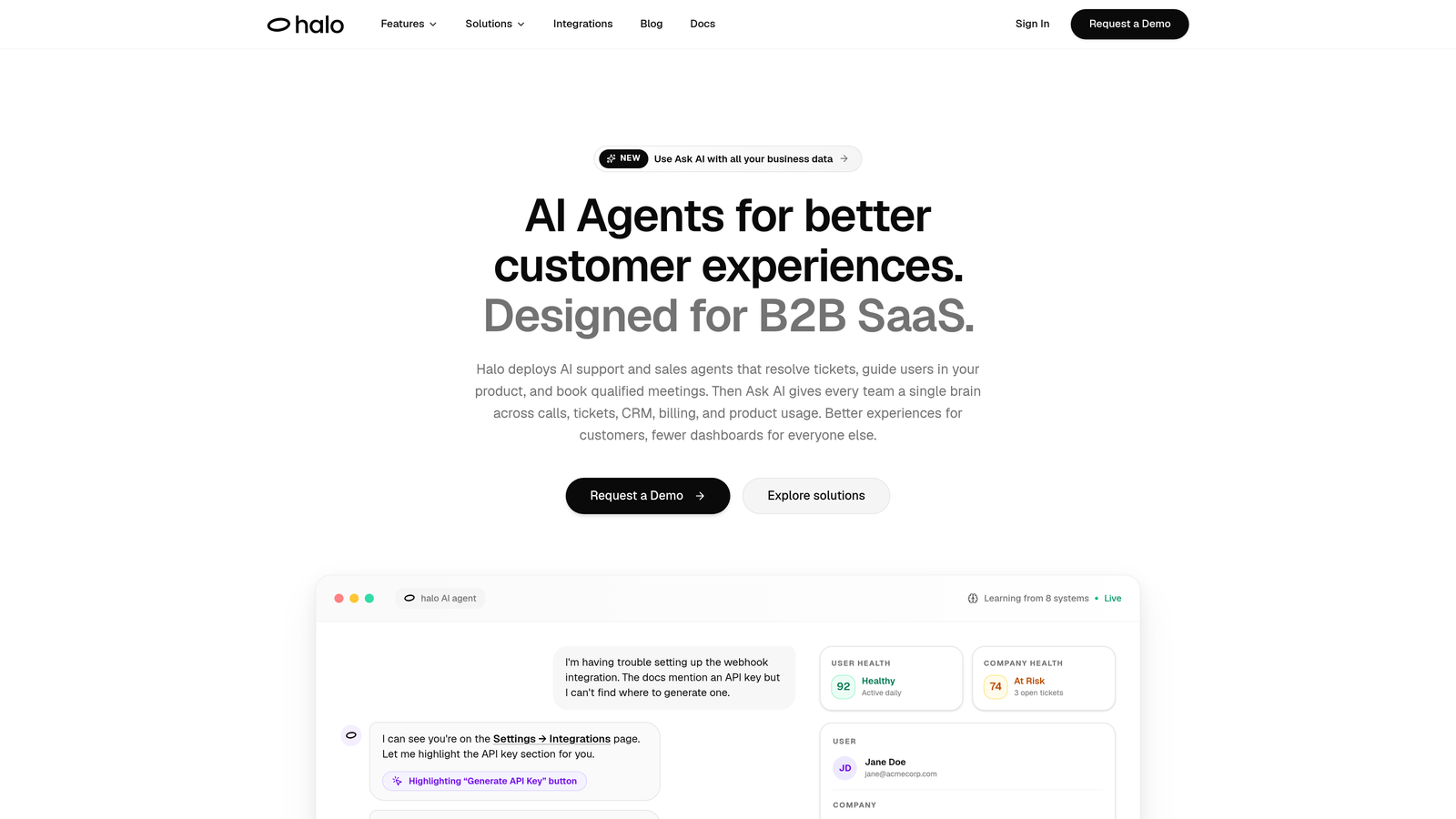
Halo AI is an AI-first customer support platform built from the ground up for B2B SaaS teams that want to scale support without scaling headcount.
Where This Tool Shines
What separates Halo from most tools on this list is architectural. Rather than layering AI onto a traditional ticketing system, Halo was built around autonomous resolution from day one. Its page-aware chat widget doesn't just respond to what a user types — it understands where they are in your product and delivers visual, in-context guidance that actually solves problems.
The smart inbox goes beyond support analytics. It surfaces business intelligence signals: customer health indicators, revenue anomalies, and early churn signals that help product and success teams act before problems escalate. Every interaction feeds back into the system, so the AI gets measurably smarter over time.
Key Features
Page-Aware Chat Widget: Sees exactly what the user sees in your product and delivers visual, step-by-step guidance in context — not generic help articles.
Intelligent AI Agents: Autonomously resolve support tickets end-to-end for common issues, with intelligent escalation for complex ones.
Auto Bug Ticket Creation: Automatically generates and routes bug reports to Linear, Jira, or your preferred engineering workflow without manual intervention.
Smart Inbox with Business Intelligence: Surfaces customer health signals, revenue anomalies, and churn indicators directly in the support workflow.
Live Agent Handoff: Transfers conversations to human agents with full context preserved — no repetition, no dropped threads.
Integration Depth: Connects natively with Linear, Slack, HubSpot, Intercom, Stripe, Zoom, PandaDoc, and Fathom.
Best For
B2B SaaS companies and product teams that want genuine AI autonomy rather than agent-assist features. Particularly well-suited for teams whose support load is growing faster than their headcount, and who want support data to inform product decisions, not just track ticket volume.
Pricing
Contact Halo AI directly for current pricing. The platform is designed for B2B SaaS teams scaling support operations, so pricing is structured accordingly.
2. Zendesk AI
Best for: Large enterprises with complex routing needs and existing Zendesk infrastructure
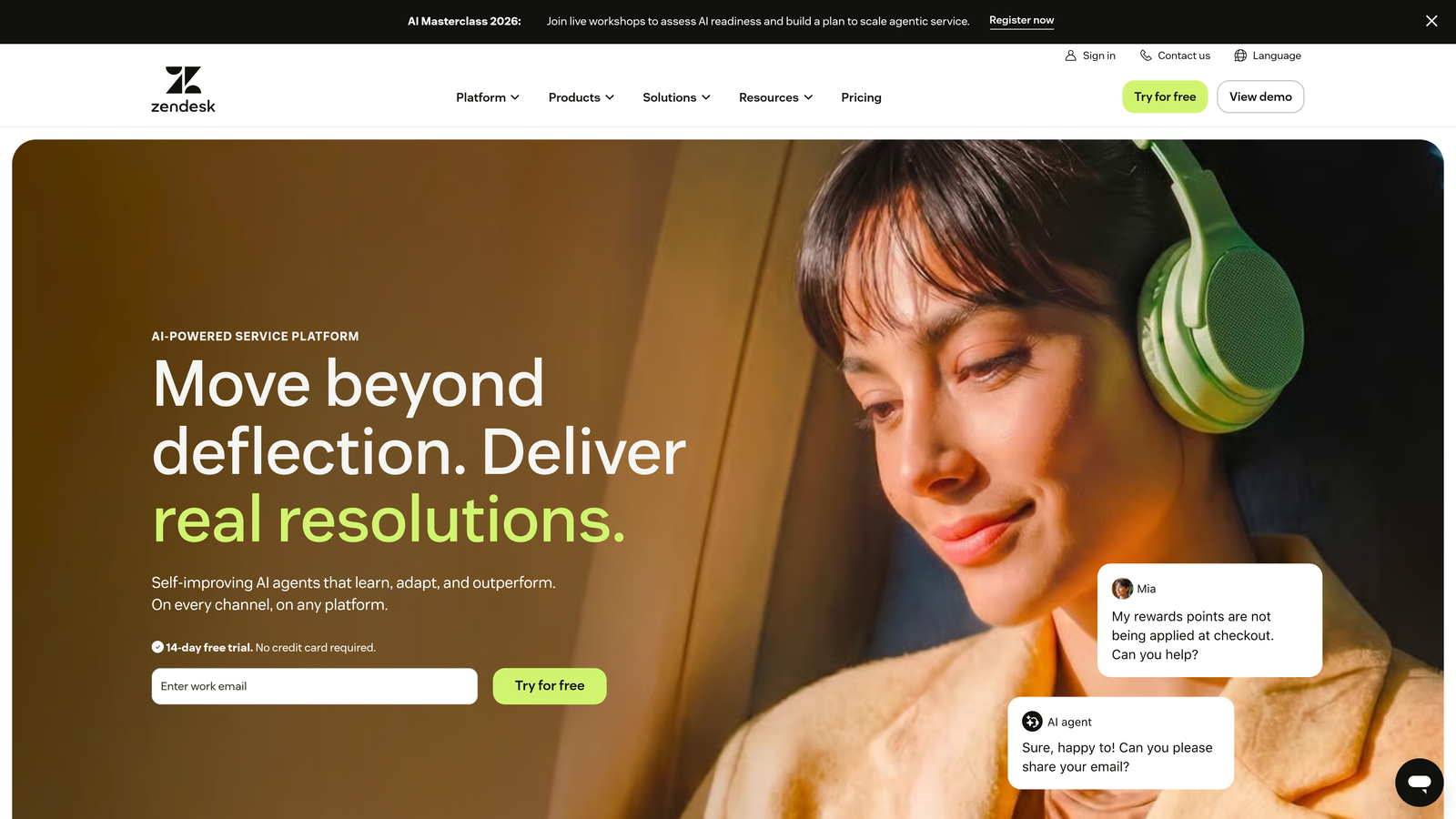
Zendesk AI is an enterprise-grade helpdesk with AI triage, intent detection, and generative reply capabilities layered onto one of the most mature ticketing platforms available.
Where This Tool Shines
Zendesk's strength is its maturity. The platform has been refined over many years, and its AI additions — intent detection, automatic triage, and generative reply drafts — integrate cleanly into workflows that large support teams already know. If your team has significant Zendesk configuration already in place, the AI layer adds real value without requiring migration.
The tradeoff is that Zendesk AI is fundamentally agent-assist rather than autonomous resolution. It makes human agents faster and more consistent, but the model still centers on human-handled tickets at scale.
Key Features
AI Triage and Intent Detection: Automatically categorizes incoming tickets by topic and intent to speed up routing and prioritization.
Generative AI for Agents: Drafts suggested replies and conversation summaries to reduce agent writing time.
Advanced Routing and Automation: Sophisticated workflow rules for complex multi-team environments.
Omnichannel Support: Unified inbox across email, chat, voice, and social channels.
Marketplace Integrations: Extensive third-party app ecosystem for custom stack connections.
Best For
Enterprise teams with established Zendesk deployments, complex routing requirements, and large agent pools that benefit from AI-assisted efficiency. Less compelling for teams starting fresh who want autonomous resolution out of the box.
Pricing
Suite plans start at approximately $55 per agent per month. AI features are available on higher-tier plans. Verify current pricing on the Zendesk website.
3. Freshdesk (Freddy AI)
Best for: Mid-market teams wanting omnichannel AI support at accessible pricing
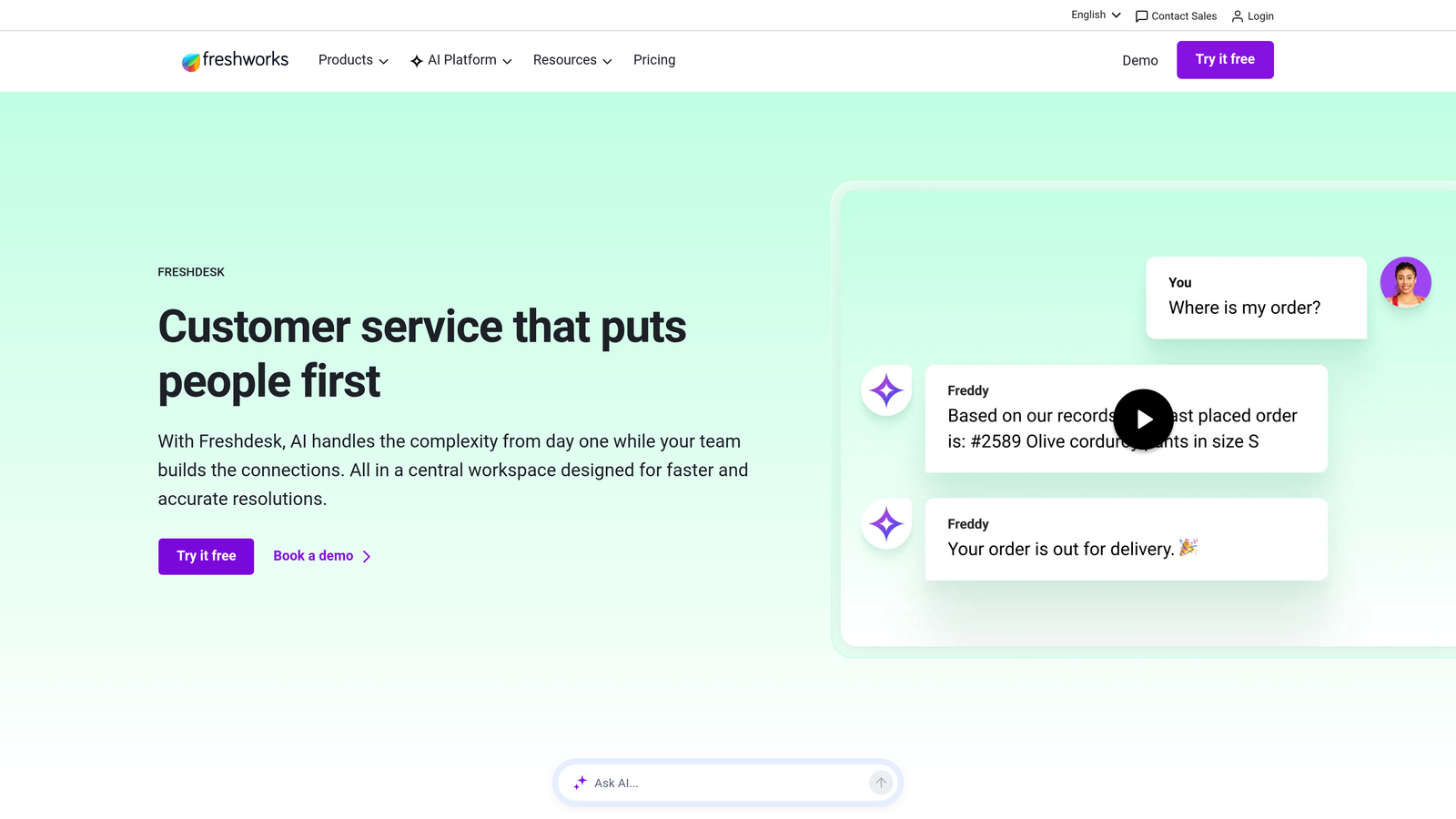
Freshdesk pairs a full omnichannel helpdesk with Freddy AI, offering both a customer-facing self-service bot and an agent co-pilot within the broader Freshworks ecosystem.
Where This Tool Shines
Freshdesk hits a practical sweet spot for teams that need real AI capability without enterprise-level pricing. Freddy Self Service handles customer-facing resolution automatically, while Freddy Copilot assists agents with suggestions, summarization, and response drafting. The two layers work together without requiring separate tooling.
Teams already using Freshworks products — particularly Freshsales CRM or Freshservice ITSM — benefit from native data sharing across the suite, which meaningfully improves the context available to Freddy AI during ticket handling.
Key Features
Freddy Self Service: Customer-facing AI bot that resolves common queries without agent involvement.
Freddy Copilot: Agent-assist tool providing reply suggestions, conversation summaries, and response drafting.
Omnichannel Inbox: Unified email, chat, phone, and social support in a single interface.
Freddy Insights: AI-generated analytics surfacing support trends and performance patterns.
Freshworks Ecosystem Integration: Native connections to Freshsales CRM and Freshservice ITSM.
Best For
Mid-market SaaS and tech teams that want a capable omnichannel helpdesk with AI features at a more accessible price point than Zendesk. Also strong for teams already invested in the Freshworks product suite.
Pricing
A free plan is available. Paid plans start at approximately $15 per agent per month. Freddy AI features are available on higher tiers. Confirm current pricing on the Freshdesk website.
4. Intercom (Fin AI)
Best for: SaaS product teams with mature knowledge bases wanting conversational AI resolution
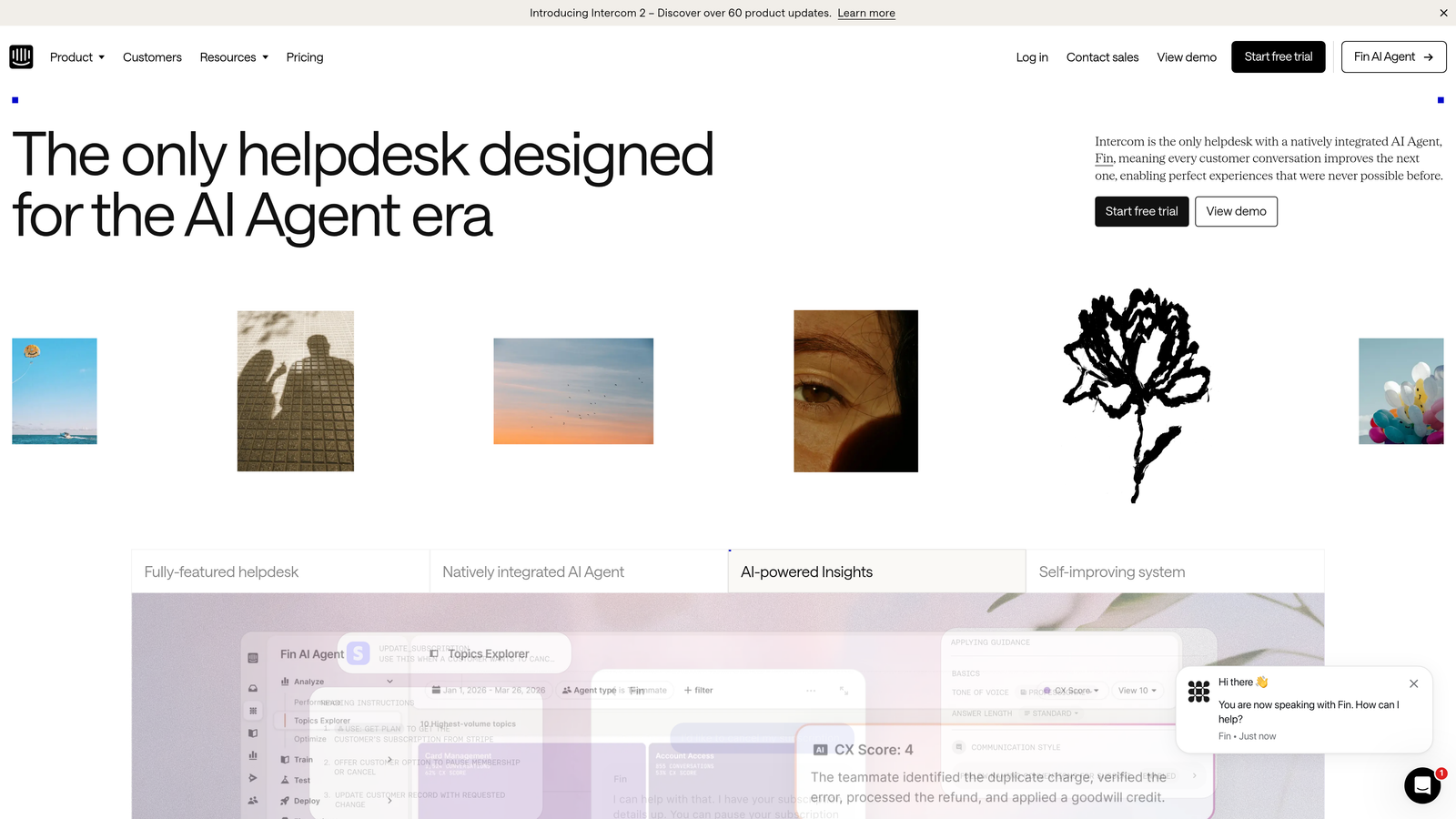
Intercom's Fin AI is a conversational AI agent trained directly on your help center content, handling customer questions autonomously before escalating to human agents when needed.
Where This Tool Shines
Fin is at its best when a well-developed knowledge base exists to train on. It doesn't rely on rigid decision trees — it reads your help content and uses it to generate accurate, contextual responses to customer questions. For SaaS teams that have invested in documentation, Fin can achieve meaningful deflection rates without extensive configuration.
Beyond Fin, Intercom's AI Copilot assists human agents during complex conversations, and the platform's proactive messaging and product tour capabilities make it a broader customer engagement tool rather than a pure support platform.
Key Features
Fin AI Agent: Autonomous conversational resolution trained on your help center and support content.
Seamless Human Handoff: Transfers to live agents when Fin cannot resolve the issue, with full conversation context.
AI Copilot for Agents: Assists human agents with suggestions and context during complex conversations.
Proactive Messaging: Outbound messaging and product tours to engage users before they need support.
Knowledge Base Integration: Fin learns directly from your existing help center content.
Best For
SaaS product teams with established help documentation who want strong conversational AI deflection. Less suited for teams with sparse knowledge bases, as Fin's quality depends heavily on the quality of source content.
Pricing
Plans start at approximately $39 per month. Fin AI is charged per resolution on some plans. Pricing structure can vary, so verify current rates on the Intercom website.
5. Tidio
Best for: SMBs and e-commerce teams wanting fast AI chat setup with minimal configuration
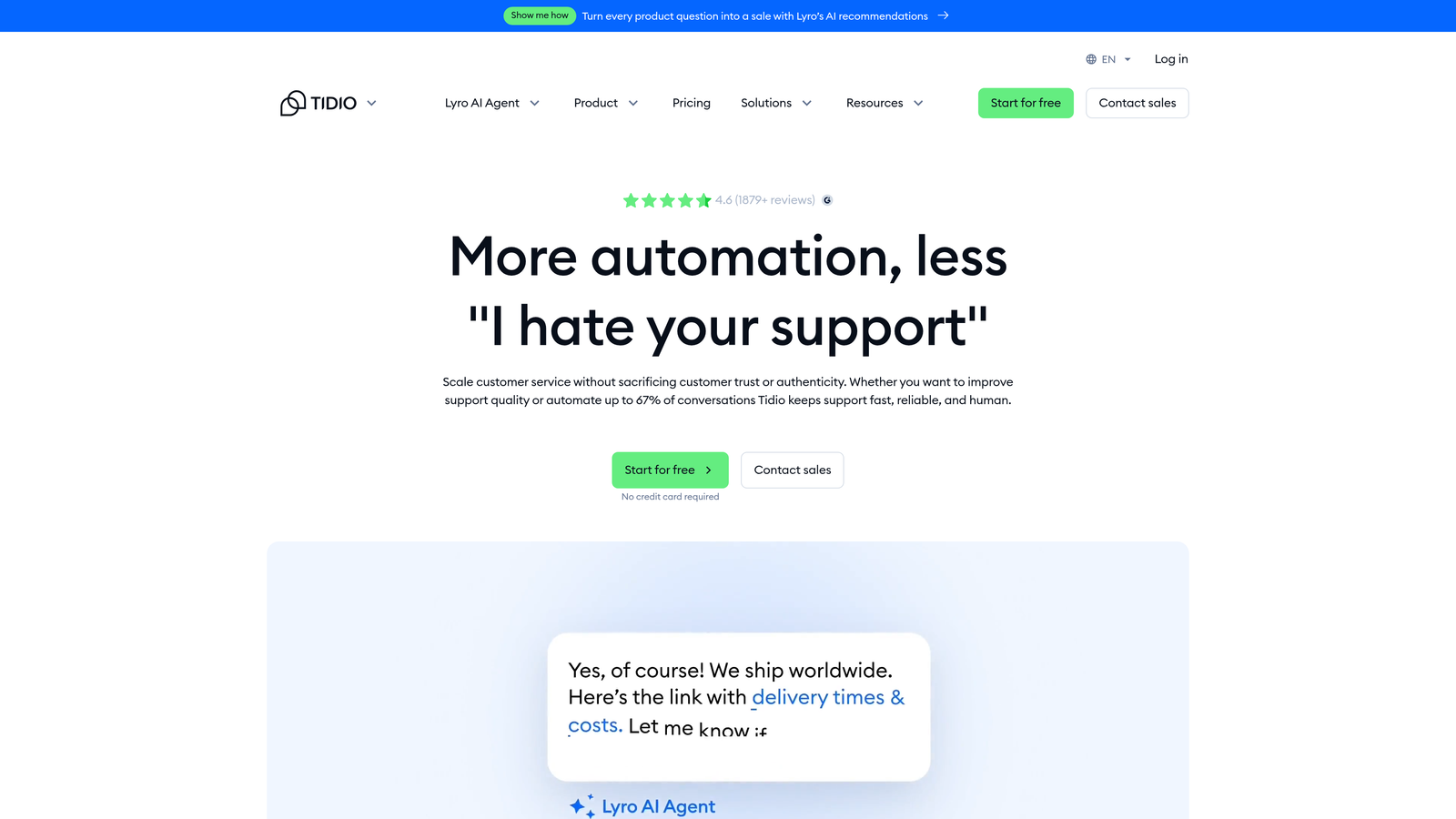
Tidio is a lightweight AI helpdesk featuring the Lyro AI chatbot alongside live chat and basic email ticketing, designed for fast deployment without technical overhead.
Where This Tool Shines
Tidio's main appeal is speed and simplicity. Lyro AI can be configured and deployed quickly, making it practical for small teams that don't have dedicated operations resources to manage a complex helpdesk rollout. It handles common customer questions automatically and hands off to live agents when needed.
The platform's e-commerce integrations with Shopify and WooCommerce make it particularly well-suited for DTC and online retail brands, where order status, returns, and product questions make up the bulk of support volume.
Key Features
Lyro AI Chatbot: Automated conversational AI for handling common customer questions without agent involvement.
Live Chat with Agent Takeover: Human agents can step into any conversation when AI escalation is needed.
Email Ticketing: Basic helpdesk ticketing alongside chat for multi-channel support.
E-Commerce Integrations: Native connections to Shopify and WooCommerce for order-related support automation.
Quick Setup: Minimal technical configuration required to get the platform live.
Best For
Small businesses, e-commerce brands, and early-stage SaaS teams that need functional AI chat support without the complexity or cost of enterprise platforms. Not suited for teams with sophisticated routing needs or deep integration requirements.
Pricing
A free plan is available. Lyro AI plans start at approximately $29 per month. Check the Tidio website for current plan details.
6. Zoho Desk (Zia AI)
Best for: Teams already in the Zoho ecosystem wanting AI-enhanced ticketing with CRM context
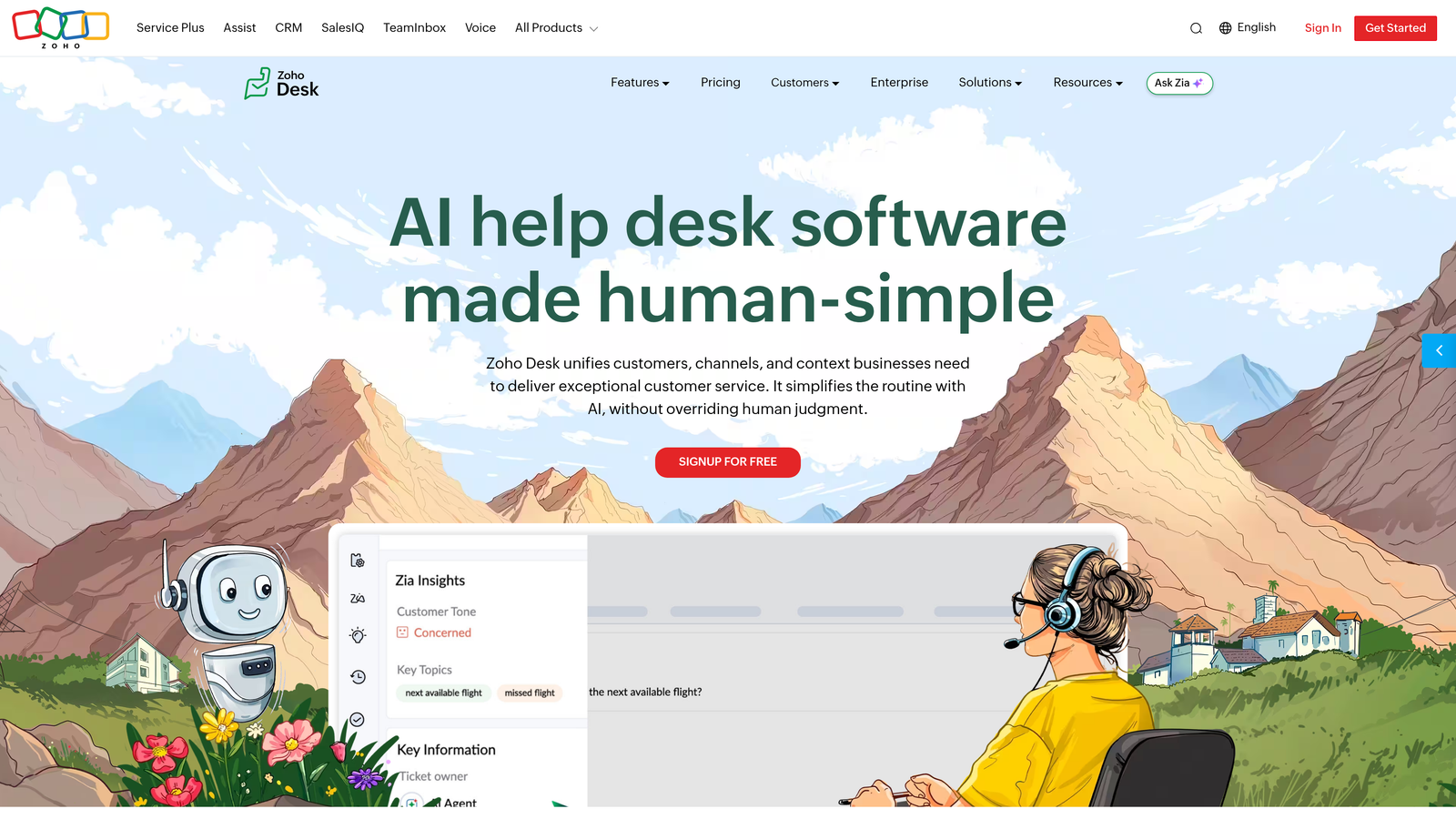
Zoho Desk brings Zia AI to helpdesk workflows with sentiment analysis, auto-tagging, and agent suggestions, tightly connected to Zoho CRM and the broader Zoho product suite.
Where This Tool Shines
Zia's integration with Zoho CRM is where the platform earns its place on this list. When a support ticket comes in, agents see the customer's full CRM history alongside the conversation — deal stage, recent activity, account value. That context makes AI-assisted routing and prioritization more meaningful than in platforms where support and CRM data live separately.
Zia also monitors ticket patterns and sends anomaly alerts when something unusual is happening with support volume or response times, which helps managers catch issues before they compound.
Key Features
Zia Sentiment Analysis: Automatically reads emotional tone on incoming tickets to flag urgent or frustrated customers.
Auto-Tagging and Classification: Categorizes tickets without manual effort to streamline routing.
Agent Suggestions: Surfaces relevant knowledge base articles and response suggestions for agents.
Anomaly Alerts: Notifies managers when ticket volume or response patterns fall outside normal ranges.
Zoho CRM Integration: Deep native connection brings full customer context into every support interaction.
Best For
Mid-market teams already using Zoho CRM or other Zoho products who want to add AI-assisted support without switching ecosystems. The value compounds significantly when Zoho Desk is part of a broader Zoho deployment.
Pricing
Plans start at approximately $14 per agent per month. Zia AI features are available on higher-tier plans. Verify current pricing on the Zoho Desk website.
7. Help Scout
Best for: Teams prioritizing human-quality support with AI that assists rather than replaces agents
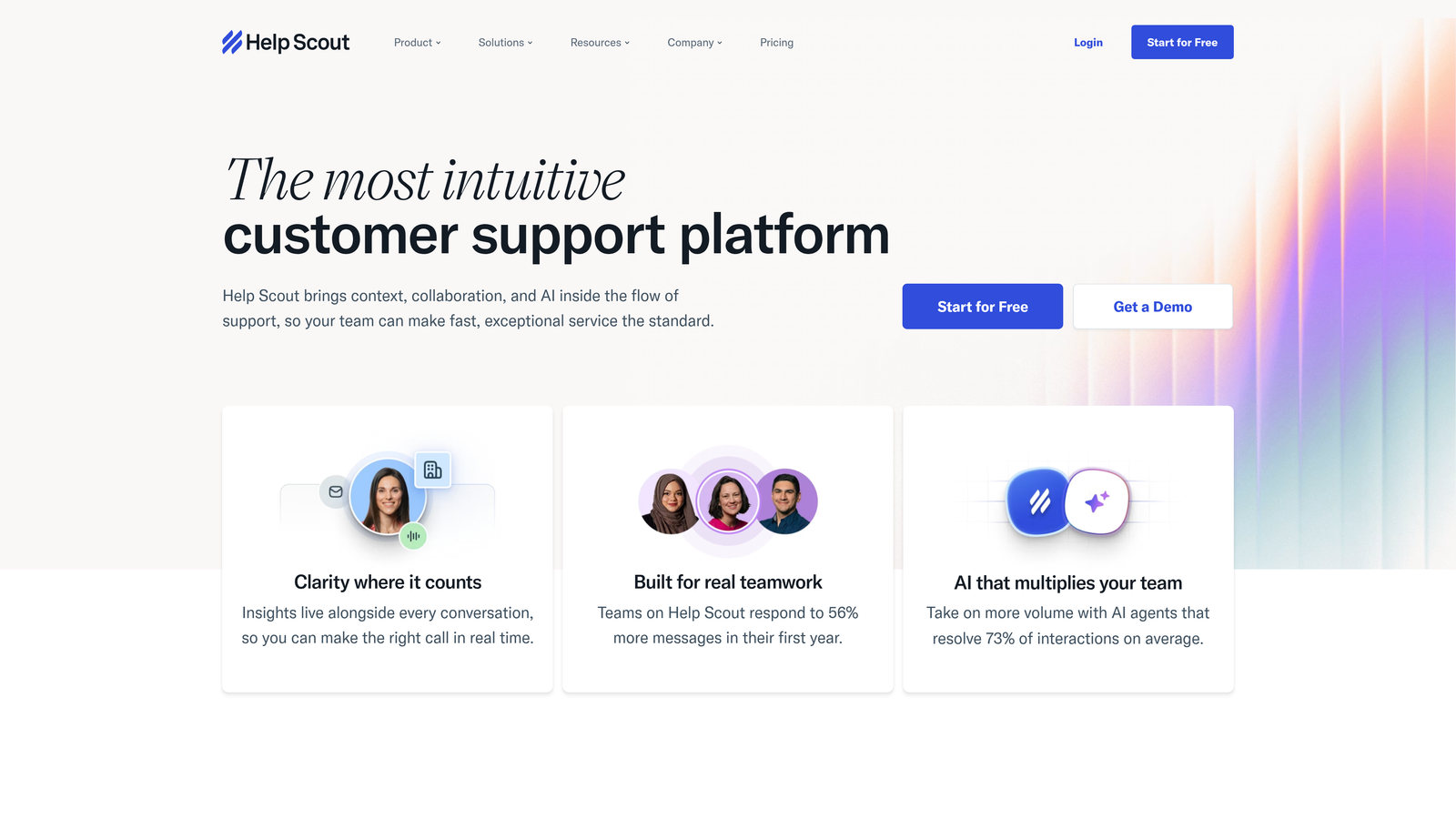
Help Scout is a human-first support platform that uses AI to make agents faster and more consistent — not to remove them from the equation.
Where This Tool Shines
Help Scout's philosophy is different from most tools on this list. It's designed for teams where the personal, human feel of support is a deliberate product decision, not a limitation. AI Summarize gives agents instant context when picking up a conversation mid-thread, and AI Drafts suggests replies that agents can review and send rather than write from scratch.
The result is a platform that reduces the cognitive load on agents without changing the fundamental dynamic of human-handled support. For brands where relationship quality is the differentiator, that's a meaningful distinction.
Key Features
AI Summarize: Generates instant conversation summaries so agents get up to speed immediately on any ticket.
AI Drafts: Suggests agent replies based on conversation context and knowledge base content.
Shared Inbox with Collision Detection: Prevents two agents from working on the same ticket simultaneously.
Docs Knowledge Base: Built-in knowledge base with AI-assisted content suggestions for self-service.
Clean Agent UX: Minimal, focused interface designed to reduce distraction and cognitive overhead.
Best For
Customer-focused SaaS teams, professional services firms, and brands where human relationship quality matters. Not the right choice for teams whose primary goal is autonomous ticket deflection at scale.
Pricing
Plans start at approximately $22 per user per month. Check the Help Scout website for current plan details and feature availability.
8. Kustomer
Best for: High-volume brands needing AI automation built around unified customer records
Kustomer is a CRM-native AI support platform that organizes automation around the complete customer timeline rather than individual tickets, making it well-suited for complex, high-volume support environments.
Where This Tool Shines
Most helpdesks treat each ticket as an isolated unit. Kustomer inverts this: every interaction is attached to a unified customer record that aggregates the full history across channels, orders, and touchpoints. AI routing and automation decisions are made with that full context available, which meaningfully improves resolution quality for customers with complex histories.
Proactive support triggers allow the platform to reach out to customers based on behavioral signals before they even submit a ticket — a capability that shifts support from reactive to anticipatory.
Key Features
Unified Customer Timeline: Aggregates all interactions, orders, and touchpoints into a single customer record.
AI-Powered Routing: Routes conversations based on customer data and history, not just ticket metadata.
Conversational AI: Self-service resolution for common queries without agent involvement.
Proactive Support Triggers: Initiates outreach based on customer behavior signals before issues escalate.
E-Commerce and CRM Integrations: Connects to fulfillment platforms, CRM systems, and commerce tools.
Best For
High-volume B2C and DTC brands, as well as SaaS companies with complex customer histories and multi-channel support needs. Enterprise-oriented pricing means it's less accessible for smaller teams.
Pricing
Enterprise pricing applies. Contact Kustomer directly for current rates and plan details.
9. Forethought (Agatha)
Best for: Enterprises wanting AI triage and resolution intelligence on top of existing helpdesks
Forethought is an AI layer designed to sit on top of platforms like Zendesk, Salesforce Service Cloud, and ServiceNow — adding intelligent triage, routing, and resolution suggestions without requiring a platform migration.
Where This Tool Shines
Forethought solves a specific problem well: enterprises that have significant investment in an existing helpdesk but want AI capabilities their current platform doesn't deliver. Rather than requiring a full migration, Forethought's Agatha AI integrates into the existing workflow and adds triage, auto-tagging, and resolution suggestions on top of it.
This makes it particularly valuable for organizations where switching platforms would be operationally costly but the current system's AI capabilities are insufficient. It's an augmentation play rather than a replacement strategy.
Key Features
AI Triage and Auto-Tagging: Automatically classifies and tags incoming tickets to speed routing and prioritization.
Intelligent Routing: Routes tickets based on issue type, agent expertise, and historical resolution patterns.
Agatha Resolution Suggestions: Surfaces relevant resolution steps to agents based on ticket content and knowledge base.
Customer-Facing AI Agent: Self-service deflection layer for common queries before tickets reach agents.
Existing Helpdesk Compatibility: Works alongside Zendesk, Salesforce Service Cloud, ServiceNow, and other enterprise platforms.
Best For
Large enterprises with established Zendesk or Salesforce Service Cloud deployments that want to add AI intelligence without platform migration. Less relevant for teams starting fresh or operating at smaller scale.
Pricing
Enterprise pricing applies. Contact Forethought directly for current rates and deployment options.
Which Tool Is Right for Your Team?
The right AI helpdesk depends on three things: your team's size, your existing tech stack, and how autonomous you want AI to be in your support workflow.
If your goal is genuine AI autonomy built for B2B SaaS, Halo AI is the strongest option on this list. Its page-aware context, business intelligence signals, and continuous learning architecture go well beyond what agent-assist tools can offer. It's designed specifically for the problem of scaling support without scaling headcount.
If you're deeply embedded in Zendesk and not ready to migrate, Forethought gives you meaningful AI intelligence on top of your existing investment. If you're on Zendesk but open to evolution, Zendesk AI's native features are worth evaluating first before adding a third-party layer.
For mid-market teams watching budget carefully, Freshdesk with Freddy AI delivers capable omnichannel AI at pricing that makes sense without sacrificing core functionality. Zoho Desk is the clear choice if you're already in the Zoho ecosystem.
SaaS product teams with strong knowledge bases will find Intercom's Fin AI highly effective for conversational deflection. Teams where human relationship quality is the differentiator should look at Help Scout. High-volume brands with complex customer histories are well-served by Kustomer's CRM-native approach. And for small teams that need something live quickly, Tidio removes almost all the setup friction.
Your support team shouldn't scale linearly with your customer base. Let AI agents handle routine tickets, guide users through your product, and surface business intelligence while your team focuses on complex issues that need a human touch. See Halo in action and discover how continuous learning transforms every interaction into smarter, faster support.