9 Best AI Support Automation Tools for SaaS in 2026
This guide reviews the 9 best AI support automation for SaaS platforms in 2026, evaluating each on autonomy, integration depth, and fit for B2B product teams. Whether you're scaling on Zendesk, Freshdesk, or Intercom — or ready to replace your stack — it identifies the right tool to break the ticket-volume-versus-headcount paradox.
 Matt PattoliFounder13 min read
SaaS support teams face a familiar paradox: as your product grows, ticket volume scales faster than headcount can. AI support automation breaks that equation, letting you resolve more issues faster without burning out your team or ballooning your hiring budget.
But not all AI support tools are built the same. Some bolt AI onto legacy helpdesk workflows. Others are purpose-built for SaaS product teams who need context-aware agents, deep integrations, and intelligence that goes beyond deflection rates.
This list covers the best AI support automation platforms for SaaS companies in 2026, evaluated on autonomy, integration depth, learning capability, and fit for B2B product teams. Whether you're running support on Zendesk, Freshdesk, or Intercom, or looking to replace your stack entirely, there's an option here that fits. Halo AI leads at #1 as the most purpose-built option for SaaS, but every tool on this list earns its place.
1. Halo AI
Best for: SaaS product teams wanting AI-first, context-aware support with business intelligence built in.
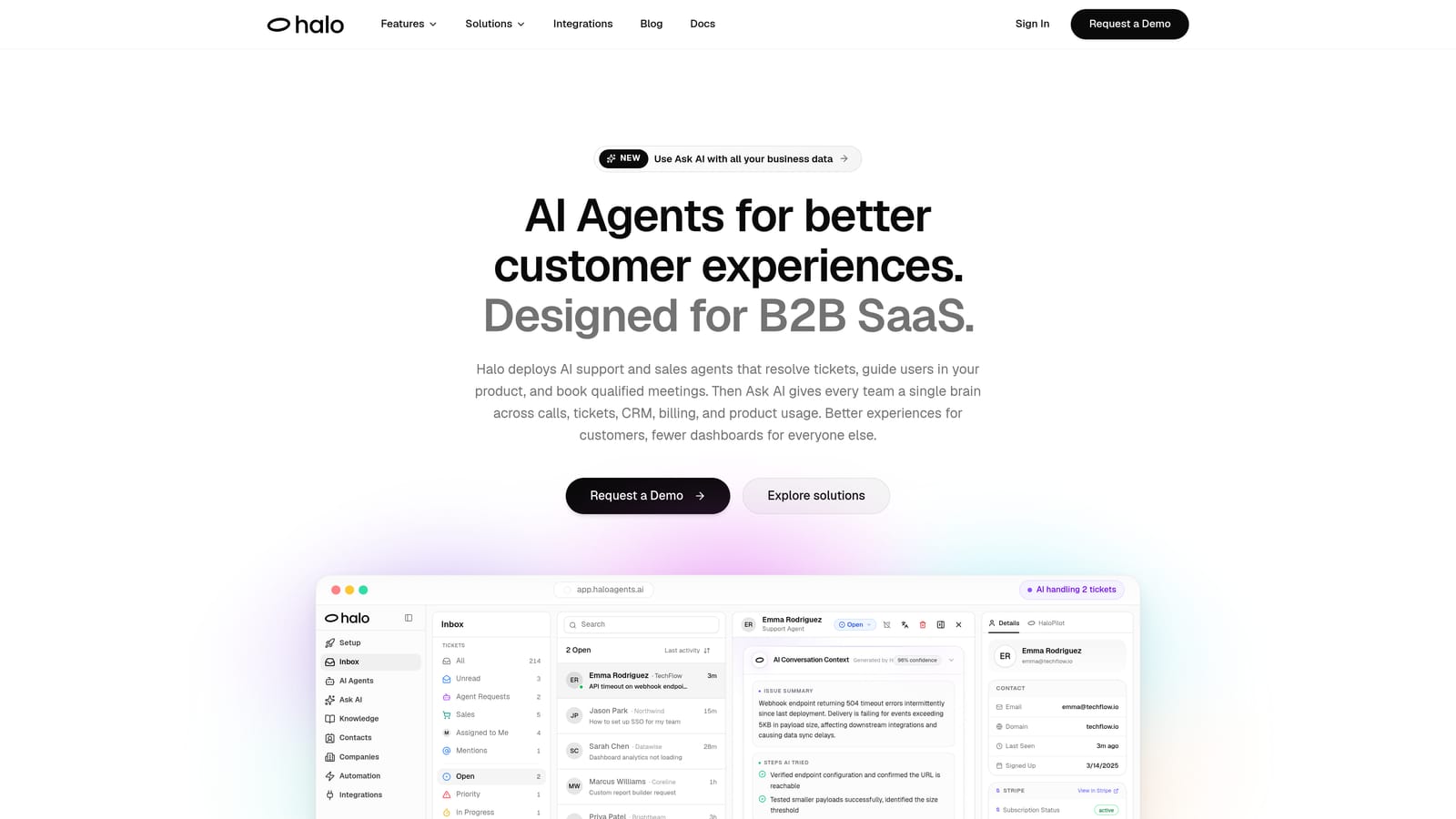
Halo AI is an AI-first customer support platform purpose-built for SaaS, resolving tickets, guiding users through your product, creating bug reports, and generating business intelligence from every interaction.
Where This Tool Shines
What separates Halo from most tools on this list is its page-aware architecture. The AI agent doesn't just read a user's message; it sees what page they're on and what they're looking at, giving it the context to provide visual UI guidance rather than generic help center links. That's a meaningful difference when your users are stuck mid-workflow in a complex SaaS product.
Beyond resolution, Halo's smart inbox surfaces business intelligence that most support tools ignore entirely: customer health signals, revenue flags, and anomaly detection that tell you when something is wrong before it becomes a churn event. Support stops being a cost center and starts generating strategic signal.
Key Features
Page-Aware Chat Widget: The AI sees what the user sees and delivers contextual, visual UI guidance rather than generic responses.
Autonomous AI Agents: End-to-end ticket resolution with intelligent live agent handoff when issues exceed the AI's scope.
Auto Bug Ticket Creation: Automatically identifies and routes bug reports to Linear or Jira, closing the loop between support and engineering.
Smart Inbox with Business Intelligence: Surfaces customer health scoring, revenue signals, and anomaly detection directly in the support workflow.
Deep Integration Stack: Connects to Linear, Slack, HubSpot, Intercom, Stripe, Zoom, PandaDoc, and Fathom out of the box.
Continuous Learning: Improves autonomously from every interaction without requiring manual retraining cycles.
Best For
SaaS product teams and B2B companies that want more than ticket deflection. Halo is particularly strong for teams whose support function should also generate product intelligence, where understanding what users struggle with is as valuable as resolving their issues quickly.
Pricing
Pricing is not publicly listed. Contact Halo directly for a demo and custom quote based on your team's needs.
2. Intercom Fin
Best for: Teams already invested in the Intercom ecosystem wanting native AI resolution.
Intercom Fin is Intercom's native AI agent powered by large language models, resolving customer queries directly from your help center content.
Where This Tool Shines
Fin's biggest advantage is how seamlessly it sits inside the Intercom platform. If your team already lives in Intercom, there's no separate setup, no integration overhead, and no context switching. The LLM-powered resolution is genuinely capable for conversational queries, and the handoff to human agents within the Intercom inbox is smooth.
Where Fin has limitations is outside the Intercom ecosystem. If you need deep integrations with tools like Linear, Stripe, or custom data sources, you'll be working around its boundaries rather than with them. It's a strong native option, not a standalone AI platform.
Key Features
LLM-Powered Resolution: Answers customer questions directly from help center articles using large language model reasoning.
Native Intercom Integration: No separate setup required; works within your existing Intercom configuration.
Seamless Human Handoff: Escalates to live agents within the Intercom inbox when queries exceed Fin's scope.
Multi-Language Support: Handles customer queries across multiple languages without additional configuration.
Per-Resolution Pricing: Charges only when Fin successfully resolves a query, aligning cost with outcome.
Best For
SaaS teams already running support on Intercom who want to add AI resolution without migrating or rebuilding their stack. Less suited for teams needing AI intelligence that extends beyond the Intercom platform.
Pricing
Charged per resolution on top of your existing Intercom base plan. Costs scale with resolution volume, so model your expected usage before committing.
3. Zendesk AI
Best for: Enterprise SaaS teams on Zendesk needing intelligent triage and agent assist at scale.
Zendesk AI is AI capability natively embedded in Zendesk's ticketing platform, covering triage, intent detection, agent assist, and automated responses.
Where This Tool Shines
Zendesk AI is most powerful when you're already running a mature Zendesk environment with established workflows, routing rules, and a large knowledge base. The AI layers on top of that existing infrastructure, improving triage accuracy and reducing agent handle time without requiring a migration.
It's worth being clear about what Zendesk AI is: an enhancement to an existing platform, not a ground-up AI architecture. For enterprise teams with complex routing requirements and compliance needs, that's a feature. For teams looking for autonomous AI-first support, it may feel like AI bolted onto legacy workflows.
Key Features
Intelligent Ticket Triage: Detects intent and routes tickets based on content, reducing manual sorting for support teams.
AI-Suggested Responses: Surfaces relevant response suggestions to agents in real time during ticket handling.
Automated Resolutions: Zendesk bots handle common query types without agent involvement.
Sentiment Analysis: Scores ticket priority based on customer sentiment to surface urgent issues faster.
Enterprise Compliance: Meets enterprise-grade security and compliance requirements for regulated industries.
Best For
Enterprise SaaS companies with large support teams already on Zendesk Suite Professional or Enterprise. Teams starting fresh or looking for AI-native architecture will find better options elsewhere.
Pricing
AI features are included in Zendesk Suite Professional and Enterprise plans. Check current Zendesk pricing pages for the most up-to-date tier breakdowns.
4. Freshdesk Freddy AI
Best for: Mid-market SaaS teams on Freshdesk wanting AI across self-service, agent assist, and analytics.
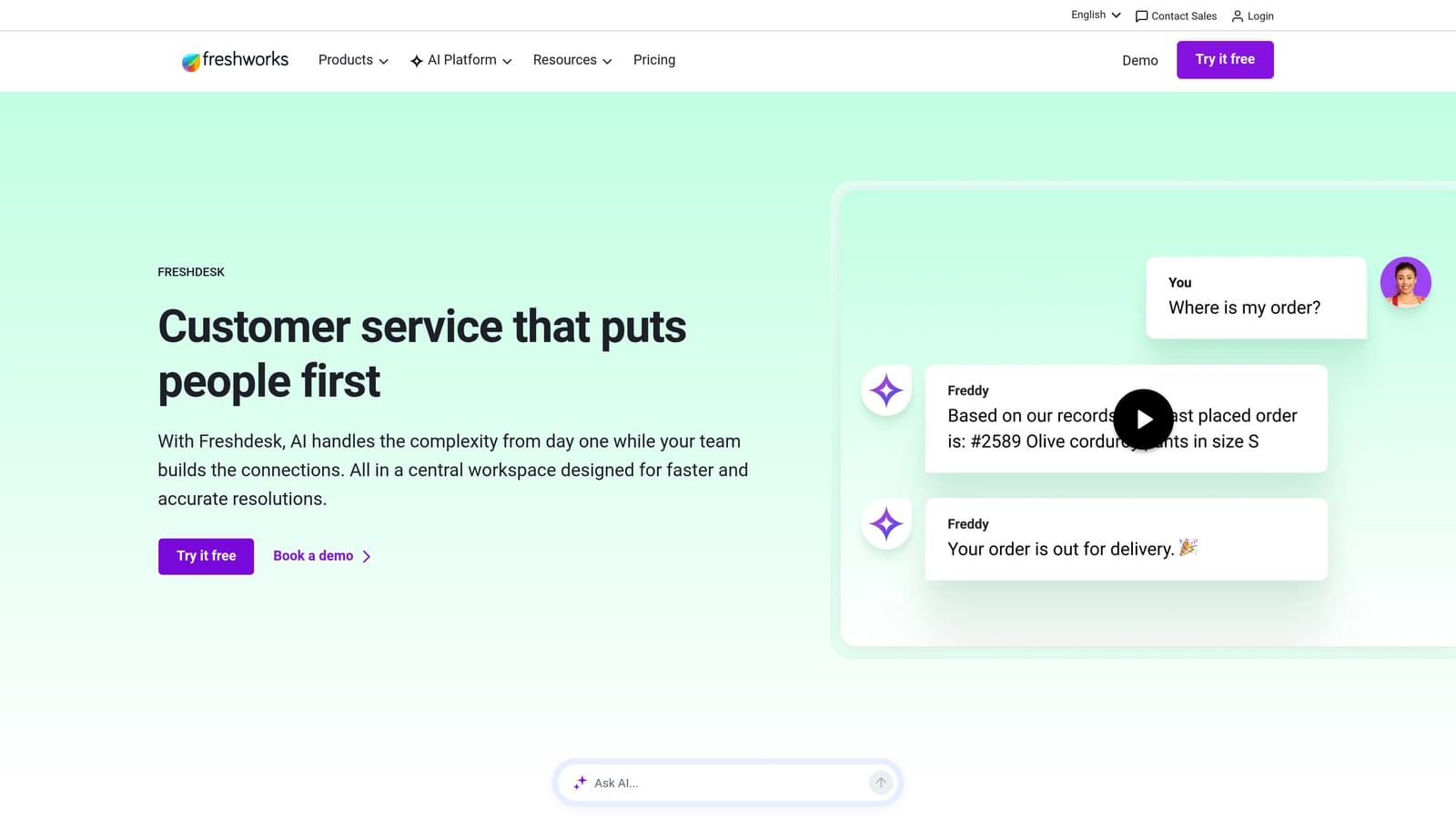
Freshdesk Freddy AI is Freshworks' AI layer across the Freshdesk support suite, spanning self-service, agent copilot, and support analytics.
Where This Tool Shines
Freddy's strength is breadth. Rather than a single AI feature, it covers three distinct use cases: customer-facing resolution through Freddy Self Service, in-context agent help through Freddy Copilot, and support trend detection through Freddy Insights. For mid-market teams that want AI across the full support workflow without switching platforms, that coverage is valuable.
The tradeoff is depth. Each Freddy component is solid without being exceptional, and the overall intelligence is tied to how well your Freshdesk knowledge base and workflows are already structured. Teams with mature Freshdesk setups will get more out of it than those starting from scratch.
Key Features
Freddy Self Service: Autonomous customer-facing resolution using your knowledge base content.
Freddy Copilot: Provides agents with in-context suggestions, response drafts, and next-step guidance during ticket handling.
Freddy Insights: Analytics layer that identifies support trends, volume patterns, and workflow gaps.
Multi-Language Support: Handles queries across languages within the same Freshdesk environment.
Native Freshdesk Integration: Works within existing Freshdesk workflows without additional configuration overhead.
Best For
Mid-market SaaS teams already on Freshdesk who want to add AI across multiple support functions without migrating. Less compelling for teams not already in the Freshworks ecosystem.
Pricing
Freddy features are tiered across Freshdesk Growth, Pro, and Enterprise plans. Higher-tier features require higher-tier plans; check Freshdesk's current pricing for specifics.
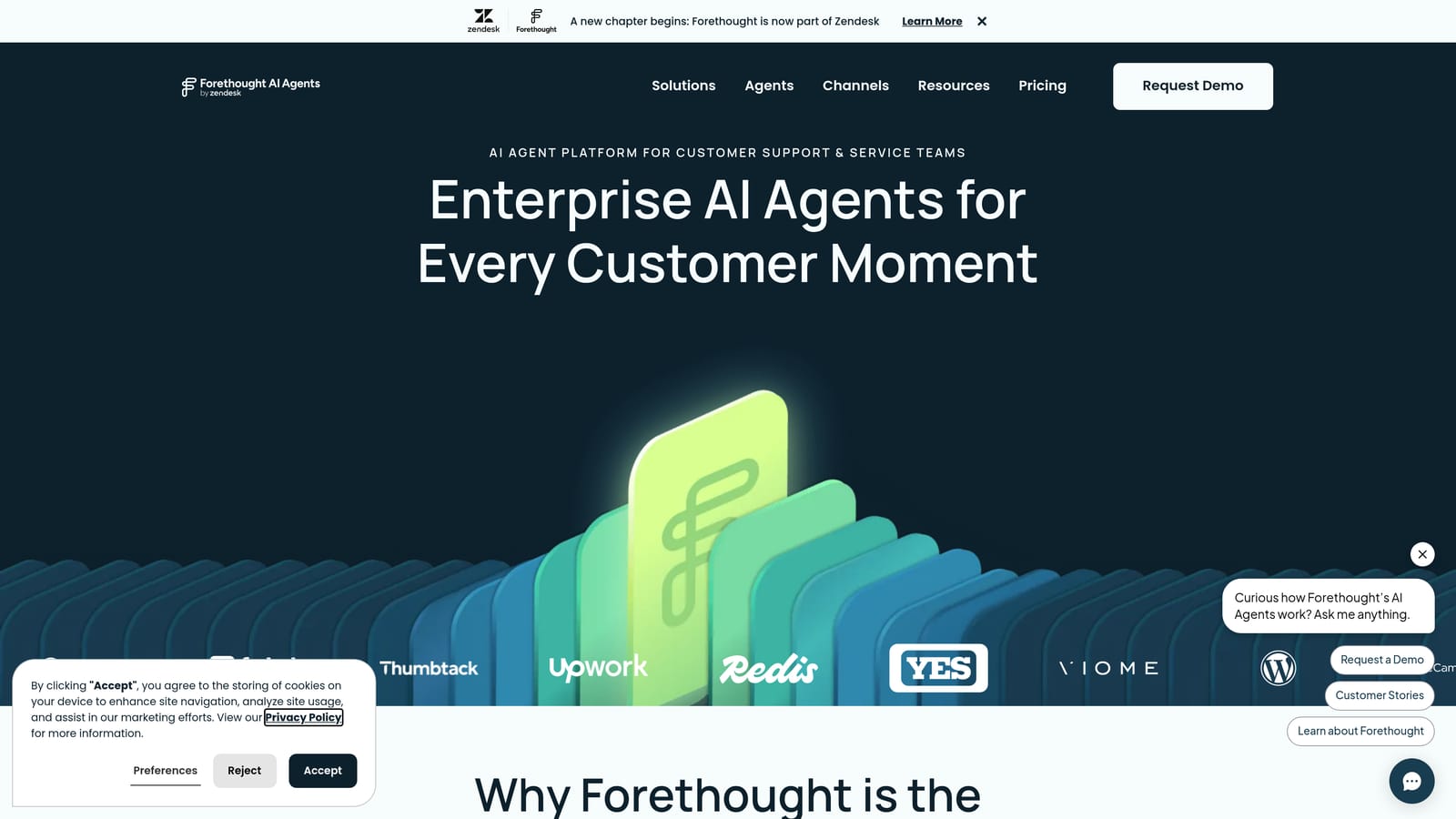
5. Forethought
Best for: Support ops teams wanting to add AI intelligence on top of existing Zendesk or Salesforce workflows.
Forethought is an AI platform designed to layer intelligent triage, agent assist, and autonomous resolution on top of existing helpdesks without requiring migration.
Where This Tool Shines
Forethought's product architecture maps cleanly to the support workflow: Triage handles routing, Assist supports agents in real time, Solve handles autonomous resolution for common query types, and Discover surfaces workflow gaps and insights. That modular structure means you can start with one component and expand without rebuilding your stack.
It's a strong fit for support operations leaders who want to improve an existing Zendesk or Salesforce environment rather than replace it. The AI works with your current data and workflows, which reduces deployment friction significantly for established teams.
Key Features
Triage: Intent detection and smart routing that directs tickets to the right queue or agent without manual sorting.
Assist: Real-time agent suggestions and response recommendations surfaced during ticket handling.
Solve: Autonomous resolution for high-volume, repeatable query types without agent involvement.
Discover: Support analytics that identifies workflow gaps, common failure points, and optimization opportunities.
Helpdesk Integrations: Works on top of Zendesk, Salesforce Service Cloud, and other major helpdesk platforms.
Best For
Enterprise support ops teams with established Zendesk or Salesforce environments who want AI improvements without a full platform migration. Less suited for early-stage SaaS teams building support infrastructure from scratch.
Pricing
Custom enterprise pricing. Contact Forethought directly for a quote based on your volume and use case.
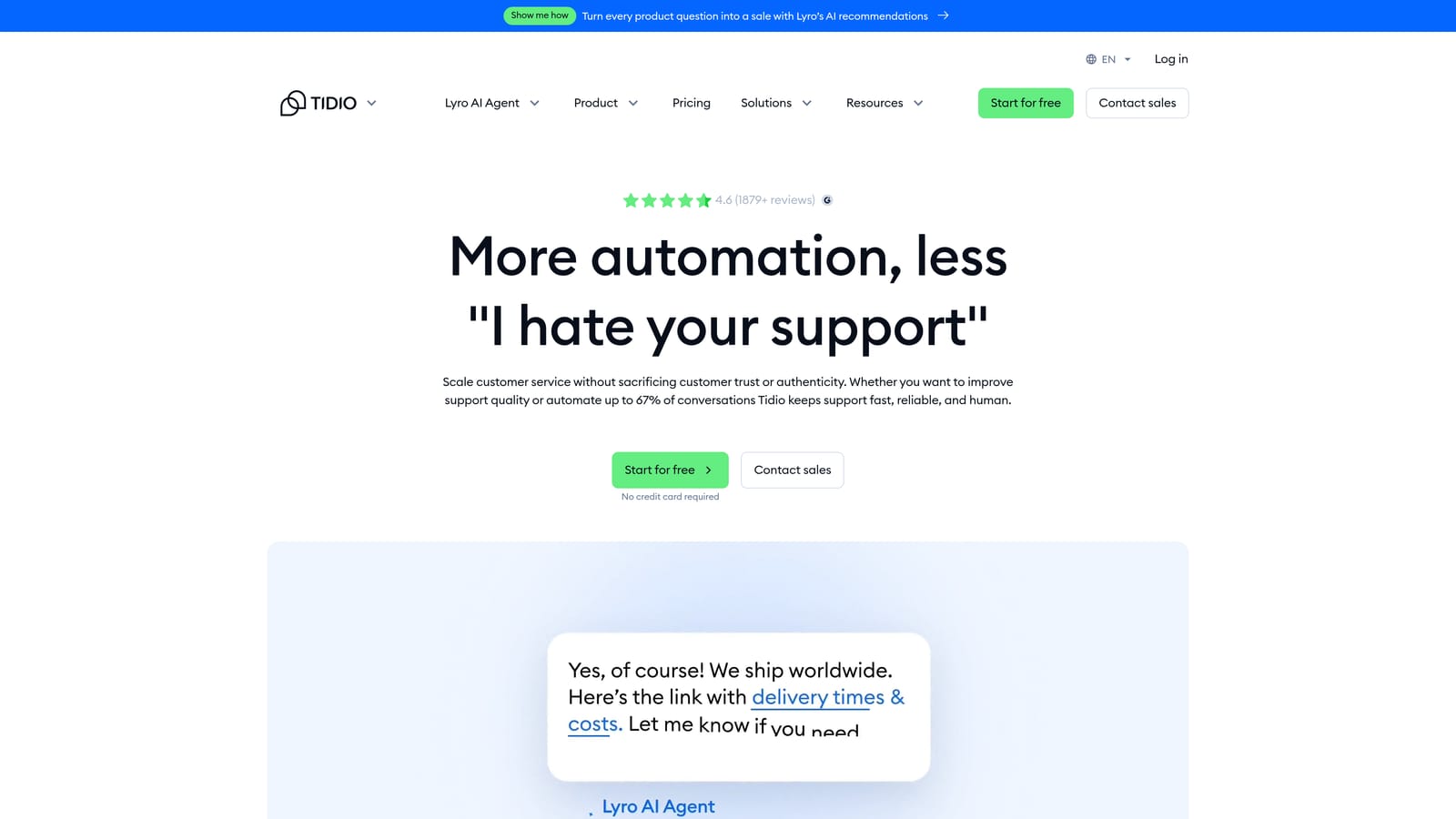
6. Tidio Lyro
Best for: Smaller SaaS teams wanting fast, low-complexity AI chatbot deployment.
Tidio Lyro is a conversational AI chatbot with NLP-driven resolution built for fast deployment, targeting smaller SaaS and e-commerce teams.
Where This Tool Shines
Lyro's standout quality is speed to value. No-code deployment means a small team can go from setup to live AI resolution in hours rather than weeks. For teams that don't have dedicated support ops resources, that simplicity is genuinely useful.
The ceiling is lower than enterprise platforms. Lyro works well for common, repeatable queries drawn from knowledge base content, but complex B2B product support with nuanced user context isn't its primary design target. Teams with straightforward support needs will get strong ROI; teams with complex product support requirements may outgrow it quickly.
Key Features
Lyro AI Agent: Answers customer questions directly from your knowledge base using NLP-driven resolution.
No-Code Deployment: Fast setup without engineering resources or complex configuration.
Live Chat Fallback: Seamlessly transfers conversations to human agents when the AI reaches its limits.
Visitor Tracking: Behavioral triggers that initiate conversations based on user activity on your site.
CRM and Platform Integrations: Connects with Shopify, WordPress, and major CRM platforms.
Best For
Smaller SaaS teams and early-stage companies that need AI chat resolution deployed quickly without significant technical overhead. E-commerce-adjacent SaaS teams also fit well given Tidio's native Shopify integration.
Pricing
Lyro is available as an add-on to Tidio's base plans. Entry-level pricing is accessible for small teams; check Tidio's current pricing page for the latest tier details.
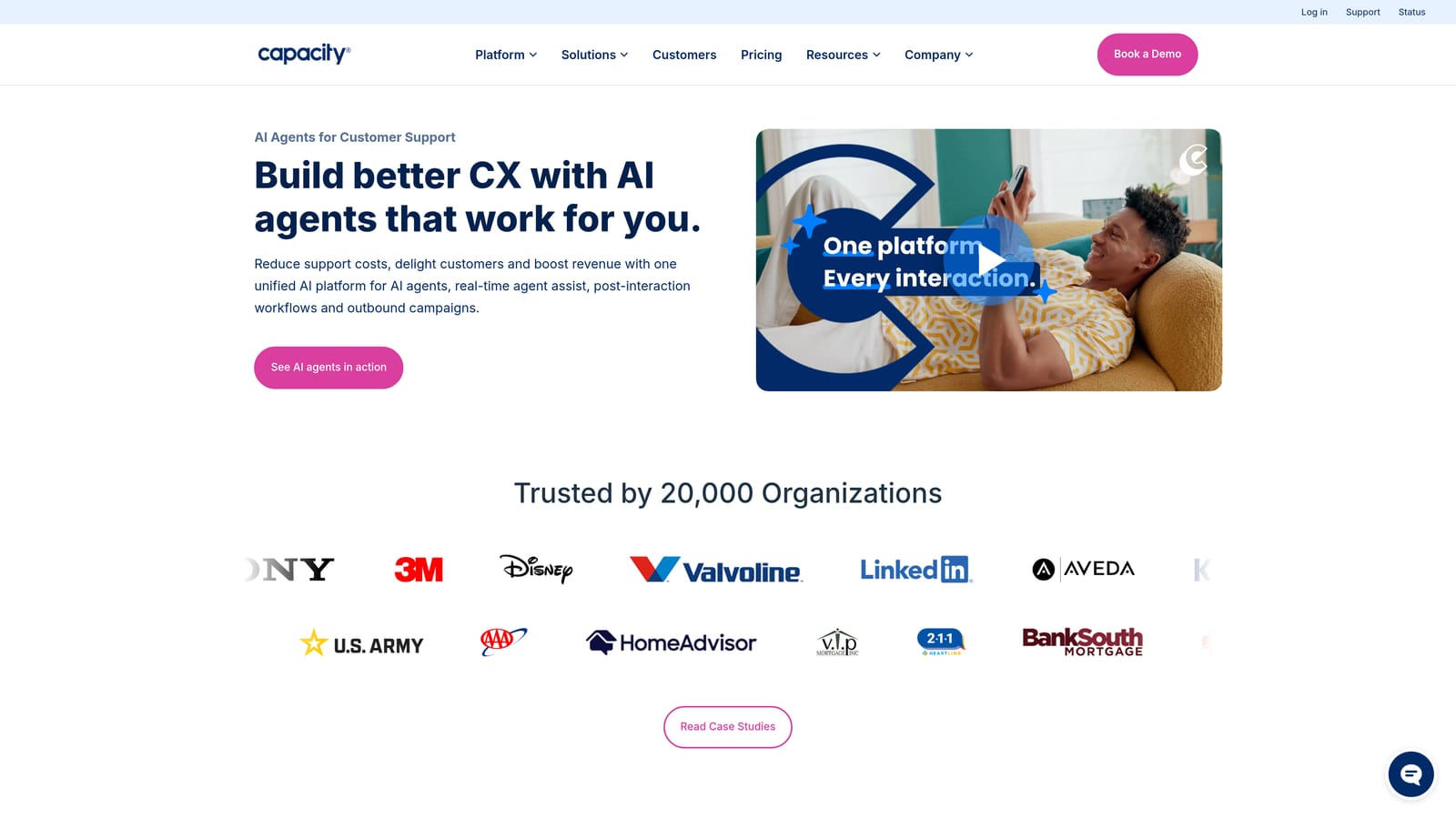
7. Capacity
Best for: Teams wanting AI support automation that extends across support, HR, and internal operations.
Capacity is an AI-powered support automation platform with a knowledge base at its core, designed to automate support, HR, and internal ops workflows from a single platform.
Where This Tool Shines
Capacity's differentiation is cross-departmental scope. While most tools on this list focus on customer-facing support, Capacity also automates internal workflows: HR questions, IT helpdesk, onboarding, and knowledge management across teams. For companies that want a single AI automation layer across the business, that breadth is compelling.
For pure SaaS product support, it's less specialized than purpose-built options. The knowledge base automation is strong, but the customer-facing AI intelligence doesn't go as deep as tools designed specifically for product support teams. It's a better fit for operations-minded buyers than product-led support teams.
Key Features
Knowledge Base Automation: AI-powered article suggestions and knowledge management that keeps content accurate and accessible.
AI Triage: Helpdesk ticketing with intelligent routing to reduce manual queue management.
Cross-Department Workflows: Automates support, HR, and IT workflows from a single platform.
No-Code Chatbot Builder: Visual interface for building and customizing chatbot flows without engineering resources.
Broad Integrations: Connects with Salesforce, Zendesk, Slack, and other major business tools.
Best For
Mid-size companies looking for AI automation that spans multiple departments, not just customer support. Operations leaders who want a unified automation layer across support, HR, and internal ops will find the most value here.
Pricing
Tiered plans are available with enterprise pricing on request. Contact Capacity for a quote based on team size and use case scope.
8. Kustomer
Best for: Omnichannel or high-touch support teams wanting CRM-native AI with a unified customer timeline.
Kustomer is a CRM-native customer service platform with AI automation, built around a unified customer timeline for omnichannel and high-touch support environments.
Where This Tool Shines
Kustomer's core strength is context. Every support interaction sits within a full customer timeline that includes purchase history, previous conversations, and CRM data, giving agents and AI a complete picture before they respond. For high-touch support where relationship context matters, that's a significant advantage over ticket-centric tools.
For pure SaaS product support, it may be more platform than you need. Kustomer's depth is in omnichannel operations and CRM integration, which is powerful for consumer-facing or high-volume support teams but can feel overbuilt for B2B SaaS product support focused on technical resolution.
Key Features
Unified Customer Timeline: Aggregates all customer interactions, purchases, and history into a single view for agents and AI.
AI Routing and Suggestions: Intelligent routing and AI-generated response suggestions based on full customer context.
Workflow Automation: Business rule engine for automating ticket routing, escalations, and follow-up actions.
Omnichannel Support: Handles email, chat, SMS, and social channels from a unified platform.
Embedded CRM Data: CRM context is available in every support interaction without switching between tools.
Best For
Omnichannel support teams and companies with high-touch customer relationships where historical context drives resolution quality. Less optimized for SaaS teams primarily focused on technical product support and autonomous AI resolution.
Pricing
Per-user monthly pricing model. Contact Kustomer for current rates, as pricing has evolved following the company's ownership changes.
9. Tiledesk
Best for: Technical SaaS teams wanting open-source flexibility and full control over AI deployment.
Tiledesk is an open-source live chat and chatbot platform with LLM integration, giving technical SaaS teams full control over deployment, customization, and data.
Where This Tool Shines
Tiledesk occupies a unique position on this list: it's the option for teams who want to own their AI support infrastructure entirely. Open-source architecture means you can self-host, customize deeply, and integrate with any LLM provider, including OpenAI and others, without being locked into a vendor's opinionated platform.
The tradeoff is that out-of-the-box intelligence is lower than purpose-built platforms. You're trading plug-and-play capability for flexibility. Teams with engineering resources who want to build something tailored will find Tiledesk a strong foundation; teams without that bandwidth should look at more turnkey options.
Key Features
Open-Source Architecture: Full source code access with self-hosting option for teams that need data sovereignty or deep customization.
LLM Integration: Connects with OpenAI and other LLM providers to power AI chatbot responses.
Visual Chatbot Builder: No-code conditional logic builder for designing conversation flows without writing code.
Live Chat with Handoff: Human agent takeover when AI conversations require escalation.
REST API: Deep custom integration capability for connecting Tiledesk to proprietary systems and workflows.
Best For
Technical SaaS teams with engineering resources who prioritize customization, data control, and flexibility over out-of-the-box AI capability. Also well-suited for teams with budget constraints who want to start on the free open-source tier.
Pricing
Open-source tier is free with self-hosting. Cloud-hosted plans are available at competitive rates. Check Tiledesk's current pricing page for the latest options.
Which Tool Is Right for Your SaaS Team?
The right choice depends on where you are, what you're building toward, and how much of your support motion you want AI to own.
Here's a quick way to think through it:
Purpose-built SaaS AI with business intelligence: Halo AI is the strongest fit for product teams that want context-aware resolution, auto bug routing, and support that generates strategic signal, not just deflection metrics.
Already on Intercom: Fin is the natural starting point. It's native, capable, and requires no migration. Evaluate whether you'll hit its integration ceiling before committing long-term.
Enterprise on Zendesk or Salesforce: Zendesk AI and Forethought both layer effectively onto existing infrastructure. Forethought gives you more modular AI control; Zendesk AI is simpler if you want everything in one vendor relationship.
Mid-market on Freshdesk: Freddy AI covers the full support workflow without requiring a platform change. Good breadth for teams that don't want to manage multiple tools.
Small team, fast deployment: Tidio Lyro gets you to live AI resolution quickly with minimal overhead. Right-sized for teams that need something working this week, not next quarter.
Cross-department automation: Capacity makes sense when your automation needs extend beyond customer support into HR and internal ops.
High-touch omnichannel support: Kustomer's unified customer timeline is hard to match for teams where relationship context drives every interaction.
Technical teams who want full control: Tiledesk's open-source architecture is the right foundation if you have engineering resources and want to own your AI infrastructure.
Your support team shouldn't scale linearly with your customer base. Let AI agents handle routine tickets, guide users through your product, and surface business intelligence while your team focuses on complex issues that need a human touch. See Halo in action and discover how continuous learning transforms every interaction into smarter, faster support.