9 Best AI Support Tools for SaaS Companies in 2026
SaaS companies need more than a generic chatbot — they need AI support tools built for complex software, global users, and critical onboarding moments. This guide ranks the 9 best AI support for SaaS companies in 2026, evaluated on integration depth, autonomous ticket resolution, and business intelligence that goes far beyond basic helpdesk metrics.
 Grant CooperFounder13 min read
SaaS companies face a support challenge that most helpdesks were never designed to solve. Your users expect instant, accurate answers about complex software at 2 AM, across time zones, during product launches, and in the middle of critical onboarding moments. A generic chatbot that deflects tickets isn't enough. Neither is a traditional helpdesk with a thin AI layer painted on top.
The tools on this list were evaluated against SaaS-specific criteria: integration depth with developer and GTM stacks, ability to handle technical queries, autonomous ticket resolution (not just deflection), and business intelligence beyond basic support metrics. Whether you're a 10-person startup or a scaling B2B SaaS with thousands of customers, here are the top AI support tools worth your attention.
1. Halo AI
Best for: SaaS teams that want an AI-first support platform with deep integrations and business intelligence.
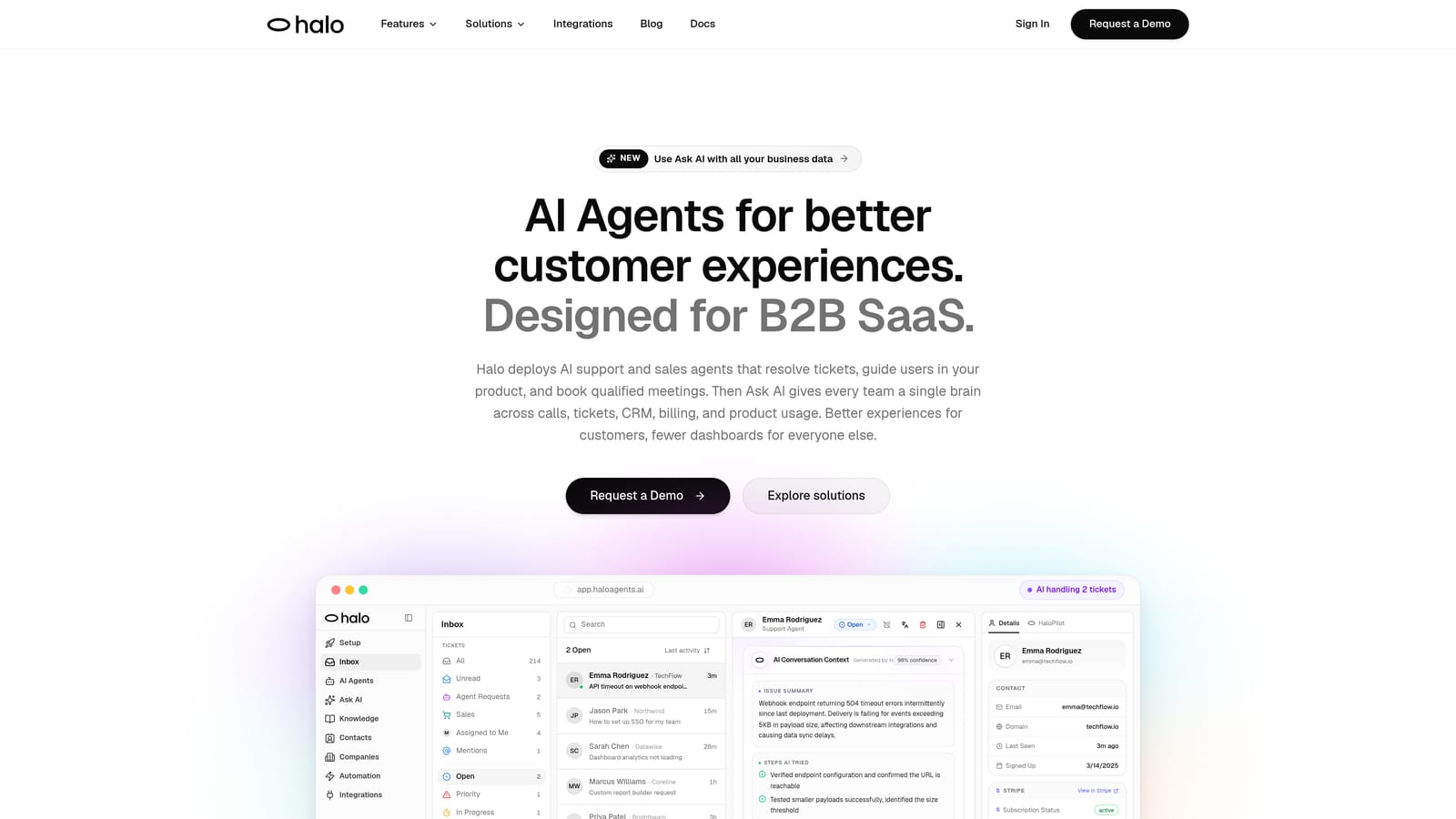
Halo AI is an AI-first customer support platform built specifically for SaaS teams, deploying autonomous agents that resolve tickets, guide users through your product, and surface business intelligence — all while learning continuously from every interaction.
Where This Tool Shines
What separates Halo from most tools on this list is the architectural decision to build AI-first rather than bolt AI onto an existing helpdesk. That distinction matters in practice. The AI doesn't just suggest replies — it resolves tickets autonomously, understands the context of what a user is looking at on-screen, and escalates intelligently when a human is genuinely needed.
The page-aware chat widget is a particularly strong differentiator for SaaS products. Instead of giving generic answers, Halo's AI sees what the user sees on-screen and provides contextual guidance tied to their exact situation. Combine that with continuous learning from every resolved interaction, and the system gets meaningfully smarter over time rather than staying static.
Key Features
Page-Aware Chat Widget: The AI sees what users see on-screen, enabling contextual, step-by-step guidance rather than generic help center responses.
Autonomous Ticket Resolution: AI agents resolve tickets end-to-end, with intelligent live agent handoff for complex issues that genuinely require human judgment.
Auto Bug Ticket Creation: Automatically creates bug reports and routes them to Linear when user-reported issues meet defined criteria — closing the loop between support and engineering.
Smart Inbox with Business Intelligence: Goes beyond support metrics to surface customer health signals, revenue intelligence, and anomaly detection — turning your support queue into a source of strategic insight.
Deep Integration Stack: Native integrations with Linear, Slack, HubSpot, Intercom, Stripe, Zoom, PandaDoc, and Fathom connect Halo to your entire business stack, not just your helpdesk.
Best For
SaaS teams that want more than ticket deflection — particularly B2B SaaS companies with technical users, complex onboarding flows, and a need for support data to inform product and revenue decisions. Also a strong fit for teams already using tools like Linear, HubSpot, or Intercom who want AI that connects across their stack.
Pricing
Contact for pricing or book a demo at haloagents.ai. Pricing is tailored to team size and use case rather than published as a fixed tier.
2. Intercom (Fin AI)
Best for: Teams already on Intercom who want AI resolution without migrating platforms.
Intercom Fin is Intercom's native AI agent, handling customer conversations autonomously using your help center content and escalating to human agents when needed — all within the familiar Intercom Messenger interface.
Where This Tool Shines
Fin's biggest advantage is its zero-friction adoption path for existing Intercom customers. There's no separate platform to manage, no new interface for agents to learn, and no migration risk. If your team is already living in Intercom, Fin extends what you already have rather than replacing it.
The per-resolution pricing model is also worth noting. You pay for outcomes rather than seats, which aligns costs with actual value delivered. For teams with variable support volumes, that structure can be more predictable than per-agent pricing.
Key Features
Native Messenger Integration: Fin operates directly within Intercom Messenger, requiring no separate tool or workflow changes for your support team.
Resolution-Based AI: Uses your existing help center content to resolve queries autonomously, without requiring you to rebuild your knowledge base from scratch.
Smooth Escalation: Hands off to human agents with full conversation context preserved, so customers don't have to repeat themselves.
Per-Resolution Pricing: You pay for resolved conversations rather than agent seats, making costs directly tied to outcomes.
Best For
SaaS teams already invested in the Intercom ecosystem who want to add AI resolution without switching platforms. Less ideal for teams looking for an AI-first architecture or deep integrations outside the Intercom stack.
Pricing
Fin AI is available as an add-on to existing Intercom plans, priced per resolution. Contact Intercom for current rates based on your volume.
3. Zendesk AI
Best for: Established SaaS teams with existing Zendesk infrastructure looking to add AI capabilities incrementally.
Zendesk AI layers intelligent triage, AI agents for self-service, and agent assist tools into the Zendesk Suite — built on one of the most established helpdesk platforms in the market, bolstered by the acquisition of Ultimate.ai.
Where This Tool Shines
Zendesk's AI story is strongest for teams that are deeply embedded in the Zendesk ecosystem. The AI capabilities integrate directly with existing workflows, reporting, and routing rules — which means less configuration work and lower adoption risk for teams that already know the platform.
The Agent Copilot feature is particularly useful for complex SaaS support scenarios where full automation isn't appropriate but agents still benefit from suggested replies and next-best-action guidance during live conversations.
Key Features
Intelligent Triage and Routing: Automatically categorizes and routes incoming tickets based on intent, priority, and content — reducing manual queue management.
AI Agents for Self-Service: Built on Zendesk's Ultimate.ai acquisition, these agents handle common queries before tickets reach a human agent.
Agent Copilot: Provides suggested replies, conversation summaries, and next-best-action recommendations to speed up human agent responses.
Deep Workflow Integration: AI features connect natively with existing Zendesk reporting, macros, and ticket workflows — no separate configuration layer required.
Best For
SaaS teams already on Zendesk Suite who want to add AI without a platform migration. Teams evaluating Zendesk fresh should weigh whether the AI depth at their required tier justifies the investment compared to AI-first alternatives.
Pricing
AI features are available on higher-tier Zendesk Suite plans. Enterprise pricing requires direct contact with Zendesk's sales team.
4. Freshdesk Freddy AI
Best for: SaaS teams that want AI features across self-service, agent assist, and analytics at a more accessible price point.
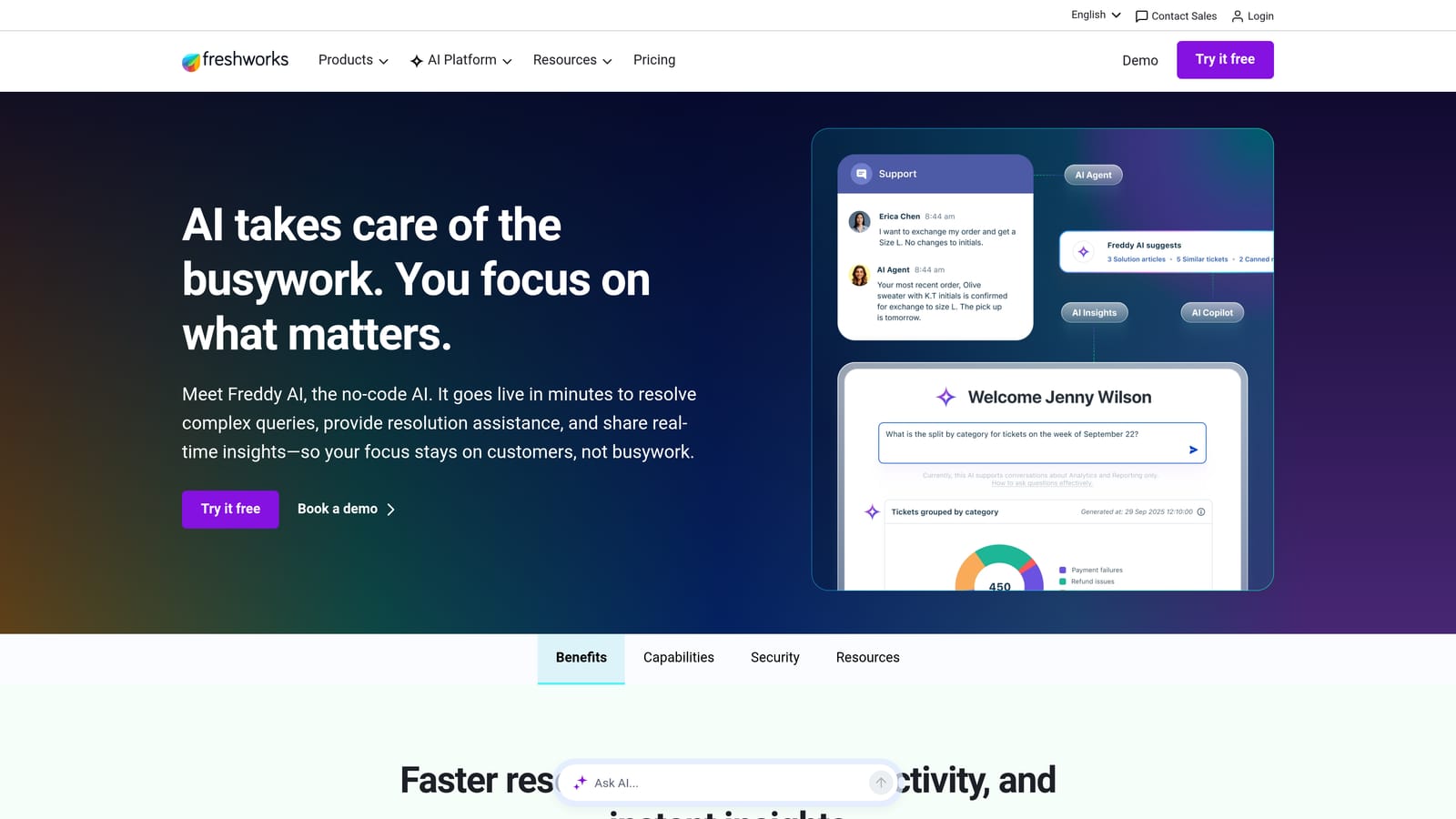
Freshdesk Freddy AI spans self-service, agent assist, and analytics across the Freshdesk platform — offering a more accessible entry point for SaaS teams that want AI features without enterprise-level investment.
Where This Tool Shines
Freddy AI's three-layer structure covers the full support workflow: deflection before a ticket is created, assistance while an agent is working, and analytics after the fact. That breadth across the entire support lifecycle is useful for teams that want AI impact at multiple points rather than just one.
Freshdesk also tends to be more competitively priced than Zendesk for comparable AI features, which makes it a practical consideration for SaaS teams at earlier growth stages who still want meaningful automation.
Key Features
Freddy Self Service: AI chatbot that handles deflection and self-service resolution before tickets reach your queue.
Freddy Copilot: Agent assist tool providing suggested replies, conversation summaries, and response drafts during live support interactions.
Freddy Insights: AI-powered analytics layer that identifies trends, flags anomalies, and surfaces actionable patterns in your support data.
Scalable Tier Structure: Freddy AI features are available across multiple Freshdesk plans, with the full suite unlocked at higher tiers.
Best For
Growing SaaS teams that want AI across self-service, agent assist, and analytics without committing to enterprise pricing. Teams already on Freshdesk will find adoption straightforward.
Pricing
Freddy AI features are distributed across Freshdesk's paid plans. The full Freddy AI suite requires a higher-tier plan; entry-level AI features are accessible at mid-tier pricing.
5. Tidio
Best for: Smaller SaaS teams or PLG products that need AI chat deployed quickly with minimal setup.
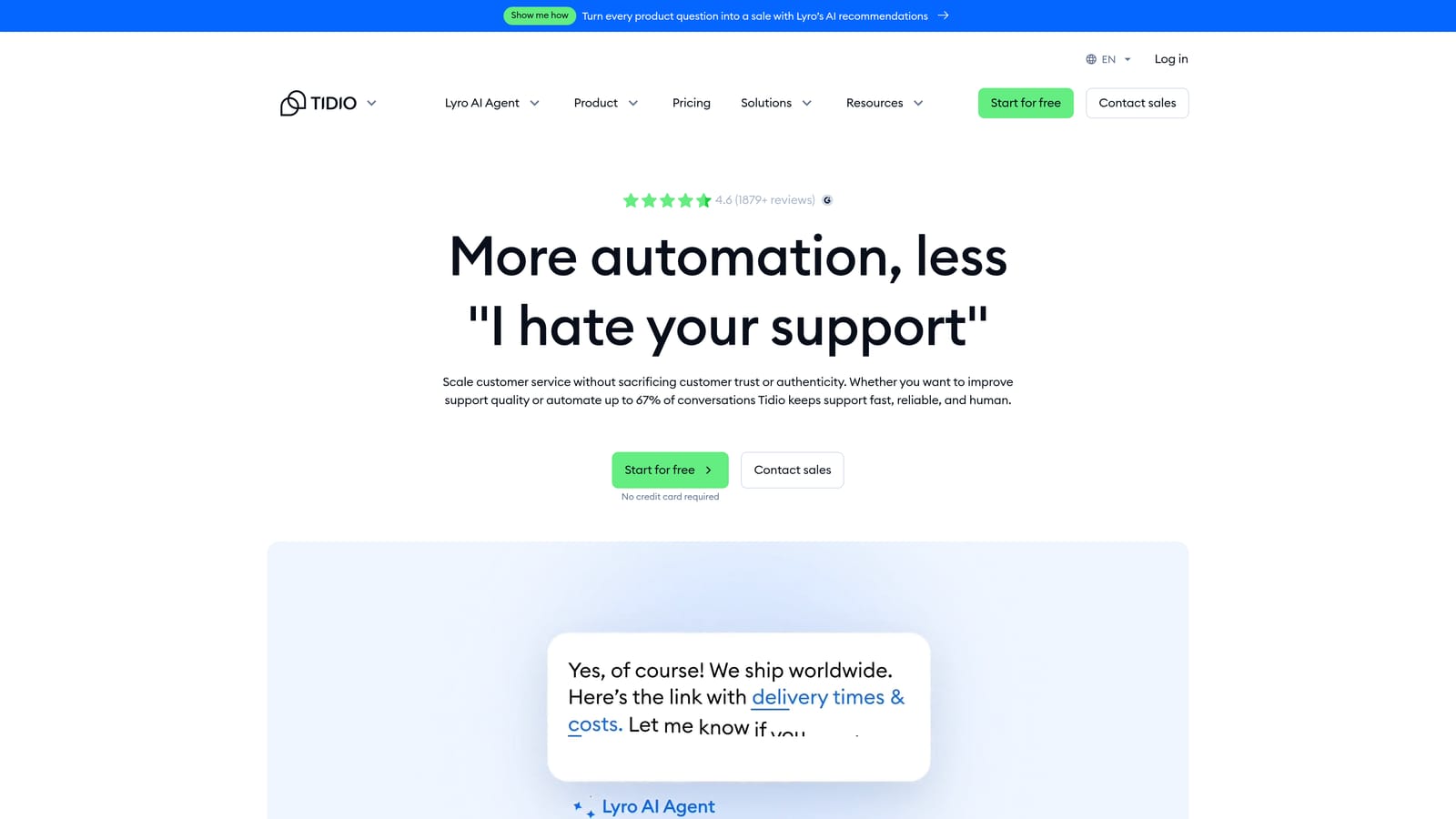
Tidio is a live chat and AI agent platform built for fast, low-code deployment — making it a strong option for teams that need AI support up and running quickly rather than spending weeks on configuration.
Where This Tool Shines
Tidio's Lyro AI agent is designed for speed of deployment. Many teams can go live in under an hour, which is a genuine advantage for smaller SaaS companies or product-led growth products where support needs to scale quickly without a dedicated ops team to manage the rollout.
The platform consolidates live chat, email, and chatbot into a single interface, which reduces tool sprawl for teams that are still in the process of building out their support stack.
Key Features
Lyro AI Agent: Handles common queries autonomously with minimal setup, using your existing FAQ and help content as its knowledge base.
Unified Inbox: Combines live chat, email, and chatbot conversations in one platform, reducing context-switching for small support teams.
Rapid Deployment: Low-code setup means most teams can go live quickly without engineering involvement or extended implementation timelines.
Conversation-Based Pricing: Pricing is tied to conversation volume rather than agent seats, which works well for teams with variable or growing support demand.
Best For
Smaller SaaS teams, PLG products, or early-stage companies that need AI chat running quickly. Less suited for complex technical SaaS support or teams that need deep integrations with developer and GTM tooling.
Pricing
Lyro AI is available on Tidio's paid plans with conversation-based pricing. Check Tidio's website for current tier details as pricing evolves regularly.
6. Forethought
Best for: SaaS teams that want AI triage and resolution layered on top of an existing helpdesk without migrating platforms.
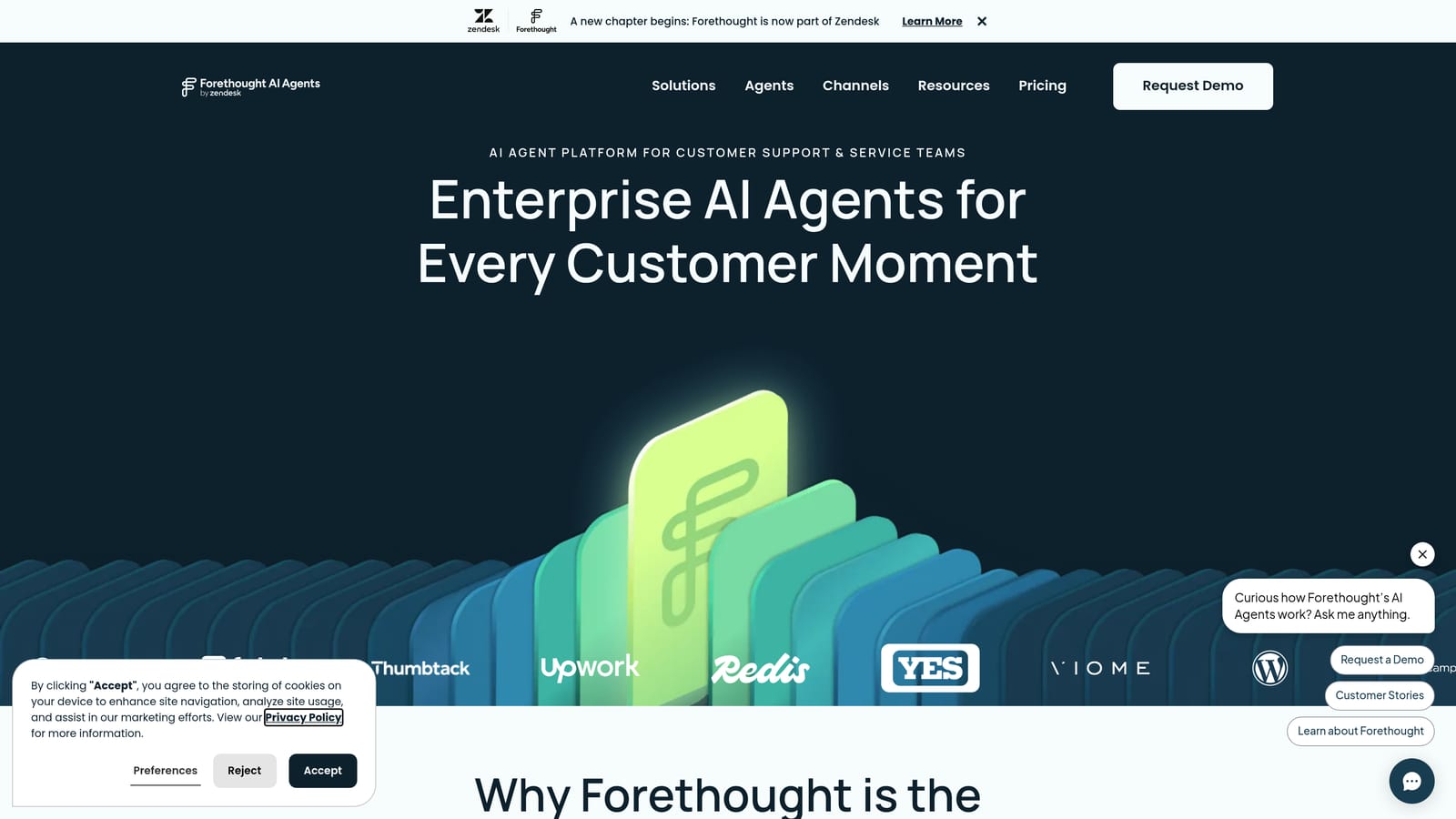
Forethought sits between your customers and your existing helpdesk, triaging, routing, and resolving tickets before they reach a human agent — without requiring you to replace your current support infrastructure.
Where This Tool Shines
Forethought's core value proposition is additive: it makes your existing helpdesk smarter without requiring a migration. If your team is deeply invested in Zendesk, Freshdesk, or Salesforce Service Cloud and switching isn't realistic, Forethought adds an intelligent layer on top rather than asking you to start over.
The topic clustering and resolution analytics give support leaders visibility into what's driving ticket volume — which is particularly useful for SaaS teams trying to identify product friction points or documentation gaps from support data.
Key Features
Helpdesk-Agnostic AI Layer: Integrates with Zendesk, Freshdesk, Salesforce Service Cloud, and others — works alongside your existing platform rather than replacing it.
Auto-Resolution Before Agent Involvement: Resolves common queries before they enter the agent queue, reducing workload without requiring helpdesk migration.
Topic Clustering: Groups incoming tickets by theme, surfacing patterns in support volume that inform product and documentation decisions.
Resolution Analytics: Tracks deflection and resolution rates with enough granularity to identify which query types AI is handling well versus where it needs improvement.
Best For
Mid-market and enterprise SaaS teams with existing helpdesk investments who want to add AI resolution without a platform migration. The enterprise pricing focus makes it less accessible for early-stage teams.
Pricing
Enterprise-focused pricing; contact Forethought directly for a quote based on your volume and helpdesk environment.
7. Kustomer
Best for: B2B SaaS companies with complex, relationship-heavy customer accounts where CRM context matters in every support interaction.
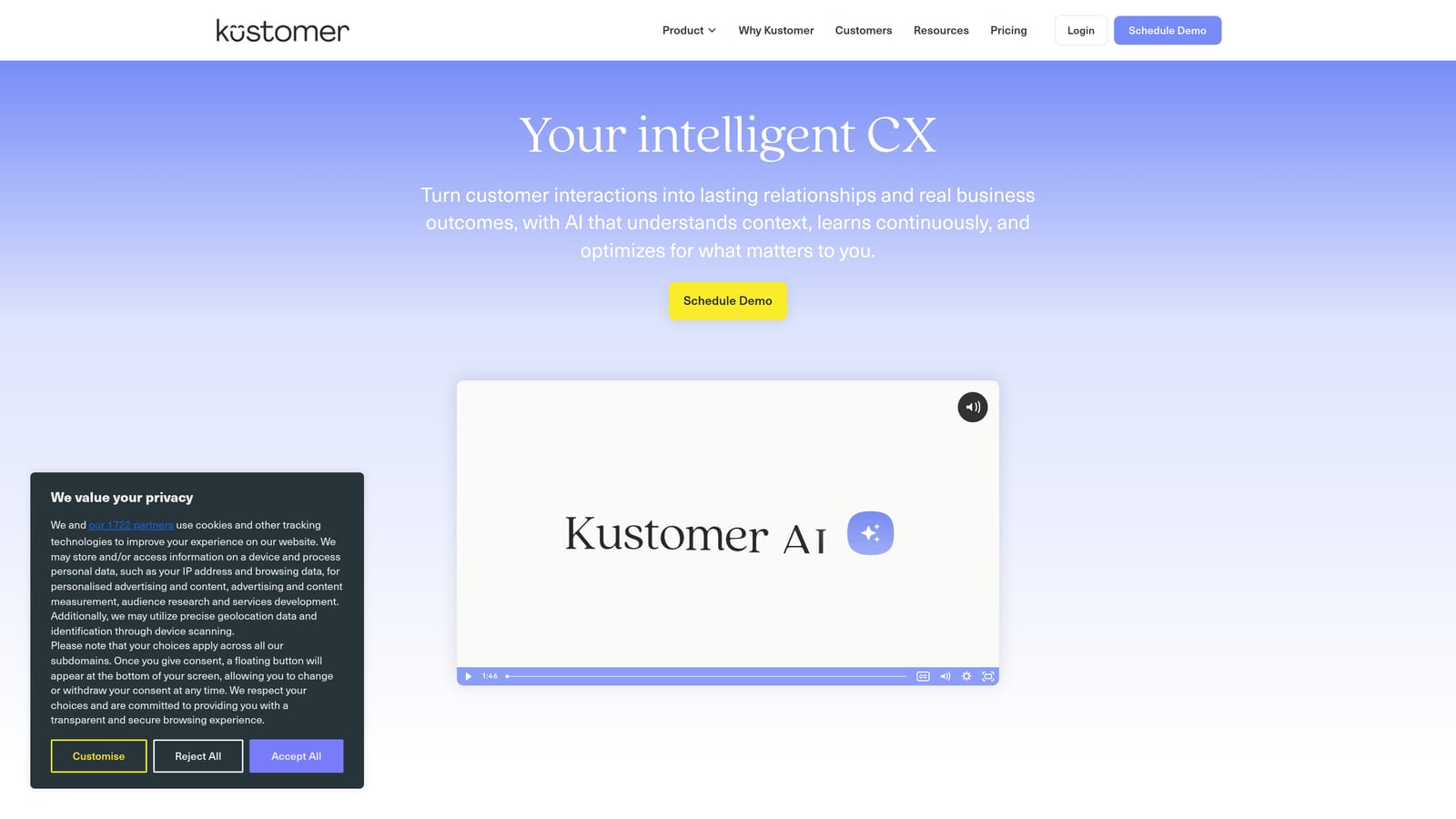
Kustomer combines CRM functionality with AI-powered conversations, giving support teams a unified view of every customer interaction across their entire lifecycle — not just the current ticket.
Where This Tool Shines
Kustomer's differentiation is the unified customer timeline. Rather than treating each support interaction as an isolated ticket, Kustomer surfaces the full relationship context: past conversations, account history, product usage signals, and CRM data — all in one view. For B2B SaaS teams managing complex accounts with CSM involvement, that context changes the quality of every interaction.
The AI features build on that foundation, using the full customer history to generate more relevant suggested replies, summaries, and intent detection than tools that only see the current conversation thread.
Key Features
Unified Customer Timeline: Combines CRM data and support conversations in a single view, giving agents full relationship context without switching tools.
AI-Powered Agent Assist: Suggested replies, conversation summaries, and intent detection informed by the complete customer history rather than just the current ticket.
Multi-Channel Support: Handles chat, email, social, and phone in one platform, relevant for B2B SaaS with enterprise customers across multiple communication channels.
CSM and Support Alignment: Strong fit for teams where customer success and support overlap, particularly accounts with long lifecycle and renewal complexity.
Best For
B2B SaaS companies with complex, high-touch customer relationships where CRM context and support history need to be unified. Less suited for high-volume, transactional support scenarios where ticket speed matters more than relationship depth.
Pricing
Per-agent pricing with enterprise tiers available. Contact Kustomer for a quote based on team size and required features.
8. Ada
Best for: Enterprise SaaS teams that need granular control over brand voice, escalation flows, and compliance requirements without engineering resources.
Ada is a no-code AI agent builder that gives enterprise SaaS teams precise control over how their AI behaves — from brand voice and conversation flows to compliance requirements and escalation logic — without requiring ongoing engineering involvement.
Where This Tool Shines
Ada's no-code builder is designed for CX teams that need to own and iterate on their AI agent without filing engineering tickets every time something needs to change. For enterprise SaaS teams with dedicated CX ownership and strict brand standards, that autonomy is genuinely valuable.
The compliance and data governance features are a meaningful differentiator for SaaS companies operating in regulated industries — healthcare, fintech, legal tech — where AI behavior needs to meet specific standards and auditability requirements.
Key Features
No-Code AI Agent Builder: CX teams can build, customize, and iterate on AI conversation flows without engineering involvement.
Brand Voice Customization: Deep control over tone, language, and response style ensures the AI reflects your brand standards consistently across every interaction.
Compliance and Data Governance: Built-in features for regulated industries, including data handling controls and auditability for AI decisions.
Broad Integration Support: Connects with major CRMs, helpdesks, and data sources, fitting into existing enterprise stacks without requiring a full infrastructure rebuild.
Best For
Enterprise SaaS teams with dedicated CX ownership, strict brand standards, or compliance requirements in regulated industries. The no-code approach is most valuable when CX teams need to move independently from engineering.
Pricing
Enterprise pricing; contact Ada directly for a quote. Not structured for small teams or early-stage SaaS budgets.
9. Drift (Salesloft)
Best for: SaaS companies where inbound chat blurs the line between support and sales qualification.
Drift, now part of Salesloft, handles both inbound support and sales qualification simultaneously — making it a natural fit for SaaS teams where the same chat conversation might need to route to either a support agent or a sales rep depending on intent.
Where This Tool Shines
Drift's AI is built to handle the ambiguity that comes with inbound SaaS conversations. When a user asks "how do I upgrade my plan?" that's simultaneously a support question and a revenue moment. Drift's AI can handle the support component, qualify the intent, and route to the right team — without requiring the customer to start over in a different channel.
The integration with Salesloft's broader revenue platform makes this a coherent choice for SaaS teams that have already standardized on Salesloft for their sales motion and want their support and sales chat to operate from the same infrastructure.
Key Features
Dual-Purpose AI: Handles support queries and sales qualification within the same conversation, routing based on detected intent rather than requiring separate tools for each function.
Intelligent Routing: Directs conversations to support agents or sales reps based on intent signals, reducing manual triage and ensuring the right person responds.
Playbook-Driven Conversations: Configurable conversation flows for both CX and revenue scenarios, giving teams control over how the AI behaves across different visitor types.
Salesloft Platform Integration: Native connection to Salesloft's broader revenue platform for teams that want support and sales AI to share data and context.
Best For
SaaS companies with active inbound chat where support and sales overlap frequently — particularly those already using Salesloft for their revenue motion. Less suited for teams that want a pure support-focused AI without the sales layer.
Pricing
Contact Salesloft for current pricing following the acquisition. Pricing structure has evolved since Drift joined the Salesloft platform.
Which Tool Is Right for Your SaaS Team?
The right choice depends on where you are in your growth journey and what you actually need AI to do — not just deflect, but genuinely resolve, learn, and contribute to your business intelligence.
If you're an early-stage or PLG SaaS team that needs something running fast, Tidio offers the lowest barrier to entry. If you're already embedded in Intercom or Zendesk and want AI without a migration, Fin AI or Zendesk AI extend what you already have. For teams that want AI layered on top of an existing helpdesk without replacing it, Forethought is worth a close look. Enterprise teams with compliance requirements or dedicated CX ownership will find Ada gives them the control they need. And if your support and sales conversations regularly overlap, Drift via Salesloft handles that dual-purpose scenario well.
For SaaS teams that want an AI-first platform built from the ground up — one that resolves tickets autonomously, sees what users see on-screen, connects to your entire business stack, and surfaces intelligence beyond basic support metrics — Halo AI is the strongest fit on this list.
Your support team shouldn't scale linearly with your customer base. AI agents can handle routine tickets, guide users through your product, and surface business intelligence while your team focuses on complex issues that genuinely need a human touch. See Halo in action and discover how continuous learning transforms every interaction into smarter, faster support.