9 Best AI Support Software Platforms in 2026
Discover the best AI support software platforms of 2026, evaluated on autonomous resolution capability, integration depth, and real-world performance rather than marketing claims. This guide helps B2B SaaS teams identify tools that genuinely reduce ticket volume and improve customer experience, cutting through the noise to highlight solutions that get smarter over time and deliver measurable results at any scale.
 Matt PattoliFounder14 min read
Most AI support software promises to transform your customer experience. What it often delivers is a slightly smarter FAQ bot that frustrates users and pushes ticket volume back to your human team. The gap between marketing claims and actual resolution capability is wide, and for B2B SaaS teams scaling fast, that gap is expensive.
The tools that actually move the needle share a few qualities: they resolve tickets autonomously rather than just deflecting them, they understand context, they integrate deeply with your existing stack, and they get smarter over time. The ones that don't? They add another layer of complexity without reducing your support burden.
This list covers the platforms worth evaluating in 2026. Selection criteria include deployment model, integration depth, autonomous resolution capability, learning loop quality, escalation handling, and pricing transparency. Whether you're running a lean SaaS support team or managing enterprise-scale ticket volumes, there's a meaningful difference between these tools worth understanding before you commit.
1. Halo AI
Best for: B2B SaaS teams wanting AI-first architecture with page-aware context and business intelligence
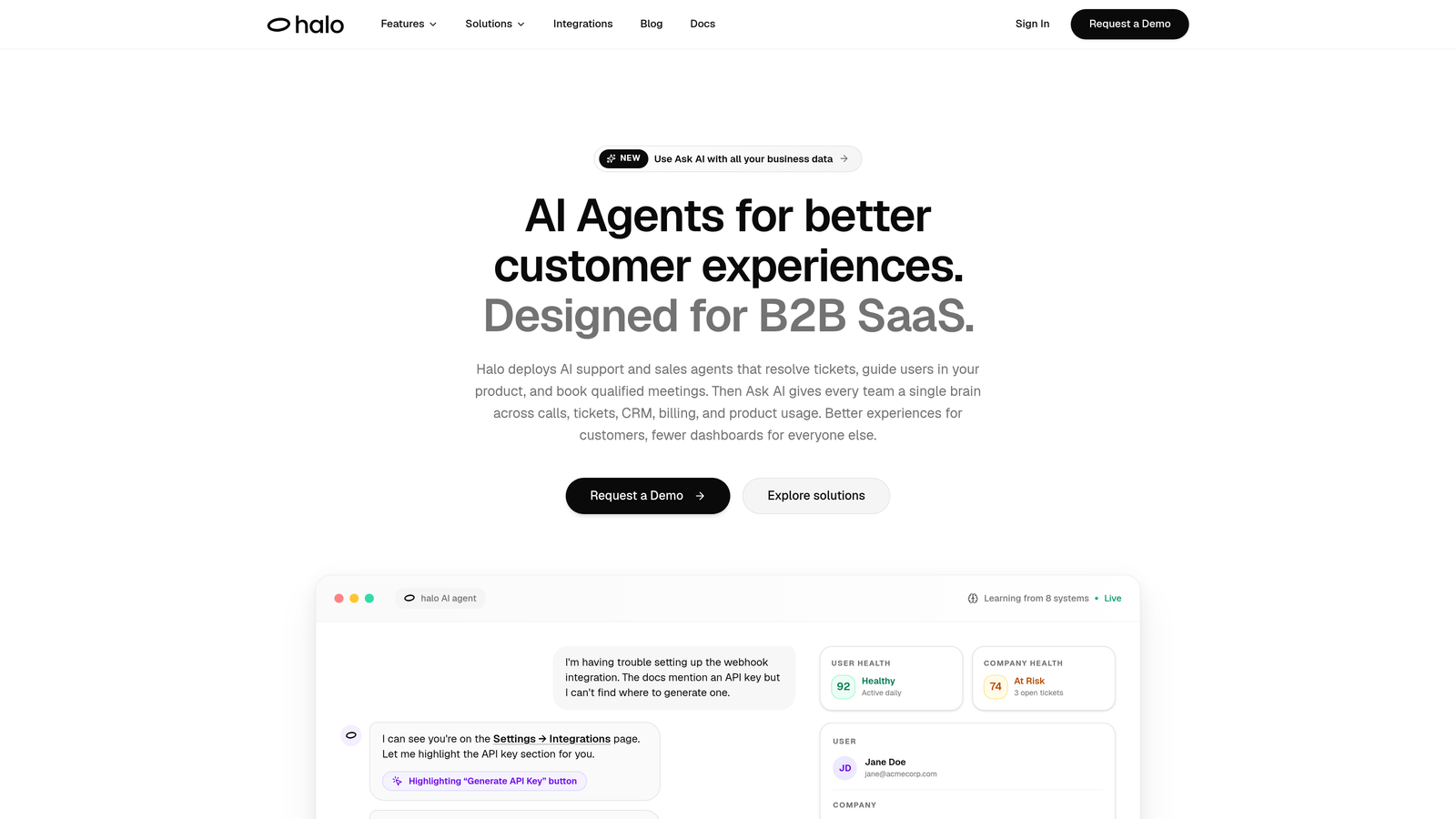
Halo AI is an AI-native customer support platform built specifically for B2B SaaS product teams who need genuine ticket resolution, not just deflection.
Where This Tool Shines
Halo's standout capability is page-aware context: the AI agent sees what the user sees inside your product, allowing it to provide guidance that's specific to where someone is stuck rather than generic help center responses. That level of contextual awareness is rare in this category and makes a meaningful difference in resolution quality.
Beyond ticket resolution, Halo surfaces business intelligence that most support tools ignore entirely. Its smart inbox identifies customer health signals, revenue anomalies, and escalation risks, turning your support queue into a source of strategic insight rather than just a cost center.
Key Features
Page-Aware AI Agents: The AI understands which product page or workflow a user is on and delivers contextual UI guidance accordingly.
Autonomous Ticket Resolution: Agents resolve tickets end-to-end with smart handoff to live agents when needed, transferring full conversation context so nothing is repeated.
Auto Bug Ticket Creation: Support conversations that surface bugs automatically generate tickets routed to Linear or your project management tool, closing the loop between support and engineering.
Smart Inbox with Business Intelligence: Customer health scoring, revenue signals, and anomaly detection surface directly in the support inbox, giving teams visibility beyond ticket counts.
Deep Integration Stack: Native connections to Slack, HubSpot, Intercom, Stripe, Zoom, PandaDoc, and Fathom allow the AI to operate with full business context.
Continuous Learning Loop: Every resolved interaction feeds back into the AI, improving resolution accuracy over time without manual retraining.
Best For
Halo is purpose-built for B2B SaaS product teams and customer success leaders who want AI that genuinely resolves tickets rather than routing them. It's particularly well-suited for teams whose support and product feedback loops are tightly connected, and who want their support infrastructure to generate business intelligence alongside resolution.
Pricing
Contact for pricing. Halo is designed for B2B SaaS teams and positions as an enterprise-grade AI-first platform rather than a per-seat helpdesk tool.
2. Intercom (Fin AI)
Best for: Teams already on Intercom who want a capable AI agent without switching platforms
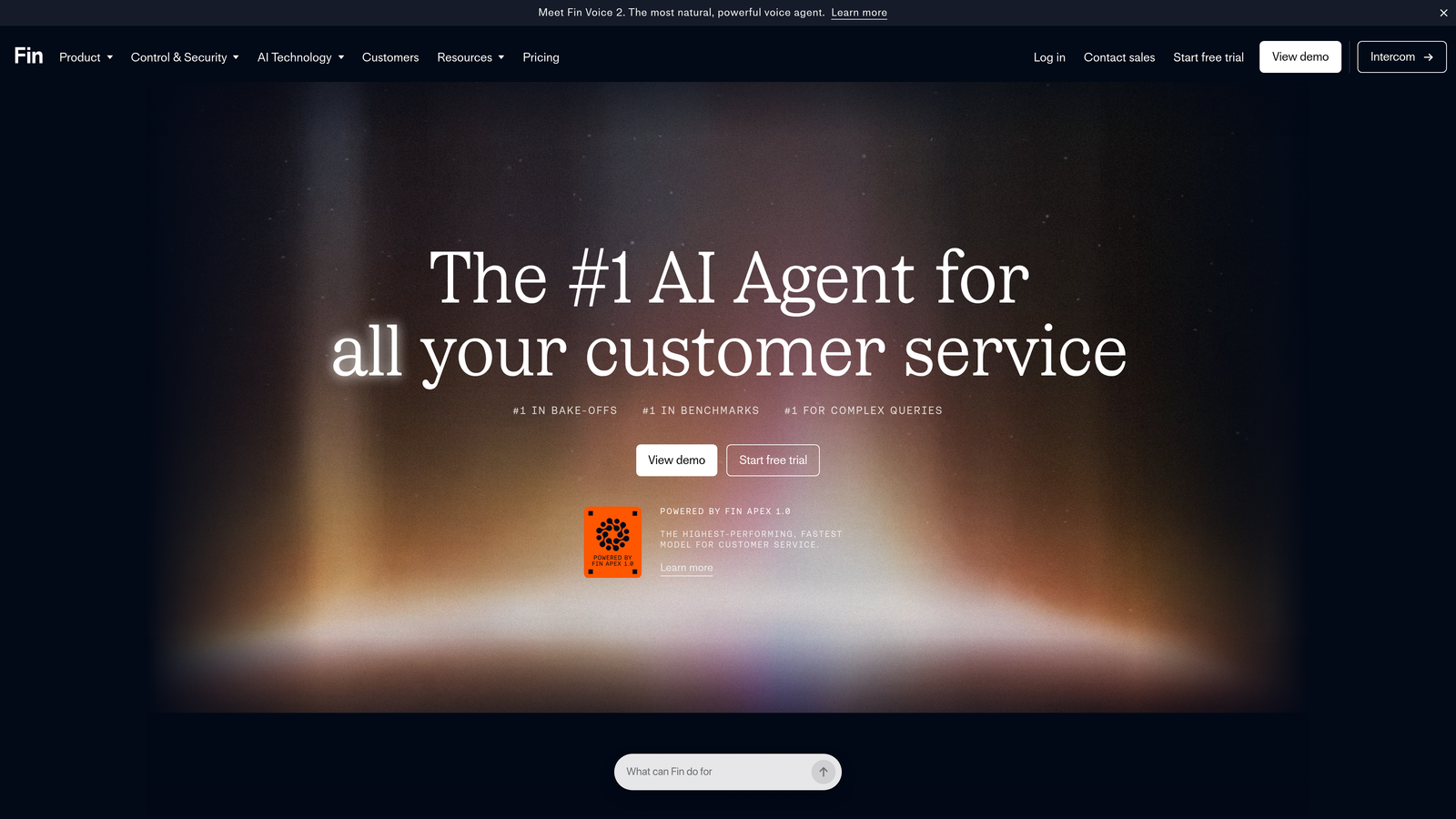
Intercom Fin AI is a purpose-built AI support agent layered into Intercom's established messaging and inbox infrastructure.
Where This Tool Shines
Fin AI benefits from Intercom's mature messenger experience and broad app ecosystem. If your team is already using Intercom for customer communication, adding Fin is a natural extension rather than a platform change. The handoff between AI and human agents is smooth, with full conversation context preserved.
The resolution-based pricing model is worth noting: you pay for conversations Fin actually resolves, which aligns incentives in a way that flat per-seat pricing doesn't. For teams with variable support volume, this can be a meaningful advantage.
Key Features
Fin AI Agent: Resolves customer questions using your help center content and custom answers you configure directly.
Seamless Human Handoff: Transfers to human agents with full conversation context when the AI reaches its limits.
Resolution-Based Pricing: Available pricing model that charges per resolved conversation rather than per seat.
App Marketplace Integrations: Broad ecosystem of third-party integrations through Intercom's existing marketplace.
Multilingual Support: Handles queries across multiple languages without separate configuration.
Best For
Teams already invested in the Intercom ecosystem, or those who want a well-supported AI agent with a mature underlying platform. Less ideal for teams that need deep CRM or engineering tool integrations beyond what Intercom's marketplace covers.
Pricing
Intercom plans start around $39/month. Fin AI uses resolution-based pricing layered on top of the base plan. Total cost scales with conversation volume and resolution rate.
3. Zendesk AI
Best for: Enterprise teams already on Zendesk Suite who need AI triage, copilot, and quality assurance in one place
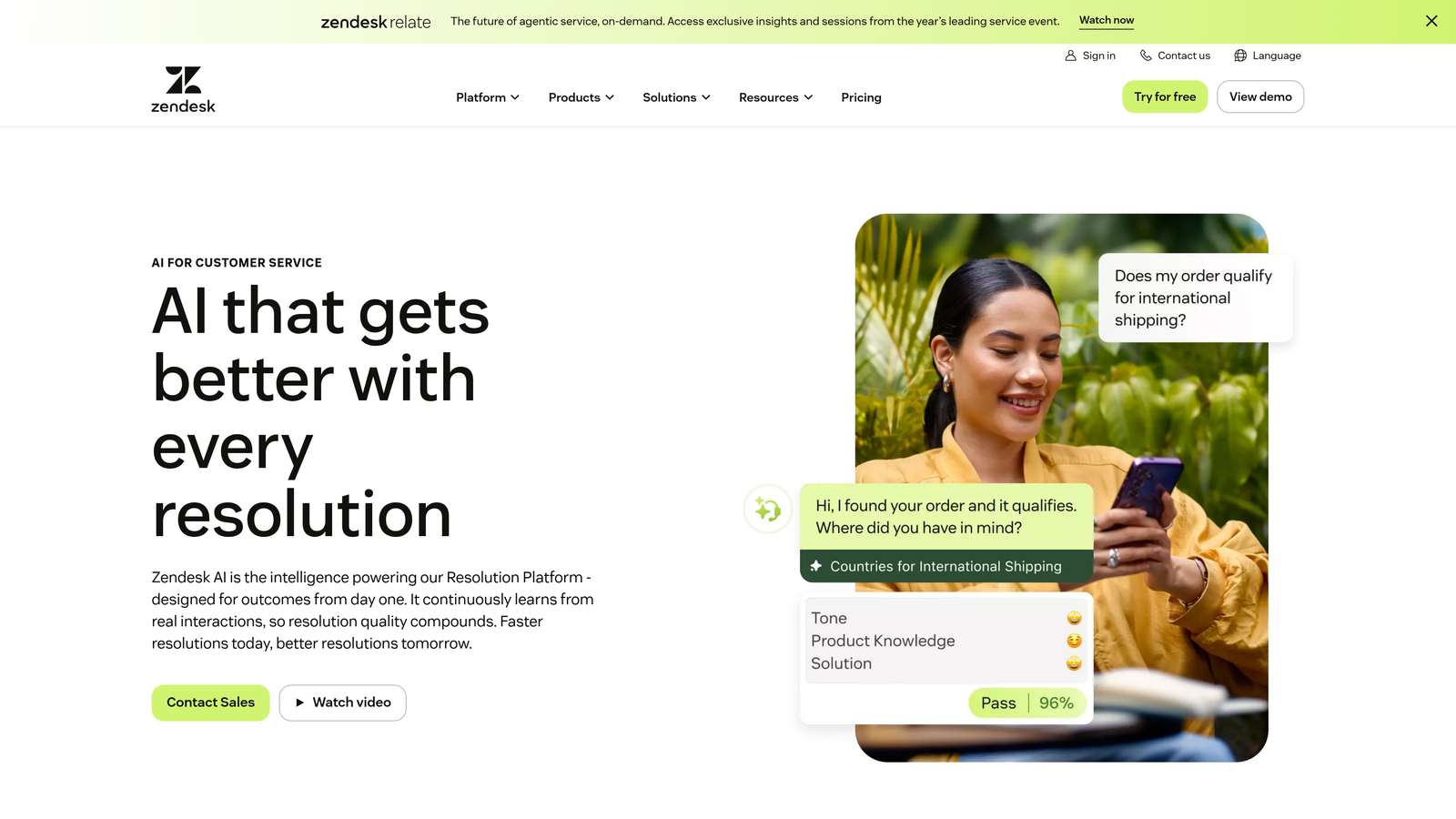
Zendesk AI brings intelligent triage, agent copilot functionality, and autonomous bots to one of the most established helpdesk platforms in the enterprise market.
Where This Tool Shines
Zendesk AI is most powerful for organizations already running on Zendesk Suite. The AI features layer directly into existing workflows: triage happens automatically, agents get real-time suggestions, and bots handle self-service before tickets are even created. For large teams with established Zendesk configurations, the AI additions can meaningfully reduce manual workload without requiring a platform change.
The quality assurance capabilities are a differentiator worth highlighting. AI-powered CSAT prediction and QA scoring give support leaders visibility into conversation quality at scale, something that's difficult to achieve with manual review alone.
Key Features
Intelligent Triage: Automatically routes and tags tickets based on detected intent, sentiment, and language.
AI Copilot for Agents: Provides suggested replies and next-best-action guidance in real time as agents work tickets.
Automated Bots: Handles self-service resolution before ticket creation, reducing inbound volume.
AI-Powered QA and CSAT Prediction: Scores conversation quality and predicts satisfaction outcomes across your ticket volume.
Enterprise Security and Compliance: Meets enterprise-grade compliance requirements across data residency, security, and access controls.
Best For
Enterprise support teams already on Zendesk Suite who want to add AI capabilities without migrating platforms. Configuration complexity can be a barrier for smaller teams without dedicated Zendesk administrators.
Pricing
Zendesk Suite starts around $55/agent/month. AI features are priced as add-ons, so total cost depends on which AI capabilities your team needs.
4. Freshdesk (Freddy AI)
Best for: SMBs and growing teams looking for accessible AI support features without enterprise pricing
Freshdesk's Freddy AI spans self-service bots, agent assist, and analytics across the Freshworks ecosystem, making it one of the more cost-effective entry points for teams adopting AI support.
Where This Tool Shines
Freddy AI's three-layer structure gives teams flexibility in how much AI they adopt. You can start with self-service bots for common queries, add copilot assistance for agents, and layer in analytics as your team matures. That progressive adoption path is genuinely useful for teams that aren't ready to go all-in on AI from day one.
The native integration across the Freshworks suite is also worth noting. If your team uses Freshsales or Freshchat alongside Freshdesk, Freddy AI operates with shared context across those tools, which reduces the integration work that typically comes with adding AI to a support stack.
Key Features
Freddy Self Service: AI bots handle autonomous query resolution before tickets reach your team.
Freddy Copilot: Provides real-time reply suggestions, conversation summarization, and draft generation for agents.
Freddy Insights: AI-driven analytics surface performance trends and recommendations for support leaders.
Freshworks Suite Integration: Native context sharing across Freshsales, Freshchat, and other Freshworks products.
Competitive Pricing: AI features accessible at price points that work for SMBs, not just enterprise budgets.
Best For
SMBs and mid-market teams transitioning from manual ticketing who want AI assistance without committing to enterprise-level spend. Teams already using other Freshworks products will see the most value from Freddy's cross-suite context.
Pricing
Freshdesk has a free plan. Freddy AI features become available on the Growth plan, starting around $15/agent/month, with more advanced capabilities on higher tiers.
5. Tidio
Best for: E-commerce businesses and small teams wanting easy AI chat setup with native store integrations
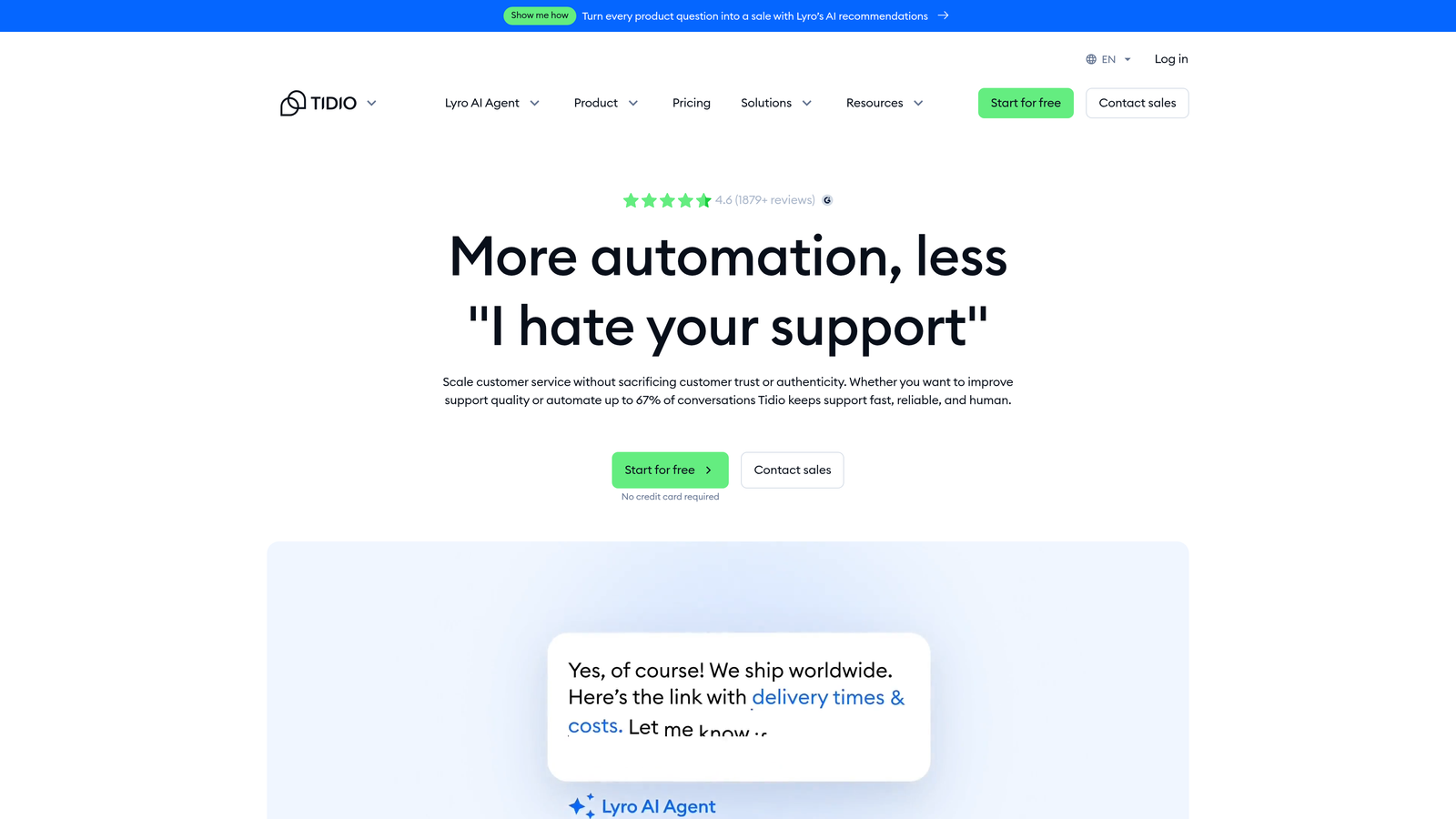
Tidio is a customer service platform built around Lyro, its AI chatbot, with particular strength in e-commerce integrations and straightforward setup for non-technical teams.
Where This Tool Shines
Tidio's setup experience is genuinely fast compared to enterprise alternatives. The visual flow builder lets non-technical team members configure chat logic without engineering support, which matters for small businesses that don't have a dedicated ops or IT function. Lyro handles a meaningful share of common queries autonomously, reducing the live chat burden on small support teams.
The e-commerce integrations are where Tidio earns its reputation. Native connections to Shopify, WooCommerce, and Magento mean the AI can reference order data, shipping status, and product information during conversations, which is exactly the context e-commerce customers need when they reach out.
Key Features
Lyro AI Chatbot: Handles autonomous conversation resolution for common queries without human intervention.
Visual Flow Builder: Drag-and-drop interface for configuring chat logic without writing code.
E-Commerce Integrations: Native connections to Shopify, WooCommerce, and Magento with order and product context.
Live Chat Fallback: Smooth handoff to human agents when Lyro reaches the limits of its training.
Multi-Channel Support: Handles email and Facebook Messenger alongside live chat from one interface.
Best For
Small e-commerce businesses and SMBs that need AI chat up and running quickly without deep technical configuration. Less suited for B2B SaaS teams that need CRM integration, engineering tool connections, or complex escalation logic.
Pricing
Tidio offers a free plan. Lyro AI starts around $29/month, with paid plans scaling based on conversation volume rather than seat count.
6. Drift (Salesloft)
Best for: Revenue-focused B2B teams where support and sales qualification overlap
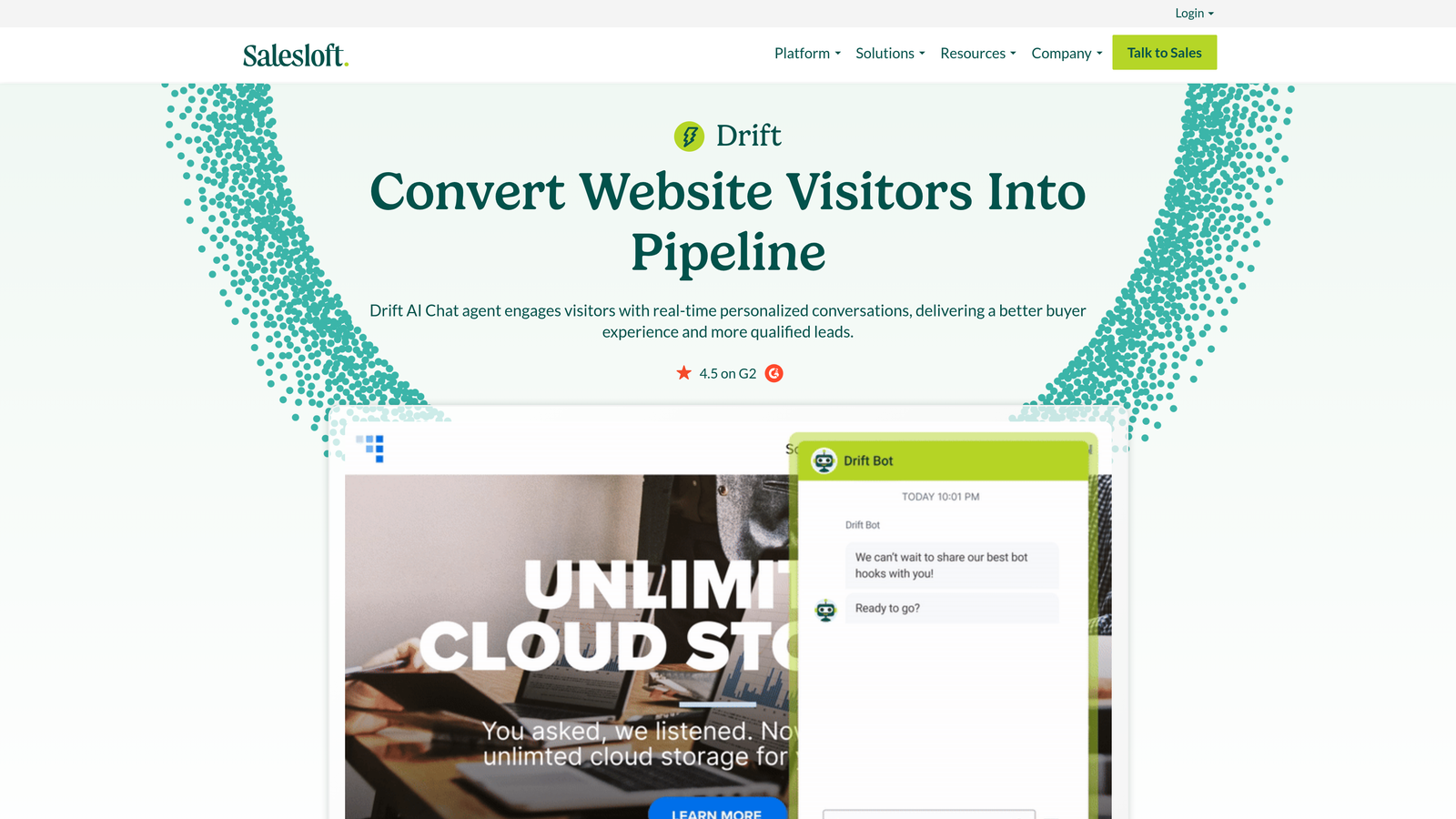
Drift, now part of Salesloft, is a conversational AI platform that blends customer support and sales qualification, making it a distinct option for teams where the two functions are tightly connected.
Where This Tool Shines
Drift's positioning within Salesloft has clarified its core use case: revenue-focused B2B conversations. The AI can qualify inbound leads, book meetings, route to sales reps, and handle support queries within the same chat flow. For companies where website visitors are both prospects and customers, that unified experience can reduce friction considerably.
The integration with Salesforce, HubSpot, and Salesloft's own platform means conversation data flows into CRM and pipeline tools automatically. Support and sales leaders get visibility into the same customer interactions from different angles.
Key Features
Dual-Purpose AI Conversations: Handles both support resolution and sales qualification within the same chat experience.
Meeting Booking and Sales Routing: AI can book demos and route qualified leads to the right sales rep without human intervention.
CRM Integrations: Native connections to Salesforce, HubSpot, and Salesloft for full pipeline visibility.
Personalized Chat Experiences: Adapts conversation flow based on visitor data, account history, and behavioral signals.
Pipeline-Tied Analytics: Conversation metrics connect to revenue outcomes, not just support resolution rates.
Best For
B2B companies with significant overlap between their support and sales motions, particularly those already in the Salesloft ecosystem. Teams looking for a pure support resolution tool will find Drift's feature set broader than they need.
Pricing
Custom pricing. Contact Drift or Salesloft directly for current package details, as pricing has evolved since the acquisition.
7. Help Scout
Best for: Teams that prioritize relationship quality and want AI to assist agents rather than replace them
Help Scout is a customer support platform known for its clean, human-centric inbox experience, with AI features designed to make agents faster without removing them from the conversation.
Where This Tool Shines
Help Scout's philosophy is deliberate: AI should reduce cognitive load for agents, not eliminate the human element. The AI Summarize and AI Draft features give agents a head start on every conversation without taking over the response entirely. For teams where tone, empathy, and relationship continuity matter, that approach is more appropriate than full autonomous resolution.
The interface itself is a genuine differentiator. Help Scout's inbox is consistently cited as one of the cleaner, less overwhelming support environments available, which has real productivity implications for teams managing high daily ticket volumes.
Key Features
AI Summarize: Generates instant conversation summaries so agents can get up to speed without reading full thread history.
AI Draft: Suggests replies based on conversation history and knowledge base content, which agents can edit before sending.
Beacon Chat Widget: Embeddable widget with AI-powered self-service answers before users escalate to a human.
Shared Inbox with Collision Detection: Prevents two agents from responding to the same ticket simultaneously.
Clean, Minimal UI: Interface designed to reduce cognitive load and keep agents focused on the conversation.
Best For
Support teams where relationship quality and brand voice matter as much as resolution speed. Particularly well-suited for SaaS companies with high-touch customer success models or businesses where support is a differentiator rather than a cost center.
Pricing
Help Scout starts at around $22/user/month on the Standard plan, making it accessible for small to mid-sized teams.
8. Kustomer
Best for: High-volume, omnichannel support environments that need AI operating on a complete customer timeline
Kustomer is a CRM-native customer service platform where AI automation operates on top of a unified customer timeline, giving both agents and AI full context across every past interaction.
Where This Tool Shines
The core differentiator is the unified customer timeline. Rather than treating each conversation as isolated, Kustomer aggregates every interaction across email, chat, social, and voice into a single customer view. When AI automation runs on top of that timeline, it has access to purchase history, previous complaints, sentiment trends, and channel preferences, which meaningfully improves the relevance of automated responses.
For high-volume environments managing thousands of tickets per day across multiple channels, Kustomer's omnichannel consistency is operationally valuable. AI behavior remains consistent whether the customer reaches out via email, Instagram DM, or live chat.
Key Features
Unified Customer Timeline: Every interaction across all channels consolidated into a single customer record accessible to AI and agents.
AI-Powered Automation: Handles routing, tagging, and resolution using the full context of the customer's history.
Proactive Messaging: Triggers outbound messages based on customer behavior signals before issues escalate to tickets.
CRM Data in Every Conversation: AI has access to deep customer data during automated responses, not just the current conversation.
Omnichannel Consistency: Uniform AI behavior across email, chat, social, and voice channels.
Best For
Enterprise and high-growth D2C or B2B companies managing large support volumes across multiple channels, where customer history and context are critical to resolution quality. The pricing reflects its enterprise positioning.
Pricing
Enterprise pricing starting around $89/user/month. Best suited for organizations with the ticket volume and complexity to justify the investment.
9. Forethought
Best for: Enterprise teams that need AI capabilities on top of their existing helpdesk without a platform migration
Forethought is an AI layer that sits on top of established helpdesks including Zendesk, Salesforce Service Cloud, Freshdesk, and ServiceNow, adding triage, agent assist, and autonomous resolution without requiring you to change platforms.
Where This Tool Shines
The core value proposition is clear: if your organization has invested heavily in a helpdesk platform and cannot migrate, Forethought adds meaningful AI capability without touching that underlying infrastructure. Triage, agent suggestions, and autonomous resolution all operate through Forethought's layer while tickets continue to live in your existing system.
This makes Forethought particularly relevant for enterprise teams where a platform migration would require months of work, significant budget, and cross-functional coordination. The workflow builder also allows custom automation logic that goes beyond out-of-the-box rules, which matters for organizations with complex routing or compliance requirements.
Key Features
Triage AI: Automatically routes and tags incoming tickets based on detected intent, reducing manual classification work.
Assist AI: Surfaces relevant knowledge and suggested replies for agents in real time during ticket handling.
Solve AI: Handles autonomous resolution for common, repeatable queries without agent involvement.
Helpdesk Integrations: Connects to Zendesk, Salesforce Service Cloud, Freshdesk, and ServiceNow without replacing them.
Workflow Builder: Custom automation logic for routing, escalation, and resolution workflows specific to your business rules.
Best For
Enterprise organizations already committed to a major helpdesk platform that want to add AI resolution capability without a migration. Also strong for teams with complex compliance or routing requirements that need custom workflow logic.
Pricing
Custom enterprise pricing. Contact Forethought directly for a quote based on your ticket volume and helpdesk configuration.
Which Tool Is Right for Your Team
The right AI support tool depends heavily on where you are, where you're going, and what you actually need the AI to do. Here's a quick way to think through the options.
For B2B SaaS teams wanting AI-first architecture: Halo AI is the clear starting point. Page-aware context, continuous learning, and business intelligence built into the support inbox make it purpose-built for product-led SaaS companies. It's not a helpdesk with AI bolted on — it's AI infrastructure designed for the way modern SaaS support actually works.
For enterprise teams already on Zendesk or Salesforce: Forethought or Zendesk AI are the practical choices. Both add meaningful AI capability without requiring a platform change, which matters enormously at enterprise scale.
For SMBs with limited budgets: Freshdesk's Freddy AI offers the most accessible entry point, with a pricing structure that scales gradually as your team grows.
For e-commerce businesses: Tidio's native Shopify and WooCommerce integrations make it the most practical option for small e-commerce teams that need order-aware AI without complex configuration.
For revenue-focused B2B teams: Drift within the Salesloft ecosystem bridges support and sales qualification in a way that none of the pure support tools do.
One thing worth emphasizing as you evaluate: deflection rate is not the same as resolution quality. A bot that sends users to a help article has "deflected" a ticket. An AI that actually resolves the issue has done something meaningfully different. Evaluate tools on resolution quality, escalation handling, and what happens when the AI doesn't know the answer.
Most of these platforms offer trials or demos. Use them with real tickets from your queue, not curated demo scenarios. That's where the differences become obvious.
Your support team shouldn't scale linearly with your customer base. Let AI agents handle routine tickets, guide users through your product, and surface business intelligence while your team focuses on complex issues that need a human touch. See Halo in action and discover how continuous learning transforms every interaction into smarter, faster support.