9 Best AI Support Ticket Software Tools in 2026
This guide ranks the 9 best AI support ticket software tools of 2026, evaluating each on AI capability depth, integration ecosystem, ease of deployment, and human handoff quality. Whether you're a lean startup or a scaling B2B company, it covers the right fit for reducing ticket volume without adding headcount.
 Grant CooperFounder13 min read
If your support team is drowning in repetitive tickets, AI support ticket software can change that fast. These platforms go beyond simple auto-replies: the best ones resolve tickets autonomously, route complex issues to the right humans, and surface insights that improve your product and processes over time.
This list covers nine tools worth evaluating in 2026, from AI-first platforms built around autonomous resolution to established helpdesks that have layered AI features onto their existing workflows. Whether you're a lean startup handling support with a small team or a scaling B2B company looking to reduce ticket volume without adding headcount, there's a fit here.
We evaluated each tool on AI capability depth, integration ecosystem, ease of deployment, and how well it handles the handoff between automation and human agents. Halo AI is listed first because it's the platform behind this article, but every tool on this list earns its place on merit.
1. Halo AI
Best for: B2B SaaS teams wanting autonomous ticket resolution with business intelligence built in.
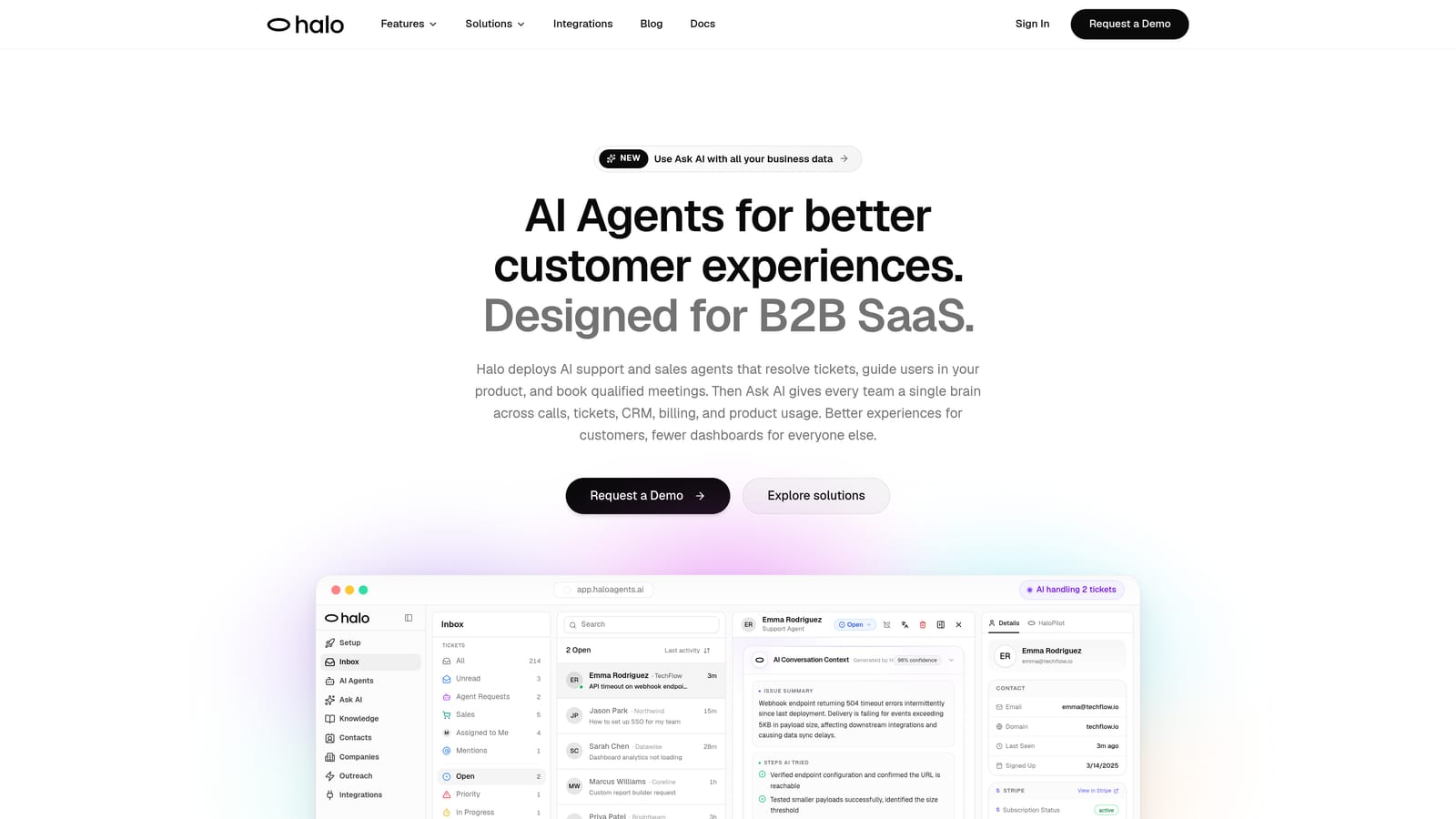
Halo AI is an AI-first customer support platform that deploys autonomous agents to resolve tickets, guide users through your product, and surface business intelligence signals — all without requiring you to bolt AI onto an existing helpdesk workflow.
Where This Tool Shines
What separates Halo from AI-layered helpdesks is the architecture. It's built AI-first, meaning autonomous resolution isn't a feature you toggle on — it's the foundation. The page-aware chat widget understands what a user is looking at inside your product and can provide visual UI guidance specific to that context, not generic answers pulled from a help center article.
Beyond ticket resolution, Halo's smart inbox surfaces business intelligence signals that most support tools ignore entirely: customer health indicators, revenue anomalies, and churn signals that your support conversations are already generating. That's genuinely useful for B2B teams where a single account can represent significant revenue.
Key Features
Autonomous AI Agents: Resolve routine tickets end-to-end without requiring human review, handling the full conversation lifecycle.
Page-Aware Chat Widget: Understands what the user sees inside your product and delivers contextual, visual UI guidance rather than generic help content.
Auto Bug Ticket Creation: Detects issues during support interactions and automatically creates bug tickets routed directly to Linear.
Smart Inbox with Business Intelligence: Surfaces customer health signals, revenue anomalies, and churn indicators from support conversation data.
Live Agent Handoff: Escalates complex issues to human agents with full conversation context preserved, so nothing gets repeated.
Integration Ecosystem: Connects with HubSpot, Intercom, Slack, Stripe, Zoom, PandaDoc, Fathom, and Linear out of the box.
Best For
B2B SaaS companies and product teams that want AI to do more than deflect tickets. If you're looking for a platform that learns from every interaction, integrates with your full business stack, and generates intelligence beyond support metrics, Halo is worth evaluating seriously. Less suited for teams that need to stay within an existing Zendesk or Freshdesk environment.
Pricing
Demo-first sales process; contact Halo directly for pricing. Visit haloagents.ai to book a discovery call.
2. Zendesk AI
Best for: Enterprise teams that want AI capabilities layered onto a proven, scalable helpdesk platform.
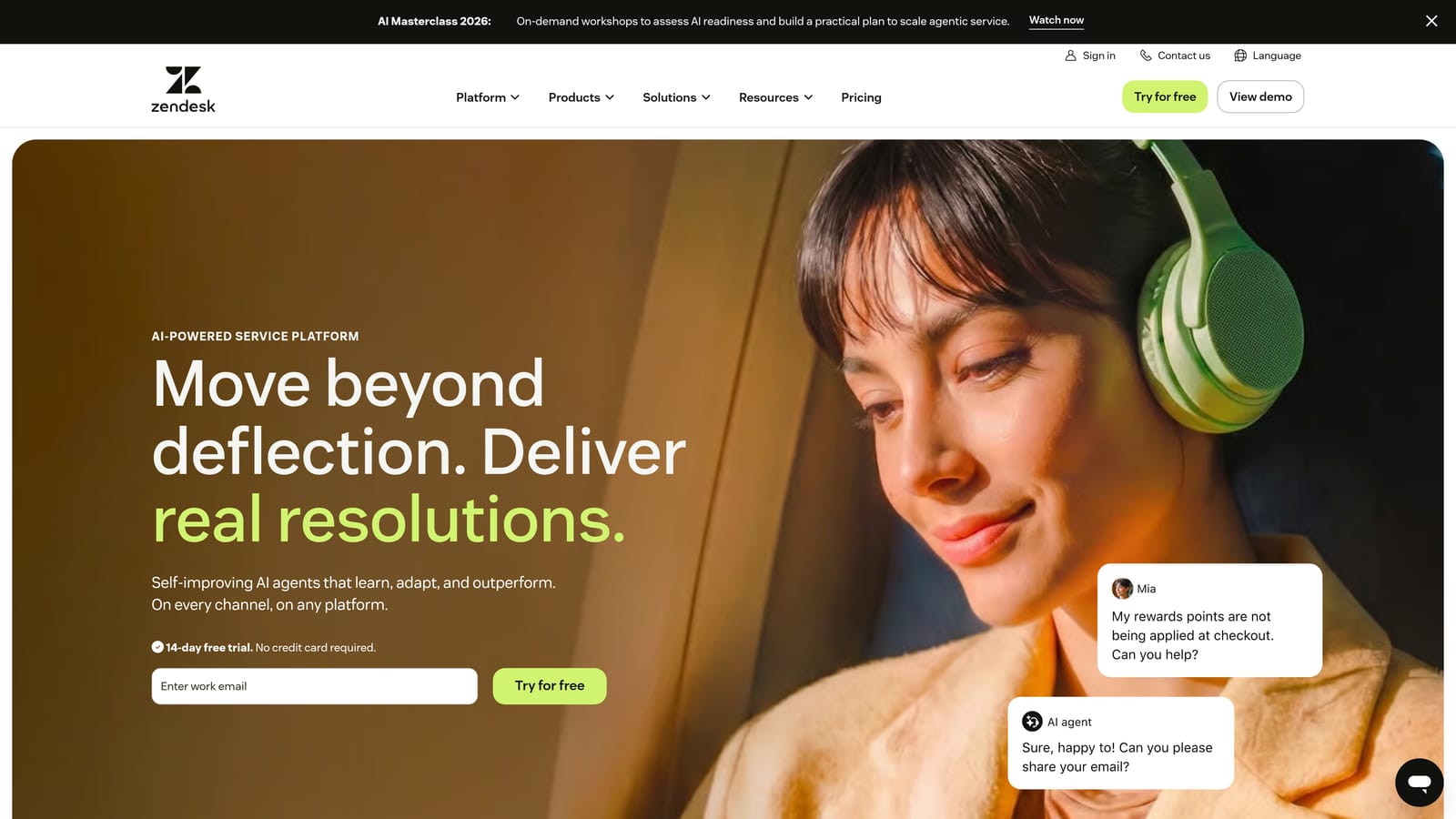
Zendesk is the industry-standard helpdesk platform, and its AI layer adds deflection bots, intelligent triage, and an agent copilot to its already mature ticket management infrastructure.
Where This Tool Shines
Zendesk's strength is its maturity. If your team already lives in Zendesk, the AI features slot in without a platform migration. Intelligent triage automatically classifies and routes incoming tickets, and Agent Copilot surfaces suggested replies and next-best-action recommendations so agents can move faster without starting from scratch.
The app marketplace is extensive, and enterprise-grade reporting gives large support organizations the visibility they need. That said, AI capability is more of an enhancement to the existing workflow than a ground-up autonomous resolution engine.
Key Features
AI Agents: Automated bots for first-line ticket deflection before queries reach human agents.
Intelligent Triage: Automatic ticket classification, prioritization, and routing based on content and context.
Agent Copilot: Suggested replies and next-best-action recommendations to speed up human agent responses.
Generative AI for Content: AI-assisted creation of macros, help center articles, and knowledge base content.
Enterprise Reporting: Robust analytics and an extensive app marketplace for customization at scale.
Best For
Enterprise support teams already invested in the Zendesk ecosystem, or organizations that need a proven platform with AI features rather than an AI-first architecture. Strong fit for high-volume support operations with complex routing requirements.
Pricing
Suite plans start at approximately $55/agent/month; AI add-ons are priced separately. Verify current pricing at zendesk.com.
3. Intercom (Fin AI Agent)
Best for: Chat-first support teams that want an AI agent handling full conversations, not just routing.
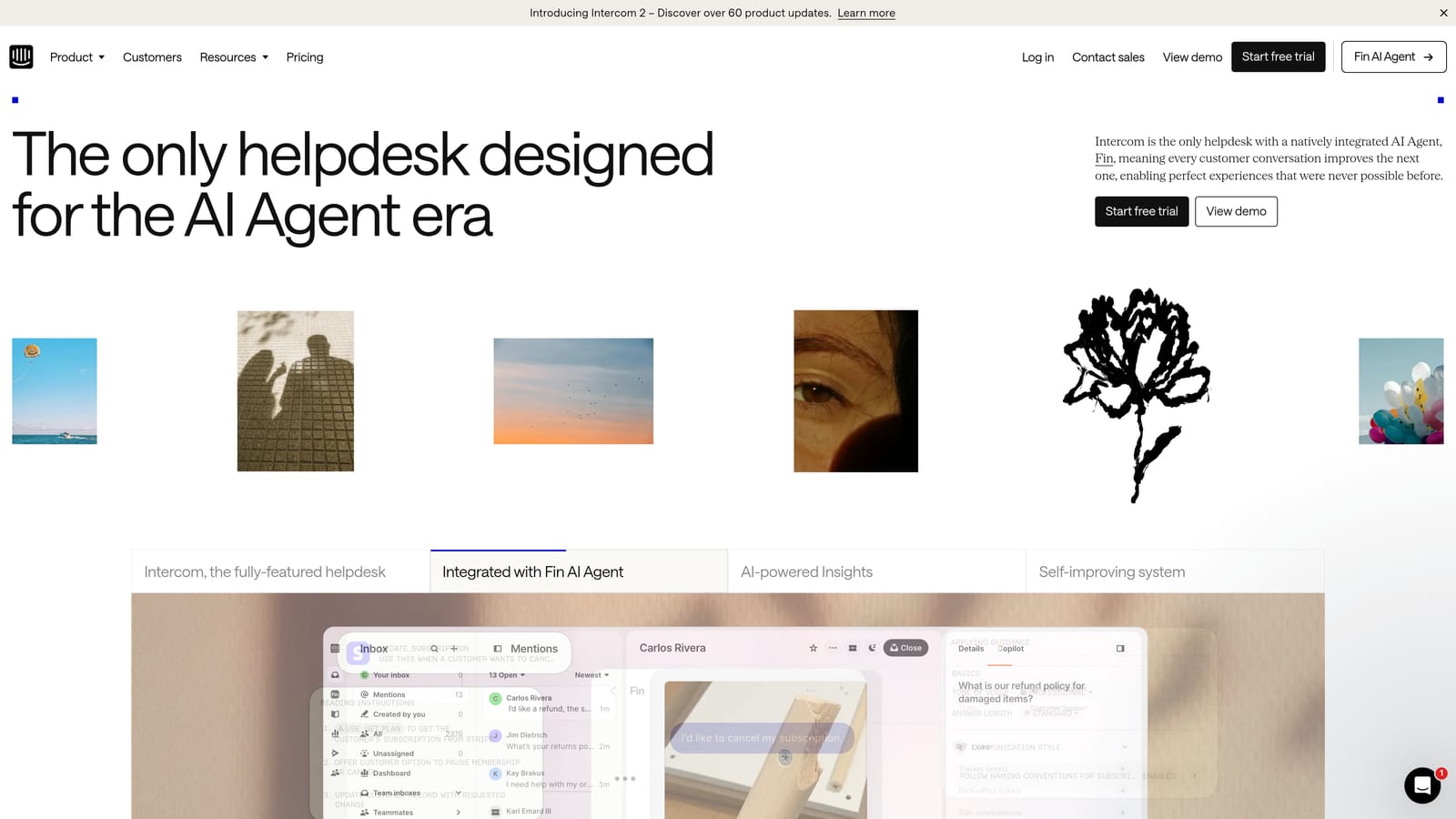
Intercom's Fin AI Agent handles complete support conversations autonomously, drawing on your knowledge base and connected data sources to resolve queries without requiring human intervention for a significant share of incoming volume.
Where This Tool Shines
Fin is one of the more capable conversational AI agents in the market. Rather than routing tickets or suggesting replies, it takes ownership of the full conversation: asking clarifying questions, pulling from help content, and resolving the query end-to-end. The per-resolution pricing model on some tiers aligns cost directly to value delivered, which is a refreshing change from per-seat pricing that charges you regardless of AI performance.
Handoff to human agents is smooth, with full conversation context preserved so customers don't have to repeat themselves. Omnichannel coverage across chat, email, and messaging platforms makes it versatile for teams supporting users across multiple touchpoints.
Key Features
Fin AI Agent: Handles complete conversations autonomously, not just first-touch deflection or routing suggestions.
Per-Resolution Pricing: Available pricing model that ties cost to actual resolutions delivered rather than seats.
Multi-Source Knowledge: Draws on help center content, PDFs, and connected data sources for accurate responses.
Contextual Handoff: Transfers to human agents with full conversation history intact.
Omnichannel Coverage: Supports chat, email, and messaging platforms from a single platform.
Best For
Teams that are already using Intercom for customer messaging and want to extend it with a capable AI agent. Also strong for companies prioritizing chat-first support workflows and looking for a per-resolution cost model.
Pricing
Fin AI Agent is available on a per-resolution basis; Intercom base plans start at approximately $29/seat/month. Verify current pricing at intercom.com.
4. Freshdesk (Freddy AI)
Best for: SMB and mid-market teams wanting a full AI suite at pricing that undercuts enterprise alternatives.
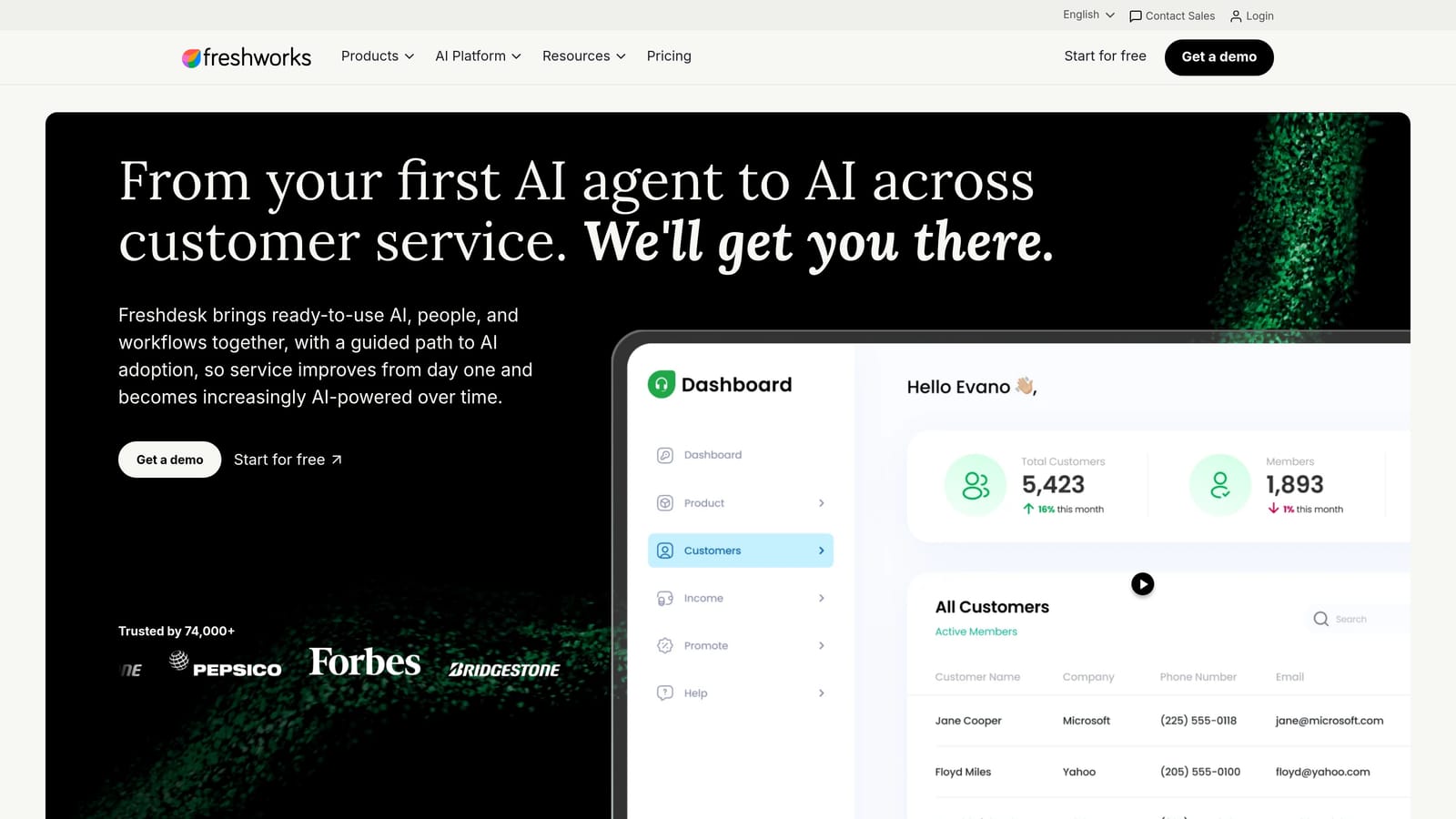
Freshdesk's Freddy AI spans autonomous bot resolution, agent copilot assistance, and analytics insights across a platform that consistently prices below comparable Zendesk tiers.
Where This Tool Shines
Freddy covers three distinct layers: Freddy AI Agent for autonomous first-line resolution, Freddy Copilot for in-conversation agent assistance, and Freddy Insights for trend detection and CSAT analysis. Getting all three in one platform at Freshdesk's price point makes it genuinely compelling for budget-conscious teams that don't want to choose between AI capability and affordability.
The free tier and low entry-level pricing also make it accessible for small teams testing AI support automation for the first time, with room to scale as volume grows.
Key Features
Freddy AI Agent: Autonomous first-line ticket resolution for common query types before escalation to human agents.
Freddy Copilot: Suggested replies, conversation summarization, and tone adjustment to speed up agent workflows.
Freddy Insights: Trend detection, CSAT analysis, and reporting to surface patterns in support volume and quality.
Omnichannel Support: Covers email, chat, phone, and social channels from a single platform.
Competitive Pricing: Free tier available with paid plans that undercut most enterprise alternatives at comparable feature sets.
Best For
SMB and mid-market support teams looking for a capable AI suite without enterprise pricing. Also a strong option for teams already in the Freshworks ecosystem (Freshsales, Freshservice) who want native integration across products.
Pricing
Free tier available; paid plans start at approximately $15/agent/month. Verify current pricing at freshdesk.com.
5. Help Scout
Best for: Teams that want AI to augment human agents rather than replace them, with a clean and fast-to-learn interface.
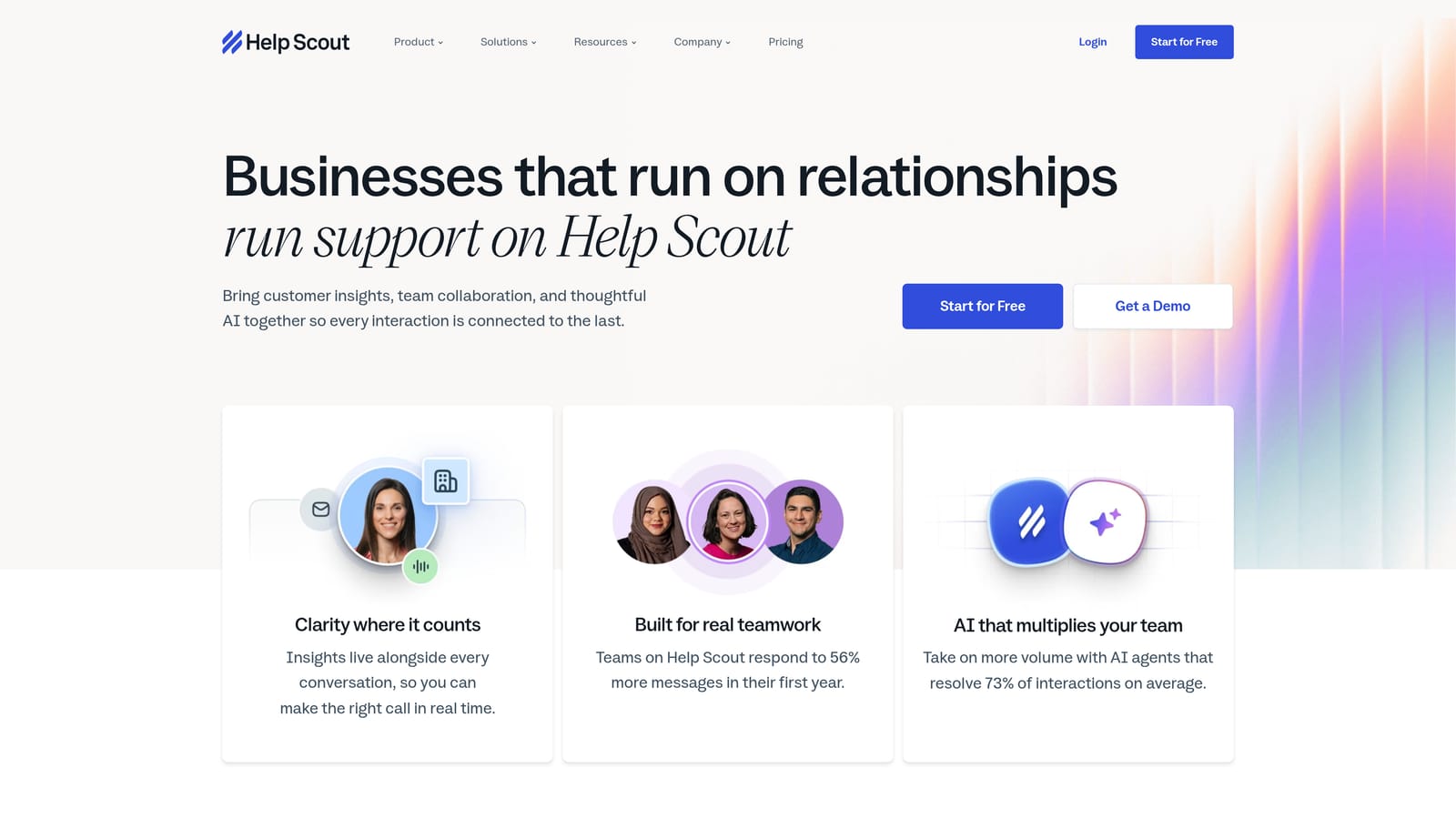
Help Scout is a human-centered support platform that has added AI features for drafting, summarization, and self-service deflection, built around the philosophy that great support still needs a human at the center.
Where This Tool Shines
Help Scout's AI additions are practical rather than ambitious. AI Summarize gives agents instant conversation context without reading through a long thread. AI Assist helps draft and refine replies faster. AI Answers deflects common queries through the Docs knowledge base before they reach the inbox. None of these replace agents; they make agents meaningfully faster.
The shared inbox is clean and well-designed, with collision detection that prevents two agents from responding to the same ticket simultaneously. Onboarding is fast, which matters for small teams that can't afford weeks of implementation work.
Key Features
AI Summarize: Instant conversation summaries so agents can pick up context without reading full threads.
AI Assist: Drafts and improves agent replies, reducing time spent on composition.
AI Answers: Self-service deflection through the Docs knowledge base before queries hit the inbox.
Shared Inbox: Collision detection and internal notes keep team coordination clean and transparent.
Fast Onboarding: Minimal setup time with an interface that agents can learn quickly without formal training.
Best For
Teams that value the human touch in customer support and want AI to make their agents faster rather than replace them. Particularly well-suited for companies where support quality is a brand differentiator and fully autonomous resolution isn't the goal.
Pricing
Plans start at approximately $20/user/month. Verify current pricing at helpscout.com.
6. Tidio (Lyro AI)
Best for: Small businesses and e-commerce teams that want AI support up and running in hours, not weeks.
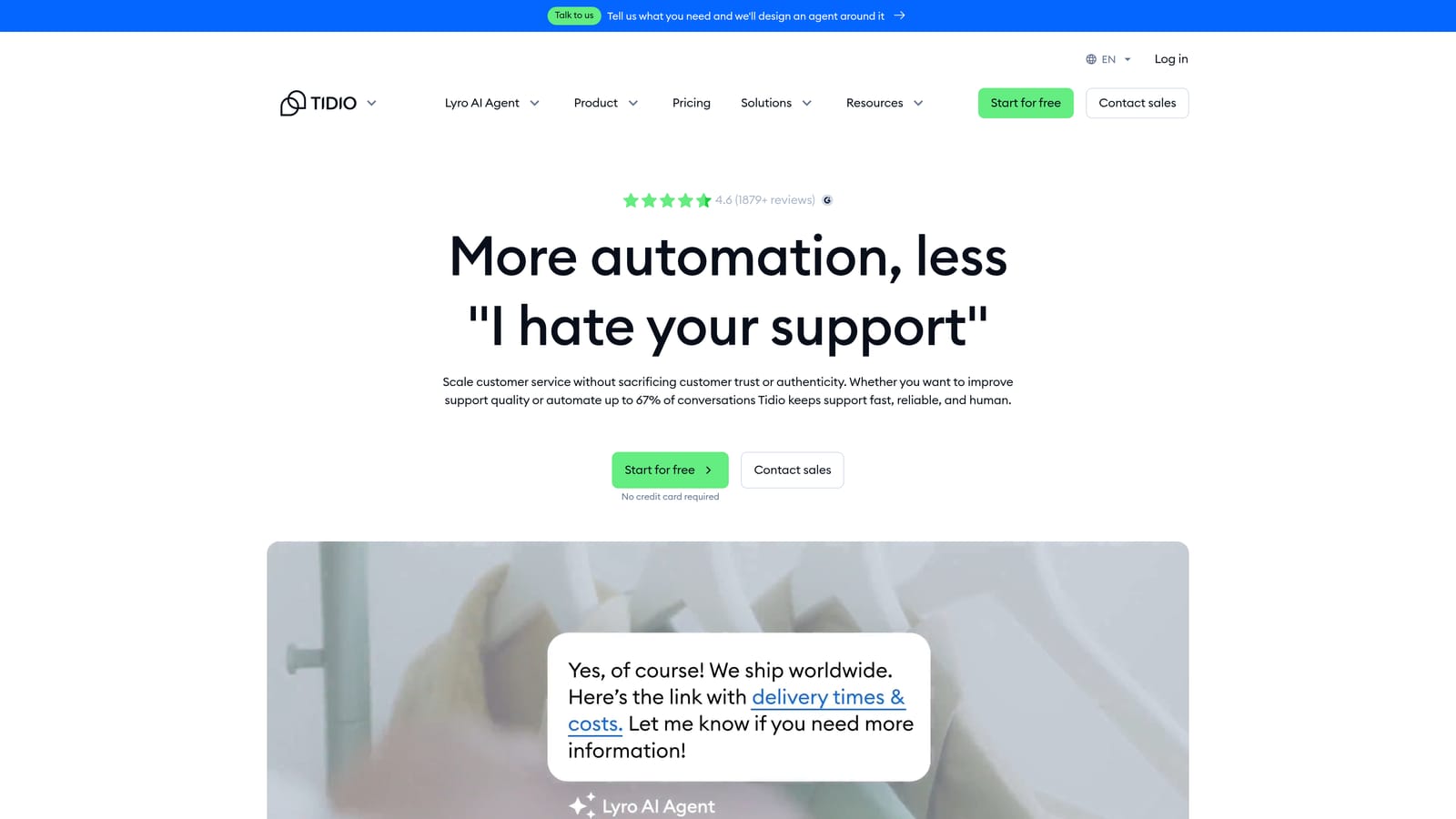
Tidio's Lyro AI agent resolves customer queries using your existing knowledge base content with minimal setup, making it one of the fastest AI support tools to deploy for teams without dedicated implementation resources.
Where This Tool Shines
Speed to value is Lyro's defining characteristic. Connect your knowledge base or FAQ content, and Lyro can start resolving queries almost immediately. There's no complex training process or lengthy configuration required. For small teams that need AI support capability without an IT project, that's a meaningful advantage.
When Lyro can't resolve a query, it falls back to live chat with a human agent smoothly. E-commerce integrations with Shopify and WooCommerce make it a natural fit for online retail teams handling high volumes of repetitive order and shipping questions.
Key Features
Lyro AI Agent: Resolves conversations autonomously using FAQ and knowledge base content with minimal configuration.
Fast Deployment: Connect knowledge content and go live quickly without lengthy implementation timelines.
Live Chat Fallback: Smooth handoff to human agents when AI cannot resolve a query confidently.
E-Commerce Integrations: Native connections to Shopify and WooCommerce for retail-specific support workflows.
Affordable Entry Pricing: Accessible price point designed for small business budgets.
Best For
Small businesses, e-commerce merchants, and teams that need AI support capability without a complex deployment process. Less suited for enterprise B2B teams with complex integration requirements or the need for deep business intelligence from support data.
Pricing
Free tier available; Lyro AI plans start at approximately $29/month. Verify current pricing at tidio.com.
7. Salesforce Service Cloud (Einstein AI)
Best for: Enterprise teams operating within the Salesforce ecosystem who need support and CRM context unified in one place.
Salesforce Service Cloud with Einstein AI brings case classification, routing intelligence, and generative AI capabilities to enterprise support teams that are already deeply embedded in the Salesforce platform.
Where This Tool Shines
The core advantage here is CRM context. When a support agent opens a case, they're looking at the full Salesforce account record: deal history, contract value, open opportunities, and every prior interaction across sales and support. Einstein AI layers on top of that with automatic case classification, intelligent routing, and generative AI for drafting replies and creating knowledge articles.
For enterprise organizations where support and sales are tightly connected, that unified context is genuinely difficult to replicate with a standalone support tool. The trade-off is complexity and cost, particularly for teams that aren't already in the Salesforce ecosystem.
Key Features
Einstein Case Classification: Automatic case categorization and intelligent routing based on content and account context.
Generative AI for Agents: AI-drafted reply suggestions and knowledge article creation to accelerate agent workflows.
Full CRM Integration: Support agents see complete sales and account history alongside every case, with no context switching.
Einstein Bots: Self-service deflection across channels before cases reach human agents.
Enterprise Compliance: Robust security, audit capabilities, and compliance features for regulated industries.
Best For
Large enterprise teams already invested in Salesforce CRM where unified sales-and-support context is a priority. Not the right fit for teams outside the Salesforce ecosystem due to implementation complexity and cost.
Pricing
Starter plans begin at approximately $25/user/month; Einstein AI features require higher tiers. Verify current pricing at salesforce.com.
8. Kustomer
Best for: Consumer brands handling high-volume omnichannel support across messaging and social channels.
Kustomer is a CRM-first support platform owned by Meta, built around a unified customer timeline that aggregates every interaction across channels into a single view for agents and AI alike.
Where This Tool Shines
The unified customer timeline is Kustomer's strongest differentiator. Rather than treating each ticket as an isolated event, Kustomer shows agents every prior conversation, purchase, and interaction in a single chronological view. AI intent detection and automated workflow routing then work on top of that full context, which improves accuracy compared to systems that only see the current conversation.
For consumer brands with strong messaging and social support channels, the Meta ecosystem connection and WhatsApp integration are practical advantages. AI-suggested replies and conversation summaries keep agents moving efficiently even at high volumes.
Key Features
Unified Customer Timeline: Every interaction across all channels aggregated into a single chronological view per customer.
AI Intent Detection: Automatic identification of query intent and routing to the appropriate workflow or agent.
AI-Suggested Replies: Recommended responses and conversation summaries to accelerate agent handling time.
Omnichannel Messaging: Strong coverage across social messaging, WhatsApp, email, and chat.
Meta Ecosystem Integration: Ownership by Meta provides native advantages for brands heavily invested in Facebook and Instagram channels.
Best For
Consumer brands managing high-volume support across messaging and social channels, particularly those with meaningful Facebook or Instagram customer interaction. Less suited for B2B SaaS teams whose support needs center on technical product questions rather than transactional consumer queries.
Pricing
Plans start at approximately $89/user/month. Verify current pricing at kustomer.com.
9. Gorgias
Best for: E-commerce merchants, particularly Shopify stores, that need AI resolving order and shipping queries using live store data.
Gorgias is purpose-built for e-commerce support, with an AI Agent that resolves tickets using live order, shipping, and return data pulled directly from Shopify and other e-commerce platforms.
Where This Tool Shines
Gorgias solves a specific problem exceptionally well: the enormous volume of repetitive order-related queries that e-commerce teams face. Where is my order? Can I return this? What's my tracking number? Gorgias AI Agent answers these autonomously using real-time data from your store, not static knowledge base content. That's a meaningful difference when order status changes by the hour.
The revenue statistics feature links support interactions to conversion impact, which helps e-commerce teams make the case internally that support quality drives revenue, not just cost. Automation rules handle tagging, routing, and ticket closure for common patterns without requiring AI involvement at all.
Key Features
AI Agent for E-Commerce: Resolves order, return, and shipping queries autonomously using live store data rather than static content.
Deep Shopify Integration: Live order data surfaces directly within every ticket for AI and human agents alike.
Revenue Statistics: Links support interactions to conversion and revenue impact for business case visibility.
Automation Rules: Tagging, routing, and ticket closure automation for high-frequency query patterns.
Multi-Platform E-Commerce Support: Integrations with WooCommerce, Magento, BigCommerce, and major e-commerce apps beyond Shopify.
Best For
Shopify merchants and e-commerce teams handling high volumes of transactional support queries. Not designed for B2B SaaS or service businesses whose support needs don't center on order management and retail workflows.
Pricing
Plans start at approximately $10/month for small ticket volumes, scaling with usage. Verify current pricing at gorgias.com.
Which Tool Is Right for Your Team?
The right choice depends less on feature lists and more on where your team sits today and where you want to go. Here's a quick breakdown by use case.
AI-first autonomous resolution: Halo AI or Intercom Fin. Both are built around the idea that AI should close tickets, not just suggest responses.
Enterprise helpdesk with AI layers: Zendesk AI or Salesforce Service Cloud Einstein. Strong infrastructure and compliance, with AI added progressively on top.
SMB and mid-market on a budget: Freshdesk Freddy or Tidio Lyro. Capable AI at pricing that doesn't require an enterprise budget to justify.
E-commerce focused: Gorgias. Nothing else on this list matches its depth of integration with live store data for order-related queries.
Human-first with AI assist: Help Scout. If your brand depends on the quality of human interaction, this augments rather than replaces.
Omnichannel consumer brands: Kustomer. The unified timeline and Meta ecosystem advantages are real differentiators for high-volume messaging support.
Before committing to any platform, ask three questions: Does this tool resolve tickets autonomously or just suggest responses? How does it handle edge cases and escalations? Does it integrate with your existing stack without heavy implementation work?
If you're a B2B SaaS team looking for an AI-first platform that goes beyond deflection — surfacing business intelligence, creating bug reports automatically, and learning from every interaction — Halo AI is worth a closer look. Your support team shouldn't scale linearly with your customer base. Let AI agents handle routine tickets, guide users through your product, and surface business intelligence while your team focuses on complex issues that need a human touch. See Halo in action and discover how continuous learning transforms every interaction into smarter, faster support.