9 Best AI Support Tools for Teams in 2026
This guide ranks the 9 Best AI Support Tools For Teams in 2026, evaluating each platform on autonomous resolution capability, integration depth, ease of deployment, and scalability — so whether you run a lean startup or a high-volume B2B operation, you can find the right fit without the guesswork.
 Matt PattoliFounder13 min read
Support teams are drowning in repetitive tickets while customers expect instant answers. AI support tools have shifted from novelty to necessity, but the market is crowded, and not every platform delivers on its promises.
This list cuts through the noise. We evaluated tools on autonomous resolution capability, integration depth, ease of deployment, and how well they scale without adding headcount. Whether you're running a lean startup support team or managing a high-volume B2B operation, there's a tool here that fits.
We've included Halo AI at #1 because it's our product and genuinely the strongest fit for B2B SaaS teams, but every tool on this list earns its place on merit. Let's get into it.
1. Halo AI
Best for: B2B SaaS teams that want AI-first support with deep business intelligence built in.
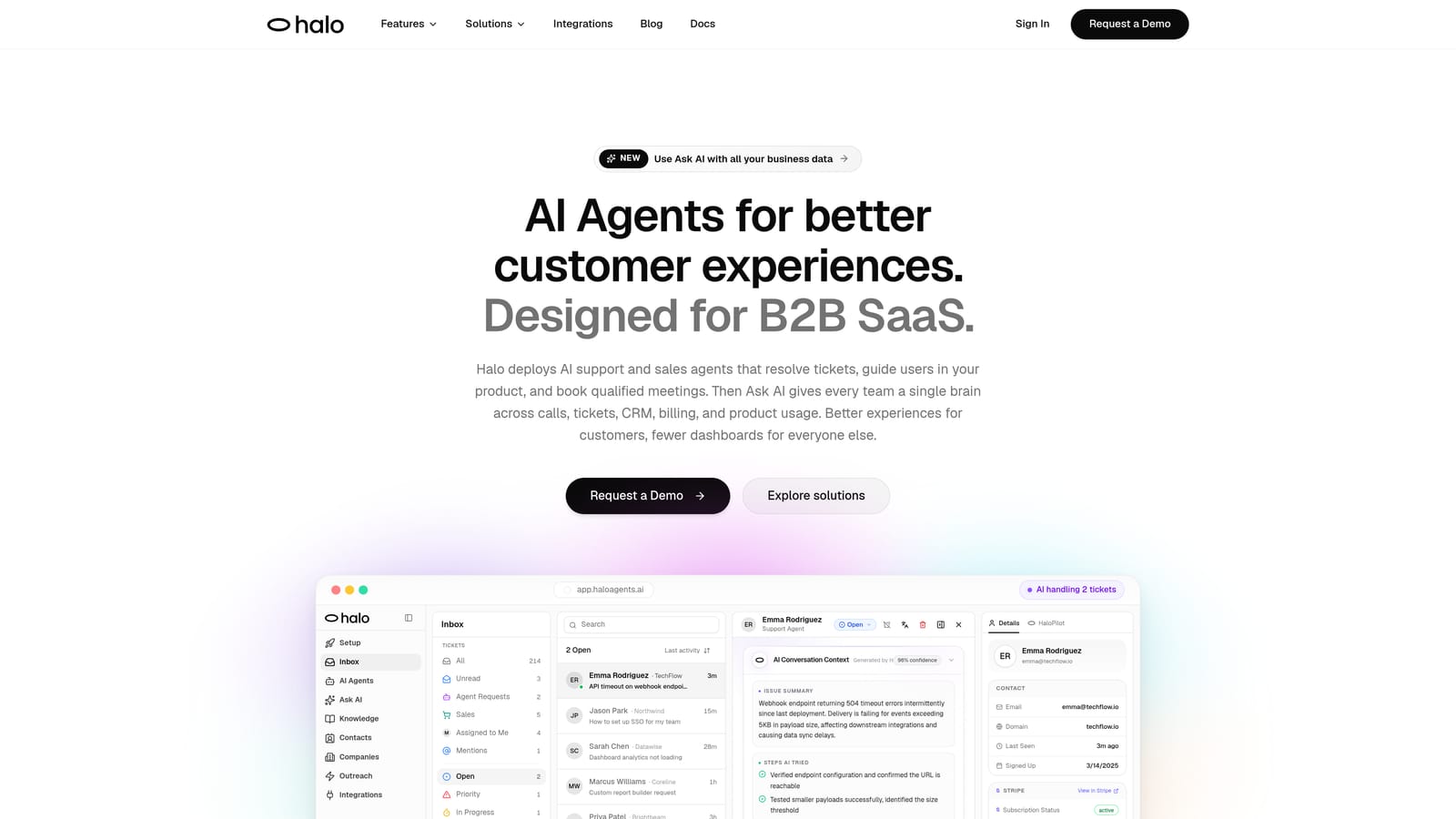
Halo AI is an AI-first customer support platform built from the ground up for B2B SaaS teams, combining autonomous ticket resolution with page-aware agents and business intelligence analytics.
Where This Tool Shines
Most AI support tools answer questions. Halo understands context. The page-aware chat widget sees exactly what a user is looking at on-screen, which means it can provide step-by-step visual guidance rather than generic help center responses. For SaaS products with complex UIs, this is a meaningful difference.
The other standout is what Halo does beyond support. The smart inbox surfaces customer health signals, revenue anomalies, and churn indicators alongside ticket data. Your support queue becomes an intelligence layer for the whole business, not just a queue to clear.
Key Features
Page-Aware Chat Widget: The agent sees what users see on-screen, enabling precise contextual guidance rather than generic responses.
Autonomous Ticket Resolution: AI agents resolve tickets end-to-end with continuous learning from every interaction, improving accuracy over time.
Auto Bug Ticket Creation: Detected issues are automatically routed as bug tickets directly to Linear, closing the loop between support and engineering.
Smart Inbox with Business Intelligence: Surfaces customer health signals, revenue anomalies, and churn indicators alongside standard ticket metrics.
Live Agent Handoff: Complex issues escalate to humans with full conversation context preserved, so agents never start from scratch.
Deep Integrations: Connects with Linear, Slack, HubSpot, Stripe, Zoom, PandaDoc, Fathom, and Intercom, covering the full B2B SaaS stack.
Best For
B2B SaaS companies that want more than deflection metrics. Halo is particularly well-suited for product-led growth teams where support touches onboarding, retention, and revenue, and where connecting support signals to business outcomes matters as much as resolution speed.
Pricing
Contact for pricing, tailored to team size and usage. Given the business intelligence layer and deep integration set, this is positioned as a strategic platform investment rather than a per-seat helpdesk tool.
2. Intercom
Best for: Teams already in the Intercom ecosystem that want conversational AI with strong workflow design tools.
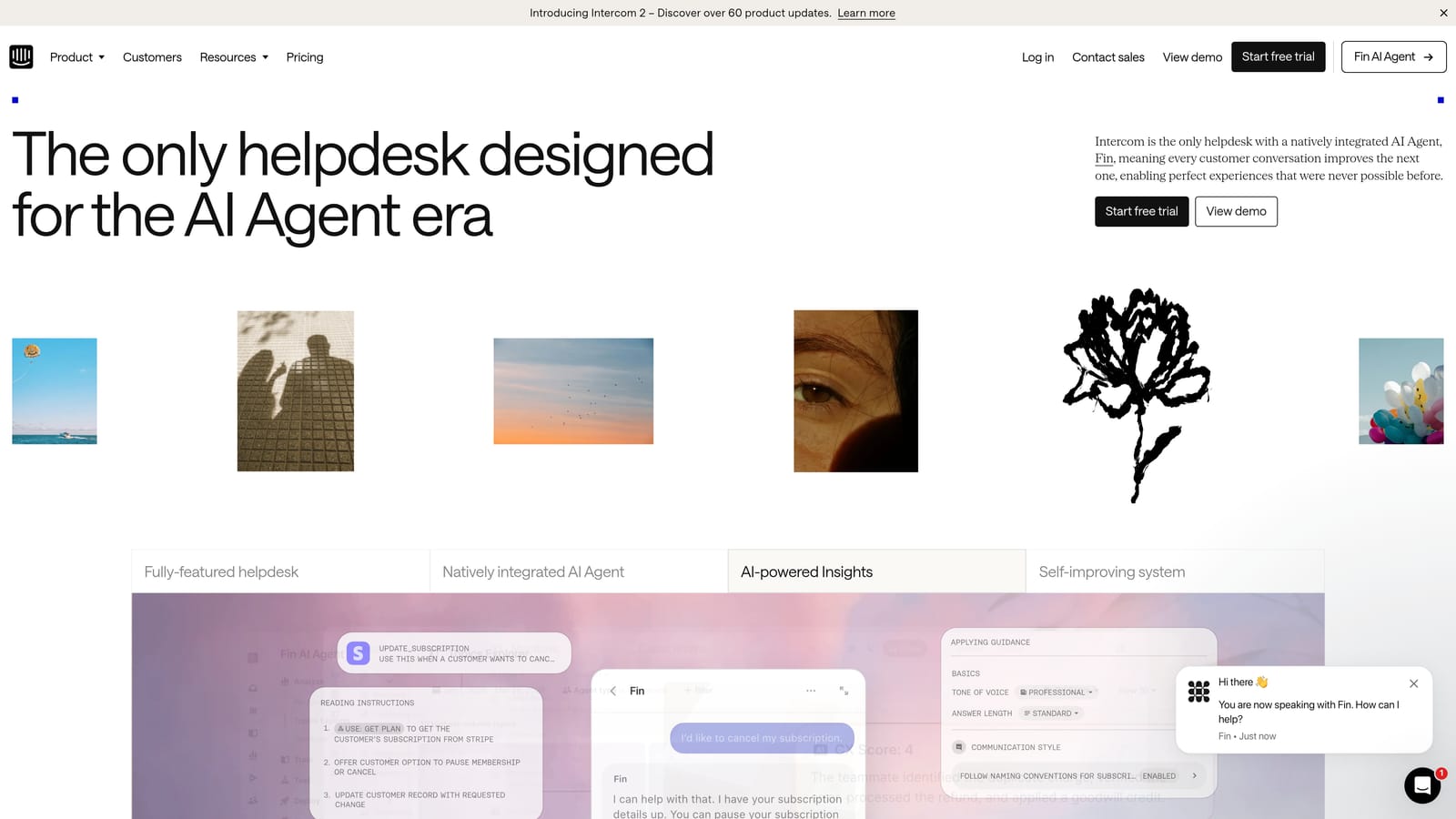
Intercom is a long-established conversational support platform with a capable AI agent called Fin that resolves queries from help center content using large language models.
Where This Tool Shines
Fin AI has matured considerably since its launch. It handles multi-turn conversations with reasonable accuracy and integrates naturally into Intercom's broader workflow builder, making it relatively straightforward to design escalation paths and proactive messaging sequences alongside your automation.
The conversation design tooling is genuinely strong. If your team thinks carefully about customer journey stages and wants to build nuanced flows, Intercom gives you the canvas to do it. The omnichannel inbox covering chat, email, and social is also well-executed.
Key Features
Fin AI Agent: LLM-powered agent that resolves queries conversationally from your help center content without manual rule-building.
Workflow Builder: Visual conversation design tools for building escalation paths, routing logic, and proactive messaging sequences.
Omnichannel Inbox: Unified inbox covering live chat, email, and social channels for agents.
Proactive Messaging and Product Tours: Reach customers in-app before they submit a ticket, reducing inbound volume proactively.
Reporting and CSAT Tracking: Built-in conversation analytics and customer satisfaction scoring.
Best For
Teams already invested in the Intercom ecosystem, or those that prioritize polished conversation design and proactive engagement alongside reactive support automation. Less suited to teams that need deep CRM or engineering tool integrations out of the box.
Pricing
Starts at approximately $39/seat/month. Fin AI resolution is charged per resolution on higher plans, so costs can scale quickly with volume. Worth modeling your expected resolution rate before committing.
3. Zendesk AI
Best for: Enterprise organizations with complex workflows, large agent teams, and existing Zendesk infrastructure.
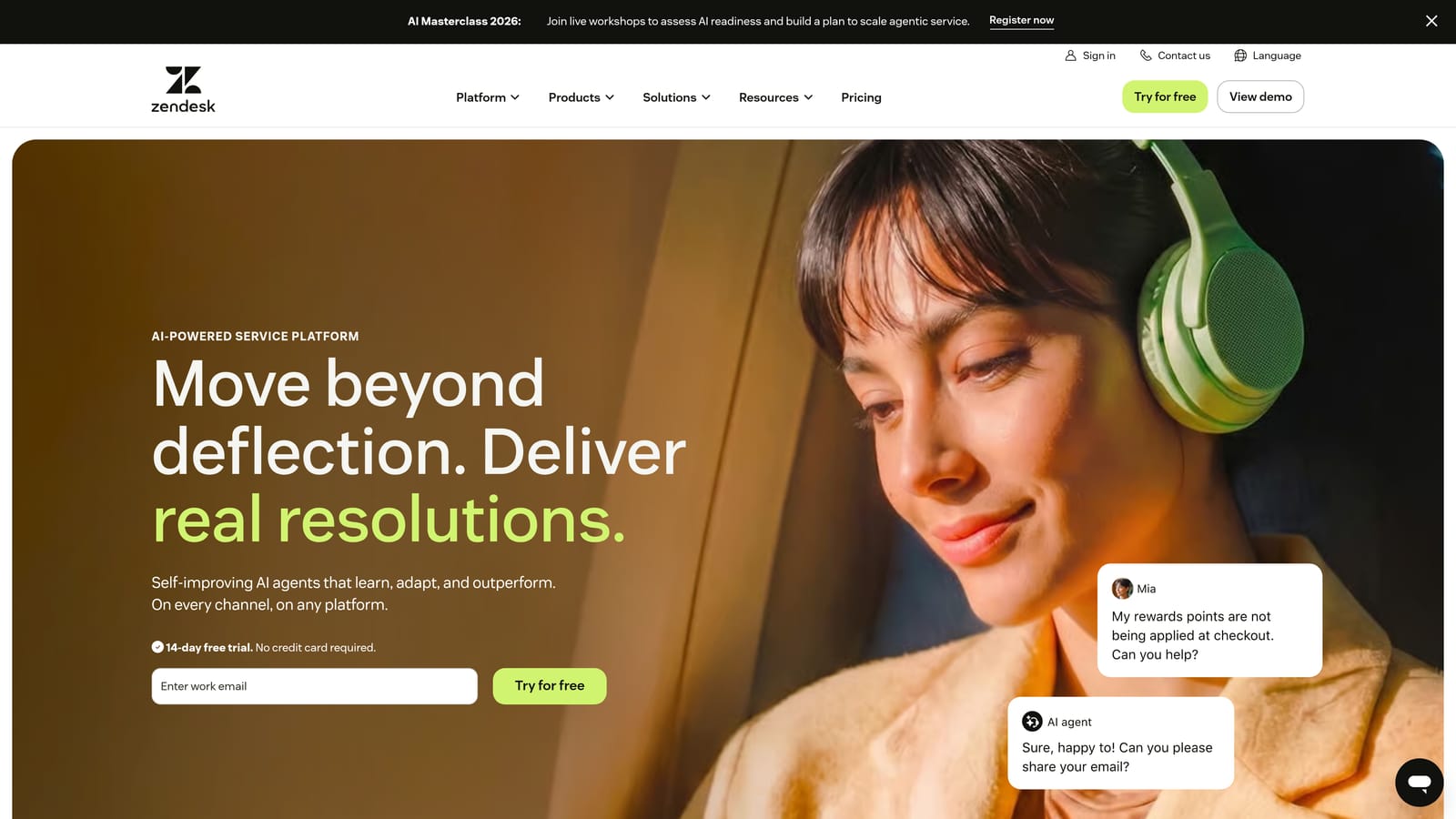
Zendesk is the incumbent enterprise helpdesk, with an AI suite covering intelligent triage, ticket summarization, suggested responses, and a full bot builder layered on top of its established platform.
Where This Tool Shines
Zendesk's depth is its biggest advantage. The reporting and analytics suite is genuinely industry-leading, and the marketplace of over 1,000 integrations means it connects to almost anything your organization already uses. For large teams with complex routing logic and compliance requirements, the infrastructure is battle-tested.
The AI features, including intent detection for triage, AI-generated ticket summaries, and agent assist suggestions, are solid additions to an already mature platform. The caveat is that the AI layer can feel bolted on rather than native, particularly compared to AI-first platforms built around automation from day one.
Key Features
Intelligent Triage and Routing: AI detects intent and sentiment to route tickets to the right team or queue automatically.
AI-Generated Summaries and Agent Assist: Agents get instant ticket context and suggested replies without reading full threads.
Advanced Bot Builder: Conversational AI bot with branching logic for self-service deflection before tickets reach agents.
Industry-Leading Reporting: Deep analytics covering resolution times, agent performance, CSAT, and custom metrics.
1,000+ Integration Marketplace: Connects to virtually every business tool an enterprise organization uses.
Best For
Enterprise support operations with large agent teams, established Zendesk workflows, and a need for deep reporting. Less compelling for teams starting fresh who want AI-native architecture rather than AI added to a legacy platform.
Pricing
Suite plans start at approximately $55/agent/month. AI features require higher-tier plans, so the effective cost for full AI capability sits meaningfully above the entry price.
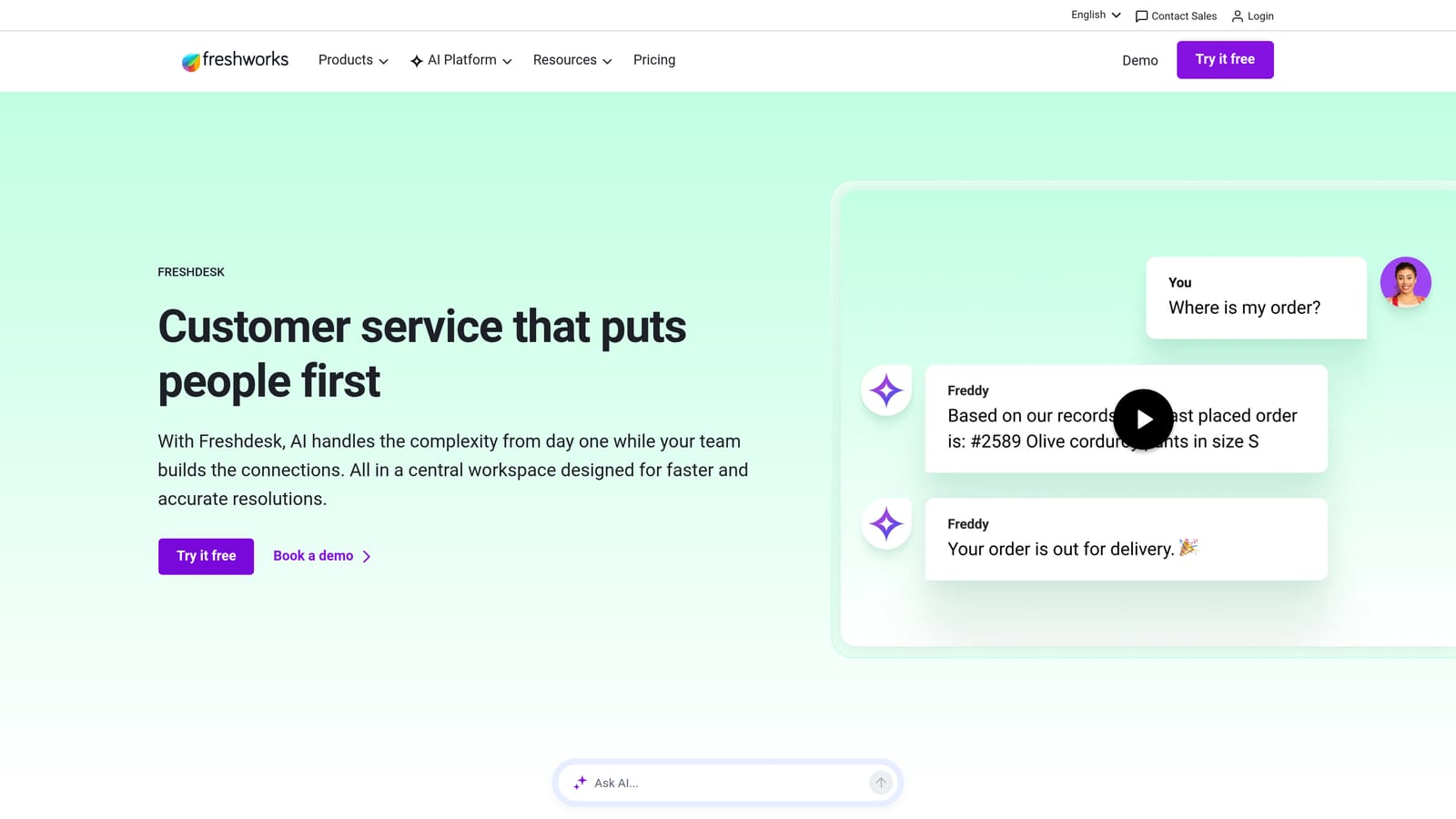
4. Freshdesk (Freddy AI)
Best for: SMBs and mid-market teams that want Zendesk-comparable features at a lower price point.
Freshdesk is a well-rounded helpdesk with the Freddy AI suite handling self-service deflection, agent assist, and analytics across a genuinely competitive omnichannel feature set.
Where This Tool Shines
Freshdesk's strongest argument is value. The Freddy AI suite covers deflection, agent assistance, and analytics at price points that make Zendesk look expensive for teams that don't need enterprise-grade complexity. Freddy Insights, in particular, surfaces anomalies and trends that help support managers make faster decisions without building custom reports.
The omnichannel coverage is broad, including email, chat, phone, and social, which matters for teams that support customers across multiple channels without wanting separate tools for each.
Key Features
Freddy Self Service: AI-powered chatbot for deflection that handles common queries before they reach agents.
Freddy Copilot: Agent-facing assist with suggested replies, ticket summarization, and knowledge retrieval.
Freddy Insights: AI-driven analytics that surfaces anomalies, trends, and actionable recommendations from ticket data.
Omnichannel Coverage: Unified inbox across email, chat, phone, and social channels.
Competitive Pricing: Comparable feature depth to Zendesk at a lower per-agent cost, particularly at mid-market scale.
Best For
SMBs and mid-market teams that need solid omnichannel coverage and AI assist features without enterprise pricing. Also a good fit for teams migrating off spreadsheets or basic ticketing tools who want room to grow.
Pricing
Free plan available for small teams. Paid plans start at approximately $15/agent/month. AI features unlock on higher tiers, so factor that into your comparison.
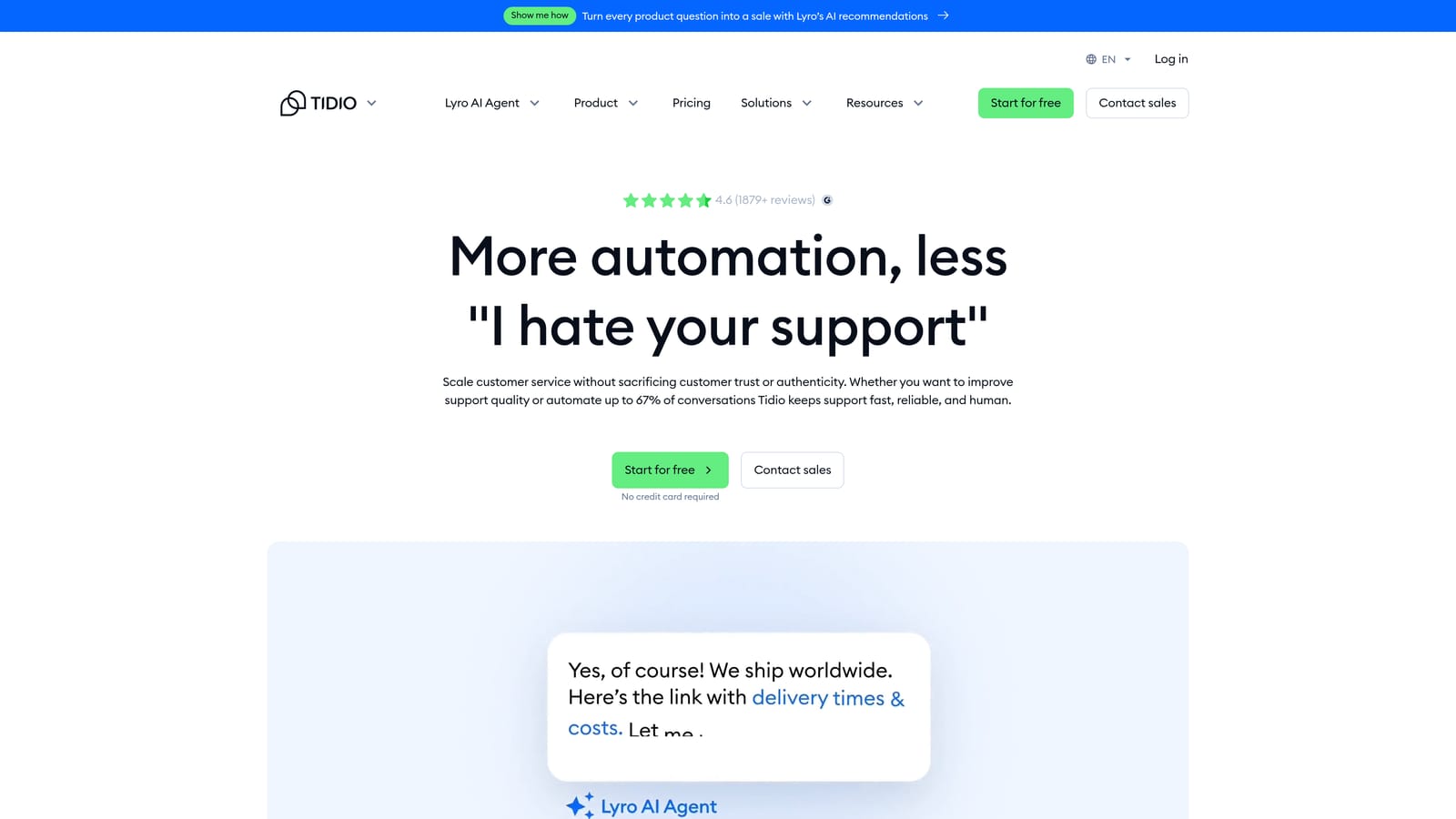
5. Tidio
Best for: Small teams and startups that need fast deployment and an affordable entry point for AI chat.
Tidio is a lightweight AI chat and ticketing platform built around its Lyro AI chatbot, designed for quick no-code deployment by teams that can't afford weeks of implementation time.
Where This Tool Shines
Speed to value is Tidio's defining quality. Lyro AI can be set up without technical resources and starts handling conversational support almost immediately. For a startup or small e-commerce team that needs something running this week, that matters more than deep enterprise feature sets.
The combination of live chat and ticketing in a single interface also reduces tool sprawl for lean teams. It's not trying to be everything, and that focus shows in how approachable the product is for non-technical operators.
Key Features
Lyro AI Chatbot: Conversational AI with no-code setup that handles support queries without requiring engineering involvement.
Combined Live Chat and Ticketing: Unified interface for both real-time chat and asynchronous ticket management.
E-Commerce Integrations: Native connections to Shopify and WooCommerce for order-aware support responses.
Visitor Tracking and Proactive Triggers: Identify high-intent visitors and initiate conversations before they bounce.
Affordable Entry Pricing: Accessible to teams with limited budgets who are just beginning to automate support.
Best For
Small teams, early-stage startups, and e-commerce operators that need quick deployment and affordable AI chat. Teams with complex B2B workflows or deep integration requirements will likely outgrow it.
Pricing
Free plan available. Lyro AI starts at approximately $29/month and scales with conversation volume, making it one of the more accessible entry points on this list.
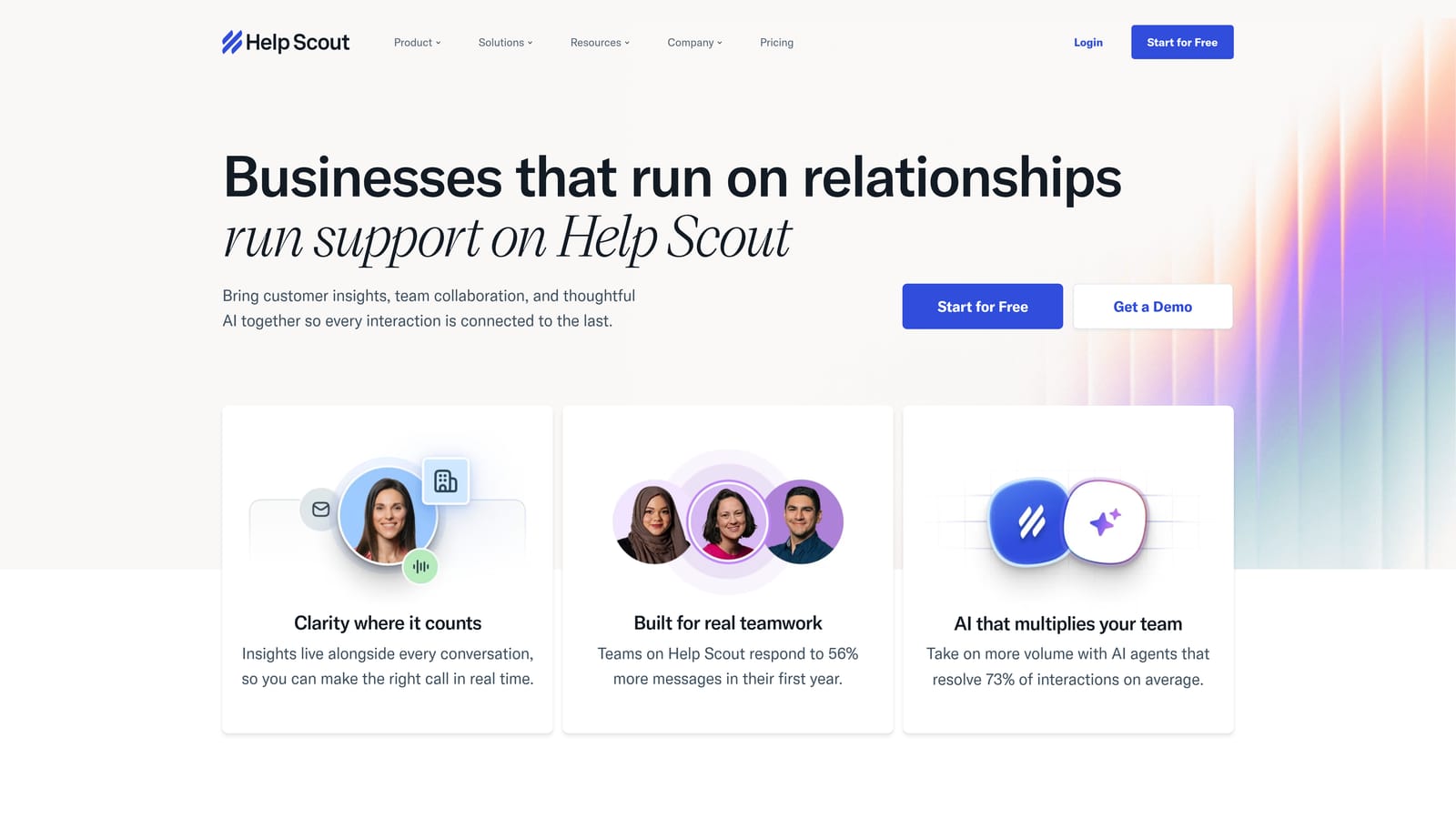
6. Help Scout
Best for: Teams that want AI to assist agents rather than replace them, with a focus on relationship quality.
Help Scout is a human-centered support platform that uses AI to make agents faster and more effective, rather than routing customers to bots as the primary experience.
Where This Tool Shines
Help Scout's philosophy is genuinely different from most tools on this list. AI Summarize gives agents instant context on any thread without reading the full history. AI Drafts suggests replies that agents review and send, keeping a human in the loop on every response. For brands where tone and relationship quality are non-negotiable, this approach reduces the risk of AI responses feeling off-brand.
The Docs knowledge base builder and Beacon chat widget are also well-regarded, offering a clean self-service layer that complements the agent experience without being the centerpiece.
Key Features
AI Summarize: Instant ticket context generated from full conversation history, so agents can respond quickly without reading everything.
AI Drafts: Suggested replies for agents to review, edit, and send, keeping humans in control of every customer interaction.
Docs Knowledge Base: Clean, searchable knowledge base builder integrated with the Beacon chat widget for self-service.
Shared Inbox UX: Thoughtfully designed agent interface that prioritizes clarity and reduces cognitive load.
Human-First Philosophy: AI assists agents rather than replacing them, preserving relationship quality at scale.
Best For
Teams where brand voice and customer relationship quality are priorities, particularly in professional services, SaaS, or any context where an impersonal bot response would damage trust. Not the right fit for teams that need high autonomous resolution rates.
Pricing
Starts at approximately $22/user/month on the Standard plan. AI features are included on paid plans, which is a cleaner pricing model than tools that charge separately per AI resolution.
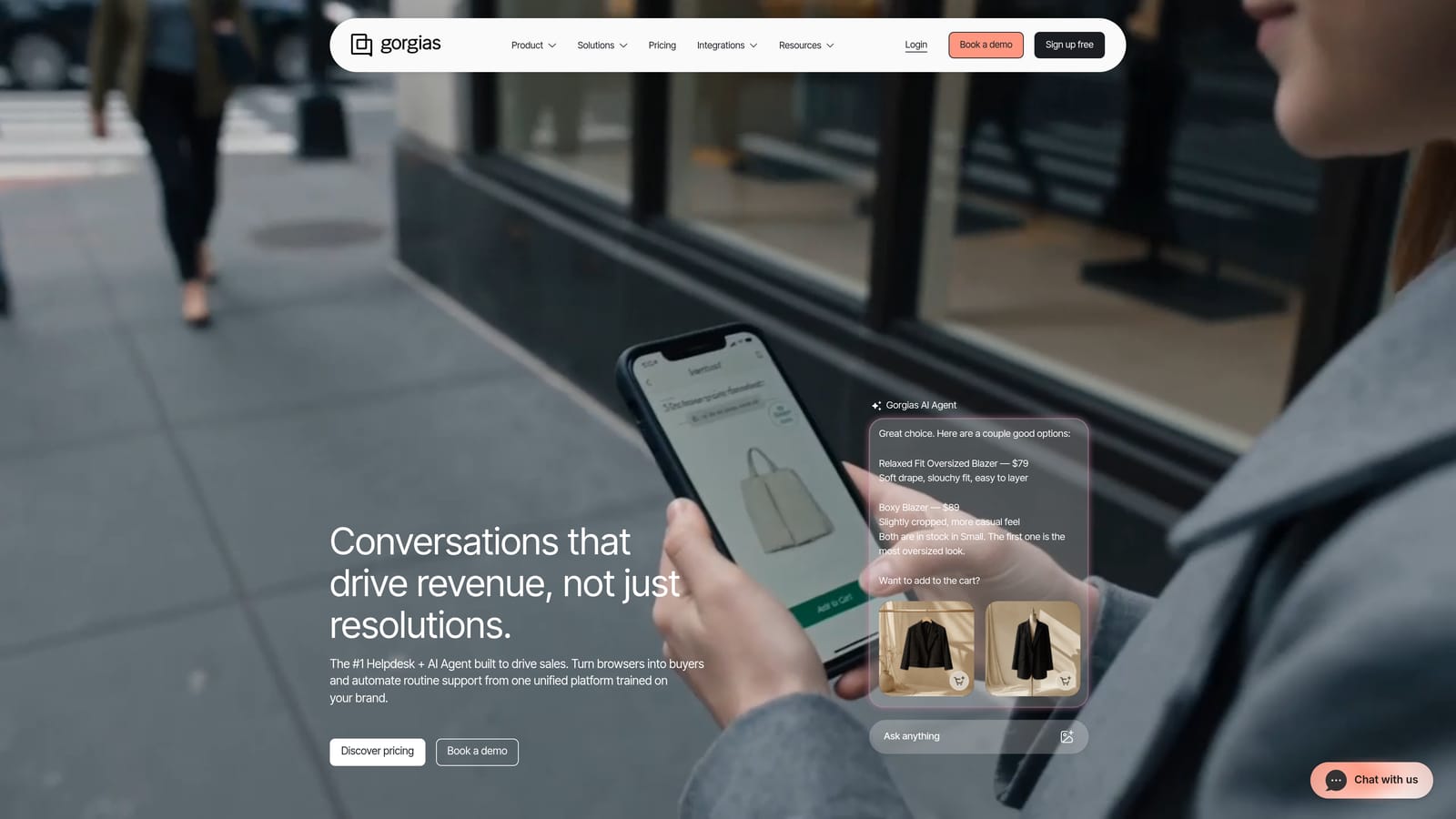
7. Gorgias
Best for: Direct-to-consumer e-commerce brands with high repetitive query volume around orders, returns, and shipping.
Gorgias is an e-commerce-native support platform built around deep Shopify, WooCommerce, and Magento integrations, with AI auto-responses designed specifically for commerce-specific support patterns.
Where This Tool Shines
If your support queue is dominated by "where's my order," "how do I return this," and "why was I charged twice," Gorgias is purpose-built for exactly that. The AI agents have direct access to order data, shipping status, and return policies, which means they can resolve these queries end-to-end without a human touching the ticket.
The revenue statistics feature is a nice differentiator: it links support interactions to sales outcomes, helping teams demonstrate the commercial value of good support rather than just measuring resolution times.
Key Features
Deep Commerce Integrations: Native Shopify, WooCommerce, and Magento connections that surface order data directly inside tickets.
AI Auto-Responses: Automated resolution for high-volume commerce intents including order status, returns, and shipping inquiries.
Automation Rules and Macros: Configurable rules for handling repetitive patterns without AI involvement where simpler automation suffices.
Revenue Statistics: Links support interactions to sales data, showing the commercial impact of support quality.
Omnichannel Coverage: Handles email, chat, social, and SMS from a unified inbox.
Best For
DTC and e-commerce brands running on Shopify or WooCommerce with high repetitive query volume. Significantly less useful outside of an e-commerce context, so B2B SaaS teams should look elsewhere.
Pricing
Starts at approximately $10/month for the Starter plan covering 50 tickets. Pricing scales by ticket volume rather than per seat, which works well for small teams with predictable query patterns.
8. Kustomer
Best for: Customer-obsessed brands that want support and CRM unified, with AI operating on full relationship context.
Kustomer is a CRM-native support platform where AI agents have access to complete customer history, order data, and relationship context, not just recent ticket history.
Where This Tool Shines
The core insight behind Kustomer is that better context produces better support. When an AI agent can see a customer's full purchase history, previous interactions across every channel, and CRM attributes, the responses it generates are more relevant and less frustrating for the customer. That context-richness is genuinely harder to replicate by bolting AI onto a standard helpdesk.
Intelligent routing based on customer attributes and sentiment also means high-value or at-risk customers can be prioritized automatically, which is a meaningful capability for retention-focused teams.
Key Features
Unified Customer Timeline: CRM data, order history, and support tickets combined in a single view for agents and AI alike.
Context-Rich AI Agents: AI operates with full customer history rather than just the current conversation thread.
Intelligent Routing: Routes tickets based on customer attributes, lifetime value, and sentiment signals.
Omnichannel Inbox with Proactive Outreach: Handles inbound support across channels while enabling proactive customer engagement.
Customizable Workflows: Flexible business rules and automation for teams with complex support operations.
Best For
Brands where customer lifetime value and retention are central to the support strategy. The higher price point makes most sense for teams where the CRM and support unification creates measurable business value, typically mid-market to enterprise.
Pricing
Enterprise pricing, typically in the range of $89 to $139/agent/month depending on plan. One of the higher price points on this list, reflecting the CRM platform depth.
9. Forethought
Best for: Enterprise teams locked into an existing helpdesk that want to add AI triage and deflection without switching platforms.
Forethought is an AI layer that sits on top of existing helpdesks like Zendesk and Salesforce Service Cloud, adding intelligent triage, routing, and deflection without requiring a platform migration.
Where This Tool Shines
The positioning here is pragmatic: not every enterprise team can or wants to switch their helpdesk. Forethought acknowledges that reality and delivers AI value within the constraints of an existing system. The Solve agent handles self-service deflection, Triage AI improves routing accuracy inside your current helpdesk, and Assist AI surfaces relevant knowledge for agents mid-conversation.
The Discover analytics module is particularly useful for teams that want to identify where automation can have the most impact before committing to broader AI initiatives. It's a thoughtful starting point for organizations that want evidence before expanding.
Key Features
Solve AI Agent: Self-service deflection that handles tickets before they reach agents, integrated with your existing helpdesk.
Triage AI: Intelligent routing and prioritization within Zendesk, Salesforce Service Cloud, ServiceNow, and other platforms.
Assist AI: Agent-facing knowledge retrieval and suggested responses surfaced in the agent's existing workspace.
Broad Helpdesk Compatibility: Works with Zendesk, Salesforce Service Cloud, ServiceNow, and others without requiring a platform switch.
Discover Analytics: Identifies the highest-value automation opportunities in your existing ticket data before you build anything.
Best For
Enterprise organizations with significant investment in an existing helpdesk platform that want to layer AI intelligence without a migration project. Less compelling for teams that are open to switching platforms and want a more integrated AI-native approach.
Pricing
Custom enterprise pricing. Contact Forethought directly for a quote based on your helpdesk environment and ticket volume.
Which Tool Is Right for Your Team?
The right AI support tool depends less on feature checklists and more on where your team is today and where you're trying to go.
If you're a B2B SaaS team that wants AI-first architecture, business intelligence beyond ticket metrics, and deep integrations across your full product stack, Halo AI is the strongest fit. The page-aware agents and revenue intelligence layer set it apart from tools that treat support as an isolated function rather than a business signal.
For teams already committed to a major helpdesk, the choice is more about AI depth. Zendesk AI suits large enterprise operations with complex workflows. Freshdesk with Freddy AI offers comparable capability at a lower cost for SMBs and mid-market teams. If you can't switch platforms at all, Forethought adds meaningful AI value on top of whatever you're already running.
E-commerce brands with high order-related query volume should look seriously at Gorgias. Teams that prioritize relationship quality over automation rates will find Help Scout's human-first philosophy refreshing. Startups that need something running fast and affordably should start with Tidio. And for teams where full customer context is the differentiator, Kustomer earns its premium price point.
Your support team shouldn't scale linearly with your customer base. Let AI agents handle routine tickets, guide users through your product, and surface business intelligence while your team focuses on complex issues that need a human touch. See Halo in action and discover how continuous learning transforms every interaction into smarter, faster support.