9 Best AI Ticket Resolution Software Tools in 2026
Discover the best AI ticket resolution software tools available in 2026, comparing nine platforms on autonomous resolution capability, smart routing, and integration depth. Whether you're a lean startup or enterprise support team, this guide helps you identify which AI-first solution will reduce ticket backlog, improve response times, and free your team from repetitive requests without requiring constant oversight.
 Matt PattoliFounder13 min read
Support teams are drowning in repetitive tickets while customers wait longer than they should. AI ticket resolution software changes that equation, handling routine requests autonomously, routing complex issues intelligently, and giving your team back time for work that actually requires a human touch.
But not all AI support tools are built the same. Some bolt AI onto legacy helpdesk infrastructure. Others are built AI-first, designed to learn and improve with every interaction. The difference shows up in resolution rates, response times, and how much your team still has to babysit the system.
This list covers the top AI ticket resolution platforms available in 2026, evaluated on autonomous resolution capability, integration depth, learning mechanisms, and how well they scale without scaling headcount. Whether you're running a lean support team at a growing SaaS company or managing high-volume enterprise tickets, there's a fit here for your stack.
1. Halo AI
Best for: SaaS and B2B teams wanting a purpose-built AI agent that resolves tickets, guides users, and surfaces business intelligence.
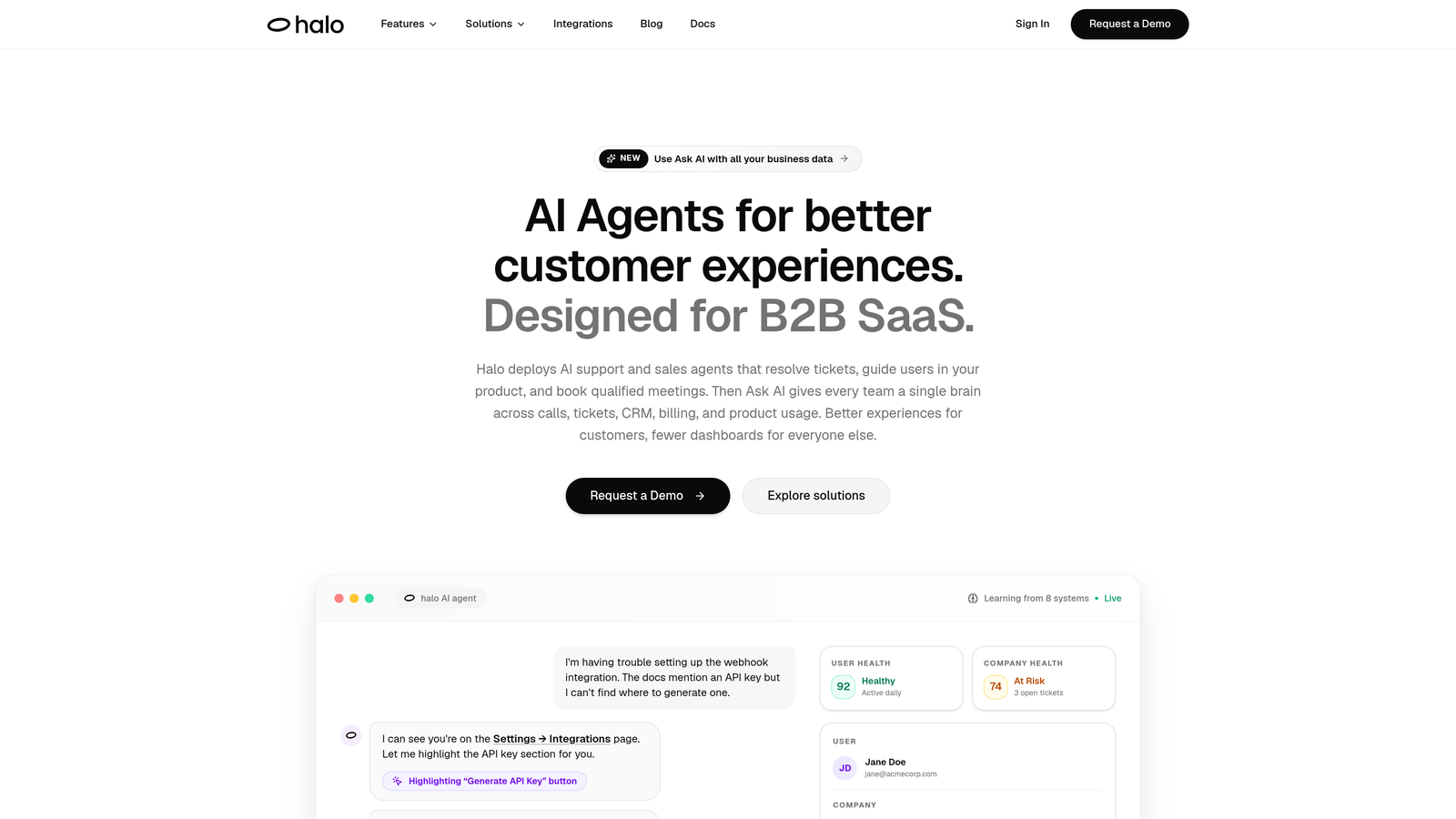
Halo AI is an AI-first customer support platform that deploys intelligent agents to resolve tickets autonomously, guide users through your product with page-aware context, and surface business intelligence from every interaction.
Where This Tool Shines
Most AI support tools know a ticket came in. Halo knows where the user was when they sent it. The page-aware chat widget understands exactly which screen a customer is on, letting the AI provide visual UI guidance rather than generic help center links. That context gap is where most AI tools fall short, and Halo closes it.
What separates Halo further is what happens after the ticket closes. The platform doesn't just resolve and move on. It surfaces customer health signals, revenue anomalies, and product friction patterns from support data, turning your inbox into a source of business intelligence rather than a queue to empty.
Key Features
Page-Aware Chat Widget: Understands the user's current screen and delivers contextual, visual UI guidance rather than generic responses.
Continuous Learning Engine: Improves resolution accuracy with every support interaction, getting smarter the more it's used.
Auto Bug Ticket Creation: Detects product issues from support conversations and automatically creates structured bug reports in Linear or your preferred tracker.
Smart Inbox with Business Intelligence: Surfaces customer health signals, revenue anomalies, and product friction insights beyond standard ticket metrics.
Live Agent Handoff: Escalates gracefully to human agents with full conversation context when complexity exceeds AI confidence thresholds.
Deep Integration Stack: Connects natively with Linear, Slack, HubSpot, Intercom, Stripe, Zoom, PandaDoc, and Fathom.
Best For
Halo is built for B2B SaaS companies and product teams that want more than ticket deflection. If your support data should be feeding product decisions, flagging at-risk accounts, or automatically creating bug reports, this is the platform designed for that level of operational intelligence.
Pricing
Custom pricing based on your team's needs. Contact Halo AI directly to request a demo and discuss your specific use case.
2. Zendesk AI
Best for: Existing Zendesk customers who want to add AI capabilities without migrating to a new platform.
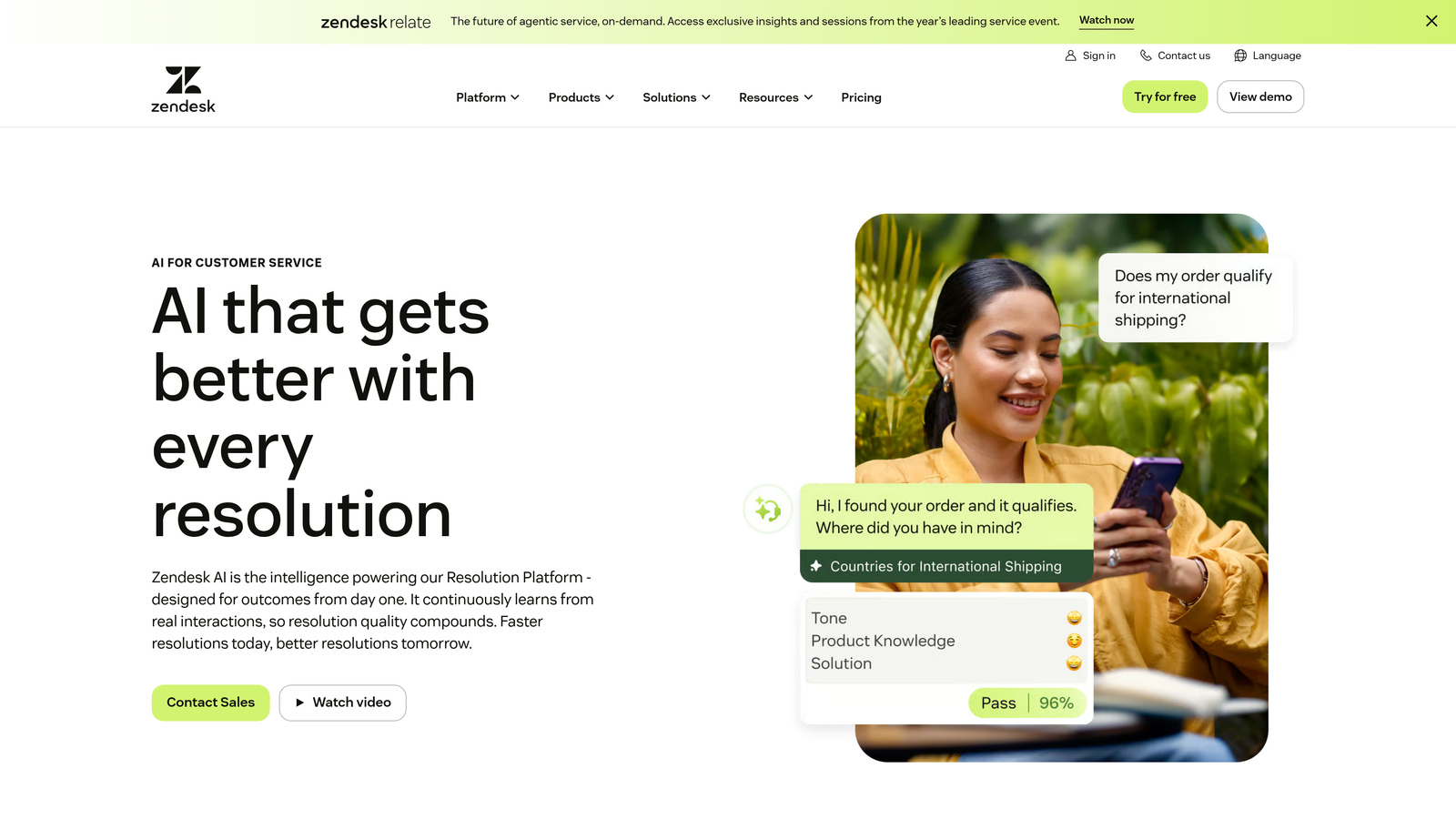
Zendesk AI is a suite of AI capabilities layered into the Zendesk platform, including intelligent triage, automated routing, suggested macros, and an AI Agent for autonomous ticket deflection.
Where This Tool Shines
If your team is already running Zendesk, the AI features slot in without disruption. Intelligent triage automatically categorizes and routes incoming tickets by intent and sentiment, reducing the manual sorting that eats agent time. The Copilot feature provides real-time assistance during live conversations, surfacing relevant articles and suggested responses as agents work.
The trade-off is that Zendesk AI feels additive rather than foundational. It enhances existing workflows rather than reimagining them, which is exactly what some teams need and a limitation for others looking for a more autonomous resolution layer.
Key Features
Intelligent Triage: Auto-categorizes and routes incoming tickets based on detected intent and sentiment.
AI Agent: Formerly Answer Bot, resolves common queries before they reach a human agent.
Suggested Macros: Recommends relevant response templates and next-best actions for agents handling tickets.
Copilot: Provides real-time agent assistance during live conversations with contextual suggestions.
Native Suite Integration: No migration required for existing Zendesk users — AI features activate within your current environment.
Best For
Teams already invested in the Zendesk ecosystem who want incremental AI improvements without a platform change. Less ideal for teams starting fresh who want AI-first architecture from day one.
Pricing
Suite Team starts at approximately $55 per agent per month. Full AI features are available on higher tiers, with some capabilities priced as separate add-ons.
3. Intercom Fin
Best for: Chat-first support teams that want autonomous AI resolution powered by existing help documentation.
Intercom Fin is Intercom's GPT-4-powered AI agent that resolves support conversations autonomously using your help center content, then hands off to human agents when needed.
Where This Tool Shines
Fin's strength is in how quickly it can become useful. Train it on your existing help documentation and it starts resolving conversations immediately, without complex workflow configuration. The handoff to human agents is smooth, with full conversation context preserved so nothing gets repeated.
Fin performs best in chat-heavy environments. Teams running primarily email-based or complex multi-step ticket workflows may find it less suited to their needs than platforms built for broader ticket management.
Key Features
GPT-4-Powered Resolution: Trained on your existing help documentation to answer questions in natural, conversational language.
Autonomous Conversation Handling: Resolves support conversations end-to-end with graceful human handoff when needed.
Multi-Language Support: Handles conversations across languages for global customer bases.
Multi-Channel Coverage: Works across chat, email, and messaging channels within the Intercom platform.
Resolution-Based Pricing: Pay per resolved conversation rather than per seat, aligning cost with outcomes.
Best For
SaaS and consumer businesses already using Intercom that want to add autonomous AI resolution to their chat workflow. The resolution-based pricing model is attractive for teams with variable support volume.
Pricing
Approximately $0.99 per resolved conversation. Pricing is subject to change, so verify current rates at intercom.com before budgeting.
4. Freshdesk Freddy AI
Best for: Teams running Freshdesk who want AI automation across self-service, agent assist, and analytics in one integrated layer.
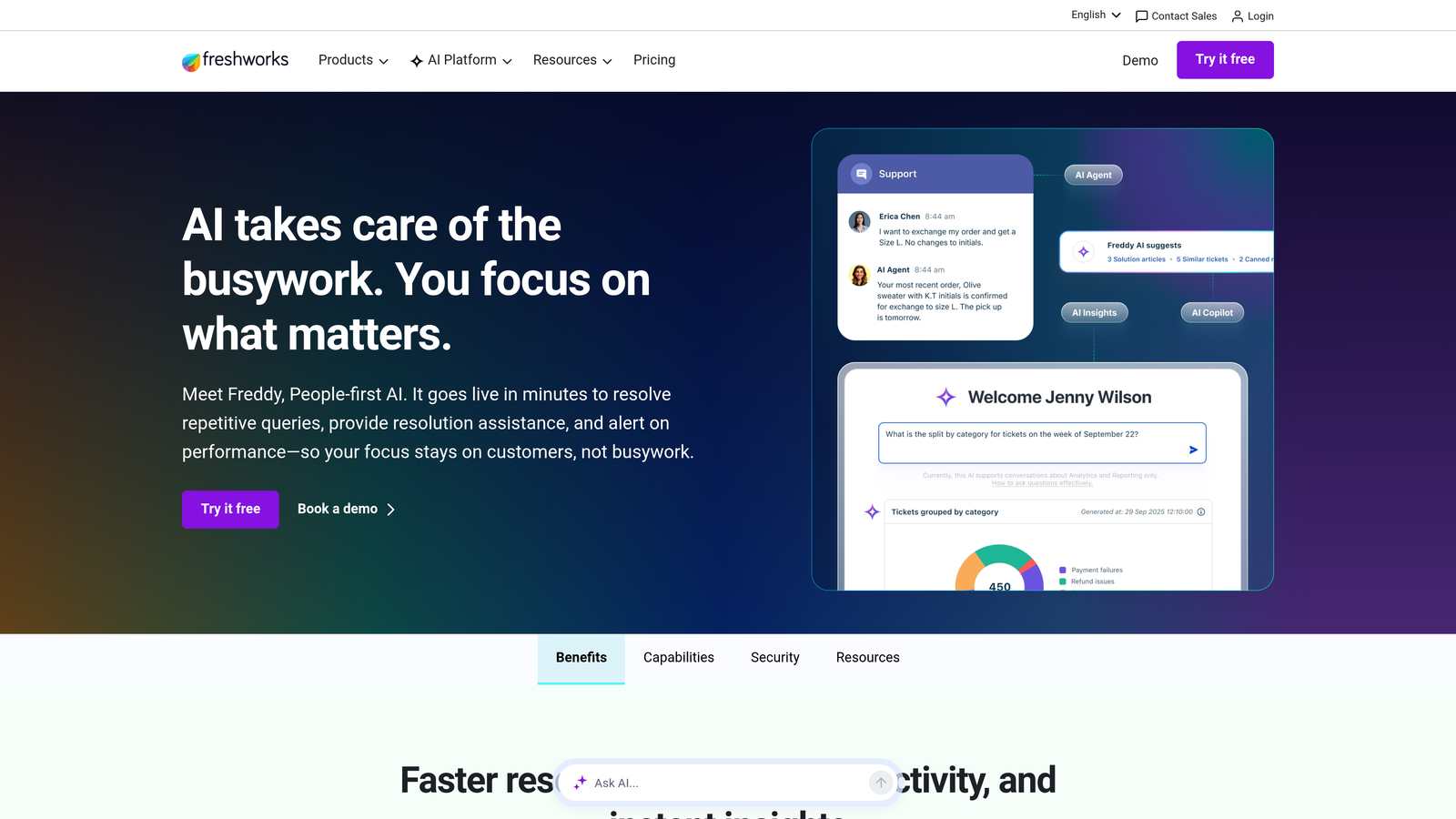
Freshdesk Freddy AI is Freshworks' AI layer spanning self-service bots, agent copilot assistance, and analytics insights, fully integrated within the Freshdesk support suite.
Where This Tool Shines
Freddy covers more ground than most AI add-ons by operating across three distinct layers. Freddy Self Service handles autonomous deflection, Freddy Copilot assists agents in real time, and Freddy Insights surfaces anomalies and trends in your support data. That breadth makes it a solid choice for teams that want AI working at every stage of the ticket lifecycle.
Like Zendesk AI, Freddy's value is strongest if you're already in the Freshworks ecosystem. Migration from another platform just to access Freddy is harder to justify unless the broader Freshdesk feature set is also a fit.
Key Features
Freddy Self Service: AI bot for autonomous ticket deflection before tickets reach human agents.
Freddy Copilot: Real-time suggestions, conversation summaries, and draft responses for agents handling active tickets.
Freddy Insights: AI-driven analytics with anomaly detection across support data.
No-Code Bot Builder: Lets teams configure custom conversation flows without developer involvement.
Full Suite Span: Works across Freshdesk, Freshchat, and Freshservice for unified AI coverage.
Best For
Existing Freshdesk and Freshworks customers who want a layered AI approach without switching platforms. Also suitable for mid-market teams that want a no-code bot builder with analytics built in.
Pricing
Freddy AI features are included on the Growth plan and above. Freddy Copilot is available as a paid add-on.
5. Tidio Lyro
Best for: SMBs and e-commerce teams that need fast AI deployment without enterprise overhead or complex configuration.
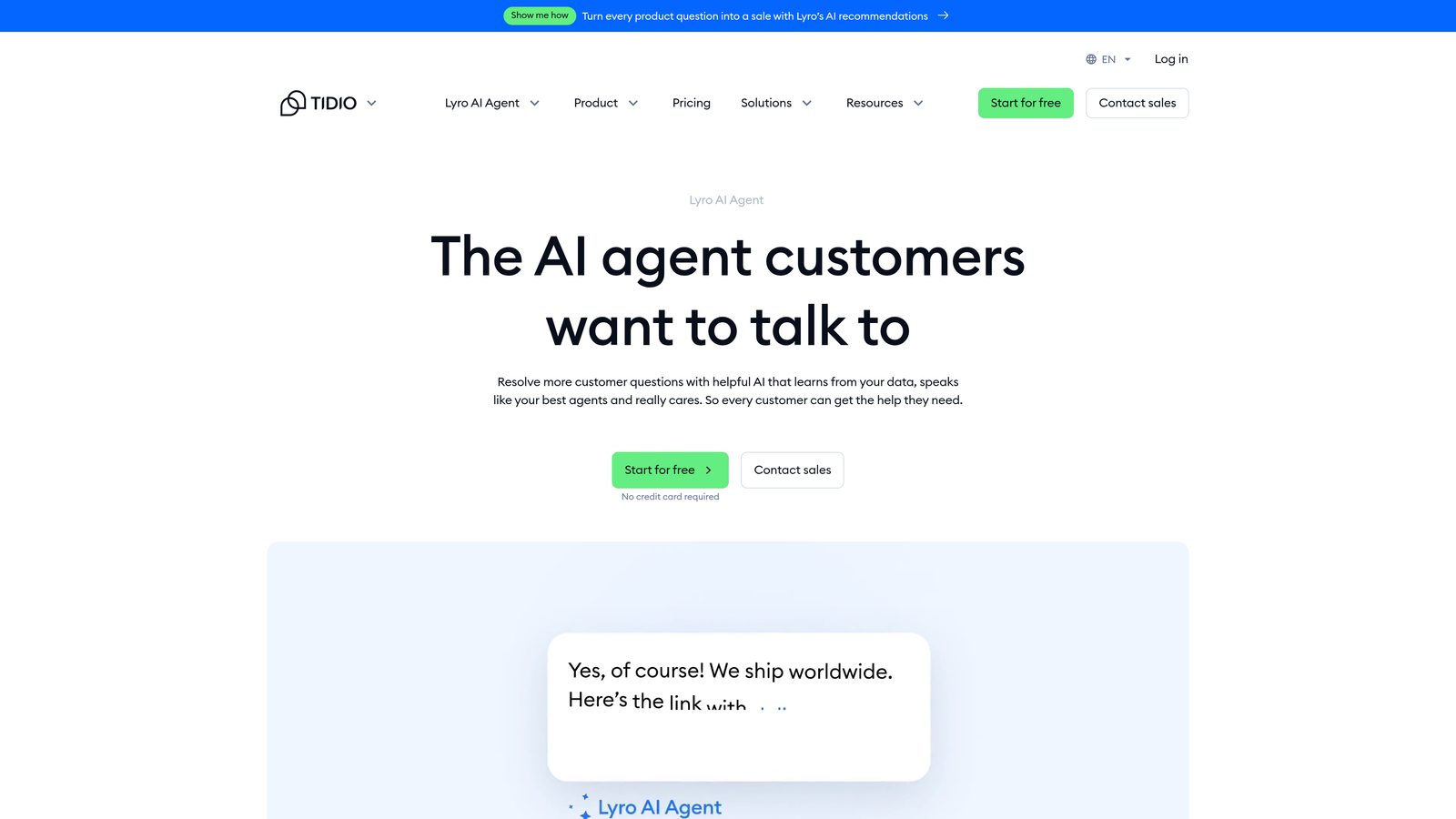
Tidio Lyro is a conversational AI designed for rapid deployment, connecting to your existing FAQ and help content to start resolving customer queries almost immediately.
Where This Tool Shines
Lyro's biggest advantage is speed to value. Connect it to your existing help content and it begins handling repetitive queries across chat and email without weeks of configuration. For small teams that need AI assistance without a dedicated implementation project, that simplicity is genuinely valuable.
The trade-off is ceiling, not floor. Lyro handles common queries well but is less equipped for complex B2B support scenarios with deep product workflows, multi-step troubleshooting, or enterprise integration requirements.
Key Features
Fast Onboarding: Connects to FAQ and help documentation to begin resolving queries immediately after setup.
Autonomous Query Handling: Manages repetitive questions across chat and email without human involvement.
Low-Confidence Escalation: Automatically routes to live agents when it can't resolve confidently.
Resolution Analytics: Simple dashboard for tracking what Lyro is resolving and where it's falling short.
E-Commerce Integrations: Lightweight connections with popular e-commerce platforms and CRMs.
Best For
Small businesses, e-commerce brands, and early-stage SaaS teams that want AI ticket resolution without enterprise complexity or pricing. Not the right fit for high-volume B2B support with complex workflows.
Pricing
Lyro is available as an add-on to Tidio plans. Paid plans start at approximately $29 per month.
6. Salesforce Einstein for Service
Best for: Enterprise teams with customer data in Salesforce who need AI-powered case management deeply integrated with their CRM.
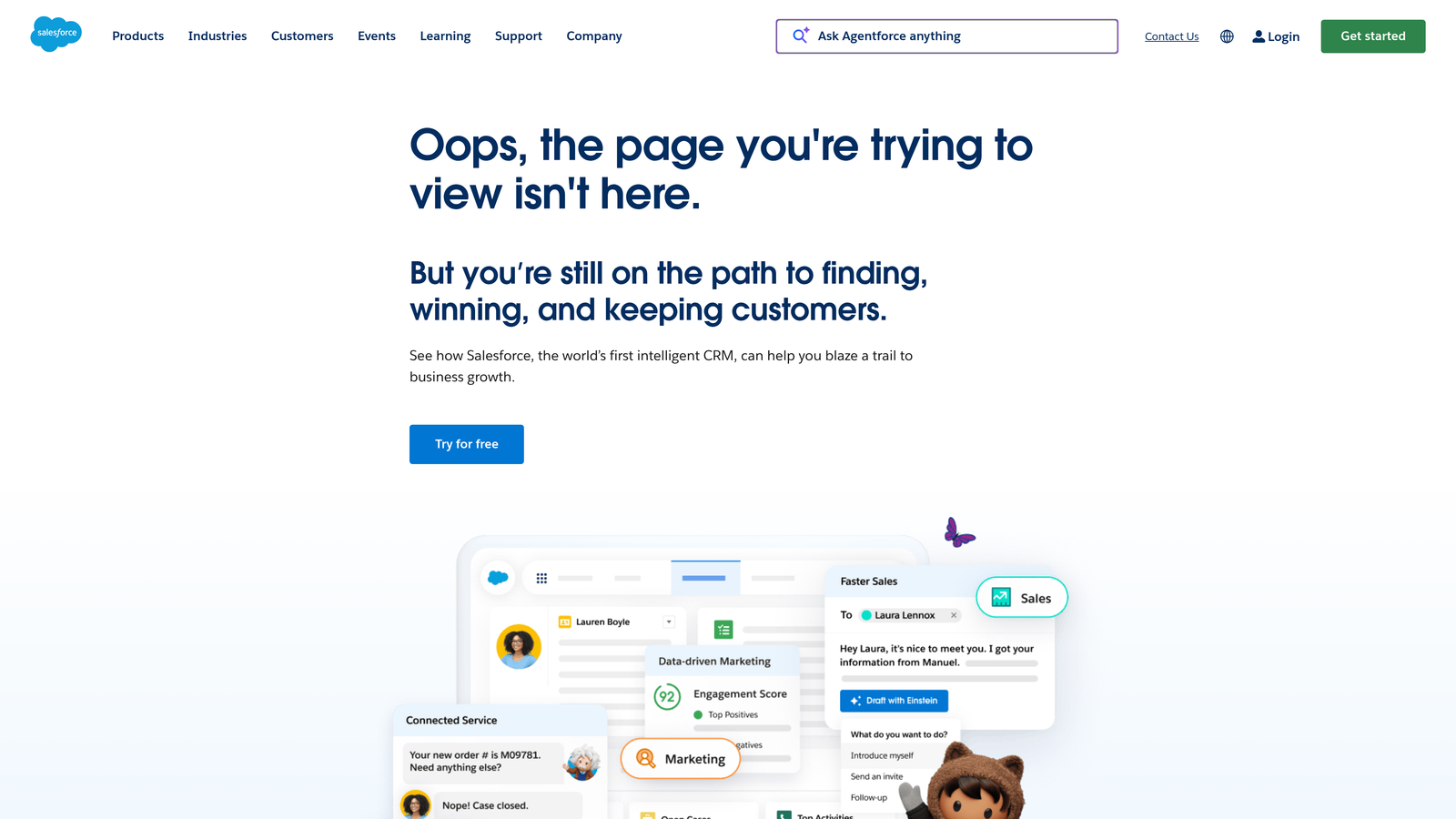
Salesforce Einstein for Service brings AI automation to Salesforce Service Cloud, using native CRM data to personalize ticket handling and automate case resolution at enterprise scale.
Where This Tool Shines
Einstein's edge is context depth. Because it operates natively within Salesforce, every ticket is handled with the full weight of your CRM data behind it: purchase history, account status, previous interactions, and relationship tier. For enterprises where that context drives support prioritization, the native integration is a significant advantage.
The complexity and cost of implementation are real considerations. Einstein for Service is not a tool you stand up in an afternoon. It rewards organizations with Salesforce expertise and the resources to configure it properly.
Key Features
CRM-Native AI: Uses complete customer history from Salesforce to contextualize and personalize every ticket interaction.
Einstein Case Classification: Automatically assigns case fields and routes tickets based on AI-detected patterns.
Einstein Reply Recommendations: Suggests agent responses based on historical resolution data.
Einstein Bots: Configurable AI agents for self-service deflection at scale.
Cross-Cloud Integration: Connects across Sales, Service, and Marketing clouds within the Salesforce ecosystem.
Best For
Large enterprises already running Salesforce as their primary CRM and customer data platform. The ROI is highest when the full Salesforce ecosystem is in use. Teams not on Salesforce will find better-fit options elsewhere on this list.
Pricing
Service Cloud starts at approximately $25 per user per month on the Starter tier. Einstein AI features require Enterprise tier or above.
7. Forethought AI
Best for: Teams that want intelligent triage and routing on top of their existing helpdesk without replacing their current platform.
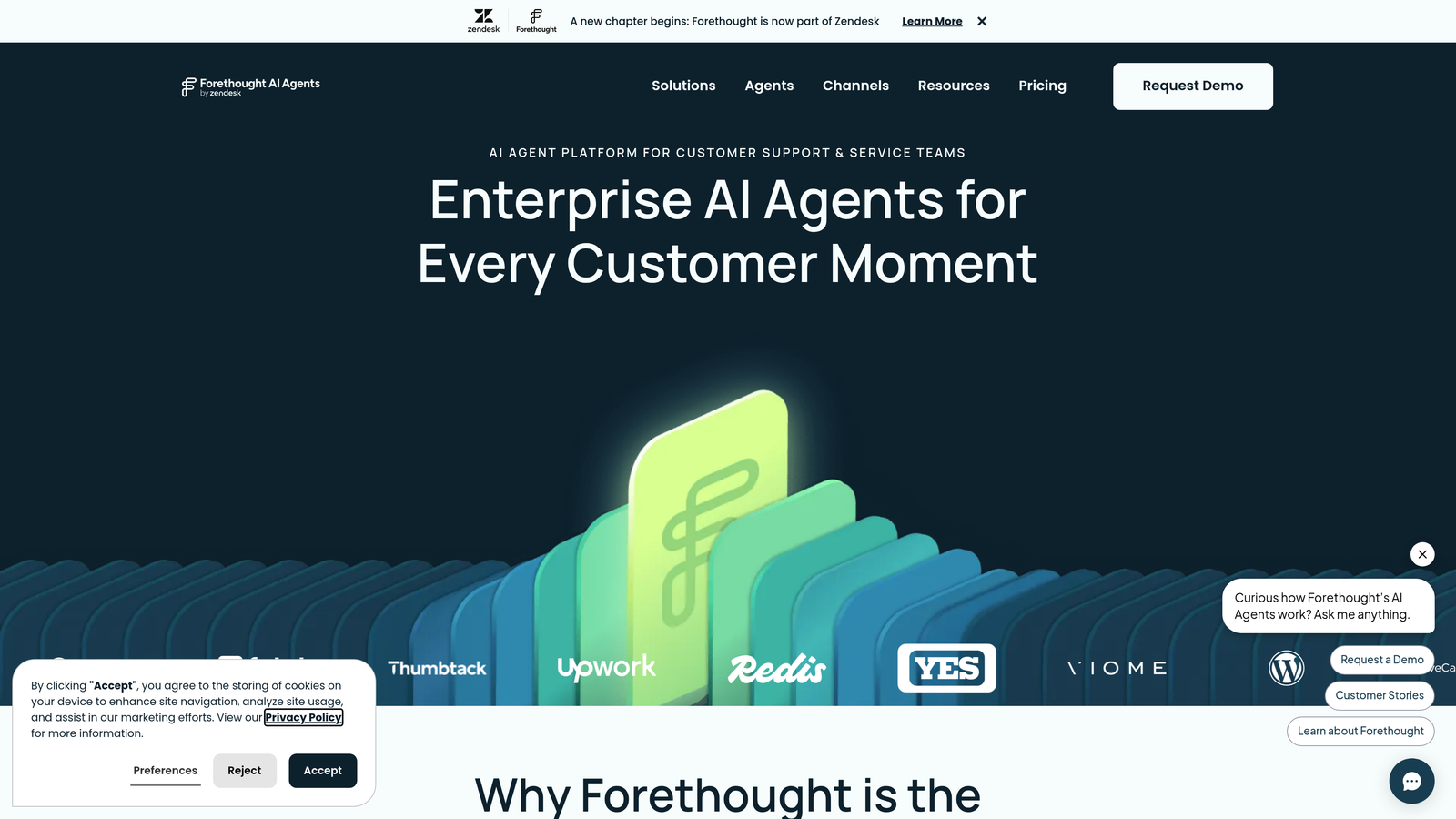
Forethought AI is an intelligent middleware layer for support teams, specializing in AI triage, predictive routing, and autonomous deflection that works on top of Zendesk, Salesforce, Freshdesk, and other major helpdesks.
Where This Tool Shines
Forethought is built for teams that are happy with their helpdesk but frustrated with how tickets are categorized, routed, and handled before they reach an agent. Its intent detection is strong, identifying what a customer needs and predicting the likely resolution path before any human gets involved.
Think of it as an intelligent layer between your customers and your helpdesk rather than a replacement for either. That positioning makes it a useful addition for teams with mature support operations looking to improve efficiency without a platform overhaul.
Key Features
Solve: AI agent for autonomous ticket resolution before human agents are involved.
Triage: Intent detection and smart routing based on predicted resolution paths.
Assist: Real-time recommendations for agents working on active tickets.
Discover: AI-powered insights into support trends, common issues, and knowledge gaps.
Multi-Helpdesk Compatibility: Integrates with Zendesk, Salesforce, Freshdesk, and other major platforms.
Best For
Mid-market and enterprise teams with established helpdesk setups that want to add a smart AI layer without migrating. Particularly strong for teams where triage accuracy and routing efficiency are the primary bottlenecks.
Pricing
Custom enterprise pricing. Contact Forethought directly for a quote based on your volume and integration requirements.
8. Kustomer IQ
Best for: High-volume support teams managing complex customer relationships who need AI embedded within a CRM-native support platform.
Kustomer IQ adds AI automation, intent detection, and deflection to Kustomer's CRM-native support platform, built for teams managing relationship-heavy customer interactions at scale.
Where This Tool Shines
Kustomer's core differentiator is the unified customer timeline. Every ticket is handled with the full history of that customer's relationship visible in context, and Kustomer IQ's AI operates within that view. Intent detection and sentiment analysis work against a richer data backdrop than most standalone ticketing tools can offer.
The platform suits brands where the support relationship is part of the customer experience, not just a problem-resolution channel. High-volume consumer brands and subscription businesses often find this approach more aligned with how they think about customer relationships.
Key Features
Intent Detection: Understands what customers need before routing or generating a response.
AI Deflection with Context: Handles deflection within the full customer timeline rather than in isolation.
Automated Workflows: Triggers actions based on AI-detected patterns across incoming tickets.
Sentiment Analysis: Prioritizes urgent or at-risk customers based on detected emotional signals.
Unified CRM and Support: Eliminates data silos between customer history and active ticket management.
Best For
Enterprise and high-growth consumer brands managing complex, relationship-heavy support at volume. Teams looking for a lightweight or low-cost option will find the pricing and implementation overhead a barrier.
Pricing
Enterprise pricing starting at approximately $89 per user per month.
9. Help Scout AI
Best for: Small teams that want AI-assisted support features within a clean, simple shared inbox without heavy automation overhead.
Help Scout brings lightweight AI features including summarization, draft assistance, and reply suggestions to its shared inbox platform, designed for teams that want AI-assisted responses rather than fully autonomous resolution.
Where This Tool Shines
Help Scout AI is refreshingly honest about what it is: AI that helps your agents work faster, not AI that replaces them. AI Summarize condenses long threads so agents get up to speed without reading every message. AI Drafts generates reply starting points so agents aren't staring at a blank compose window. The result is a faster, less mentally taxing agent experience.
If your team values simplicity and a clean UI over deep automation, Help Scout is one of the most approachable options on this list. The trade-off is that autonomous resolution is limited. This tool assists humans rather than operating independently.
Key Features
AI Summarize: Condenses long conversation threads into quick summaries for agents picking up mid-conversation.
AI Drafts: Generates reply drafts based on conversation context to accelerate agent response time.
AI Assist: Handles tone adjustment, translation, and content expansion for agent-written responses.
Beacon: Embeddable help widget with AI-powered self-service for customers before they submit a ticket.
Simple Configuration: Minimal setup overhead with a clean UI that doesn't require dedicated admin time to maintain.
Best For
Small support teams, startups, and businesses that want AI to speed up human agents rather than replace them. Teams looking for autonomous ticket resolution will need a more capable platform.
Pricing
Standard plan starts at $20 per user per month. AI features are included on the Plus plan and above.
Which Tool Is Right for Your Team?
The right choice here depends on two things: where your team is today and what you're actually trying to solve.
If you're already deep in a platform like Zendesk, Freshdesk, or Salesforce, the AI layers built for those ecosystems (Zendesk AI, Freddy AI, Einstein for Service) are the path of least resistance. They won't transform your support architecture, but they'll meaningfully improve what you already have.
For teams that want genuine autonomous resolution without being locked into a legacy helpdesk, the AI-first options are more compelling. Intercom Fin is strong for chat-heavy workflows. Forethought excels as an intelligent middleware layer. Tidio Lyro is the fastest path to value for SMBs with straightforward support needs.
For B2B SaaS teams that want AI to do more than deflect tickets, Halo AI stands apart. The combination of page-aware context, continuous learning, auto bug ticket creation, and business intelligence from support data makes it a different category of tool. It's not just resolving tickets. It's feeding product and revenue insights back to the teams that need them.
Your support team shouldn't scale linearly with your customer base. Let AI agents handle routine tickets, guide users through your product, and surface business intelligence while your team focuses on complex issues that need a human touch. See Halo in action and discover how continuous learning transforms every interaction into smarter, faster support.