9 Best AI Tools for Customer Support Teams in 2026
Discover the best AI tools for customer support teams in 2026, covering nine platforms evaluated on autonomous resolution capability, integration flexibility, and scalability. From lean startup help desks to enterprise operations, this guide breaks down which solutions can reduce ticket volume, improve response times, and hand off complex issues to human agents effectively.
 Grant CooperFounder14 min read
Customer support teams are under more pressure than ever. Ticket volumes climb, customer expectations rise, and headcount budgets stay stubbornly flat. The good news: AI tools have moved well beyond basic chatbots. Today's platforms can resolve tickets autonomously, detect bugs, surface revenue signals, and hand off seamlessly to human agents when complexity demands it.
This list covers the best AI tools for customer support teams in 2026, evaluated on automation depth, integration flexibility, ease of deployment, and how well they scale with growing operations. Whether you're running a lean startup support desk or managing an enterprise helpdesk across multiple regions, there's a solution here worth a close look.
Selection criteria: autonomous resolution capability, native integrations, learning and improvement mechanisms, human handoff quality, and pricing transparency.
1. Halo AI
Best for: B2B SaaS teams that want an AI-first support platform built to resolve, learn, and scale autonomously.
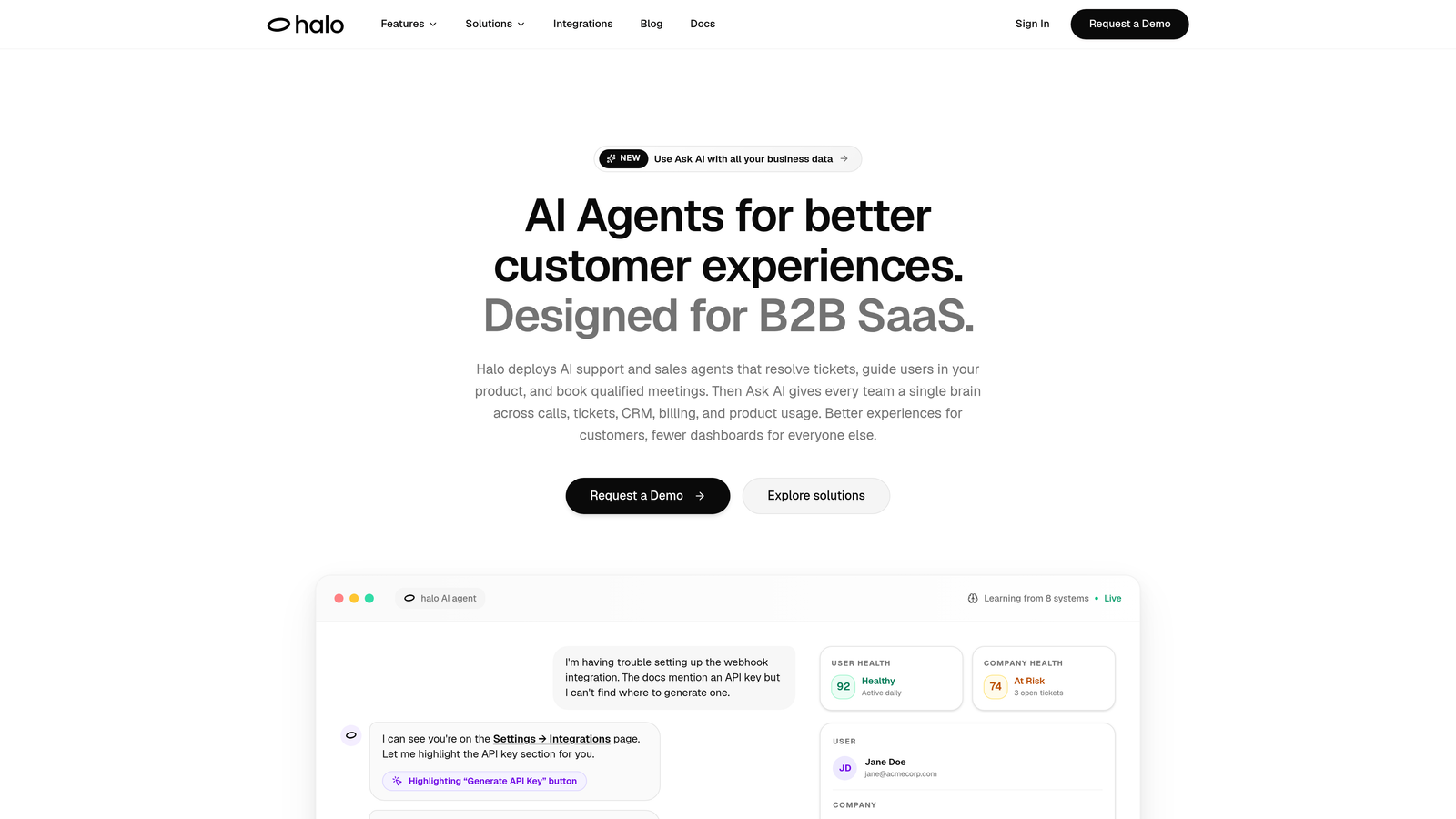
Halo AI is an AI-first customer support platform that deploys intelligent agents to resolve tickets, guide users through your product with page-aware visual context, auto-create bug reports, and surface business intelligence signals — all while learning from every interaction.
Where This Tool Shines
What separates Halo from most tools on this list is its architecture. It's not AI bolted onto a legacy ticketing system. The entire platform is built around autonomous resolution, which means the AI isn't just suggesting replies for a human to approve — it's closing tickets, routing bugs, and flagging customer health signals in real time.
The page-aware chat widget is a particularly notable differentiator. Halo's AI sees what the user sees, providing visual UI guidance that's contextually relevant to the exact page or workflow they're stuck on. That level of context awareness is rare and meaningfully improves resolution quality for complex SaaS products.
Key Features
Page-Aware Chat Widget: The AI understands which page a user is on and delivers visual UI guidance specific to that context, not generic help center articles.
Intelligent AI Agents: Autonomous ticket resolution with continuous learning from every interaction, so the system gets smarter over time without manual retraining.
Smart Inbox with Business Intelligence: Goes beyond support to surface customer health signals, anomaly detection, and revenue intelligence directly in the inbox.
Auto Bug Ticket Creation: Automatically generates and routes bug reports to Linear or Jira when users report product issues, closing the loop between support and engineering.
Live Agent Handoff: Graceful escalation to human agents for complex issues, with full conversation context preserved.
Deep Integrations: Connects to Linear, Slack, HubSpot, Intercom, Stripe, Zoom, PandaDoc, and Fathom — linking support to the broader business stack.
Best For
B2B SaaS companies and product teams that want AI-first support without migrating to a new helpdesk. Particularly strong for teams that need support intelligence to flow into engineering, sales, and customer success workflows, not just stay siloed in a ticketing system.
Pricing
Contact for pricing, tailored to team size and usage. Given the depth of integrations and business intelligence features, this is positioned as a platform investment rather than a per-seat ticketing tool.
2. Intercom
Best for: Mid-market SaaS teams that want a polished, well-integrated AI agent within a mature messaging platform.
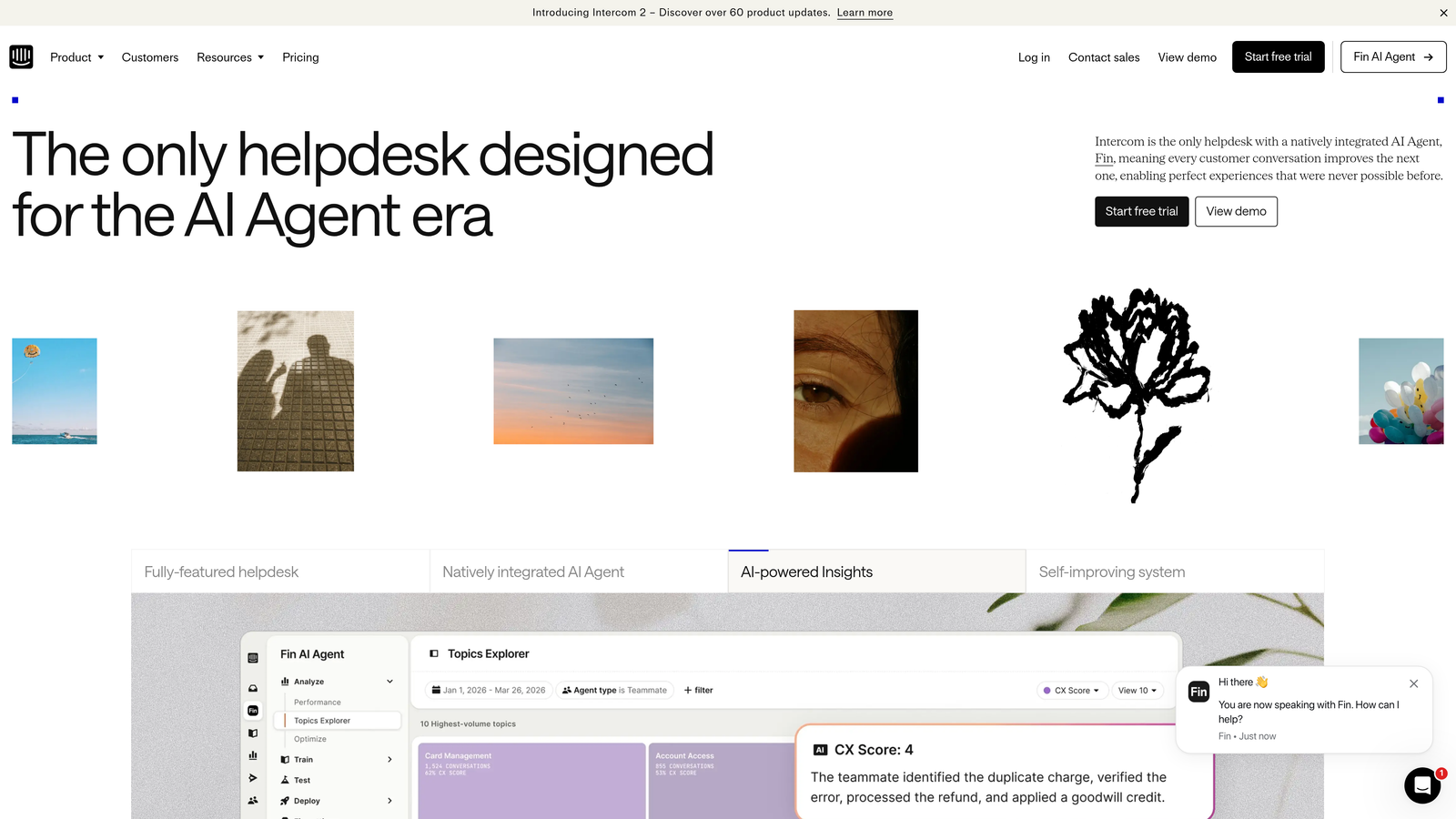
Intercom is a widely-adopted customer messaging platform with Fin, its AI agent built on large language models and trained on your help content.
Where This Tool Shines
Fin is one of the more capable AI agents in the market for teams already living in the Intercom ecosystem. It draws on your existing knowledge base and help center content to resolve common queries without human intervention. The setup experience is relatively straightforward for teams that already have well-documented support content.
Intercom's broader platform strength is its omnichannel inbox, which consolidates chat, email, and social conversations in one place. If your team is already using Intercom for customer messaging, adding Fin as an AI resolution layer is a natural extension rather than a separate implementation project.
Key Features
Fin AI Agent: Autonomous ticket resolution powered by large language models, trained on your help center and support documentation.
Omnichannel Inbox: Unified view across chat, email, and social channels with routing and assignment rules.
Help Center Builder: Robust knowledge base creation tools that feed directly into Fin's training data.
Workflow Automation: Routing rules, assignment logic, and automation sequences for common support scenarios.
App Marketplace: Broad integration ecosystem with popular CRM, analytics, and productivity tools.
Best For
Mid-market SaaS and tech companies that are already using Intercom for customer communications and want to layer AI resolution on top of their existing setup without changing platforms.
Pricing
Starts at $39 per seat per month. Fin AI usage is billed per resolution, so costs can escalate at higher volumes. Worth modeling usage carefully before committing.
3. Zendesk AI
Best for: Large enterprise teams already running the Zendesk Suite who want AI capabilities without changing platforms.
Zendesk AI is a set of AI capabilities layered across the entire Zendesk Suite, covering intelligent triage, agent suggestions, and advanced analytics.
Where This Tool Shines
Zendesk's AI additions are most valuable for teams already deeply invested in the Zendesk ecosystem. Intelligent triage routes tickets to the right agent or queue automatically, while suggested replies and macro recommendations reduce the time agents spend composing responses from scratch. For high-volume enterprise helpdesks, these incremental time savings add up meaningfully across the team.
The generative AI tools for knowledge base content creation are a practical addition, helping support teams keep documentation current without dedicating significant writing time to it. QA automation is another standout for enterprise teams that need to monitor agent quality at scale.
Key Features
AI-Powered Triage: Intelligent ticket classification and routing based on intent, sentiment, and content.
Suggested Replies and Macros: Real-time recommendations that help agents respond faster without starting from a blank page.
Generative AI for Knowledge Base: Automatically drafts and updates help center content based on support interactions.
Advanced Analytics and QA Automation: AI-driven quality assurance and reporting for large agent teams.
Enterprise Integration Ecosystem: Connects with Salesforce, Slack, Jira, and hundreds of other enterprise tools.
Best For
Large enterprise support organizations running Zendesk Suite who want to add AI capabilities without a platform migration. Less compelling for teams not already in the Zendesk ecosystem, given the entry price point.
Pricing
AI features are available on Suite Professional and above, starting at $115 per agent per month. Enterprise tier pricing is higher and requires a conversation with sales.
4. Freshdesk Freddy AI
Best for: SMB and mid-market teams that want a well-rounded AI layer at a competitive price point.
Freshdesk Freddy AI is Freshdesk's AI layer spanning self-service chatbots, agent copilot assistance, and analytics insights within the Freshworks ecosystem.
Where This Tool Shines
Freddy AI covers three distinct use cases in one package: customer-facing deflection, real-time agent assistance, and analytics. That breadth makes it a strong value proposition for smaller teams that want AI across the full support workflow without buying multiple tools. Freddy Copilot, in particular, is useful for agents who need real-time summaries and suggested responses during live conversations.
Freshdesk's pricing is notably more accessible than Zendesk, which makes Freddy AI an attractive option for budget-conscious teams that still want meaningful AI automation. The native integration with Freshdesk's ticketing workflows means setup is relatively painless for existing Freshworks customers.
Key Features
Freddy Self Service: Customer-facing AI chatbot for deflecting common queries before they reach an agent.
Freddy Copilot: Real-time suggestions, response drafts, and conversation summaries for agents handling live tickets.
Freddy Insights: AI-driven analytics that surface trends, volume patterns, and areas for process improvement.
Native Freshdesk Integration: Tight integration with Freshdesk ticketing workflows, routing, and SLA management.
Competitive SMB Pricing: Base plans start at accessible price points relative to enterprise alternatives.
Best For
SMB and mid-market support teams on Freshdesk looking to add AI across self-service, agent assist, and analytics without a significant budget increase or platform change.
Pricing
Freddy AI is available as an add-on with pricing that varies by plan. Base Freshdesk plans start at $15 per agent per month, making this one of the more accessible options on this list.
5. Tidio
Best for: E-commerce and small business teams that need fast deployment and a conversational AI that handles common queries.
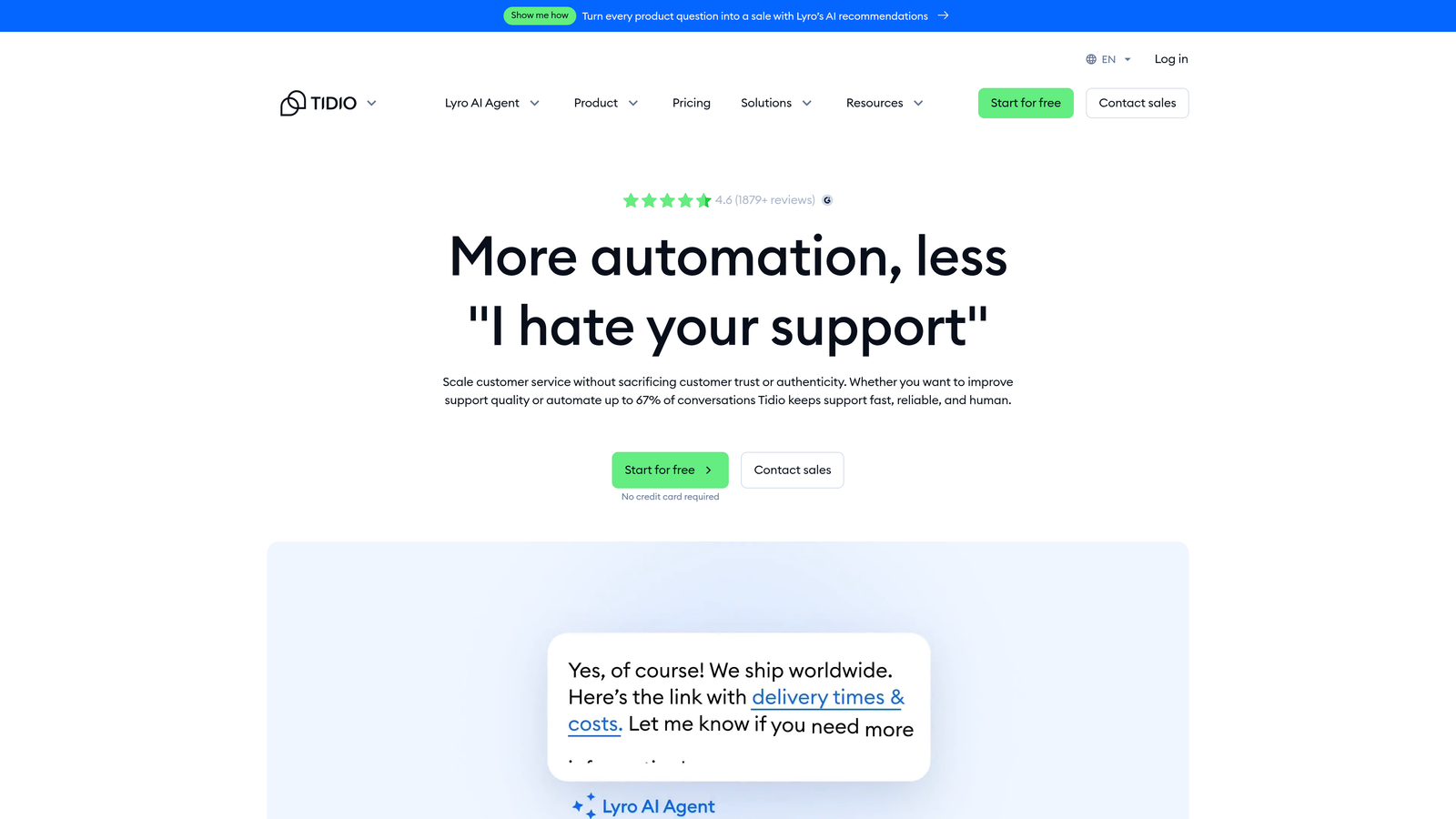
Tidio is a lightweight AI chat platform built around Lyro, its conversational AI agent, and is particularly popular with e-commerce and small business support teams.
Where This Tool Shines
Tidio's biggest selling point is speed of deployment. Lyro can be trained on your existing support content and embedded on your site in a matter of hours, not weeks. For small teams without dedicated implementation resources, that matters. The no-code setup means support managers can get the chatbot running without engineering involvement.
The native Shopify and WooCommerce integrations make Tidio a natural fit for e-commerce brands. Proactive messaging triggers allow the chatbot to reach out to visitors based on behavior, which can help deflect questions before customers even open a support ticket.
Key Features
Lyro AI Chatbot: Conversational AI trained on your support documentation and help content, handling common queries autonomously.
No-Code Deployment: Fast setup with minimal technical requirements, suitable for non-technical support managers.
E-Commerce Integrations: Native connections to Shopify, WooCommerce, and other e-commerce platforms.
Live Chat Fallback: Smooth handoff to human agents when Lyro reaches the limits of its knowledge.
Proactive Messaging: Visitor tracking and behavior-based triggers that initiate conversations before a user submits a ticket.
Best For
E-commerce brands and small business teams that need a fast, affordable AI chatbot with minimal setup. Less suited to complex B2B SaaS workflows that require deep product context or multi-system integrations.
Pricing
Free plan available. Lyro AI starts at $29 per month, with paid plans scaling based on conversation volume. One of the most accessible entry points on this list.
6. Forethought
Best for: Enterprise teams that want AI automation on top of their existing helpdesk without a platform migration.
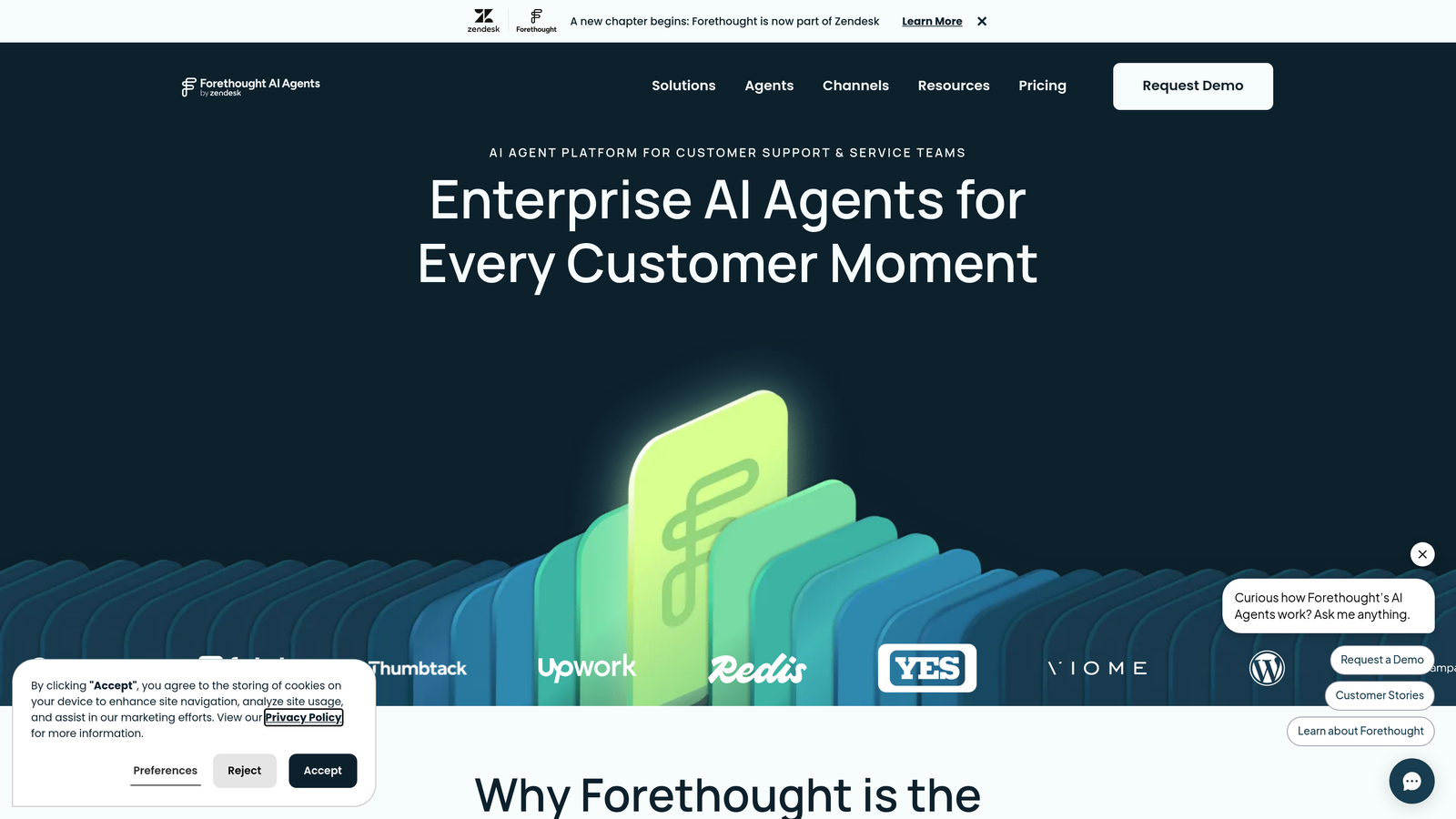
Forethought is an enterprise AI platform that sits on top of existing helpdesks, adding intelligent deflection, triage, and agent assist without requiring teams to change their core ticketing system.
Where This Tool Shines
Forethought's core value proposition is additive intelligence. If your enterprise has years of history, custom workflows, and significant investment in Zendesk, Salesforce Service Cloud, or Freshdesk, ripping that out for a new platform is rarely realistic. Forethought layers AI on top of what you already have, which removes the migration risk entirely.
The three-product structure, Solve for deflection, Triage for routing, and Assist for agent suggestions, allows teams to adopt AI incrementally. You can start with deflection, measure impact, and expand from there rather than committing to a full platform overhaul upfront.
Key Features
Solve: AI-powered self-service deflection layer that handles common queries before they reach an agent queue.
Triage: Intelligent ticket classification and routing based on intent, urgency, and topic.
Assist: Real-time AI suggestions and knowledge retrieval for agents handling live conversations.
Helpdesk Compatibility: Works natively with Zendesk, Salesforce Service Cloud, Freshdesk, and ServiceNow.
No Migration Required: Designed to enhance existing helpdesk investments rather than replace them.
Best For
Enterprise support organizations with established helpdesk platforms that want to add AI automation without the risk and cost of a full migration. Strong for teams with complex routing requirements and large agent populations.
Pricing
Enterprise pricing, available on request. Given the target market, expect pricing to reflect enterprise-level implementation and support requirements.
7. Kustomer
Best for: High-volume B2C teams that need full customer history context woven into every support interaction.
Kustomer is a CRM-native customer support platform with built-in AI automation, designed for high-volume teams that need complete customer history context at the point of resolution.
Where This Tool Shines
Kustomer's differentiation is its CRM-first architecture. Rather than treating each ticket as an isolated event, Kustomer builds a unified customer timeline that aggregates all interactions across every channel. When an agent or AI picks up a conversation, they have the full history, not just the current ticket. For high-volume B2C operations where repeat customers are common, this context is genuinely valuable.
The AI automation handles conversation routing and auto-responses, while custom workflow automation allows teams to build complex business processes without heavy engineering involvement. Omnichannel coverage across chat, email, voice, and social makes it a strong fit for consumer-facing brands managing diverse support channels.
Key Features
Unified Customer Timeline: Aggregates all interactions across channels into a single customer view, giving full context for every conversation.
AI-Powered Routing and Auto-Responses: Intelligent conversation assignment and automated responses for common query types.
Business Process Automation: Custom workflow builder for complex support processes without requiring code.
Omnichannel Support: Covers chat, email, voice, and social from a single platform.
CRM-First Data Architecture: Customer data is a first-class citizen, not an afterthought bolted onto a ticketing system.
Best For
High-volume B2C brands, particularly in retail, subscription, and consumer services, where customer history context significantly improves resolution quality. Less commonly used in pure B2B SaaS environments.
Pricing
Starts at $89 per agent per month on the Enterprise plan. Pricing reflects the CRM-depth and omnichannel capabilities included in the platform.
8. Aisera
Best for: Large enterprises that need unified AI automation across customer support, IT helpdesk, and HR service management.
Aisera is an enterprise AI service management platform covering customer support, IT helpdesk, and HR use cases, providing unified AI automation across departments from a single platform.
Where This Tool Shines
Aisera's scope is broader than most tools on this list. While others focus exclusively on customer-facing support, Aisera extends AI automation to IT service management and HR service delivery as well. For large enterprises looking to standardize on a single AI platform across departments, that breadth is a meaningful advantage over buying separate tools for each function.
The domain-specific language models are worth noting. Rather than a generic LLM applied to all use cases, Aisera's conversational AI is trained on domain-specific data for customer support, IT, and HR contexts. The enterprise-grade security and compliance controls are important for regulated industries where data governance requirements are strict.
Key Features
Multi-Department AI Coverage: Unified AI automation across customer experience, IT helpdesk, and HR service management.
Domain-Specific Language Models: Conversational AI trained on domain-specific data for more accurate responses across different business functions.
Autonomous Ticket Resolution: Workflow automation that handles and closes tickets without human intervention for defined issue types.
Enterprise Integrations: Connects with ServiceNow, Salesforce, Zendesk, and Jira, among others.
Security and Compliance Controls: Enterprise-grade data governance, access controls, and compliance features for regulated environments.
Best For
Large enterprises that want to consolidate AI automation across customer support, IT, and HR under one platform. Implementation complexity is higher than most tools on this list, so this is best suited to organizations with dedicated implementation resources.
Pricing
Enterprise pricing available on request. Given the multi-department scope and implementation complexity, expect pricing to reflect a significant platform investment.
9. Chatbase
Best for: Startups and small teams that want a fast, no-code way to deploy a custom AI chatbot trained on their own content.
Chatbase is a no-code AI chatbot builder that lets teams train a custom GPT-powered chatbot on their own documentation, knowledge base, or website content.
Where This Tool Shines
Chatbase lowers the barrier to entry for AI-powered support about as far as it can go. You upload your PDFs, point it at your URLs, or paste in text content, and Chatbase builds a chatbot trained on that material. No engineering required, no lengthy implementation, no complex configuration. For startups that need something working quickly, that simplicity is the entire value proposition.
The white-label customization options and API access make Chatbase more flexible than it might appear at first glance. Teams can embed the widget on their site, customize the appearance to match their brand, and use the API to connect it to other tools. It's a solid starting point that can grow with a team before they need a more sophisticated platform.
Key Features
Content-Based Training: Train your chatbot on uploaded PDFs, website URLs, or pasted text content with no technical setup required.
Embeddable Chat Widget: Drop the chatbot onto any website with a simple embed code.
API Access: Connect Chatbase to other tools and workflows via API for teams that need custom integrations.
Conversation Analytics: Track chatbot performance and identify gaps in your training content over time.
White-Label Options: Customize branding and appearance to match your product or company identity.
Best For
Startups and small teams that need a quick, affordable way to stand up an AI chatbot without engineering resources. Workflow automation depth is limited compared to enterprise tools, so teams with complex support processes will likely outgrow it.
Pricing
Free plan available. Paid plans start at $19 per month, making this the most accessible entry point on this list by a significant margin.
Which Tool Is Right for Your Team?
The right choice depends less on feature checklists and more on where your team is today and where you're trying to go.
If you're a B2B SaaS company that wants an AI-first platform built for autonomous resolution, continuous learning, and business intelligence beyond support, Halo AI is the strongest fit. The page-aware context, auto bug routing, and smart inbox signals set it apart from tools that simply add AI onto a ticketing system.
For enterprise teams already deeply invested in Zendesk, Zendesk AI is the path of least resistance. You get meaningful AI capabilities without a migration, though the price point is significant. Similarly, Forethought is worth serious consideration for enterprises that want AI automation across their existing helpdesk, whether that's Zendesk, Salesforce, or Freshdesk, without touching their core platform.
Budget-conscious SMB teams on Freshdesk will find Freddy AI delivers strong value relative to its cost. E-commerce brands and small businesses that need something running fast should look at Tidio first, given its no-code deployment and native Shopify integration. And for startups that need a chatbot up in an afternoon, Chatbase is the most accessible starting point available.
For teams that need CRM-depth in their support platform, Kustomer's unified customer timeline is genuinely differentiated, particularly for high-volume B2C operations. Aisera is the right conversation for large enterprises looking to standardize AI automation across customer support, IT, and HR under one platform.
Your support team shouldn't scale linearly with your customer base. Let AI agents handle routine tickets, guide users through your product, and surface business intelligence while your team focuses on complex issues that need a human touch. See Halo in action and discover how continuous learning transforms every interaction into smarter, faster support.