9 Best Automated Customer Service Platforms in 2026
The best automated customer service platforms in 2026 go far beyond basic chatbots, offering autonomous ticket resolution, intelligent routing, and seamless human handoffs. This guide compares nine leading solutions across three distinct categories—AI-native platforms, traditional helpdesks with AI add-ons, and chat-first tools—helping support teams choose the right fit based on AI depth, integration capabilities, and long-term scalability.
 Matt PattoliFounder14 min read
Customer support teams are under more pressure than ever. Ticket volumes keep climbing, customers expect 24/7 responses, and most teams aren't growing headcount to match. Automated customer service platforms have moved well beyond simple rule-based chatbots: today's best solutions resolve tickets autonomously, route intelligently, surface business insights, and hand off to humans without friction.
But not all platforms are built the same way. There are now three meaningfully different categories: AI-native platforms built from the ground up around autonomous agents, traditional helpdesks with AI layers added on top, and chat-first platforms that expanded into automation. That distinction matters more than most buyers realize, because it shapes how much your system learns over time and how much human configuration it needs to keep working.
This list covers the top platforms worth evaluating in 2026. Selection criteria include depth of AI capability, integration ecosystem, ease of deployment, scalability, and value for B2B teams. Whether you're replacing a legacy helpdesk or layering intelligence on top of an existing stack, there's an option here for your stage and use case.
1. Halo AI
Best for: AI-native SaaS and product-led teams that want autonomous ticket resolution with business intelligence built in.
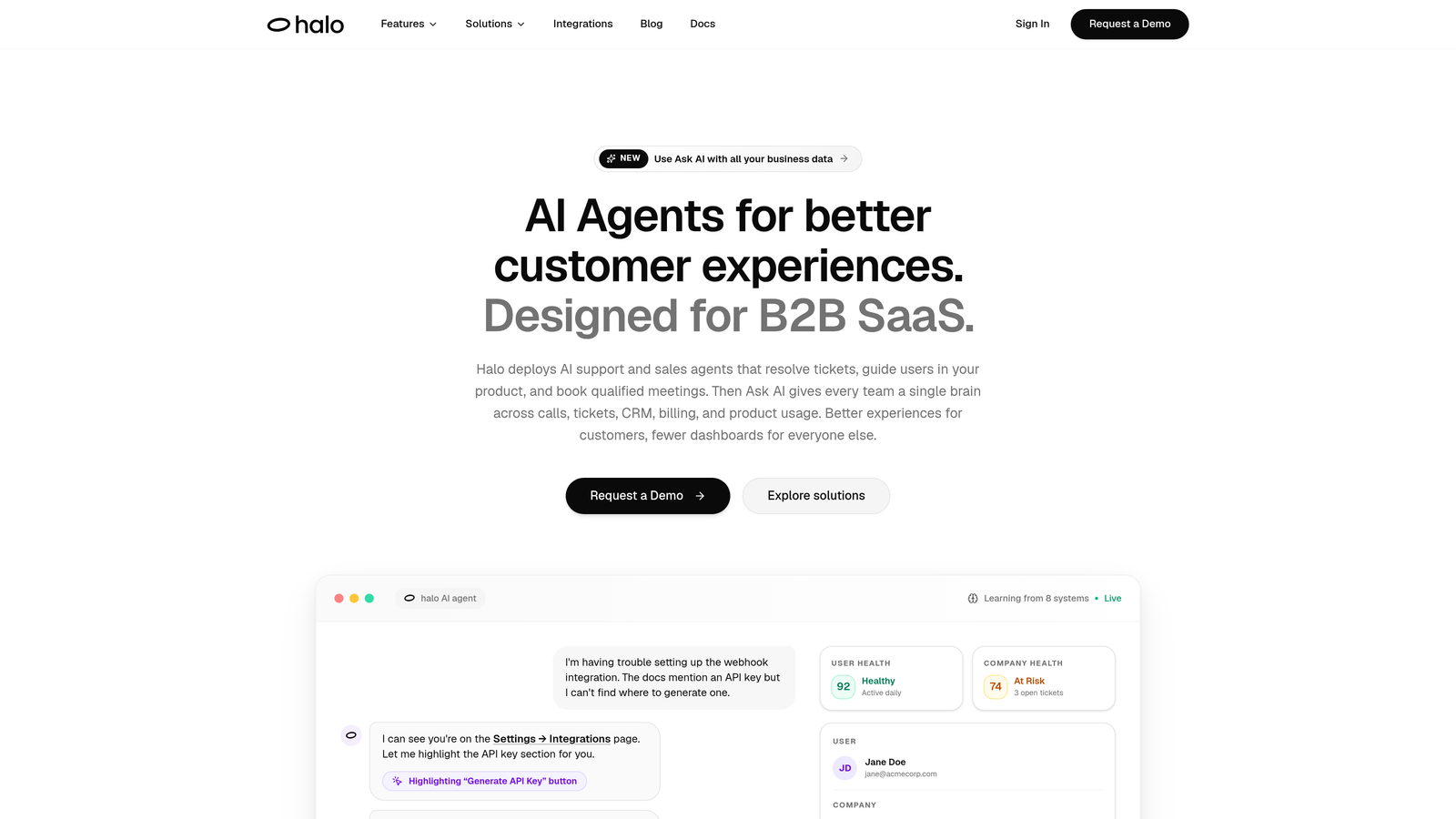
Halo AI is an AI-first customer support platform that deploys autonomous agents to resolve tickets, guide users through your product, and surface actionable business intelligence — all while learning from every interaction.
Where This Tool Shines
What separates Halo AI from most platforms on this list is its architecture. It wasn't built as a helpdesk with AI bolted on — it was designed from the ground up around autonomous agents. That means the learning loop is tighter: every resolved ticket makes the system smarter, and that intelligence compounds over time rather than requiring constant manual retraining.
The page-aware chat widget is a particularly distinctive capability. Instead of serving generic responses, Halo's agent sees exactly what the user sees on screen and can provide visual UI guidance specific to their current context. For SaaS teams dealing with onboarding friction or feature adoption questions, this changes the nature of support entirely. Add the smart inbox's business intelligence layer, which surfaces customer health signals and revenue anomalies alongside ticket data, and you have a support platform that also functions as an early warning system for your business.
Key Features
Page-Aware Chat Widget: The AI agent sees the user's current page context and provides visual UI guidance specific to where they are in your product.
Autonomous Ticket Resolution: AI agents handle tickets end-to-end with continuous learning from every resolved interaction, improving accuracy over time without manual retraining.
Auto Bug Ticket Creation: Automatically generates and routes bug reports directly to Linear or your existing engineering workflow when issues are detected.
Smart Inbox with Business Intelligence: Surfaces customer health signals, revenue anomalies, and trend detection alongside standard support metrics — turning your inbox into a business intelligence layer.
Live Agent Handoff: Escalates complex issues to human agents with full conversation context preserved, so customers never have to repeat themselves.
Deep Integration Ecosystem: Connects natively with Linear, Slack, HubSpot, Intercom, Stripe, Zoom, PandaDoc, and Fathom.
Best For
Product-led SaaS companies and B2B teams that want support to do more than close tickets. Particularly strong for teams that need support data to feed back into product development, customer success, and revenue workflows — and who want a system that gets smarter without constant manual oversight.
Pricing
Contact for pricing. Visit haloagents.ai for current details and to request a demo tailored to your team's use case.
2. Intercom
Best for: SaaS companies wanting unified in-product support, onboarding, and AI-powered chat in one platform.
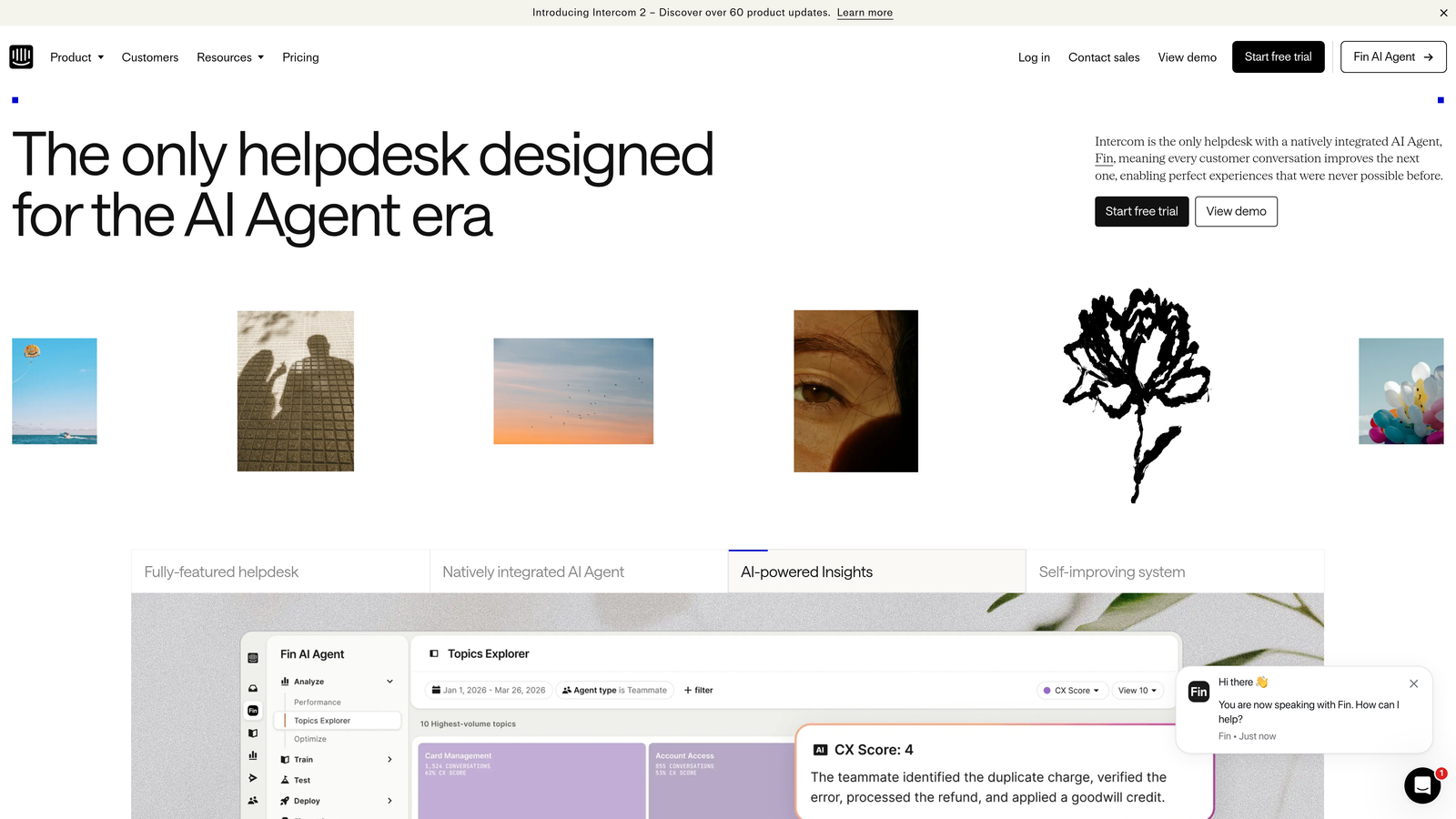
Intercom is a unified customer communications platform combining its Fin AI agent, live chat, and helpdesk — widely used by SaaS companies for in-product support and onboarding flows.
Where This Tool Shines
Intercom's strength is the combination of support and onboarding in a single product. Teams can manage proactive messaging, product tours, and reactive support from the same platform, which reduces context-switching and keeps customer data in one place. Fin, Intercom's AI agent, is built on large language models and resolves common queries using your existing help content without requiring you to build conversation flows from scratch.
The shift to resolution-based pricing is worth noting. Rather than paying per seat, you pay for outcomes on higher tiers, which aligns the platform's incentives with your actual support goals. For teams with high deflection rates, this model can be cost-effective.
Key Features
Fin AI Agent: Resolves common queries autonomously using your help center content, with no manual flow building required.
Omnichannel Coverage: Handles in-app, email, social, and SMS conversations from a shared inbox.
AI-Powered Summaries and Suggested Replies: Speeds up human agent responses with conversation summaries and contextual reply suggestions.
Resolution-Based Pricing: Higher tiers charge per resolved conversation rather than per agent seat.
Product Tours and Onboarding: Built-in tools for proactive user guidance alongside reactive support.
Best For
SaaS teams that want support and onboarding in one platform, particularly those already invested in the Intercom ecosystem. Also strong for teams that want AI deflection without building custom conversation flows.
Pricing
Essential plan starts at approximately $39/month. Fin AI is charged per resolution on higher tiers. Verify current pricing at intercom.com.
3. Zendesk
Best for: Enterprise teams needing a mature, deeply configurable helpdesk with a comprehensive AI suite layered on top.
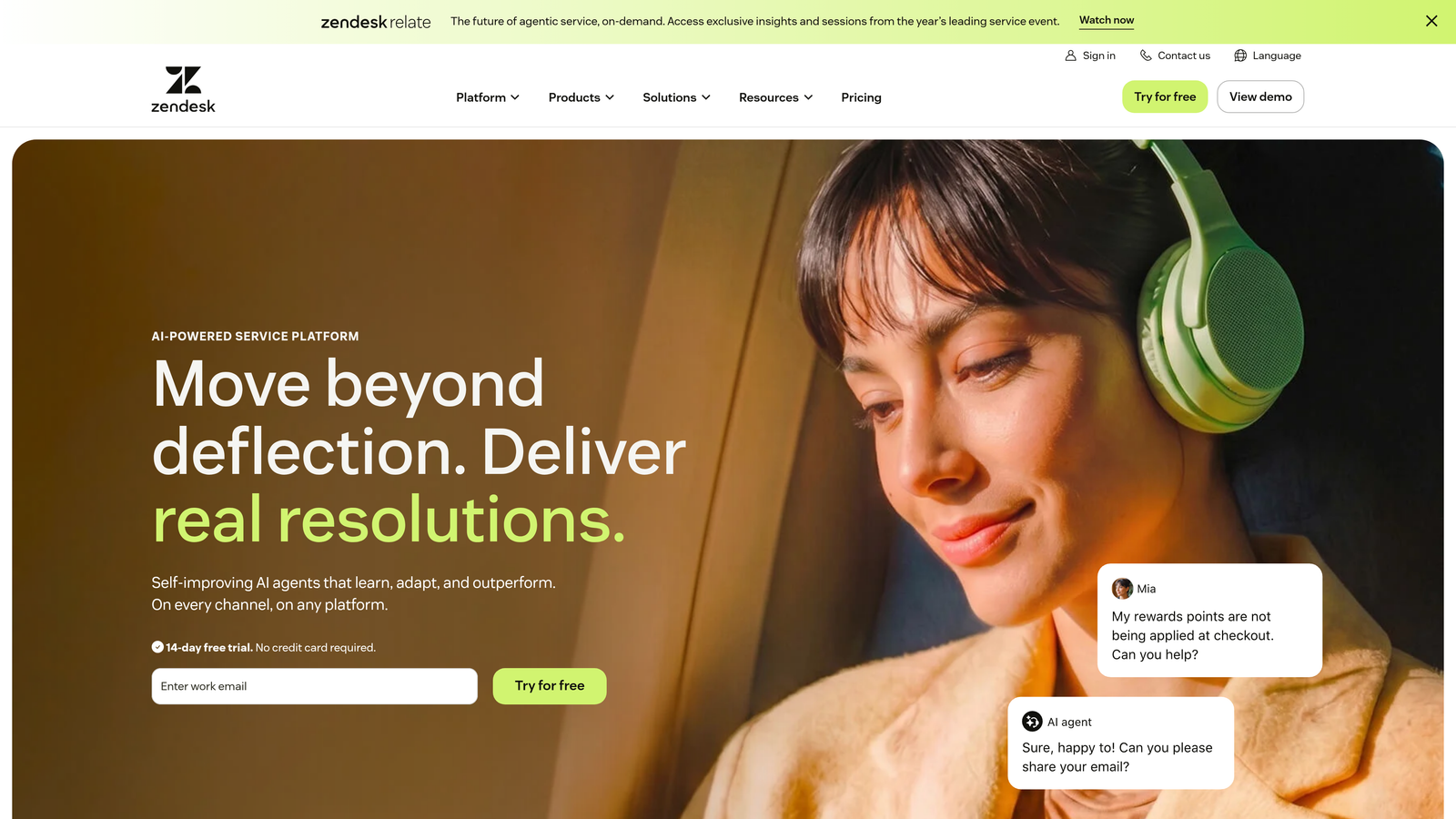
Zendesk is one of the most established helpdesk platforms available, now with a broad AI suite covering triage, agent assist, and self-service — built to handle enterprise-scale complexity.
Where This Tool Shines
Zendesk's primary advantage is maturity. The platform has been refined over many years and handles complex support operations with a depth of workflow customization that few competitors match. Its app marketplace, with over 1,000 integrations, means it fits into almost any enterprise tech stack without custom development.
The AI additions, including intelligent triage, auto-tagging, and the Agent Copilot, are genuinely useful for high-volume teams. That said, Zendesk's AI capabilities are layered on top of a traditional helpdesk architecture, which means some of the more advanced autonomous resolution features require more configuration than AI-native platforms offer out of the box.
Key Features
Zendesk AI Triage: Automatically tags, categorizes, and routes tickets based on intent detection and historical patterns.
Agent Copilot: Provides human agents with suggested responses and next-best-action recommendations during live conversations.
Extensive App Marketplace: Over 1,000 integrations covering CRM, e-commerce, analytics, and engineering tools.
Advanced Workflow Automation: Conditional triggers, SLA management, and escalation rules for complex support operations.
Robust Reporting and CSAT Tracking: Detailed analytics on team performance, resolution times, and customer satisfaction.
Best For
Enterprise support teams with complex routing requirements, strict SLA obligations, and existing investments in the Zendesk ecosystem. Also appropriate for teams that need deep customization and have the support ops resources to configure and maintain it.
Pricing
Suite plans start at approximately $55/agent/month. AI features are included in higher tiers. Verify current pricing at zendesk.com.
4. Freshdesk
Best for: Growing SMB and mid-market teams that want omnichannel support with built-in AI at accessible price points.
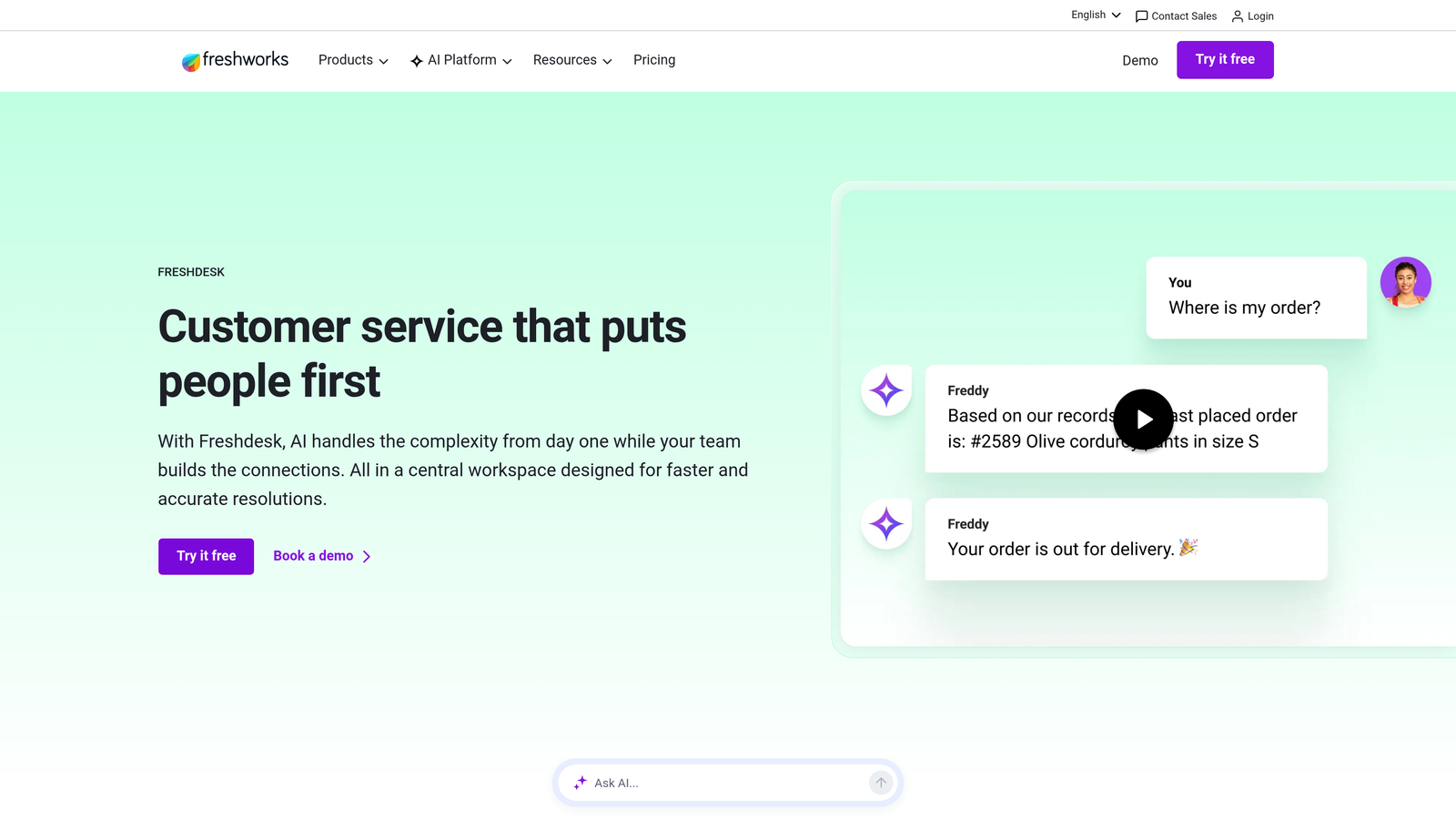
Freshdesk is a feature-rich helpdesk platform with Freddy AI built in, offering automation, self-service, and omnichannel support at pricing tiers that work for teams that aren't yet at enterprise scale.
Where This Tool Shines
Freshdesk hits a strong value-to-capability ratio for teams that need a full-featured helpdesk without enterprise pricing. Freddy AI handles auto-triage, suggested responses, and article recommendations without requiring a dedicated support ops team to configure it. The free tier makes it a realistic starting point for early-stage teams.
Collision detection, which prevents two agents from responding to the same ticket simultaneously, is a practical feature that larger platforms sometimes overlook. For teams scaling from a small support function, these operational basics matter as much as AI capabilities.
Key Features
Freddy AI Auto-Triage: Automatically categorizes and routes incoming tickets based on content and intent.
Freddy Self Service Bot: Deflects common queries with automated responses before they reach the agent queue.
Omnichannel Inbox: Manages email, chat, phone, and social media conversations from a unified interface.
Collision Detection: Alerts agents when another team member is already working on the same ticket.
Free Tier: Available for small teams, with paid plans scaling as needs grow.
Best For
SMB and mid-market teams that want a capable helpdesk with AI features without committing to enterprise pricing. Also a strong choice for teams already using other Freshworks products like Freshsales or Freshservice.
Pricing
Free plan available. Paid plans start at approximately $15/agent/month. Freddy AI features are available on higher tiers. Verify current pricing at freshdesk.com.
5. Tidio
Best for: E-commerce brands and early-stage SaaS teams that need fast deployment and AI-powered chat without complex setup.
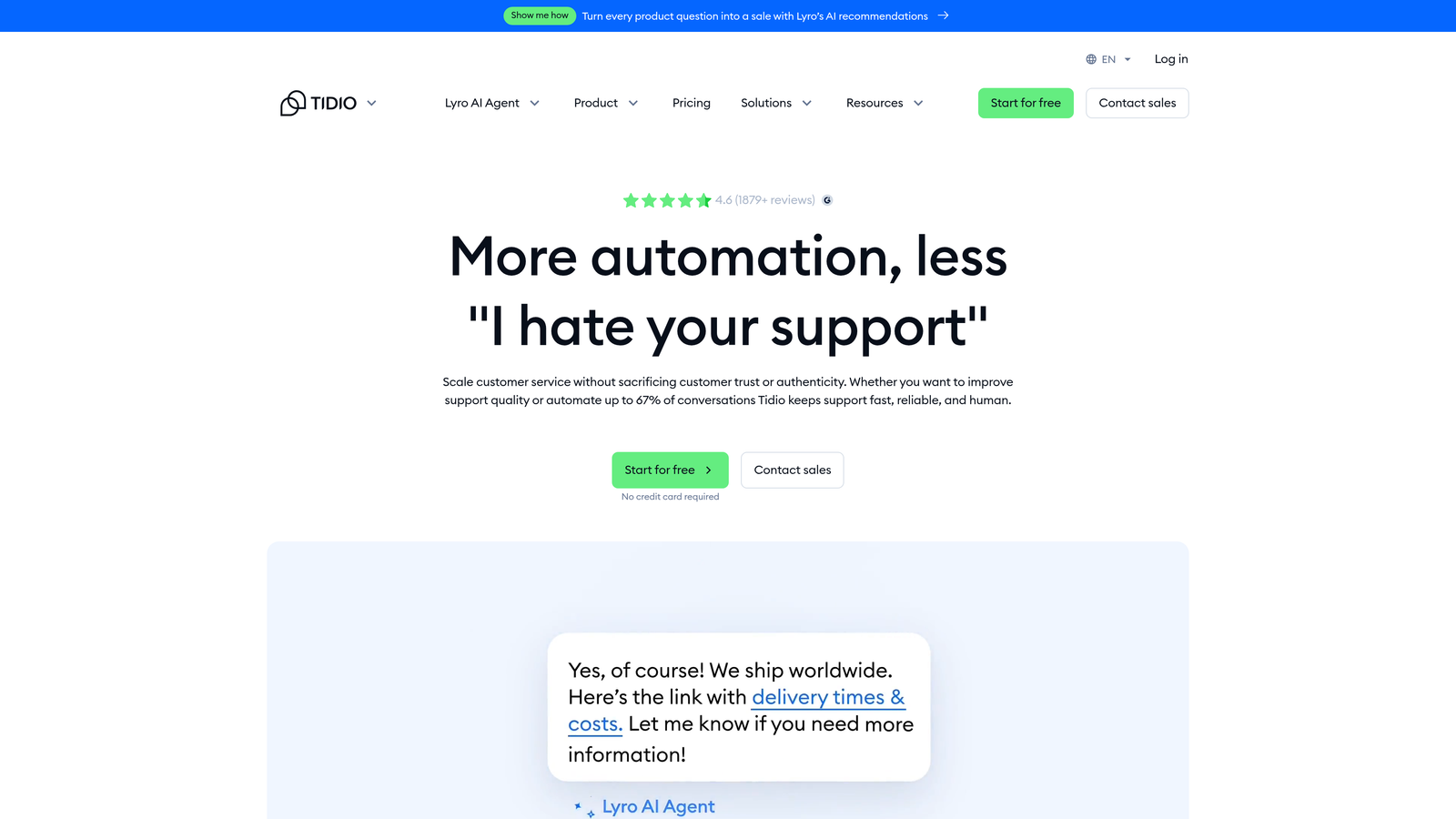
Tidio is a live chat and AI chatbot platform built for speed of deployment, with its Lyro AI handling autonomous conversations and native integrations for e-commerce environments.
Where This Tool Shines
Tidio's biggest advantage is how quickly teams can get up and running. The visual chatbot flow builder requires no coding, and Lyro AI can start handling common queries using your existing content without lengthy training periods. For e-commerce teams in particular, the native Shopify and WooCommerce integrations mean the AI has order and product context from day one.
It's worth being clear about where Tidio sits in the market: it's designed for simplicity and speed, not enterprise complexity. Teams with sophisticated routing requirements or deep CRM integrations will likely outgrow it. But for the right use case, that simplicity is the point.
Key Features
Lyro AI Chatbot: Resolves common customer queries autonomously without requiring human intervention for routine questions.
Native E-Commerce Integrations: Direct integrations with Shopify and WooCommerce provide product and order context to the AI.
Visual Flow Builder: Drag-and-drop chatbot builder that requires no coding or technical background.
Live Chat with Agent Takeover: Smooth handoff to human agents when Lyro reaches the limits of its knowledge.
Multichannel Coverage: Handles website chat, email, Instagram, and Facebook Messenger.
Best For
E-commerce brands and early-stage SaaS teams that want a working AI chat solution deployed quickly without a dedicated support ops function. Less suited for complex B2B support workflows or teams needing deep CRM integration.
Pricing
Free plan available. Lyro AI starts at approximately $29/month. Paid plans scale with conversation volume. Verify current pricing at tidio.com.
6. Drift (now Salesloft)
Best for: B2B revenue teams that need to handle both support queries and sales qualification within the same conversation platform.
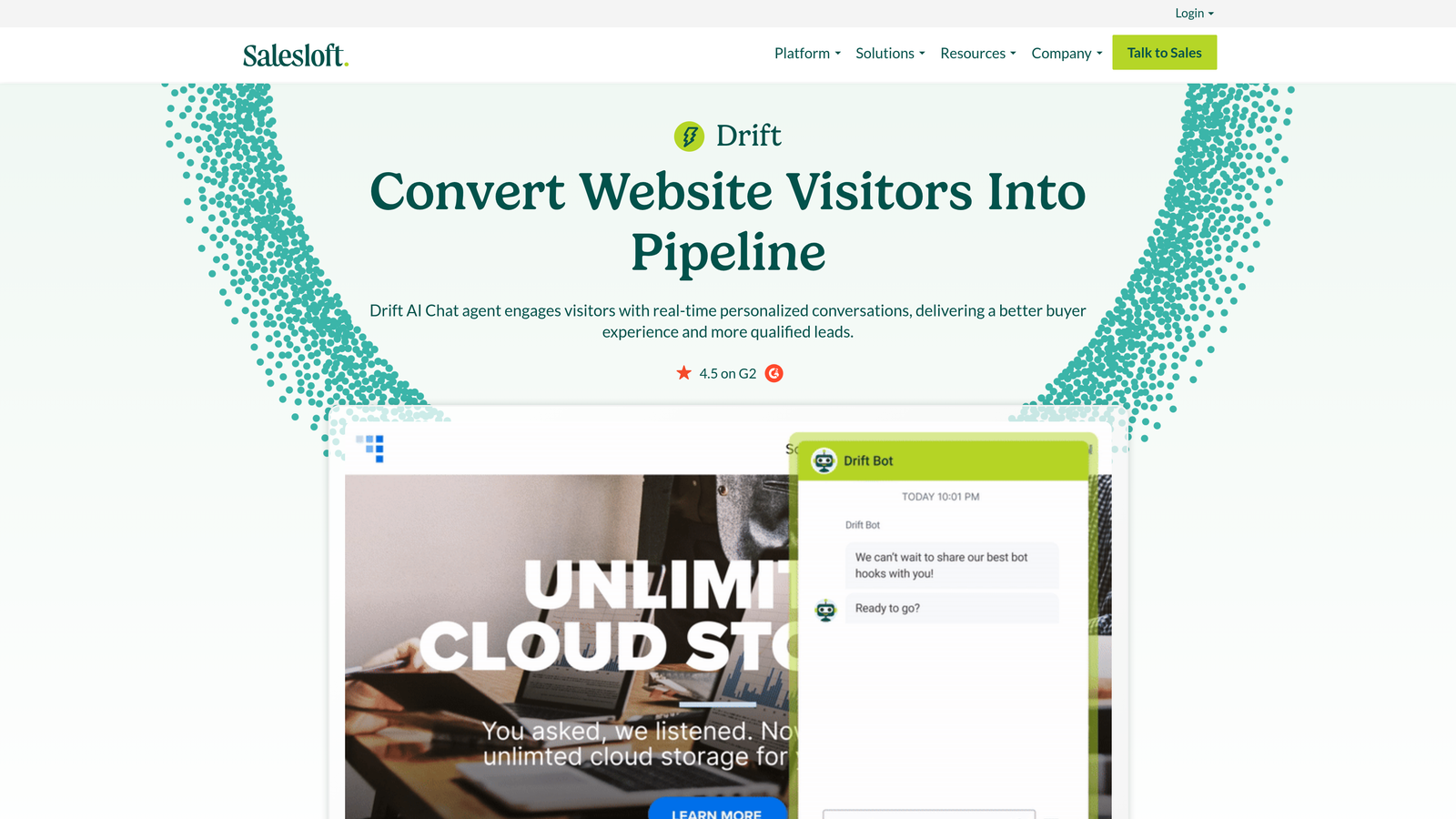
Drift, now part of Salesloft following its 2023 acquisition, is a conversational AI platform that blurs the line between sales and support — using AI playbooks to qualify, route, and book meetings alongside handling customer queries.
Where This Tool Shines
Drift is a different kind of tool on this list. If your support and sales motions are tightly connected, which is common in B2B SaaS, Drift handles both within a single conversation layer. AI playbooks can detect whether an incoming conversation is a support request, a sales inquiry, or a billing question, and route accordingly without manual intervention.
The meeting booking automation is genuinely useful for revenue teams: prospects and customers can book directly within chat without leaving the conversation. For teams where support interactions frequently uncover expansion opportunities, this integration of sales and support intelligence is a meaningful differentiator.
Key Features
AI-Powered Intent Routing: Detects whether conversations are support, sales, or billing-related and routes them to the right flow automatically.
Meeting Booking Automation: Allows prospects and customers to schedule meetings directly within the chat interface.
Account-Based Targeting: Personalizes conversation flows based on company segment, firmographic data, or account status.
Playbook Builder: Visual builder for creating automated conversation flows without engineering involvement.
CRM Integrations: Native integrations with Salesforce, HubSpot, and Marketo.
Best For
B2B companies where the line between support and sales is blurry, particularly teams using Salesforce or HubSpot as their CRM backbone. Less suited for teams that need pure support automation without a sales component.
Pricing
Premium plans. Contact Salesloft for current pricing at drift.com.
7. Ada
Best for: Large enterprises needing high-volume, multilingual AI support with strong compliance and security requirements.
Ada is an enterprise-grade no-code AI agent platform built for organizations that need autonomous support at significant scale, across multiple languages, with the compliance certifications that large companies require.
Where This Tool Shines
Ada's reasoning-based AI is designed to handle complex, multi-step queries rather than just pattern-matching against a FAQ library. For consumer brands with diverse customer bases asking nuanced questions, that distinction matters. The no-code bot builder means non-technical teams can build and maintain conversation flows without depending on engineering resources for every update.
The compliance posture is a genuine differentiator for regulated industries. Ada holds SOC 2 certification and is designed with GDPR and HIPAA-readiness in mind, which eliminates a significant procurement hurdle for enterprise buyers in healthcare, financial services, and similar sectors.
Key Features
Reasoning-Based AI: Handles complex, multi-step customer queries rather than simple keyword matching or FAQ retrieval.
No-Code Bot Builder: Enables non-technical teams to build, update, and manage conversation flows independently.
Multilingual Support: Handles conversations across dozens of languages out of the box without separate configuration per language.
Enterprise Security Certifications: SOC 2 certified, GDPR-compliant, and HIPAA-ready for regulated industries.
CRM and Helpdesk Integrations: Deep integrations with Zendesk, Salesforce, and other major enterprise platforms.
Best For
Large consumer brands and enterprise organizations with high ticket volumes, multilingual customer bases, and compliance requirements that rule out less mature platforms. The no-code builder is particularly valuable for teams without dedicated bot development resources.
Pricing
Enterprise pricing. Contact Ada directly for a quote at ada.cx.
8. Kustomer
Best for: Customer-obsessed teams that need complete interaction history merged with AI-powered support automation.
Kustomer is a CRM-native customer service platform that merges full customer history with AI-powered support automation — giving both AI agents and human agents complete context before they respond to anything.
Where This Tool Shines
Most support platforms treat each ticket as an isolated event. Kustomer treats every interaction as part of an ongoing customer relationship. The customer timeline view pulls together purchases, previous tickets, chat history, and email into a single chronological view, which means the AI has genuine context to work with rather than responding in a vacuum.
The AI for proactive outreach is a capability worth highlighting: rather than waiting for customers to submit tickets, Kustomer can trigger proactive support based on behavioral signals. For e-commerce teams managing post-purchase experiences, this shifts support from reactive to anticipatory.
Key Features
Customer Timeline View: Unifies all touchpoints — purchases, tickets, chat, and email — in a single chronological view for agents and AI.
AI for Proactive Outreach: Triggers automated support or messaging based on customer behavior signals before issues escalate to tickets.
Omnichannel Routing: Manages voice, chat, email, SMS, and social from a single platform.
Workflow Automation: Business rules and SLA enforcement for consistent handling of complex support operations.
E-Commerce Integrations: Native integrations with Shopify, Magento, and BigCommerce for order and product context.
Best For
E-commerce and direct-to-consumer brands that need complete customer context informing every support interaction. Also strong for teams where proactive support and retention are as important as reactive ticket resolution.
Pricing
Starts at approximately $89/agent/month at the Enterprise tier. Verify current pricing at kustomer.com.
9. Zoho Desk
Best for: Teams already in the Zoho ecosystem that want AI-assisted support at highly competitive price points.
Zoho Desk is an AI-assisted helpdesk that integrates deeply with the broader Zoho suite, offering Zia AI for sentiment analysis, anomaly detection, and smart tagging at price points that are genuinely accessible for smaller teams.
Where This Tool Shines
Zoho Desk's strongest argument is value within the Zoho ecosystem. If your team already uses Zoho CRM, Zoho Analytics, or other Zoho One products, the native integrations eliminate the data silos that plague multi-vendor support stacks. Zia AI's anomaly detection, which flags unusual spikes in ticket volume or shifts in sentiment, is a useful early warning capability that many more expensive platforms don't include at comparable price points.
The Blueprint workflow automation feature deserves specific mention. It allows teams to standardize support processes with visual workflow maps, reducing inconsistency in how different agents handle the same types of issues.
Key Features
Zia AI: Handles sentiment analysis, ticket tagging, and anomaly detection to surface issues before they escalate.
Zoho Ecosystem Integration: Native connections to Zoho CRM, Zoho Analytics, and the full Zoho One suite.
Multi-Channel Support: Manages email, chat, phone, social, and web forms from a unified inbox.
Blueprint Workflow Automation: Visual workflow builder for standardizing support processes across the team.
Self-Service Portal: AI-suggested articles help customers find answers before submitting tickets.
Best For
SMB and mid-market teams already invested in the Zoho ecosystem, or cost-conscious teams that need a capable helpdesk with AI features without paying enterprise prices. Less compelling as a standalone purchase outside the Zoho stack.
Pricing
Free plan for up to 3 agents. Paid plans start at approximately $14/agent/month. Verify current pricing at zoho.com/desk.
Which Platform Is Right for Your Team?
The right answer depends on one fundamental question: are you adding AI on top of an existing helpdesk, or building your support operation around an AI-first architecture? That choice shapes everything from integration complexity to how much your system learns and improves over time.
Here's a quick way to think through the options based on your situation:
AI-native SaaS teams that want autonomous resolution and business intelligence: Halo AI is the clear starting point, particularly if you need support data to flow back into product, engineering, and revenue workflows.
Enterprise helpdesk with deep customization needs: Zendesk remains the benchmark for complex support operations with extensive integration requirements.
Unified messenger, onboarding, and AI in one platform: Intercom is the natural choice for SaaS teams that want support and product-led growth tools under one roof.
Budget-conscious SMB or growing mid-market team: Freshdesk and Zoho Desk both offer strong AI-assisted support at price points that don't require an enterprise procurement process.
E-commerce chatbot with fast deployment: Tidio is purpose-built for this use case, with Shopify and WooCommerce context built in from the start.
B2B revenue and support hybrid: Drift (Salesloft) handles the overlap between support queries and sales qualification better than any other platform on this list.
Enterprise no-code AI with multilingual and compliance requirements: Ada is built for exactly this scenario.
CRM-first support with complete customer history: Kustomer's timeline view makes it the strongest choice for teams where customer context is everything.
Your support team shouldn't scale linearly with your customer base. Let AI agents handle routine tickets, guide users through your product, and surface business intelligence while your team focuses on complex issues that need a human touch. See Halo in action and discover how continuous learning transforms every interaction into smarter, faster support.