9 Best Automated Customer Support Platforms in 2026
This guide ranks the 9 best automated customer support platforms of 2026, evaluating each on AI capability depth, integration ecosystem, deployment ease, and scalability — helping B2B SaaS teams make a foundational platform decision that spans product, engineering, customer success, and revenue.
 Matt PattoliFounder15 min read
Automated customer support has moved well beyond simple chatbots and canned responses. Today's platforms can resolve tickets end-to-end, guide users through complex workflows, surface business intelligence, and hand off seamlessly to human agents — all without scaling headcount proportionally.
For B2B SaaS teams managing growing support volumes, choosing the right platform is a foundational decision that touches product, engineering, customer success, and revenue. The options available in 2026 span genuinely different architectures: AI-first platforms built for autonomous resolution, legacy helpdesks with AI layered on top, messaging platforms that have added AI agents, and intelligence layers that sit above your existing stack.
This guide covers the top automated customer support platforms evaluated on AI capability depth, integration ecosystem, ease of deployment, and how well they scale with product complexity. We've included Halo AI as our top pick because it's the platform we build, but every other tool on this list is evaluated honestly on its own merits.
1. Halo AI
Best for: B2B SaaS teams that want autonomous ticket resolution with deep product and business intelligence integration.
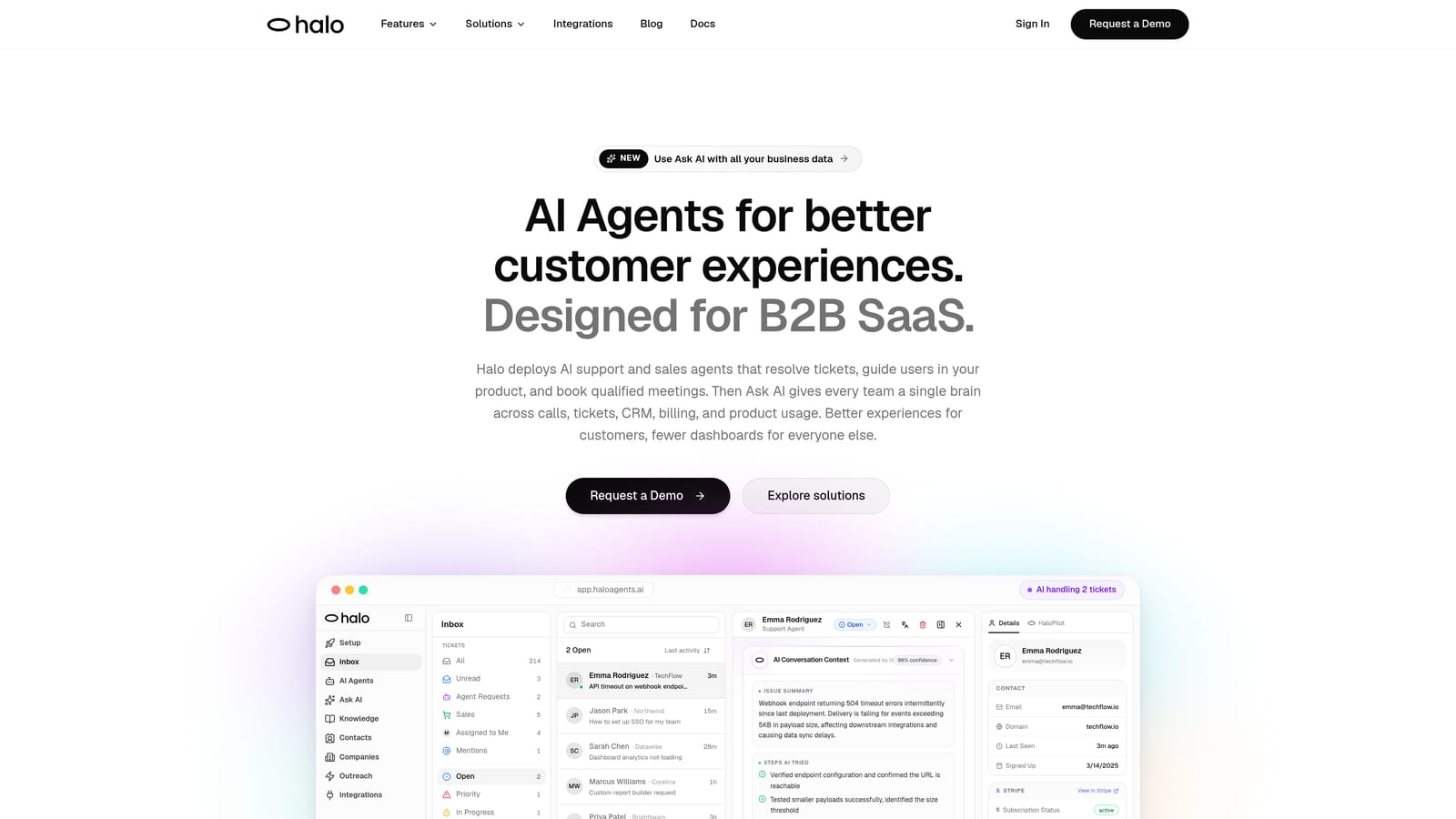
Halo AI is an AI-first customer support platform purpose-built for B2B SaaS teams that need support to scale without scaling headcount.
Where This Tool Shines
Most support platforms started as helpdesks and bolted AI on afterward. Halo was designed from the ground up around autonomous resolution, which means the AI isn't an add-on feature: it's the core of how the platform operates. Every interaction the AI handles teaches it something, so resolution quality improves continuously without manual tuning.
The page-aware context is a genuine differentiator. Rather than responding to support queries in a vacuum, Halo's chat widget understands which page a user is currently on within your product and can provide visual UI guidance specific to that context. For complex SaaS products where "how do I do X?" depends entirely on where the user is in the workflow, this changes the quality of automated support meaningfully.
Key Features
Page-Aware AI Agents: The AI understands the user's current product context and provides guidance specific to where they are in the interface, not generic help center responses.
Autonomous Ticket Resolution with Continuous Learning: AI agents close tickets end-to-end and learn from every interaction, improving resolution rates over time without manual retraining.
Smart Inbox with Business Intelligence: Goes beyond standard support analytics to surface customer health signals, revenue intelligence, and anomaly detection — giving support data strategic value.
Auto Bug Ticket Creation: When users report issues, Halo automatically creates structured bug reports in connected systems, eliminating manual handoff between support and engineering.
Live Agent Handoff with Full Context: Complex issues escalate to human agents with the entire conversation context preserved, so agents never start from scratch.
Integration Ecosystem: Connects to Linear, Slack, HubSpot, Intercom, Stripe, Zoom, PandaDoc, and Fathom, making it a hub across your full business stack.
Best For
Product-led B2B SaaS companies with growing support volumes who want AI to handle routine tickets autonomously, surface business intelligence from support interactions, and integrate tightly with engineering and revenue tools — without migrating to a new helpdesk.
Pricing
Contact for pricing. Halo is positioned for B2B SaaS teams and enterprise buyers; pricing is customized based on team size and integration requirements.
2. Intercom
Best for: Mid-market SaaS teams wanting a mature messaging platform with a capable AI agent and strong onboarding tools.
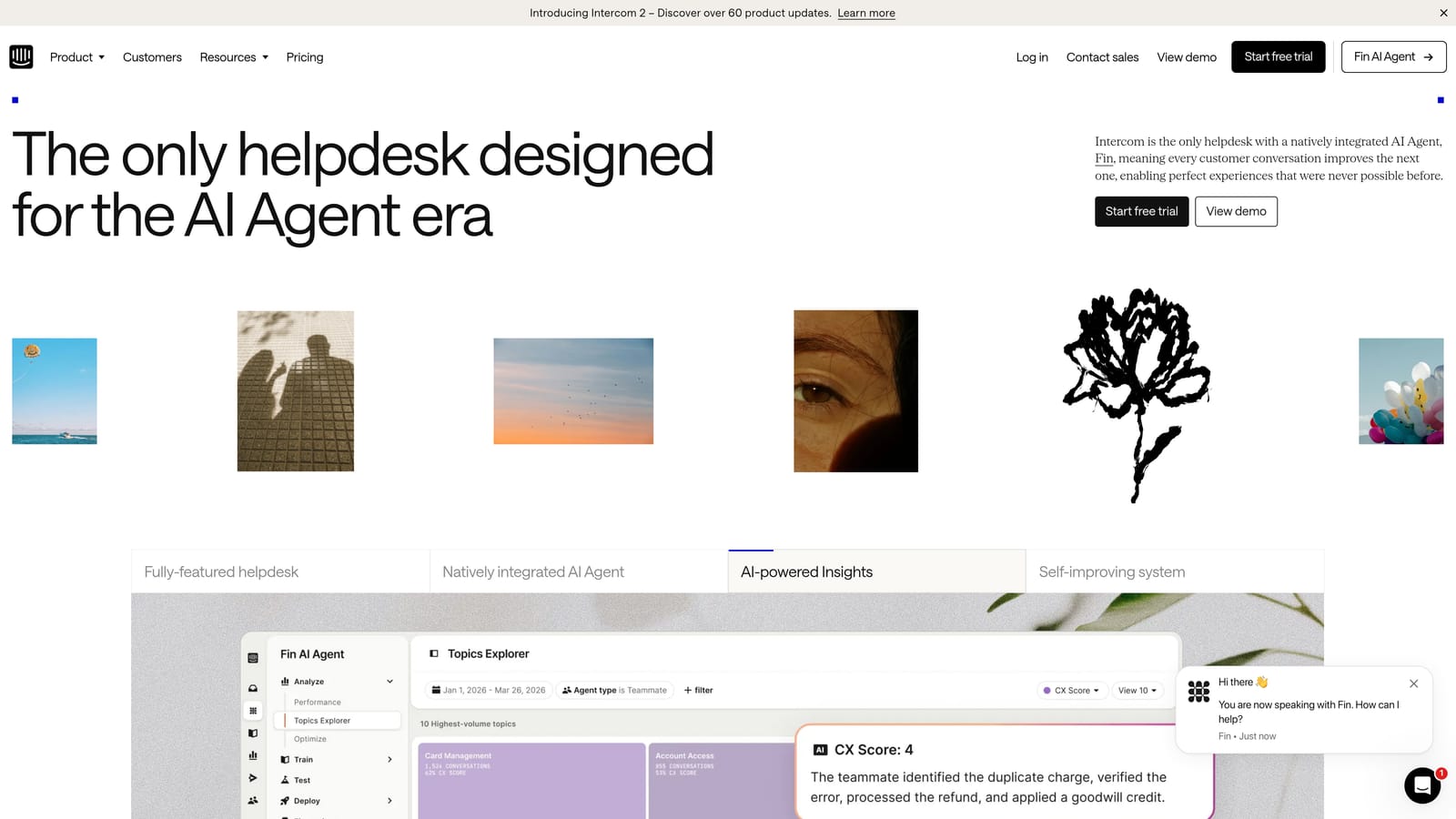
Intercom is one of the most established customer messaging platforms, combining in-app chat, onboarding flows, and Fin, its LLM-powered AI agent for autonomous query resolution.
Where This Tool Shines
Intercom's strength is the breadth of the platform. Beyond support, it handles product tours, onboarding sequences, and proactive messaging, making it a reasonable choice for teams that want a single platform covering customer communication across the lifecycle. Fin AI Agent has matured considerably and can resolve a meaningful portion of queries using your help center content and custom answers without human involvement.
The integration marketplace is extensive, and Intercom's UI is polished and well-documented, which reduces time-to-value for teams deploying it for the first time. For teams that are already invested in Intercom for product messaging, adding AI-powered support resolution is a natural extension rather than a platform switch.
Key Features
Fin AI Agent: Built on large language models, Fin resolves support queries autonomously using help center content and custom-trained answers.
In-App Messaging and Product Tours: Onboarding flows and proactive messaging built into the same platform as support.
300+ Integration Marketplace: Connects to a wide range of CRM, billing, and productivity tools.
Omnichannel Coverage: Handles chat, email, phone, and messaging channels from a unified inbox.
Reporting and Analytics: Dashboards for resolution rates, CSAT, and team performance.
Best For
Mid-market SaaS teams that want a unified platform for support and customer messaging, particularly those already using Intercom for onboarding or product communication who want to add AI resolution without switching platforms.
Pricing
Tiered plans with AI features available on higher tiers. Full pricing details are available on the Intercom website. Can become expensive at scale.
3. Zendesk
Best for: Enterprise teams with complex routing requirements, multi-brand support, and strict SLA management needs.
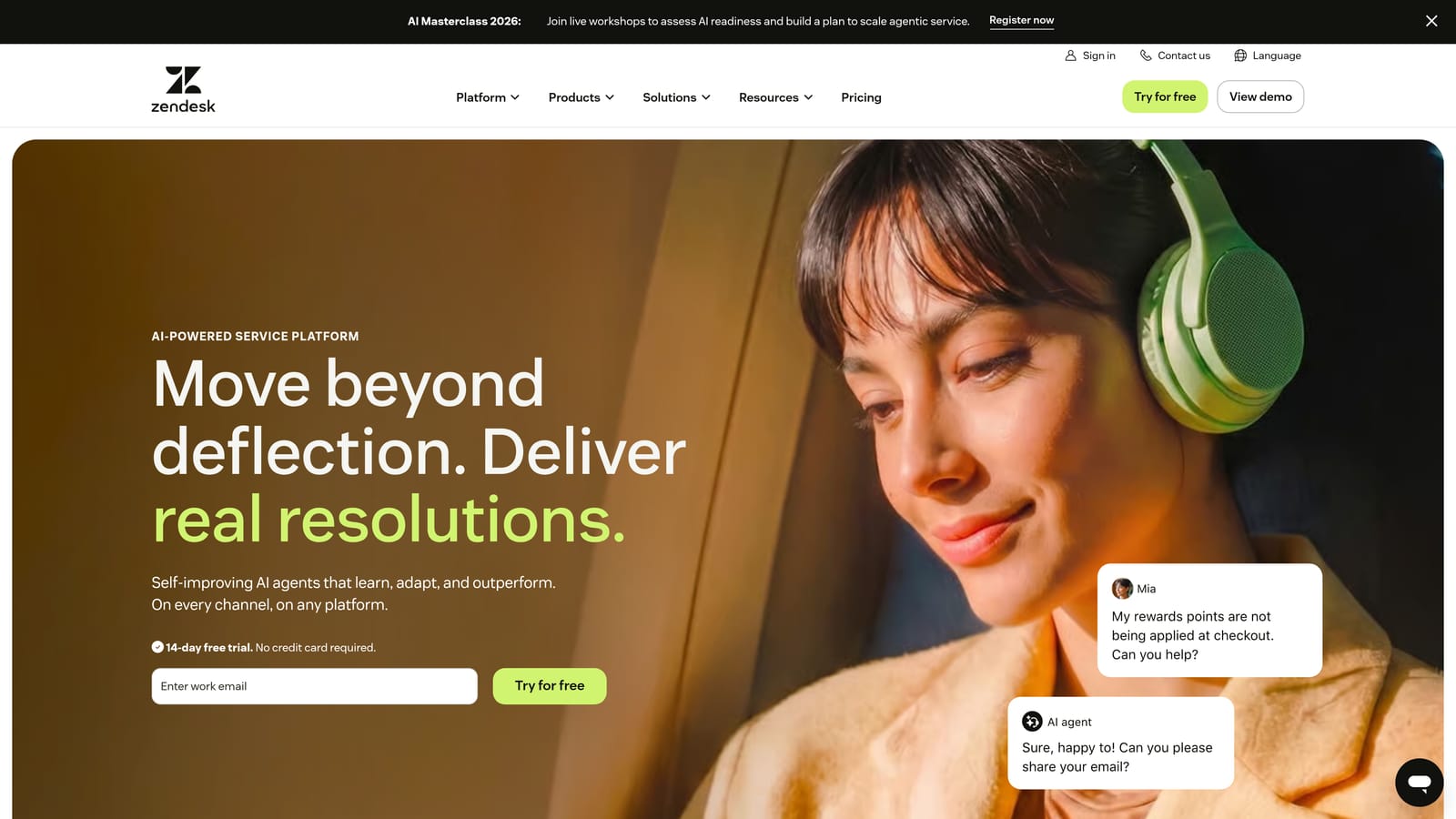
Zendesk is the market-leading enterprise helpdesk, with Zendesk AI layered on top to add intelligent triage, suggested replies, and autonomous agent capabilities.
Where This Tool Shines
Zendesk's configurability is its primary advantage. For organizations with complex ticket routing logic, multiple brands or product lines, multi-language support requirements, and strict SLA enforcement, Zendesk provides the infrastructure to handle it. The platform has been refined over nearly two decades, and the ecosystem of apps, integrations, and implementation partners is unmatched in depth.
The AI features have improved substantially, though they remain layered onto a legacy architecture rather than built from the ground up for autonomous resolution. Teams that need a proven, enterprise-grade helpdesk with AI assistance will find Zendesk reliable. Teams prioritizing autonomous AI resolution as the primary capability may find the AI feels like an enhancement rather than the core product.
Key Features
Zendesk AI: Intelligent triage, suggested replies, and autonomous AI agents for ticket deflection and resolution.
Advanced Routing and SLA Management: Highly configurable rules for complex multi-team, multi-brand, and multi-language environments.
Large App Marketplace: Hundreds of integrations covering CRM, billing, analytics, and productivity tools.
Multi-Channel Support: Email, chat, voice, social, and messaging channels in a unified workspace.
Enterprise Reporting: Detailed analytics on team performance, SLA compliance, and customer satisfaction.
Best For
Enterprise support organizations with high ticket volumes, complex routing requirements, and dedicated operations teams who can configure and maintain the platform. Also well-suited for companies that need multi-brand or multi-language support infrastructure.
Pricing
Suite plans at varying tiers; AI features are included in higher-tier plans. Full pricing is available on the Zendesk website.
4. Freshdesk
Best for: Growing teams and SMBs that need a capable helpdesk with AI assistance at an accessible price point.
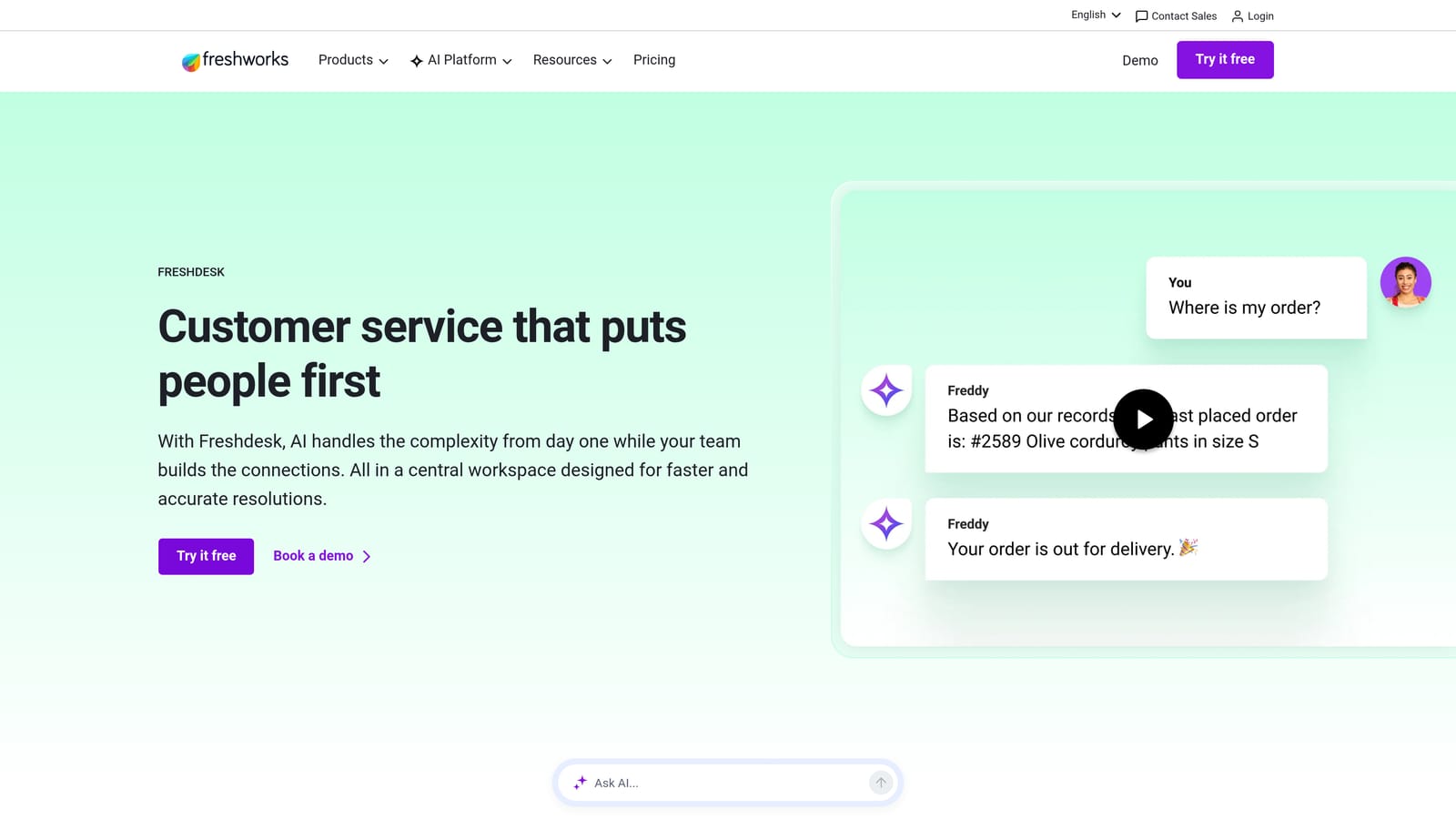
Freshdesk is a cost-effective helpdesk platform from Freshworks, featuring Freddy AI for ticket categorization, suggested responses, and customer-facing automation, with a generous free tier for teams just getting started.
Where This Tool Shines
Freshdesk's value proposition is clear: you get a well-rounded helpdesk with solid omnichannel coverage, reasonable AI assistance, and competitive pricing, including a free plan that's genuinely usable for small teams. For companies that don't yet need deep autonomous AI resolution but want structured ticket management with AI-assisted workflows, Freshdesk delivers strong value per dollar.
Being part of the broader Freshworks suite is an advantage for teams already using Freshworks CRM or ITSM tools, since data flows between products with less integration overhead. The platform won't match AI-first platforms on autonomous resolution depth, but for teams where human agents are still handling most tickets and AI is a productivity layer, it's a practical choice.
Key Features
Freddy AI: Handles ticket triage, suggested replies for agents, and a customer-facing chatbot for deflection.
Omnichannel Inbox: Email, chat, phone, and social channels managed from a single workspace.
Free Plan: A functional free tier makes it accessible for early-stage teams before committing to paid plans.
Freshworks Suite Integration: Connects natively with Freshworks CRM, ITSM, and other products in the ecosystem.
Automation and Workflow Builder: Rule-based automation for routing, escalation, and ticket management.
Best For
SMBs and growing mid-market teams that need structured helpdesk functionality with AI assistance, particularly those already in the Freshworks ecosystem or operating on a budget that makes Zendesk or Intercom feel expensive.
Pricing
Free plan available; paid plans scale with features and agent count. Full pricing details on the Freshdesk website.
5. Tidio
Best for: E-commerce businesses that need conversational AI chat with native integrations for Shopify, WooCommerce, and BigCommerce.
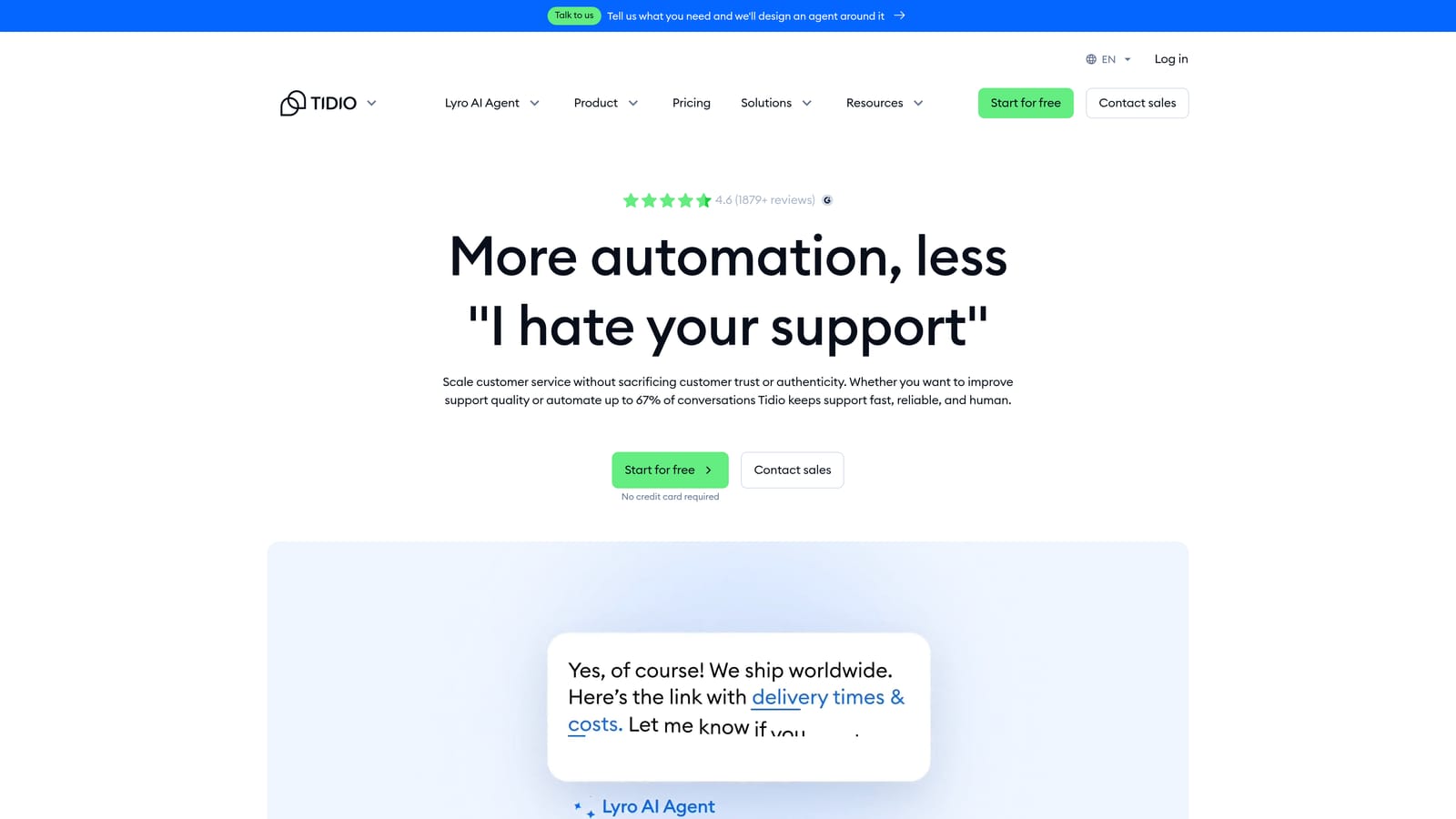
Tidio is a live chat and AI chatbot platform built with e-commerce in mind, featuring Lyro AI for conversational automation and tight integrations with major e-commerce platforms.
Where This Tool Shines
For e-commerce teams, Tidio's native integrations with Shopify, WooCommerce, and BigCommerce mean setup is fast and the AI has immediate access to order data, product information, and customer history. Lyro AI handles common queries conversationally, deflecting questions about order status, returns, and product details without agent involvement.
The visual flow builder allows non-technical teams to build automation sequences without writing code, which reduces dependency on developers for support workflow changes. Tidio is less suited to complex B2B SaaS support scenarios, but for e-commerce and SMB contexts where the support queries are relatively predictable, it's an efficient and affordable solution.
Key Features
Lyro AI Chatbot: Conversational AI that handles common queries using your existing content and product data.
Visual Flow Builder: No-code automation builder for creating support workflows without developer involvement.
Native E-Commerce Integrations: Direct connections to Shopify, WooCommerce, and BigCommerce for order and product context.
Live Chat with Agent Takeover: Agents can step into any conversation when the AI reaches its limits.
Email Marketing Automation: Included in the platform, adding value beyond support for small teams.
Best For
E-commerce businesses and SMBs that want affordable conversational AI with minimal setup, particularly those running on Shopify or WooCommerce who want support automation without a complex enterprise platform.
Pricing
Free plan available; Lyro AI is available on paid plans. Full pricing on the Tidio website.
6. Drift (Salesloft)
Best for: B2B companies where website chat serves both inbound sales qualification and support routing simultaneously.
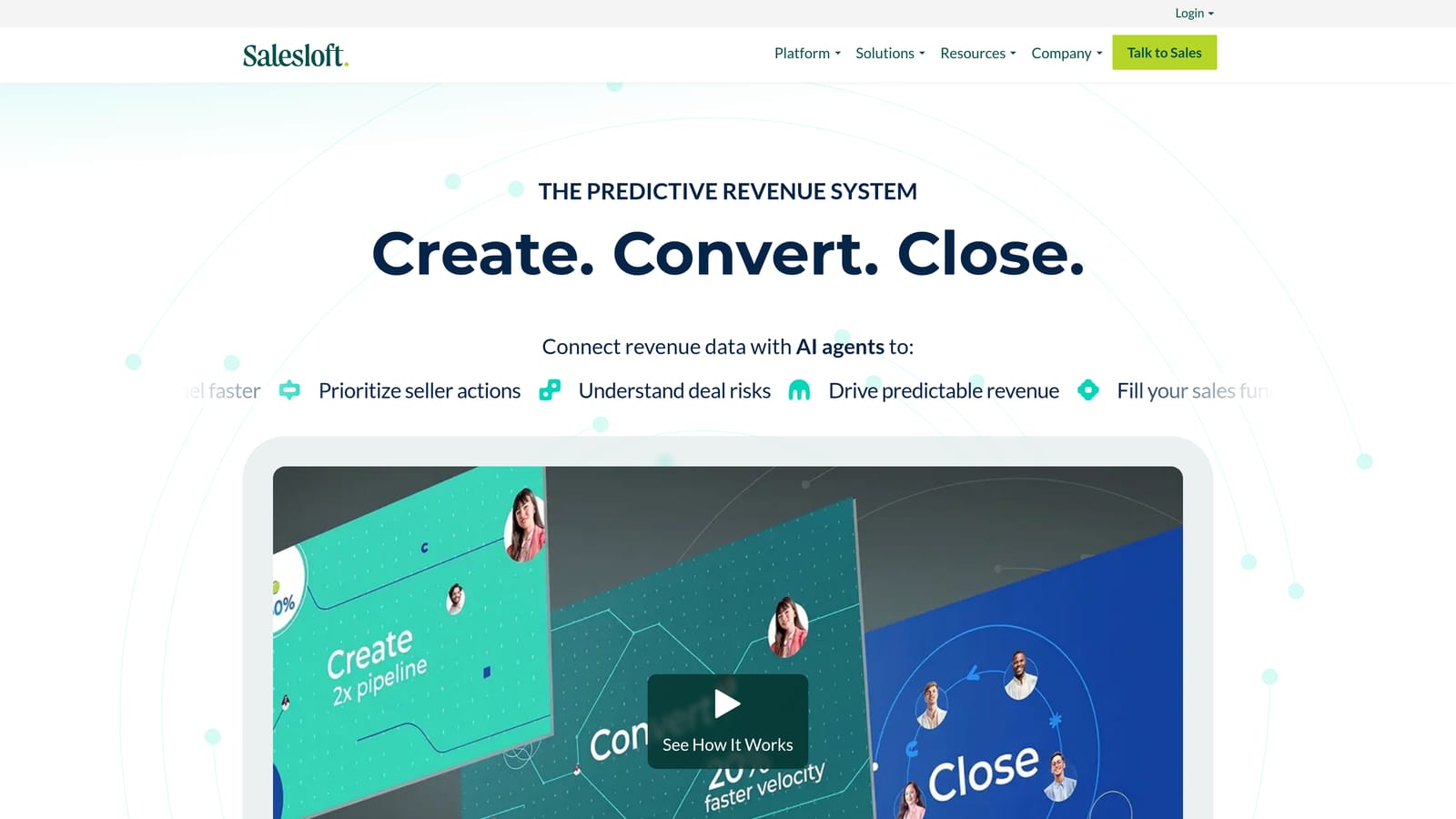
Drift, now part of Salesloft, is an AI-powered conversational platform that blends support routing with sales qualification, making it a strong fit for revenue-focused B2B teams.
Where This Tool Shines
Drift's core insight is that website chat isn't purely a support channel for B2B companies: it's often where prospects and customers coexist, and routing them correctly in real time has revenue implications. The platform handles both functions simultaneously, qualifying visitors for sales while routing support queries appropriately, with AI managing the initial conversation layer.
Since the Salesloft acquisition, the platform has leaned further into revenue use cases. Teams that need a pure support resolution tool may find the focus has shifted. But for B2B companies where sales and support share the same chat channel and where pipeline impact matters as much as ticket deflection, Drift's positioning is genuinely useful.
Key Features
AI Conversations for Dual-Purpose Routing: Qualifies leads and routes support queries simultaneously within the same conversation flow.
Revenue-Focused Reporting: Analytics tied to pipeline impact, not just support resolution metrics.
Meeting Scheduling and Sales Automation: Books demos and sales calls directly from chat conversations.
CRM Integrations: Deep integrations with Salesforce, HubSpot, and other major CRMs.
Visitor Segment Playbooks: Different conversation flows for different visitor types and intents.
Best For
B2B SaaS and enterprise teams where the website chat channel serves both inbound sales and customer support, and where connecting support interactions to revenue outcomes is a priority alongside ticket resolution.
Pricing
Enterprise pricing; contact Salesloft for quotes. Not typically suited for small teams or pure support use cases.
7. Help Scout
Best for: Teams that prioritize human-quality support experiences and want AI to make agents faster, not replace them.
Help Scout is a shared inbox platform built around human-first support, with AI Summarize and AI Assist features designed to improve agent productivity without pushing toward bot-first resolution.
Where This Tool Shines
Help Scout is a deliberate counterpoint to the autonomous resolution trend. The platform's philosophy is that great support is human, and AI should accelerate agents rather than replace them. AI Summarize condenses long email threads so agents get context instantly, and AI Assist helps draft replies faster, but the human is always in the loop.
The interface is clean and minimal by design, which reduces cognitive load for support teams handling high volumes of email-based tickets. Collision detection prevents two agents from working the same conversation simultaneously. For companies where support quality and relationship depth matter more than ticket deflection rates, Help Scout's approach is intentionally different from the automation-first platforms on this list.
Key Features
AI Summarize: Condenses long conversation threads so agents can get up to speed instantly without reading every message.
AI Assist: Helps agents draft replies faster using AI suggestions, keeping humans in control of the final response.
Shared Inbox with Collision Detection: Prevents duplicate responses by showing when another agent is already working a conversation.
Docs Knowledge Base: Built-in tool for creating and managing help center content.
Clean Agent Interface: Minimal, focused UI designed to reduce friction for agents handling email-heavy support queues.
Best For
Teams where support quality and human relationship-building are competitive differentiators, and where the goal is faster, better human responses rather than autonomous ticket deflection. Not the right choice if reducing human agent involvement is the primary objective.
Pricing
Per-user pricing with straightforward plan tiers. Full pricing available on the Help Scout website.
8. Kustomer
Best for: High-volume consumer support teams that need every interaction tied to a complete customer timeline and CRM context.
Kustomer is a CRM-native support platform that ties every interaction to a unified customer timeline, with AI features for routing, suggested responses, and chatbot automation built for high-volume consumer support environments.
Where This Tool Shines
Kustomer's differentiator is context depth. Rather than treating each support ticket as an isolated event, the platform surfaces the customer's complete history across every channel within the conversation view. Agents see purchase history, previous tickets, subscription status, and interaction patterns without switching tools, which changes the quality and speed of resolution for complex customer situations.
The AI features handle routing and response suggestions competently, and the chatbot handles deflection for common queries. Kustomer is more complex to deploy than lighter-weight tools and typically requires dedicated operations resources to configure effectively. It's built for teams where customer data richness directly improves support outcomes.
Key Features
Unified Customer Timeline: Every interaction across every channel is tied to a single customer record, visible within the support conversation.
AI-Powered Routing and Suggested Responses: Intelligent routing based on customer attributes and AI-suggested replies to speed agent responses.
Chatbot Automation: Customer-facing bot for deflecting common queries before they reach human agents.
Omnichannel Coverage: Email, chat, SMS, social, and voice channels managed from a unified platform.
Deep CRM Data Access: Full customer data accessible within every support conversation without switching to a separate CRM tool.
Best For
High-volume consumer support teams, particularly in retail, subscription, or marketplace businesses, where customer history and CRM context directly improve resolution quality and where dedicated operations resources are available for deployment and configuration.
Pricing
Per-user enterprise pricing; contact Kustomer for quotes. Better suited to teams with the budget and ops capacity for an enterprise CRM-native platform.
9. Forethought
Best for: Teams with existing helpdesk investments that want to add AI intelligence without a full platform migration.
Forethought is an AI intelligence layer that sits on top of existing helpdesks like Zendesk and Salesforce Service Cloud, adding autonomous deflection, intelligent triage, and agent productivity features without requiring teams to abandon their current infrastructure.
Where This Tool Shines
Forethought solves a specific and common problem: you've invested significantly in a helpdesk, your team knows it well, and migration isn't realistic, but you need better AI capabilities than your current platform provides natively. Rather than replacing the helpdesk, Forethought enhances it with a dedicated AI layer that handles deflection, routing intelligence, and agent assistance on top of your existing system.
The three-product architecture (Solve for deflection, Triage for routing, Assist for agent productivity) allows teams to deploy incrementally, starting with the component that addresses the most pressing need. This modular approach reduces deployment risk compared to full platform replacements, and the analytics on AI resolution rates give teams clear visibility into what the AI is actually contributing.
Key Features
Solve: Customer-facing AI agent that deflects tickets before they reach human agents, using your existing knowledge base and content.
Triage: Intelligent ticket routing and prioritization that improves on the basic routing rules in most helpdesks.
Assist: AI-powered suggestions and productivity features for human agents handling tickets in the existing helpdesk interface.
No Migration Required: Works on top of Zendesk, Salesforce Service Cloud, and other major helpdesks without replacing them.
AI Performance Analytics: Clear reporting on resolution rates, deflection performance, and where AI is and isn't working.
Best For
Enterprise teams with established helpdesk investments, particularly on Zendesk or Salesforce Service Cloud, who want to improve AI resolution capabilities without a platform migration. Not a standalone support platform; requires an existing helpdesk as the foundation.
Pricing
Enterprise pricing; contact Forethought for quotes. Requires an existing helpdesk investment in addition to Forethought's own cost.
Which Platform Fits Your Situation
The right automated customer support platform depends less on feature checklists and more on your architecture: what you're building, how complex your product is, and what role you want AI to play in your support operation.
Here's how the tools on this list map to common situations:
AI-first with deep product and business intelligence integration: Halo AI is built specifically for B2B SaaS teams that want autonomous resolution, page-aware context, and business intelligence signals beyond standard support analytics.
Enterprise helpdesk with AI layers: Zendesk remains the most configurable option for large organizations with complex routing, multi-brand requirements, and SLA management needs. The AI capabilities are improving but are layered onto a mature helpdesk architecture.
Mid-market messaging and onboarding: Intercom makes the most sense for teams already using the platform for product communication who want to extend into AI-powered support resolution without switching platforms.
SMB and budget-conscious teams: Freshdesk's free tier and competitive pricing make it the practical starting point for growing teams that need structured helpdesk functionality before investing in AI-first platforms.
E-commerce chat automation: Tidio's native Shopify and WooCommerce integrations make it the obvious choice for e-commerce teams that want conversational AI without enterprise complexity or pricing.
Revenue and support in one channel: Drift (Salesloft) is built for B2B teams where website chat serves both inbound sales qualification and support routing, and where pipeline impact matters alongside ticket deflection.
Human-touch support teams: Help Scout is the right call when support quality and relationship depth are competitive differentiators and the goal is faster humans, not fewer humans.
CRM-native high-volume consumer support: Kustomer fits teams where customer history context directly improves resolution quality and where dedicated ops resources are available for deployment.
AI overlay on an existing stack: Forethought is the practical choice for teams with established Zendesk or Salesforce Service Cloud investments who want better AI without a full migration.
Your support team shouldn't scale linearly with your customer base. Let AI agents handle routine tickets, guide users through your product, and surface business intelligence while your team focuses on complex issues that need a human touch. See Halo in action and discover how continuous learning transforms every interaction into smarter, faster support.