9 Best Automated Support Ticket Systems in 2026
This guide ranks the 9 best automated support ticket systems in 2026, evaluating each platform on AI resolution capability, automation depth, integration ecosystem, and scalability for B2B SaaS teams. From AI-native agents that handle tickets end-to-end to established helpdesks with powerful automation layers, it delivers honest assessments of pricing and ideal use cases so teams can choose confidently without wading through endless demos.
 Matt PattoliFounder15 min read
If your support team is drowning in repetitive tickets, the problem isn't headcount — it's the system. The best automated support ticket systems don't just route and log requests; they resolve them, learn from them, and surface intelligence your whole business can use.
This list covers nine platforms worth serious consideration in 2026, from AI-native agents that handle tickets end-to-end to established helpdesks with strong automation layers. We evaluated each on ticket resolution capability, automation depth, integration ecosystem, analytics quality, and scalability for B2B SaaS teams.
Whether you're replacing an aging helpdesk, adding AI on top of an existing workflow, or building a support stack from scratch, this guide cuts through the noise. Honest assessments of pricing, ideal use cases, and where each tool genuinely shines — so you can make a confident decision without booking a dozen demos first.
1. Halo AI
Best for: B2B SaaS teams that want AI to resolve tickets end-to-end, not just assist agents.
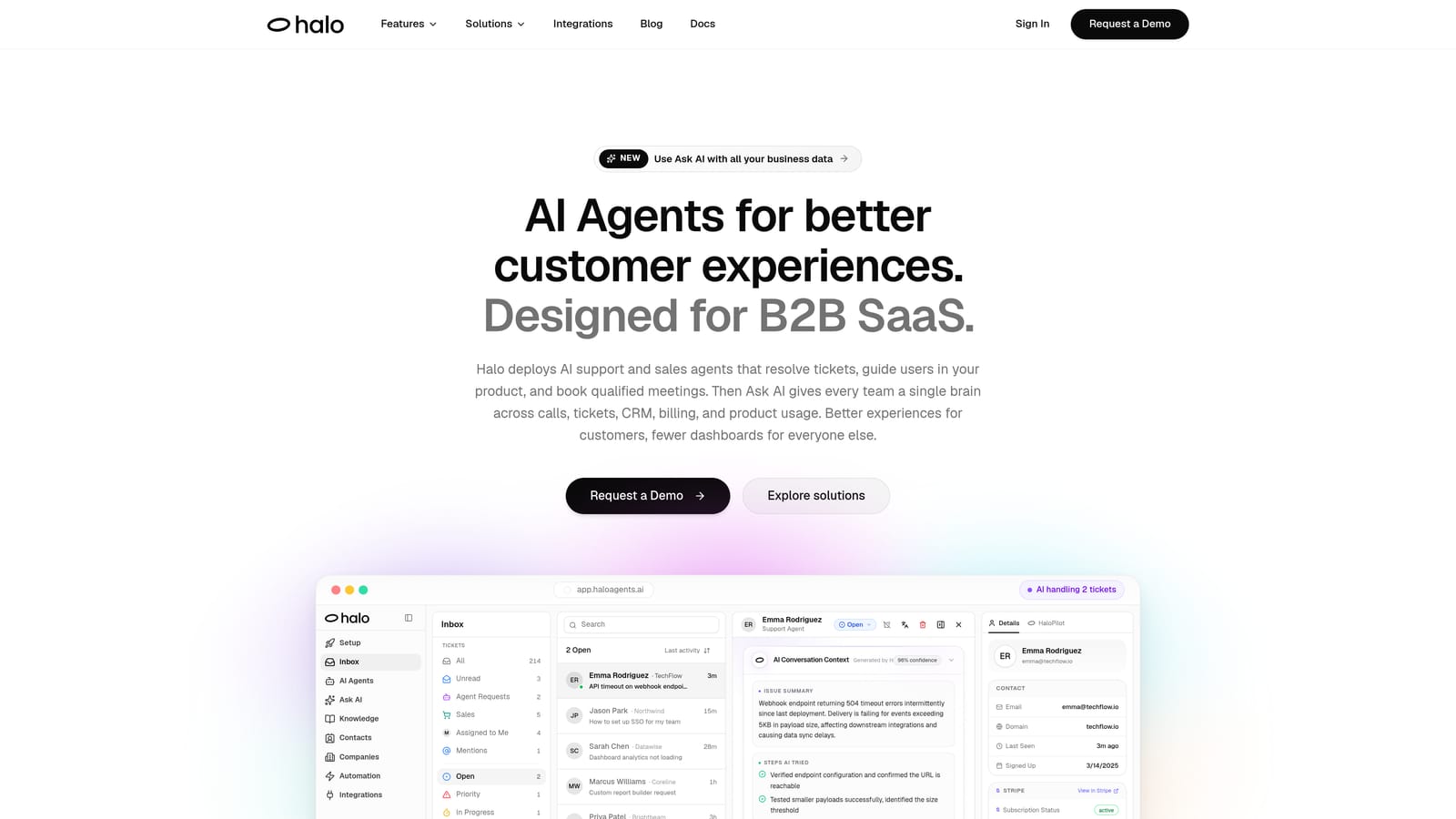
Halo AI is an AI-native customer support platform that deploys intelligent agents to resolve tickets, guide users through your product with page-aware context, and surface business intelligence — all while learning from every interaction.
Where This Tool Shines
The fundamental difference between Halo AI and most tools on this list is architecture. Rather than layering AI features onto a legacy helpdesk, Halo was built AI-first. That distinction matters: the system isn't suggesting replies for a human to approve — it's resolving tickets autonomously and escalating only when a human genuinely adds value.
The page-aware context capability is particularly notable for SaaS teams. The AI understands which screen a user is currently on and can deliver precise, visual UI guidance rather than generic documentation links. Combined with the smart inbox that surfaces customer health signals and revenue anomalies, Halo extends support intelligence into territory most helpdesks never reach.
Key Features
Page-Aware AI Agents: The AI sees the user's current screen context and delivers precise, visual UI guidance tailored to exactly where they are in your product.
Autonomous Ticket Resolution: AI agents handle tickets from first contact through to resolution, with intelligent handoff to live agents when complexity warrants it.
Auto Bug Ticket Creation: When users report issues, Halo automatically generates structured bug reports and logs them directly into Linear or connected tools — no manual triage required.
Smart Inbox with Business Intelligence: Goes beyond support metrics to surface customer health signals, revenue intelligence, and product usage anomalies that inform decisions across your whole team.
Deep Integration Ecosystem: Connects natively with Linear, Slack, HubSpot, Intercom, Stripe, Zoom, PandaDoc, and Fathom — covering the modern B2B SaaS stack.
Best For
Product-led SaaS companies that want AI handling routine support from start to finish, teams using modern dev and sales stacks who need support intelligence to flow across tools, and organizations ready to move beyond ticket management into genuine autonomous resolution.
Pricing
Contact for pricing. Visit haloagents.ai to learn more and see the platform in action.
2. Zendesk
Best for: Large enterprise teams needing a mature, highly configurable multi-channel support platform.
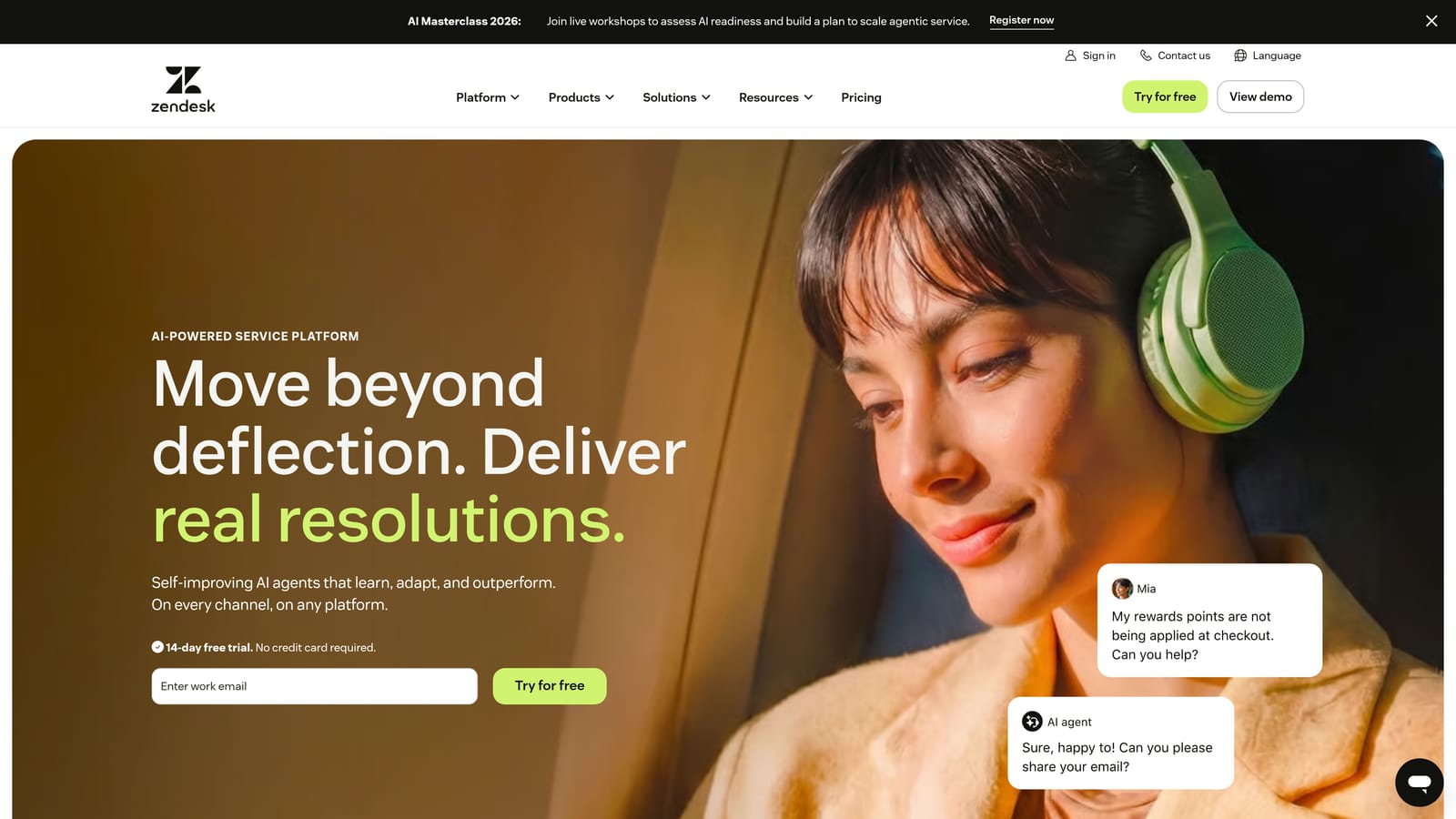
Zendesk is the industry's most established helpdesk platform, offering a mature automation engine, AI-powered triage and suggestions, and a vast integration marketplace for enterprise support operations.
Where This Tool Shines
Zendesk's strength is depth of configuration. The triggers and automations engine can handle genuinely complex multi-step routing logic, SLA management, and escalation rules that enterprise teams have spent years refining. If your support operation has intricate requirements across multiple channels and regions, Zendesk has almost certainly seen that use case before.
The AI layer, built through an OpenAI partnership, adds intelligent triage, suggested replies, and conversation summarization. It's an AI-augmented experience rather than an AI-native one, which means human agents remain central to the workflow. For teams that want AI assistance rather than AI autonomy, that's a feature rather than a limitation.
Key Features
Triggers and Automations Engine: Highly configurable multi-step routing logic that handles complex enterprise workflows, SLA rules, and escalation paths.
Zendesk AI: Intelligent triage, suggested replies, and conversation summarization powered by an OpenAI partnership.
Omnichannel Coverage: Email, chat, voice, social, and messaging channels unified in a single platform with consistent routing rules.
Integration Marketplace: Hundreds of third-party integrations covering virtually every business tool category.
Advanced Reporting and SLA Management: Detailed analytics dashboards and configurable SLA policies for teams with formal service commitments.
Best For
Large support teams with dedicated admins who can invest time in configuration, enterprises needing formal SLA management and compliance features, and organizations already embedded in the Zendesk ecosystem with years of workflow history.
Pricing
Starts at approximately $19/agent/month (Suite Team plan). Enterprise pricing is available on request and scales significantly with seat count and feature requirements.
3. Freshdesk
Best for: Growing teams that need strong omnichannel coverage at a more accessible price point than enterprise alternatives.
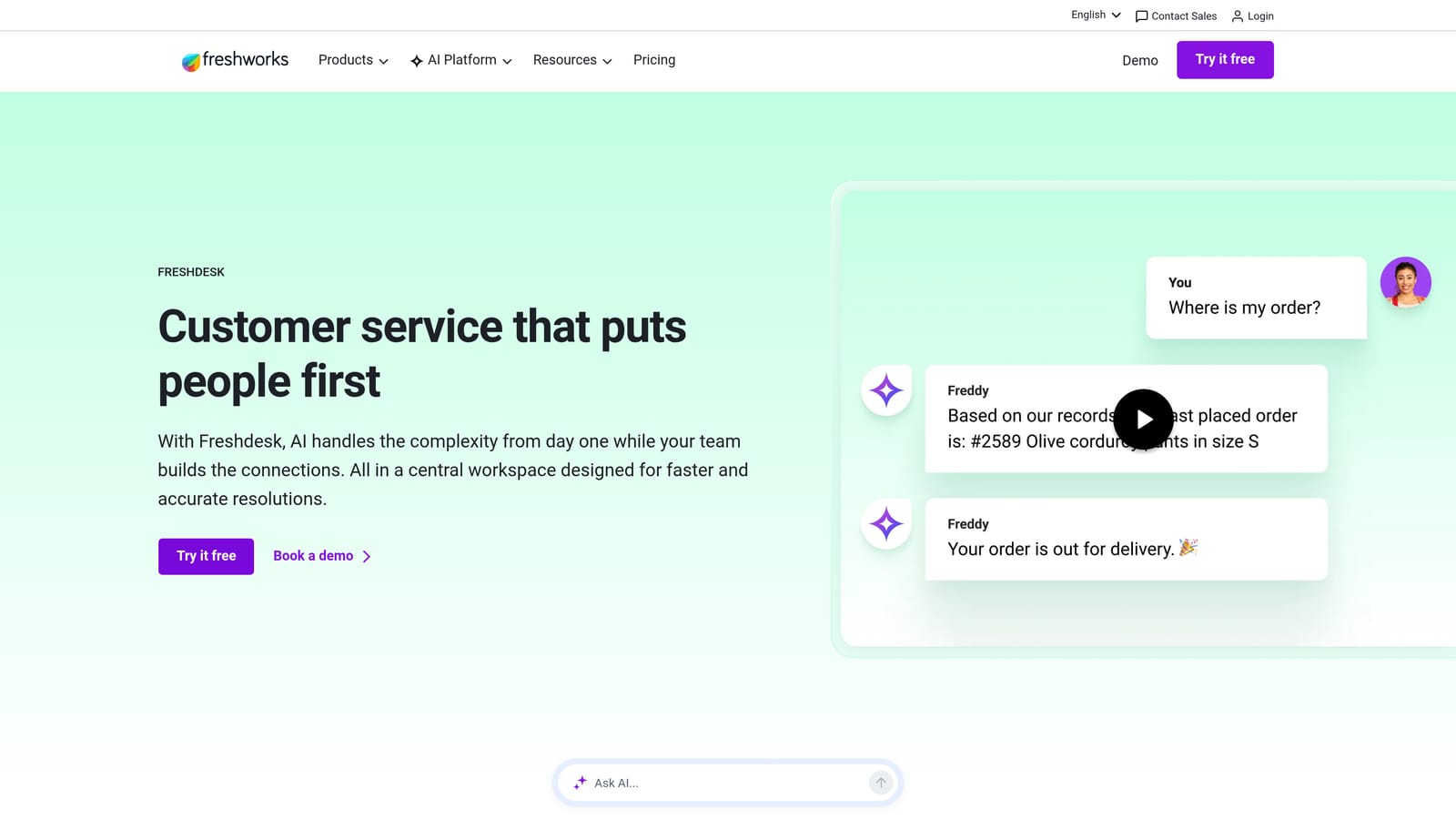
Freshdesk is a full-featured helpdesk with Freddy AI built in, offering omnichannel ticketing and solid automation at a price point more accessible than many enterprise alternatives.
Where This Tool Shines
Freshdesk hits a sweet spot for teams that have outgrown email-based support but aren't ready for the complexity and cost of enterprise platforms. The Freddy AI layer handles auto-triage, suggested responses, and self-service article recommendations without requiring a dedicated admin to configure everything from scratch.
The free tier is genuinely useful for small teams getting started, and the pricing steps are clear enough that you can plan your cost trajectory as you scale. Collision detection — which prevents multiple agents from working the same ticket simultaneously — is a small feature that saves real friction in practice.
Key Features
Freddy AI: Handles auto-triage, suggested responses, and knowledge base article recommendations to reduce agent workload on common queries.
Omnichannel Coverage: Email, chat, phone, social media, and WhatsApp in a single unified inbox with consistent routing rules.
Collision Detection: Alerts agents when someone else is already viewing or replying to a ticket, preventing duplicated effort.
Scenario Automations: Execute multiple ticket actions in a single click — reassign, tag, change status, and notify in one step.
Free Tier: A genuinely functional starting point for small teams before committing to paid plans.
Best For
SMB and mid-market teams moving beyond email-based support, organizations that need omnichannel coverage without enterprise complexity, and budget-conscious teams that want AI assistance built in at a reasonable price point.
Pricing
Free tier available with limits. Paid plans start at approximately $15/agent/month. Freddy AI Copilot and Freddy Self Service are available as add-on tiers.
4. Intercom
Best for: SaaS teams that want conversational support integrated with product usage data and customer engagement workflows.
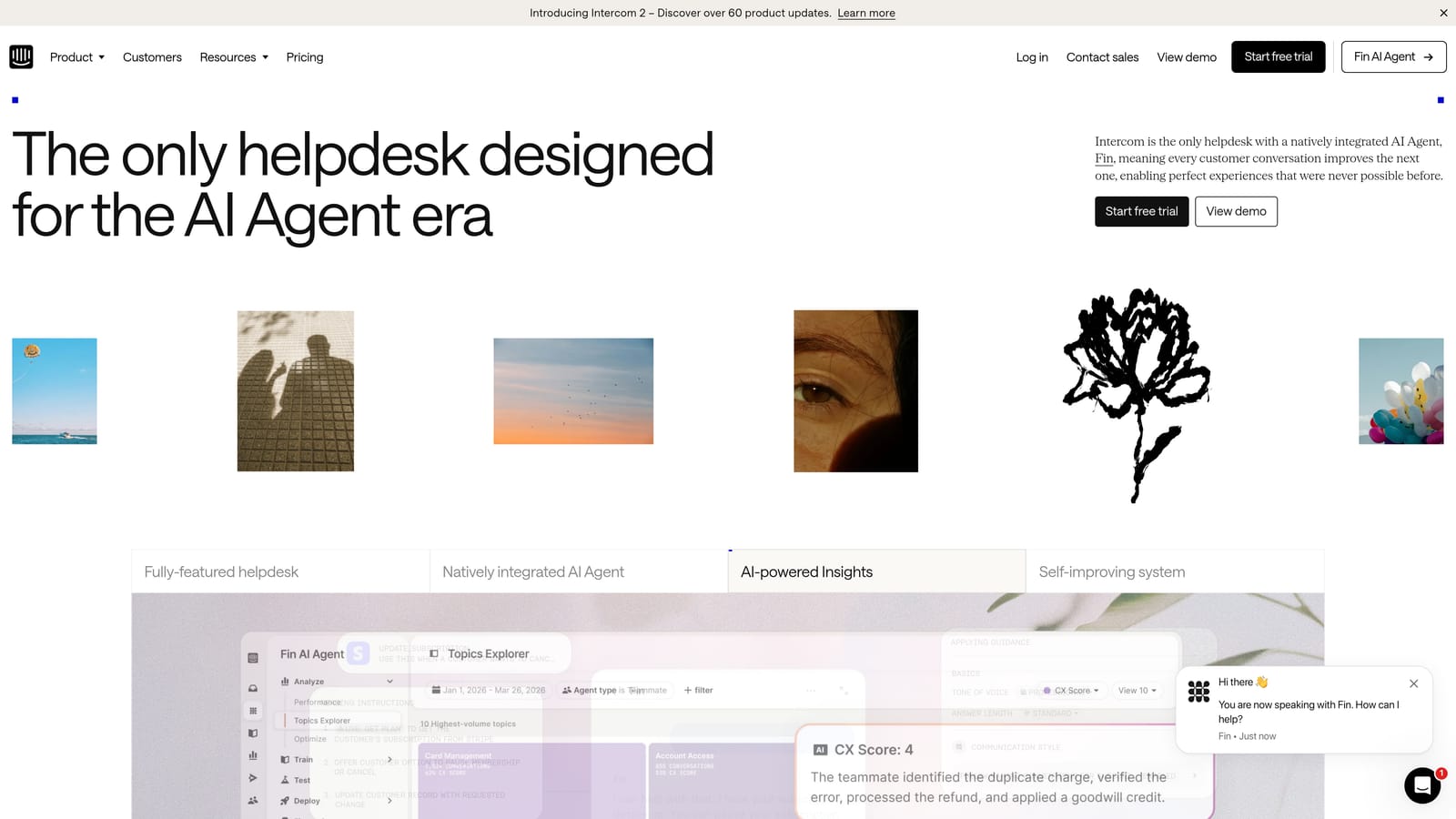
Intercom is a conversational support platform with Fin AI Agent handling queries end-to-end, deeply integrated with product usage data for personalized, context-aware customer interactions.
Where This Tool Shines
Intercom's Fin AI Agent is one of the more capable conversational AI implementations in the market, handling support queries autonomously within the Intercom Messenger. What differentiates it from generic AI assistants is the product data integration: Fin can personalize responses based on a user's plan, behavior, and attributes, which means the same question from a free-tier user and an enterprise customer can receive genuinely different, contextually appropriate answers.
Intercom also covers territory beyond support: onboarding flows, proactive messaging, and product tours all live in the same platform. For teams where support is part of a broader customer engagement strategy, that consolidation has real value. It's worth noting that Halo AI integrates with Intercom, so teams already invested in Intercom's messenger can layer Halo's resolution capabilities on top.
Key Features
Fin AI Agent: Resolves support conversations autonomously within Intercom Messenger, handling queries from start to finish without agent involvement.
Product Data Integration: Personalizes AI responses based on user plan, behavior, and custom attributes for context-aware support.
Unified Customer Engagement: Support, onboarding, proactive messaging, and product tours in a single platform.
AI Copilot for Agents: Assists human agents in the shared inbox with suggested responses and context surfacing.
Robust API and Webhooks: Supports custom workflows and integrations with your existing business systems.
Best For
SaaS teams where support is part of a broader customer lifecycle strategy, companies that want AI-powered personalization tied to product usage data, and organizations already using Intercom for onboarding and engagement who want to consolidate tooling.
Pricing
Starts at approximately $39/seat/month. Fin AI usage-based pricing applies separately, which means costs can scale with conversation volume in ways worth modeling before committing.
5. Help Scout
Best for: Teams that prioritize relationship quality and want support to feel like a personal email conversation rather than a ticket system.
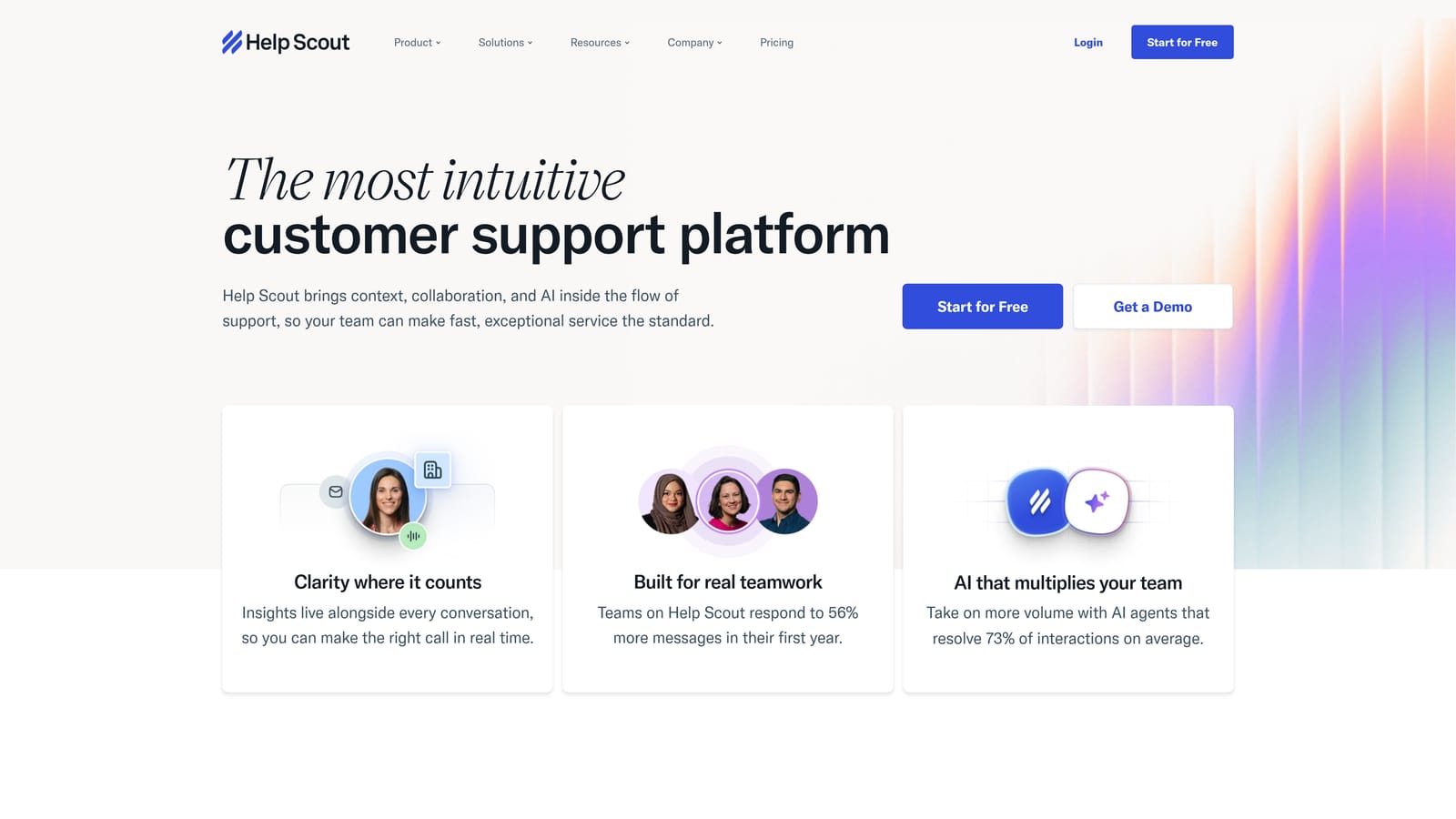
Help Scout is a shared inbox-first helpdesk that keeps support feeling like email to customers, with AI tools for drafting, summarizing, and assisting agents without overwhelming the experience.
Where This Tool Shines
Help Scout's defining design choice is that customers never see ticket numbers. Every interaction looks and feels like a personal email reply. For teams where tone, warmth, and relationship quality are central to the brand experience, that distinction matters more than it might sound.
The AI additions — Summarize, Assist, and Drafts — are thoughtfully integrated: they make agents faster without turning support into a robotic exchange. The Beacon in-app widget handles contextual self-service and live chat, and the built-in Docs knowledge base means you're not paying extra for documentation hosting. The trade-off is that Help Scout's automation depth is lighter than Zendesk or Freshdesk, so teams with complex routing requirements may hit limits.
Key Features
No Ticket Numbers: Customers experience support as a personal email conversation, preserving relationship quality at scale.
AI Summarize, Assist, and Drafts: Helps agents respond faster with AI-generated summaries, suggestions, and draft replies without replacing the human voice.
Beacon Widget: In-app widget for contextual self-service, knowledge base access, and live chat without leaving your product.
Built-in Docs Knowledge Base: Included in all plans — no separate subscription required for documentation hosting.
Workflows: Automated routing, tagging, and follow-up rules for keeping the inbox organized without manual effort.
Best For
Teams where customer relationship quality is a brand priority, companies with straightforward support workflows that don't need deep automation complexity, and organizations that want a clean, low-friction tool their agents will actually enjoy using.
Pricing
Starts at approximately $20/user/month on the Standard plan. Pricing is transparent and predictable as teams scale.
6. Zoho Desk
Best for: Teams already operating within the Zoho ecosystem who want deep CRM integration with their support workflows.
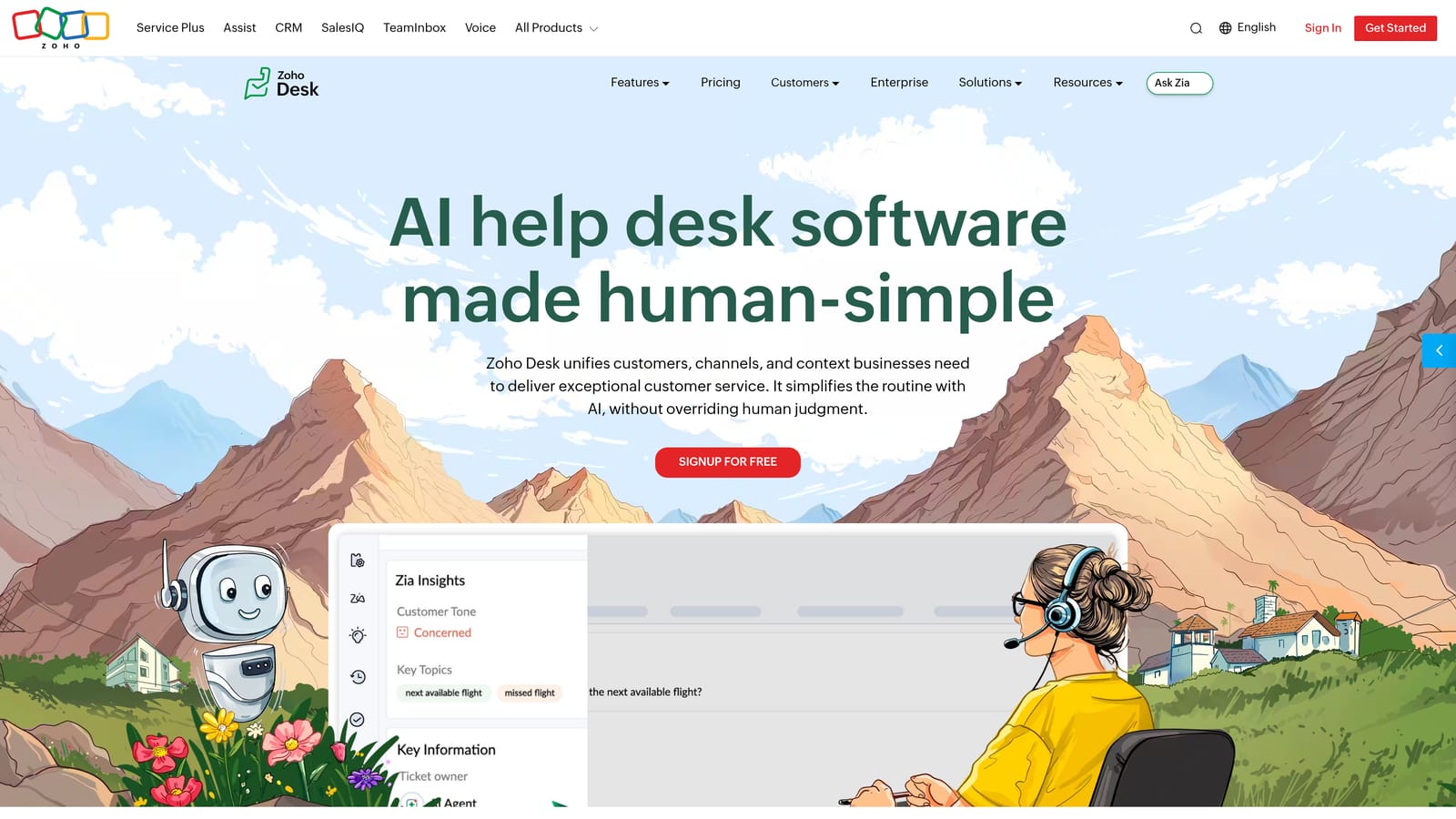
Zoho Desk is a context-aware helpdesk with Zia AI and deep Zoho CRM integration, making it a natural choice for teams already operating within the Zoho ecosystem.
Where This Tool Shines
If your team runs on Zoho CRM, the bi-directional sync with Zoho Desk is a genuine differentiator. Customer data flows both ways: agents see full CRM context inside every ticket, and support interactions update customer records automatically. That closed loop eliminates a lot of manual data entry and context-switching that plagues teams using disconnected tools.
Zia AI adds sentiment analysis, ticket tagging, and anomaly detection — a useful layer for teams managing high ticket volumes across multiple departments. The Blueprint feature for process automation is particularly strong for organizations that need to standardize complex, multi-step support workflows across different teams or regions.
Key Features
Zia AI: Provides sentiment analysis, automatic ticket tagging, anomaly detection, and response suggestions to reduce manual triage work.
Blueprint Process Automation: Standardizes multi-step support workflows with defined stages, ensuring consistent handling across agents and departments.
Bi-Directional Zoho CRM Sync: Customer data flows automatically between CRM and helpdesk, giving agents full context without switching tabs.
Multi-Department Support: Handles complex organizational structures with separate queues, teams, and workflows for different business units.
Competitive Pricing: Accessible price points, especially for teams already paying for other Zoho products in the suite.
Best For
Teams already using Zoho CRM who want seamless data flow into support, organizations with complex multi-department structures needing standardized workflows, and budget-conscious teams that want solid AI assistance without premium pricing.
Pricing
Free tier available. Paid plans start at approximately $14/agent/month, with strong value for teams using multiple Zoho products.
7. Tidio
Best for: Small teams and e-commerce businesses that need fast deployment and an accessible entry point into AI-assisted support.
Tidio is a lightweight combined live chat and helpdesk platform with Lyro AI chatbot, designed for teams that need fast deployment and accessible pricing without complex configuration.
Where This Tool Shines
Tidio's biggest advantage is setup speed. Teams can typically go from sign-up to live support in hours rather than weeks. The Lyro AI chatbot trains on your existing content and handles conversations autonomously, which is a meaningful capability for small teams that can't afford to staff chat coverage around the clock.
The visual automation builder makes it accessible to non-technical users, and the Shopify and WooCommerce integrations give e-commerce teams order context inside conversations. The trade-off is that Tidio is less suited to complex B2B support workflows with sophisticated routing requirements or deep integration needs beyond the e-commerce stack.
Key Features
Lyro AI Chatbot: Trained on your content to handle conversations autonomously, reducing the volume of queries that reach human agents.
Combined Live Chat and Ticketing: Both channels in a single, easy-to-navigate interface without switching between separate tools.
Visual Automation Builder: Create ticket flows and routing rules without writing code, accessible to non-technical team members.
Shopify and WooCommerce Integrations: Pulls live order context into conversations for e-commerce support teams.
Fast Setup: Low configuration friction means teams are typically live within hours of signing up.
Best For
Small teams and early-stage companies needing a quick, affordable entry into AI-assisted support, e-commerce businesses that want order context in live chat, and non-technical teams that need automation without a dedicated admin.
Pricing
Free tier available. Lyro AI plans start at approximately $29/month, making it one of the more accessible entry points on this list.
8. Gorgias
Best for: DTC and e-commerce brands where the majority of support tickets are order-related and transactional.
Gorgias is a helpdesk purpose-built for e-commerce brands, automating order-related tickets using live Shopify, WooCommerce, and Magento data without requiring agent involvement for common queries.
Where This Tool Shines
Gorgias does one thing exceptionally well: it connects live order data directly to support tickets. When a customer asks about their order status, return, or shipment, Gorgias can pull that information in real time and respond automatically — without a human agent ever seeing the ticket. For DTC brands where a large portion of support volume is transactional, that automation can significantly reduce ticket workload.
The revenue statistics feature is a useful differentiator: it tracks how support interactions influence purchases, giving support teams a business case for their work beyond resolution rates. The trade-off is that Gorgias is built specifically for e-commerce and is not a strong fit for B2B SaaS support workflows.
Key Features
Deep E-Commerce Integrations: Native connections to Shopify, WooCommerce, and Magento pull live order data into every ticket automatically.
Automated Order Query Resolution: Handles order status, returns, and shipping queries without agent involvement using live data.
Macros and Rules Engine: Manages high-volume repetitive ticket types with pre-built responses and automated actions.
Revenue Statistics: Tracks how support interactions influence purchase behavior, connecting support performance to business outcomes.
Unified Inbox: Consolidates email, chat, social DMs, and SMS in one place for e-commerce teams managing multiple channels.
Best For
DTC and e-commerce brands with high volumes of transactional support queries, Shopify-heavy operations where order data context is central to every interaction, and teams that want to measure support's direct contribution to revenue.
Pricing
Starts at approximately $10/month on the Starter plan. Pricing scales by ticket volume rather than seat count, which can be favorable or unfavorable depending on your support patterns.
9. Kustomer
Best for: High-volume brands that need AI workflows triggered by complete customer history rather than just the current ticket's content.
Kustomer is a CRM-first support platform that builds a complete customer timeline, enabling AI workflows that trigger based on full interaction history rather than just the current ticket's content.
Where This Tool Shines
Kustomer's core insight is that context matters more than content. Most helpdesks evaluate each ticket in relative isolation. Kustomer builds a unified timeline for every customer, combining support history, purchase data, and behavioral signals, so AI workflows can trigger based on who the customer is and what they've experienced rather than just the words in their latest message.
That approach is particularly powerful for high-volume brands with complex customer journeys: a customer who has contacted support three times in the past month and recently churned a subscription gets a very different automated response than a first-time contact. The business rules engine handles sophisticated routing and escalation logic, and the open API supports custom integrations with existing systems.
Key Features
Customer Timeline View: Unifies all support interactions, purchase history, and behavioral data in a single chronological view for every customer.
History-Aware AI Workflows: Triggers automated actions based on full customer history, not just current ticket keywords or content.
Omnichannel Support: Email, chat, voice, social, and SMS channels managed in a single platform with consistent routing rules.
Business Rules Engine: Handles complex automated routing, prioritization, and escalation logic for high-volume operations.
Open API: Supports custom integrations with existing business systems for teams with non-standard stack requirements.
Best For
High-volume brands with complex customer journeys where history context meaningfully changes how tickets should be handled, mid-market to enterprise teams that want CRM and support data unified rather than synced, and organizations with sophisticated routing requirements that simpler tools can't accommodate.
Pricing
Starts at approximately $89/agent/month. Enterprise pricing is available on request, positioning Kustomer firmly in the mid-market to enterprise segment.
Which Tool Is Right for Your Team
The right choice comes down to three honest questions: Do you want AI to resolve tickets autonomously, or just assist the agents handling them? How much does your support stack need to connect with the rest of your business? And what does scaling support look like for your team over the next twelve months?
Here's a quick map by use case to cut through the decision:
AI-native resolution for B2B SaaS: Halo AI — built from the ground up to close tickets without human intervention, with business intelligence that extends beyond support.
Enterprise multi-channel complexity: Zendesk — the most mature configuration depth for large teams with dedicated admins and formal SLA requirements.
Budget-conscious growing team: Freshdesk — solid omnichannel coverage and Freddy AI at a price point that scales predictably for SMB and mid-market.
Conversational SaaS support: Intercom — Fin AI Agent with product usage personalization, best when support is part of a broader customer engagement strategy.
Human-first relationship support: Help Scout — when tone and relationship quality matter more than automation depth.
Zoho ecosystem teams: Zoho Desk — bi-directional CRM sync and competitive pricing for teams already in the Zoho stack.
Lightweight e-commerce entry point: Tidio — fast setup, Lyro AI, and accessible pricing for small teams and early-stage companies.
DTC and Shopify-heavy brands: Gorgias — purpose-built for transactional e-commerce support with live order data automation.
CRM-first high-volume operations: Kustomer — history-aware AI workflows for complex customer journeys at scale.
Your support team shouldn't scale linearly with your customer base. AI agents should handle routine tickets, guide users through your product, and surface business intelligence while your team focuses on complex issues that genuinely need a human touch. See Halo in action and discover how continuous learning transforms every interaction into smarter, faster support.