9 Best Customer Service AI Platforms in 2026
This guide evaluates the best customer service AI platforms available in 2026, comparing nine solutions on autonomous ticket resolution, integration depth, and real-world fit for B2B SaaS teams. Whether you're upgrading a legacy helpdesk or building a new support stack, this breakdown helps you find the right AI platform to handle rising ticket volumes without expanding headcount.
 Grant CooperFounder14 min read
Support teams are under more pressure than ever. Ticket volumes keep climbing, customer expectations have risen sharply, and headcount budgets aren't keeping pace. The good news: AI customer service platforms have matured significantly in 2026, moving well beyond basic chatbots into systems that can resolve tickets autonomously, detect churn signals, and hand off to humans without friction.
This list covers the top customer service AI platforms available right now, evaluated on what actually matters: autonomous resolution capability, integration depth, learning mechanisms, pricing transparency, and real fit for B2B SaaS teams. Whether you're replacing a legacy helpdesk, layering AI onto an existing stack, or building from scratch, there's an option here that fits.
1. Halo AI
Best for: B2B SaaS teams wanting an AI-first platform that learns, resolves, and surfaces business intelligence.
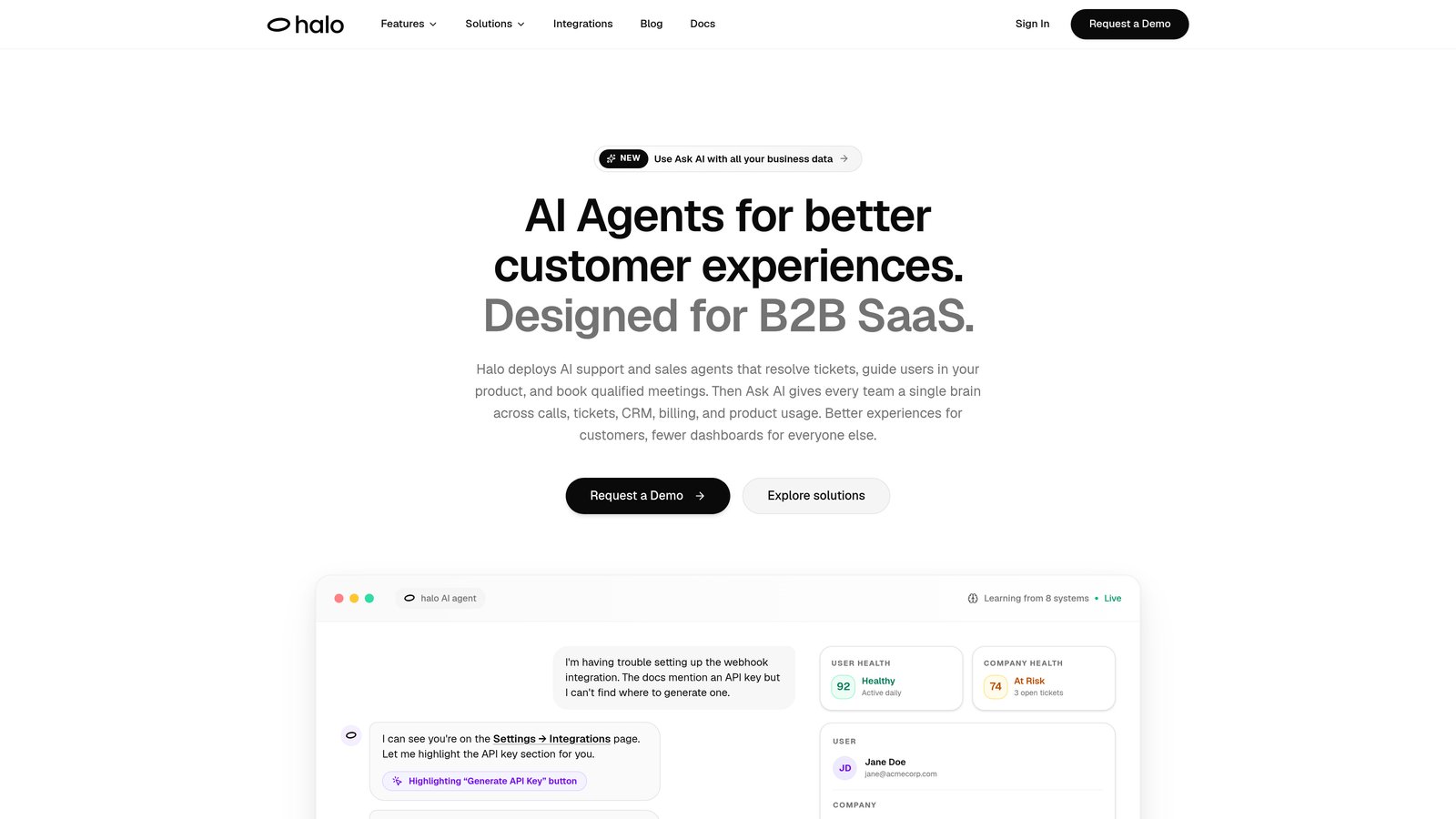
Halo AI is an AI-first customer support platform that deploys intelligent agents to resolve tickets, guide users through your product with page-aware context, auto-create bug reports, and surface business intelligence signals.
Where This Tool Shines
What separates Halo from most competitors is the architecture. This isn't a chatbot bolted onto a helpdesk — AI is the core of the platform. The page-aware chat widget is a genuine differentiator: the AI sees what your user sees on screen, enabling contextual UI guidance rather than generic help center links. That's a meaningful leap from "here's an article" to "here's exactly what to click next."
The business intelligence layer is equally compelling. Beyond resolving tickets, Halo surfaces churn signals, revenue anomalies, and customer health indicators from support interactions. For SaaS teams, that transforms the support inbox from a cost center into a source of strategic insight. And because the system learns continuously from every resolved interaction, it gets sharper over time without manual retraining.
Key Features
Page-Aware Chat Widget: The AI sees the user's current screen context and provides specific, visual UI guidance rather than generic documentation links.
Autonomous Ticket Resolution: AI agents handle tickets end-to-end with continuous learning from each resolved interaction, improving accuracy over time.
Auto Bug Ticket Creation: Automatically generates and routes bug reports to Linear or Jira, removing a manual step from your support-to-engineering workflow.
Smart Inbox with Business Intelligence: Surfaces churn signals, revenue anomalies, and customer health data from support conversations — not just ticket metrics.
Live Agent Handoff: Seamlessly escalates complex issues to human agents with full conversation context preserved.
Native Integrations: Connects with Linear, Slack, HubSpot, Intercom, Stripe, Zoom, PandaDoc, and Fathom — the full B2B SaaS stack, not just your helpdesk.
Best For
B2B SaaS companies and product teams that want AI to do more than deflect tickets. Particularly strong for teams already using tools like HubSpot, Stripe, Linear, or Slack who want their support layer connected to the broader business stack. Less suited for pure e-commerce or teams with no technical resources for initial setup.
Pricing
Contact for pricing. Custom plans based on team size and usage. Visit haloagents.ai for details.
2. Intercom
Best for: Teams wanting a mature all-in-one messaging and AI support platform with broad channel coverage.
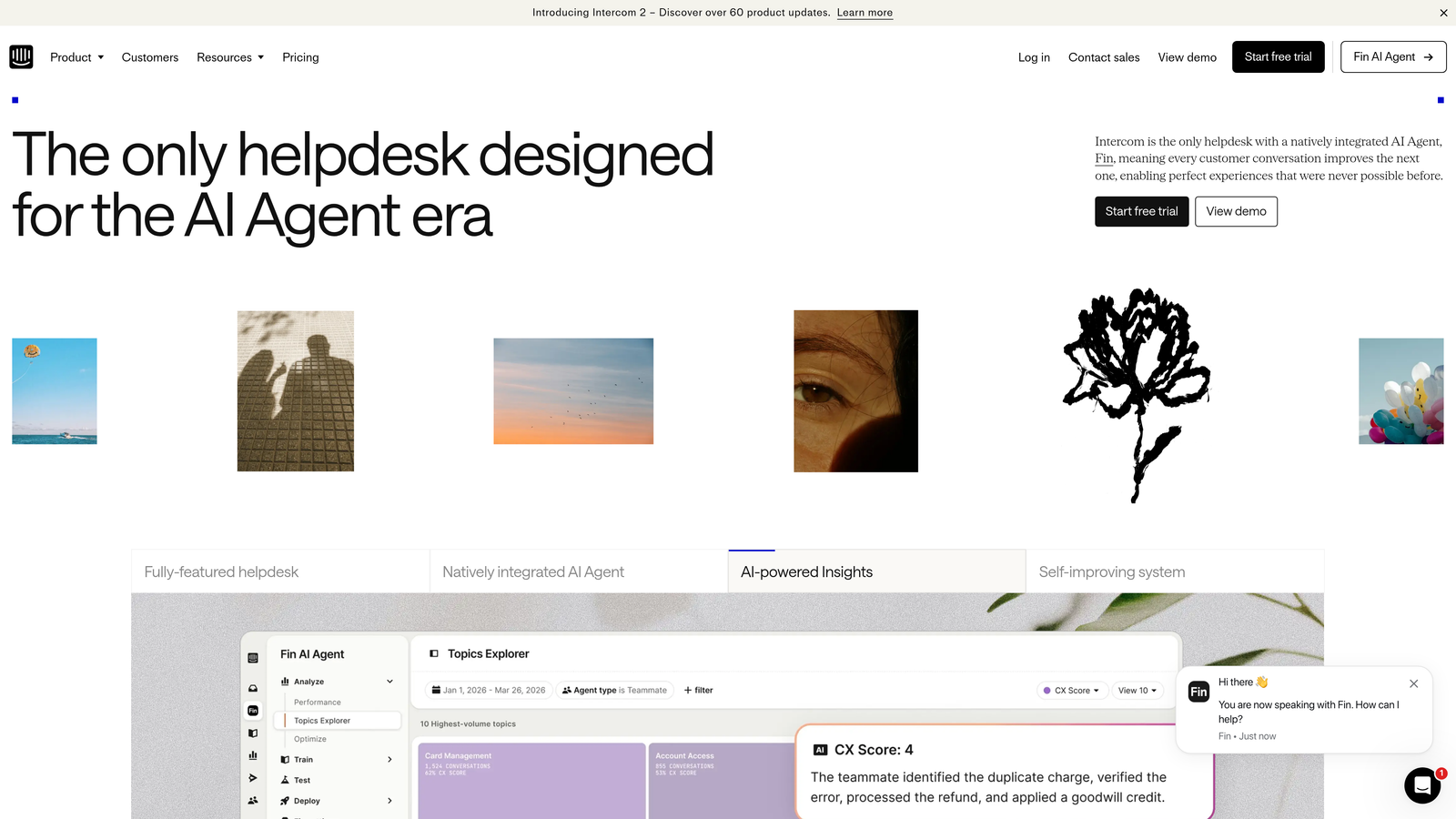
Intercom is a mature customer messaging platform with Fin, its AI agent built on large language models, handling support conversations across chat, email, and in-app messaging.
Where This Tool Shines
Fin is one of the more capable AI agents on the market for multi-step conversation handling. It can resolve complex support queries without human intervention, and the handoff to live agents when needed is smooth and well-designed. The platform's maturity shows in its reliability, its analytics depth, and its 300+ integration ecosystem.
Intercom also doubles as a product engagement tool, offering in-app tours, onboarding flows, and proactive messaging alongside reactive support. For teams that want one platform to handle the full customer communication lifecycle, it's a strong contender. The main consideration is cost: pricing has increased notably in recent years, and Fin AI resolution fees are layered on top of seat costs.
Key Features
Fin AI Agent: Handles autonomous multi-step conversation resolution across channels using large language models.
Unified Inbox: Combines chat, email, and social channels into a single agent workspace.
300+ Integrations: Includes Salesforce, Stripe, Jira, and most major SaaS tools.
Product Tours and Onboarding Flows: In-app guidance tools that extend beyond support into customer activation.
Conversation Analytics and CSAT: Detailed reporting on resolution rates, response times, and customer satisfaction scores.
Best For
Growth-stage and mid-market SaaS companies that want AI-powered support and customer messaging in a single platform. Strong choice for teams that blend support with product onboarding. Budget-conscious buyers should model total cost carefully given usage-based Fin pricing.
Pricing
Starts around $39/seat/month; Fin AI resolution fees apply separately. Check intercom.com for current pricing as rates change frequently.
3. Zendesk AI
Best for: Large enterprises with complex SLAs already invested in the Zendesk ecosystem.
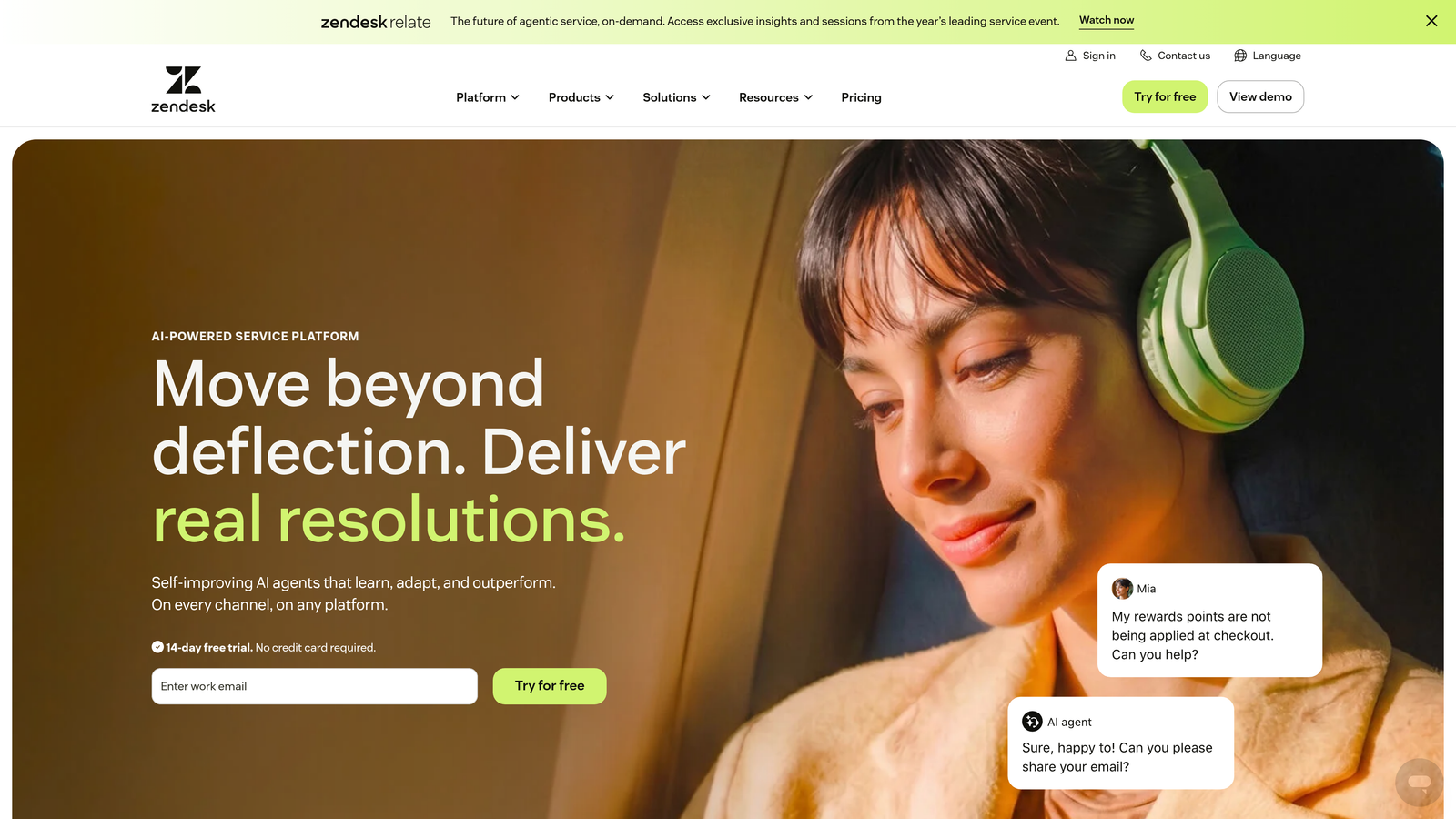
Zendesk is the world's most widely deployed helpdesk platform, now with AI triage, intelligent routing, agent copilot, and self-service automation built into its Suite plans.
Where This Tool Shines
Zendesk's scale is its biggest asset. The platform handles enormous ticket volumes reliably, and its AI features have matured into genuinely useful tools rather than marketing additions. AI-powered triage and intelligent routing reduce manual queue management, while the Agent Copilot provides suggested replies and next-best actions that meaningfully speed up resolution time.
For organizations already running Zendesk, adding AI features is relatively low-friction. The 1,000+ app marketplace and deep compliance controls make it the default choice for regulated industries and enterprise procurement teams. The trade-off: advanced AI features require higher-tier plans, and the platform can feel heavyweight for smaller teams.
Key Features
AI-Powered Triage and Routing: Automatically classifies and routes incoming tickets to the right agent or team based on content and context.
Agent Copilot: Suggests replies, next-best actions, and relevant knowledge base articles within the agent workspace.
AI-Generated Help Center Content: Assists with creating and maintaining self-service articles at scale.
SLA Management and Compliance Controls: Robust tooling for enterprise-grade service level tracking and regulatory compliance.
1,000+ App Marketplace: Extensive integration ecosystem covering virtually every enterprise software category.
Best For
Large enterprises and teams already on Zendesk Suite. Strong for organizations with complex routing rules, strict SLA requirements, or compliance needs. Less compelling as a first platform for smaller teams due to pricing and complexity.
Pricing
Suite starts around $55/agent/month; advanced AI features on higher-tier plans. Verify current pricing at zendesk.com.
4. Freshdesk (Freddy AI)
Best for: SMB and mid-market teams wanting a full-featured helpdesk with AI at a more accessible price point.
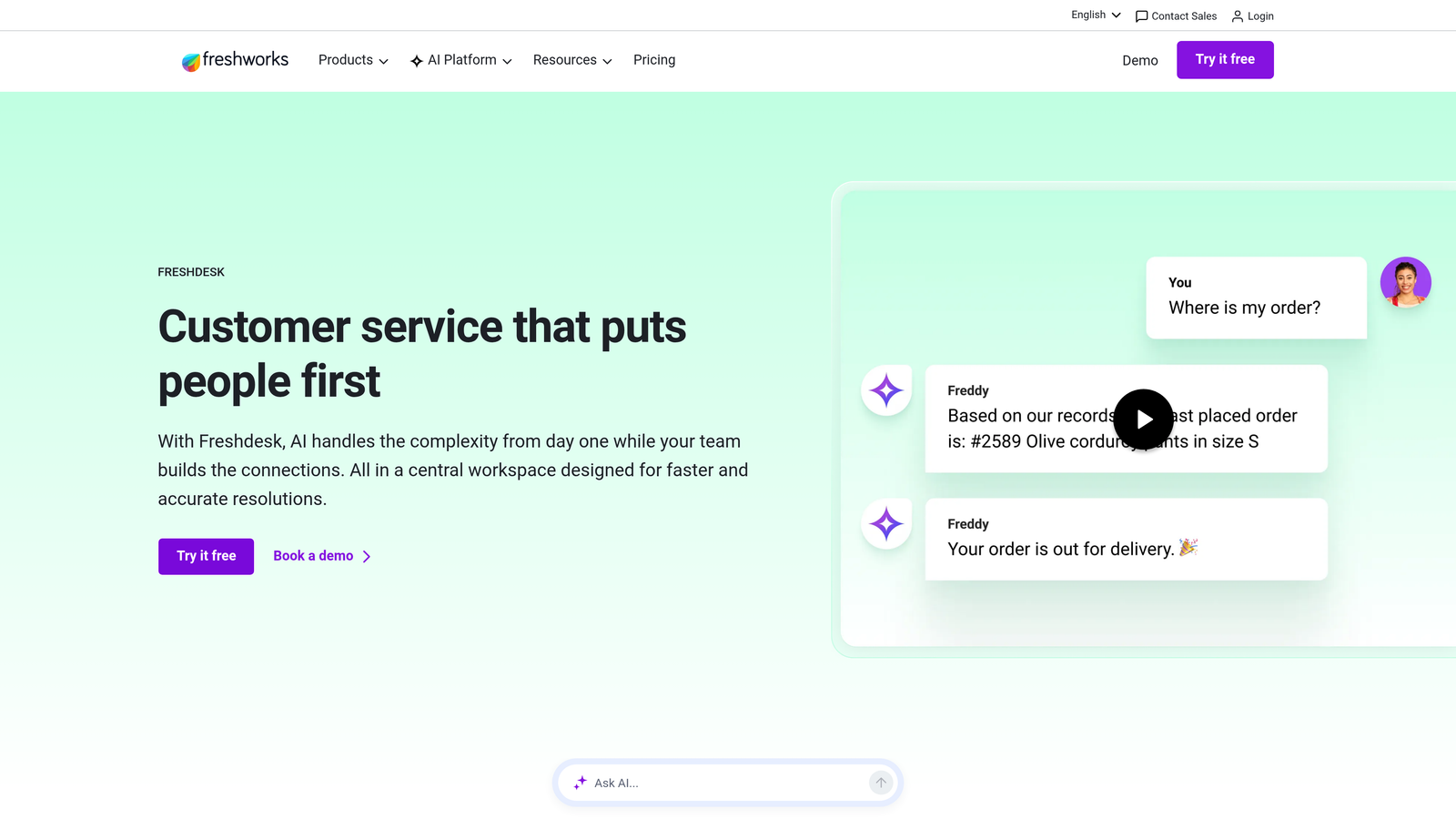
Freshdesk is a full-featured helpdesk platform with Freddy AI spanning self-service bots, agent assistance, and analytics — at a more accessible price than enterprise alternatives.
Where This Tool Shines
Freshdesk's Freddy AI is structured in three distinct layers, which makes it unusually flexible. Freddy Self Service handles customer-facing autonomous resolution. Freddy Copilot assists agents with in-context suggestions and conversation summaries. Freddy Insights applies AI to support analytics, surfacing trends and anomalies in your ticket data. You can adopt each layer incrementally rather than committing to the full suite upfront.
The pricing model is genuinely more accessible than Zendesk for comparable functionality, and the free tier gives small teams a real starting point. Omnichannel coverage across email, chat, phone, and social is solid. For teams that don't need the complexity of enterprise platforms but want more than a basic helpdesk, Freshdesk hits a useful middle ground.
Key Features
Freddy Self Service: Autonomous customer-facing bot that handles common queries without agent involvement.
Freddy Copilot: In-context agent suggestions, reply drafts, and conversation summaries to speed up resolution.
Freddy Insights: AI-driven analytics that surface support trends, anomalies, and performance signals.
Omnichannel Support: Unified inbox covering email, chat, phone, and social media channels.
Free Tier: A functional starting point for small teams before committing to paid plans.
Best For
SMB and mid-market teams that want a capable helpdesk with layered AI features without enterprise pricing. Good fit for teams transitioning from basic email support to a structured platform.
Pricing
Free tier available; Growth plans from approximately $15/agent/month; Freddy AI features on Pro and Enterprise plans. Check freshworks.com for current rates.
5. Tidio
Best for: E-commerce teams on Shopify or WooCommerce wanting fast AI deployment with minimal technical overhead.
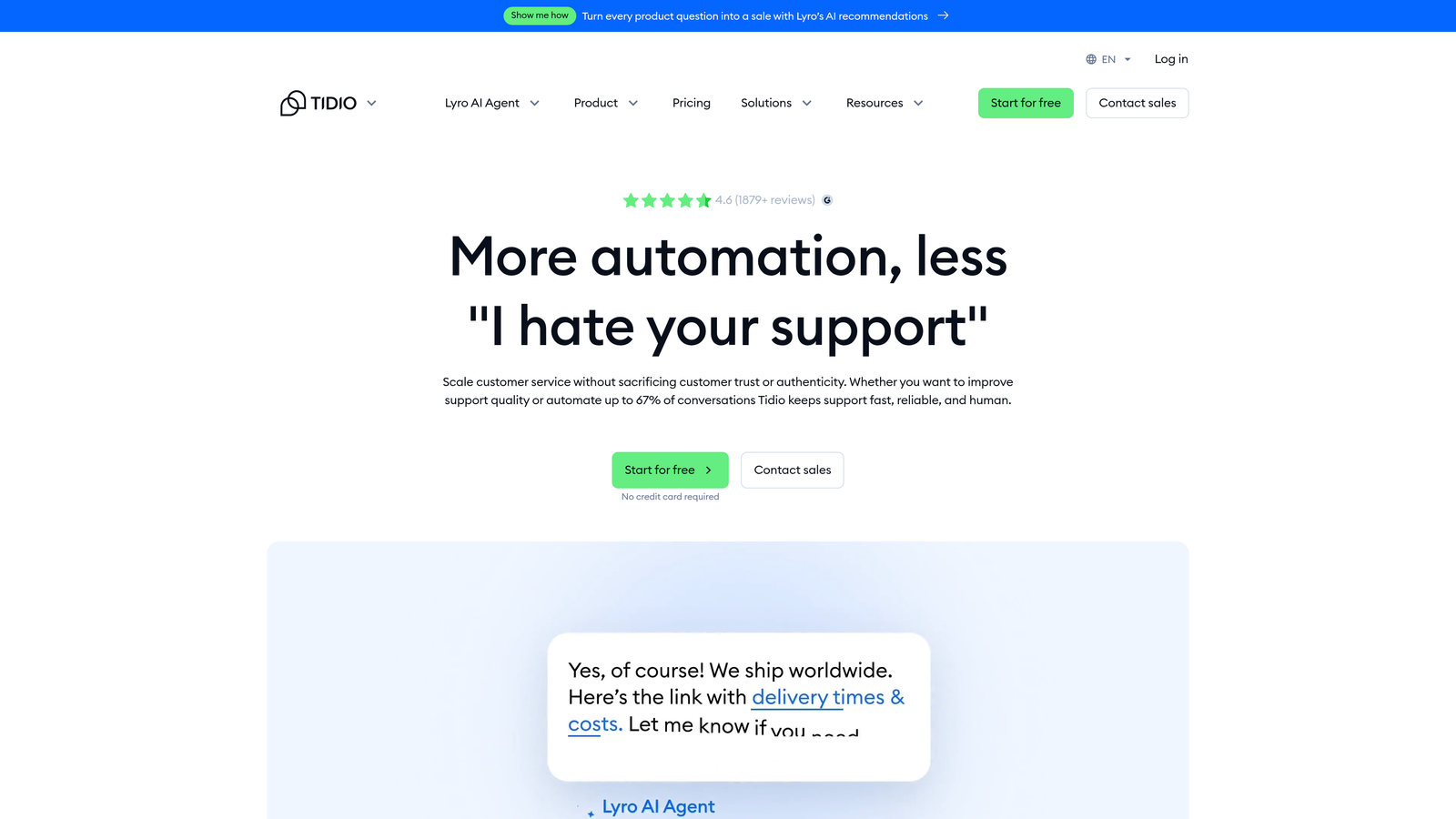
Tidio is a lightweight AI customer service platform built for e-commerce, featuring Lyro — an AI agent that handles common questions autonomously with fast, low-code deployment.
Where This Tool Shines
Tidio's standout feature is Lyro, an AI agent that handles FAQ-style and order-related queries autonomously. The deployment speed is genuinely impressive: teams can be live in under an hour without engineering resources. For e-commerce operators who need AI support quickly and don't have a dedicated technical team, that's a real advantage over more complex platforms.
The native Shopify and WooCommerce integrations are tight, giving Lyro access to order data and product information that makes its responses more contextually useful. The visual chatbot flow builder lets non-technical teams customize conversation paths without writing a line of code. Where Tidio falls short is in complex B2B SaaS scenarios — it's optimized for high-volume, pattern-driven e-commerce queries, not nuanced enterprise support workflows.
Key Features
Lyro AI Agent: Handles autonomous resolution of common questions and order-related queries without human involvement.
Native E-Commerce Integrations: Deep connections with Shopify and WooCommerce, giving AI access to real order and product data.
Unified Inbox: Combines live chat, email, and Messenger in a single agent workspace.
Visual Chatbot Flow Builder: No-code tool for building and customizing conversation paths.
Fast Deployment: Live in under an hour — no engineering resources required for basic setup.
Best For
E-commerce businesses on Shopify or WooCommerce that need fast AI deployment for common customer queries. Less suited for B2B SaaS teams with complex, context-dependent support workflows.
Pricing
Free tier available; paid plans from approximately $29/month; Lyro AI conversations priced separately. See tidio.com for current details.
6. Drift (Salesloft)
Best for: Sales-led organizations where support and revenue conversations share the same chat surface.
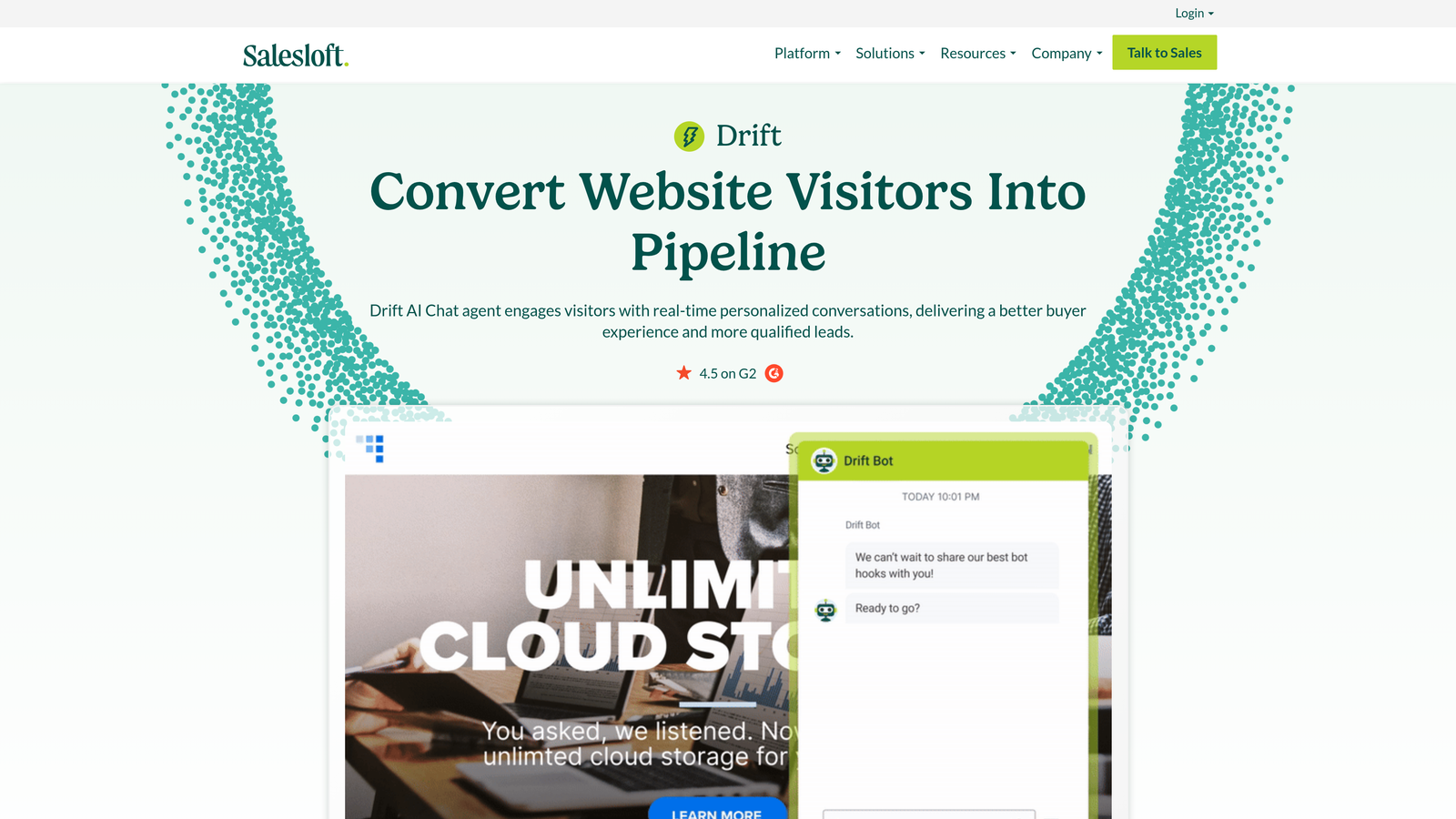
Drift is a conversational platform that blends revenue and support conversations, using AI to qualify leads and handle support simultaneously — now part of the Salesloft ecosystem.
Where This Tool Shines
Drift occupies a unique position: it's the platform for teams where the same chat widget needs to handle a prospect asking about pricing and a customer reporting a bug. The AI can qualify a sales lead and route a support issue in the same session, which eliminates the awkward "wrong door" experience that frustrates visitors on sites with separate sales and support channels.
The Salesloft integration creates a natural workflow for revenue-focused teams, connecting conversational data directly into sales sequences and account management. Account-based targeting lets you personalize the experience for high-value visitors automatically. For teams where support and sales are genuinely intertwined, this is a differentiated offering. For teams with clearly separated functions, the complexity may not be worth it.
Key Features
Unified Revenue and Support AI: Handles lead qualification and support resolution within the same conversation flow.
CRM-Based Routing: Routes conversations to the right sales rep or support agent based on CRM data.
Account-Based Targeting: Personalizes chat experiences for high-value accounts and target visitors automatically.
Native Salesloft Integration: Connects conversational data directly into Salesloft revenue workflows.
Meeting Booking: Allows prospects and customers to book meetings directly within the chat widget.
Best For
Sales-led B2B organizations where the same team handles inbound support and revenue conversations. Strong for companies already in the Salesloft ecosystem. Less compelling for teams with clearly separated support and sales functions.
Pricing
Contact for pricing — enterprise-focused since the Salesloft acquisition. Visit drift.com for current information.
7. Kustomer
Best for: High-volume consumer support teams that need AI operating with full customer history context.
Kustomer is a CRM-native customer service platform where AI operates with full customer history context — order data, past interactions, subscription status — making it well-suited for high-volume consumer support.
Where This Tool Shines
The core differentiator is the unified customer timeline. Every interaction, order, subscription event, and support conversation lives in a single record, and the AI operates with that full context rather than just the current ticket. That matters enormously for consumer businesses where a customer's history is essential to resolving their issue correctly. An AI that knows a customer has contacted you three times this month about the same issue responds very differently than one that treats each ticket in isolation.
The AI-powered CSAT prediction and proactive escalation features add a layer of quality control that's particularly valuable in high-volume environments. Kustomer has had an interesting ownership journey — acquired by Meta, then sold — and is now independent again, which is worth noting for buyers evaluating long-term platform stability.
Key Features
Unified Customer Timeline: Combines all interactions, orders, and transaction data in a single customer record accessible to AI and agents.
Context-Aware AI Automation: AI operates with full CRM context, not just ticket history, enabling more accurate and personalized resolution.
Omnichannel Support: Covers chat, email, SMS, social, and voice in a unified workspace.
Complex Workflow Automation: Handles multi-step processes like returns, exchanges, and subscription changes automatically.
AI-Powered CSAT Prediction: Identifies at-risk conversations and triggers proactive escalation before customers become frustrated.
Best For
D2C brands, subscription businesses, and high-volume consumer support teams where full customer history context meaningfully improves resolution quality. Less suited for pure B2B SaaS teams with simpler customer data models.
Pricing
Starts around $89/agent/month. Verify current pricing at kustomer.com.
8. Forethought
Best for: Enterprises locked into existing helpdesks that want AI triage and deflection without migrating platforms.
Forethought is an AI layer designed to sit on top of existing helpdesks, adding intelligent triage, deflection, and routing without requiring teams to migrate away from Zendesk, Salesforce, or ServiceNow.
Where This Tool Shines
Forethought solves a specific and common problem: your organization has significant investment in an existing helpdesk, your workflows are built around it, and switching is not a realistic option. But you still want AI to improve triage accuracy, deflect routine tickets before they reach agents, and route what does come in more intelligently. That's exactly what Forethought is designed to do.
The no-migration value proposition is real. Teams can add Forethought's AI layer without disrupting existing agent workflows, compliance configurations, or reporting structures. The trade-off is that you're adding another vendor and integration point rather than consolidating. For large enterprises where migration risk is genuinely high, that trade-off often makes sense.
Key Features
AI Triage and Auto-Tagging: Classifies and tags incoming tickets automatically, layered over your existing helpdesk platform.
Pre-Ticket Deflection: AI-powered self-service intercepts common queries before they become tickets.
Intelligent Routing: Routes tickets to the right agent or team based on content, skills, and workload.
Multi-Platform Compatibility: Works natively with Zendesk, Salesforce Service Cloud, and ServiceNow.
No Migration Required: Preserves existing helpdesk workflows, configurations, and agent habits entirely.
Best For
Large enterprises with substantial investment in Zendesk, Salesforce Service Cloud, or ServiceNow who want AI improvements without the risk and cost of platform migration. Not the right choice if you're starting fresh or open to switching platforms.
Pricing
Contact for pricing — enterprise-focused. Visit forethought.ai for details.
9. Help Scout
Best for: Small-to-mid teams that prioritize relationship-driven support with selective AI augmentation.
Help Scout is a human-first support platform with selective AI augmentation — AI Drafts and AI Summarize assist agents without replacing them, making it a strong choice for teams that prioritize relationship-driven support.
Where This Tool Shines
Help Scout is deliberately positioned against the trend of full AI autonomy. Rather than trying to resolve tickets without human involvement, it focuses on making human agents faster and more effective. AI Drafts suggests reply text that agents can edit and send. AI Summarize condenses long conversation threads so agents can get up to speed quickly. These are practical, well-executed features that genuinely reduce cognitive load without removing the human from the interaction.
The platform's clean, minimal UX is a genuine differentiator for teams that have been frustrated by the complexity of enterprise helpdesks. If your team's culture values personal, relationship-driven support and you're not chasing autonomous resolution rates, Help Scout is a well-designed platform that won't get in your way. It's not the right choice if your primary goal is reducing agent involvement.
Key Features
AI Drafts: Generates suggested reply text within the agent inbox, which agents can review, edit, and send.
AI Summarize: Condenses long conversation threads into brief summaries so agents can quickly understand context.
Shared Inbox, Live Chat, and Knowledge Base: Core support channels in a single, cleanly designed platform.
Docs Knowledge Base: AI-assisted article suggestions help customers self-serve before contacting support.
Minimal, Intuitive UX: Designed for small-to-mid teams that want a platform agents actually enjoy using.
Best For
Small-to-mid support teams, agencies, and companies where personal relationships with customers are a deliberate part of the brand experience. Not suited for teams whose primary goal is autonomous ticket resolution or significant deflection rates.
Pricing
Starts around $22/user/month. Check current pricing at helpscout.com.
Which Platform Is Right for Your Team?
The right customer service AI platform depends heavily on what you're optimizing for. Here's a quick orientation by use case to cut through the noise.
AI-first B2B SaaS: Halo AI is the strongest choice for teams that want genuine AI architecture, page-aware context, business intelligence signals, and deep integration with the full SaaS stack — not just the helpdesk.
All-in-one messaging and support: Intercom's Fin AI is a mature, capable option for teams that want AI support and customer messaging in a single platform with broad channel coverage.
Enterprise Zendesk users: Zendesk AI makes sense if you're already in the ecosystem and need AI triage, copilot, and self-service at scale without changing platforms.
SMB helpdesk with AI: Freshdesk's Freddy AI gives you a capable, layered AI feature set at a price point that doesn't require enterprise budgets.
E-commerce teams: Tidio's Lyro is purpose-built for Shopify and WooCommerce operators who need fast deployment and autonomous handling of common order-related queries.
Sales and support blended: Drift is the natural choice when the same chat surface needs to qualify leads and resolve support issues for sales-led organizations.
High-volume consumer support: Kustomer's CRM-native AI operates with full customer history context, making it the strongest option for D2C and subscription businesses with complex customer records.
AI layer over existing stack: Forethought is designed specifically for enterprises that can't migrate away from Zendesk, Salesforce, or ServiceNow but want meaningful AI improvements.
Human-first small teams: Help Scout augments agents rather than replacing them, making it ideal for teams where personal support relationships are a deliberate part of the brand.
Before committing to any platform, ask four questions: Does it learn from your specific interactions over time, or does it rely purely on generic AI? Can it integrate with your full business stack, not just your helpdesk? Does it surface business intelligence beyond ticket deflection metrics? And what does escalation to a human actually look like in practice?
If you're a B2B SaaS team looking for an AI-first platform built to learn and scale with you, See Halo in action and discover how continuous learning transforms every interaction into smarter, faster support.