9 Best Customer Service AI Tools in 2026
Discover the best customer service AI tools in 2026, with nine platforms evaluated for automation depth, integration flexibility, and scalability to help B2B SaaS teams handle rising ticket volumes, resolve issues autonomously, and meet growing customer expectations without expanding headcount.
 Matt PattoliFounder13 min read
Customer support teams are under more pressure than ever. Ticket volumes keep climbing, customer expectations have never been higher, and headcount budgets aren't growing to match. The good news: AI tools have moved well beyond simple chatbots. Today's platforms can resolve tickets autonomously, guide users through complex workflows, detect bugs before customers report them, and surface business intelligence that goes far beyond support metrics.
This list covers the best customer service AI tools available in 2026, chosen based on automation depth, integration flexibility, scalability, and real-world fit for B2B SaaS and product-led teams. Whether you're replacing a legacy helpdesk, augmenting a live support team, or building a fully autonomous support layer, there's a tool here that fits your stack.
We've included Halo AI at #1 because it's our product. But we've also included honest assessments of every alternative so you can make the right call for your team.
1. Halo AI
Best for: B2B SaaS and product-led teams that want AI-first support with business intelligence built in.
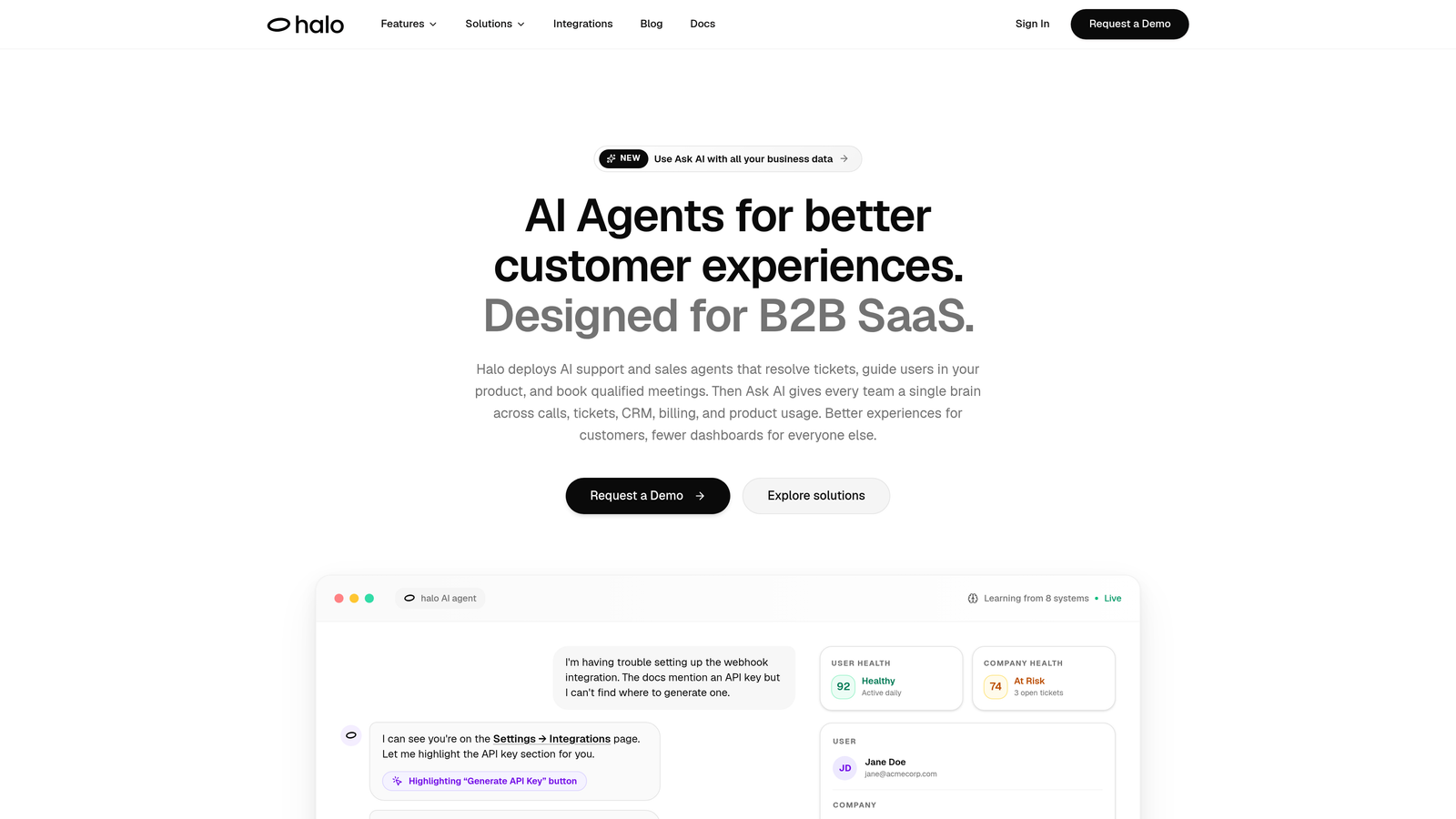
Halo AI is an AI-first customer support platform that deploys intelligent agents to resolve tickets, guide users through your product, auto-create bug reports, and surface business intelligence — all while learning continuously from every interaction.
Where This Tool Shines
Most AI support tools are built on top of legacy helpdesks, which means you're adding intelligence to a system designed for a different era. Halo was built AI-first, which changes what's possible. The platform's page-aware chat widget understands what a user is actually looking at in your product UI, so responses aren't generic FAQ answers — they're contextually relevant to where someone is stuck right now.
The other standout capability is the smart inbox with business intelligence analytics. Halo doesn't just resolve tickets; it reads patterns across conversations to surface customer health signals, revenue intelligence, and anomaly detection. Your support data becomes a strategic asset, not just a queue to clear.
Key Features
Autonomous Ticket Resolution: AI agents resolve tickets end-to-end with continuous learning that improves accuracy over time without manual retraining.
Page-Aware Chat Widget: The widget understands the user's current UI context, enabling guidance that's specific to where they are in your product.
Auto Bug Ticket Creation: Detected issues are automatically converted into bug tickets and routed to Linear or your preferred issue tracker.
Smart Inbox with Business Intelligence: Customer health signals, revenue intelligence, and anomaly detection surface directly from support data.
Live Agent Handoff: Complex escalations transfer seamlessly to human agents with full conversation context preserved.
Deep Integrations: Connects with Linear, Slack, HubSpot, Intercom, Stripe, Zoom, PandaDoc, and Fathom.
Best For
Halo is purpose-built for B2B SaaS companies and product-led teams that need more than ticket deflection. If you want your support layer to also generate product insights, catch bugs proactively, and integrate with your entire business stack without stitching together multiple tools, Halo is worth a close look.
Pricing
Pricing is available directly at haloagents.ai. Contact the team for current rates and packaging options.
2. Intercom (Fin AI Agent)
Best for: Teams already on Intercom who want AI resolution without switching platforms.
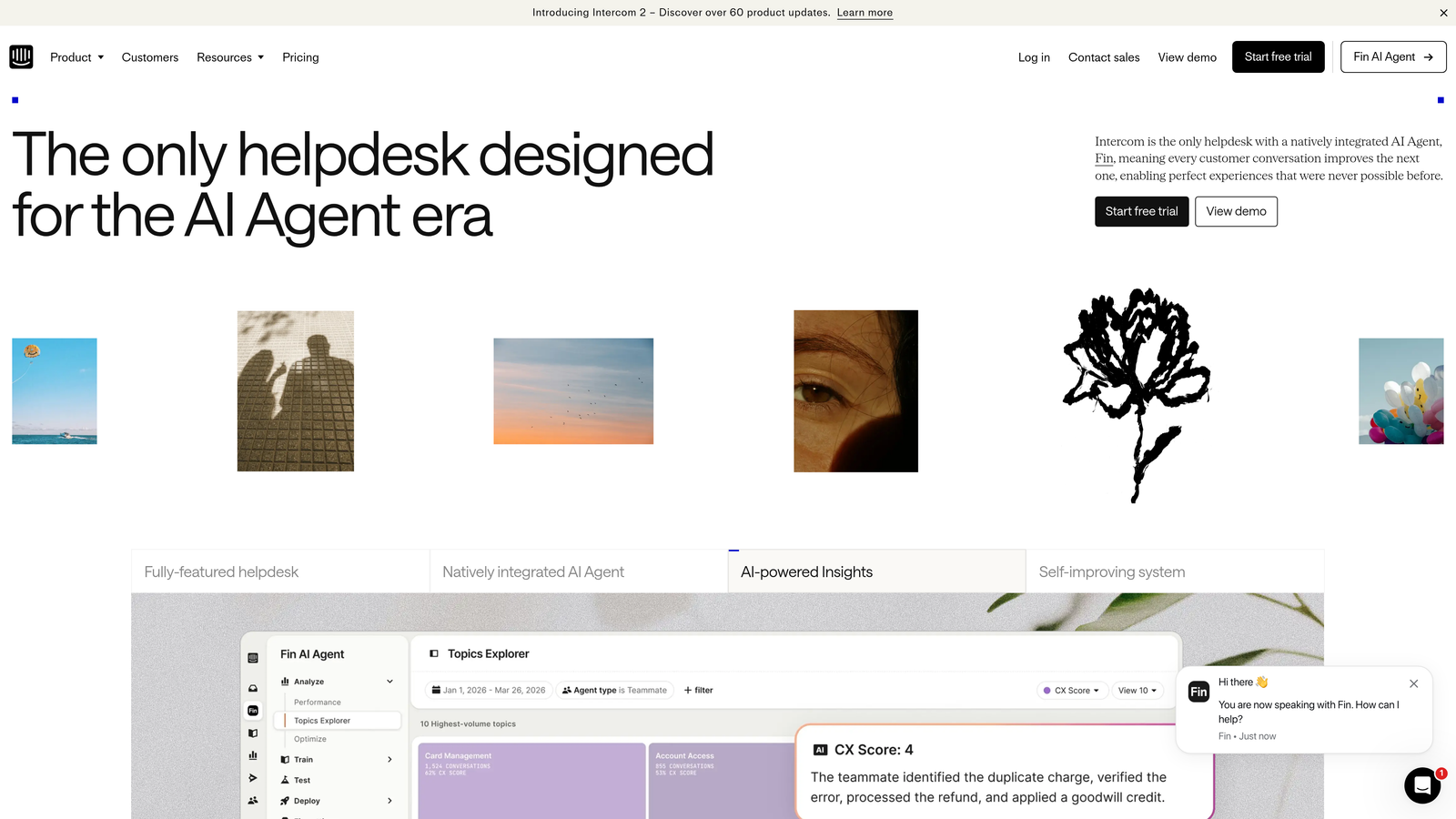
Intercom's Fin AI Agent resolves customer conversations using your existing help center content and custom answers, deeply embedded within the Intercom messenger and ticketing ecosystem.
Where This Tool Shines
If your team is already living in Intercom, Fin is the path of least resistance to AI resolution. There's no migration, no new interface to learn, and no disconnection between your AI layer and your human agent inbox. Fin reads your existing help center content and starts resolving conversations with minimal configuration.
The per-resolution pricing model is worth noting. You only pay when Fin actually resolves a conversation without human intervention, which aligns costs directly with value delivered. For teams with high deflection potential, this can be economically attractive.
Key Features
AI Resolution from Existing Content: Fin uses your help center articles and custom answers to resolve conversations autonomously.
Seamless Human Handoff: Escalations transfer to the Intercom inbox without friction, preserving conversation history.
Custom Answers: You can define specific answers for product-specific or sensitive questions outside the help center.
Per-Resolution Pricing: Costs scale with actual AI resolutions rather than seat count.
Full Suite Integration: Works natively with Intercom tickets, analytics, and outbound messaging.
Best For
Teams already invested in the Intercom ecosystem who want to add AI resolution without a platform change. Less suited to teams that need deep product context, business intelligence, or integrations beyond the Intercom stack. Worth noting: Halo AI integrates with Intercom, so some teams layer both.
Pricing
Fin is charged per resolution on top of your Intercom plan. Intercom plans start around $39 per seat per month. Verify current rates at intercom.com, as pricing changes frequently.
3. Zendesk AI
Best for: Large support organizations already running Zendesk Suite that need enterprise-grade AI across the full ticketing workflow.
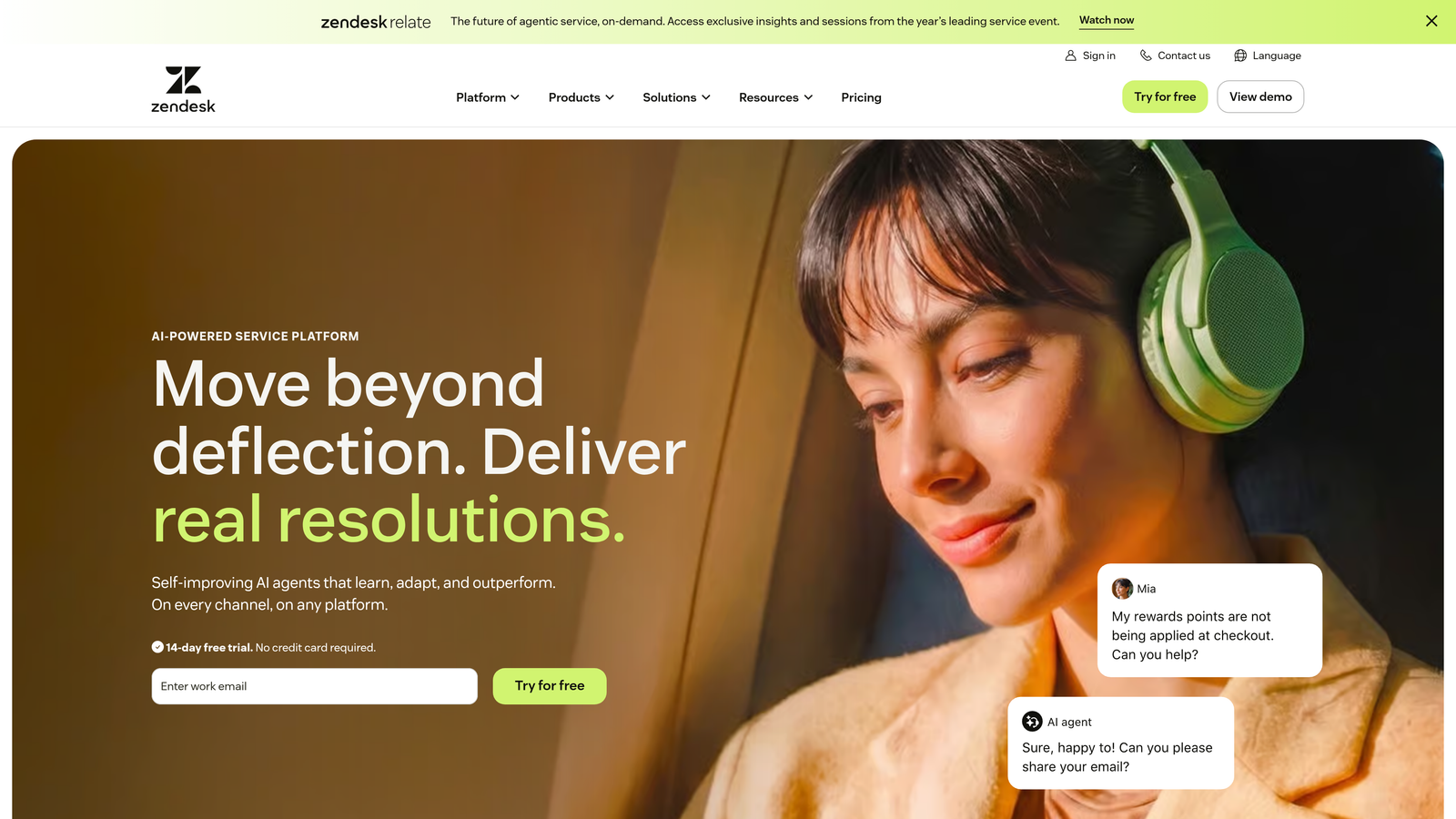
Zendesk AI is enterprise AI layered across the entire Zendesk Suite, covering intelligent triage, agent copilot, macro suggestions, and self-service automation for high-volume support teams.
Where This Tool Shines
Zendesk AI's strength is breadth. It touches every part of the support workflow: tickets get triaged by intent, sentiment, and language before a human ever sees them; agents get suggested responses and next-best-action guidance in real time; and self-service gets smarter through knowledge base integration. For large organizations with complex support operations, that end-to-end coverage matters.
The tradeoff is configuration complexity. Getting Zendesk AI tuned to your specific workflows takes time and often requires dedicated admin resources. It's a powerful system, but it rewards investment in setup and ongoing management.
Key Features
Intelligent Triage: Automatically detects intent, sentiment, and language to route and prioritize tickets before agents engage.
Agent Copilot: Provides suggested responses and next-best-action recommendations directly in the agent workspace.
Macro and Workflow Suggestions: AI identifies opportunities to automate repetitive actions based on usage patterns.
Self-Service AI: Knowledge base integration enables automated resolution of common queries before they reach the queue.
Advanced Analytics and QA: Quality assurance tools and reporting for tracking AI performance and agent effectiveness.
Best For
Large enterprises with established Zendesk deployments and the admin resources to configure and maintain AI features. Overkill for smaller teams; genuinely powerful for organizations with hundreds of agents and complex workflows.
Pricing
Suite plans start around $115 per agent per month; AI features are available on higher tiers. Check zendesk.com for current pricing, as tiers and features evolve regularly.
4. Freshdesk Freddy AI
Best for: SMBs and growing teams that want AI-enhanced helpdesk capabilities without enterprise complexity or pricing.
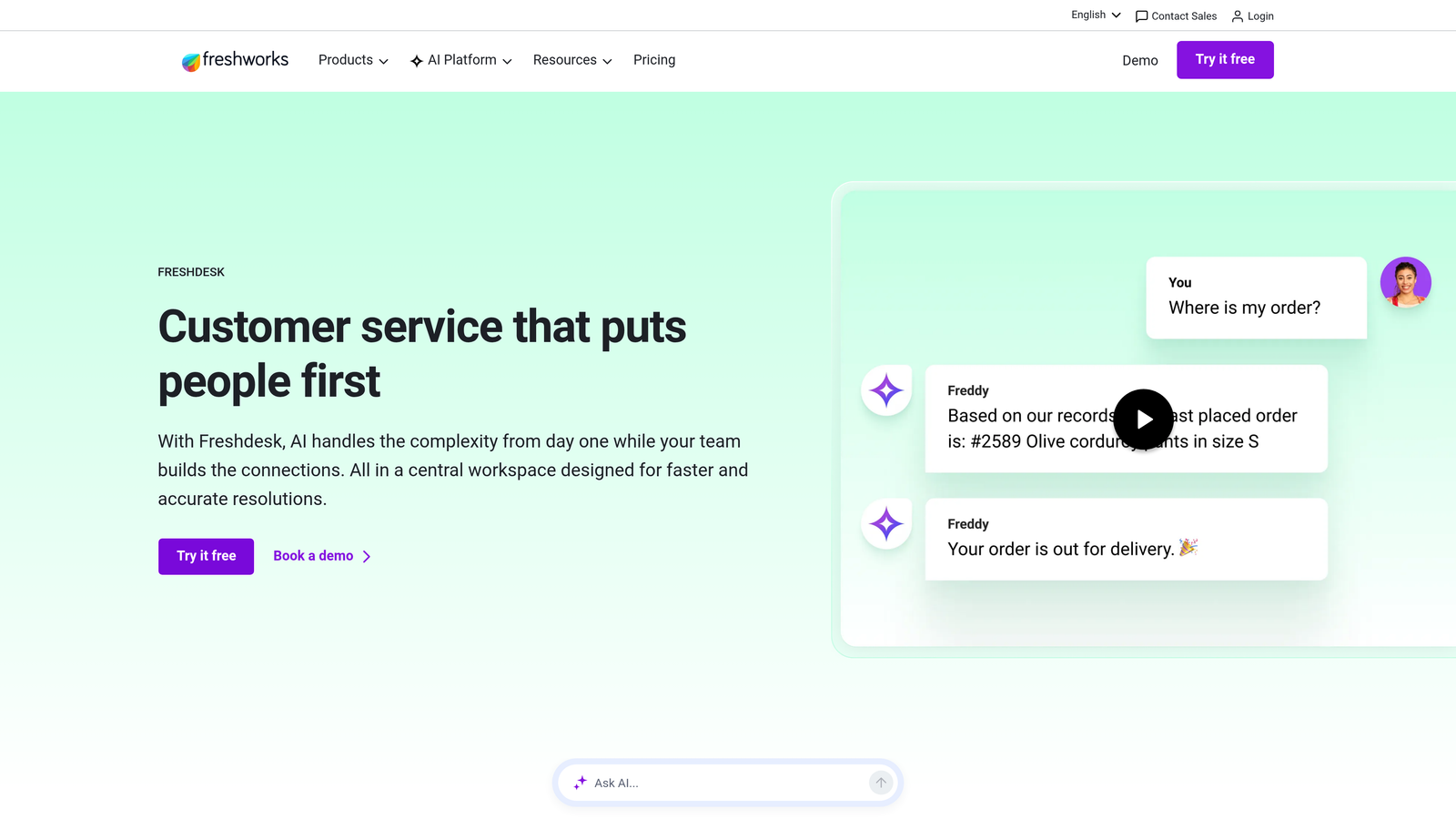
Freshdesk Freddy AI is Freshworks' AI layer across Freshdesk, spanning self-service chatbots, real-time agent assist, and analytics within a familiar helpdesk interface.
Where This Tool Shines
Freshdesk's appeal has always been its approachability, and Freddy AI extends that to the AI layer. The three-part structure (Freddy Self Service for deflection, Freddy Copilot for agent assist, Freddy Insights for analytics) gives teams a clear upgrade path. You can start with self-service deflection and add copilot capabilities as your team grows.
The no-code bot builder is a practical differentiator for teams without engineering resources. Building custom workflows doesn't require developer involvement, which matters when your support team needs to move quickly.
Key Features
Freddy Self Service: AI chatbot that deflects common queries using your knowledge base and custom flows.
Freddy Copilot: Real-time suggestions, response drafts, and conversation summaries for agents.
Freddy Insights: AI-powered analytics that surface trends, anomalies, and automation opportunities.
No-Code Bot Builder: Custom workflow creation without engineering resources required.
Omnichannel Coverage: Consistent AI experience across email, chat, phone, and social channels.
Best For
SMBs and mid-market teams that want meaningful AI capabilities within a cost-effective helpdesk. Teams that need enterprise-scale agentic AI or deep product context will likely outgrow Freddy's current capabilities.
Pricing
Freshdesk plans start at $15 per agent per month; Freddy Copilot is available as an add-on. Check freshdesk.com for current add-on pricing.
5. Salesforce Agentforce
Best for: Large enterprises already in the Salesforce ecosystem that need AI agents operating across service, sales, and commerce in a unified CRM context.
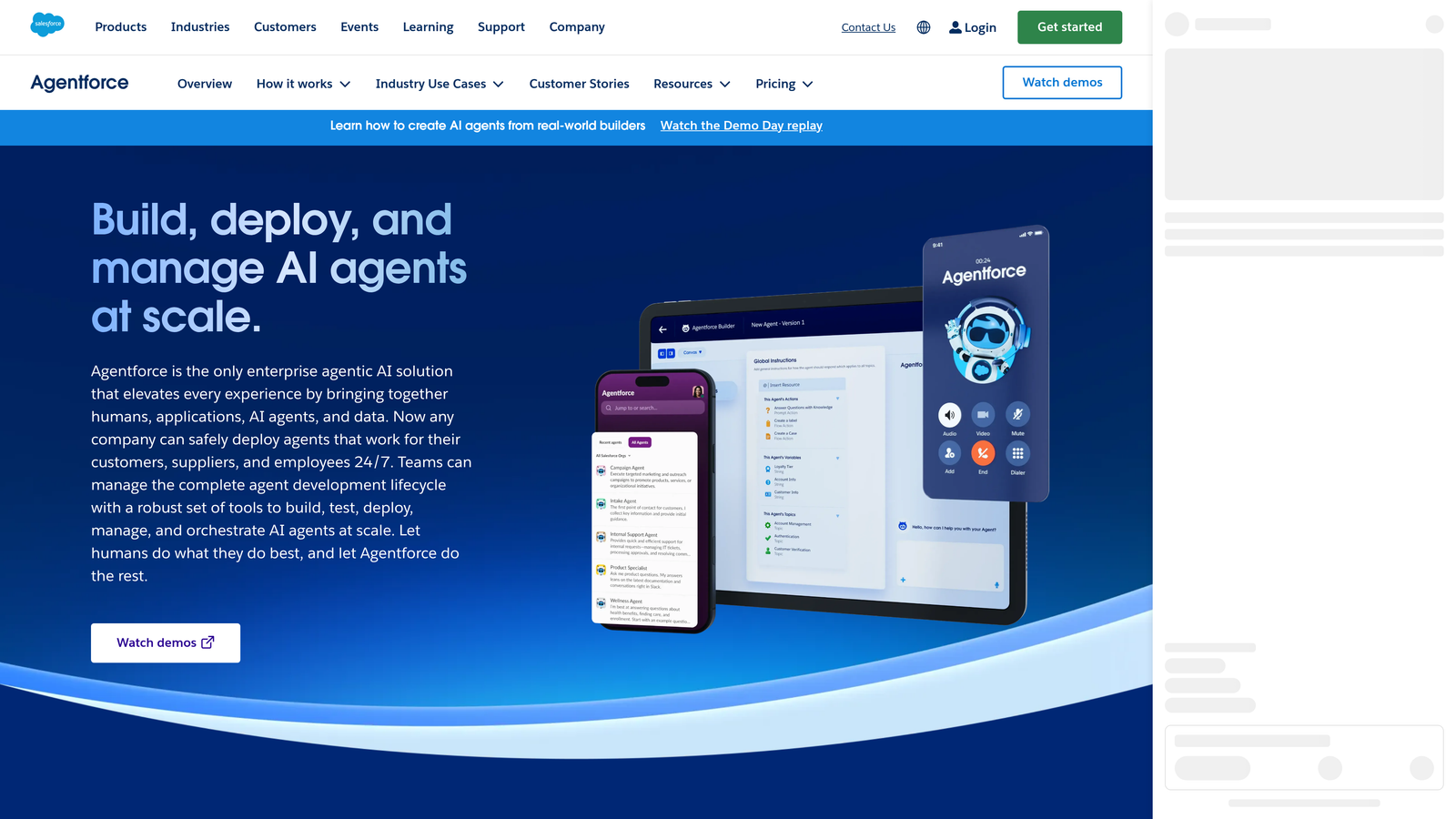
Salesforce Agentforce is Salesforce's agentic AI platform that deploys autonomous AI agents across Service Cloud, Sales Cloud, and Commerce Cloud, using your full CRM data as the intelligence layer.
Where This Tool Shines
Agentforce's core advantage is access to the full Salesforce data model. When an AI agent handles a support conversation, it's not working from a knowledge base alone — it has access to the customer's full CRM history, purchase records, open opportunities, and service cases. That context depth is difficult to replicate outside the Salesforce ecosystem.
The cross-cloud operation is also genuinely differentiated. An AI agent can handle a service case, identify an upsell signal, and hand off to a sales workflow — all within one platform. For enterprises where service and sales overlap heavily, that's a meaningful capability.
Key Features
Full CRM Context: AI agents access complete customer history, purchase data, and case history from Salesforce.
Cross-Cloud Operation: Single agent framework spanning Service Cloud, Sales Cloud, and Commerce Cloud.
Pre-Built Agent Templates: Ready-to-deploy templates for common support and service scenarios.
Einstein AI: Predictive analytics and case classification built on Salesforce's AI layer.
Enterprise Compliance: Data governance, audit trails, and compliance controls built into the platform.
Best For
Large enterprises with existing Salesforce deployments and dedicated Salesforce admin resources. The implementation complexity and cost make it a poor fit for smaller teams or those without deep Salesforce expertise already in-house.
Pricing
Enterprise pricing; Agentforce is charged per conversation. Contact Salesforce directly for current rates and packaging.
6. Tidio Lyro AI
Best for: Small businesses and e-commerce merchants that need fast AI deployment with minimal technical setup.
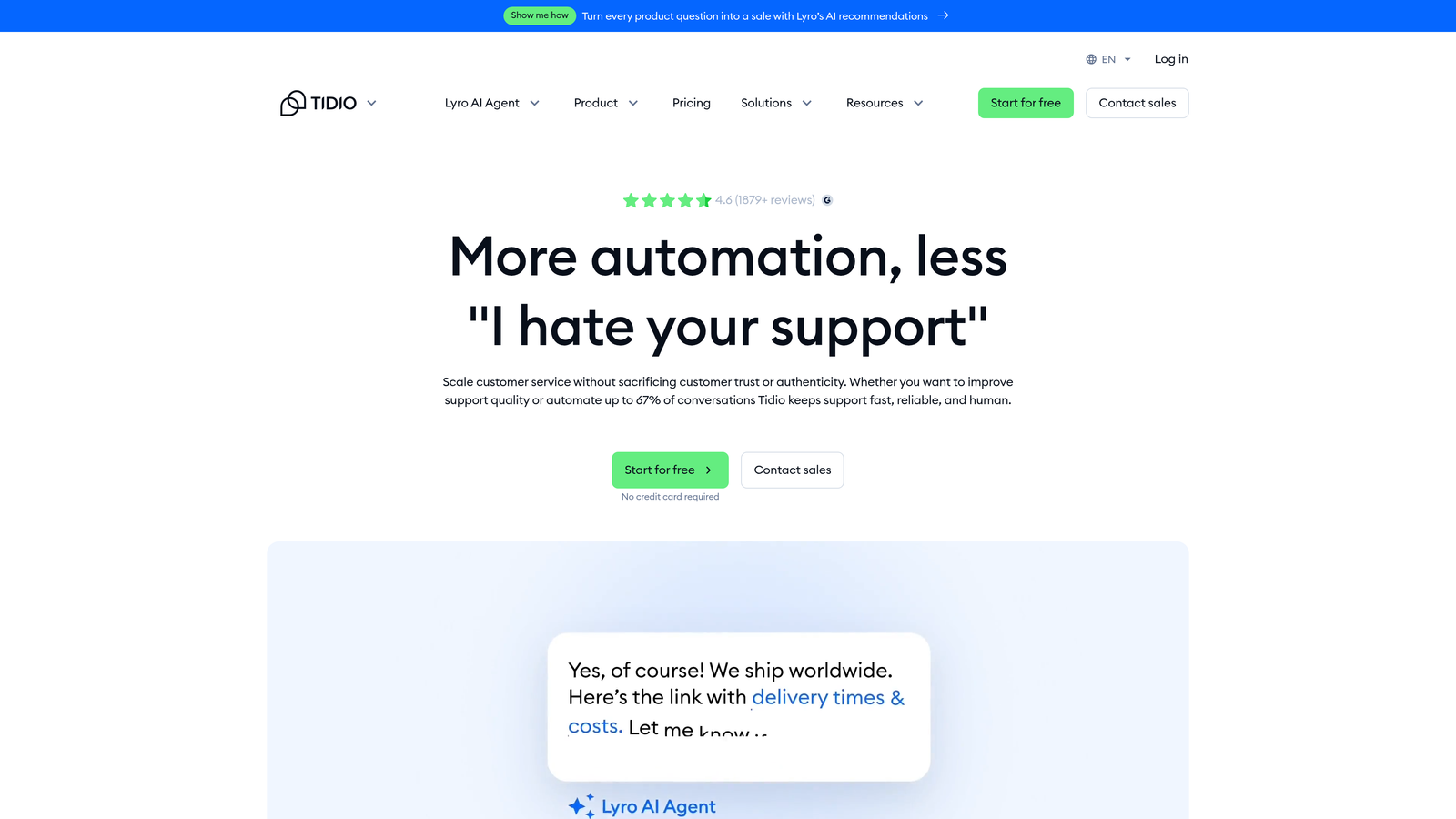
Tidio's Lyro AI is a conversational AI product designed for fast deployment with minimal technical setup, with strong e-commerce integrations and a focus on small-to-mid-sized businesses.
Where This Tool Shines
Lyro's defining characteristic is speed to value. Where enterprise AI platforms can take weeks or months to configure, Lyro can be deployed in hours. The low-code setup means non-technical teams can get AI resolution running without involving engineering, which matters enormously for small businesses and lean teams.
The native Shopify and WooCommerce integrations make Lyro particularly well-suited to e-commerce. Common merchant questions about orders, shipping, and returns are handled autonomously, with a live chat fallback when AI confidence drops below a threshold.
Key Features
Autonomous Question Handling: Lyro answers common questions using your content without manual rule-building.
Low-Code Setup: Deployable in hours with no technical resources required.
E-Commerce Integrations: Native Shopify and WooCommerce support for order and product data.
Confidence-Based Fallback: Automatically routes to live chat when AI confidence is low.
Conversation Analytics: Performance tracking and conversation-level reporting.
Best For
Small businesses, e-commerce merchants, and teams that need AI support running quickly without technical resources. Teams with complex B2B workflows, multi-system integrations, or enterprise compliance requirements will find Lyro's capabilities limiting.
Pricing
Lyro AI starts around $29 per month for a limited conversation volume, scaling up with usage. Check tidio.com for current tiers and conversation limits.
7. Kustomer
Best for: High-volume consumer brands and DTC companies that need AI built on a unified customer CRM timeline.
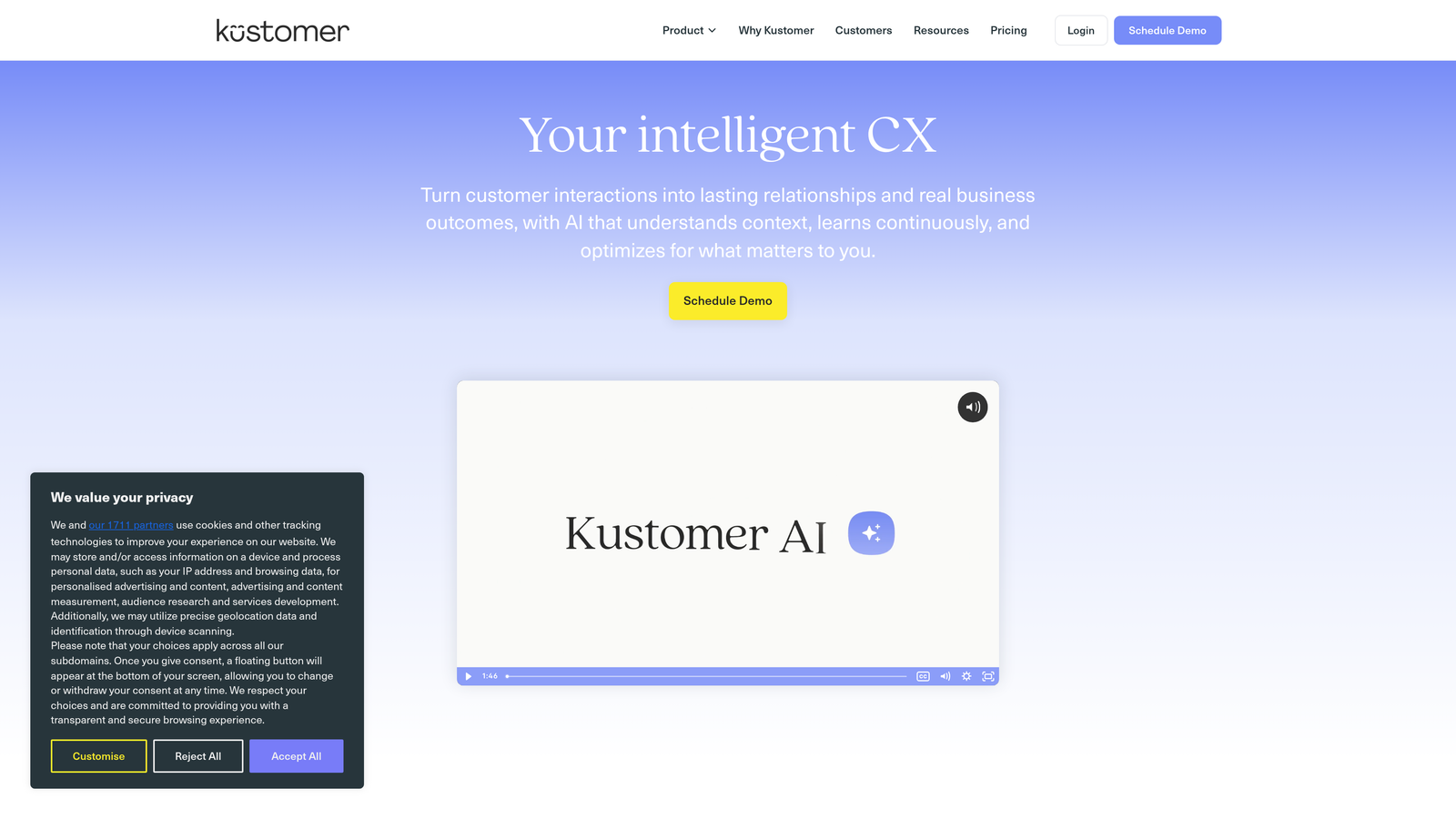
Kustomer is a CRM-native customer service platform built around a unified customer timeline, with AI automation for routing, suggested responses, and workflow management.
Where This Tool Shines
Kustomer's foundation is the unified customer timeline: every interaction across every channel, consolidated into a single chronological view. AI features are built on top of that context, which means routing decisions and suggested responses are informed by the full customer relationship, not just the current ticket.
For high-volume consumer brands handling thousands of interactions daily across email, chat, SMS, social, and voice, that unified view is a meaningful operational advantage. Agents spend less time context-switching and more time resolving.
Key Features
Unified Customer Timeline: All interactions across all channels consolidated into a single customer view.
Intelligent Routing and Prioritization: AI-powered routing based on customer context, not just ticket attributes.
Suggested Responses and Summaries: Real-time agent assist with conversation summaries to reduce handle time.
Workflow Automation: Business logic triggers for automating repetitive processes.
Omnichannel Coverage: Email, chat, SMS, social, and voice in one platform.
Best For
High-volume consumer brands, DTC companies, and subscription businesses with complex omnichannel support needs. Less suited to B2B SaaS teams that need product-aware AI or deep developer tool integrations.
Pricing
Enterprise pricing, typically quoted based on volume and configuration. Contact Kustomer directly for current rates.
8. Ada
Best for: Global enterprises that need multilingual AI support deployed across multiple channels with enterprise-grade compliance.
Ada is an enterprise AI agent platform with a no-code builder, strong multilingual capabilities, and channel-agnostic deployment designed for global enterprises needing scalable, compliant AI support.
Where This Tool Shines
Ada's multilingual capability is genuinely strong. Supporting customers across dozens of languages without building separate bots for each market is a real operational challenge at scale, and Ada addresses it well. For global enterprises serving customers across regions with different languages and regulatory requirements, that matters.
The channel-agnostic architecture is another strength. Ada deploys across web, mobile, SMS, voice, and social from a single configuration, which reduces the overhead of managing separate AI experiences per channel.
Key Features
No-Code Agent Builder: Build and configure AI agents without engineering involvement, with pre-built integrations.
Multilingual Support: AI resolution across dozens of languages from a single platform.
Channel-Agnostic Deployment: Consistent AI experience across web, mobile, SMS, voice, and social.
Enterprise Compliance Controls: Data privacy, audit trails, and compliance features for regulated industries.
Handoff with Full Context: Escalations to live agents include complete conversation history and context.
Best For
Large global enterprises with multilingual support needs and strict compliance requirements. Ada is less focused on the B2B SaaS product-led use case; teams that need product-aware AI or deep developer integrations will find better fits elsewhere on this list.
Pricing
Enterprise pricing, typically quoted. Contact Ada directly at ada.cx for current rates and packaging.
9. Forethought
Best for: Teams that want AI triage, deflection, and agent assist layered on top of their existing helpdesk without a platform migration.
Forethought is an AI triage and resolution layer that sits on top of existing helpdesks like Zendesk, Salesforce Service Cloud, and Freshdesk, adding intelligent deflection, routing, and agent assist without requiring teams to change platforms.
Where This Tool Shines
The core value proposition is additive intelligence. If your team is deeply embedded in Zendesk or Salesforce and a full migration isn't realistic, Forethought lets you add meaningful AI capabilities without disrupting existing workflows. That's a genuinely useful position in the market.
The four-product structure (Solve for deflection, Triage for routing, Assist for agent copilot, Discover for analytics) gives teams a modular upgrade path. You can start with deflection and add routing or agent assist as you build confidence in AI-driven workflows.
Key Features
Solve: AI deflection that answers tickets before they reach the agent queue.
Triage: Intelligent ticket routing by intent and priority, improving queue efficiency.
Assist: Real-time agent copilot with suggested responses and relevant knowledge surfaced in context.
Discover: Analytics that identify automation opportunities and track AI performance over time.
Helpdesk Compatibility: Works alongside Zendesk, Salesforce Service Cloud, and Freshdesk without replacing them.
Best For
Teams with established helpdesk investments that want AI augmentation without migration risk. Particularly useful for organizations where a platform change isn't politically or operationally feasible in the near term.
Pricing
Enterprise pricing, typically quoted. Contact Forethought directly at forethought.ai for current rates.
Which Tool Is Right for Your Team?
Every tool on this list solves a real problem. The question is which problem matches yours.
If you're a B2B SaaS or product-led team that wants AI-first support with business intelligence, page-aware context, and deep integrations across your stack, Halo AI was built for exactly that use case. It's not a bolt-on to a legacy helpdesk; it's a purpose-built AI support layer that gets smarter with every interaction.
For teams already on specific platforms, the decision is often simpler. If you're running Intercom, Fin is the natural first step. If you're on Zendesk at enterprise scale, Zendesk AI extends what you already have. Freshdesk Freddy is the right call for SMBs that want AI without enterprise pricing. Salesforce Agentforce is the obvious choice if you're deep in the Salesforce ecosystem and have the admin resources to support it.
For use-case-specific needs: Tidio Lyro is the fastest path to AI support for e-commerce merchants and small businesses. Kustomer fits high-volume consumer brands with complex omnichannel needs. Ada is purpose-built for global enterprises with multilingual requirements. And Forethought is the right answer when you need AI augmentation without the disruption of a platform migration.
The broader shift worth keeping in mind: the best customer service AI tools in 2026 aren't just deflecting tickets. They're resolving them autonomously, surfacing product insights, catching bugs before customers report them, and feeding intelligence back into your business. Your support team shouldn't scale linearly with your customer base.
See Halo in action and discover how continuous learning transforms every interaction into smarter, faster support — without adding headcount to keep up.