9 Best Customer Service Automation Software Tools in 2026
This guide ranks the 9 best customer service automation software platforms of 2026, evaluating each on AI capability, integration depth, ease of deployment, and fit for B2B SaaS teams — from AI-first autonomous resolution tools to flexible layers on top of existing helpdesks.
 Matt PattoliFounder14 min read
Customer service teams are under more pressure than ever. Ticket volumes keep climbing, customer expectations rise with every product update, and headcount budgets rarely move in the same direction. The right automation software doesn't just deflect tickets; it resolves them intelligently, surfaces business insights, and scales without requiring you to hire a support team for every new customer cohort.
This list covers the best customer service automation platforms available in 2026, evaluated on AI capability, integration depth, ease of deployment, and suitability for B2B SaaS teams. Whether you're looking to replace a legacy helpdesk, layer AI onto an existing setup, or build a fully autonomous support operation, there's an option here for your stage and use case.
A quick note on methodology: tools were selected based on feature depth, real-world applicability for product-led and sales-led B2B companies, and their ability to handle complex, multi-step support interactions — not just simple FAQ deflection.
1. Halo AI
Best for: B2B SaaS teams that want AI-first autonomous ticket resolution with business intelligence built in.
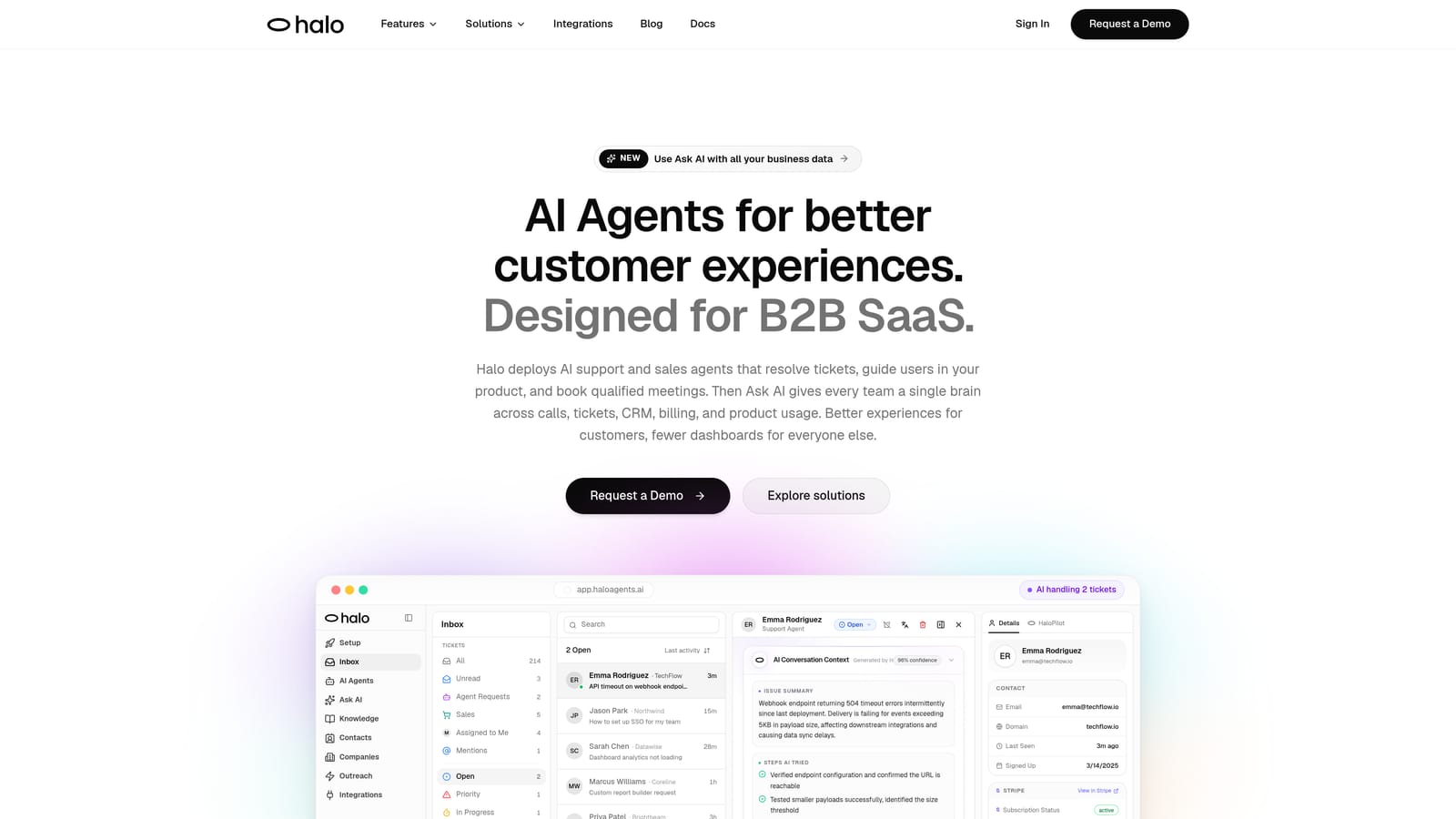
Halo AI is an AI-native customer support platform built specifically for B2B SaaS, deploying intelligent agents that resolve tickets, guide users through your product, and surface business signals — all while learning from every interaction.
Where This Tool Shines
What separates Halo from most tools on this list is its architecture. It was built AI-first, not retrofitted. That distinction matters in practice: the AI doesn't just suggest responses for agents to approve — it resolves tickets autonomously, with full context about who the user is, what page they're on, and what they've already tried.
The page-aware chat widget is a standout feature. It sees what the user sees, allowing it to provide visual UI guidance rather than generic instructions. When a ticket does need a human, the handoff includes full context so agents aren't starting from scratch. Beyond support, Halo's smart inbox surfaces customer health signals, revenue anomalies, and churn indicators — turning your support queue into a source of business intelligence.
Key Features
Page-Aware Chat Widget: Understands the user's current context in your product and provides visual UI guidance tailored to exactly where they are.
Autonomous Ticket Resolution: AI agents handle tickets end-to-end, with intelligent escalation to live agents when complexity warrants it — including full conversation context on handoff.
Auto Bug Ticket Creation: Automatically identifies and routes bug reports to Linear or connected project management tools, removing manual triage from your engineering workflow.
Smart Inbox with Business Intelligence: Goes beyond support metrics to surface customer health signals, revenue anomalies, and churn indicators directly in the inbox.
Deep Integration Stack: Connects across HubSpot, Slack, Linear, Stripe, Intercom, Zoom, PandaDoc, and Fathom — not just your helpdesk, but your entire business stack.
Continuous Learning Loop: Improves resolution quality from every interaction, meaning the system gets meaningfully smarter the longer it runs.
Best For
Product-led and sales-led B2B SaaS companies that want AI-first automation rather than a bolt-on chatbot. Particularly well-suited to teams that are hitting scale limits with their current helpdesk and want support to generate business intelligence, not just close tickets.
Pricing
Contact for pricing. You can book a demo at haloagents.ai to discuss your team's specific needs and volume.
2. Intercom
Best for: Mid-market SaaS teams wanting a mature, all-in-one communications platform with a capable AI agent.
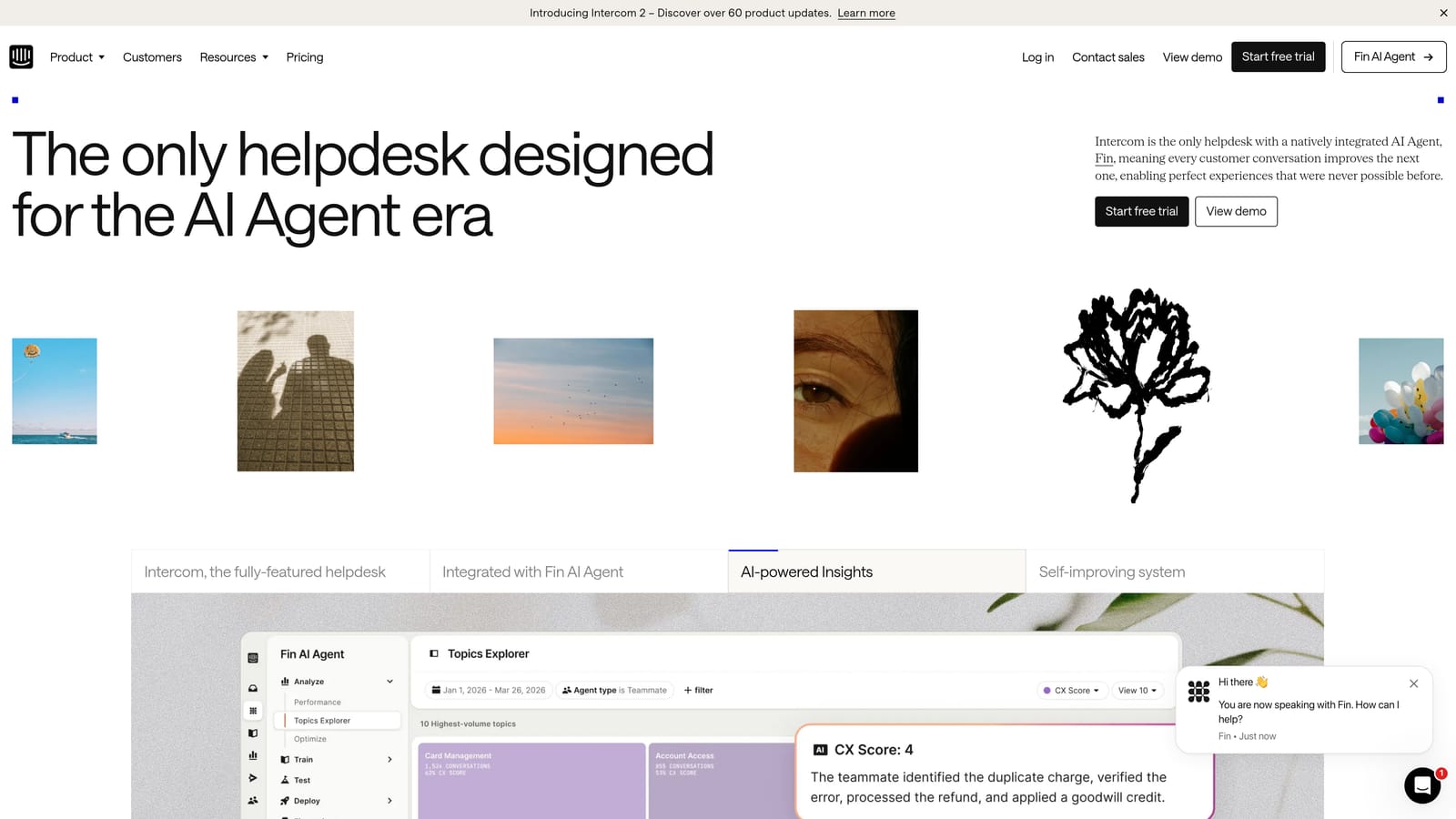
Intercom is a mature customer communications platform combining its Fin AI agent, live chat, helpdesk ticketing, and CRM in a single ecosystem.
Where This Tool Shines
Intercom has been in this space long enough to get a lot of things right. The Fin AI agent, built on GPT-4 class models, delivers solid conversational resolution rates for common SaaS support queries. It handles the kind of repetitive, knowledge-base-answerable questions that eat up agent time, and it does so within a polished product experience.
The broader Intercom ecosystem is its real strength. You get a unified inbox, CRM, messenger, and ticketing all in one place. For teams that want to consolidate their customer communications stack rather than stitch together multiple tools, Intercom is one of the most complete options available. It's worth noting that Halo AI integrates directly with Intercom for teams that want to layer additional AI capability on top.
Key Features
Fin AI Agent: Conversational AI agent capable of autonomous resolution for common support queries, built on large language model foundations.
Unified Inbox: Combines email, chat, and social channels into a single agent workspace.
Built-in CRM: Customer data platform included natively, reducing reliance on external integrations for basic customer context.
Customizable Workflows: Automation rules and workflow builder for routing, tagging, and escalation logic.
Reporting and CSAT: Strong built-in analytics including satisfaction measurement and team performance metrics.
Best For
Mid-market SaaS companies that want a consolidated platform covering chat, ticketing, and basic CRM without managing multiple vendors. Also a strong choice for teams already using Intercom's messenger who want to add AI resolution without switching platforms.
Pricing
Starts at approximately $39 per seat per month. Fin AI usage is billed separately on a per-resolution basis, so total cost scales with AI activity volume.
3. Zendesk
Best for: Large enterprise support organizations with complex workflows, SLA requirements, and compliance needs.
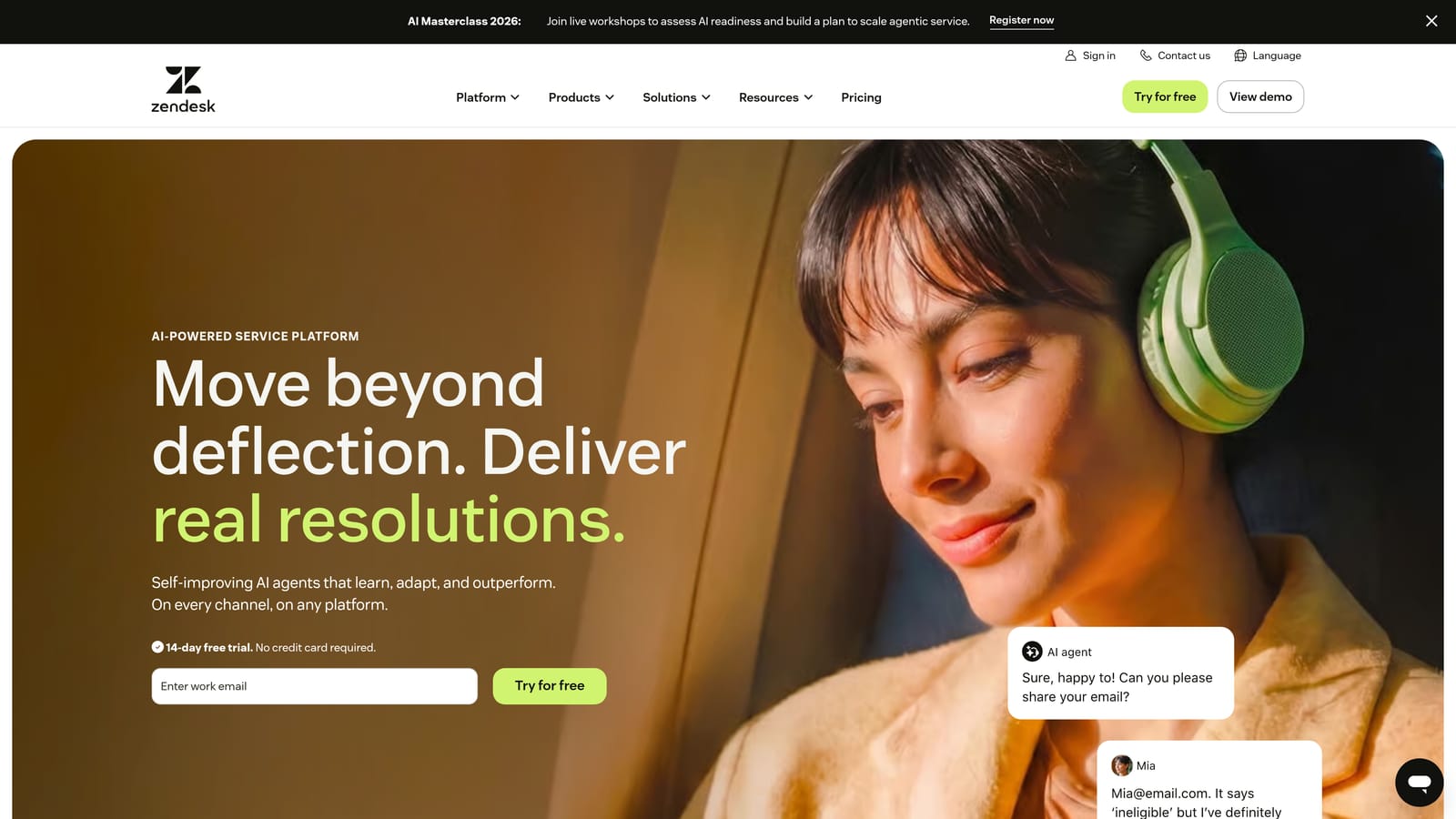
Zendesk is the market-leading enterprise helpdesk platform, with AI features layered onto a mature ticketing, routing, and reporting backbone.
Where This Tool Shines
If you're running a large support operation with strict SLA management, complex routing rules, and compliance requirements, Zendesk's depth is hard to match. The platform has been refined over many years, and that shows in its reporting capabilities, agent tooling, and the breadth of its integration marketplace.
The honest tradeoff is that Zendesk's AI capabilities feel additive rather than foundational. The platform was built around human agents, and AI was layered on through acquisition. For teams where AI-first resolution is the priority, that architecture matters. For teams that need enterprise-grade ticketing infrastructure with AI assistance, Zendesk remains a strong choice.
Key Features
AI-Powered Triage and Routing: Automated ticket classification, routing, and suggested responses powered by Zendesk AI.
Advanced SLA Management: Granular SLA policies, escalation rules, and compliance controls built for large support teams.
1,000+ Integration Marketplace: Extensive app marketplace covering almost every business tool a support team might need.
Omnichannel Support: Handles email, chat, voice, and social channels within a unified agent workspace.
Robust Analytics: Custom reporting, dashboards, and performance metrics with significant configurability.
Best For
Enterprise organizations with large, established support teams, complex SLA requirements, and significant investment in existing Zendesk workflows. Less ideal for teams starting fresh who want AI-first architecture from day one.
Pricing
Suite plans start at approximately $55 per agent per month. AI add-ons are priced separately, so enterprise AI deployments can carry significant additional cost.
4. Freshdesk
Best for: SMBs and growing teams that need solid omnichannel support with competitive pricing and a usable free tier.
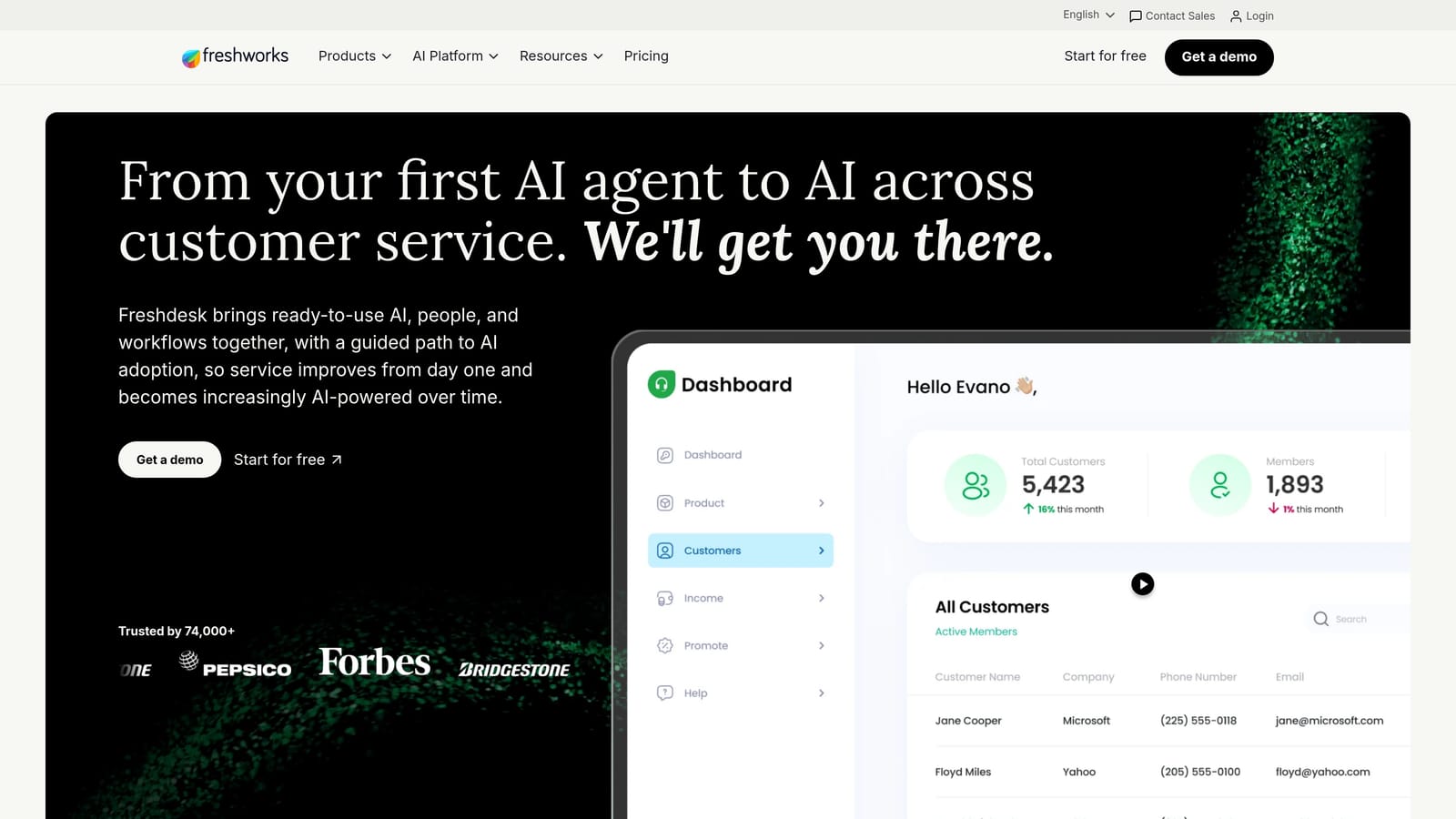
Freshdesk is Freshworks' helpdesk solution, offering Freddy AI for automation, omnichannel support coverage, and pricing that makes it accessible for teams at earlier growth stages.
Where This Tool Shines
Freshdesk's primary strength is approachability. The interface is clean, the pricing is competitive, and the free tier gives small teams a genuine starting point rather than a feature-stripped trial. Freddy AI handles answer suggestions, auto-triage, and basic sentiment detection — enough to meaningfully reduce manual workload for teams transitioning away from pure email-based support.
Omnichannel coverage is solid: email, chat, phone, and social all route into a unified inbox. For teams that are consolidating scattered support channels and want AI assistance without a heavy implementation project, Freshdesk hits a practical sweet spot.
Key Features
Freddy AI: Provides answer suggestions, automated ticket triage, and sentiment detection to assist agents and reduce manual sorting.
Omnichannel Inbox: Consolidates email, chat, phone, and social channels into a single workspace.
Collision Detection: Prevents multiple agents from responding to the same ticket simultaneously.
Marketplace and Open API: Integration options for connecting Freshdesk to broader business tools.
Free Tier: Genuinely usable free plan for small teams, making it easy to evaluate before committing.
Best For
SMBs, early-stage SaaS companies, and growing teams that need reliable omnichannel helpdesk functionality without enterprise-level costs. Teams that want to start with AI assistance and scale up over time.
Pricing
Free plan available for small teams. Paid plans start at approximately $15 per agent per month, making it one of the more accessible options on this list.
5. Salesforce Service Cloud
Best for: Enterprises already invested in the Salesforce ecosystem that need support tightly integrated with CRM data.
Salesforce Service Cloud is an enterprise support platform deeply integrated with Salesforce CRM, featuring Einstein AI for case management, routing, and next-best-action guidance.
Where This Tool Shines
The core value proposition here is the Salesforce integration. Support agents get a unified view of the customer that includes sales history, open opportunities, contract details, and previous interactions — all without switching tabs. For organizations where support and sales are tightly coordinated, that context is genuinely valuable and difficult to replicate with standalone tools.
Einstein AI adds case classification, intelligent routing, and next-best-action recommendations. The platform also supports complex multi-step workflow automation through Flow. The honest caveat: Service Cloud carries significant implementation overhead and cost. It rewards organizations with dedicated Salesforce admins and the budget to configure it properly.
Key Features
Einstein AI: Handles case classification, routing recommendations, and next-best-action guidance within the agent workflow.
Unified CRM View: Full customer data across sales and support in a single interface, eliminating context-switching.
Omni-Channel Routing: Intelligent routing and workforce management tools for complex support operations.
Flow Automation: Visual workflow builder for complex, multi-step automation across the Salesforce platform.
AppExchange Ecosystem: Extensive third-party app marketplace for extending Service Cloud functionality.
Best For
Enterprise organizations already committed to the Salesforce platform where CRM-support integration is a strategic priority. Not recommended for teams without existing Salesforce infrastructure — the implementation investment is substantial.
Pricing
Starter plans begin at approximately $25 per user per month, but enterprise configurations with full AI capabilities run significantly higher. Total cost of ownership includes implementation and admin overhead.
6. Tidio
Best for: Small businesses and e-commerce teams that need fast deployment, live chat, and accessible AI chatbot functionality.
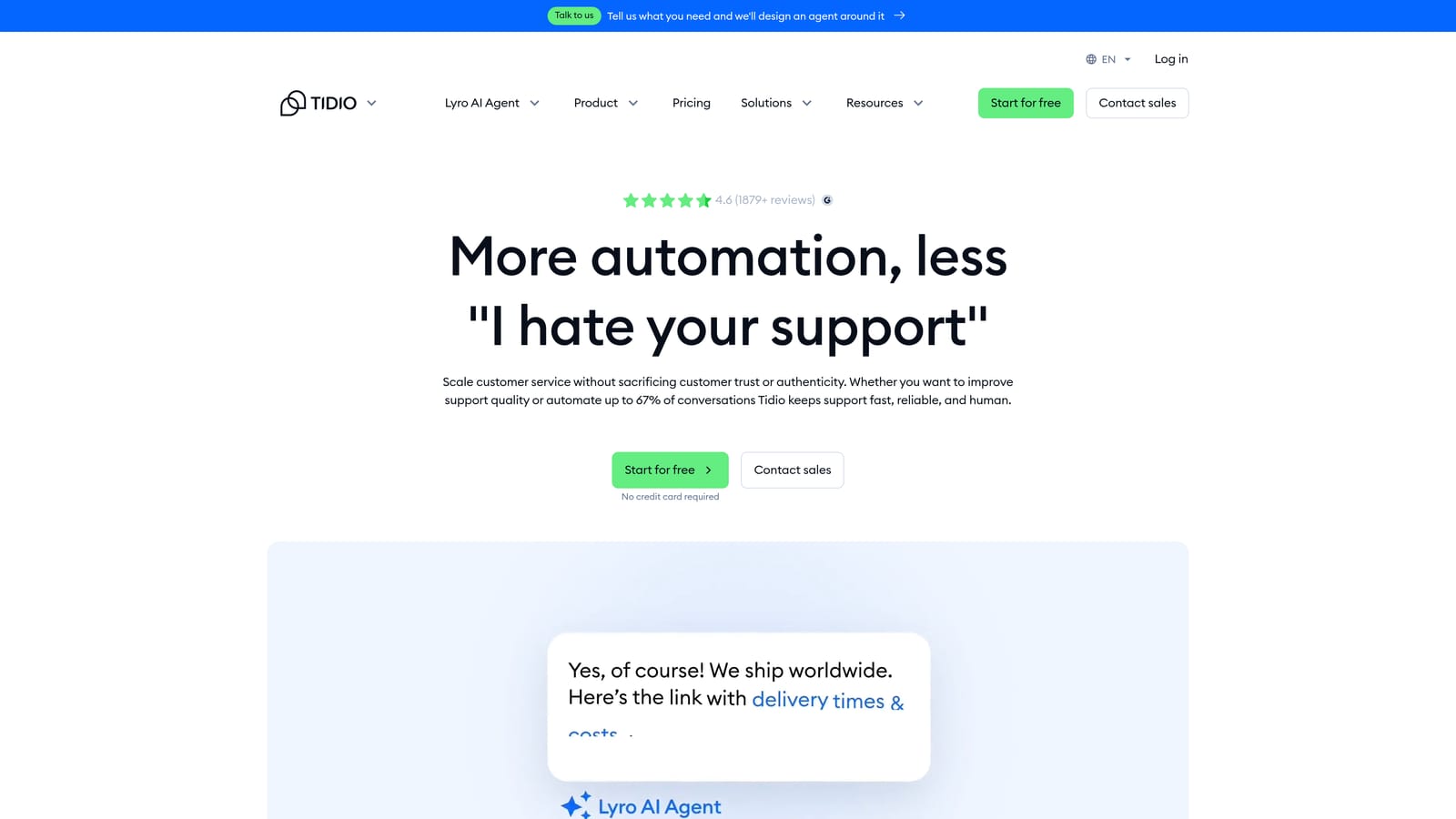
Tidio is an SMB-focused live chat and AI chatbot platform featuring the Lyro AI agent, designed for quick setup and strong e-commerce integrations.
Where This Tool Shines
Tidio's biggest advantage is speed to value. You can have a live chat widget and a functional AI chatbot running on your site in a matter of hours, not weeks. For small teams that need something operational quickly without a dedicated implementation project, that matters a lot.
Lyro AI handles conversational FAQ resolution well within its scope. It's not designed for complex, multi-step B2B support scenarios, but for straightforward deflection of common questions — especially in e-commerce contexts — it performs reliably. The no-code chatbot builder also makes it accessible to non-technical team members who need to update flows without developer involvement.
Key Features
Lyro AI Chatbot: Conversational AI agent for FAQ resolution, capable of handling common queries without agent involvement.
Live Chat with Mobile App: Agents can respond from mobile, useful for small teams without dedicated support staff on shift.
E-commerce Integrations: Native Shopify and WooCommerce integrations for product and order context.
Visual Chatbot Builder: No-code flow builder for creating and updating chatbot logic without developer support.
Multi-Channel Support: Covers email and Messenger in addition to live chat.
Best For
Small businesses, e-commerce brands, and teams that need a fast, accessible entry point into chat and AI automation. Less suited to complex B2B SaaS support scenarios requiring deep integrations or multi-step reasoning.
Pricing
Free plan available. Lyro AI plans start at approximately $29 per month, making it one of the most cost-accessible AI chatbot options on this list.
7. Gorgias
Best for: E-commerce brands, particularly Shopify merchants, that need automated handling of order, refund, and return queries.
Gorgias is a customer support platform built specifically for e-commerce brands, with deep Shopify integration and automation purpose-built for order management workflows.
Where This Tool Shines
Gorgias does one thing exceptionally well: e-commerce support automation. The native Shopify integration means agents and AI have immediate access to order data, customer history, and fulfillment status without any custom setup. Automated responses for order status inquiries, return requests, and refund workflows can handle a significant portion of a typical e-commerce support queue without human involvement.
The revenue statistics feature is a genuine differentiator in this space. Gorgias links support interactions to sales outcomes, helping teams understand which support conversations are influencing conversion and retention. If you're running an e-commerce operation, that framing of support as a revenue function — rather than a cost center — is valuable.
Key Features
Native E-commerce Integrations: Deep Shopify, BigCommerce, and Magento integrations with order data surfaced directly in the support interface.
Order Workflow Automation: Automated responses for order status, returns, and refunds without agent involvement.
Revenue Statistics: Links support interactions to sales outcomes, measuring support's impact on conversion and retention.
Macros and Rules: Template-based automation for high-volume, repetitive ticket types.
Omnichannel Coverage: Handles email, chat, social, and SMS from a unified workspace.
Best For
E-commerce brands running on Shopify or similar platforms with high volumes of order-related queries. Not the right fit for B2B SaaS teams — Gorgias is purpose-built for its vertical and doesn't try to be anything else.
Pricing
Starts at approximately $10 per month for 50 tickets, with pricing scaling based on ticket volume rather than seat count — a model that suits e-commerce brands with variable support demand.
8. Help Scout
Best for: Teams that prioritize relationship quality and a human-first support experience with AI assistance layered in.
Help Scout is a relationship-focused support platform with a clean email-like interface, AI drafting and summarization tools, and an embeddable Beacon widget for self-service.
Where This Tool Shines
Help Scout has a clear philosophy: support should feel human, and AI should assist agents rather than replace them. That's a deliberate positioning choice, and it resonates with teams that serve customers where relationship quality matters as much as resolution speed. The interface is intentionally simple — it looks and feels like email, which reduces the learning curve for new agents significantly.
The AI features — Summarize, Assist for response drafting, and the Beacon widget — are genuinely useful without being intrusive. For teams that have had bad experiences with chatbots that frustrate customers, Help Scout's measured approach to AI is a feature, not a limitation.
Key Features
Shared Inbox: Collaborative email-like inbox with collision detection and private notes for internal team communication.
AI Assist: AI-powered response drafting and conversation summarization to speed up agent workflows.
Beacon Widget: Embeddable self-service widget with docs search, contact forms, and proactive messaging.
Customer Profiles: Full interaction history and customer context surfaced alongside every conversation.
Satisfaction Ratings: Built-in CSAT measurement and reporting.
Best For
Professional services firms, smaller SaaS companies, and teams running high-touch support models where the quality of individual interactions matters more than deflection rates. Also a good fit for teams moving off shared Gmail inboxes who want structure without complexity.
Pricing
Starts at approximately $22 per user per month, positioning it as a mid-range option that balances features with accessibility.
9. Kustomer
Best for: High-volume consumer-facing brands that need a unified customer timeline and AI-powered routing across multiple channels.
Kustomer is a CRM-first support platform offering a unified customer timeline, AI-powered routing, and high-volume conversation automation designed for consumer-facing brands.
Where This Tool Shines
Kustomer's defining feature is the unified customer timeline. Every interaction a customer has had — across every channel — is aggregated into a single chronological view. For high-volume support operations where context continuity is critical, that timeline eliminates the frustrating experience of customers having to repeat themselves every time they contact support.
AI handles intent detection and intelligent routing, ensuring conversations reach the right team or automation path quickly. The custom objects feature gives operations teams flexibility to model data structures that match their specific business, rather than forcing everything into a standard ticket schema. Kustomer is less common in pure B2B SaaS environments but is well-regarded in consumer-facing industries with complex, high-volume support needs.
Key Features
Unified Customer Timeline: Aggregates all customer touchpoints across channels into a single chronological view for full context.
AI Intent Detection: Identifies customer intent and routes conversations to the appropriate team or automated workflow.
Automation Workflows: Handles repetitive, high-volume query types without agent involvement.
Omnichannel Coverage: Email, chat, SMS, social, and voice channels managed from a single workspace.
Custom Objects: Flexible data modeling for businesses with non-standard support data structures.
Best For
Consumer-facing brands with high interaction volumes across multiple channels, where customer context continuity is a priority. Teams that need flexible data modeling to accommodate complex customer data structures beyond standard ticket fields.
Pricing
Starts at approximately $89 per user per month, positioning Kustomer at the higher end of the market — a reflection of its CRM depth and enterprise feature set.
Which Tool Is Right for Your Team?
The right choice depends on where you are, who you serve, and how seriously you want to invest in AI-first support. Here's a quick breakdown by use case.
B2B SaaS and product-led teams: Halo AI is the strongest fit for teams that want autonomous resolution, page-aware context, and business intelligence built into the support layer. Intercom is a solid alternative if you want a mature all-in-one platform with a capable AI agent and don't need the depth of Halo's integration stack.
Enterprise organizations: Zendesk leads for large support orgs with complex SLA requirements and established workflows. Salesforce Service Cloud is the clear choice if you're already in the Salesforce ecosystem and need CRM-support integration as a strategic priority.
SMBs and growing teams: Freshdesk offers the best balance of features and pricing, with a usable free tier and a clear upgrade path. Tidio is the fastest route to live chat and basic AI chatbot functionality for very small teams.
E-commerce brands: Gorgias is purpose-built for this vertical and handles order, return, and refund automation better than any general-purpose tool on this list.
High-touch and relationship-focused teams: Help Scout's human-first philosophy and clean interface make it the right choice for teams where interaction quality matters more than deflection volume. Kustomer suits high-volume consumer brands that need a unified customer timeline across every channel.
Your support team shouldn't scale linearly with your customer base. Let AI agents handle routine tickets, guide users through your product, and surface business intelligence while your team focuses on complex issues that need a human touch. See Halo in action and discover how continuous learning transforms every interaction into smarter, faster support.