9 Best Customer Support AI Platforms in 2026
This guide evaluates the best customer support AI platforms available in 2026, comparing top tools on automation depth, integration capabilities, and genuine ticket resolution—not just deflection. Whether you're a lean startup or a scaling mid-market team, it helps you identify which platform best fits your specific support needs and operational goals.
 Matt PattoliFounder13 min read
Customer support teams are under more pressure than ever. Ticket volumes keep climbing, headcounts stay flat, and customers expect answers in seconds rather than hours. The good news is that AI-powered support platforms have moved well beyond basic chatbots. Today's best tools resolve tickets autonomously, hand off to human agents without losing context, and surface business intelligence that goes far beyond answering questions.
Whether you're running a lean SaaS startup or scaling a mid-market product team, the right AI support platform can fundamentally change how your team operates. This list covers the top customer support AI platforms available in 2026, evaluated on automation depth, integration breadth, ease of deployment, and how well they actually resolve tickets rather than just deflect them.
Each tool has a distinct strength, and we've noted who each one is best suited for. Let's get into it.
1. Halo AI
Best for: Product-led SaaS teams that want autonomous ticket resolution and business intelligence in one platform.
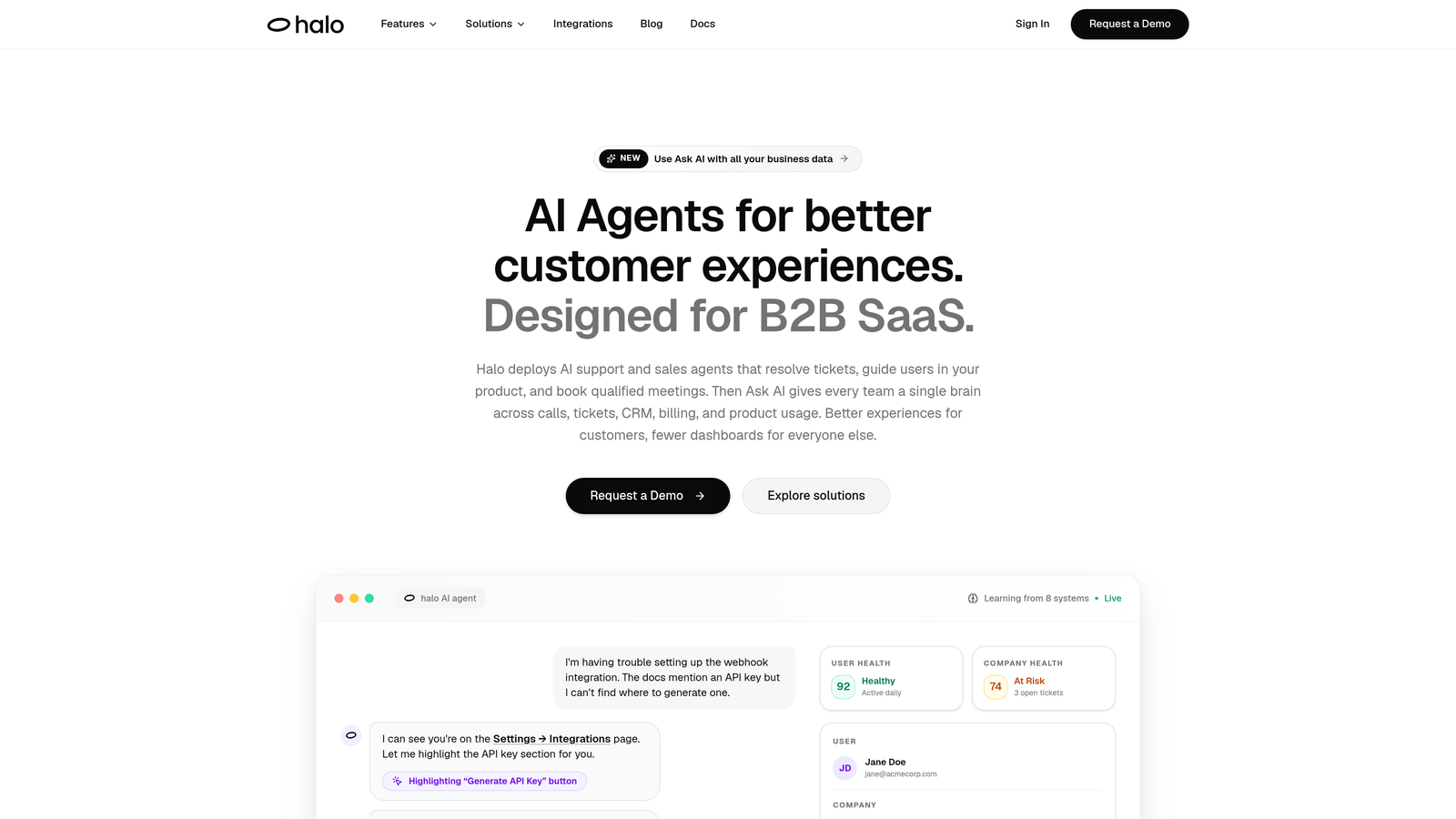
Halo AI is an AI-first customer support platform that deploys autonomous agents to resolve tickets, guide users through your product with page-aware context, and surface business intelligence from every interaction.
Where This Tool Shines
What separates Halo from most platforms on this list is its architecture. It was built from the ground up as an AI-first system, not a bolt-on layer added to an existing helpdesk. That distinction matters because it means the intelligence runs deeper. Halo's agents don't just respond to tickets; they learn from every interaction, getting smarter about your product, your users, and your common failure points over time.
The page-aware chat widget is a standout capability. Halo can see what screen a user is on and provide visual UI guidance in context, which is a meaningful upgrade from generic chatbot responses. Pair that with a smart inbox that surfaces customer health signals, churn indicators, and revenue anomalies, and you have a support platform that doubles as a business intelligence layer for your product team.
Key Features
Autonomous Ticket Resolution: AI agents handle support tickets end-to-end without requiring human intervention on routine issues.
Page-Aware Chat Widget: Knows exactly what screen the user is on and delivers contextually relevant guidance and visual UI walkthroughs.
Smart Inbox with Business Intelligence: Surfaces customer health signals, revenue anomalies, and churn indicators directly from support interactions.
Auto Bug Ticket Creation: Automatically generates and routes bug reports to Linear or your preferred issue tracker when patterns suggest a product problem.
Live Agent Handoff: Escalates complex issues to human agents with full conversation context preserved, so nothing gets repeated.
Deep Integrations: Connects natively with Linear, Slack, HubSpot, Intercom, Stripe, Zoom, PandaDoc, and Fathom.
Best For
Halo is the strongest fit for product-led SaaS companies that want more than ticket deflection. If your team needs autonomous resolution, wants to connect support data to CRM and billing systems, and values the kind of business intelligence that helps you catch churn before it happens, Halo is built for that use case.
Pricing
Contact for pricing. Visit haloagents.ai to learn more and request a demo.
2. Intercom (Fin AI Agent)
Best for: Teams already using Intercom's messenger and inbox who want to add LLM-powered resolution.
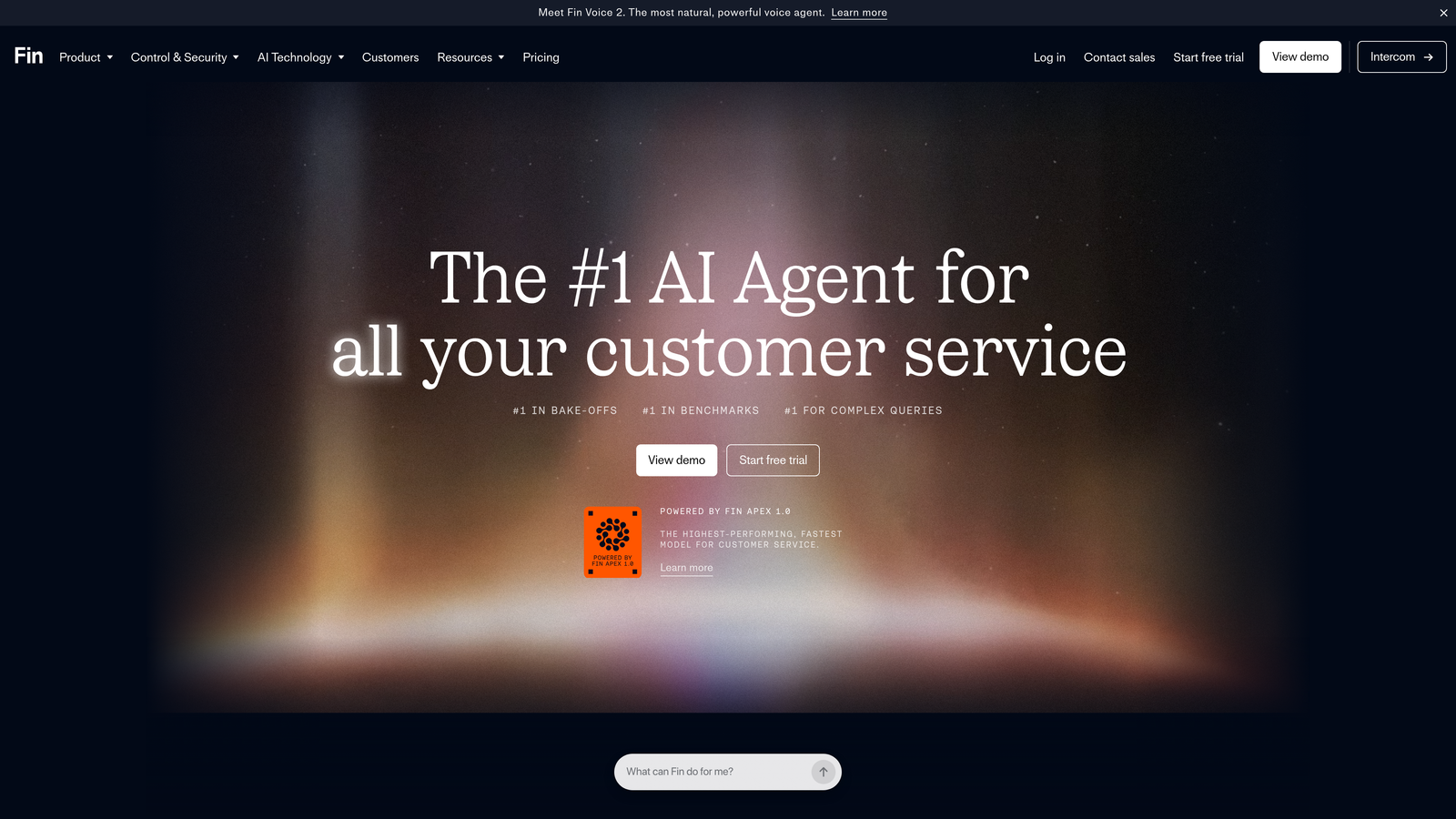
Intercom's Fin AI Agent is a large language model-powered support agent trained on your help center content, designed to resolve conversations without human involvement.
Where This Tool Shines
Fin's biggest advantage is how naturally it fits into the Intercom ecosystem. If your team already uses Intercom for live chat, inbox management, and customer messaging, Fin layers on top of that infrastructure without requiring a platform migration. Setup is relatively fast because Fin learns from your existing help center content.
The source citation feature is a nice touch for trust. When Fin answers a question, it can reference the specific help article it drew from, which gives customers more confidence in the response and makes it easier for your team to identify gaps in your documentation.
Key Features
LLM-Powered Responses: Trained on your existing help center content to generate accurate, contextual answers.
Source Citations: References the specific knowledge base articles used in each answer for transparency.
Seamless Human Handoff: Routes complex conversations to live agents within the Intercom inbox without disruption.
Multi-Channel Support: Works across web messenger, email, and WhatsApp.
Resolution Reporting: Built-in analytics tracking resolution rates and CSAT scores.
Best For
Fin is a natural choice for teams already invested in the Intercom platform. It's less compelling as a standalone decision if you're not using Intercom's broader suite, since much of its value comes from the tight ecosystem integration.
Pricing
Fin AI Agent is priced per resolution. Intercom plans start at $39/seat/month. Verify current pricing at intercom.com.
3. Zendesk AI
Best for: Large enterprise support teams with complex workflows already running on Zendesk.
Zendesk AI adds intelligent triage, routing, agent copilot, and generative AI capabilities to one of the most established enterprise helpdesk platforms on the market.
Where This Tool Shines
Zendesk's AI layer benefits enormously from the platform's maturity. Enterprise teams with years of ticket history, complex routing rules, and large agent teams get a meaningful boost from AI triage and the Agent Copilot, which suggests replies and next-best-action prompts without requiring agents to start from scratch on every ticket.
The quality assurance scoring is particularly useful for support leaders managing large teams. It provides automated evaluation of agent interactions, which would otherwise require significant manual review time.
Key Features
Intelligent Triage and Routing: Automatically categorizes and routes tickets based on intent and sentiment detection.
Agent Copilot: Provides suggested replies and next-best-action prompts directly within the agent workspace.
AI-Powered Self-Service Bots: Integrated with the Zendesk help center for automated customer-facing resolution.
Advanced Analytics and QA Scoring: Automated quality assurance evaluation across agent interactions.
Enterprise Compliance Controls: Enterprise-grade security and compliance features for regulated industries.
Best For
Zendesk AI is the right call for large organizations already running on Zendesk that want to add AI capabilities without a platform change. It's less suited for teams starting fresh or those looking for an AI-first architecture rather than an AI layer.
Pricing
AI features are available on Suite plans starting at $55/agent/month. Verify current pricing at zendesk.com.
4. Freshdesk Freddy AI
Best for: SMBs and growing teams that want an affordable AI-assisted helpdesk within the Freshworks ecosystem.
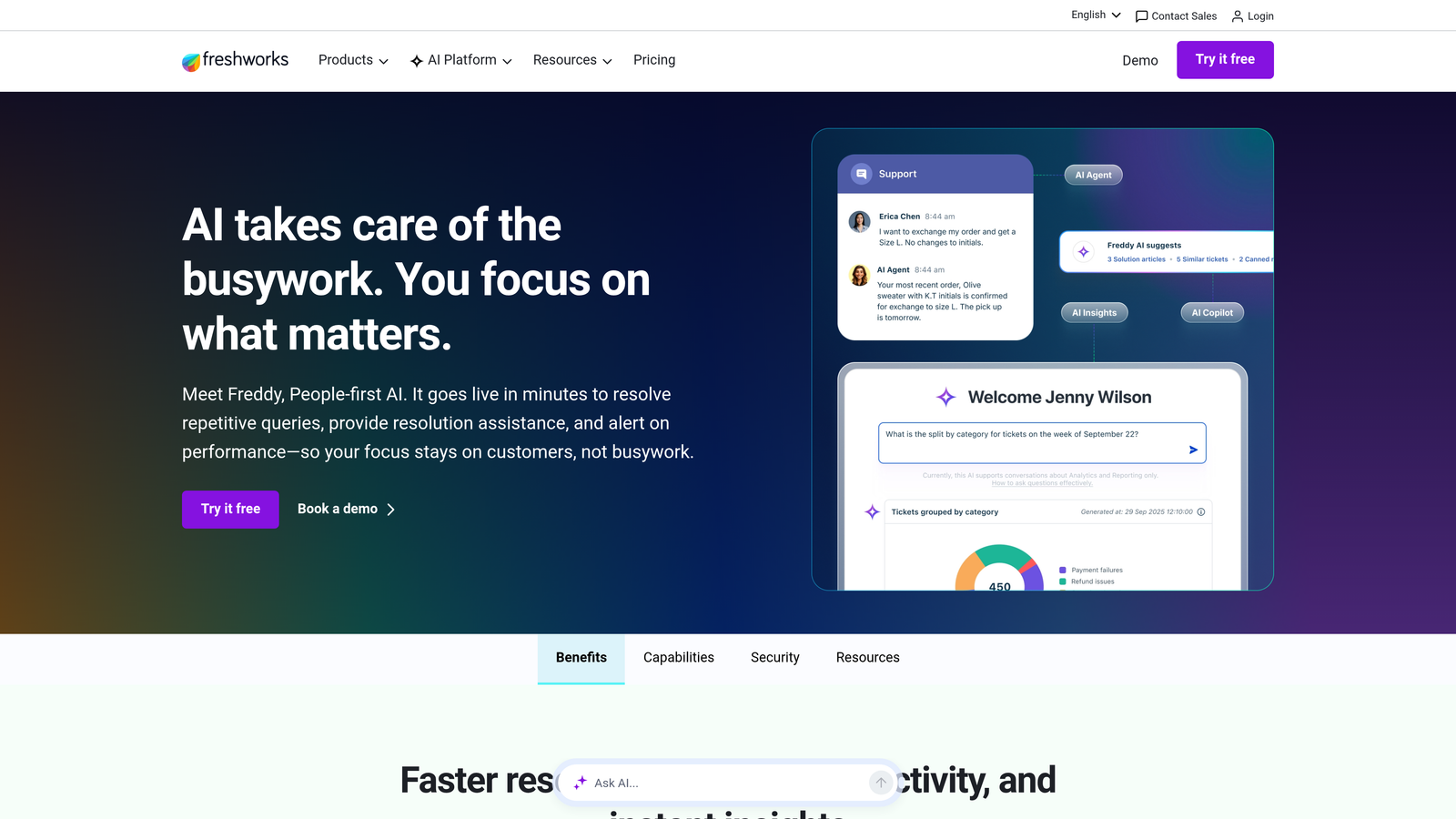
Freddy AI is Freshworks' embedded AI layer spanning self-service chatbots, agent assist, and analytics across the Freshdesk helpdesk suite.
Where This Tool Shines
Freddy's strength is breadth at an accessible price point. Rather than offering a single AI capability, it covers three distinct layers: self-service deflection, agent assistance, and leadership-level analytics. For a team that's growing and wants AI support without enterprise-level spend, that combination is genuinely useful.
The Freddy Insights layer is worth highlighting for support managers. It provides AI-driven analytics and anomaly detection, flagging unusual spikes in ticket volume or shifts in customer sentiment before they become larger problems.
Key Features
Freddy Self Service: AI chatbot that handles common queries without agent involvement.
Freddy Copilot: Agent assist with suggested responses, ticket summarization, and reply drafting.
Freddy Insights: AI-driven analytics with anomaly detection for support leaders.
No-Code Bot Builder: Custom conversation flows without engineering resources.
Native Freshworks Integration: Works across Freshdesk, Freshchat, and Freshsales out of the box.
Best For
Freddy AI is a strong fit for SMBs and mid-market teams that are already using or considering Freshworks products. It offers a solid entry point into AI-assisted support without requiring a large budget or dedicated implementation team.
Pricing
Freddy AI features are available on the Growth plan and above, starting at $15/agent/month. Verify current pricing at freshworks.com.
5. Tidio
Best for: E-commerce businesses and small teams that need fast AI chat deployment with minimal setup.
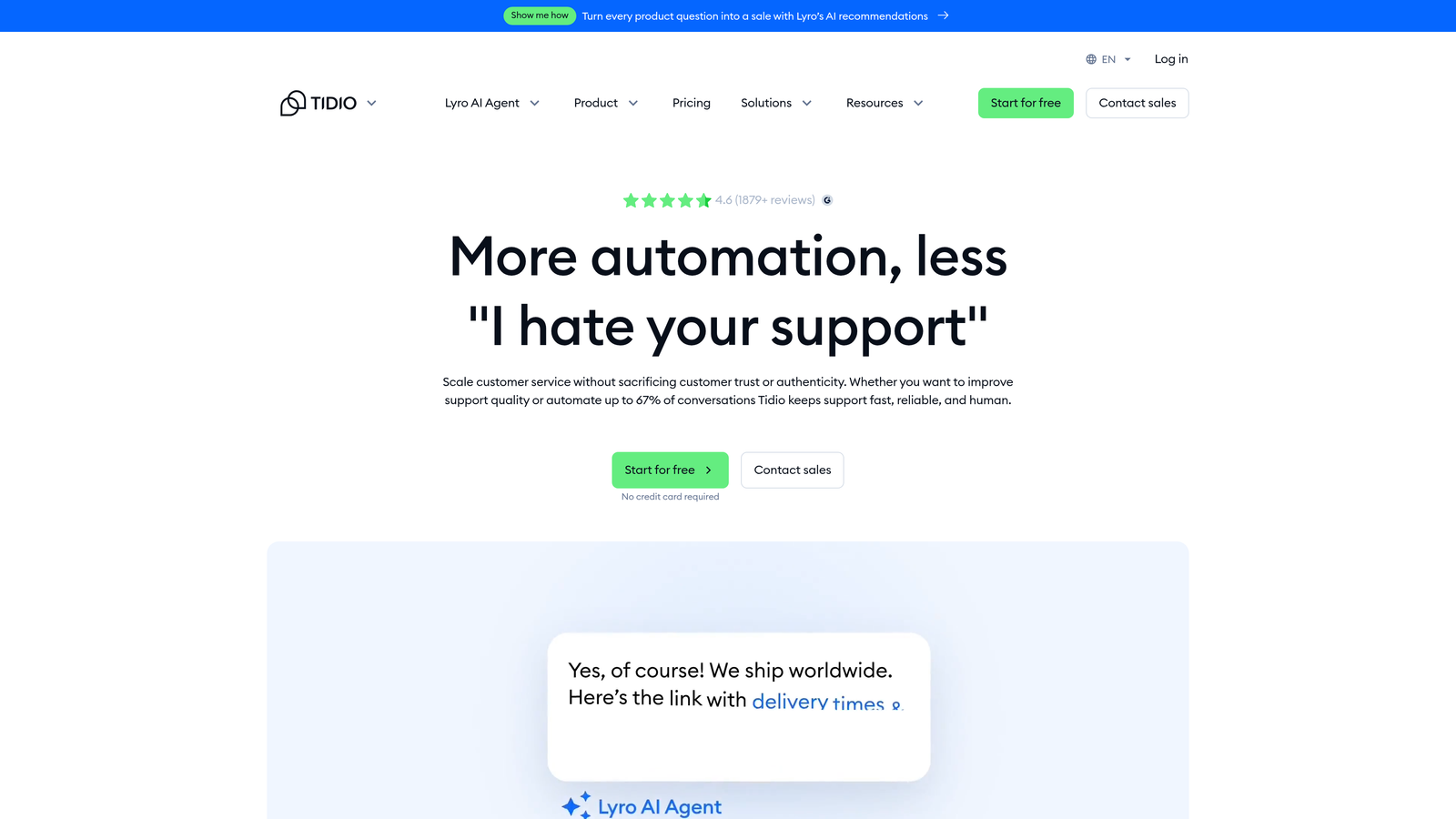
Tidio is a live chat and AI chatbot platform built for e-commerce and small businesses, featuring Lyro, an AI agent that handles customer conversations with minimal configuration.
Where This Tool Shines
Tidio's Lyro AI agent is designed to get up and running quickly. For e-commerce teams that don't have dedicated support engineers or lengthy implementation timelines, that matters. The native Shopify and WooCommerce integrations mean Lyro can pull order data and answer product questions with real context right out of the box.
The unified inbox that combines live chat and AI chat is a practical feature for small teams. Agents don't need to switch between systems to see what the bot handled and what needs a human response.
Key Features
Lyro AI Agent: Handles automated customer conversations with minimal setup required.
E-Commerce Integrations: Native connections with Shopify, WooCommerce, and Wix.
No-Code Chatbot Builder: Pre-built templates for common conversation flows.
Unified Inbox: Live chat and AI chat managed in a single interface.
Multi-Channel Support: Handles email and Facebook Messenger in addition to web chat.
Best For
Tidio is the right tool for small e-commerce businesses and consumer brands that want AI chat without complexity. It's less suited for B2B SaaS teams or organizations with sophisticated integration requirements.
Pricing
Free plan available. Lyro AI starts at $29/month. Verify current pricing at tidio.com.
6. Kustomer
Best for: High-volume consumer brands that need a CRM-first support platform with AI automation.
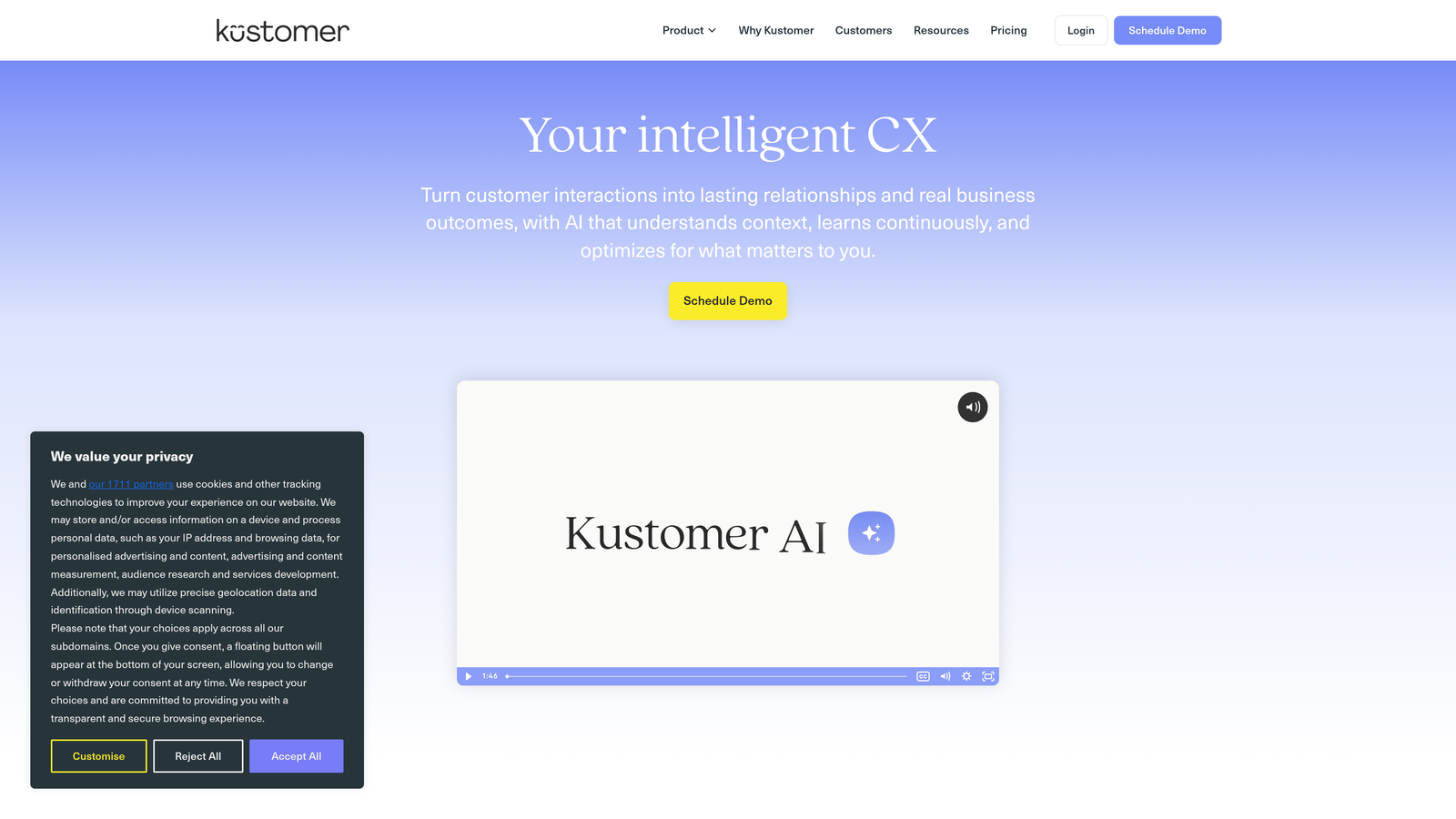
Kustomer is a CRM-first customer service platform with AI automation built into a unified customer timeline, designed for brands handling large volumes of consumer interactions.
Where This Tool Shines
Kustomer's defining feature is the unified customer timeline. Rather than treating each support interaction in isolation, Kustomer surfaces the full picture: order history, previous conversations, CRM data, and behavioral signals all in one view. That context makes AI-powered routing and agent suggestions significantly more useful because the system understands who the customer is, not just what they're asking.
The omnichannel breadth is also notable. Kustomer handles email, chat, SMS, social media, and voice from a single platform, which matters for consumer brands operating across multiple customer touchpoints.
Key Features
Unified Customer Timeline: Combines order history, conversations, and CRM data into a single agent view.
AI-Powered Routing: Routes tickets based on customer context and intent detection.
Kustomer IQ: Intent detection and suggested replies powered by AI.
Omnichannel Support: Handles email, chat, SMS, social media, and voice in one platform.
E-Commerce and CRM Integrations: Deep connections with major e-commerce platforms and CRM systems.
Best For
Kustomer is well suited for high-volume consumer brands and direct-to-consumer companies that need CRM context baked into their support workflows. It's less commonly chosen by B2B SaaS teams with simpler support structures.
Pricing
Plans start at $89/user/month. Verify current pricing at kustomer.com.
7. Salesforce Einstein for Service
Best for: Enterprise organizations already operating within the Salesforce ecosystem.
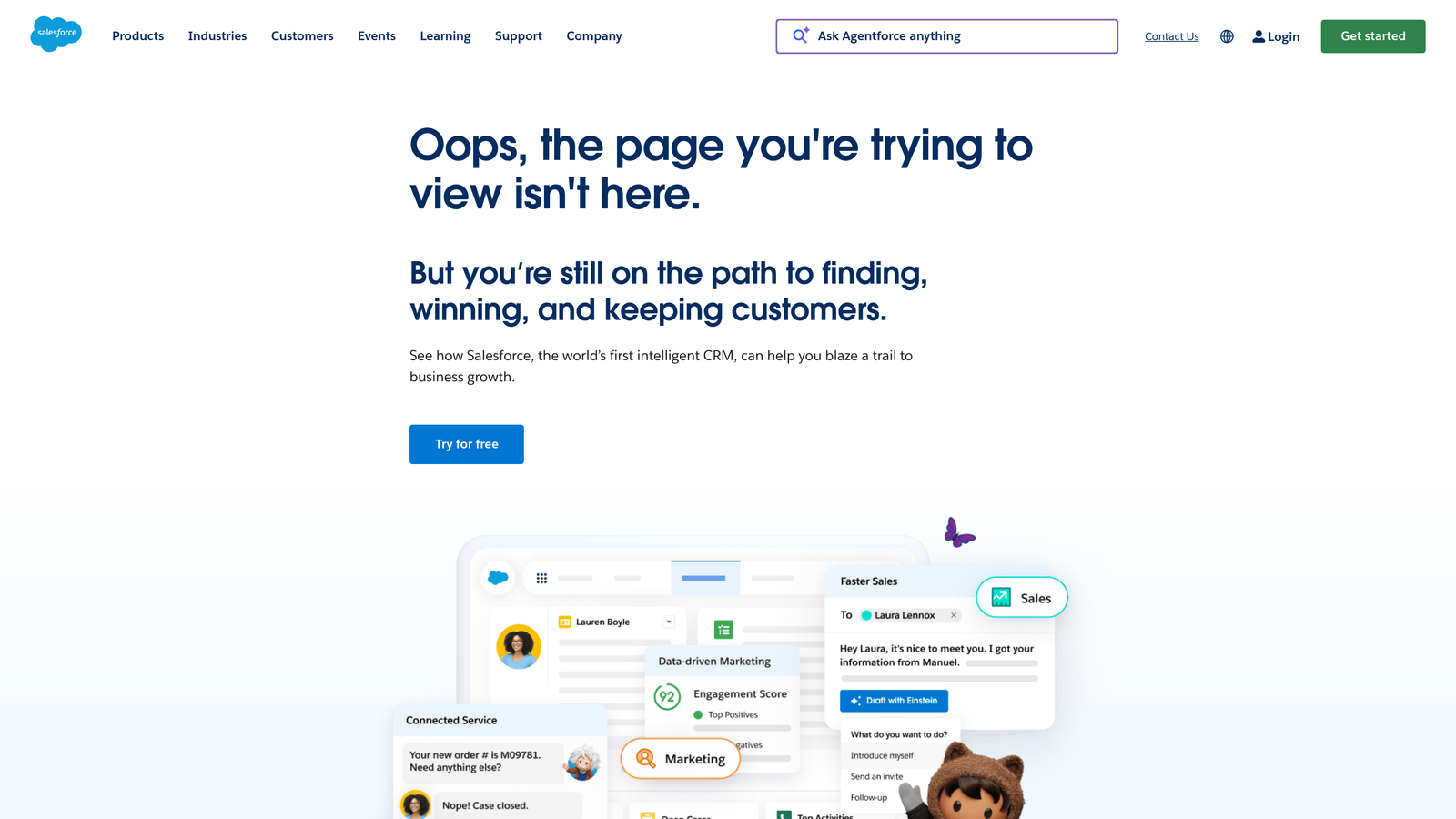
Salesforce Einstein for Service is Salesforce's AI layer embedded in Service Cloud, offering case intelligence, agent copilot, and generative AI for enterprises already using the platform.
Where This Tool Shines
Einstein's core advantage is CRM depth. Because it sits inside Salesforce, it has access to the full customer record: sales history, contract status, health scores, marketing interactions, and more. That context enables genuinely intelligent next-best-action recommendations that a standalone support tool simply can't replicate.
The generative AI features for knowledge article creation are also worth noting. Support teams that maintain large knowledge bases can use Einstein to draft, update, and organize articles based on resolved case patterns, which reduces the manual burden on senior agents.
Key Features
Einstein Copilot for Service: Natural language case summarization and agent assistance within Service Cloud.
Next-Best-Action Recommendations: AI recommendations based on full CRM context and case history.
Generative AI for Content: Drafts reply templates and knowledge base articles from resolved cases.
Cross-Cloud Integration: Deep connections with Sales Cloud, Marketing Cloud, and Commerce Cloud.
Einstein Bots: Self-service automation for common customer queries.
Best For
Einstein for Service is the clear choice for enterprises already running on Salesforce. The value is tightly coupled to the Salesforce data model, so teams outside that ecosystem won't see the same return.
Pricing
Einstein for Service is an add-on to Service Cloud; pricing varies by edition. Verify current pricing at salesforce.com.
8. Help Scout
Best for: Small teams that want simple, human-centric support with lightweight AI assistance.
Help Scout is a straightforward, human-centric support platform that has added lightweight AI features to help small teams work faster without adding complexity.
Where This Tool Shines
Help Scout's philosophy has always been simplicity, and its AI additions reflect that. Rather than building toward full automation, Help Scout uses AI to make agents faster: summarizing long conversations so new agents get up to speed instantly, drafting reply suggestions based on conversation history, and powering self-service answers from your Docs knowledge base.
For small teams that value a clean, intuitive interface and don't need deep automation, that approach is refreshing. There's no complex setup, no dedicated implementation, and no AI behavior to manage at scale.
Key Features
AI Summarize: Instant conversation summaries that give agents immediate context without reading full threads.
AI Drafts: Suggested reply drafts generated from conversation history.
AI Answers: Self-service answers powered by your Docs knowledge base.
Unified Interface: Shared inbox, live chat, and knowledge base in one clean workspace.
No-Engineering Setup: Fully operational without technical resources or implementation support.
Best For
Help Scout is ideal for small businesses, early-stage startups, and teams that prioritize simplicity over automation depth. If you're looking for autonomous ticket resolution or deep integrations, you'll want a more capable platform.
Pricing
Plans start at $22/user/month. AI features are included on the Standard plan and above. Verify current pricing at helpscout.com.
9. Ada
Best for: Mid-market and enterprise teams that need a no-code AI agent builder with strong brand control.
Ada is an enterprise-grade, no-code AI agent platform that handles complex, multi-step customer conversations across web, app, and messaging channels.
Where This Tool Shines
Ada's reasoning-based AI agent is built to handle conversations that go beyond simple FAQ deflection. It can navigate multi-step flows, pull data from integrated systems, and make decisions mid-conversation based on customer context. That makes it genuinely useful for scenarios like account changes, order modifications, or troubleshooting sequences that require several back-and-forth exchanges.
The brand voice and tone controls are a differentiator for enterprise buyers who care about consistency. Ada lets you define exactly how the AI communicates, which matters when the AI agent is representing your brand across millions of interactions.
Key Features
Reasoning-Based AI Agent: Handles complex, multi-step conversations with contextual decision-making.
No-Code Agent Builder: Configure and deploy AI agents without engineering involvement.
Brand Voice Controls: Define tone, language, and communication style at the platform level.
Omnichannel Deployment: Web, mobile app, SMS, WhatsApp, and social media channels.
Enterprise Integrations: Deep connections with Salesforce, Zendesk, and other enterprise platforms.
Best For
Ada is well suited for mid-market and enterprise companies that need a capable, no-code AI agent with strong governance and brand consistency requirements. It's a strong choice when the AI agent is a customer-facing brand touchpoint, not just a support utility.
Pricing
Enterprise pricing. Contact Ada for a quote at ada.cx.
Which Platform Is Right for Your Team?
The right customer support AI platform depends on where you are as a business and what you actually need the AI to do. Here's a quick way to think through it.
For product-led SaaS startups and mid-market teams: Halo AI is the strongest fit. Its AI-first architecture, page-aware context, and business intelligence layer go well beyond ticket deflection. If you want your support platform to also surface churn signals, auto-create bug reports, and connect to your CRM and billing stack, Halo was built for exactly that use case.
For teams already on Intercom or Zendesk: Fin AI Agent and Zendesk AI are the natural extensions. They add meaningful AI capability without requiring a platform migration, which matters when your team is already trained and your workflows are established.
For SMBs and growing teams on a budget: Freshdesk Freddy AI offers the broadest AI capability at the most accessible price point. Help Scout is the right call if simplicity and agent experience matter more than automation depth.
For e-commerce brands: Tidio's fast deployment and native Shopify integrations make it the easiest starting point. Kustomer is the upgrade path when volume grows and CRM context becomes critical.
For enterprise organizations: Salesforce Einstein is the obvious choice for teams in the Salesforce ecosystem. Ada is the right pick when you need a sophisticated, no-code AI agent with strong brand governance across multiple channels.
The broader trend worth noting is that the benchmark has shifted. Ticket deflection used to be the headline metric. In 2026, autonomous resolution rate is what separates good platforms from great ones. The best tools on this list don't just push customers to a help article; they actually close the loop.
Your support team shouldn't scale linearly with your customer base. Let AI agents handle routine tickets, guide users through your product, and surface business intelligence while your team focuses on the complex issues that need a human touch. See Halo in action and discover how continuous learning transforms every interaction into smarter, faster support.