9 Best Customer Support Automation Platforms in 2026
This guide evaluates the best customer support automation platforms available in 2026, comparing top solutions on AI capability, integration depth, and scalability for B2B teams facing rising ticket volumes and customer expectations. Whether you're upgrading a legacy helpdesk or building a support operation from scratch, this breakdown helps you identify the right platform to autonomously resolve tickets, surface actionable insights, and seamlessly escalate to human agents.
 Grant CooperFounder13 min read
Customer support teams are under more pressure than ever. Ticket volumes keep climbing, customer expectations keep rising, and headcount budgets rarely keep pace. The good news is that modern customer support automation platforms have moved well beyond basic chatbots and canned response rules. Today's best solutions resolve tickets autonomously, surface business intelligence from support data, guide users through your product in real time, and hand off to human agents with full context preserved.
This list covers the top platforms available in 2026, evaluated on AI capability, integration depth, ease of deployment, and how well they scale with growing B2B teams. Whether you're replacing a legacy helpdesk, layering AI onto an existing stack, or building a support operation from scratch, there's a right fit here. Selection criteria include autonomous resolution capability, native integrations, analytics depth, pricing transparency, and suitability for B2B SaaS teams.
1. Halo AI
Best for: B2B SaaS teams that want AI-first support with page-aware context and business intelligence
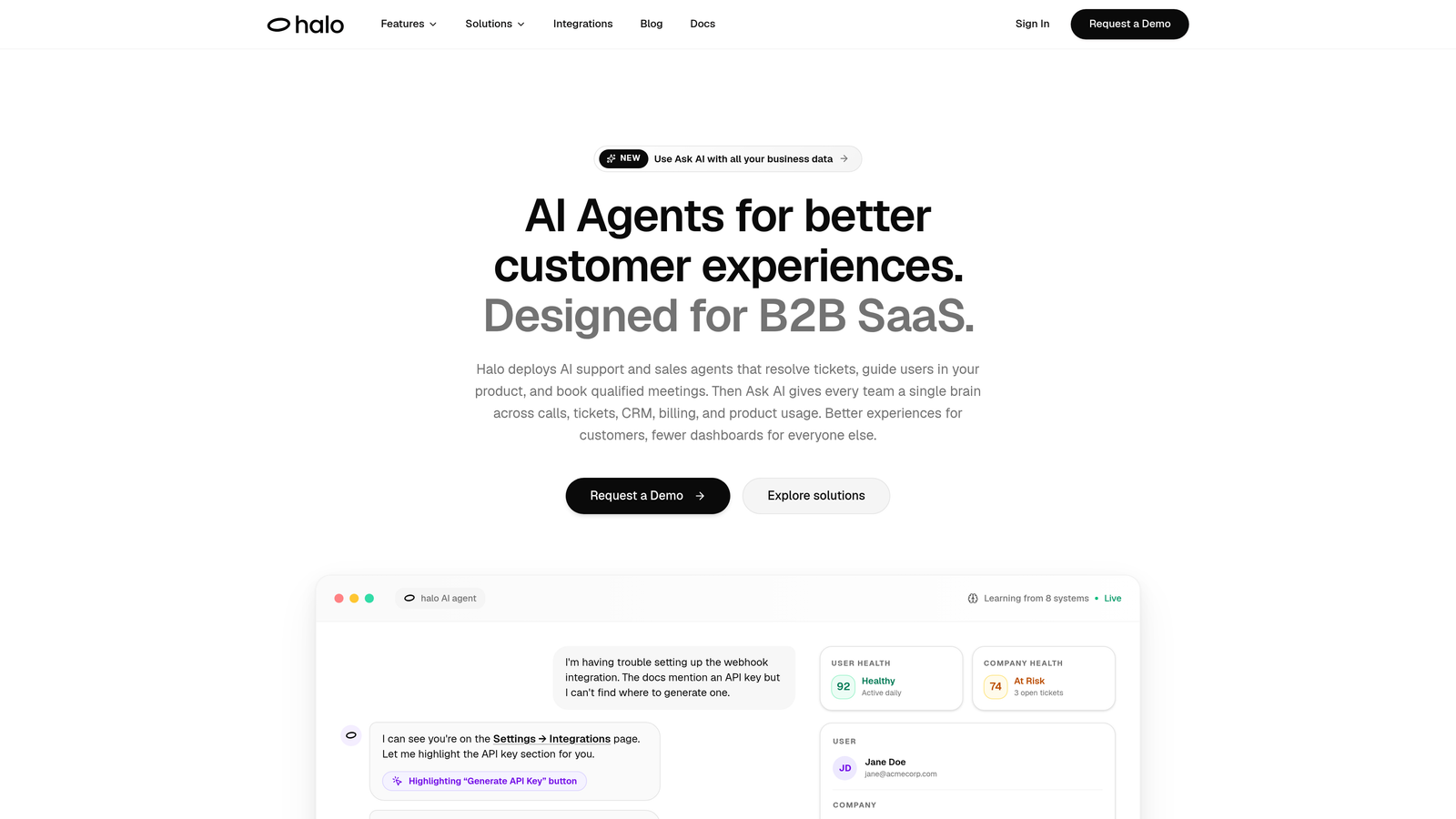
Halo AI is an AI-first customer support platform that deploys intelligent agents to resolve tickets, guide users through your product, create bug reports automatically, and surface business intelligence from every interaction.
Where This Tool Shines
Halo AI's standout differentiator is its page-aware architecture. The chat widget actually sees what users see, which means it can provide visual UI guidance specific to the screen a user is on, not just generic knowledge base answers. For SaaS products with complex workflows, this is a meaningful step up from traditional chatbots.
The platform is also genuinely AI-first rather than AI-bolted-on. It learns continuously from every interaction, and its smart inbox goes beyond ticket management to surface customer health signals, revenue anomalies, and trend detection. That makes it useful not just for support teams, but for product and customer success functions as well.
Key Features
Page-Aware Chat Widget: Understands the user's current screen context and delivers visual UI guidance relevant to their exact location in the product.
Intelligent AI Agents: Resolve tickets autonomously and improve with every interaction through continuous learning, reducing repetitive workload for human agents.
Smart Inbox with Business Intelligence: Surfaces customer health signals, revenue anomalies, and support trend detection beyond standard ticket reporting.
Auto Bug Ticket Creation: Automatically generates and routes bug reports to engineering tools like Linear, closing the loop between support and product teams.
Live Agent Handoff: Escalates complex issues to human agents with full conversation context preserved, so customers never have to repeat themselves.
Broad Integration Stack: Connects natively with Slack, HubSpot, Intercom, Stripe, Zoom, PandaDoc, and Fathom, covering the full B2B SaaS business stack.
Best For
B2B SaaS companies and product-led growth teams that want AI to do more than deflect tickets. Particularly valuable for teams where support data should be informing product, customer success, and revenue decisions. Also a strong fit for teams that need deep integration across their existing business stack without replacing every tool they use.
Pricing
Contact for pricing. Visit haloagents.ai for current plans and to see a demo of the platform in action.
2. Intercom
Best for: Teams already in the Intercom ecosystem looking for mature AI-assisted support
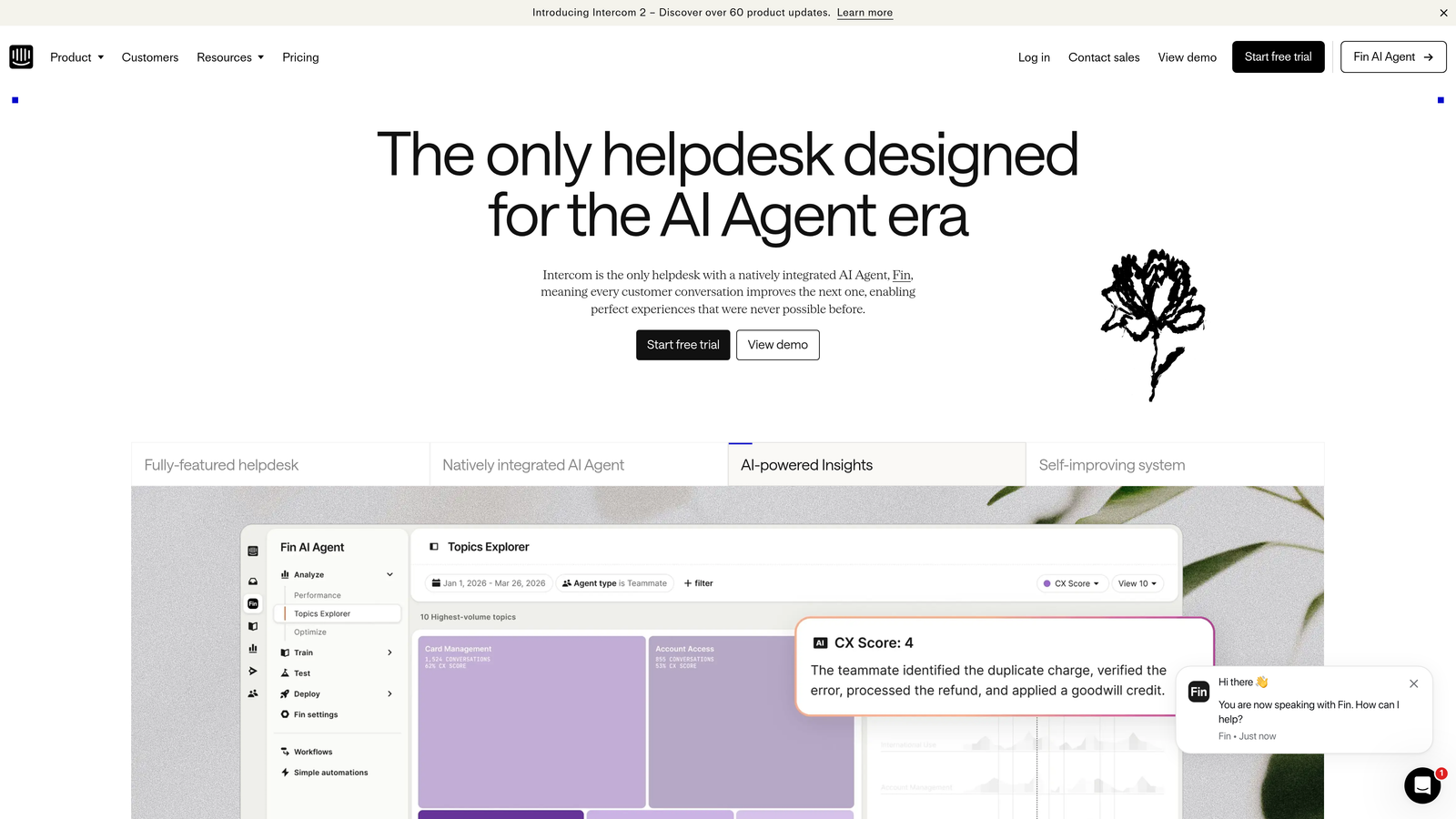
Intercom is a mature customer messaging platform with Fin, its AI agent built to resolve support queries autonomously using your existing knowledge base.
Where This Tool Shines
Intercom has one of the most polished AI agent experiences in the category. Fin draws on your existing help content to resolve queries without requiring significant re-training or setup, which makes it a relatively low-friction upgrade for teams already using the platform. The overall product experience, from proactive messaging to product tours to the shared inbox, is cohesive and well-designed.
The ecosystem depth is also worth noting. Intercom's app marketplace and native integrations cover most common SaaS stacks, and the AI Copilot feature helps live agents respond faster with real-time suggestions during active conversations.
Key Features
Fin AI Agent: Resolves support queries autonomously by drawing on your existing knowledge base content, with minimal additional configuration required.
Omnichannel Inbox: Consolidates chat, email, and social conversations into a single shared workspace for support teams.
Proactive Messaging and Product Tours: Enables in-app messaging campaigns and guided product walkthroughs to reduce inbound support volume proactively.
AI Copilot: Provides real-time suggestions and knowledge base lookups to assist live agents during active customer conversations.
Integration Ecosystem: Extensive marketplace of integrations covering CRM, billing, analytics, and engineering tools.
Best For
Teams already invested in the Intercom platform who want to add AI resolution capability without migrating to a new system. Also a solid choice for SaaS companies that rely heavily on proactive messaging and product tours as part of their support and onboarding strategy.
Pricing
Starts at approximately $39/seat/month; Fin AI usage is billed separately per resolution. Pricing can scale quickly at higher volumes. Check intercom.com for current pricing.
3. Zendesk
Best for: Large, structured support organizations with complex routing and compliance requirements
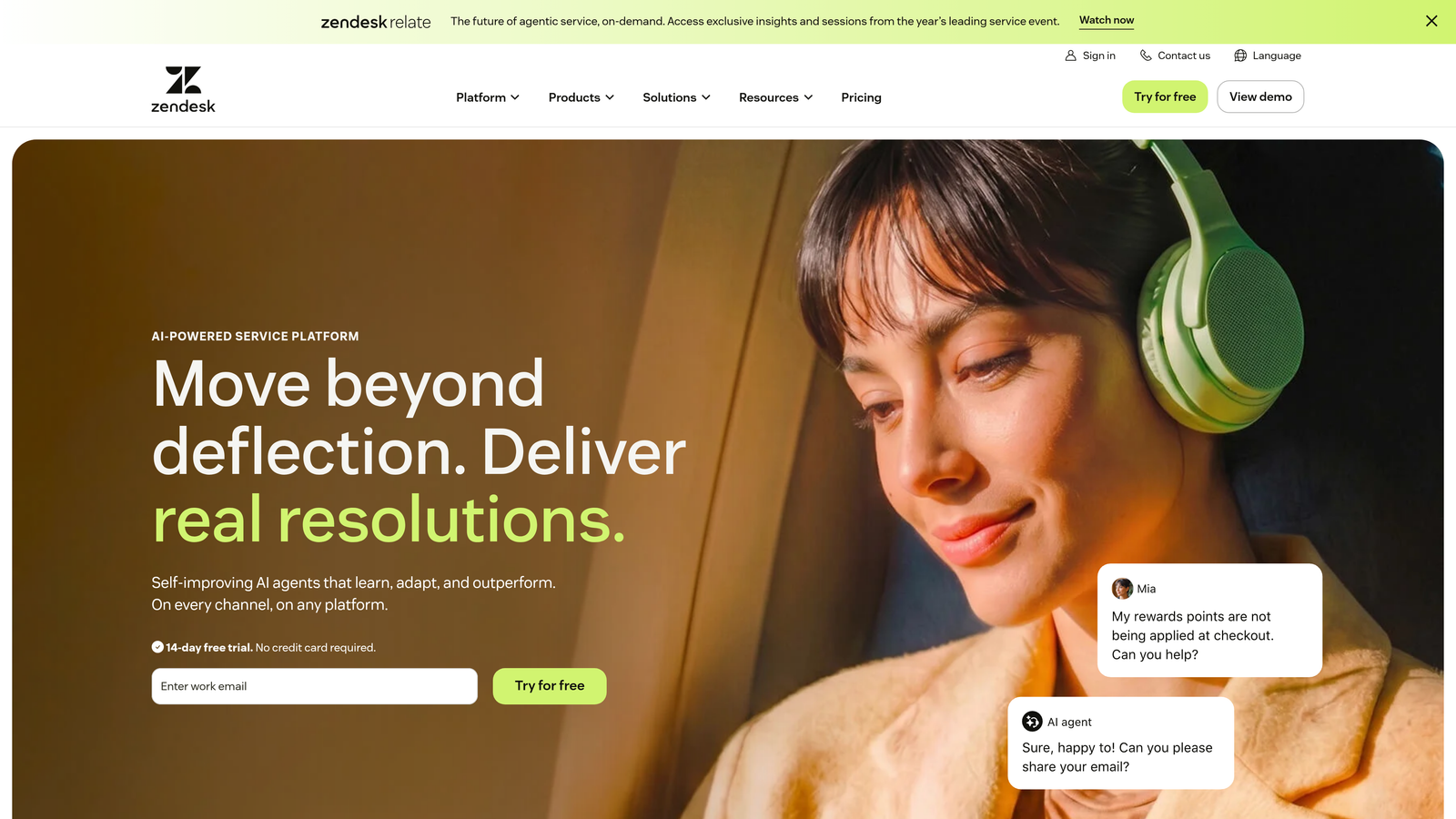
Zendesk is an enterprise-grade helpdesk platform with AI Agents and agent copilot capabilities layered into a robust ticketing and workflow system.
Where This Tool Shines
Zendesk's strength is its depth. For organizations managing high ticket volumes across multiple channels, with strict SLA requirements and complex routing logic, it remains one of the most configurable platforms available. The reporting and analytics layer is mature, and the AI Agents feature handles front-line resolution across common query types.
The AI QA tooling is also increasingly useful for support managers who need to monitor conversation quality at scale without manually reviewing every ticket. That said, Zendesk's AI capabilities feel more like additions to a ticketing system than a native AI architecture, which is worth factoring in if autonomous resolution is your primary goal.
Key Features
AI Agents: Handle automated front-line resolution for common queries before routing to human agents.
Agent Copilot: Provides real-time suggestions, knowledge base lookups, and next-step recommendations during live agent conversations.
Advanced Routing and SLA Management: Sophisticated ticket routing rules, priority management, and SLA tracking built for large support teams.
AI-Powered QA Tools: Automated quality assurance that reviews conversation quality at scale, flagging issues for manager review.
Extensive Integration Marketplace: Hundreds of integrations covering virtually every major SaaS category.
Best For
Enterprise support organizations with large teams, complex workflows, and compliance requirements. Less ideal for smaller teams or companies prioritizing fast AI deployment over workflow configurability.
Pricing
Suite plans start at approximately $55/agent/month. Enterprise plans are significantly higher. Check zendesk.com for current pricing.
4. Freshdesk
Best for: Growing SMBs that need omnichannel support with AI assistance at an accessible price point
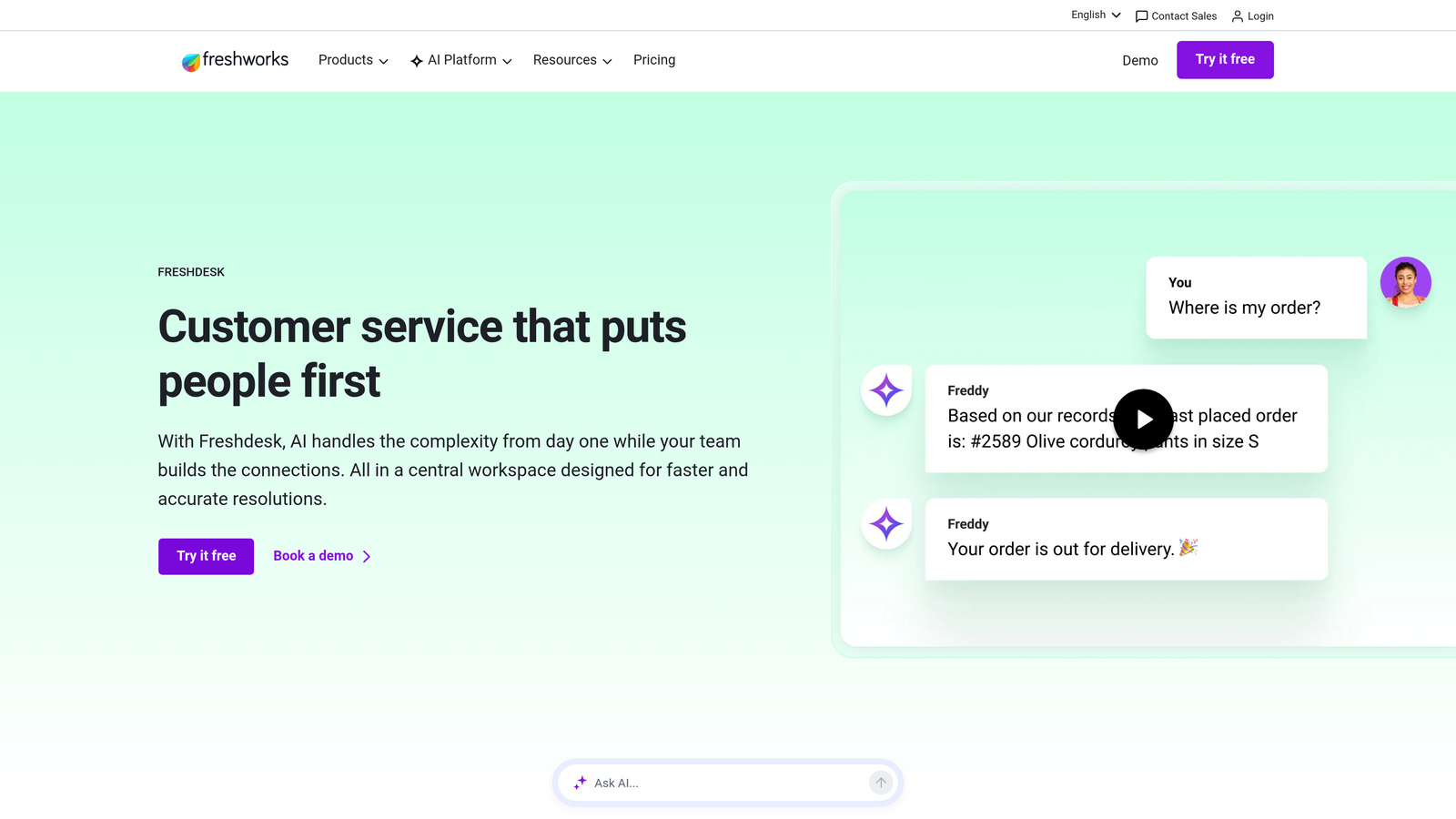
Freshdesk is a helpdesk platform by Freshworks featuring Freddy AI for ticket automation, agent assistance, and omnichannel support at a price point accessible to growing teams.
Where This Tool Shines
Freshdesk occupies a valuable middle ground: more affordable than Zendesk at comparable feature tiers, with solid omnichannel coverage and a genuinely useful AI layer in Freddy. For teams that need email, chat, phone, and social managed in one place without enterprise-level pricing, it's a strong contender.
The free tier is also worth highlighting for very small teams. It provides a functional starting point without any upfront commitment, and upgrading to paid tiers unlocks Freddy AI's more advanced capabilities as teams scale.
Key Features
Freddy AI for Ticket Automation: Handles ticket categorization, auto-tagging, and suggested responses to reduce manual triage work.
Freddy Copilot: Provides agent assist during live interactions with suggested replies and knowledge base recommendations.
Omnichannel Support: Unified inbox covering email, chat, phone, and social media channels.
Collision Detection: Prevents multiple agents from working the same ticket simultaneously, reducing duplicated effort.
Free Tier: A functional free plan for small teams, with a clear upgrade path as support volume grows.
Best For
SMBs and mid-market companies that need solid omnichannel helpdesk functionality with AI assistance, particularly those who find Zendesk's pricing prohibitive. Also a good fit for teams that want a free starting point with room to grow.
Pricing
Free plan available; paid plans start at approximately $15/agent/month. Check freshdesk.com for current pricing.
5. Tidio
Best for: E-commerce and SMB teams that want fast AI deployment with strong live chat
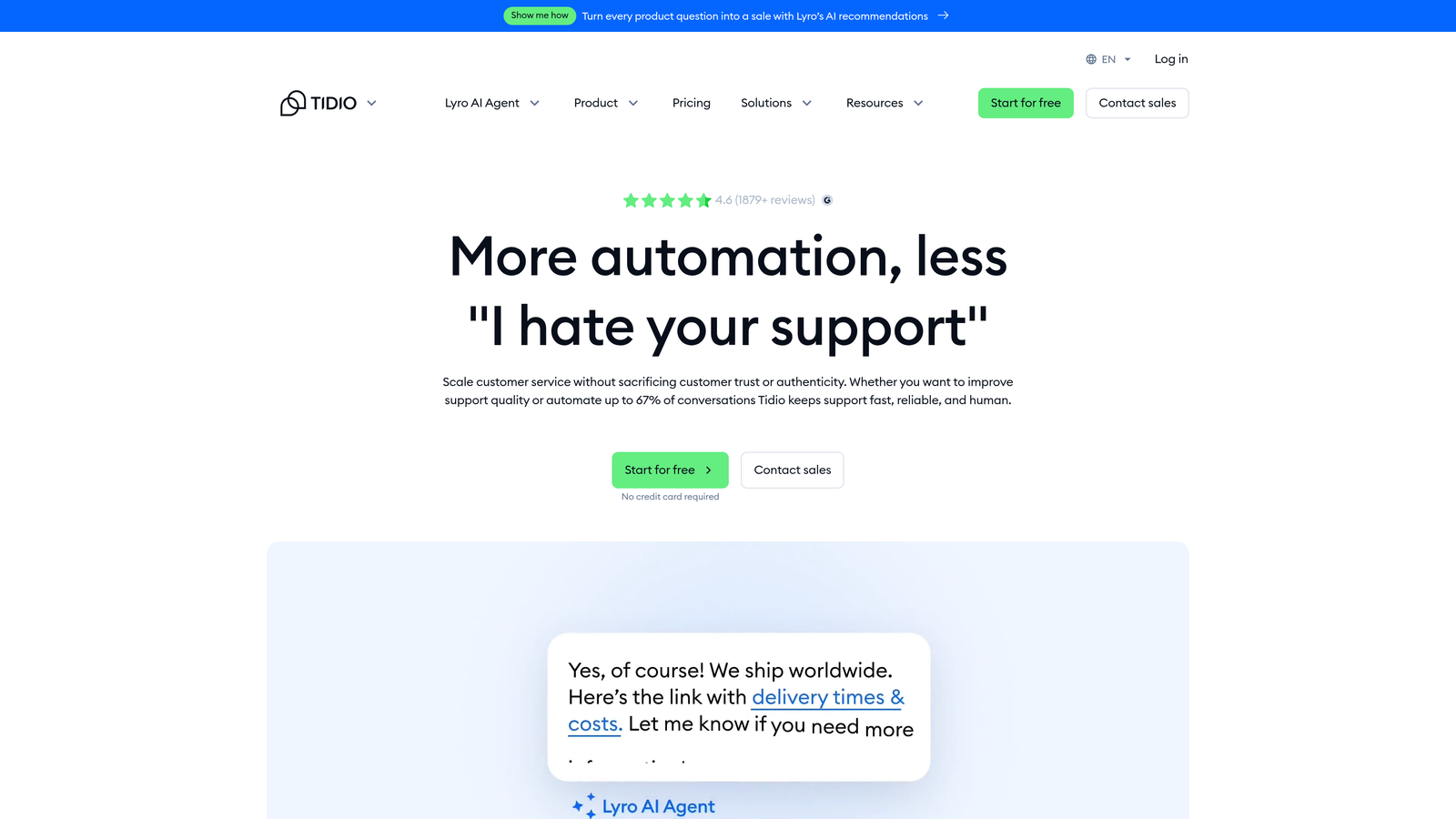
Tidio is a live chat and AI chatbot platform built for fast deployment, with Lyro AI handling common support queries and strong e-commerce integrations.
Where This Tool Shines
Tidio's Lyro AI chatbot is well-regarded for how quickly it can be deployed and made useful. Pre-built conversation flows reduce the setup time significantly, and the native Shopify and WooCommerce integrations make it a natural fit for e-commerce teams. For businesses that need a functional AI support layer running within days rather than weeks, Tidio is hard to beat on speed.
The live chat experience is also polished, with clean agent takeover functionality when Lyro reaches the limits of what it can resolve autonomously. It's less suited to complex B2B support workflows with deep integration requirements, but for its target use case it delivers well.
Key Features
Lyro AI Chatbot: Handles autonomous resolution of common support queries using your existing FAQ and knowledge content.
Pre-Built Conversation Flows: Ready-to-use flows that reduce time-to-value significantly compared to building from scratch.
Native E-Commerce Integrations: Deep integrations with Shopify and WooCommerce for order status, returns, and product queries.
Live Chat with Agent Takeover: Smooth handoff from Lyro AI to human agents when queries require personal handling.
Email and Messenger Support: Extends coverage beyond live chat to email and Facebook Messenger channels.
Best For
E-commerce brands and SMBs that want fast AI chatbot deployment without heavy configuration. Less suited to B2B SaaS teams with complex workflows and deep integration needs.
Pricing
Free plan available; Lyro AI plans start at approximately $29/month. Check tidio.com for current pricing.
6. Drift (by Salesloft)
Best for: B2B teams where support and sales workflows are closely linked
Drift is a conversational AI platform that blends support automation with sales engagement, routing conversations intelligently between support resolution and revenue workflows.
Where This Tool Shines
Since Salesloft's acquisition of Drift, the platform's positioning has shifted meaningfully toward revenue teams. That's actually a feature if your support and sales motions are tightly integrated. Drift excels at identifying who is on your site, routing high-value visitors to sales while handling support queries through AI, and booking meetings directly within the chat experience.
For B2B companies where a support conversation can easily turn into an expansion or upsell opportunity, Drift's ability to blend both workflows in one platform is genuinely useful. Teams looking for a pure support automation tool may find the sales-first positioning a mismatch, however.
Key Features
AI-Powered Chatbot: Handles support query resolution and sales qualification within the same conversation flow.
Intelligent Routing: Routes conversations between support and sales teams based on visitor identity, behavior, and intent signals.
Visitor Personalization: Customizes conversation experiences based on known account data and browsing behavior.
Meeting Booking Integration: Allows prospects and customers to book meetings directly from the chat widget, connecting to sales pipeline.
CRM Integrations: Deep native integrations with Salesforce and HubSpot for full revenue workflow connectivity.
Best For
B2B teams where support and sales are closely aligned, particularly those using Salesforce or HubSpot as their CRM. Less ideal for teams that want a dedicated support automation platform without the sales layer.
Pricing
Custom pricing. Contact Salesloft/Drift directly for current plans at salesloft.com/drift.
7. Ada
Best for: Enterprise brands needing no-code AI agent deployment with multilingual support
Ada is a no-code AI agent platform designed for enterprise brands, with behavior-based personalization and strong multilingual support for global support operations.
Where This Tool Shines
Ada's no-code builder is genuinely accessible for non-technical teams, which matters at enterprise scale where support operations and IT resources don't always align. The platform's behavior-based personalization uses customer data to tailor AI responses, making interactions feel more relevant than generic knowledge base lookups.
Multilingual support across dozens of languages is a standout for global brands managing support across multiple regions. The enterprise-grade security and compliance controls also make Ada a credible option for regulated industries where data handling requirements are strict.
Key Features
No-Code AI Agent Builder: Enables non-technical support and operations teams to build and modify AI agents without engineering involvement.
Behavior-Based Personalization: Uses customer data to tailor AI agent responses based on user history and behavior patterns.
Multilingual Support: Handles customer interactions across dozens of languages, enabling consistent global support coverage.
Proactive and Outbound AI: Supports proactive messaging and outbound AI interactions, not just reactive query resolution.
Enterprise Security Controls: Built-in compliance and security features suited to regulated industries and large enterprise environments.
Best For
Enterprise brands with global customer bases and non-technical teams managing support operations. Requires meaningful initial setup investment to realize full value. Less suited to smaller teams or those needing rapid deployment.
Pricing
Custom enterprise pricing. Contact Ada directly at ada.cx for current plans.
8. Kustomer
Best for: High-volume support teams that need full customer timeline context available to AI agents
Kustomer is a CRM-native customer service platform that gives AI agents full customer timeline context, enabling more informed and personalized automated resolutions.
Where This Tool Shines
Kustomer's core architectural advantage is that its AI agents operate with a complete view of the customer relationship, not just the current ticket. Every prior interaction, purchase, complaint, and conversation is available in a unified timeline, which means AI-powered responses can be meaningfully more contextual than platforms where support and CRM data are siloed.
This is particularly valuable for high-volume support environments where customers expect agents, human or AI, to already know their history. The built-in CRM also reduces the need for separate customer data tools, which simplifies the overall tech stack for teams managing complex customer relationships.
Key Features
Unified Customer Timeline: Combines all interactions, purchases, and communications into a single view accessible to both AI agents and human agents.
AI-Powered Workflow Automation: Automates ticket routing, categorization, and response workflows based on customer data and interaction history.
Omnichannel Inbox: Handles email, chat, SMS, social, and voice in a single unified workspace.
Built-In CRM: Eliminates the need for a separate customer data platform by combining support and CRM functionality natively.
AI Assist: Provides human agents with suggested responses and auto-response capabilities during active interactions.
Best For
High-volume support operations where customer context significantly affects resolution quality, particularly in retail, subscription, and financial services. The higher price point makes it less suitable for smaller teams.
Pricing
Starts at approximately $89/agent/month. Check kustomer.com for current pricing.
9. Gorgias
Best for: E-commerce brands on Shopify that need AI to take autonomous actions, not just answer questions
Gorgias is a support automation platform purpose-built for e-commerce brands, with deep Shopify integration and AI that can take autonomous actions like issuing refunds or editing orders.
Where This Tool Shines
Gorgias goes further than most platforms in what its AI can actually do. Rather than just providing answers, the AI agent can take real actions within connected e-commerce platforms: issuing refunds, editing orders, applying discounts. For high-volume e-commerce support where a large proportion of tickets are transactional, this level of autonomy is a significant operational advantage.
The revenue attribution feature is also worth calling out. Gorgias tracks which support interactions contribute to purchases, giving support teams a way to demonstrate commercial impact rather than just cost savings. For e-commerce brands evaluating support ROI, that's a meaningful differentiator.
Key Features
Deep E-Commerce Integrations: Native integrations with Shopify, BigCommerce, and Magento for full order and customer data access.
Autonomous AI Actions: AI agent can issue refunds, edit orders, and apply discounts without human agent involvement.
Revenue Attribution: Tracks the commercial impact of support interactions, connecting support activity to downstream purchases.
Macros and Automation Rules: High-speed ticket automation using rules and templates for the most common e-commerce query types.
Unified Inbox: Consolidates email, chat, social, and SMS into a single support workspace.
Best For
E-commerce brands, particularly those on Shopify, with high volumes of transactional support queries. The platform's strengths are tightly tied to e-commerce use cases, making it less relevant for pure B2B SaaS support operations.
Pricing
Starts at approximately $10/month for small ticket volumes, scaling with usage. Check gorgias.com for current pricing.
Which Platform Is Right for Your Team?
The right choice depends heavily on your team's size, tech stack, and what you actually need AI to do. Here's a quick reference to help you orient.
B2B SaaS and PLG teams: Halo AI is the strongest fit, particularly if you need page-aware guidance, business intelligence from support data, and deep integration with your existing stack. It's built for exactly this environment.
Enterprise support organizations: Zendesk remains the benchmark for complex routing, SLA management, and compliance requirements. Ada is worth evaluating if multilingual coverage and no-code deployment are priorities.
Growing SMBs: Freshdesk offers the best balance of features and affordability at this tier. Intercom is worth considering if proactive messaging and product tours are part of your support strategy.
E-commerce brands: Gorgias is purpose-built for this use case and the autonomous action capability is genuinely differentiated. Tidio is a good alternative for smaller operations that want fast deployment.
B2B teams with blended support and sales workflows: Drift's integration with Salesloft makes it a natural fit if your support and revenue teams share pipeline context. Kustomer is the better choice when customer history and CRM context drive resolution quality.
The broader trend across all of these platforms is clear: autonomous resolution is now the baseline expectation, not a premium feature. The differentiators in 2026 are context-awareness, integration depth, and what intelligence the platform surfaces beyond the ticket queue itself.
Your support team shouldn't scale linearly with your customer base. Let AI agents handle routine tickets, guide users through your product, and surface business intelligence while your team focuses on complex issues that need a human touch. See Halo in action and discover how continuous learning transforms every interaction into smarter, faster support.