9 Best Intercom Alternatives for Automation in 2026
This guide evaluates the best Intercom alternatives for automation, comparing nine platforms on ticket deflection, AI-driven responses, and workflow orchestration for teams that need deeper autonomous resolution capabilities or more flexible pricing than Intercom provides.
 Matt PattoliFounder13 min read
Intercom is a capable platform, but it's not the right fit for every team. Its pricing can scale steeply, its architecture is messaging-first rather than helpdesk-first, and its AI layer — while improving — isn't always the autonomous resolution engine that modern support teams need. As AI-powered support automation has matured, a new wave of platforms has emerged that match or outpace Intercom's automation depth at different price points and for different use cases.
This list focuses specifically on automation capability: how well each tool handles ticket deflection, AI-driven responses, proactive messaging, and workflow orchestration without requiring constant human oversight. Whether you're hitting a pricing ceiling, need deeper AI autonomy, or want tighter integration with your product stack, there's a strong alternative here. For broader context, see our guide on customer support automation strategy and the benefits of AI customer support.
1. Halo AI
Best for: B2B SaaS and product teams that want autonomous AI agents, not just assisted replies.
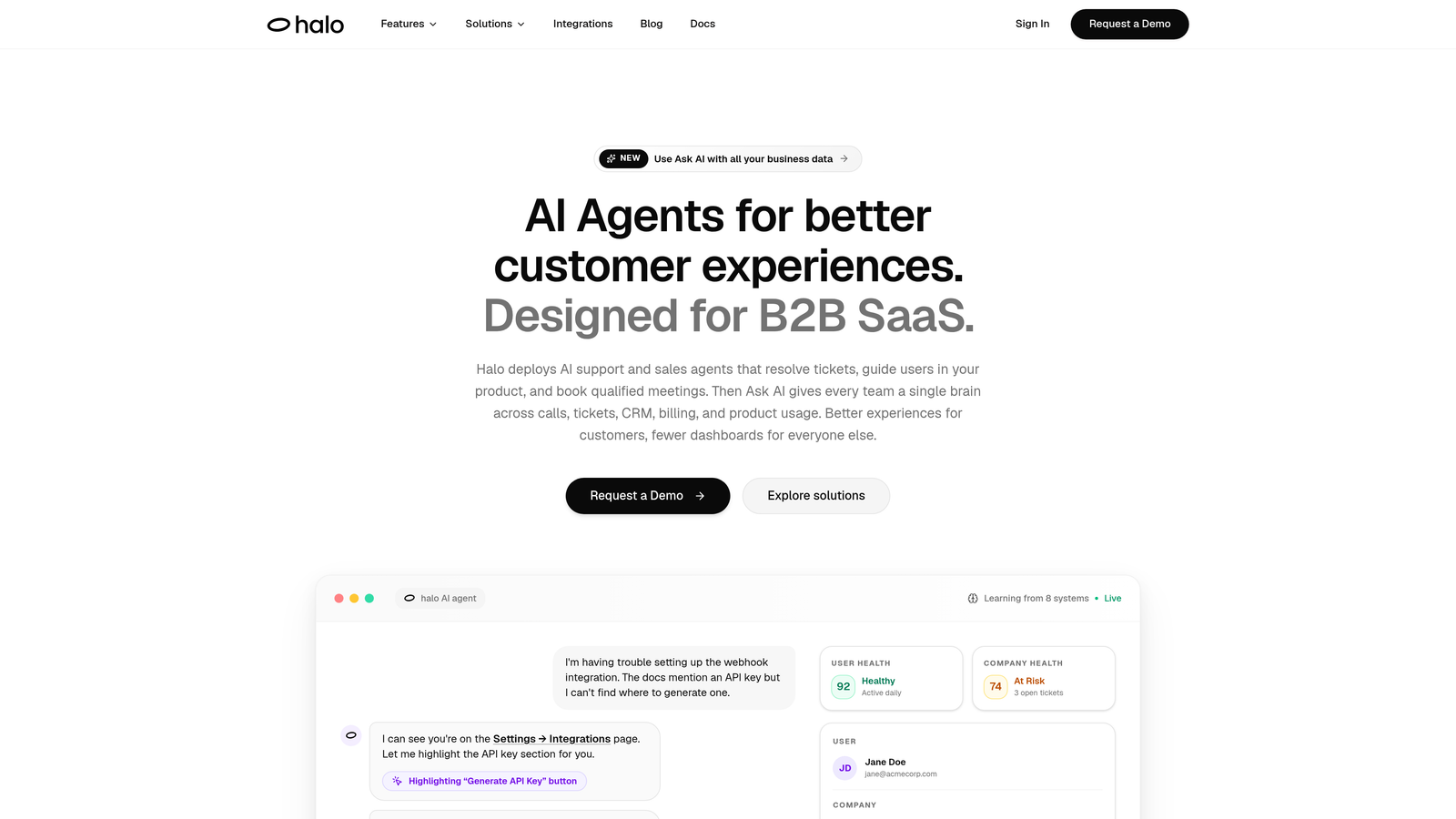
Halo AI is an AI-first customer support platform built to resolve tickets end-to-end, guide users through your product with page-aware context, and surface business intelligence from every interaction.
Where This Tool Shines
Most support automation tools layer AI on top of a legacy helpdesk. Halo was built AI-first, which means the architecture is designed around autonomous resolution rather than agent assistance. Its page-aware chat widget is a standout: the AI sees exactly what the user is looking at, enabling it to provide visual UI guidance that's contextually accurate rather than generic.
Beyond ticket resolution, Halo's smart inbox surfaces signals that most support tools miss entirely: customer health indicators, revenue insights, and anomaly detection. For product teams, the auto bug ticket creation feature automatically routes issues to Linear or your issue tracker, closing the loop between customer-reported problems and engineering without any manual triage.
Key Features
Autonomous AI Agents: End-to-end ticket resolution without requiring human review on every interaction.
Page-Aware Chat Widget: The AI sees what the user sees, enabling precise, context-specific product guidance and visual UI walkthroughs.
Smart Inbox with Business Intelligence: Customer health signals, anomaly detection, and revenue insights surfaced directly in the support workflow.
Auto Bug Ticket Creation: Automatically identifies and routes bug reports to Linear or your preferred issue tracker, eliminating manual handoffs between support and engineering.
Live Agent Handoff: Seamless escalation to human agents when complexity warrants it, with full conversation context preserved.
Deep Integrations: Connects with Slack, HubSpot, Intercom, Stripe, Zoom, PandaDoc, and Fathom, so it fits into your existing stack rather than replacing it.
Best For
B2B SaaS companies and product teams that want AI to genuinely resolve tickets rather than suggest replies. Particularly valuable for teams where support volume is growing faster than headcount, and for product organizations that want a direct feedback loop between customer issues and the engineering backlog.
Pricing
Contact for pricing. See full details at haloagents.ai.
2. Tidio
Best for: SMBs and e-commerce teams wanting affordable AI chatbot automation with a visual builder.
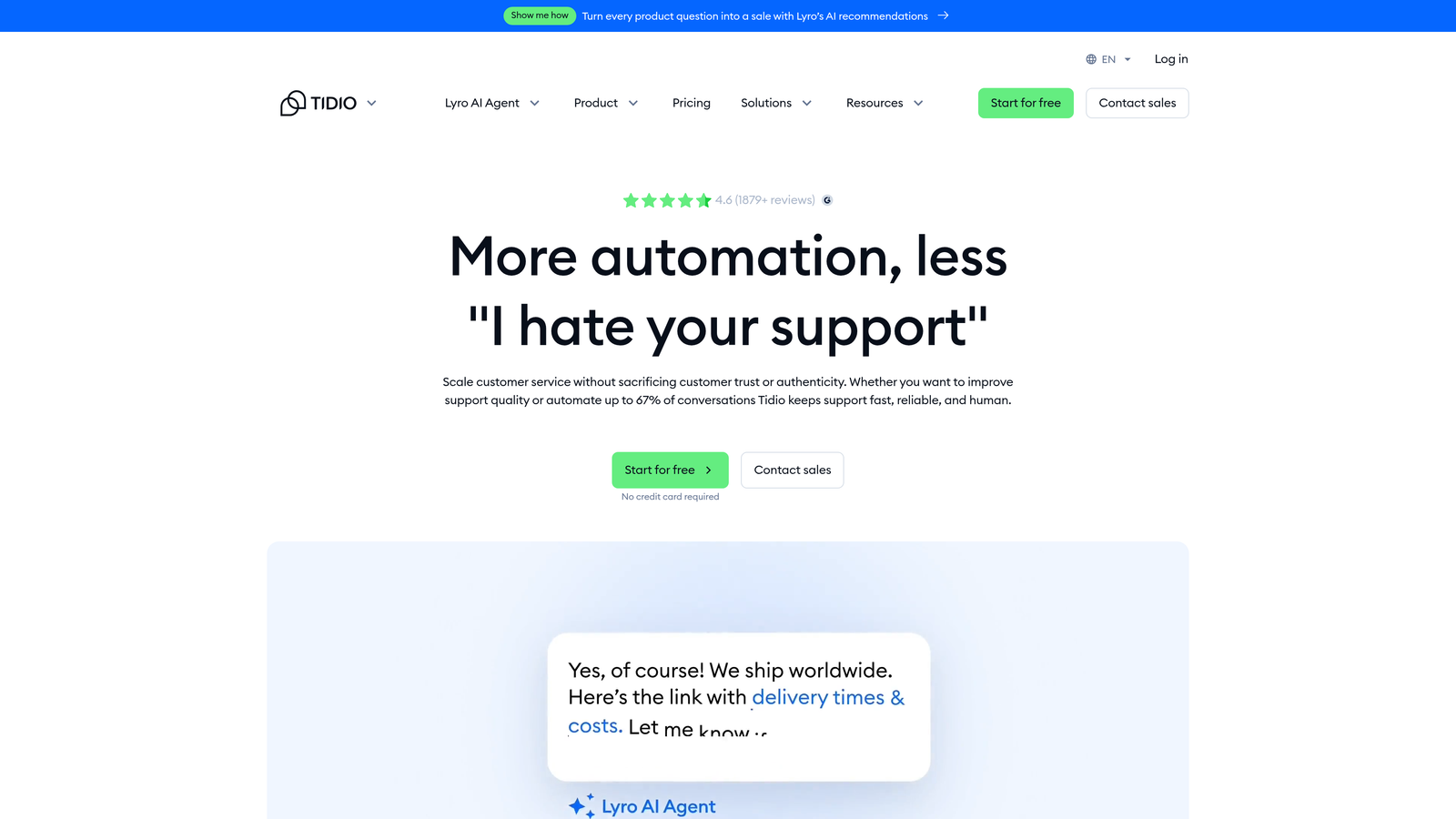
Tidio is a customer communication platform combining live chat, the Lyro AI chatbot, and a visual automation flow builder in a package that's notably more accessible than Intercom for smaller teams.
Where This Tool Shines
Tidio's Lyro AI chatbot handles conversational intent detection, meaning it can understand what a customer is asking without requiring exact keyword matches. The visual drag-and-drop automation builder makes it easy for non-technical teams to create multi-step flows without engineering help.
Its e-commerce integrations with Shopify and WooCommerce are particularly well-developed, making it a natural fit for online retailers who want to automate order status queries, returns, and product questions at scale.
Key Features
Lyro AI Chatbot: Conversational AI with intent detection that handles common queries without scripted responses.
Visual Automation Builder: Drag-and-drop flow editor for building multi-step automation without code.
Multi-Channel Inbox: Consolidates live chat, email, and Messenger into a single workspace.
E-Commerce Integrations: Native Shopify and WooCommerce connections for order and customer data automation.
Free Tier: Functional free plan that lets small teams get started without upfront commitment.
Best For
E-commerce businesses and SMBs that need accessible, affordable automation without complex configuration. Teams with limited technical resources who want a visual interface for building chatbot flows will find Tidio particularly approachable.
Pricing
Free tier available. Paid plans start around $29/month, making it one of the more budget-friendly options on this list.
3. Freshdesk
Best for: Mid-market teams that need a full ticketing system with AI-powered triage and omnichannel support.
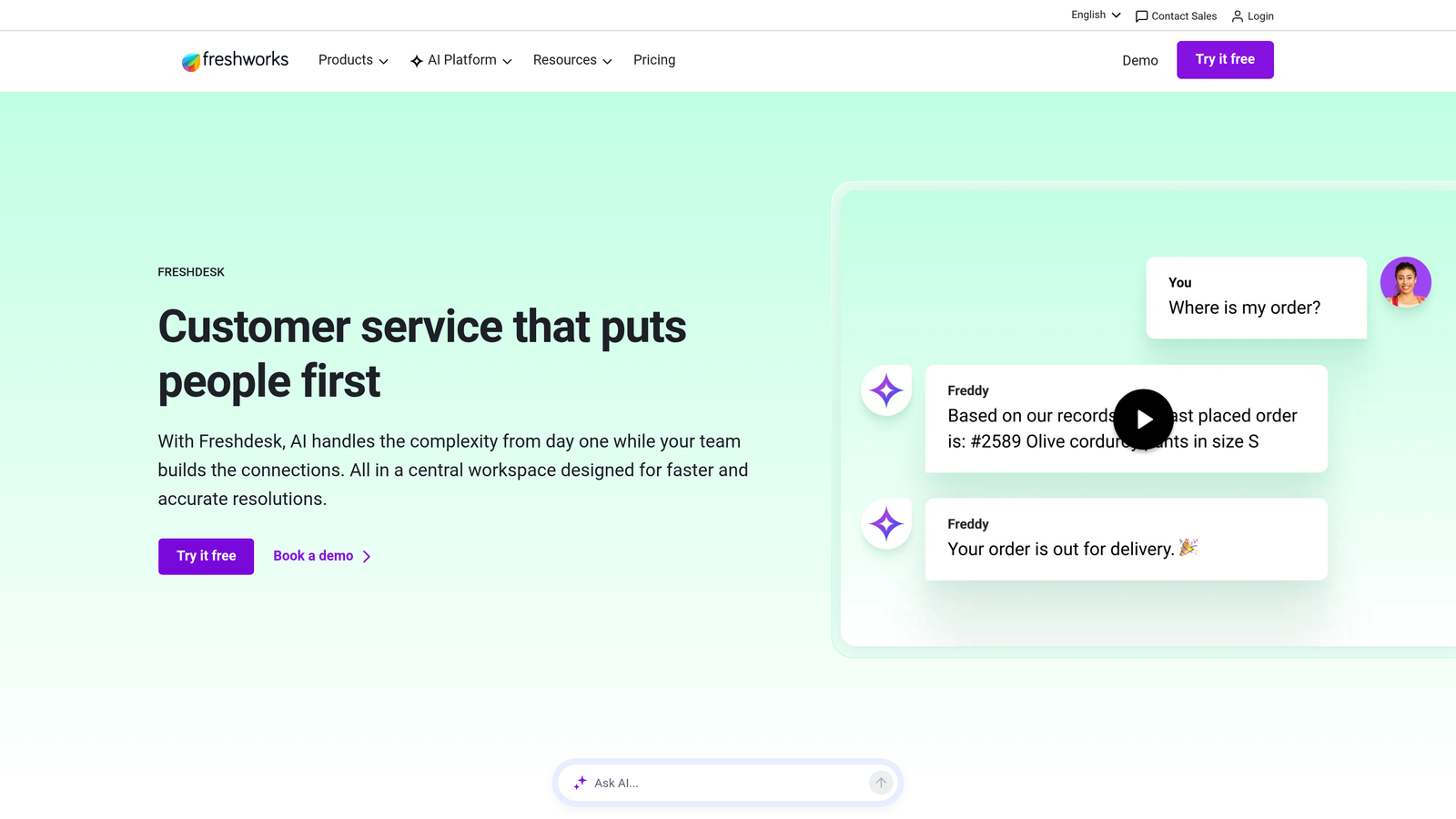
Freshdesk is a full-featured helpdesk platform from Freshworks, with Freddy AI handling ticket classification, response suggestions, and self-service automation across email, chat, phone, and social channels.
Where This Tool Shines
Where Intercom is messaging-first, Freshdesk is helpdesk-first. That distinction matters for teams managing high ticket volumes that need structured routing, SLA tracking, and organized queues. Freddy AI layers onto that foundation to handle triage and suggest responses, reducing manual work without requiring a full architectural shift.
The free tier for up to 10 agents is genuinely functional, not just a trial, making Freshdesk an accessible entry point for growing teams that aren't ready to commit to per-seat pricing at Intercom's level.
Key Features
Freddy AI: Handles ticket triage, routing, and agent assist with suggested replies and classification.
Omnichannel Support: Unified inbox across email, chat, phone, and social media channels.
Automation Rules: Condition-based workflow automation for ticket assignment, tagging, and escalation.
Self-Service Portal: Knowledge base and customer portal for deflecting common queries before they become tickets.
Free Tier: Up to 10 agents at no cost, with a clear upgrade path as teams grow.
Best For
Mid-market support teams that need a structured helpdesk foundation with AI augmentation. Also a strong fit for teams already using other Freshworks products like Freshsales or Freshservice who want to consolidate within one ecosystem.
Pricing
Free tier available. Growth plan starts around $15/agent/month, making it cost-effective for teams scaling beyond the free tier.
4. Zendesk
Best for: Enterprise and mid-market teams needing a mature omnichannel platform with a large integration ecosystem.
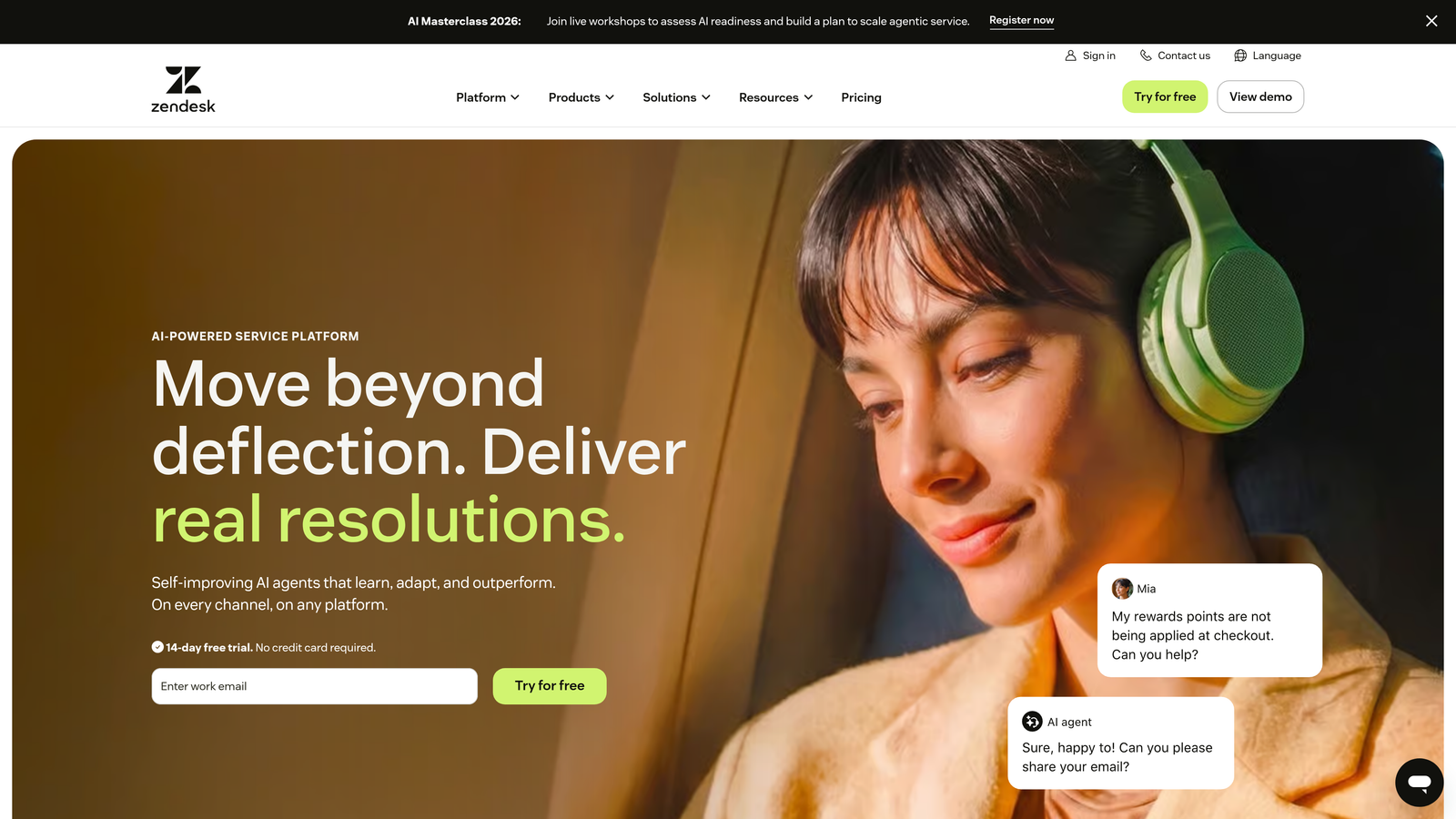
Zendesk is one of the most established names in customer support, offering AI-powered triage, omnichannel messaging, and an extensive app marketplace across a platform designed for scale.
Where This Tool Shines
Zendesk's breadth is its primary strength. Its marketplace of over 1,000 integrations means it connects to virtually any tool in a modern support stack. Sunshine Conversations extends its messaging capabilities across SMS, WhatsApp, social, and custom channels, giving enterprise teams a unified layer for complex omnichannel deployments.
The platform's AI features, including intelligent triage, Answer Bot for self-service deflection, and automated macros, are mature and well-documented. For teams that need enterprise-grade SLA management, advanced reporting, and compliance features, Zendesk's depth is hard to match.
Key Features
Intelligent Triage: AI-powered ticket classification and routing that reduces manual assignment overhead.
Answer Bot: Automated self-service deflection that suggests knowledge base articles before a ticket is created.
Sunshine Conversations: Omnichannel messaging infrastructure for SMS, WhatsApp, social, and custom channels.
Marketplace Integrations: Over 1,000 apps and integrations covering CRM, analytics, ecommerce, and more.
Advanced SLA and Reporting: Granular SLA management, custom dashboards, and reporting tools built for enterprise accountability.
Best For
Enterprise and larger mid-market teams that need a proven, scalable platform with deep customization, compliance features, and a large integration ecosystem. Teams willing to invest in configuration and onboarding to unlock the platform's full depth.
Pricing
Suite Team starts around $55/agent/month. Enterprise plans are available at higher price points with additional features and support.
5. Drift
Best for: B2B revenue teams using chat as a sales and marketing channel, not just a support channel.
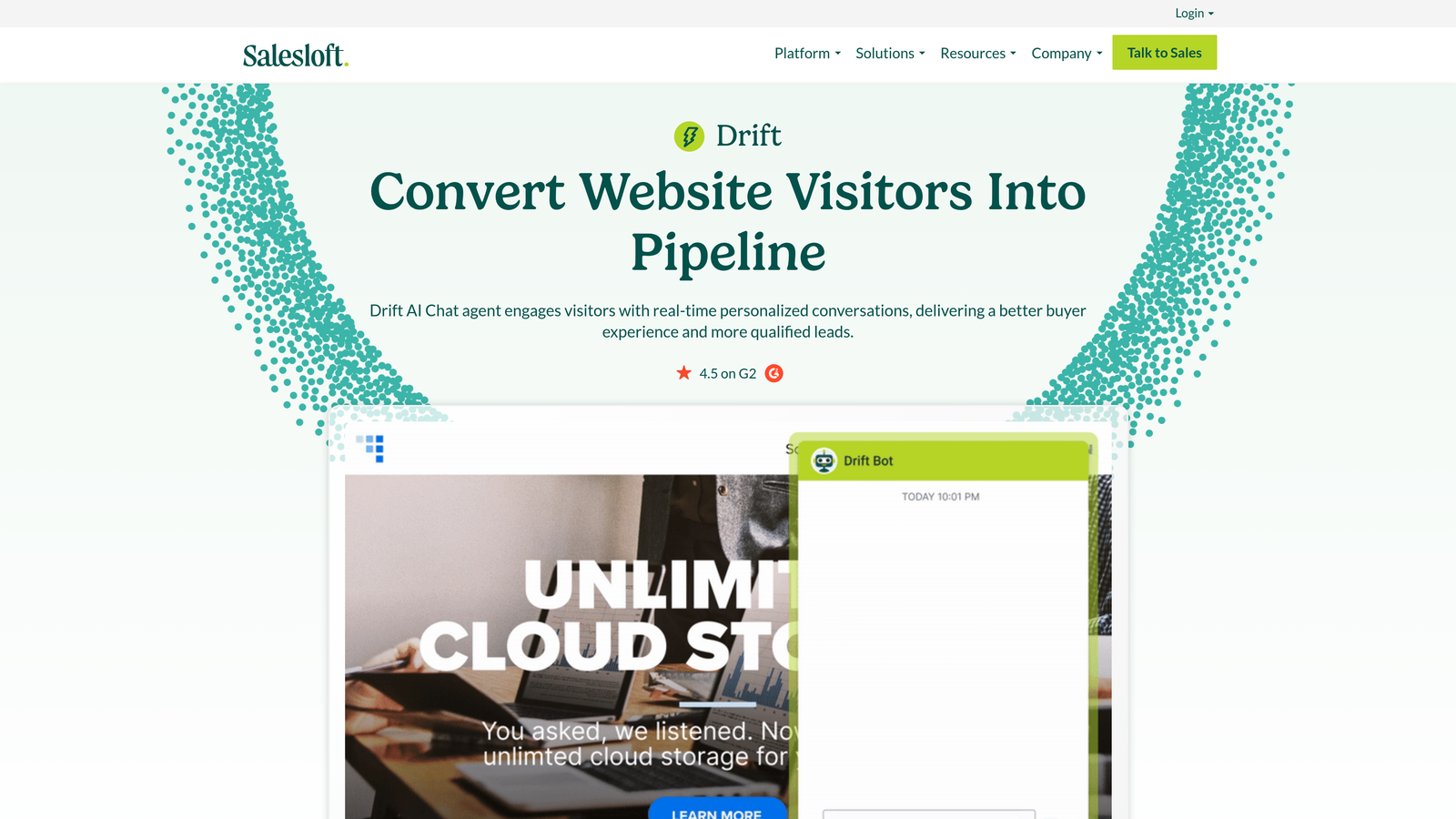
Drift, now part of Salesloft, is a conversational marketing and sales platform that uses automation to qualify buyers, route conversations, and accelerate pipeline — making it a different kind of Intercom alternative.
Where This Tool Shines
Drift is the right choice when your primary goal is revenue acceleration rather than ticket resolution. Its buyer intent signals and account-based routing identify high-value visitors and route them to the right sales rep automatically, compressing the time from first touch to qualified conversation.
For B2B companies where the website chat widget is as much a sales tool as a support tool, Drift's automated playbooks and deep Salesforce and HubSpot CRM integration create a pipeline automation layer that pure support tools can't replicate.
Key Features
Buyer Intent Signals: Identifies and prioritizes high-intent accounts for immediate routing to sales.
Automated Playbooks: Pre-built conversation flows for sales qualification, marketing nurture, and support routing.
AI Chatbot for Lead Qualification: 24/7 automated qualification and routing when sales reps aren't available.
Calendar Booking Automation: Direct meeting booking from chat, reducing friction in the sales handoff.
CRM Integration: Deep Salesforce and HubSpot integration for syncing conversation data to your revenue stack.
Best For
B2B companies with a sales-led growth motion where chat serves both revenue and support goals. Less suited for teams whose primary need is ticket volume management or technical support automation.
Pricing
Premium plan starts around $2,500/month. Enterprise pricing available on request. Best evaluated by teams where the revenue impact justifies the investment.
6. HubSpot Service Hub
Best for: Teams already using HubSpot for sales and marketing who want to consolidate support in the same ecosystem.
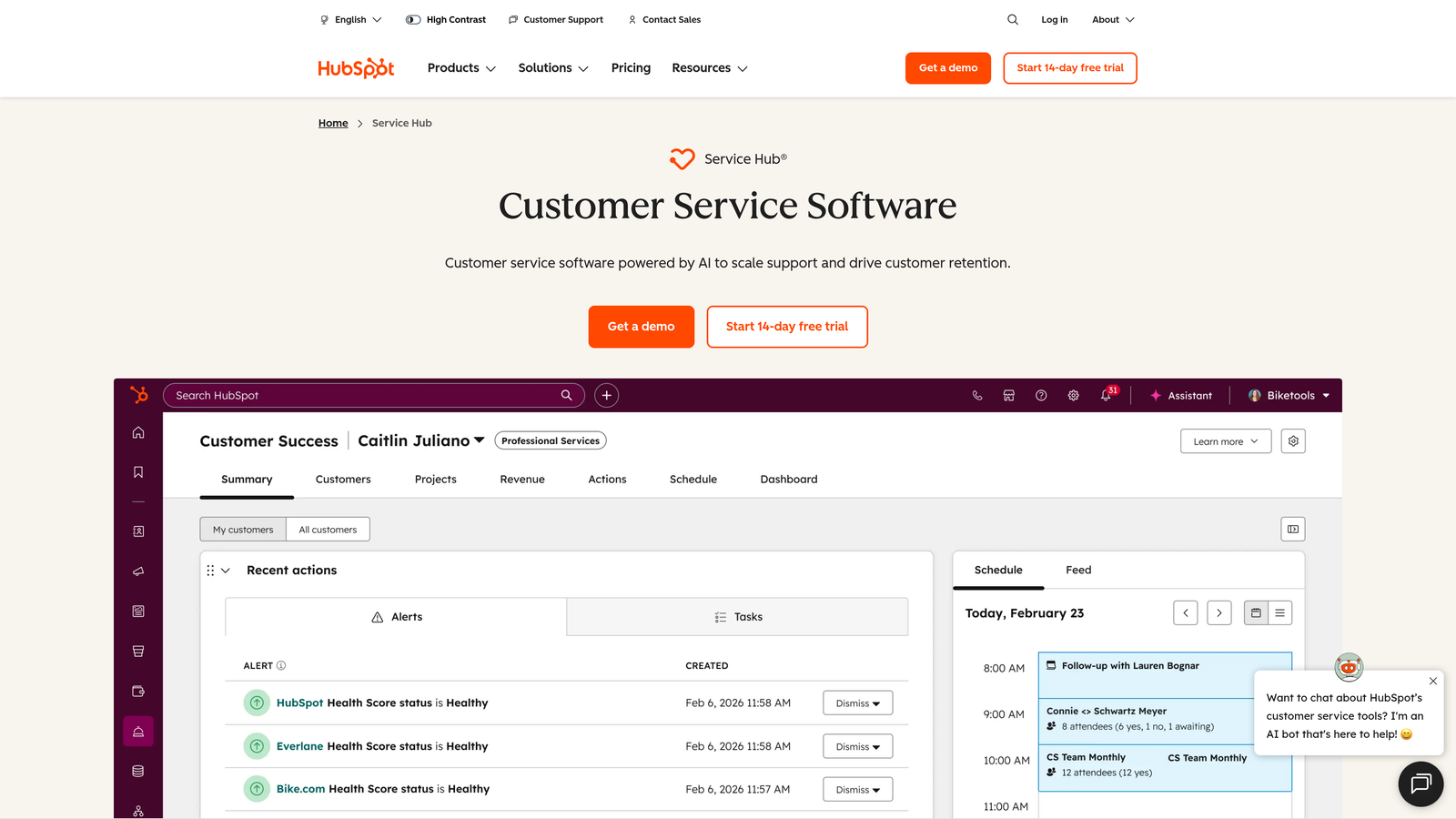
HubSpot Service Hub is HubSpot's customer service product, leveraging native CRM data to power automation, AI ticket drafts, and self-service — all without the data sync headaches of a separate platform.
Where This Tool Shines
The core advantage here is CRM-native automation. Because Service Hub shares data with HubSpot's CRM, you can build automation rules that trigger based on contact properties, deal stage, or lifecycle status — something that requires custom integrations in most standalone support tools. This creates support workflows that are genuinely aware of the customer's commercial relationship with your business.
HubSpot's AI features for ticket summarization and reply drafts help agents move faster without replacing the human element, which suits teams that value high-touch support but want to reduce repetitive work.
Key Features
CRM-Native Automation: Automation rules that leverage contact, deal, and lifecycle data from HubSpot's CRM directly.
AI Ticket Summarization and Drafts: AI-powered tools that summarize long threads and draft replies for agent review.
Shared Inbox with Chatbot Builder: Live chat and automated chatbot flows within a unified inbox.
Knowledge Base with AI Search: Self-service knowledge base with AI-powered search for faster deflection.
Customer Feedback Surveys: Built-in NPS, CSAT, and CES surveys tied to contact records in the CRM.
Best For
Teams already invested in the HubSpot ecosystem who want to eliminate point-solution complexity. Particularly strong for companies where support, sales, and marketing teams need to share customer context without manual data transfers.
Pricing
Free tools available. Starter from $15/seat/month, with Professional and Enterprise tiers at higher price points as feature needs grow.
7. Crisp
Best for: Startups and small teams wanting an affordable all-in-one messaging platform with a low learning curve.
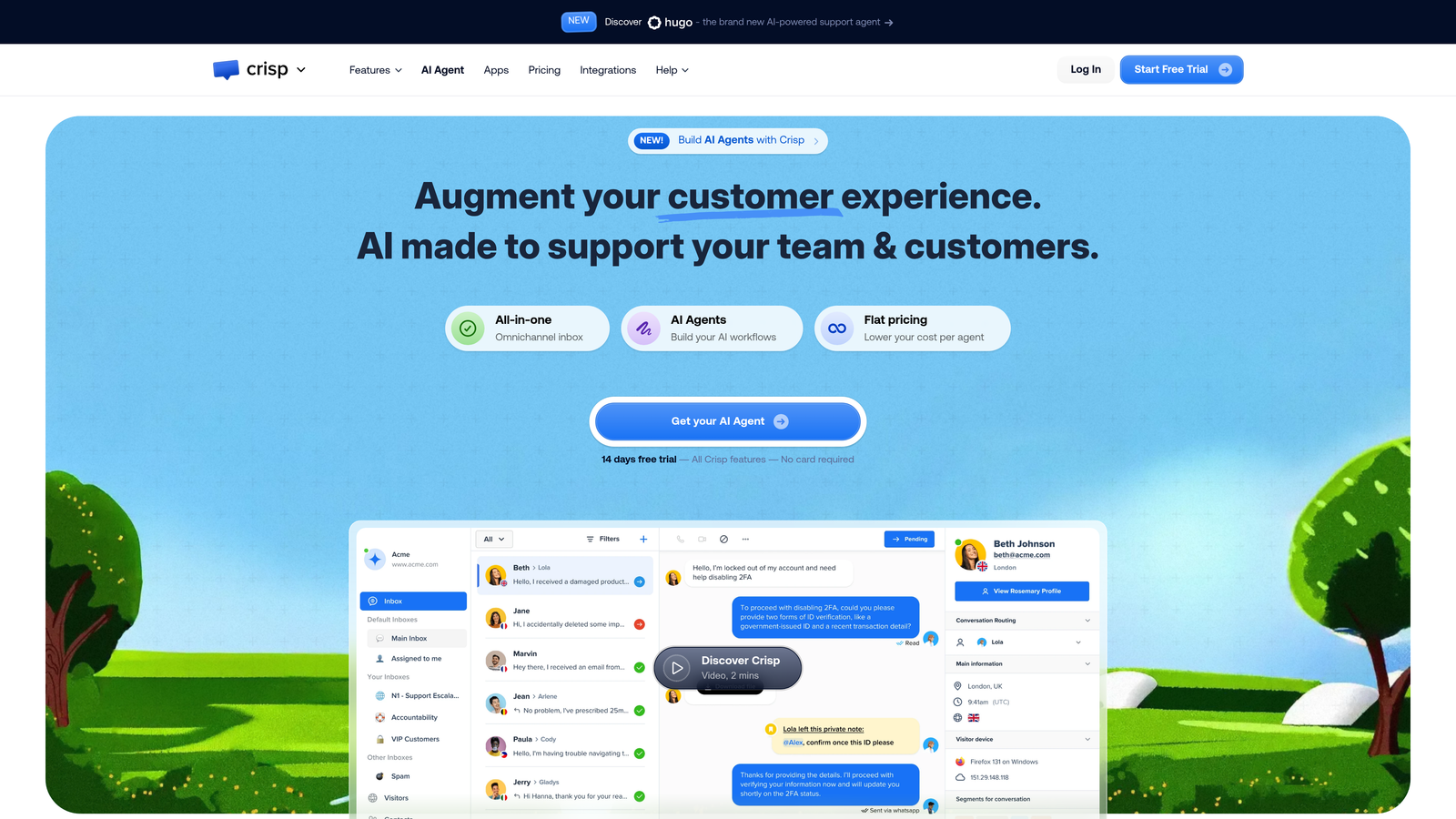
Crisp is an all-in-one customer messaging platform combining shared inbox, chatbot builder, and knowledge base at a price point that makes it one of the most practical Intercom alternatives for early-stage and budget-conscious teams.
Where This Tool Shines
Crisp punches above its price point. The shared inbox consolidates chat, email, social, and SMS into a single workspace, and the visual chatbot scenario builder lets teams create automated conversation flows without writing code. For startups that want Intercom-like functionality without Intercom-level pricing, Crisp covers the core use cases well.
The built-in CRM with contact profiles and full conversation history gives support agents context on returning customers, making interactions feel less transactional even when automation is handling the first response.
Key Features
Multi-Channel Shared Inbox: Consolidates chat, email, social media, and SMS into one workspace.
Visual Chatbot Builder: Scenario-based chatbot editor for building automated flows without technical expertise.
Knowledge Base: Integrated help center with widget connection for in-chat self-service.
CRM Contact Profiles: Built-in contact records with full conversation history for context-aware support.
Free Tier: Free plan for up to 2 agents, giving small teams a real starting point.
Best For
Startups, bootstrapped SaaS teams, and small businesses that need solid multi-channel support automation without the pricing complexity of enterprise platforms. Teams migrating from Intercom primarily due to cost will find Crisp covers most of their core needs.
Pricing
Free tier available for 2 agents. Pro plan starts around $25/month per workspace, making it one of the most affordable options on this list.
8. Help Scout
Best for: Teams that want AI to augment human agents rather than replace them, with a clean email-native experience.
Help Scout is an email-native shared inbox platform with a Beacon chat widget and AI features designed to make human agents faster and more effective, rather than automate them out of the loop.
Where This Tool Shines
Help Scout's philosophy is deliberately human-centric. Its AI features, Summarize, Assist, and Drafts, are built as agent productivity tools: they compress long email threads, suggest next steps, and draft replies that agents review before sending. This approach suits teams where the quality of human interaction is a brand differentiator and full automation would feel like a step backward.
The platform's clean, email-native UX has a notably low learning curve compared to more complex platforms like Zendesk or Intercom. Teams can onboard quickly and get value without extensive configuration work.
Key Features
AI Summarize, Assist, and Drafts: Three distinct AI tools that compress threads, recommend actions, and draft replies for agent review.
Beacon Widget: In-app chat and knowledge base widget that surfaces relevant articles before escalating to a live agent.
Workflow Automation: Rule-based automation for ticket routing, tagging, and assignment without complex configuration.
Customer Satisfaction Ratings: Built-in CSAT collection on every conversation without third-party survey tools.
Email-Native UX: Familiar interface that reduces onboarding friction and team resistance to adoption.
Best For
Customer-centric teams where human connection is a core part of the support experience. Also well-suited for teams transitioning from email-based support who want structure and AI assistance without a steep learning curve.
Pricing
Standard plan starts around $22/user/month, with Plus and Pro tiers available for teams needing advanced reporting and integrations.
9. Chatwoot
Best for: Technical teams with data sovereignty requirements who want open-source flexibility and API-first extensibility.
Chatwoot is an open-source omnichannel customer support platform that can be self-hosted, giving technical teams full control over their data, infrastructure, and customization without vendor lock-in.
Where This Tool Shines
Chatwoot's defining advantage is ownership. Self-hosting means your customer conversation data never leaves your infrastructure, which matters for teams in regulated industries or companies with strict data residency requirements. The active open-source community means the platform evolves quickly, and the API-first design makes custom integrations straightforward for teams with engineering resources.
For startups and scale-ups that want to avoid per-seat pricing entirely while still getting omnichannel inbox functionality, the self-hosted free tier is a genuinely compelling option that few commercial platforms can match.
Key Features
Self-Hosted Open Source: Full codebase available for self-hosting, giving complete data ownership and infrastructure control.
Omnichannel Inbox: Unified inbox for chat, email, social media, WhatsApp, and API-connected channels.
Automation Rules: Condition-based rules for conversation routing, labeling, and assignment.
API-First Design: Comprehensive API for building custom integrations and extending platform functionality.
Cloud Option: Managed cloud hosting available for teams that want the open-source model without self-hosting overhead.
Best For
Technical teams with privacy, compliance, or data sovereignty requirements. Also a strong fit for engineering-led organizations that want to customize their support tooling deeply and aren't constrained by the feature sets of commercial SaaS platforms.
Pricing
Self-hosted open-source is free. Cloud plan starts around $19/agent/month for teams preferring a managed deployment.
Which Tool Is Right for Your Team?
The right Intercom alternative depends heavily on what you're actually trying to solve. Here's a quick way to orient your decision.
If your primary need is autonomous AI resolution where the AI handles tickets end-to-end rather than just suggesting replies, Halo AI is the most purpose-built option on this list. Its page-aware context, continuous learning, and business intelligence layer make it particularly well-suited for B2B SaaS and product teams.
If you're budget-constrained and need solid multi-channel automation without enterprise pricing, Crisp and Tidio both offer functional free tiers and affordable paid plans. Chatwoot is the right call if you want to eliminate per-seat costs entirely and have the technical capacity to self-host.
If you need a full helpdesk foundation with AI on top, Freshdesk and Zendesk are the most mature options. Zendesk for larger teams with complex requirements; Freshdesk for mid-market teams that want a gentler pricing curve.
For teams already in the HubSpot ecosystem, Service Hub is the obvious consolidation play. For teams using chat primarily as a sales and marketing channel, Drift's revenue-focused automation is in a category of its own. And for teams that want AI to augment rather than replace human agents, Help Scout's philosophy and UX make it a natural fit.
Your support team shouldn't scale linearly with your customer base. Let AI agents handle routine tickets, guide users through your product, and surface business intelligence while your team focuses on complex issues that need a human touch. See Halo in action and discover how continuous learning transforms every interaction into smarter, faster support.