9 Best Support AI Tools for SaaS Companies in 2026
This guide ranks the 9 best support AI for SaaS companies in 2026, evaluating each platform on ticket deflection quality, helpdesk integration depth, context awareness, and human escalation — so whether you're a lean startup or a scaling team, you can find the right fit to reduce support volume without sacrificing customer experience.
 Matt PattoliFounder13 min read
SaaS support teams face a challenge that generic chatbots were never designed to solve. Your users are technical, self-service-oriented, and expect accurate answers about complex software at any hour, across time zones, without waiting in a queue. When the AI doesn't understand product context or can't connect to your existing stack, it creates more friction than it resolves.
The support AI landscape has matured considerably. The shift from rule-based bots to generative AI agents capable of handling multi-turn conversations, understanding product context, and escalating intelligently is well underway. The tools on this list reflect that evolution.
We evaluated each platform on ticket deflection quality, helpdesk integration depth, context awareness, learning loops, and how gracefully it hands off to humans. Whether you're a lean startup automating tier-1 support or an established team trying to reduce volume without sacrificing experience, there's a fit here.
1. Halo AI
Best for: B2B SaaS teams wanting an AI-first support layer with business intelligence built in.
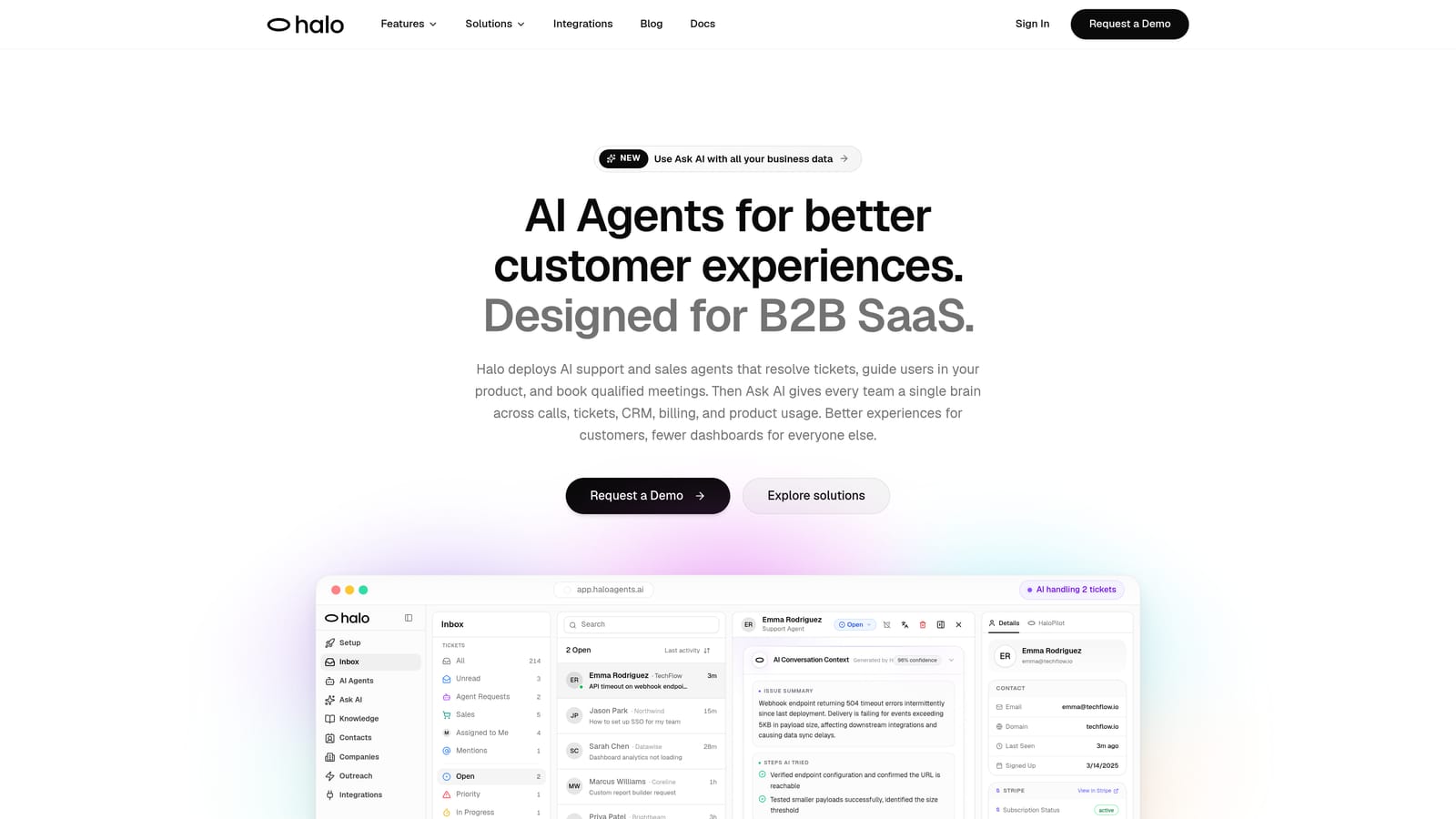
Halo AI is a purpose-built support platform for SaaS companies that acts as the support layer itself, not a bolt-on to an existing helpdesk.
Where This Tool Shines
What separates Halo from most tools on this list is its page-aware context. The chat widget understands which part of your product the user is currently viewing and can provide visual UI guidance specific to that screen. This means users get relevant, precise answers rather than generic documentation links.
Beyond ticket resolution, Halo surfaces business intelligence directly from support interactions. The smart inbox identifies customer health signals, flags anomalies, and surfaces revenue intelligence, turning support data into something your CS and product teams can actually act on. Every resolved interaction feeds a continuous learning loop, so the AI gets measurably smarter over time.
Key Features
Page-Aware Chat Widget: Understands the user's current product context and delivers visual UI guidance specific to their active screen.
Smart Inbox with Business Intelligence: Surfaces customer health signals, anomaly detection, and revenue intelligence from support data.
Auto Bug Ticket Creation: Automatically generates bug reports and pushes them directly to Linear without agent intervention.
Live Agent Handoff: Escalates to human agents with full conversation context preserved, so nothing gets repeated.
Deep Integrations: Connects with Slack, HubSpot, Intercom, Stripe, Zoom, PandaDoc, and Fathom across your business stack.
Best For
Product-led SaaS companies building their support infrastructure from scratch, or teams that have outgrown bolt-on chatbots and want AI that understands their product as deeply as their best support agent does. Particularly strong for teams where support data should feed back into product and customer success workflows.
Pricing
Contact for pricing. Halo is built specifically for B2B SaaS teams, so pricing is tailored to team size and use case rather than a one-size-fits-all tier.
2. Intercom (Fin AI Agent)
Best for: Teams already on Intercom who want a generative AI agent with minimal setup friction.
Intercom Fin is a generative AI agent trained on your help content and deployed directly within the Intercom Messenger experience.
Where This Tool Shines
Fin's strength is its conversational quality and how naturally it fits into the Intercom ecosystem. If your team already lives in Intercom, deploying Fin feels like activating a feature rather than integrating a new platform. The AI pulls from your help center, documentation URLs, and past conversations to construct answers that feel genuinely helpful rather than robotic.
The usage-based pricing model is worth noting. You pay per successful Fin resolution rather than a flat seat fee, which aligns cost directly with value delivered. For teams with variable support volume, this can be more predictable than per-agent pricing.
Key Features
Generative AI Agent: Trained on your help center, documentation, and prior support conversations for contextually accurate answers.
Multi-Source Knowledge: Pulls from docs, URLs, and historical conversations to construct complete responses.
Seamless Human Handoff: Escalates within the same Intercom Messenger thread, preserving conversation continuity.
Usage-Based Pricing: Charges per successful AI resolution rather than per seat or per month.
Workflow Integration: Works natively within existing Intercom inboxes, automations, and routing rules.
Best For
SaaS teams already invested in the Intercom platform who want to add AI deflection without switching tools. Less compelling as a standalone choice if you're not already in the Intercom ecosystem.
Pricing
Usage-based pricing per Fin resolution. Requires an active Intercom subscription. Contact Intercom for current plan details.
3. Zendesk AI
Best for: Enterprise SaaS teams deeply invested in the Zendesk Suite seeking native AI augmentation.
Zendesk AI is the native AI layer within the Zendesk Suite, covering triage, agent assistance, and self-service automation.
Where This Tool Shines
Zendesk AI's triage capabilities are genuinely strong. Intent detection, sentiment analysis, and smart routing work together to ensure tickets reach the right agent with the right priority before a human even reads them. For high-volume support operations, this kind of intelligent sorting reduces the cognitive load on agents significantly.
The Agent Copilot feature sits alongside agents in real time, surfacing suggested replies and summarizing long ticket threads. Teams that have been on Zendesk for years will find these capabilities slot naturally into existing workflows rather than requiring process changes.
Key Features
AI Triage: Detects intent and sentiment, then routes tickets intelligently based on priority and topic.
Agent Copilot: Provides suggested replies and ticket summarization directly within the agent workspace.
AI Self-Service Bots: Customer-facing automation integrated with the Zendesk help center.
Advanced Analytics: Reporting and insight layers built into the Zendesk Suite dashboard.
Enterprise Compliance: SOC 2, GDPR, and enterprise-grade security built into the platform.
Best For
Established SaaS companies running large support operations on Zendesk Suite who want AI enhancement without migrating platforms. Less ideal for teams not already using Zendesk, given the platform dependency.
Pricing
AI features are available as add-ons to Zendesk Suite plans. Suite starts at $55 per agent per month. Contact Zendesk for AI add-on pricing.
4. Freshdesk Freddy AI
Best for: SMB and mid-market SaaS teams on Freshdesk wanting bundled AI without a platform switch.
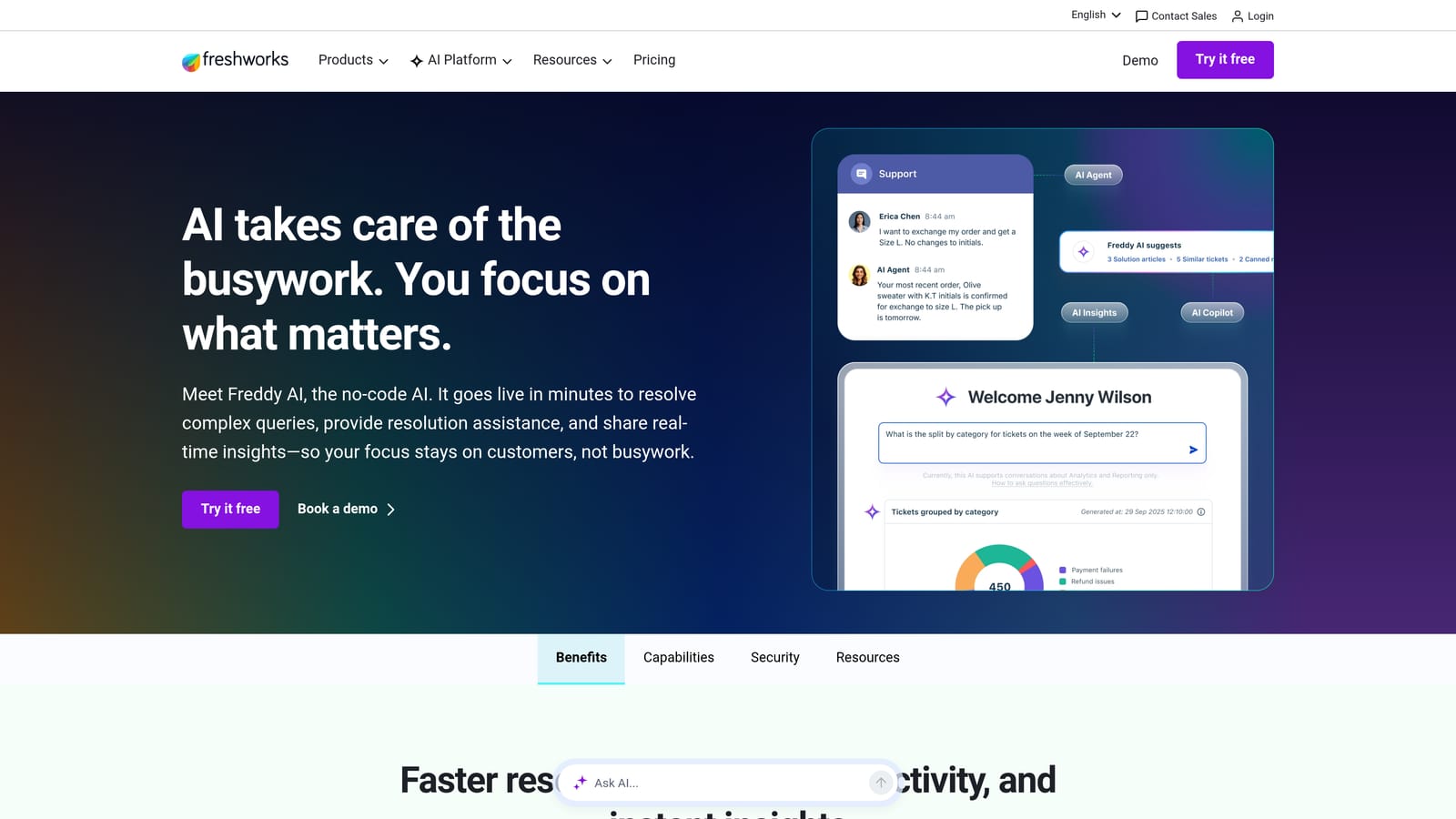
Freshdesk Freddy AI is Freshworks' AI brand covering self-service bots, agent assistance, and support analytics across the Freshdesk platform.
Where This Tool Shines
Freddy's appeal is in its accessibility. Rather than charging separately for AI features, Freshworks bundles Freddy capabilities into its Pro and Enterprise tiers. For teams already paying for Freshdesk, this means AI-powered deflection, agent assist, and analytics are available without an additional procurement conversation.
The three-layer structure, Freddy Self Service for customers, Freddy Copilot for agents, and Freddy Insights for analytics, gives teams a coherent AI experience across the full support workflow rather than isolated point solutions.
Key Features
Freddy Self Service: Customer-facing AI bot handling FAQs and common troubleshooting scenarios.
Freddy Copilot: Suggested replies, ticket summarization, and tone adjustment for agents in real time.
Freddy Insights: AI-powered analytics that surfaces trends, bottlenecks, and performance patterns.
Omnichannel Coverage: Supports email, chat, phone, and social channels within a single platform.
Bundled Pricing: Included in Pro and Enterprise tiers rather than sold as a separate add-on.
Best For
SaaS teams already running on Freshdesk who want to activate AI across their support workflow without adding another vendor or integration layer.
Pricing
Bundled with Freshdesk Pro at $49 per agent per month and Enterprise at $79 per agent per month.
5. Forethought
Best for: High-volume support teams needing intelligent triage and routing on top of an existing helpdesk.
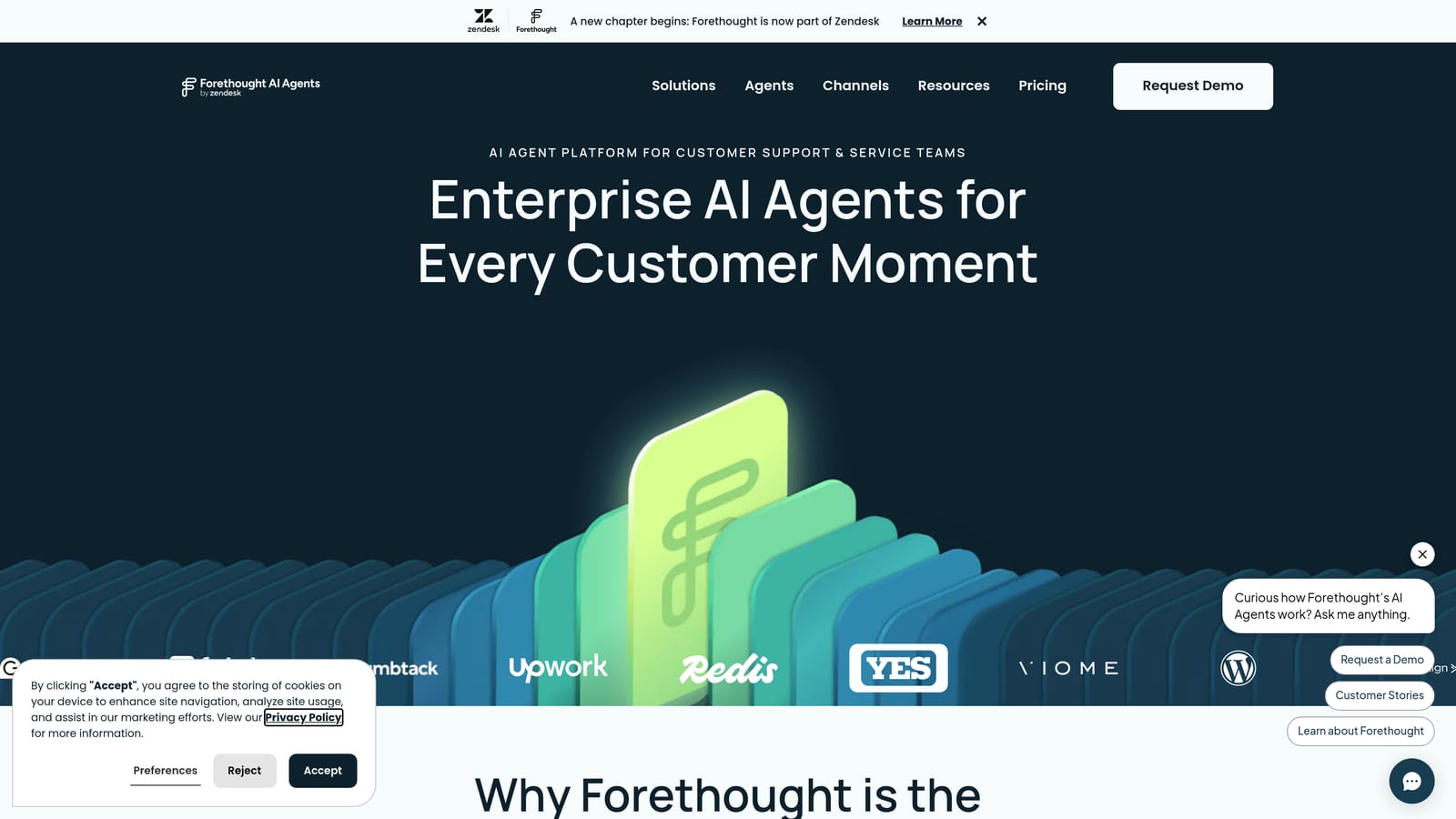
Forethought is an AI layer that sits on top of existing helpdesks, focused on smart triage, routing, and agent assistance for complex support operations.
Where This Tool Shines
Forethought's positioning is deliberately different from pure self-service tools. Its Solve product handles ticket deflection before issues reach agents, while Assist surfaces real-time recommendations and knowledge for agents actively working tickets. The combination addresses both deflection and agent productivity rather than treating them as separate problems.
The routing intelligence is particularly strong for teams with complex escalation logic. Forethought can route based on intent, sentiment, and priority simultaneously, which matters when you have multiple product lines, tiered support agreements, or specialized agent teams.
Key Features
AI Triage and Routing: Routes tickets based on detected intent, sentiment, and priority level.
Solve: Self-service AI that deflects tickets before they enter the agent queue.
Assist: Real-time agent recommendations and knowledge surfacing during active ticket work.
Broad Integrations: Works with Zendesk, Salesforce, ServiceNow, and other major helpdesks.
Workflow Builder: Visual tool for building complex routing logic without engineering involvement.
Best For
Mid-market and enterprise SaaS companies with high ticket volume and complex routing requirements who want AI intelligence layered onto their existing helpdesk rather than replacing it.
Pricing
Custom pricing. Contact Forethought directly for a quote based on volume and use case.
6. Tidio Lyro
Best for: Early-stage SaaS teams wanting fast AI deployment with a low cost of entry.
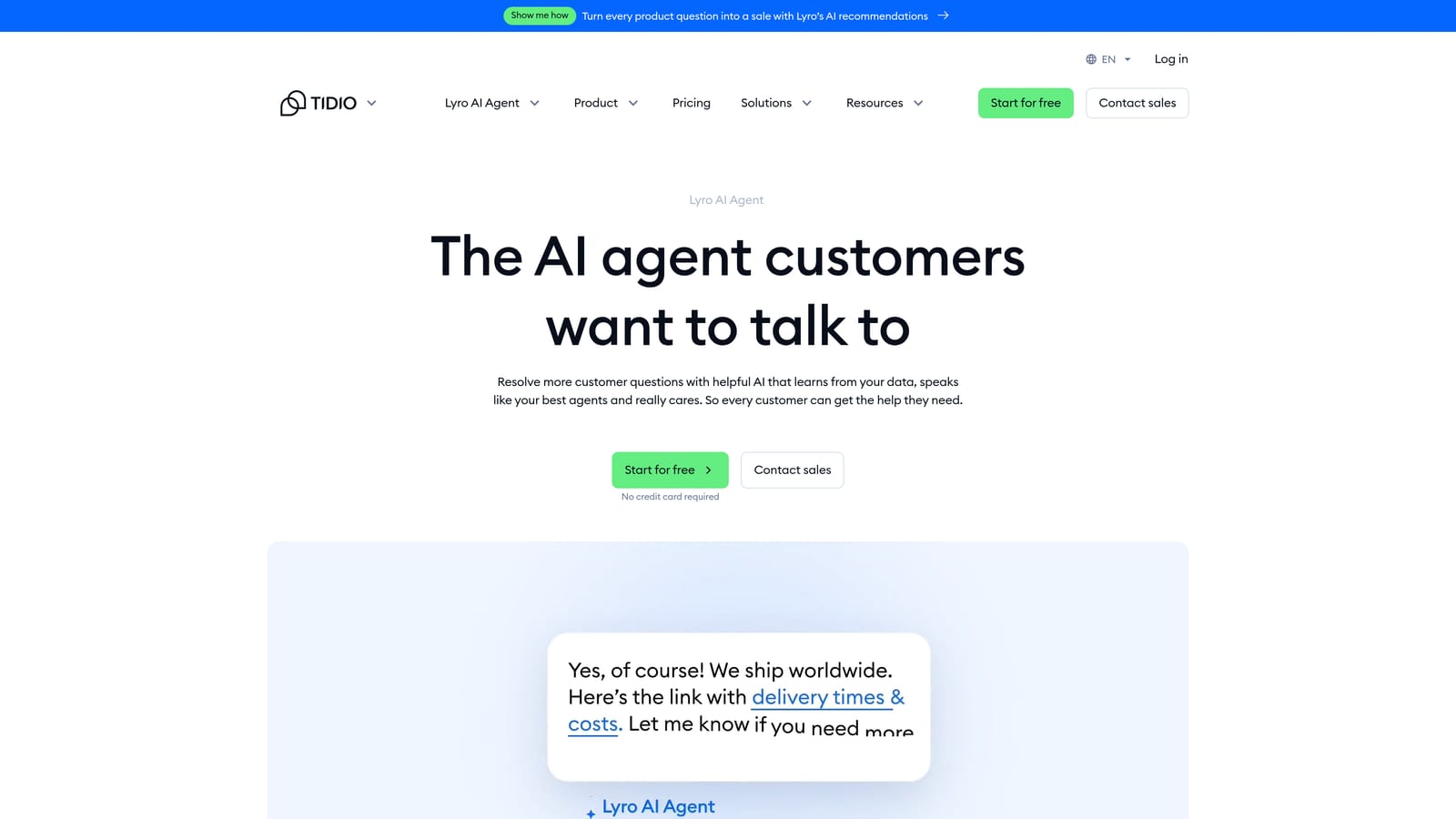
Tidio Lyro is a conversational AI agent designed for simple deployment and accessible pricing, making it a practical starting point for teams new to support AI.
Where This Tool Shines
Lyro's setup speed is genuinely impressive. You can train it on your FAQ and help content in minutes without developer involvement, which matters for small teams without dedicated engineering resources. The no-code approach means support managers can get AI deflection running in a single afternoon.
The free tier is a meaningful differentiator for early-stage companies. Being able to test AI support in production with real users before committing budget removes the typical procurement friction and lets teams validate whether AI deflection actually fits their support patterns.
Key Features
Fast Training: Learns from your FAQ and help content in minutes with no developer required.
Multi-Turn Conversations: Handles back-and-forth dialogue for common support scenarios, not just single-question lookups.
Live Chat Fallback: Escalates to human agents through Tidio's live chat when AI reaches its limits.
Free Tier: Available with a limited number of Lyro conversations per month, no credit card required.
No-Code Setup: Fully configurable by non-technical team members through a visual interface.
Best For
Seed to Series A SaaS teams handling primarily FAQ-style support volume who want to test AI deflection without significant upfront investment. Less suited for complex, multi-step technical support scenarios.
Pricing
Free tier available. Lyro add-on starts at $29 per month for additional conversations beyond the free limit.
7. Kustomer
Best for: SaaS teams where customer history and relationship context are as important as the immediate issue.
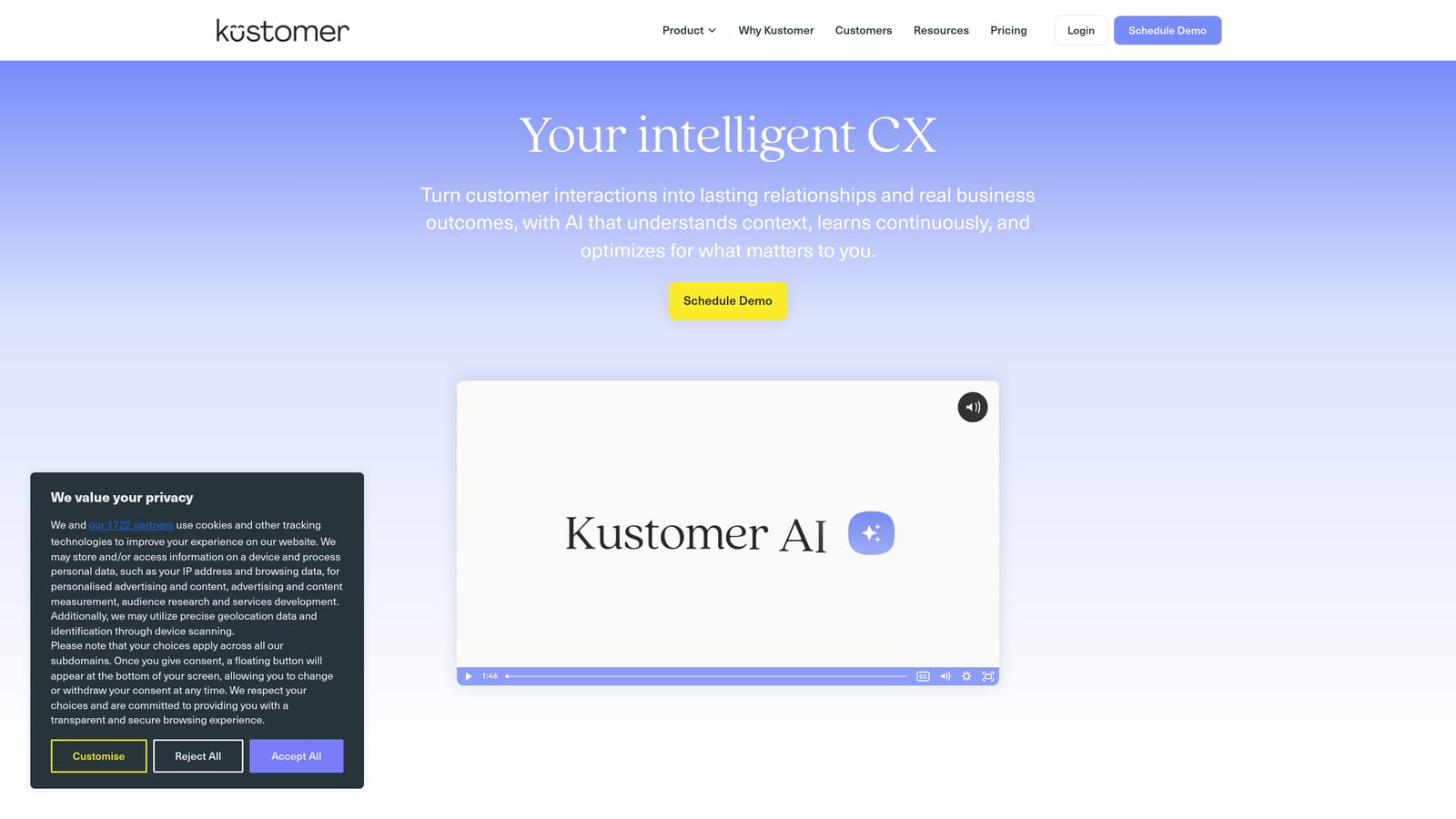
Kustomer is a CRM-style helpdesk with AI automation built in, giving agents a unified customer timeline across every interaction and channel.
Where This Tool Shines
Kustomer's unified timeline is its defining feature. Rather than treating each ticket as an isolated event, agents see the full history of a customer's purchases, prior support interactions, and channel touchpoints in a single view. When AI is making routing and response decisions, that context makes a meaningful difference in resolution quality.
For SaaS companies with high-touch relationships, particularly those managing enterprise accounts or customer success alongside support, Kustomer's CRM-native approach means support intelligence and relationship data live in the same place rather than being siloed across systems.
Key Features
Unified Customer Timeline: Full history of purchases, tickets, and interactions across all channels in a single view.
AI-Powered Automation: Intelligent routing, tagging, and response suggestions informed by customer history.
Omnichannel Support: Handles email, chat, SMS, social, and voice from a single platform.
KIQ Customer Assist: AI self-service deflection for common questions before they reach agents.
Deep CRM Integration: Customer data informs every AI decision rather than treating tickets in isolation.
Best For
SaaS companies managing complex customer relationships where account history, purchase context, and prior interactions should inform every support interaction. Strong for teams blending support with customer success functions.
Pricing
Enterprise plan from $89 per agent per month. Ultimate plan from $139 per agent per month.
8. Aisera
Best for: Enterprise SaaS companies needing AI across both external customer support and internal IT service management.
Aisera is an enterprise AI platform covering customer service and ITSM with domain-specific generative AI models built for complex organizational environments.
Where This Tool Shines
Aisera's differentiation is its domain-specific model approach. Rather than using a single general-purpose AI, it deploys models trained specifically for customer service and IT service management contexts. For enterprise SaaS companies with both external support needs and internal helpdesk operations, this breadth is genuinely valuable.
The agentic AI workflow capability deserves attention. Aisera can execute multi-step resolution processes without human intervention, moving beyond simple FAQ deflection into actual workflow automation. For complex SaaS products with predictable resolution paths, this means more issues resolved end-to-end rather than just triaged.
Key Features
Domain-Specific AI Models: Separate models trained for customer service and ITSM rather than a single general-purpose engine.
Agentic AI Workflows: Multi-step resolution automation that handles complex scenarios without human intervention.
Broad Channel Coverage: Self-service across web, mobile, Slack, and Microsoft Teams.
Enterprise Integrations: Connects with Salesforce, ServiceNow, Zendesk, Jira, and other enterprise platforms.
Enterprise Compliance: SOC 2, GDPR, and HIPAA support for regulated industries.
Best For
Large SaaS organizations needing AI coverage across both customer-facing support and internal IT operations, particularly those in regulated industries with strict compliance requirements.
Pricing
Custom enterprise pricing. Contact Aisera directly for a quote based on organizational scale and use case.
9. Capacity
Best for: SaaS teams with high FAQ and documentation-driven support volume who need AI without engineering resources.
Capacity is a no-code AI helpdesk platform focused on knowledge base automation and FAQ deflection, letting teams build AI self-service without developer involvement.
Where This Tool Shines
Capacity's strength is in making knowledge base intelligence accessible to non-technical teams. The platform learns from support interactions over time, continuously improving its ability to match user questions to the right answers from your documentation. Confidence scoring adds a useful layer of transparency, so the AI only answers when it's genuinely confident rather than guessing.
For SaaS teams where the majority of support volume comes from how-to questions and feature documentation, Capacity can handle a substantial portion of that load without requiring agents to get involved. The no-code chatbot builder means support managers can build and iterate on deflection flows without waiting on engineering sprints.
Key Features
AI Knowledge Base: Learns from support interactions to continuously improve answer accuracy over time.
No-Code Chatbot Builder: Visual interface for building self-service deflection flows without developer resources.
Confidence Scoring: AI only provides answers when confidence exceeds a set threshold, reducing incorrect responses.
Broad Integrations: Connects with Slack, Microsoft Teams, Zendesk, Salesforce, and other platforms.
AI-Assisted Agent Workflows: Helpdesk ticketing with AI recommendations for agents handling escalated issues.
Best For
SaaS teams with documentation-heavy support patterns and limited engineering bandwidth. Particularly useful for companies where self-service deflection is the primary goal rather than complex multi-turn AI conversations.
Pricing
Growth plan starts at $49 per month. Professional and Enterprise plans available with expanded features and volume limits.
Which Tool Is Right for Your SaaS Team?
The honest answer is that the best support AI depends less on which tool has the most features and more on where you are as a company and what your support patterns actually look like.
Here's a practical breakdown by situation:
Just starting with support AI on a tight budget: Tidio Lyro's free tier lets you test AI deflection in production before committing any budget. It handles FAQ-style volume well and deploys without engineering help.
Already running Zendesk or Freshdesk: Start with the native AI layer. Zendesk AI for enterprise teams, Freddy AI for those on Freshdesk. Both integrate without platform friction, and the bundled pricing makes them the lowest-risk starting point.
High-volume operations needing smarter routing: Forethought is built for exactly this. If your challenge is less about deflection and more about getting the right tickets to the right agents faster, Forethought's triage intelligence is purpose-built for that problem.
Customer relationships and history matter as much as ticket resolution: Kustomer's unified timeline approach makes it the natural fit for teams where support and customer success overlap, or where account context should inform every interaction.
Enterprise SaaS with ITSM needs alongside customer support: Aisera covers both external and internal AI support with domain-specific models and the compliance posture that regulated industries require.
Building AI-first support from scratch, without legacy helpdesk constraints: Halo AI is the strongest choice here. It's not built on top of an existing platform. It is the support layer. Page-aware context, continuous learning, business intelligence surfaced from every interaction, and deep integrations across your stack make it the most complete option for SaaS teams that want support AI to do more than deflect tickets.
Your support team shouldn't scale linearly with your customer base. Let AI agents handle routine tickets, guide users through your product, and surface business intelligence while your team focuses on complex issues that need a human touch. See Halo in action and discover how continuous learning transforms every interaction into smarter, faster support.