9 Best Ticket Automation Tools for B2B Support Teams in 2026
This guide ranks the 9 best ticket automation tools for B2B support teams in 2026, evaluating each platform on AI capabilities, automation depth, integration ecosystem, and value for modern SaaS workflows. Whether you handle a handful of tickets or thousands per month, it covers the right solution to eliminate manual triage and resolve issues faster.
 Matt PattoliFounder13 min read
If your support team is still manually triaging, tagging, and routing every incoming ticket, you're leaving serious efficiency on the table. Ticket automation has matured well beyond simple rule-based routing: today's best platforms use AI to resolve tickets outright, surface business intelligence, and learn from every interaction.
This guide covers the best ticket automation tools for B2B companies and product teams in 2026. Whether you're running a lean support operation or managing thousands of tickets a month, there's a solution here that fits. We evaluated each tool on automation depth, AI capabilities, integration ecosystem, ease of setup, and value for B2B SaaS teams specifically. Tools are ranked by overall capability and relevance to modern support workflows, not by popularity or market share.
1. Halo AI
Best for: B2B SaaS teams that want AI-native ticket resolution with business intelligence built in.
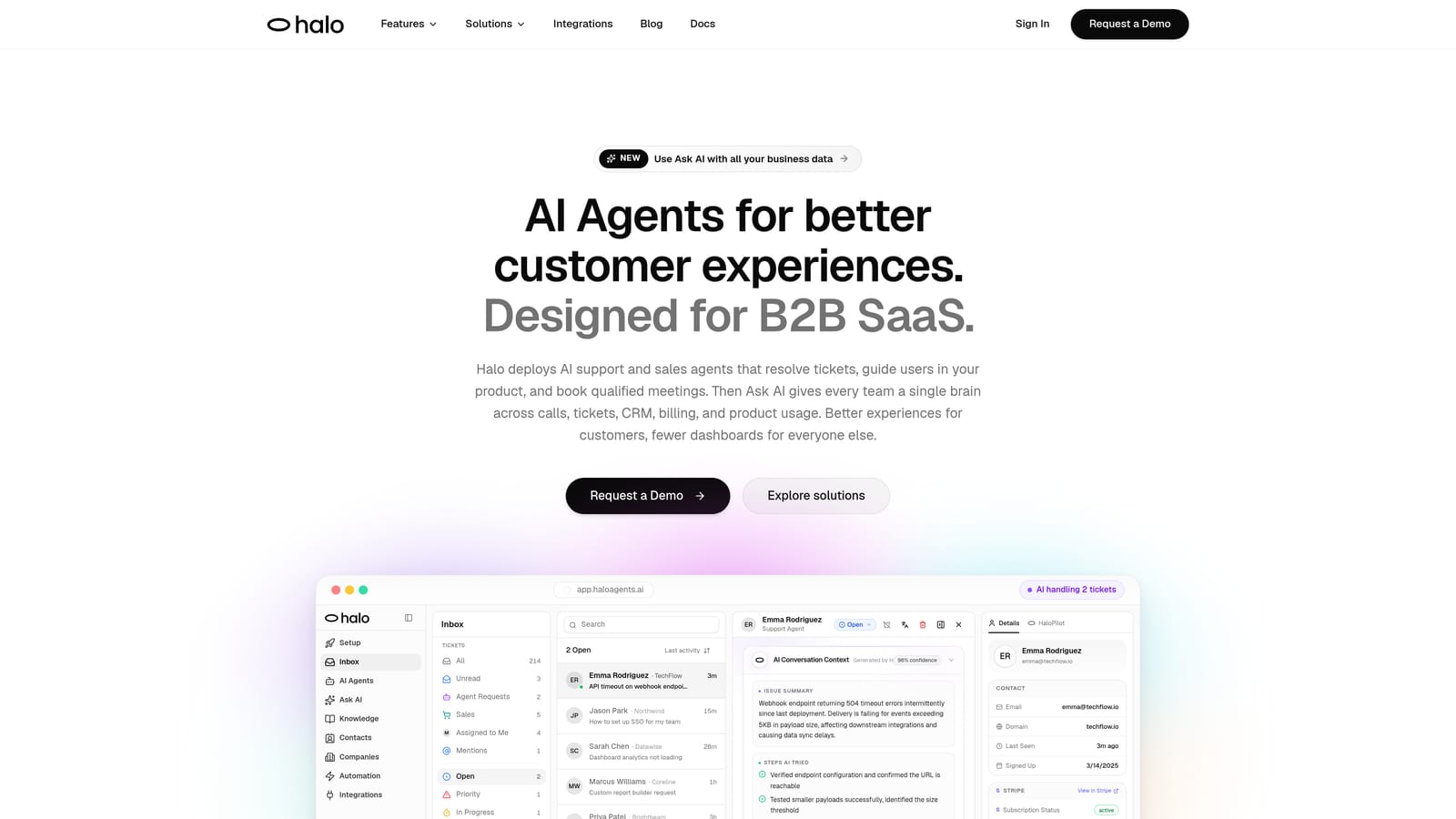
Halo AI is an AI-native customer support platform that deploys intelligent agents to resolve tickets, guide users through your product, and surface actionable business intelligence.
Where This Tool Shines
Most helpdesks were built for human agents and then had AI layered on top. Halo is architected the other way around: AI agents are the primary resolution layer, and human escalation is the exception rather than the rule. That distinction matters when you're trying to scale support without scaling headcount.
The standout capability is page-aware context. Halo's chat widget sees what the user sees on-screen, allowing it to provide step-by-step visual guidance rather than generic instructions. Combine that with a learning loop that improves from every interaction, and the system gets measurably smarter over time rather than plateauing like static rule sets do.
Key Features
Autonomous AI Agents: Resolve support tickets end-to-end without human involvement for routine issues, with smart escalation for complex cases.
Page-Aware Chat Widget: The AI sees the user's current screen context, enabling precise, visual guidance that static chatbots simply can't match.
Smart Inbox with Business Intelligence: Surfaces customer health signals, anomaly detection, and revenue intelligence from support data, turning your inbox into a strategic asset.
Auto Bug Ticket Creation: Automatically creates structured bug reports in Linear directly from support conversations, closing the loop between support and engineering without manual handoffs.
Live Agent Handoff: Seamlessly escalates to human agents when conversations require judgment, context, or relationship management.
Deep Integration Ecosystem: Connects with Stripe, HubSpot, Intercom, Slack, Zoom, PandaDoc, and Fathom for a unified view across your business stack.
Best For
B2B SaaS companies that want to move beyond agent-assistance tools toward genuine autonomous resolution. Particularly well-suited for product teams who need support to feed back into engineering workflows and leadership teams who want support data to inform retention and revenue decisions.
Pricing
Contact for pricing; Halo operates on a demo-first model. Visit haloagents.ai to book a walkthrough and get a quote tailored to your team size and ticket volume.
2. Zendesk
Best for: Enterprise support teams needing a mature, deeply configurable helpdesk with broad automation options.
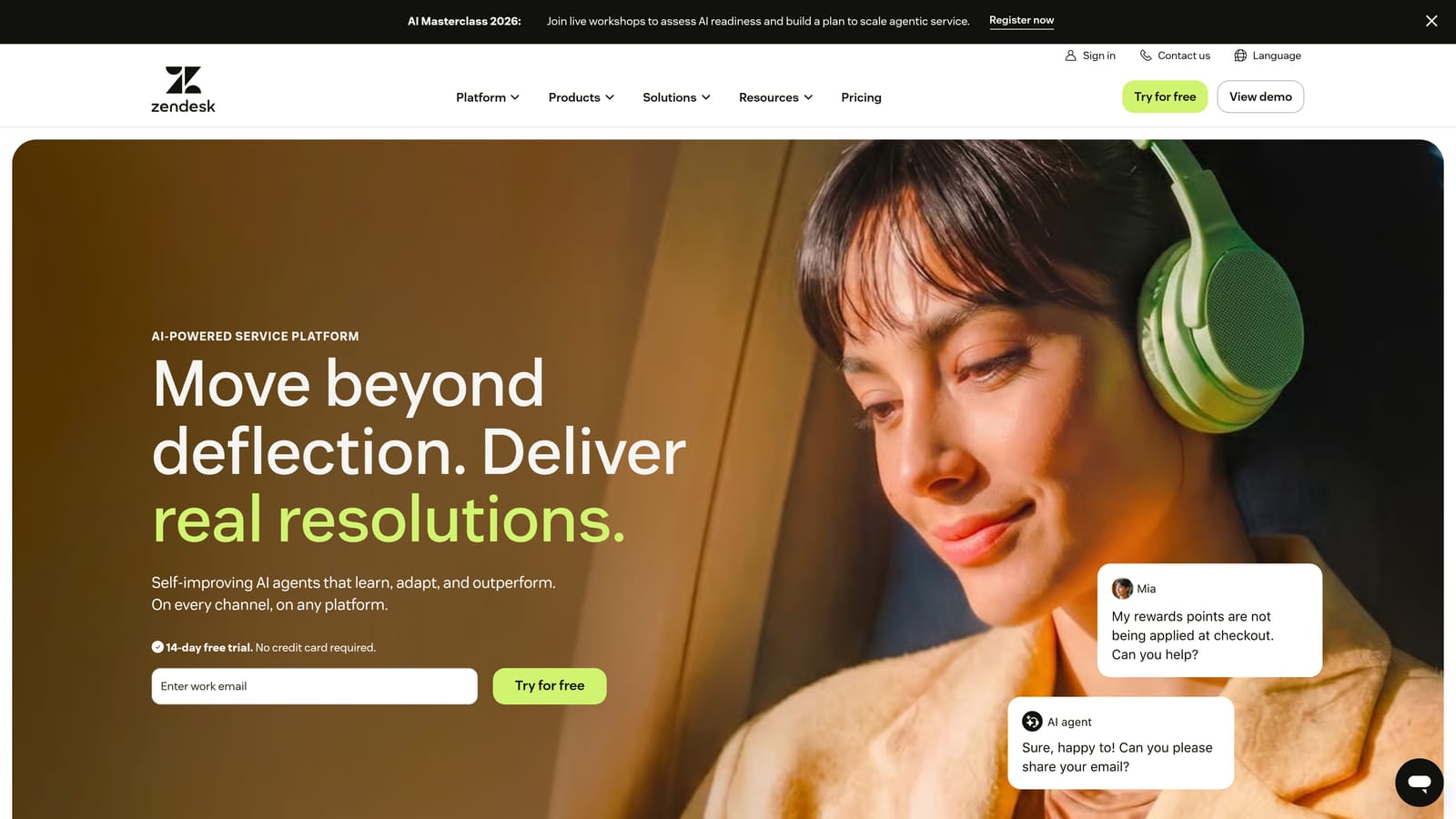
Zendesk is the market-leading helpdesk platform with a mature rule-based automation engine and a growing AI layer for intelligent triage and agent assistance.
Where This Tool Shines
Zendesk's rule-based automation, built around Triggers, Automations, and Macros, is battle-tested and highly configurable. For teams with complex routing logic, multi-tier SLAs, and large agent workforces, it remains the most proven platform in the market.
The AI features added through Zendesk AI (built on an OpenAI partnership) bring intelligent triage, intent detection, and an Agent Copilot for in-conversation assistance. These are genuinely useful additions, though they come as an additional cost on top of already premium base pricing, which can make the total investment significant at scale.
Key Features
Triggers and Automations: Rule-based routing, SLA management, and ticket actions that have been refined over years of enterprise use.
Zendesk AI: Intelligent triage, intent detection, and suggested responses powered by large language model integration.
Agent Copilot: In-conversation AI assistance that helps agents draft replies, summarize context, and navigate complex tickets faster.
App Marketplace: Over 1,000 integrations covering virtually every tool in the modern support stack.
Workforce Management and Reporting: Advanced analytics, forecasting, and scheduling tools for larger support organizations.
Best For
Enterprise teams with dedicated support operations, complex routing requirements, and the budget to match. Less ideal for lean SaaS teams looking for AI-native resolution rather than agent augmentation.
Pricing
Starts at approximately $55/agent/month (Suite Team); AI features are an additional cost. Pricing scales significantly at higher tiers. Verify current pricing at zendesk.com.
3. Freshdesk
Best for: Mid-market teams wanting AI-assisted support at a more accessible price point than enterprise alternatives.
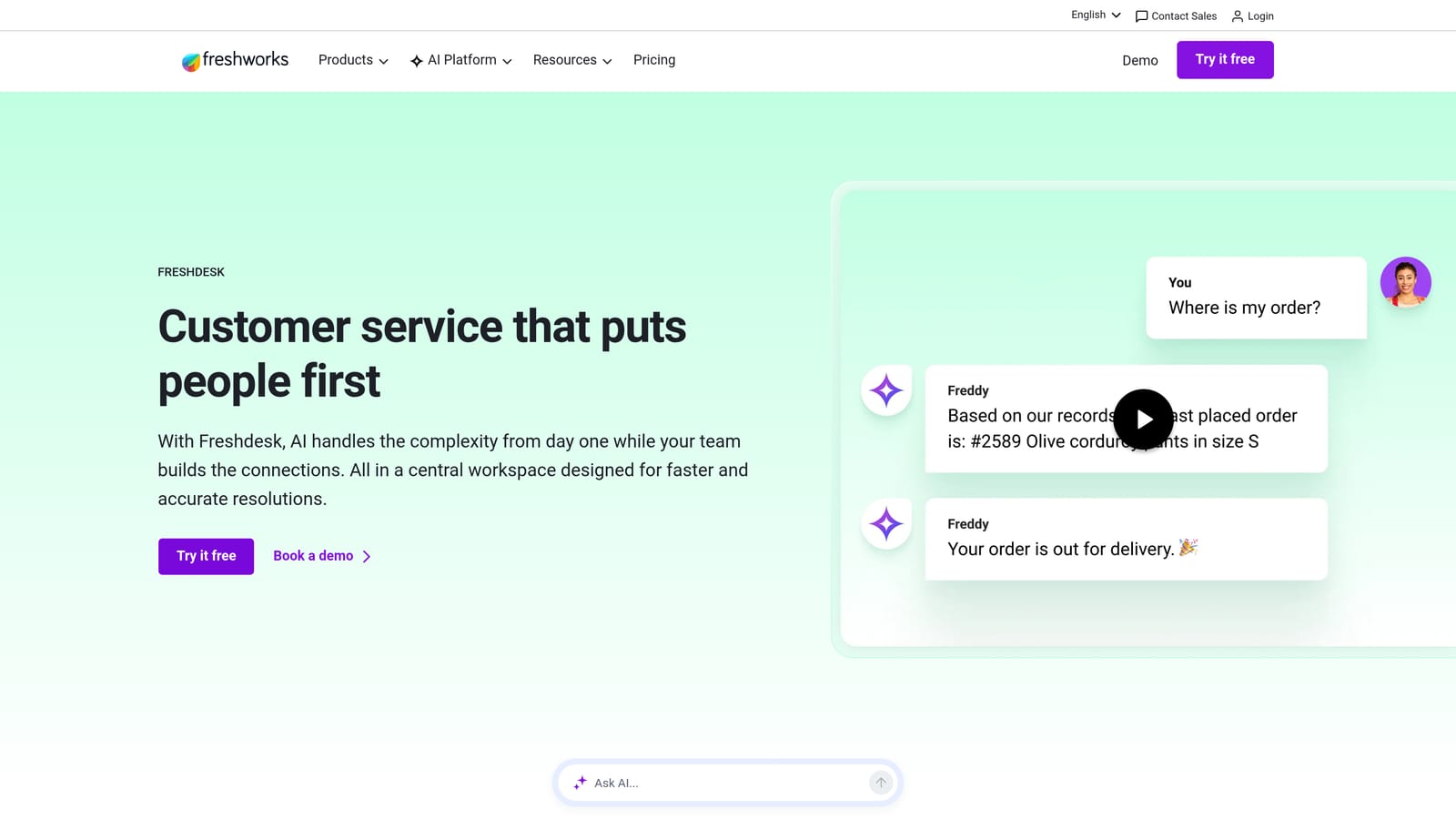
Freshdesk is a mid-market helpdesk with Freddy AI providing ticket classification, suggested responses, and self-service automation.
Where This Tool Shines
Freshdesk hits a useful middle ground: more capable than basic shared inboxes, more affordable than Zendesk at comparable feature tiers. Freddy AI handles auto-classification, sentiment detection, and basic suggested responses, which meaningfully reduces manual triage work for growing teams.
The omnichannel inbox covering email, chat, phone, and social is well-executed, and Scenario Automations allow teams to trigger multi-step ticket actions without writing complex rules. The main caveat is that the most powerful Freddy AI capabilities (Copilot and Self Service) are separate add-ons, so the total cost can climb faster than the base pricing suggests.
Key Features
Freddy AI: Auto-classification, sentiment detection, and suggested responses that reduce manual triage across high-volume inboxes.
Freddy Copilot: Agent productivity tools including conversation summarization and tone adjustment for faster, more consistent replies.
Freddy Self Service: AI-powered deflection that handles common queries before they reach an agent.
Omnichannel Inbox: Unified inbox covering email, chat, phone, and social channels.
Scenario Automations: Multi-step ticket actions triggered by conditions, reducing repetitive manual work.
Best For
Mid-market B2B teams that need a capable, affordable helpdesk with AI assistance features and don't require the deep customization or enterprise tooling of Zendesk.
Pricing
Free tier available; paid plans from approximately $15/agent/month. Freddy AI is an add-on at additional cost. Verify current pricing at freshdesk.com.
4. Intercom
Best for: SaaS teams wanting a genuine AI resolution agent deeply embedded in their product experience.
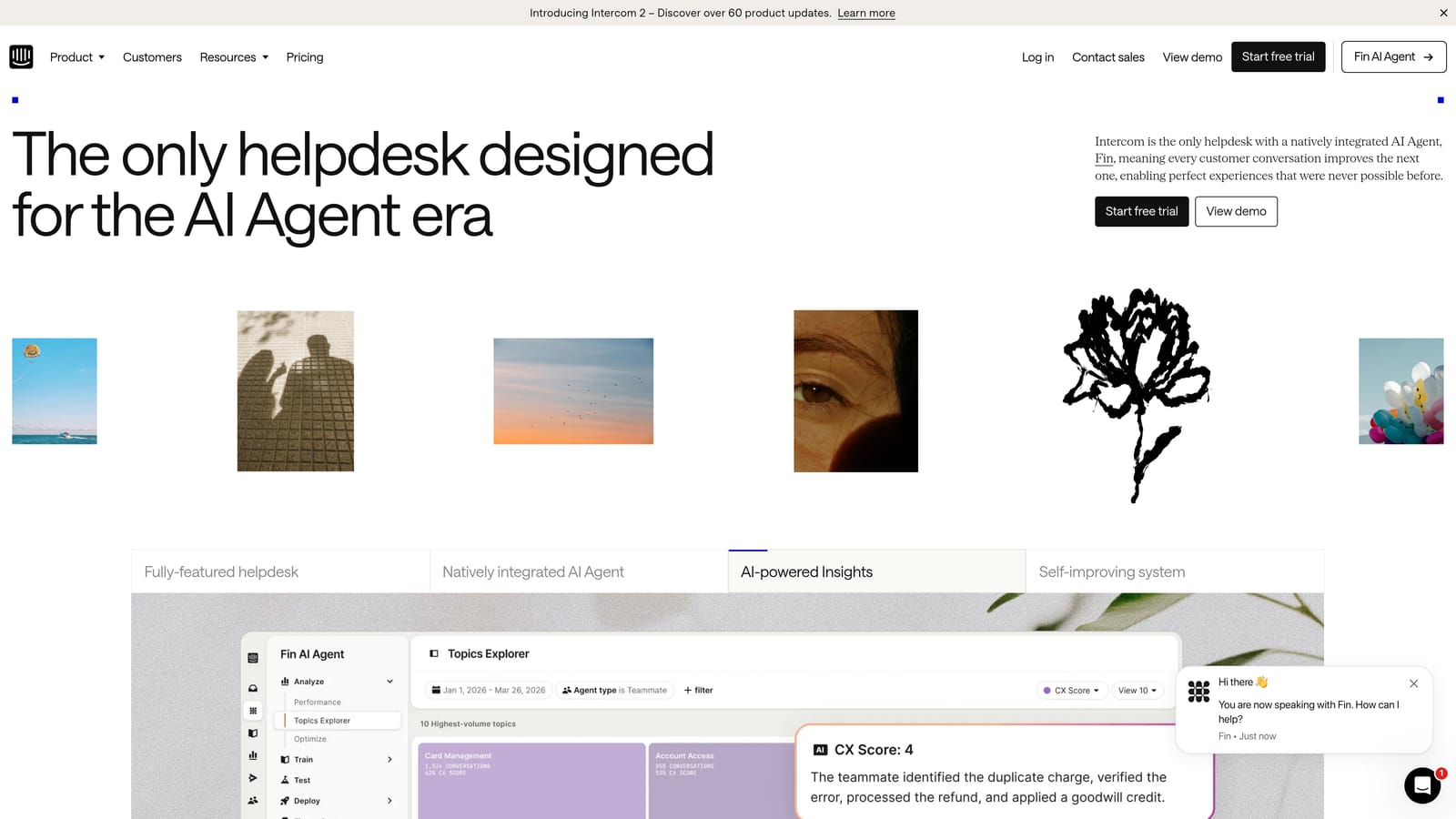
Intercom is a conversational support platform with Fin AI, a genuine AI resolution agent that handles a meaningful share of conversations before human involvement.
Where This Tool Shines
Fin AI is one of the more mature AI resolution agents on this list. Rather than simply suggesting responses for human agents to review, Fin handles full conversations autonomously for queries it can confidently resolve. For SaaS teams with product-led growth motions, Intercom's in-app messaging and product tours also make it a dual-purpose tool: support and onboarding in one platform.
The ticket automation is tied to Intercom's conversation workflows, which works well when your support is primarily chat-driven. Teams running high-volume email-first support may find the workflow model less natural. Pricing scales with usage and can become a significant line item as conversation volume grows.
Key Features
Fin AI Agent: Autonomous conversation resolution for queries within its knowledge scope, with clean handoff to humans when needed.
In-App Messaging and Product Tours: Proactive support and onboarding flows embedded directly in your product UI.
Conversation-Based Ticket Automation: Workflow automation tied to conversation state, intent, and customer data.
Customer Data Platform: Personalized routing and messaging based on user attributes and behavior.
SaaS Onboarding Capabilities: Strong tooling for product-led support and activation flows alongside reactive support.
Best For
SaaS companies with product-led growth models where support, onboarding, and in-app engagement overlap. Less ideal for teams with complex B2B ticketing workflows that go beyond conversational support.
Pricing
Starts at approximately $29/seat/month for small teams; scales significantly with usage and Fin AI resolution volume. Verify current pricing at intercom.com.
5. Help Scout
Best for: Teams prioritizing a clean, human-first customer experience with AI tools that assist agents rather than replace them.
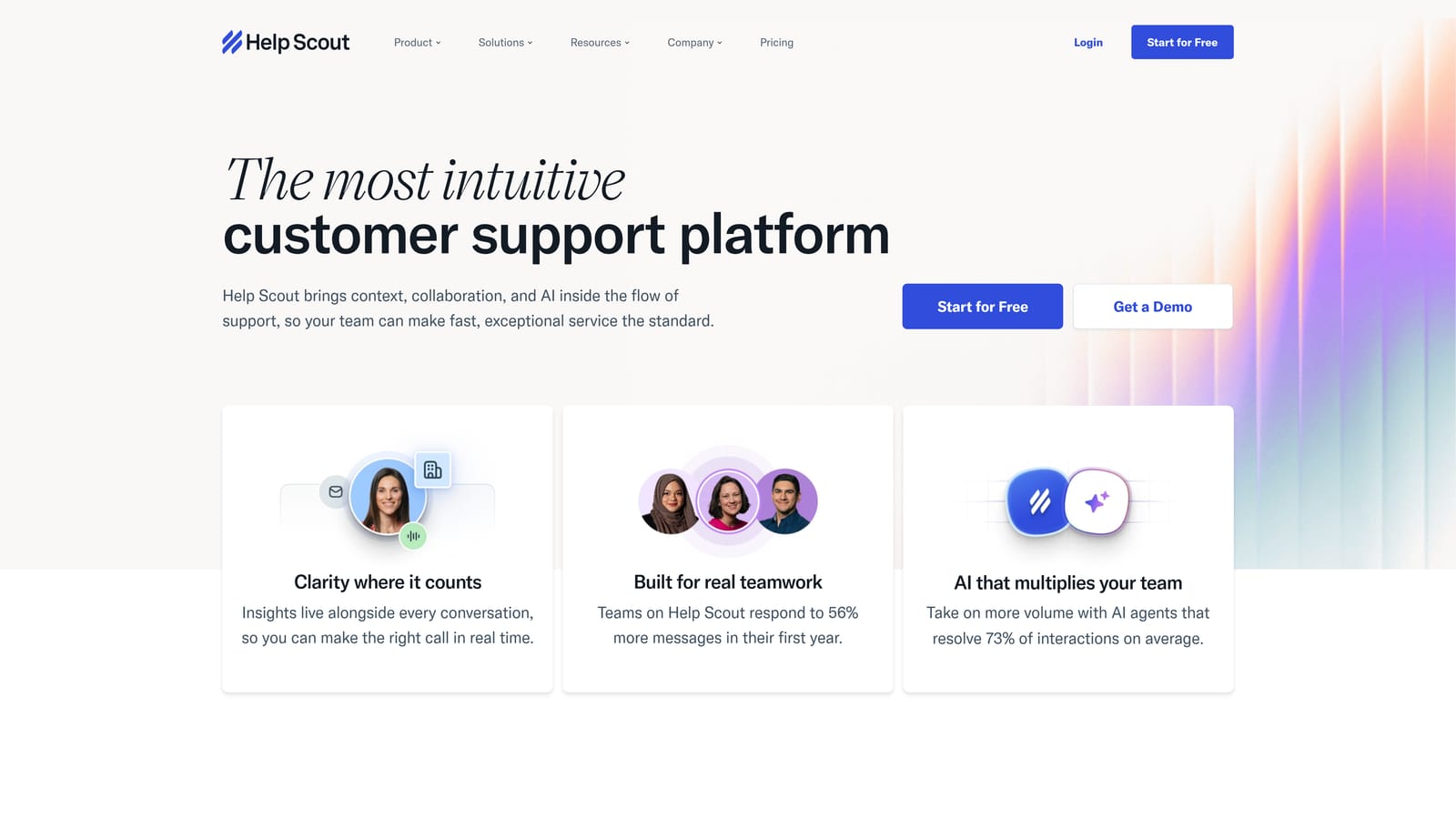
Help Scout is a deliberately simple shared inbox and helpdesk with if/then workflow automation and AI tools designed to make human agents faster.
Where This Tool Shines
Help Scout occupies a distinct position in this list: it's not trying to resolve tickets autonomously. Instead, it focuses on giving human agents the context and tools to respond faster and more consistently. For teams where relationship quality and tone matter as much as resolution speed, that's a meaningful design philosophy.
The AI Summarize and AI Assist features are well-implemented for their purpose. Agents get instant conversation context and AI-drafted reply suggestions without the tool feeling robotic to the customer on the other end. Beacon, the in-app widget, handles self-service and proactive help without overwhelming complexity.
Key Features
Workflows: If/then automation rules for routing, tagging, and assignment that cover the majority of standard triage needs.
AI Summarize: Instant conversation context for agents picking up mid-thread tickets without reading full history.
AI Assist: Drafts and improves agent replies while maintaining a natural, non-robotic tone.
Beacon Widget: In-app self-service and chat with a clean, low-friction customer experience.
Shared Inbox Design: Collaboration-first inbox with assignments, internal notes, and collision detection.
Best For
SMB and mid-market B2B teams where human relationships are central to support quality. Not the right choice if your primary goal is autonomous AI resolution or deep business intelligence from support data.
Pricing
Starts at approximately $22/user/month. Verify current pricing at helpscout.com.
6. Zoho Desk
Best for: Teams already using Zoho's business suite who want competitive AI features at a lower price point.
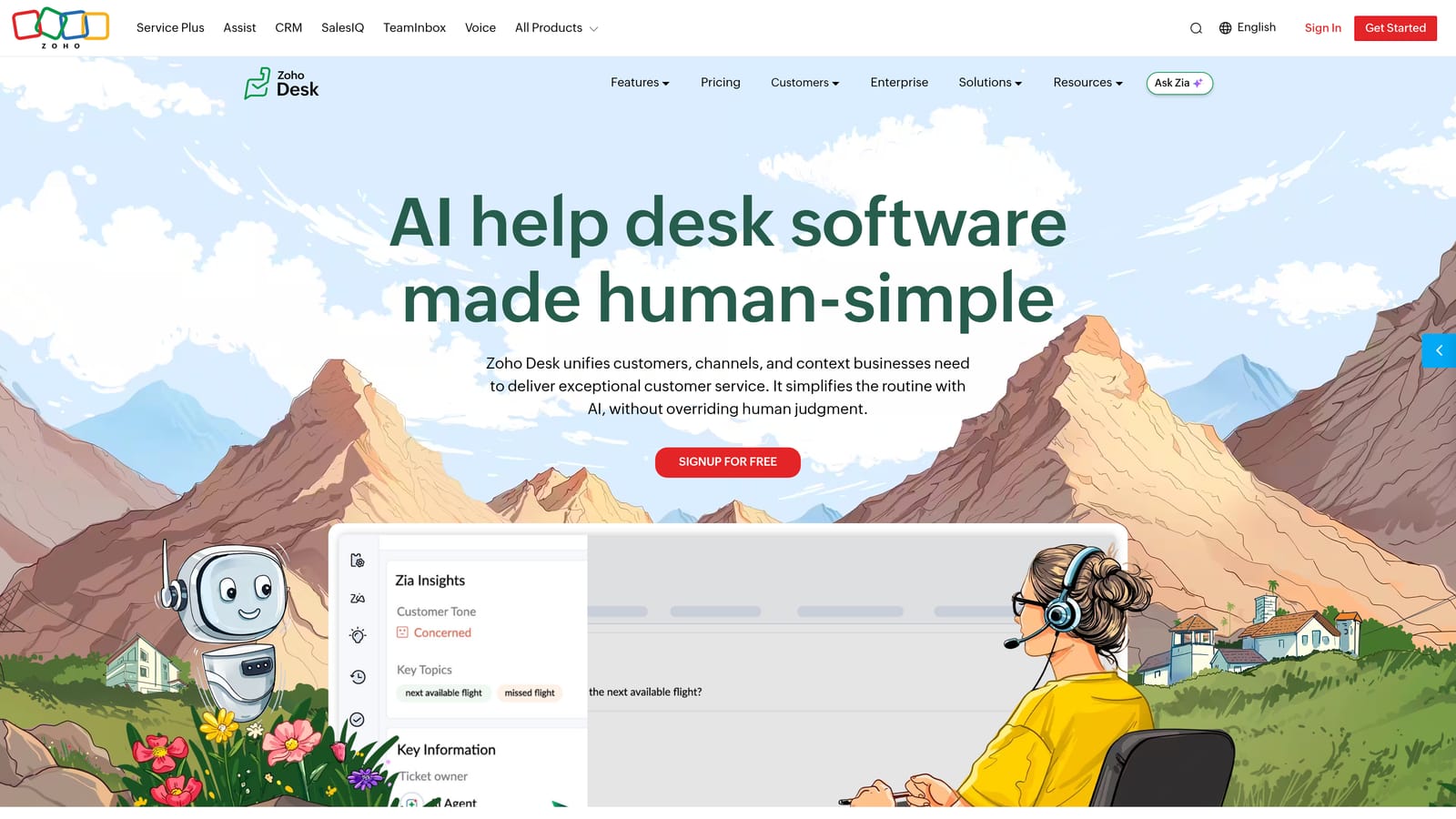
Zoho Desk is a full-featured helpdesk with Zia AI providing sentiment analysis, anomaly detection, and auto-tagging.
Where This Tool Shines
Zoho Desk's strongest argument is value density. At a price point well below most competitors, it delivers Zia AI for sentiment analysis, auto-tagging, and anomaly detection in ticket volume, plus Blueprint for structured multi-step workflow automation. For teams already using Zoho CRM, the native integration removes friction that other tools require middleware to solve.
The anomaly detection feature is worth highlighting specifically: Zia can flag unusual spikes in ticket volume or shifts in sentiment before they become visible problems, which is genuinely useful for operations teams monitoring support health. The tradeoff is that Zoho's interface and ecosystem feel less polished than Zendesk or Intercom, and the AI capabilities, while solid, aren't as advanced as dedicated AI-first platforms.
Key Features
Zia AI: Sentiment analysis, auto-tagging, suggested responses, and anomaly detection across ticket volume and customer sentiment.
Blueprint Automation: Structured multi-step workflow automation for complex, process-driven ticket handling.
Zoho CRM Integration: Native, tight integration for teams managing customer relationships across the Zoho ecosystem.
Anomaly Detection: Proactive alerts for unusual ticket volume spikes or sentiment shifts.
Competitive Pricing: Free tier and paid plans that undercut most comparable platforms.
Best For
SMB and mid-market teams already invested in the Zoho ecosystem, or cost-conscious teams that need solid AI-assisted automation without enterprise pricing.
Pricing
Free tier available; paid plans from approximately $14/agent/month. Verify current pricing at zoho.com/desk.
7. Front
Best for: Customer success and account management teams handling relationship-heavy B2B support.
Front is a collaborative shared inbox platform combining email automation rules, AI drafts, and CRM-like contact context.
Where This Tool Shines
Front is built for a specific kind of B2B support: the kind where you know your customers by name, where tone and relationship continuity matter, and where the line between support and account management is blurry. The CRM-like contact and account view alongside conversations gives agents context that a traditional ticketing queue simply doesn't provide.
The AI Drafts feature is particularly well-suited to this use case, generating suggested replies that draw on conversation history and contact context rather than just the current message. For high-touch B2B teams managing a relatively smaller volume of complex, relationship-sensitive interactions, Front's approach is more natural than a traditional ticket queue.
Key Features
Automation Rules: Routing, tagging, and SLA management through configurable if/then rules.
AI Drafts: Suggested replies generated from conversation history and contact context, not just the current message.
AI Summarize: Quick conversation context for agents picking up ongoing threads.
CRM-Like Contact View: Account and contact information displayed alongside every conversation for relationship context.
Collaborative Inbox: Internal comments, assignments, and shared drafts for team coordination on complex accounts.
Best For
Customer success, account management, and high-touch B2B support teams. Less suited for high-volume ticket environments or teams prioritizing autonomous AI resolution over agent collaboration.
Pricing
Starts at approximately $19/seat/month (Starter plan). Verify current pricing at front.com.
8. Tidio
Best for: Early-stage SaaS companies or smaller B2B teams needing fast-to-deploy automation without enterprise complexity.
Tidio is a fast-to-deploy AI chat and ticket automation platform with Lyro AI handling FAQ-style deflection and a no-code flow builder for custom sequences.
Where This Tool Shines
Tidio's primary advantage is speed to value. The no-code visual flow builder and pre-built templates mean a small team can have meaningful automation running in hours rather than weeks. Lyro AI handles common FAQ-style queries autonomously, reducing the volume that reaches human agents for teams where a significant share of tickets are repetitive and low-complexity.
The honest caveat: Tidio is designed for simpler support workflows. It handles the top of the automation stack well, but teams with complex B2B ticketing needs, multi-tier escalation logic, or requirements for deep CRM and billing integration will hit its limits relatively quickly.
Key Features
Lyro AI Agent: Autonomous resolution of FAQ-style and basic queries before they reach human agents.
No-Code Flow Builder: Visual automation sequence builder with pre-built templates for fast deployment.
Live Chat with Agent Fallback: Smooth handoff from AI to human agent when Lyro reaches the edge of its capability.
Multi-Channel Support: Email and Messenger channel coverage alongside live chat.
Quick Setup: Pre-built templates and a lightweight onboarding process suited for small teams.
Best For
Early-stage SaaS companies, small B2B teams, or businesses that need a fast, affordable entry point into AI-assisted support without complex configuration requirements.
Pricing
Free tier available; Lyro AI from approximately $29/month. Verify current pricing at tidio.com.
9. Gorgias
Best for: SaaS-adjacent or hybrid transactional businesses needing live account data pulled directly into ticket context.
Gorgias is a support automation platform with deep transactional data integration, pulling live order and account data into tickets and resolving status queries autonomously.
Where This Tool Shines
Gorgias is primarily known as an e-commerce support platform, but it belongs on this list for SaaS-adjacent businesses where transactional queries make up a significant share of ticket volume. The ability to pull live account, subscription, or order data directly into the ticket context, and resolve status queries autonomously, is genuinely powerful for the right use case.
The ticket-based pricing model is also worth noting: rather than charging per agent seat, Gorgias prices on ticket volume, which can work out favorably for teams with a small number of agents handling high ticket volume. For pure B2B SaaS companies without transactional data complexity, the fit is less obvious, and other tools on this list will likely serve better.
Key Features
AI Agent for Transactional Resolution: Autonomous resolution of repetitive status and account queries using live data from connected systems.
Live Data Integration: Order, subscription, and account data pulled directly into ticket context for agents and AI alike.
Rules and Macros: High-volume ticket automation for repetitive actions and responses.
Omnichannel Support: Email, chat, social, and SMS in a unified inbox.
Ticket-Based Pricing: Volume-based pricing model rather than per-agent seats, which suits certain team structures.
Best For
SaaS-adjacent businesses with significant transactional query volume, or hybrid companies that blend software subscriptions with physical or service components. Less suited for pure B2B SaaS teams focused on complex product support.
Pricing
Starts at approximately $10/month on a ticket-based pricing model. Verify current pricing at gorgias.com.
Which Tool Is Right for Your Team?
The right ticket automation tool depends on three things: your team size, your existing stack, and how much autonomous resolution you actually need versus agent assistance.
If you're a B2B SaaS company that wants AI to resolve tickets end-to-end, surface churn signals, and close the loop with engineering automatically, Halo AI is the most purpose-built option on this list. It's the only tool here built AI-first rather than helpdesk-first, and that architectural difference shows up in the depth of what it can do.
For enterprise teams with complex routing needs and large agent workforces, Zendesk remains the most proven platform. For mid-market teams watching budget, Freshdesk or Zoho Desk offer capable AI-assisted automation at a lower price point. If relationship-heavy B2B support is your primary challenge, Front is purpose-built for that motion. And for early-stage teams that need something running quickly, Tidio gets you to value fast without complex configuration.
The broader trend is clear: ticket automation is moving from rule-based routing toward genuine AI resolution, and the gap between tools built for that future and those retrofitting AI onto legacy architecture is widening. Your support team shouldn't scale linearly with your customer base. Let AI agents handle routine tickets, guide users through your product, and surface business intelligence while your team focuses on complex issues that need a human touch. See Halo in action and discover how continuous learning transforms every interaction into smarter, faster support.