9 Best AI Customer Support Solutions to Buy in 2026
Choosing where to buy an AI customer support solution is complex given how differently platforms perform on resolution quality, integration depth, and deployment speed. This guide evaluates nine AI-native platforms across criteria that matter most to B2B and SaaS teams—helping you identify the right fit whether you're replacing a legacy helpdesk, augmenting a lean team, or building a fully autonomous support operation.
 Grant CooperFounder13 min read
If you're evaluating AI customer support solutions right now, you already know the market is crowded. What you might not know is how dramatically different these platforms are under the hood. The gap between an AI-native platform and a chatbot wrapper bolted onto a legacy helpdesk can mean the difference between a 30-day deployment and a six-month integration project that still doesn't resolve tickets autonomously.
This guide covers nine platforms assessed across the criteria that matter most to B2B and SaaS teams: resolution quality, integration depth, escalation intelligence, and total cost of ownership. Whether you're replacing a legacy helpdesk, augmenting a lean support team, or building a fully autonomous support operation, there's a right tool for your situation.
One note on methodology: we prioritize platforms with genuine AI-first architecture, meaningful analytics beyond ticket counts, and realistic deployment timelines. Pricing tiers and feature sets shift frequently, so always verify current plans directly with vendors before purchasing.
1. Halo AI
Best for: B2B SaaS teams building autonomous, intelligence-driven customer support operations.
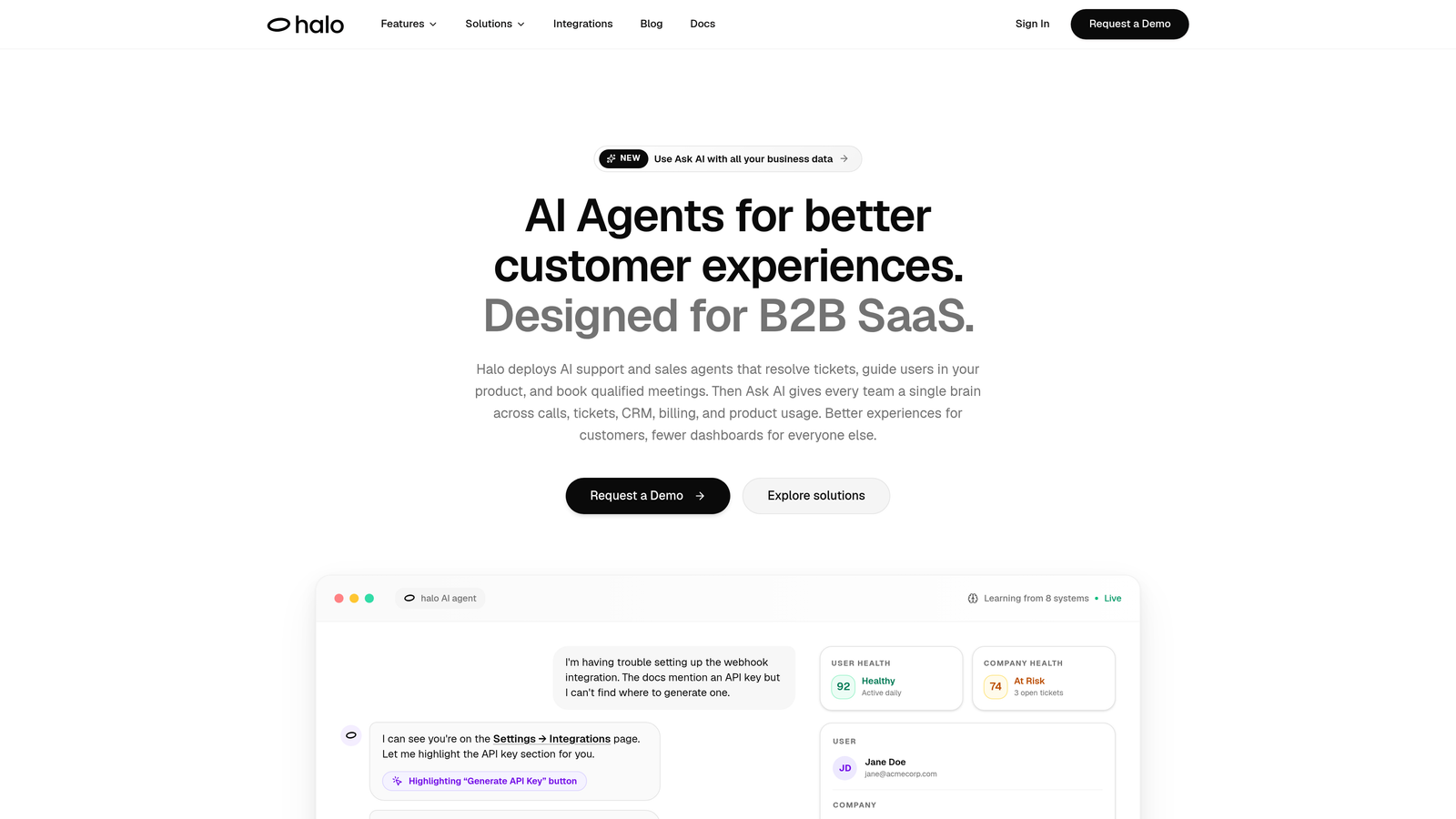
Halo AI is an AI-first customer support platform built specifically for B2B SaaS teams, deploying intelligent agents that resolve tickets, guide users visually through your product, and surface business intelligence signals while learning from every interaction.
Where This Tool Shines
Halo's most distinctive capability is page-aware context. The AI agent actually sees what the user sees on screen, which means it can provide contextual, visual UI guidance rather than generic knowledge base answers. This is a meaningful architectural difference from most support tools, which operate without any awareness of where the user is in your product.
Beyond resolution, Halo functions as a business intelligence layer. Its smart inbox surfaces customer health signals, revenue intelligence, and anomaly detection, giving support and product teams insights that go far beyond standard ticket metrics. For SaaS teams trying to connect support data to churn risk or product friction, this is genuinely differentiated.
Key Features
Page-Aware Chat Widget: Sees what users see in real time and delivers contextual visual guidance tied to the specific product screen they're on.
Autonomous Ticket Resolution: AI agents resolve support tickets end-to-end, with smart escalation to human agents when complexity warrants it.
Auto Bug Ticket Creation: Automatically identifies and routes bug reports directly to Linear, removing manual triage from engineering workflows.
Smart Inbox with Business Intelligence: Surfaces customer health signals, revenue intelligence, and anomaly detection beyond standard support analytics.
Deep Integration Stack: Bi-directional integrations with Slack, HubSpot, Intercom, Stripe, Zoom, PandaDoc, and Fathom for a fully connected support operation.
Best For
SaaS product teams and B2B companies that want AI-native support architecture rather than an add-on to an existing helpdesk. Particularly strong for teams where bug detection, customer health monitoring, and product-aware guidance are as important as ticket resolution speed.
Pricing
Contact for pricing. Verify current plans and available tiers directly at haloagents.ai.
2. Intercom Fin
Best for: SaaS companies with existing Intercom investment seeking a native AI resolution layer.
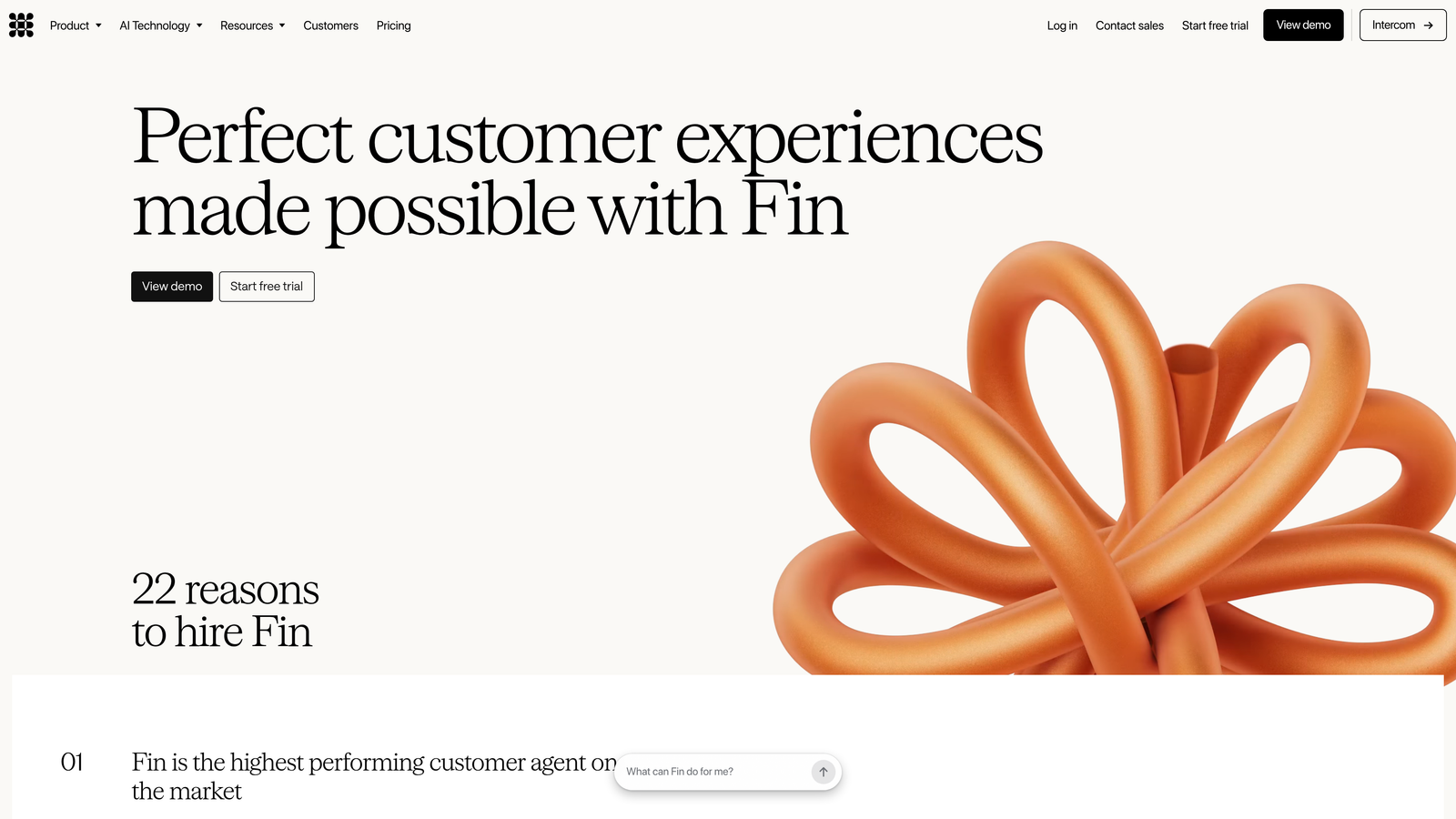
Intercom Fin is Intercom's AI agent product built on large language model technology, natively embedded in the Intercom messenger and inbox experience.
Where This Tool Shines
If your team is already operating inside Intercom's ecosystem, Fin is the path of least resistance to meaningful AI resolution. It doesn't require a separate integration or a new interface for agents. The handoff from Fin to a human agent inside the Intercom inbox is smooth, with context preserved throughout the conversation.
Fin's consumption-based pricing model is worth understanding carefully before committing. You pay per resolution rather than per seat, which can be cost-efficient at high deflection rates but unpredictable if your resolution definition isn't tightly scoped.
Key Features
Native Intercom Integration: Fully embedded in Intercom's messenger and inbox with no separate tooling required for teams already on the platform.
Resolution-Focused AI: Designed to fully resolve conversations, not just deflect them, with seamless handoff to human agents when needed.
Consumption-Based Pricing: Charged per resolution rather than per seat, which aligns cost with actual AI output.
Customizable AI Persona: Adjustable tone and persona settings to match your brand voice across conversations.
Multilingual Support: Handles conversations in multiple languages without requiring separate configuration per language.
Best For
Teams already standardized on Intercom's full suite who want to activate AI resolution without introducing a new vendor. Less compelling for teams not already using Intercom, since the value is closely tied to the existing ecosystem.
Pricing
Consumption-based pricing per resolution. Verify current rates and thresholds at intercom.com.
3. Zendesk AI
Best for: Enterprise support teams already standardized on Zendesk with dedicated admin resources.
Zendesk AI is Zendesk's AI layer spanning its Support, Guide, and Chat products, offering intelligent triage, agent copilot features, and automated workflows for large-scale enterprise support operations.
Where This Tool Shines
Zendesk AI's strength is breadth. It covers the entire support workflow from initial ticket triage through agent response drafting to self-service deflection via Zendesk Guide. For organizations already running Zendesk at scale, activating the AI layer is an extension of existing infrastructure rather than a net-new implementation.
The marketplace integration depth is also notable. With over 1,000 apps in the Zendesk marketplace, enterprise teams can connect AI-assisted support to a wide range of business systems. The trade-off is that AI capabilities are add-ons to core plans, so total cost of ownership can escalate quickly at enterprise tier.
Key Features
Intelligent Ticket Triage: Automatically classifies, prioritizes, and routes incoming tickets based on content and customer attributes.
Agent Copilot: Surfaces suggested macros and response drafts to help agents resolve tickets faster without replacing them.
AI-Powered Self-Service: Deflects common questions through Zendesk Guide with AI-enhanced search and article recommendations.
Marketplace Integrations: Access to 1,000+ app integrations for connecting support data to broader business workflows.
Enterprise Compliance: Robust security certifications and compliance frameworks suited for regulated industries.
Best For
Large enterprise organizations already invested in the Zendesk ecosystem with IT and admin resources to configure and maintain AI features. Teams starting fresh or running lean may find the implementation overhead and add-on pricing structure challenging.
Pricing
AI features are add-ons to core Zendesk plans. Verify current pricing and plan structure at zendesk.com.
4. Freshdesk Freddy AI
Best for: Growing support teams that want AI capabilities without enterprise-level contracts or complexity.
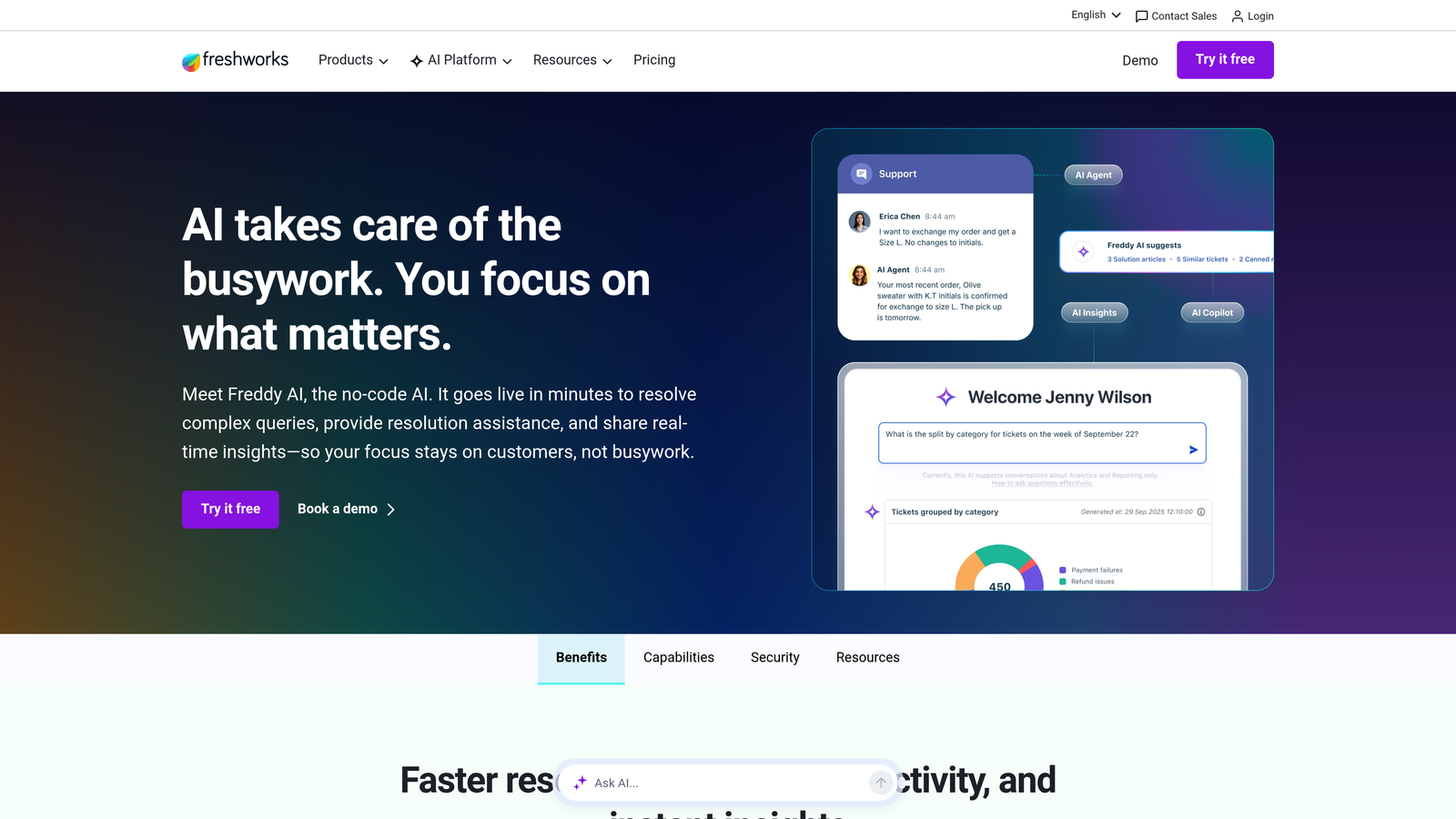
Freshdesk Freddy AI is Freshworks' AI assistant embedded across the Freshdesk customer support suite, covering ticket deflection, agent assist, and analytics at more accessible price points than enterprise-only alternatives.
Where This Tool Shines
Freddy AI's accessibility is its clearest differentiator. It spans three distinct functions: Freddy Self Service handles bot-driven deflection, Freddy Copilot assists agents with response drafting and summarization, and Freddy Insights delivers AI-driven analytics and recommendations. Getting all three without a custom enterprise contract is genuinely uncommon in this market.
The suite also spans beyond support. Freddy AI is embedded across Freshdesk, Freshchat, and Freshservice, which means teams using Freshworks for both customer support and IT service management can maintain a consistent AI layer across both workflows.
Key Features
Freddy Self Service: Bot-driven ticket deflection that handles common questions before they reach a human agent.
Freddy Copilot: Agent-side assist with response drafting, conversation summarization, and knowledge retrieval during live interactions.
Freddy Insights: AI-driven analytics that surface recommendations and patterns across support data.
Cross-Suite Coverage: Embedded across Freshdesk, Freshchat, and Freshservice for consistent AI capabilities across customer and IT support workflows.
Accessible Pricing Tier: AI features included in higher Freshdesk tiers without requiring separate enterprise contracts.
Best For
Mid-market teams and growing companies that want meaningful AI across deflection, agent assist, and analytics without the procurement complexity of enterprise-only vendors. Also a strong fit for organizations already using Freshworks products across multiple departments.
Pricing
Included in higher Freshdesk tiers. Verify current plan details at freshworks.com.
5. Tidio
Best for: E-commerce and small business teams that need fast deployment with minimal technical overhead.
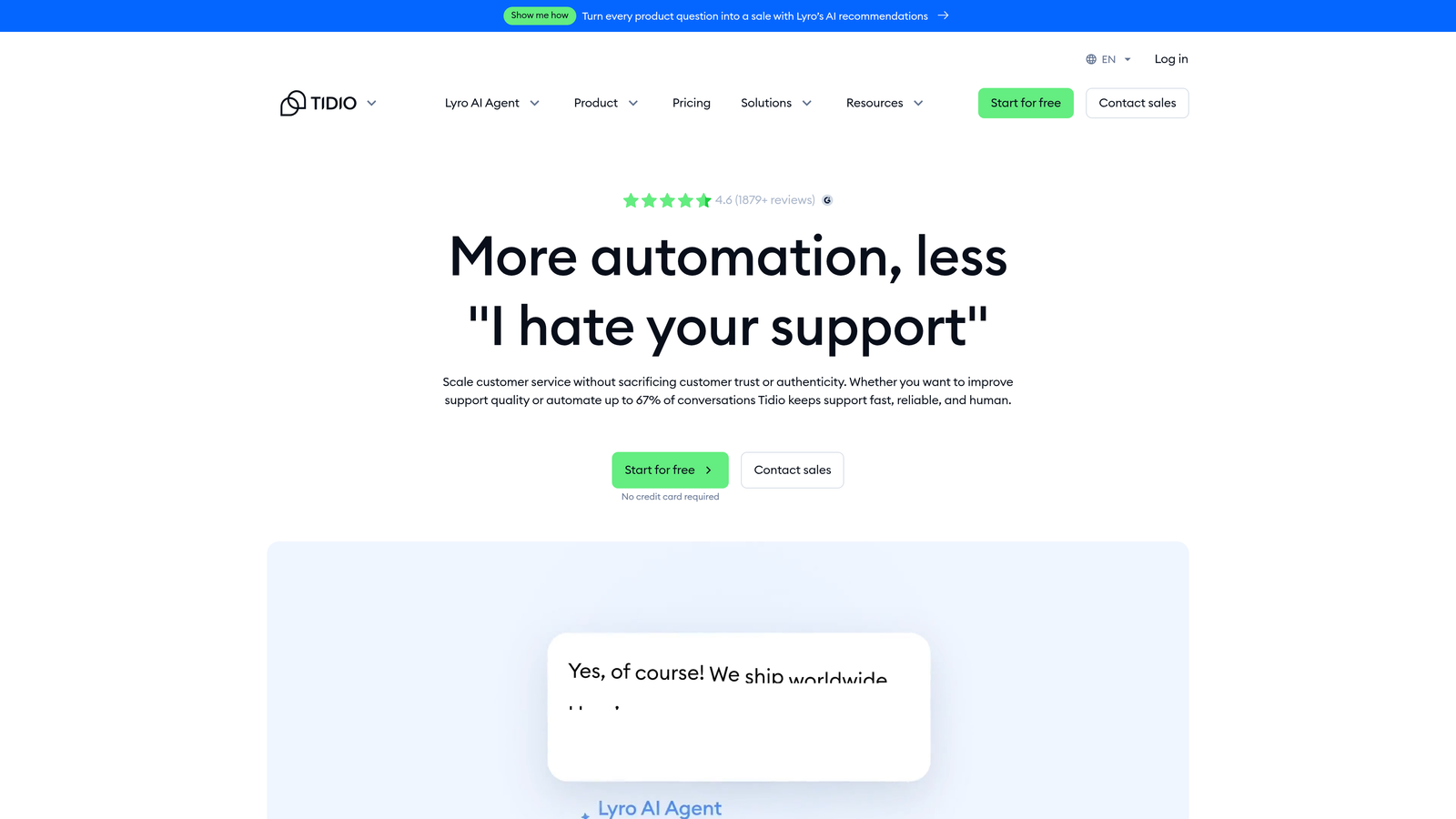
Tidio is a live chat and AI support platform featuring Lyro AI, designed for quick deployment with strong e-commerce integrations and a visual flow builder accessible to non-technical teams.
Where This Tool Shines
Tidio's deployment speed is genuinely fast for straightforward use cases. Teams with existing documentation and a clear set of common questions can be operational within hours rather than weeks. The visual flow builder means non-technical customer support managers can build and adjust conversation flows without engineering involvement.
The Shopify and WooCommerce integrations are native and well-developed, making Tidio a natural fit for e-commerce teams. The platform is less optimized for complex B2B SaaS support scenarios with multi-system integrations and technical troubleshooting workflows.
Key Features
Lyro AI: Automated conversation resolution that handles common questions across chat channels without human intervention.
Visual Flow Builder: No-code conversation design tool that non-technical team members can operate and iterate on independently.
E-Commerce Integrations: Native Shopify and WooCommerce integrations for order status, product questions, and customer data access.
Multi-Channel Support: Covers live chat, email, and Messenger within a single platform interface.
Free Tier Available: Entry-level access without a paid commitment, useful for teams evaluating before scaling.
Best For
E-commerce businesses and small teams with high chat volume and straightforward support queries. Less suited for B2B SaaS teams that need deep CRM integrations, complex escalation logic, or business intelligence beyond conversation metrics.
Pricing
Free tier available; paid plans from approximately $29/month. Verify current pricing and tier details at tidio.com.
6. Forethought
Best for: Enterprise teams that want AI triage and routing layered onto an existing helpdesk without replacing it.
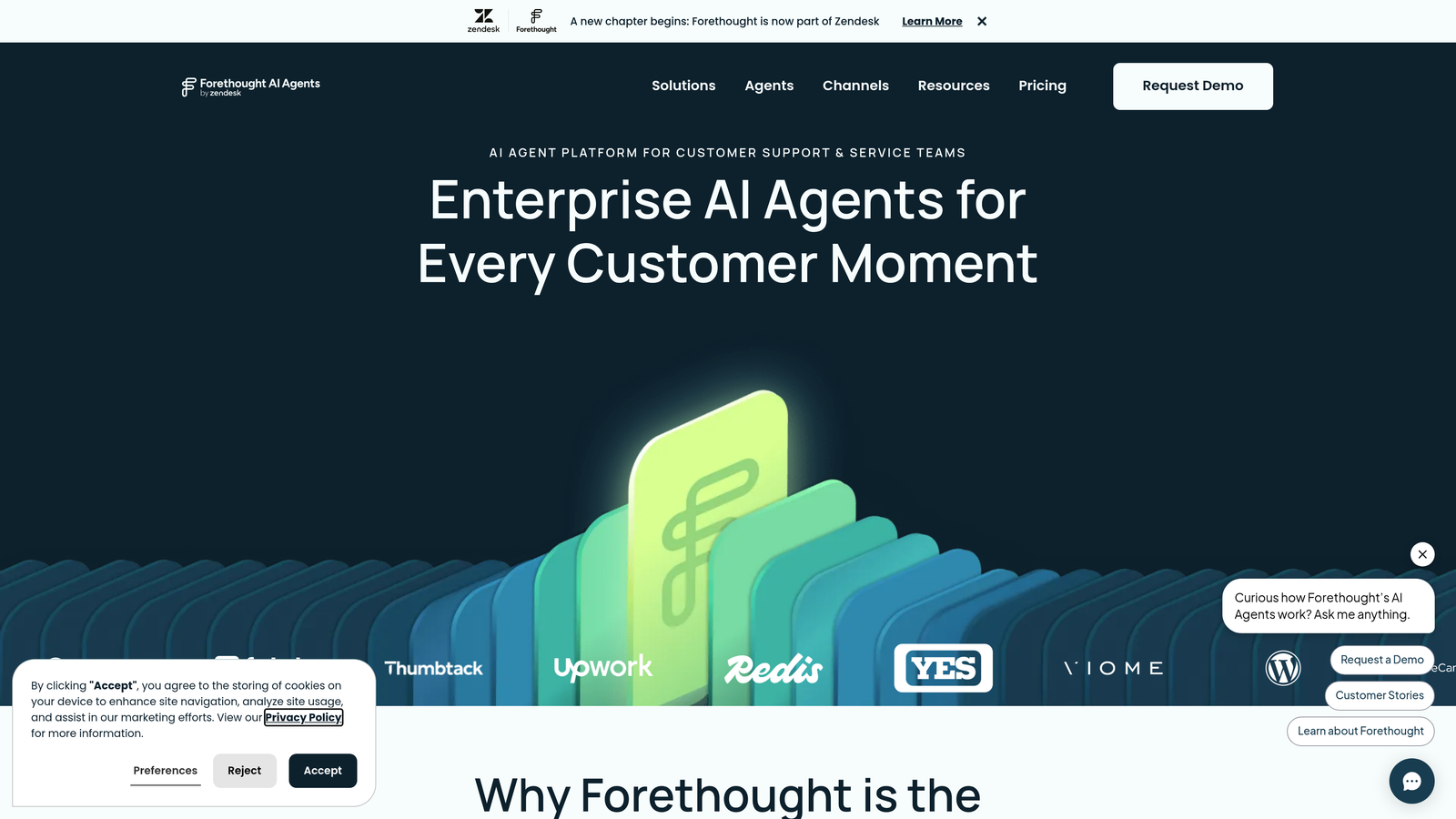
Forethought is an enterprise AI platform specializing in ticket triage, intelligent routing, and agent assist, designed to augment existing helpdesks rather than serve as a standalone support system.
Where This Tool Shines
Forethought's architecture is deliberately additive. Rather than asking you to migrate off Zendesk or Salesforce Service Cloud, it layers intelligent classification, routing, and agent assistance on top of your existing investment. For enterprise teams with years of historical ticket data and established workflows, this is often the more practical path to AI capabilities.
The three-product structure (Solve, Triage, Assist) lets teams adopt components incrementally rather than committing to full platform replacement. This modular approach reduces implementation risk for large organizations where a single failed deployment can set AI adoption back significantly.
Key Features
Solve: AI-powered ticket deflection and self-service that resolves common questions before they reach the queue.
Triage: Intelligent ticket classification and routing that directs incoming tickets to the right team or agent automatically.
Assist: Agent copilot with suggested responses and knowledge retrieval surfaced during active conversations.
Helpdesk Integrations: Designed to integrate with Zendesk, Salesforce Service Cloud, and other enterprise helpdesk platforms.
Enterprise Security: Security and compliance features suited for regulated industries and large enterprise procurement requirements.
Best For
Large enterprises with existing helpdesk investments that want to add AI capabilities incrementally without a platform migration. Less compelling for teams starting fresh or for companies that want a single unified AI-native platform.
Pricing
Custom enterprise pricing. Contact Forethought directly at forethought.ai for current rates.
7. Help Scout
Best for: Teams where brand voice, human empathy, and agent experience are primary support differentiators.
Help Scout is a human-first customer support platform with AI assist features designed to accelerate agents rather than replace them, with a clean shared inbox experience and transparent per-user pricing.
Where This Tool Shines
Help Scout's positioning is intentionally different from most tools on this list. It treats AI as an agent accelerator, not an autonomous resolver. If your support philosophy centers on human empathy and brand voice as competitive differentiators, Help Scout's AI features (summarization, draft suggestions, self-service deflection) are designed to make your agents faster without changing the fundamental character of your support experience.
The pricing model is also a meaningful differentiator. Per-user pricing with no consumption-based components means predictable costs as your volume scales. For teams burned by unexpected bills from resolution-based pricing models, this is genuinely appealing.
Key Features
AI Summarize: Instant conversation summaries that bring agents up to speed on long threads without reading the full history.
AI Drafts: Suggested reply drafts based on conversation context, which agents can edit and send rather than writing from scratch.
AI Answers: Self-service deflection through the Docs knowledge base, reducing inbound volume for common questions.
Shared Inbox UX: Clean, minimal interface with strong collaboration tools including collision detection and internal notes.
Transparent Pricing: Per-user pricing with no consumption-based surprises, making cost predictable at scale.
Best For
Companies where the quality of human support interactions is a brand differentiator, and where the goal is agent efficiency rather than autonomous resolution. Also strong for teams that prioritize pricing predictability over maximum deflection rates.
Pricing
Plans from approximately $22/user/month. Verify current pricing and plan details at helpscout.com.
8. Ada
Best for: Enterprise CX teams needing multi-channel, multilingual AI deployment without engineering resources.
Ada is a no-code AI agent builder for enterprise CX teams, enabling multi-channel deployment with strong multilingual support and enterprise-grade security controls.
Where This Tool Shines
Ada's core value proposition is giving non-technical CX teams the ability to build, deploy, and iterate on AI conversation flows without waiting on engineering. The no-code design environment means CX managers can respond to new product changes, policy updates, or seasonal support patterns quickly and independently.
The multilingual capabilities are among the strongest in this category. For enterprise teams supporting customers across multiple regions and languages, Ada's ability to handle dozens of languages without requiring separate conversation flows per language is a real operational advantage.
Key Features
No-Code Conversation Design: Visual tools that let non-technical CX teams build and modify AI conversation flows without engineering support.
Multi-Channel Deployment: Deploy across web, mobile, SMS, and messaging apps from a single configuration environment.
Multilingual Support: Handles conversations across dozens of languages, suited for global enterprise support operations.
Enterprise Security Controls: Access controls, compliance frameworks, and security features designed for large enterprise procurement requirements.
AI-Powered Coaching: Built-in tools to analyze and improve agent conversation performance over time.
Best For
Global enterprise CX teams with multi-channel, multilingual support requirements and non-technical team members who need to own conversation design. Less suited for small teams or companies that don't require multi-language or multi-channel complexity.
Pricing
Custom enterprise pricing. Contact Ada directly at ada.cx for current rates.
9. Kustomer
Best for: B2C and D2C companies where full customer relationship history informs every support interaction.
Kustomer is a CRM-native customer service platform that unifies the complete customer timeline with support interactions, with AI features that operate with full awareness of the customer relationship.
Where This Tool Shines
Kustomer's differentiation is the unified customer timeline. Rather than treating each support conversation in isolation, Kustomer surfaces the full customer history: purchase records, previous interactions, lifetime value, and behavioral attributes, all in the same view as the current conversation. For support teams where context about the customer's relationship with your business changes how you respond, this architecture is genuinely useful.
The AI features in Kustomer operate with that same context awareness. Routing, deflection, and workflow automation can be triggered by customer attributes and behavior patterns, not just the content of the current message. This is particularly valuable for B2C and D2C companies with complex customer histories and tiered service models.
Key Features
Unified Customer Timeline: Combines CRM data, purchase history, and support interaction history in a single agent view.
AI-Powered Routing and Deflection: Routes and deflects conversations with awareness of full customer relationship data, not just message content.
Omnichannel Support: Covers email, chat, SMS, social, and voice channels within a single unified platform.
Behavior-Triggered Workflows: Automated workflows that activate based on customer attributes, purchase history, and behavioral signals.
CRM-Informed AI: AI features that use complete customer relationship context to inform routing, prioritization, and response recommendations.
Best For
B2C and D2C companies with complex customer histories where purchase data, lifetime value, and behavioral context are essential inputs to support decisions. Less optimized for B2B SaaS teams or companies where customer relationships are primarily product-driven rather than transaction-driven.
Pricing
Enterprise pricing model. Verify current plans and tier details at kustomer.com.
Matching the Right Tool to Your Situation
Nine platforms is a lot to evaluate. Here's a quick-reference guide based on the most common buying scenarios.
B2B SaaS startup building AI-native support: Halo AI is the strongest fit. Page-aware context, autonomous resolution, bug ticket automation, and business intelligence signals are built for product-led SaaS teams, not retrofitted onto a legacy helpdesk architecture.
Enterprise team already on Zendesk or Salesforce: Forethought or Zendesk AI are the practical paths. Both are designed to augment existing infrastructure rather than replace it, which matters when you have years of historical data and established workflows tied to a platform.
E-commerce or high-volume B2C: Tidio works well for straightforward e-commerce support with fast deployment needs. Kustomer is the stronger choice when customer purchase history and lifetime value need to inform every support interaction.
Teams where human empathy is the differentiator: Help Scout's deliberate positioning as an agent accelerator rather than a replacement is exactly right for companies where brand voice and human connection are competitive advantages.
Global enterprise with multilingual requirements: Ada's no-code multi-channel deployment and multilingual capabilities are purpose-built for this scenario.
The most important question to ask any vendor isn't about features. It's about architecture: is this platform built AI-first, or is AI bolted onto a system designed for human agents? That distinction determines how fast you'll see results and how much the system will improve over time.
Your support team shouldn't scale linearly with your customer base. Let AI agents handle routine tickets, guide users through your product, and surface business intelligence while your team focuses on complex issues that need a human touch. See Halo in action and discover how continuous learning transforms every interaction into smarter, faster support.