9 Best AI Support Software to Buy in 2026
A practical buyer's guide evaluating nine leading platforms to help you confidently buy AI support software in 2026, comparing automation depth, integrations, learning capabilities, and real pricing across tools built for B2B SaaS teams, product-focused organizations, and growth-stage companies building support infrastructure from scratch.
 Matt PattoliFounder13 min read
Buying AI support software is no longer a "nice to have" decision. It's a competitive necessity. But with dozens of platforms claiming to automate tickets, deflect queries, and delight customers, knowing which one actually fits your stack and your team is harder than it looks.
This guide cuts through the noise. We evaluated nine leading AI support platforms on depth of automation, integration ecosystem, learning capabilities, and total cost of ownership, not just feature checklists. Whether you're a B2B SaaS team drowning in Zendesk tickets, a product team that wants smarter escalation, or a growth-stage company building support infrastructure from scratch, there's a right tool for your situation.
Each entry covers what the platform does best, who it's built for, and honest pricing context so you can make a confident purchase decision. Let's get into it.
1. Halo AI
Best for: B2B SaaS and product teams wanting AI-native support with business intelligence built in.
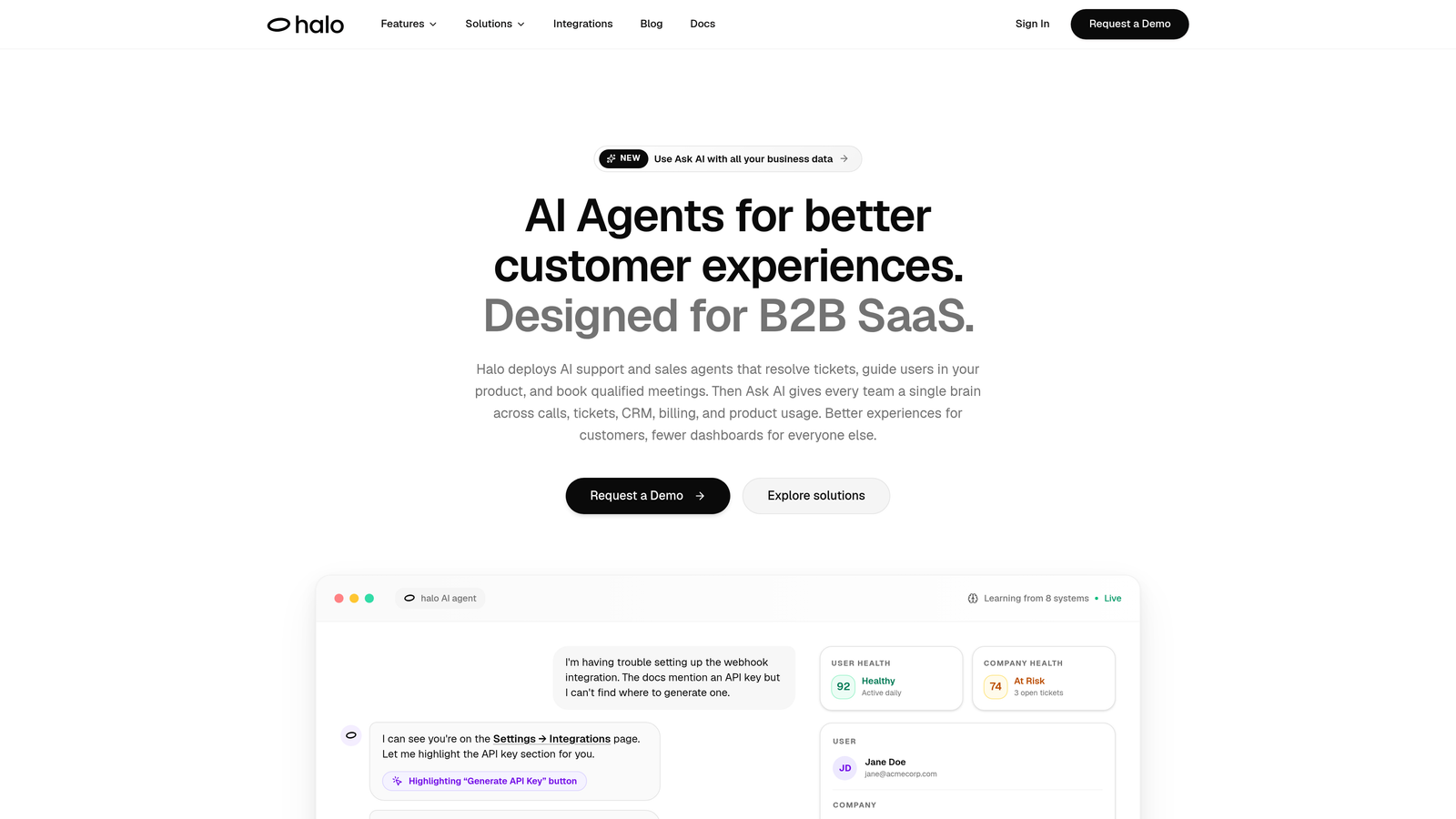
Halo AI is an AI-native customer support platform built around autonomous agents, continuous learning, and deep integrations with the modern B2B tech stack.
Where This Tool Shines
What separates Halo from most platforms on this list is that it wasn't built as an AI layer on top of an existing helpdesk. It was designed from the ground up around autonomous agents. That architectural difference shows up in features that competitors simply don't offer, particularly the page-aware chat widget that gives the AI the same view your user has on screen, enabling genuinely contextual guidance rather than generic FAQ responses.
The smart inbox is another standout. Rather than just organizing tickets, it surfaces business intelligence signals: customer health indicators, anomaly detection, and revenue-relevant patterns that feed back into product and sales decisions. Support stops being a cost center and starts generating strategic insight.
Key Features
Page-Aware Chat Widget: The AI sees what the user sees on screen, enabling contextual, step-by-step guidance without the user needing to describe their problem.
Intelligent AI Agents: Resolve tickets autonomously and continuously learn from every interaction, improving accuracy over time without manual retraining.
Smart Inbox with Business Intelligence: Goes beyond ticket management to surface customer health signals, anomaly detection, and revenue insights for product and leadership teams.
Auto Bug Ticket Creation: Automatically generates and routes bug reports to Linear or Jira, closing the loop between support and engineering without manual handoffs.
Live Agent Handoff: Escalates to human agents with full conversation context preserved, so customers never have to repeat themselves.
Deep B2B Integrations: Connects natively with Linear, Slack, HubSpot, Intercom, Stripe, Zoom, PandaDoc, and Fathom.
Best For
B2B SaaS companies and product teams that want AI support with genuine autonomy, not just a chatbot with canned responses. Particularly strong for teams that want support data to inform product decisions and revenue conversations, not just close tickets.
Pricing
Contact for pricing. Enterprise and growth plans are available at haloagents.ai. Custom quotes based on team size and integration needs.
2. Intercom
Best for: SaaS companies wanting a mature, all-in-one conversational support and messaging platform.
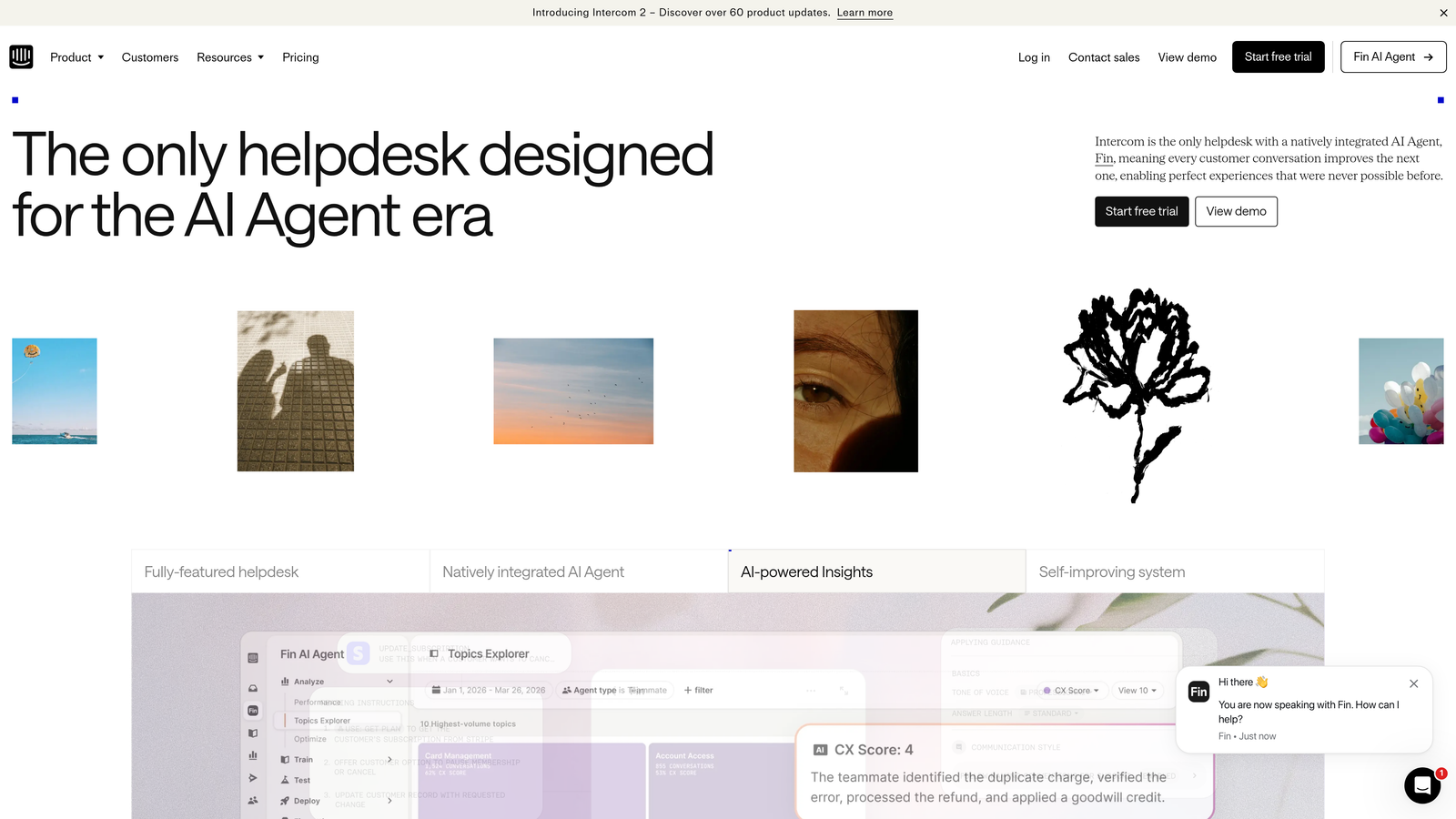
Intercom is one of the most widely adopted conversational support platforms in SaaS, featuring the Fin AI agent built on large language models and trained on your existing help center content.
Where This Tool Shines
Intercom's strength is its maturity and ecosystem. The Fin AI agent can autonomously resolve queries by drawing on your existing documentation, which means teams with well-maintained help centers can get meaningful deflection without extensive setup. The unified inbox, combining AI, live chat, and email in one place, is genuinely well-executed.
The tradeoff is that Intercom's AI capabilities are largely contained within the Intercom ecosystem. Teams with complex multi-tool stacks may find integration depth limited compared to newer AI-native platforms. Pricing can also escalate quickly at scale, particularly with Fin's per-resolution billing model.
Key Features
Fin AI Agent: Autonomous ticket resolution trained on your help center content, powered by large language models.
Unified Inbox: Combines AI-handled conversations, live chat, and email into a single agent workspace.
AI Copilot: Real-time agent assist with suggested replies and knowledge base surfacing during live conversations.
Workflows Automation Builder: Visual builder for routing, escalation, and automation logic without coding.
App Marketplace: Over 300 integrations covering CRM, billing, analytics, and productivity tools.
Best For
SaaS companies already invested in the Intercom ecosystem or teams prioritizing a polished messenger experience with solid AI augmentation. Less ideal for teams needing deep custom integrations outside Intercom's marketplace.
Pricing
Base plans start around $39 per seat per month; Fin AI is billed per resolution. Pricing can compound at volume, so verify current tiers at intercom.com before projecting costs.
3. Zendesk AI
Best for: Enterprise organizations with established Zendesk workflows needing AI layered across triage, agents, and self-service.
Zendesk AI is the AI capability layer embedded across the Zendesk Suite, covering intelligent triage, agent assist, generative reply drafting, and CSAT prediction.
Where This Tool Shines
Zendesk AI is purpose-built for organizations that already live inside Zendesk and want AI to enhance, not replace, their existing workflows. Intelligent triage with intent, sentiment, and language detection means tickets get to the right team faster. CSAT prediction is a particularly useful feature for proactively flagging interactions that are trending toward a poor outcome before they close.
The caveat is that Zendesk AI is an add-on layer, not an AI-native architecture. Teams looking for autonomous resolution at scale may find the base AI capabilities more assistive than autonomous, with deeper automation requiring the separately priced Advanced AI add-on.
Key Features
Intelligent Triage: Automatically detects intent, sentiment, and language to route tickets accurately without manual categorization.
Macro Suggestions and Ticket Summarization: Surfaces relevant macros and generates summaries to reduce agent handling time.
Generative AI for Agents: Drafts replies and knowledge base articles based on ticket context and existing documentation.
CSAT Prediction: Flags at-risk interactions proactively so teams can intervene before a negative outcome is locked in.
Advanced AI Add-On: Deeper automation capabilities for organizations needing higher containment rates beyond the base suite.
Best For
Enterprise teams already on Zendesk with complex SLA requirements, compliance needs, and large agent workforces. Not the right first choice for teams starting fresh or looking for AI-native architecture.
Pricing
Base plans start around $55 per agent per month; the Advanced AI add-on is priced separately. Confirm current pricing at zendesk.com.
4. Freshdesk Freddy AI
Best for: SMBs and growing teams wanting accessible AI support features without enterprise-level pricing.
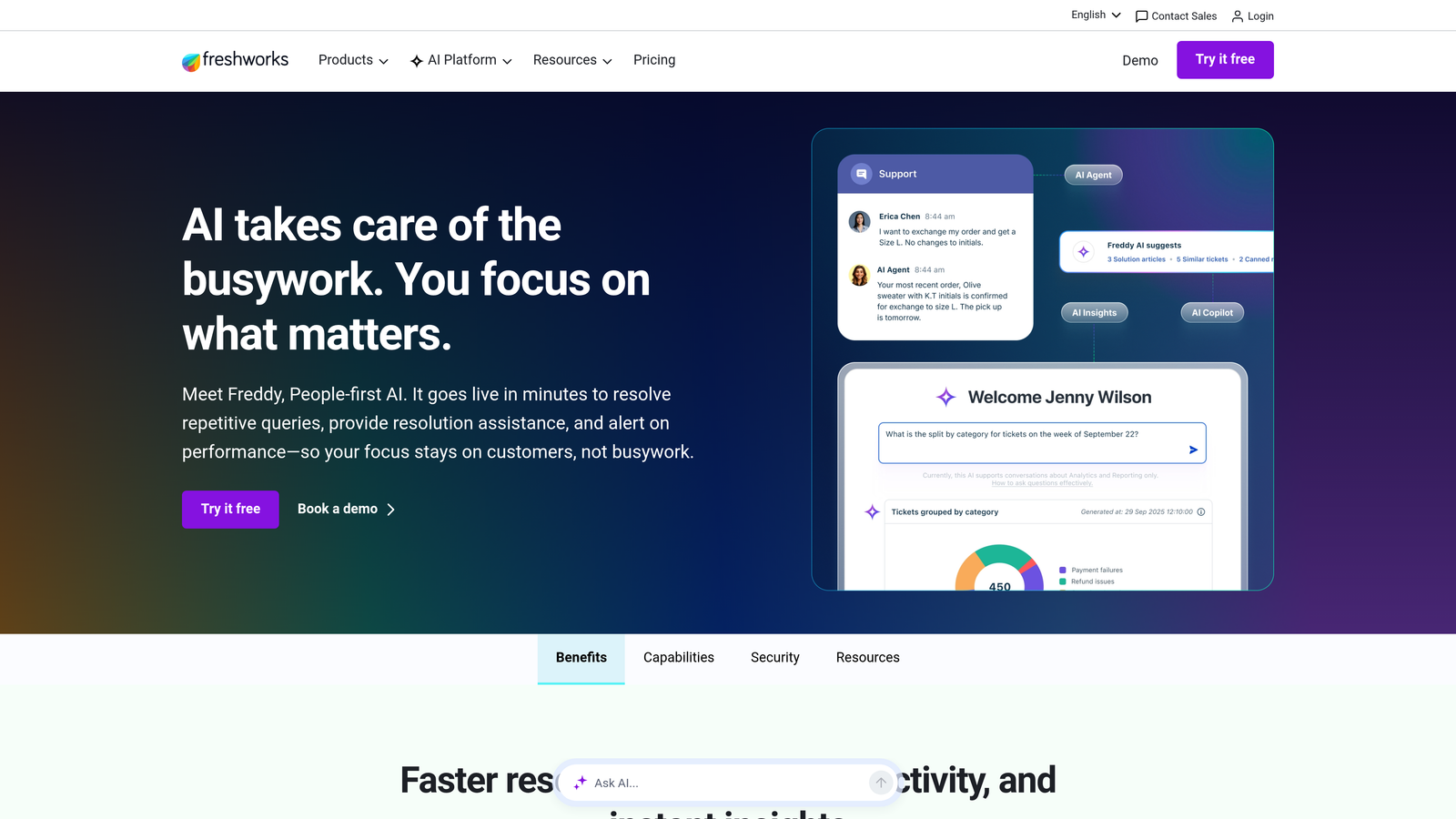
Freshdesk Freddy AI is Freshworks' AI layer across the Freshdesk platform, offering both agent-assist capabilities through Freddy Copilot and autonomous customer-facing resolution through Freddy Self Service.
Where This Tool Shines
Freshdesk's value proposition has always been accessible pricing with solid functionality, and Freddy AI extends that reputation into the AI era. Freddy Copilot gives agents real-time suggestions, ticket summaries, and draft replies without requiring significant setup. Freddy Self Service handles end-user queries autonomously, reducing ticket volume for common questions.
The platform's tiered pricing means teams can adopt AI features incrementally, which is useful for organizations that aren't ready to commit to a full AI-native overhaul. The built-in Freddy Insights analytics layer also surfaces support trends without requiring a separate BI tool.
Key Features
Freddy Copilot: Real-time agent assistance with suggested replies, ticket summaries, and draft generation during live interactions.
Freddy Self Service: Autonomous handling of end-user queries to reduce inbound ticket volume.
AI-Powered Categorization: Automatic ticket categorization and priority assignment based on content and context.
Freddy Insights: Built-in analytics for detecting support trends and identifying recurring issues across the ticket queue.
Tiered Availability: Freddy AI features scale across pricing tiers, making entry-level AI accessible without committing to top-tier plans.
Best For
SMBs, startups, and growing support teams that want meaningful AI capabilities without enterprise pricing. Strong fit for teams already using other Freshworks products.
Pricing
Freshdesk offers a free plan; paid plans start around $15 per agent per month with Freddy features scaling by tier. Verify current plan structure at freshworks.com.
5. Tidio
Best for: E-commerce brands needing fast-deploying AI chat with native Shopify and WooCommerce integration.
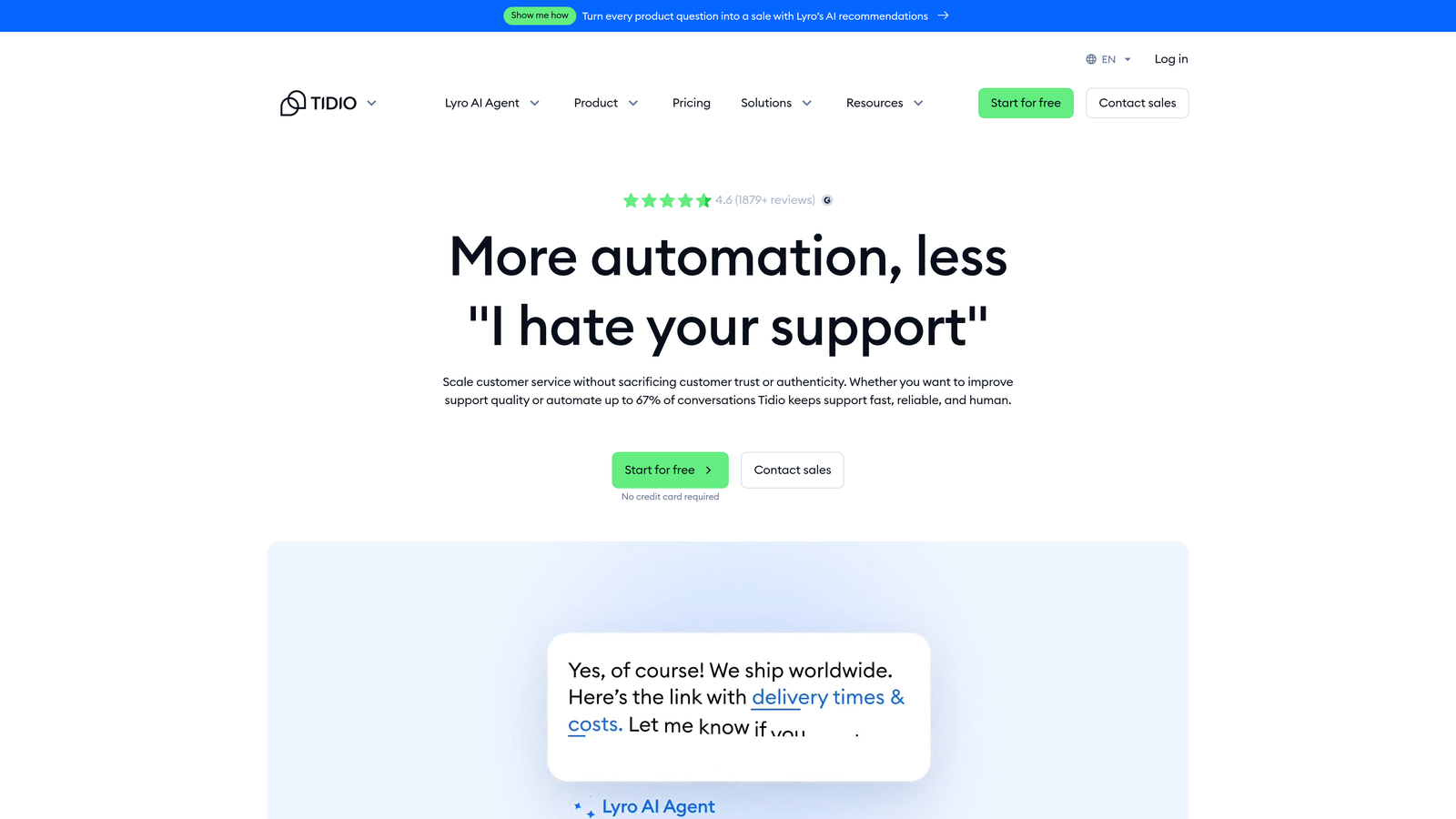
Tidio is a live chat and AI chatbot platform built for e-commerce, featuring the Lyro AI agent for automated resolution of common customer queries.
Where This Tool Shines
Tidio's biggest advantage is speed to value. Most teams can have Lyro live and handling queries within hours, not weeks. For e-commerce brands dealing with high volumes of repetitive questions around order status, returns, and shipping, that fast deployment translates directly into deflection without a lengthy implementation project.
Native Shopify and WooCommerce integrations mean Lyro can access order data to give customers real answers, not just point them to a FAQ page. The tradeoff is that Tidio is optimized for consumer-facing, high-volume, lower-complexity queries. B2B teams with nuanced support workflows or deep integration needs will likely find it limiting.
Key Features
Lyro AI Chatbot: Automated resolution of common customer queries with conversational, context-aware responses.
Native E-Commerce Integrations: Direct connections to Shopify and WooCommerce for order data access during conversations.
Agent Takeover: Live chat handoff for complex issues that exceed Lyro's resolution capability.
Pre-Built Automation Flows: Ready-made flows for order status, FAQs, and lead capture to accelerate deployment.
Fast Deployment: Typically live within hours, making it one of the lowest time-to-value options on this list.
Best For
E-commerce brands on Shopify or WooCommerce with high volumes of repetitive customer queries. Not well-suited for complex B2B support environments or teams requiring deep CRM and product tool integrations.
Pricing
Free plan available; Lyro AI starts around $29 per month. Check tidio.com for current plan tiers and usage limits.
6. Drift (Salesloft)
Best for: B2B companies where support chat and sales qualification happen in the same channel.
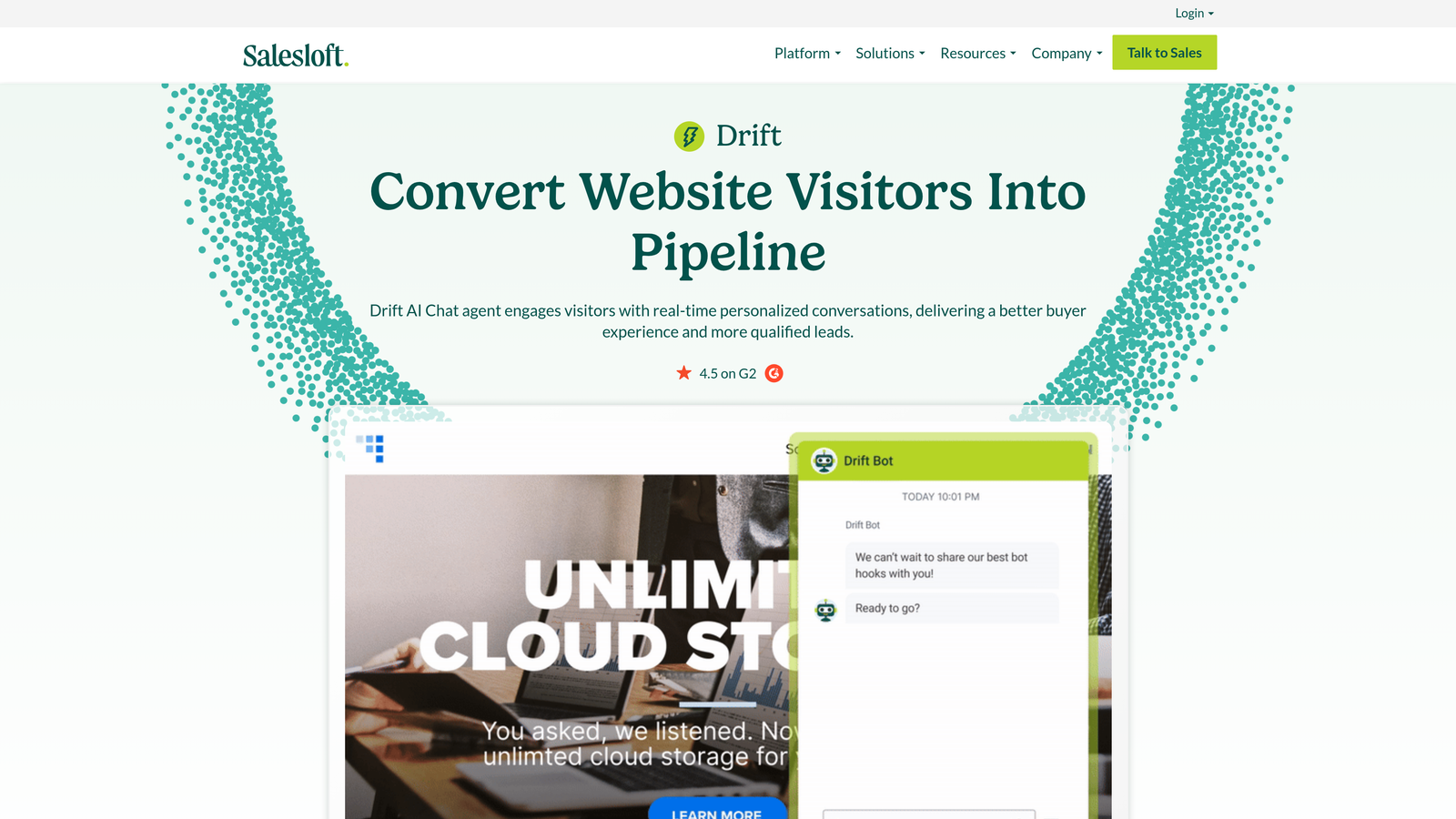
Drift, now part of the Salesloft revenue platform, is a conversational platform that blends AI-powered support handling with sales qualification and pipeline acceleration.
Where This Tool Shines
Drift's unique position is that it serves two masters: support and sales. For B2B companies where a support conversation can quickly become a renewal conversation or an upsell opportunity, having AI that can qualify intent and route accordingly is genuinely valuable. The integration with Salesforce, HubSpot, Marketo, and the broader Salesloft platform makes it a natural fit for revenue-focused teams.
The caveat is that Drift is not a pure-play support automation tool. Teams looking for deep ticket resolution, knowledge base deflection, or sophisticated support analytics will find it less capable than dedicated support platforms. Its strength is at the intersection of support and pipeline, not deep within either.
Key Features
AI Conversations: Automated chat handling across both support and sales qualification scenarios in a unified interface.
Intent-Based Routing: Identifies high-value visitors and routes them to sales reps based on behavioral signals.
Meeting Scheduling: Built-in qualification and calendar booking directly within chat flows, removing friction from the sales process.
Revenue Platform Integrations: Native connections to Salesforce, HubSpot, Marketo, and Salesloft for full funnel visibility.
Playbooks: Pre-built automation sequences for common support and sales scenarios.
Best For
B2B companies using Salesloft or those where support and sales qualification share the same front door. Less suited to teams whose primary need is autonomous ticket resolution or deep support analytics.
Pricing
Custom pricing. Contact Drift or Salesloft directly for current plans at drift.com.
7. Ada
Best for: Enterprise organizations needing high-containment AI automation with action-based capabilities across complex workflows.
Ada is an enterprise no-code AI automation platform known for high containment rates and action-based AI that can execute transactions and lookups, not just answer questions.
Where This Tool Shines
Ada's differentiator is that its AI doesn't just respond, it acts. Where many chatbots retrieve information from a knowledge base, Ada's action-based AI can perform lookups, trigger updates, and complete transactions via integrations. For industries like telecom, fintech, and retail where customers need to do things, not just learn things, that's a meaningful capability gap over conversational-only platforms.
The no-code builder makes it accessible to CX teams without engineering resources, though large-scale deployments typically benefit from implementation support. Ada is built for volume and complexity, which means smaller teams may find it over-engineered for their needs.
Key Features
Action-Based AI: Executes real tasks including lookups, account updates, and transactions via integrations, going beyond information retrieval.
No-Code Builder: Non-technical CX teams can build and modify automation flows without developer involvement.
Multilingual Support: Handles customer interactions across dozens of languages for global deployments.
Enterprise Integrations: Deep connections with Salesforce, Zendesk, ServiceNow, and other enterprise platforms.
Containment Reporting: Robust analytics focused on resolution rates and containment, the metrics enterprise buyers care about most.
Best For
Large enterprises in telecom, fintech, and retail with high interaction volumes and a need for AI that can take action on customer requests, not just answer them. Implementation investment is typically required.
Pricing
Enterprise pricing with custom quotes. Generally positioned for larger organizations. See ada.cx for details.
8. Kustomer
Best for: Subscription, DTC, and marketplace businesses where complete customer context drives support quality.
Kustomer is a CRM-native customer service platform with AI built around a unified customer timeline, combining orders, interactions, and events in a single view for every support conversation.
Where This Tool Shines
Kustomer's core insight is that support quality is directly tied to context. When an agent or AI can see a customer's full history, every order, every previous interaction, every subscription event, the conversation starts from a completely different place. For businesses where customer lifetime value is high and context is everything, that unified timeline is a genuine operational advantage.
AI-powered routing and conversation summarization layer on top of that context, ensuring agents spend less time reading history and more time resolving issues. Proactive outreach capabilities based on customer data triggers add a dimension most pure-play helpdesks don't offer.
Key Features
Unified Customer Timeline: Every order, interaction, and event consolidated in a single view, giving AI and agents complete context from the first message.
AI-Powered Routing and Summarization: Intelligent conversation routing and automatic summarization to reduce agent ramp-up time per ticket.
Proactive Outreach: Automation that triggers outreach based on customer data events, enabling proactive support before issues escalate.
Omnichannel Support: Handles chat, email, SMS, and social channels within the same unified workspace.
Data-Driven Automation: Workflow triggers built on customer attributes, behavioral signals, and order data.
Best For
Subscription businesses, DTC brands, and marketplace operators where customer history and lifetime value are central to support strategy. Strong fit for teams that find traditional helpdesks too ticket-centric and context-poor.
Pricing
Starts around $89 per user per month. Verify current pricing at kustomer.com.
9. Chatbase
Best for: Technical teams wanting a lightweight, customizable AI agent trained on their own documentation without a full enterprise platform.
Chatbase is a developer-friendly tool for building custom GPT-powered AI agents trained on your own documentation, URLs, PDFs, or plain text.
Where This Tool Shines
Chatbase occupies a different category from most tools on this list. It's not an enterprise support platform; it's a flexible building block. If your team has solid documentation and wants a custom AI agent that reflects your specific knowledge base, Chatbase lets you get there quickly without the overhead of a full platform implementation.
The API access and embeddable widget make it genuinely versatile. Technical teams can integrate it into existing workflows, customize the experience to match their brand, and use analytics on unanswered questions to identify documentation gaps. The tradeoff is that it requires more technical ownership than a turnkey platform and lacks the enterprise features like SLA management, advanced routing, or business intelligence that larger teams need.
Key Features
Custom AI Agent Training: Train your agent on docs, PDFs, URLs, or plain text in minutes, with multi-source knowledge base support.
Embeddable Chat Widget: Deploy a branded chat widget on any website or product interface with minimal setup.
API Access: Full API for custom integrations and embedding Chatbase capabilities into existing workflows and products.
Conversation Analytics: Tracks conversation patterns and flags unanswered questions to highlight knowledge base gaps.
Branding Customization: Adjust the widget appearance to match your product or brand without design resources.
Best For
Technical teams, developers, and startups wanting a customizable, lightweight AI agent without committing to a full enterprise support platform. Best suited to teams with strong existing documentation and the technical capacity to manage the integration.
Pricing
Free plan available; paid plans start around $19 per month. Check chatbase.co for current tiers and usage limits.
Which Tool Is Right for Your Situation?
The right AI support software depends less on feature lists and more on where you are, what you're building, and what your customers actually need from a support interaction.
For enterprise teams with established workflows and compliance requirements, Zendesk AI and Ada are the natural anchors. Zendesk extends what you already have; Ada brings action-based automation at scale for high-volume, transaction-heavy environments.
For SMBs and growing teams watching budget carefully, Freshdesk Freddy AI offers the most accessible entry point into meaningful AI support features without enterprise pricing. Tidio wins for e-commerce brands on Shopify or WooCommerce that need fast deployment over deep customization.
For B2B SaaS companies that want support to do more than close tickets, Halo AI stands apart. The combination of page-aware context, continuous learning, auto bug ticket creation, and a smart inbox that surfaces business intelligence signals makes it the strongest fit for product teams that want support data to inform decisions beyond the support queue. It's AI-native architecture rather than a bolt-on, and that difference compounds over time as the agents learn from every resolved interaction.
For teams at the intersection of support and sales, Drift within the Salesloft ecosystem handles qualification and routing across both functions without requiring separate tools. Kustomer is the right call for subscription and DTC businesses where customer lifetime context drives support quality.
Your support team shouldn't scale linearly with your customer base. Let AI agents handle routine tickets, guide users through your product, and surface business intelligence while your team focuses on complex issues that need a human touch. See Halo in action and discover how continuous learning transforms every interaction into smarter, faster support.