9 Best AI Support Software for SaaS Companies in 2026
This guide ranks the 9 best platforms to buy AI support software for SaaS in 2026, evaluating each on automation depth, SaaS-specific integrations, and end-to-end ticket resolution. Whether you're a lean startup or a high-volume growth-stage team, it pinpoints the right tool to scale customer support without scaling headcount.
 Matt PattoliFounder13 min read
SaaS teams are under pressure to scale support without scaling headcount, and AI support software has become the practical answer. But not all tools are built the same. Some bolt AI onto legacy helpdesk infrastructure; others are built AI-first from the ground up.
This guide covers the best AI support software platforms purpose-built (or well-suited) for SaaS businesses, whether you're a lean startup handling your first support queue or a growth-stage team managing thousands of tickets a month. We evaluated each tool on automation depth, SaaS-specific integrations, learning capabilities, and how well it handles the full support lifecycle from first contact to resolution and escalation.
If you're ready to stop drowning in tickets and start delivering faster, smarter support, here's where to start.
1. Halo AI
Best for: SaaS product teams that want AI-first support with deep toolchain integrations and business intelligence.
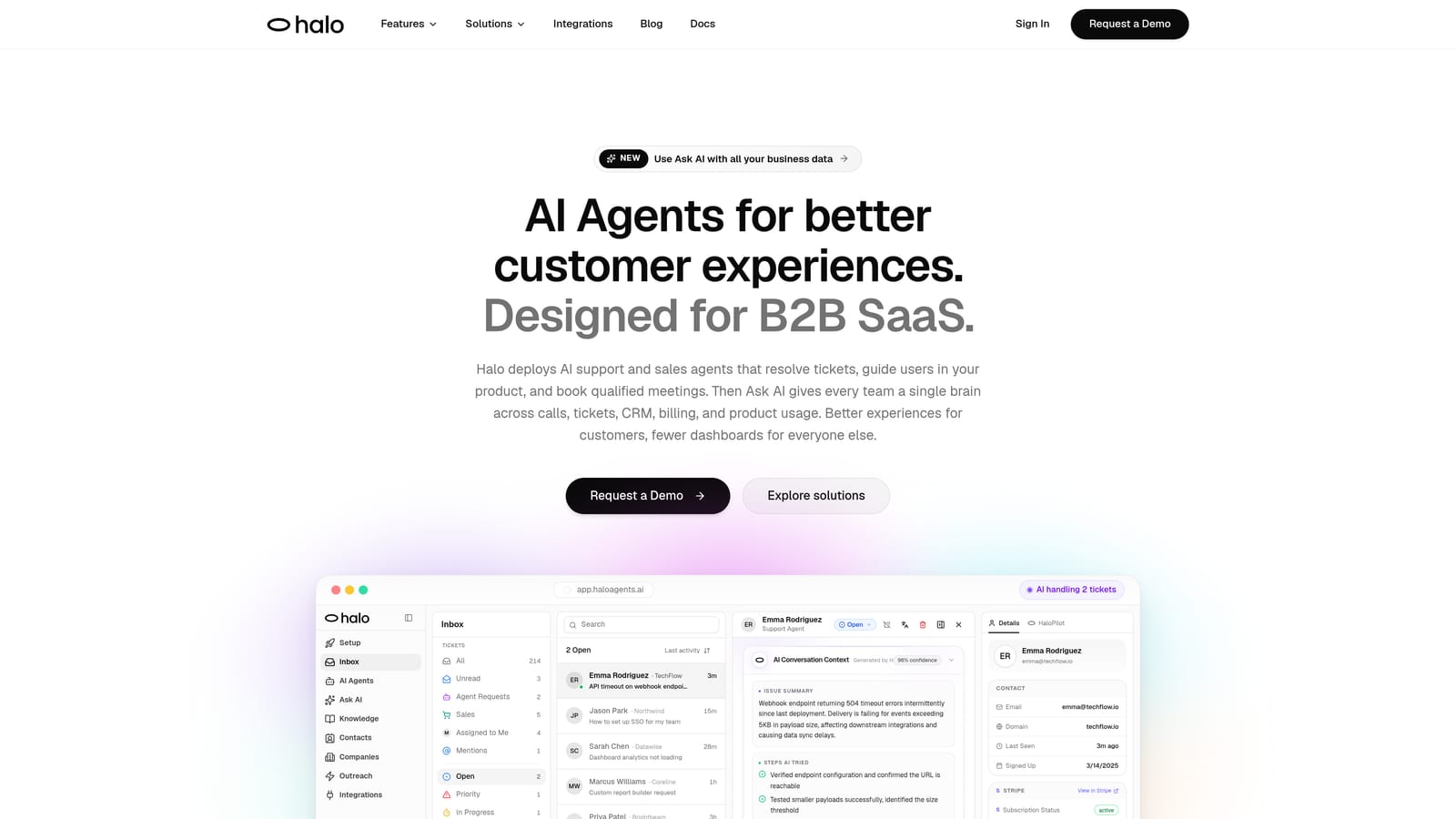
Halo AI is an AI-first customer support platform built specifically for SaaS teams, deploying intelligent agents that resolve tickets, guide users through your product, and surface actionable business insights.
Where This Tool Shines
What sets Halo apart from most tools on this list is its architecture. It wasn't built as a helpdesk with AI layered on top; it was designed from the ground up to operate autonomously, learn continuously, and integrate deeply with the SaaS toolchain. Every resolved ticket makes the system smarter, which means your support quality improves over time without manual retraining.
The page-aware chat widget is a standout differentiator. Halo's agent can see what the user sees in your product, providing visual UI guidance that's contextually relevant to the exact screen they're on. Combined with auto bug ticket creation routed directly to Linear and a smart inbox that surfaces customer health signals and revenue intelligence, Halo functions as more than a support tool. It becomes a product intelligence layer.
Key Features
Page-Aware Chat Widget: Sees the user's current product context and delivers visual UI guidance specific to their screen.
Continuous Learning: Every resolved ticket feeds back into the system, improving autonomous resolution rates over time.
Auto Bug Ticket Creation: Automatically identifies and routes bug reports to Linear without requiring manual agent intervention.
Smart Inbox with Business Intelligence: Surfaces customer health signals, revenue intelligence, and anomaly detection beyond standard support metrics.
Deep SaaS Integrations: Connects natively with Linear, Slack, HubSpot, Intercom, Stripe, Zoom, PandaDoc, and Fathom.
Live Agent Handoff: Smooth escalation to human agents for complex issues, with full context preserved.
Best For
SaaS product and customer success teams that want support automation to do more than deflect tickets. Particularly well-suited to growth-stage companies where support interactions should also inform product decisions, churn prevention, and revenue expansion.
Pricing
Contact for pricing. You can book a demo directly at haloagents.ai to discuss your team's needs and get a tailored quote.
2. Intercom
Best for: SaaS teams wanting a mature conversational support platform with strong in-product messaging.
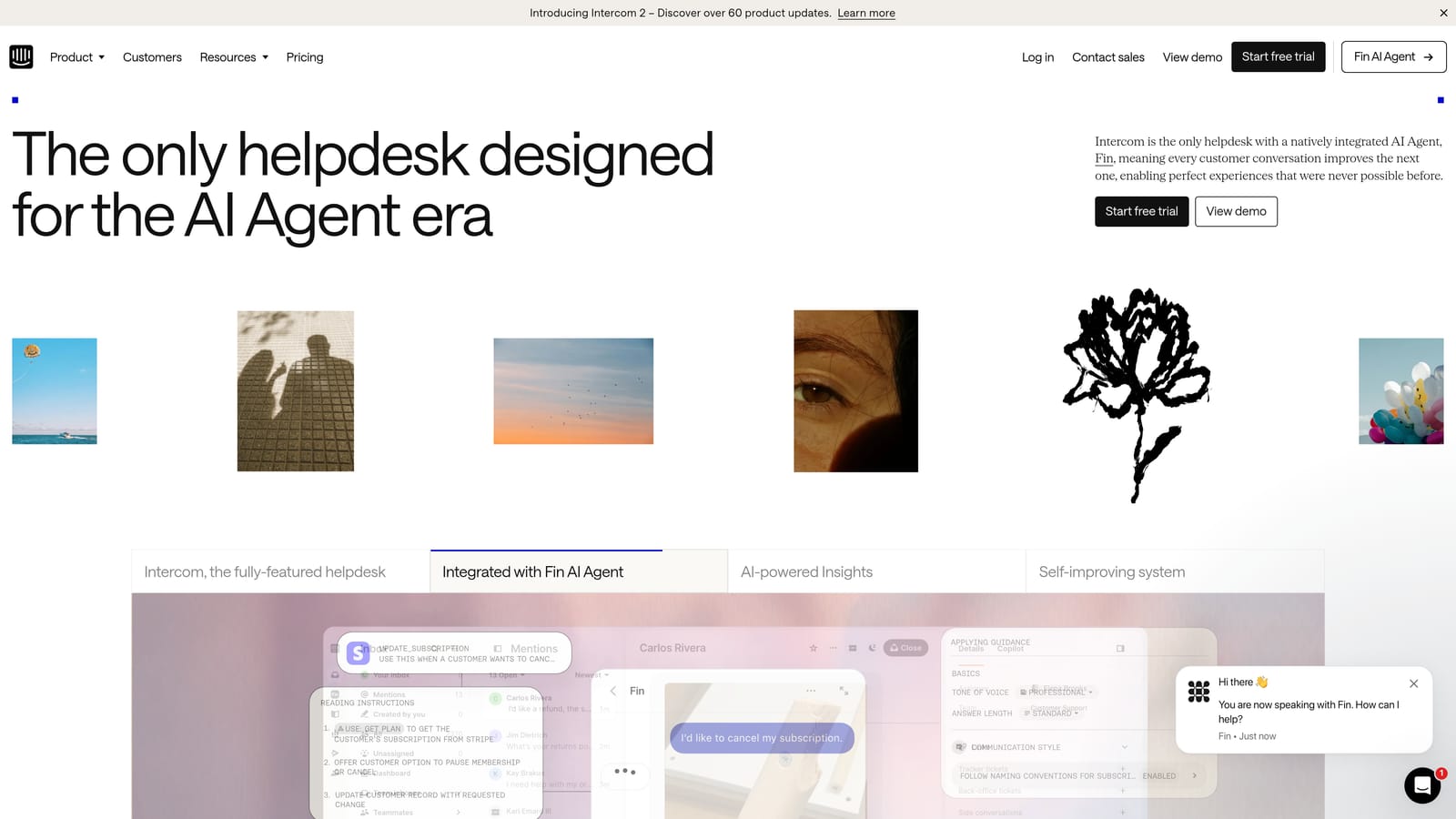
Intercom is one of the most established conversational support platforms in SaaS, combining the Fin AI agent with a robust customer data platform and in-product messaging capabilities.
Where This Tool Shines
Intercom's Fin AI agent, built on large language models, handles a wide range of support queries autonomously and has become a benchmark for conversational AI in the support space. Its customer data platform enables behavioral segmentation that most pure-play helpdesks can't match, making it strong for both support and proactive engagement.
The breadth of Intercom's platform is genuinely impressive. In-product messaging, onboarding flows, and an extensive app marketplace mean it can serve as a central communication hub for SaaS teams. Worth noting: Halo AI integrates directly with Intercom, so the two tools can complement each other rather than compete.
Key Features
Fin AI Agent: Handles autonomous support resolution across a wide range of query types.
In-Product Messaging: Supports onboarding flows, proactive outreach, and contextual messaging inside your app.
Customer Data Platform: Behavioral segmentation and customer profiles that power personalized support.
Omnichannel Support: Covers chat, email, and phone in a unified interface.
App Marketplace: Extensive integrations with the SaaS toolchain.
Best For
Mid-market to enterprise SaaS companies that want a mature, feature-rich conversational platform with strong in-product messaging and customer data capabilities. Budget-conscious startups may find the pricing steep at scale.
Pricing
Starter plans begin around $39/seat/month and scale significantly with usage and seat count. Verify current pricing at intercom.com/pricing.
3. Zendesk
Best for: Larger SaaS organizations with complex support operations requiring enterprise-grade ticket management.
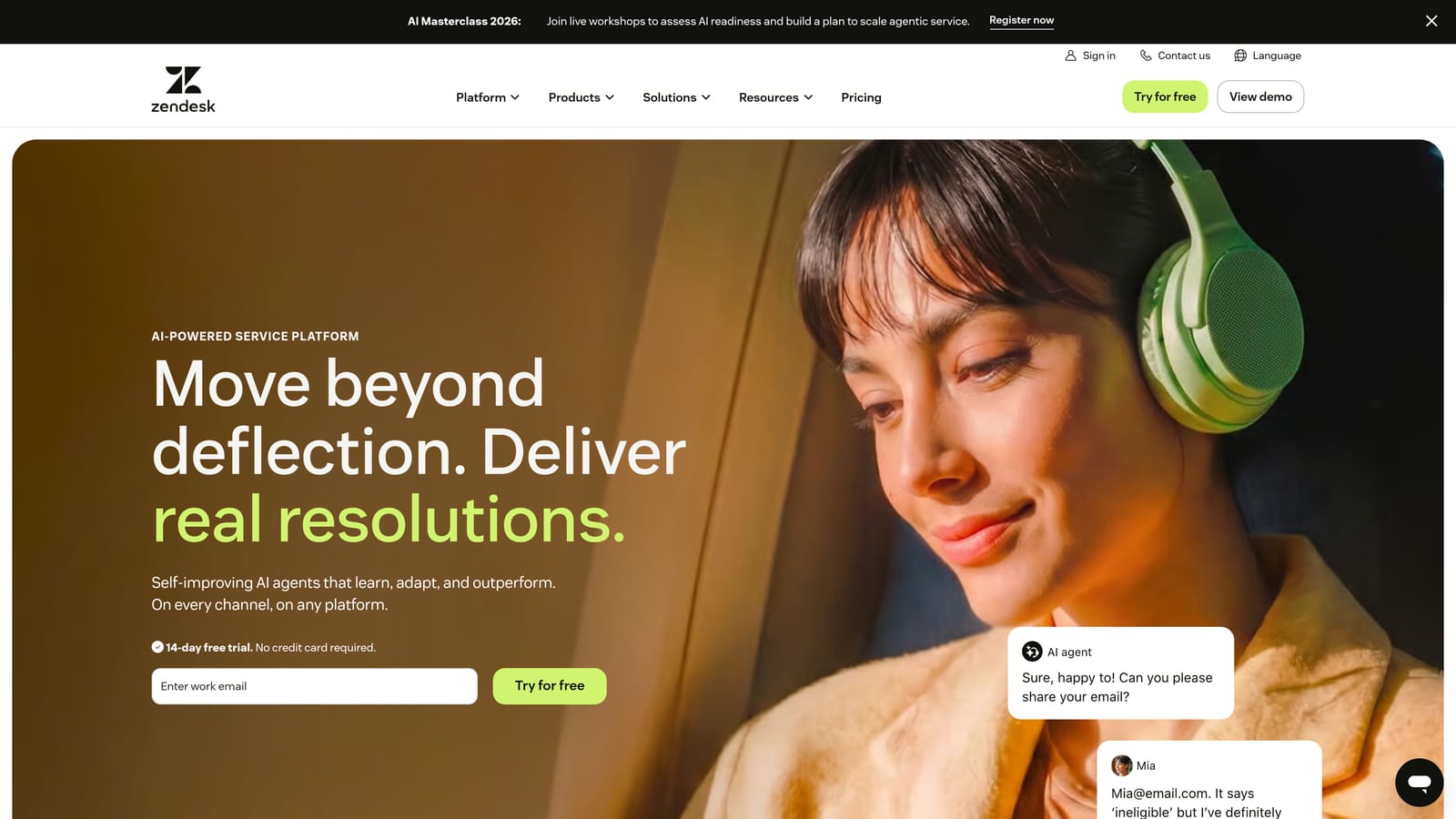
Zendesk is the market-leading helpdesk platform, offering AI-powered triage, routing, and automation capabilities built on top of a battle-tested enterprise support infrastructure.
Where This Tool Shines
Zendesk's strength is its depth and reliability at scale. For SaaS organizations managing thousands of tickets across multiple channels with strict SLA requirements, Zendesk's enterprise-grade infrastructure is hard to beat. Its AI capabilities, including intelligent triage and intent detection, have improved significantly in recent product cycles.
The integration marketplace with over 1,000 apps means Zendesk connects to virtually any tool in your stack. The tradeoff is complexity: smaller or earlier-stage SaaS teams often find Zendesk heavy to configure and maintain. It rewards organizations with dedicated support operations teams.
Key Features
Zendesk AI: Intelligent triage, routing, and intent detection that reduces manual ticket handling.
Enterprise SLA Management: Robust SLA tracking, escalation rules, and compliance reporting.
1,000+ App Marketplace: Extensive integrations covering virtually every SaaS category.
Omnichannel Ticket Management: Unified inbox across email, chat, phone, and social channels.
Advanced Security and Compliance: Enterprise-grade data governance and compliance certifications.
Best For
Enterprise and scaling SaaS companies with dedicated support operations teams, complex routing needs, and compliance requirements. Less ideal for early-stage teams looking for fast, lightweight deployment.
Pricing
Suite plans start around $55/agent/month. Verify current tiers at zendesk.com/pricing.
4. Freshdesk
Best for: Budget-conscious SaaS startups that want AI-assisted support with a generous free tier.
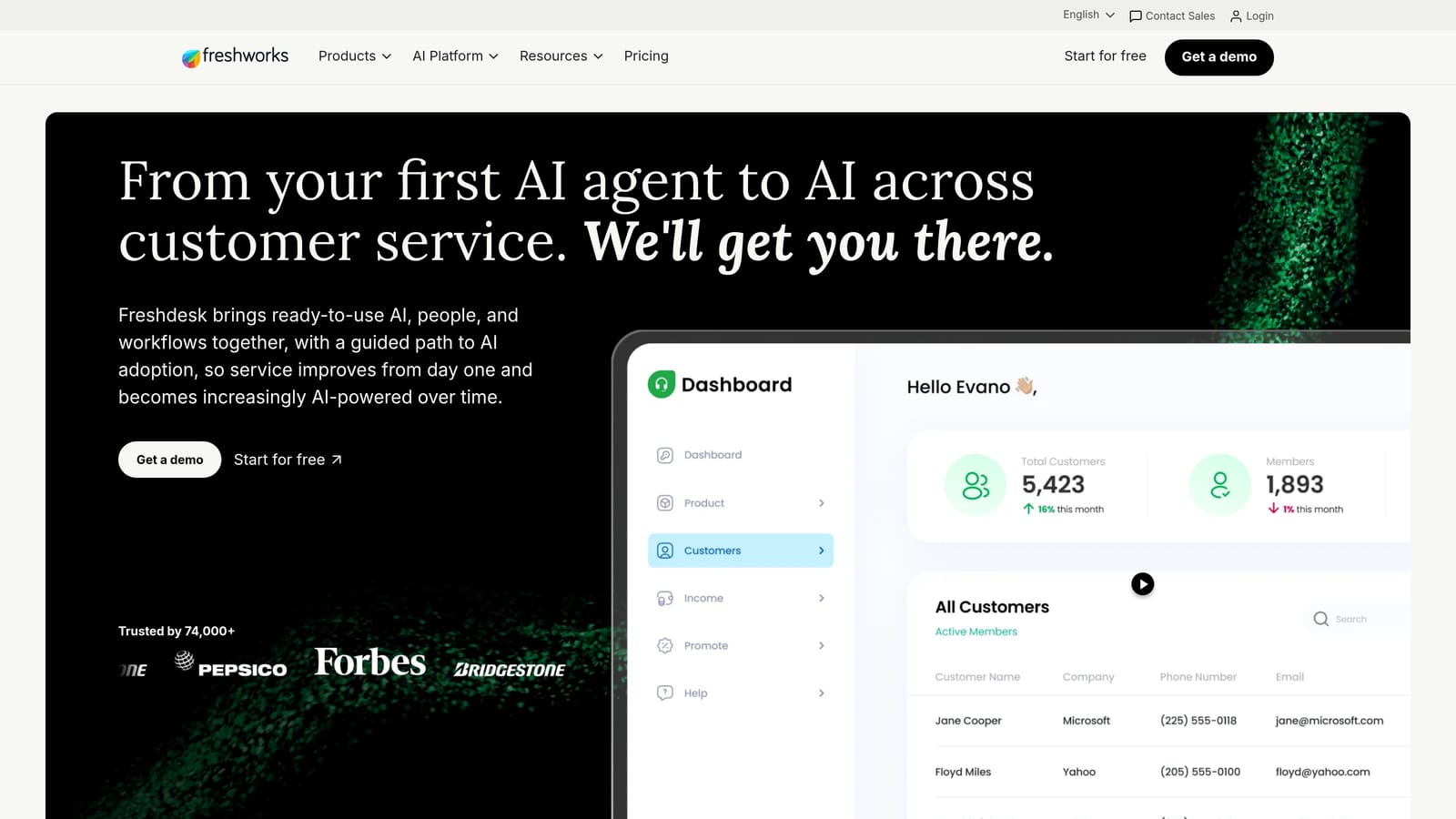
Freshdesk is Freshworks' helpdesk platform featuring Freddy AI for ticket classification, auto-suggestions, and resolution automation, with accessible pricing that makes it a strong entry point for early-stage SaaS teams.
Where This Tool Shines
Freshdesk's free tier is genuinely useful, not just a stripped-down trial. For SaaS startups managing their first support queue, it provides omnichannel coverage across email, chat, phone, and social without an upfront cost. Freddy AI handles ticket classification and suggested responses, reducing the manual load on small teams.
As teams grow, the upgrade path is incremental and predictable. Freshdesk won't match the AI depth of purpose-built AI-first platforms, but for teams prioritizing value and ease of deployment, it delivers strong fundamentals at a competitive price point.
Key Features
Freddy AI: Handles ticket classification, suggested responses, and some auto-resolution workflows.
Omnichannel Support: Covers email, chat, phone, and social channels from a unified inbox.
Free Tier: Functional free plan available for small teams, no time limit.
Automation Workflows: Rule-based automation for routing, escalation, and SLA management.
Marketplace Integrations: Connects with popular SaaS tools across CRM, billing, and communication categories.
Best For
Early-stage SaaS teams and startups that need a capable, affordable helpdesk with AI assistance. Also a solid choice for teams transitioning from shared email inboxes to a proper support system for the first time.
Pricing
Free tier available with no agent limit; paid plans start around $15/agent/month. Verify current pricing at freshdesk.com/pricing.
5. Tidio
Best for: SaaS teams that want fast, lightweight front-line chat automation with minimal setup time.
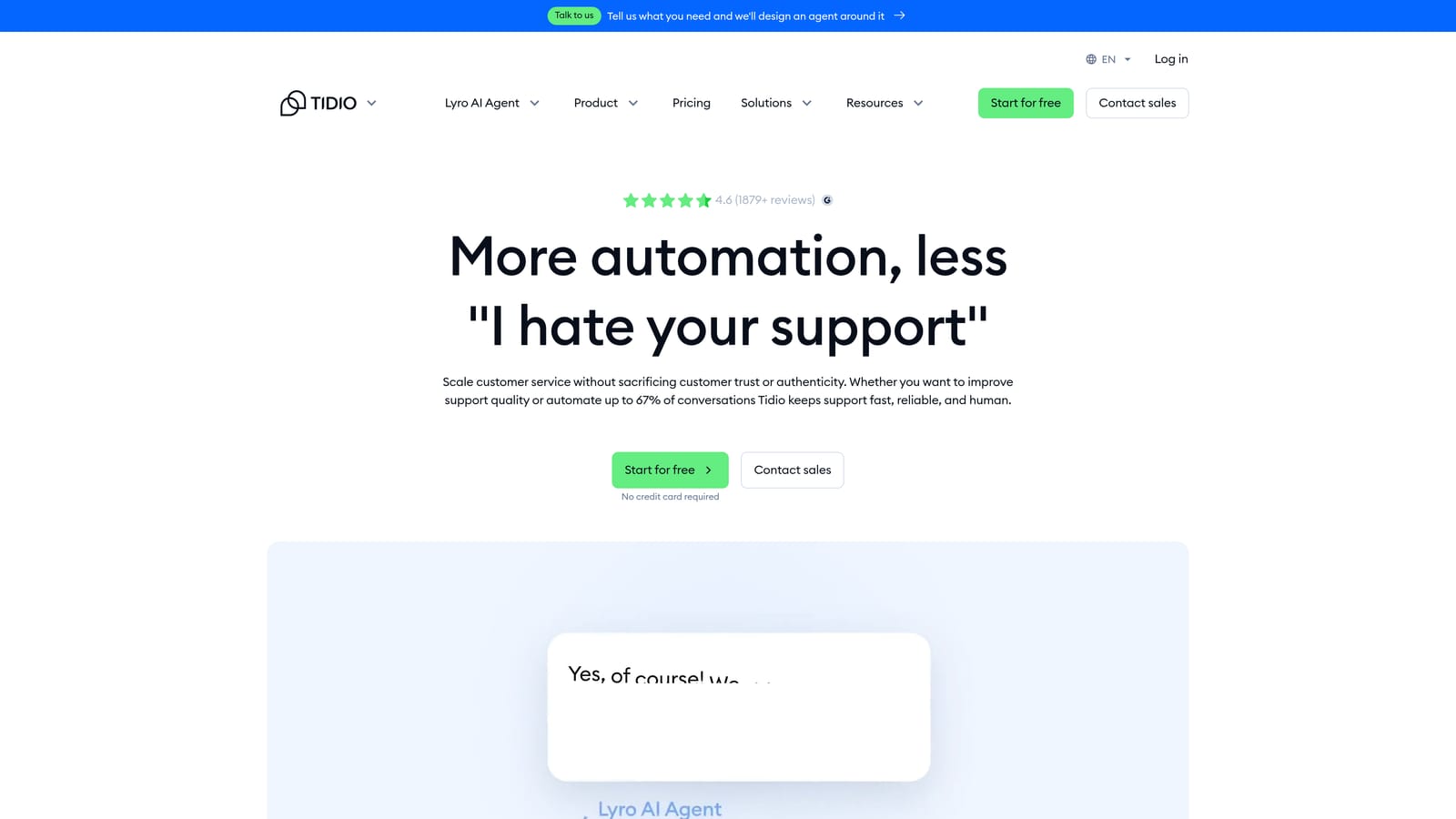
Tidio is a lightweight AI chat platform featuring the Lyro AI chatbot, designed for quick deployment and immediate deflection of common support queries without complex configuration.
Where This Tool Shines
Tidio's biggest advantage is speed to value. The Lyro AI chatbot can be deployed without engineering involvement, making it attractive for product-led growth SaaS teams that want front-line chat automation running quickly. It handles conversational queries well and provides clear analytics on bot performance and deflection rates.
The tradeoff is depth. Tidio is not a full helpdesk and doesn't try to be. It excels at the front-line chat layer but lacks the ticket management, SLA tracking, and deep workflow automation that larger support operations require. Think of it as a strong first line of defense rather than a complete support platform.
Key Features
Lyro AI Chatbot: Autonomous conversation handling for common support queries with no-code setup.
No-Code Deployment: Fast setup without engineering resources required.
Live Chat with Agent Takeover: Smooth transition from bot to human agent when needed.
Email and Messenger Integrations: Extends coverage beyond website chat.
Bot Performance Analytics: Clear reporting on deflection rates and conversation outcomes.
Best For
Small SaaS teams, PLG companies, and early-stage startups that want immediate chat automation without the overhead of a full helpdesk. Also useful as a front-line layer complementing a larger support stack.
Pricing
Free tier available; paid plans start around $29/month. Verify current pricing at tidio.com/pricing.
6. Drift
Best for: SaaS teams where trial user support and sales expansion conversations overlap significantly.
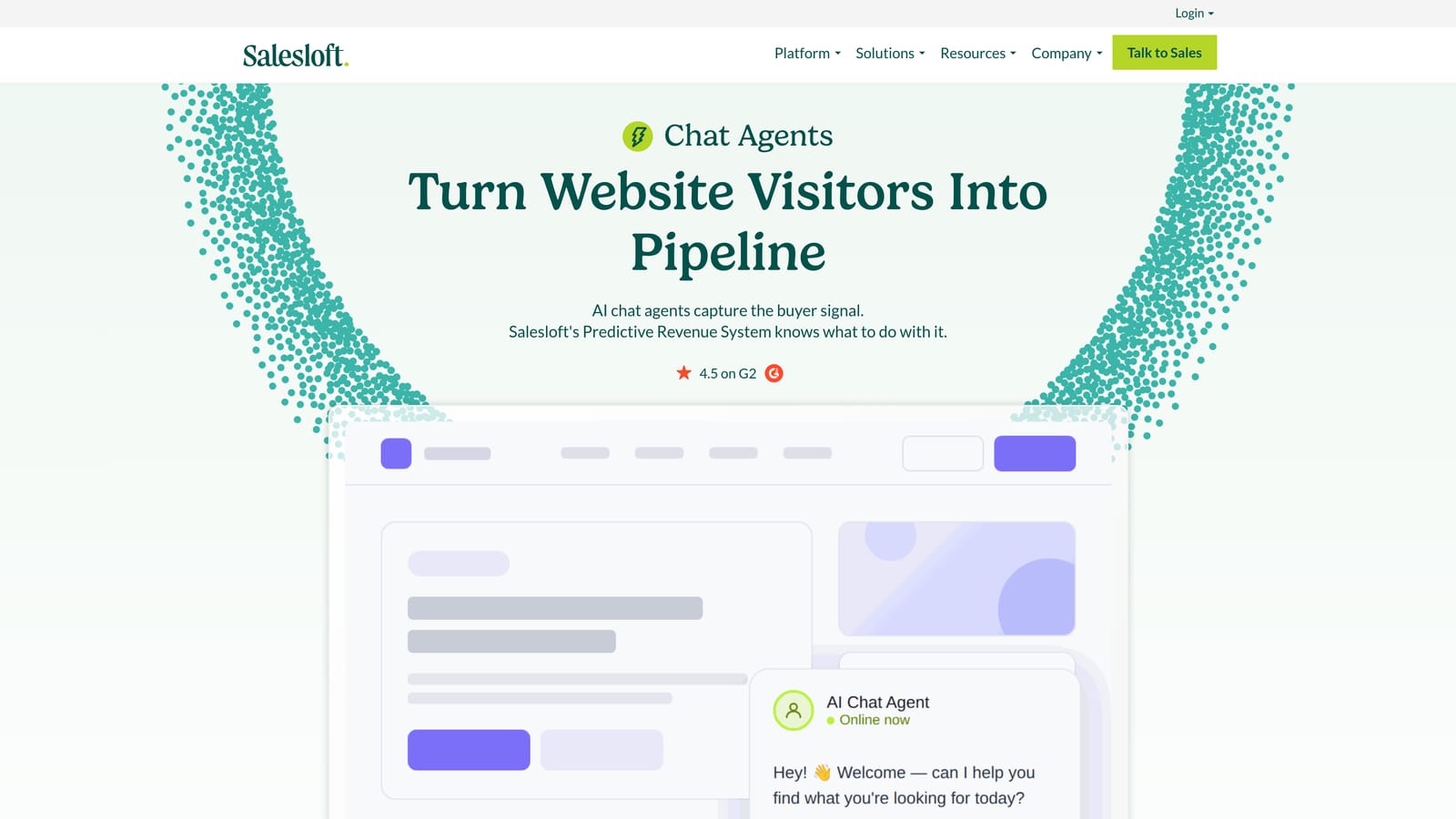
Drift (now part of Salesloft) is a conversational AI platform that blends support and sales conversations, making it well-suited for SaaS teams where the line between answering a product question and advancing a deal is thin.
Where This Tool Shines
Drift's core strength is handling conversations that don't fit neatly into "support" or "sales." For SaaS teams running trials, expansion conversations, and upgrade inquiries through the same chat interface, Drift's AI-powered routing and CRM sync keeps context intact across the customer journey. The meeting booking automation is particularly useful for hybrid support-sales workflows.
Post-acquisition by Salesloft, Drift has leaned further into the revenue intelligence side of its platform. This makes it a strong fit for sales-led or hybrid SaaS models, but teams looking for a pure support platform may find the sales-oriented framing less relevant to their use case.
Key Features
AI-Powered Conversational Chat: Handles both support and sales conversations with intent-based routing.
CRM Sync: Native integration with Salesforce and HubSpot for full conversation context.
Meeting Booking Automation: Lets prospects and users book directly from a chat conversation.
Intent-Based Routing and Personalization: Routes conversations based on visitor behavior and intent signals.
Revenue Intelligence Reporting: Tracks how conversations contribute to pipeline and expansion revenue.
Best For
Sales-led or hybrid SaaS companies where support, trial assistance, and expansion conversations happen in the same channel. Less suited to pure support-focused teams or those without a strong CRM workflow.
Pricing
Enterprise-focused pricing; contact Drift directly for a quote. Verify at drift.com.
7. Kustomer
Best for: High-volume SaaS support teams where full customer context across every channel is essential.
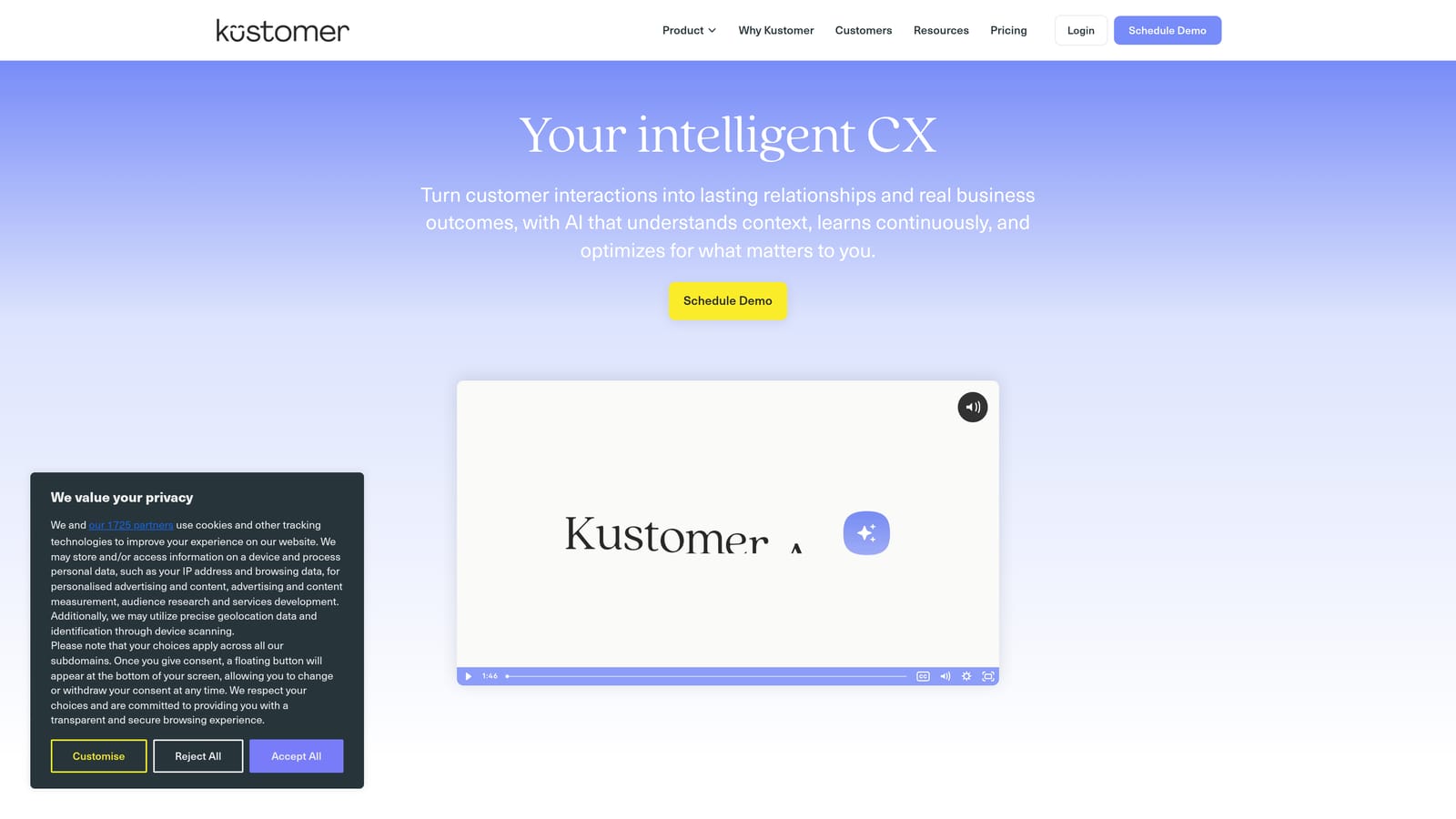
Kustomer is a CRM-native support platform owned by Meta that unifies customer history across all channels, giving agents and AI complete context in every conversation.
Where This Tool Shines
Kustomer's unified customer timeline is its defining feature. Rather than treating each ticket as an isolated event, Kustomer assembles a complete picture of every interaction a customer has had across email, chat, phone, and social. For SaaS companies with complex customer histories, this context dramatically improves both AI accuracy and agent effectiveness.
The AI layer handles conversation summaries, intent detection, and auto-routing, reducing the cognitive load on agents handling high volumes. The CRM-native architecture also means customer data doesn't need to be synced from a separate system; it lives natively in the support platform.
Key Features
Unified Customer Timeline: Complete interaction history across all channels in a single view.
AI Conversation Summaries: Automatically summarizes conversation context for agents and routing decisions.
Intent Detection and Auto-Routing: AI-powered routing based on customer intent and history.
Omnichannel Support: Email, chat, phone, and social in a CRM-native interface.
Customizable Reporting: Flexible dashboards for support performance and customer health metrics.
Best For
Mid-market and enterprise SaaS companies with high ticket volumes and complex customer histories that require full context in every interaction. The pricing reflects an enterprise positioning, so it's less accessible for smaller teams.
Pricing
Plans start around $89/agent/month. Verify current pricing at kustomer.com/pricing.
8. Gorgias
Best for: Subscription SaaS and SaaS-adjacent commerce businesses with a transactional support layer.
Gorgias is a support platform with deep ecommerce roots that's increasingly used by subscription SaaS and commerce-adjacent businesses, featuring AI auto-reply and a ticket-based pricing model that suits transaction-heavy support queues.
Where This Tool Shines
Gorgias was built for high-volume, transactional support. Its deep Shopify and ecommerce platform integrations make it a natural fit for SaaS products with a commerce layer, think subscription management, billing inquiries, and order-related support. The AI auto-reply handles repetitive queries efficiently, and the macro automation system covers common workflows without complex configuration.
The ticket-based pricing model is worth noting: instead of paying per seat, you pay based on ticket volume. For SaaS teams with small support teams handling high volumes, this can be more cost-effective than per-agent pricing. The revenue statistics tied to support interactions also provide useful visibility into how support affects retention and expansion.
Key Features
AI Auto-Reply: Automatically handles common support queries without agent involvement.
Ecommerce Platform Integrations: Deep native integrations with Shopify and other commerce platforms.
Macro and Rule-Based Automation: Templated workflows for repetitive support scenarios.
Ticket-Based Pricing: Pay per ticket volume rather than per agent seat.
Revenue Statistics: Links support interactions to revenue outcomes for retention and expansion visibility.
Best For
Subscription SaaS businesses with a commerce or transactional layer, particularly those already using Shopify or similar platforms. Less suited to pure SaaS products without a commerce component.
Pricing
Starts around $10/month on ticket-based pricing. Verify current tiers at gorgias.com/pricing.
9. Help Scout
Best for: CS-led SaaS teams that want AI efficiency without sacrificing a personal, human support feel.
Help Scout is a customer-centric support platform with AI Assist for agent drafting and a clean, intuitive UX designed to keep support interactions feeling personal even as teams scale.
Where This Tool Shines
Help Scout's philosophy is that great support should feel human, and the platform is designed to support that goal. AI Assist helps agents draft replies faster without replacing the agent's voice, which is a meaningful distinction for CS-led teams that have built their reputation on relationship-driven support. The interface is genuinely clean and requires minimal onboarding.
The Beacon in-product widget provides contextual help directly inside your product, and the Docs knowledge base with AI-powered search gives users a strong self-service option before they reach the support queue. For SaaS teams that want efficiency gains without the "talking to a bot" experience, Help Scout strikes a thoughtful balance.
Key Features
AI Assist: Helps agents draft replies faster while preserving the human voice in responses.
Beacon In-Product Widget: Contextual help and knowledge base search embedded directly in your product.
Docs Knowledge Base: AI-powered search across your documentation for effective self-service.
Shared Inbox with Collision Detection: Prevents duplicate replies when multiple agents work the same queue.
Simple, Intuitive UI: Minimal onboarding friction and a clean interface that teams adopt quickly.
Best For
CS-led SaaS teams that prioritize relationship quality alongside efficiency. Particularly well-suited to teams where the personal touch in support is a competitive differentiator and where AI should assist agents rather than replace them entirely.
Pricing
Plans start around $22/user/month. Verify current pricing at helpscout.com/pricing.
Which Tool Is Right for Your SaaS Team?
The right AI support software depends heavily on where your team sits today and where you're trying to go. Here's a quick way to think through the options.
AI-first with deep SaaS integrations: Halo AI is the clear choice if you want support that learns continuously, integrates with your entire SaaS toolchain, and surfaces business intelligence beyond ticket metrics.
Mature conversational platform: Intercom remains one of the strongest all-around options for SaaS teams that want in-product messaging, a capable AI agent, and a rich customer data platform in one place.
Enterprise ticket operations: Zendesk is the go-to for large SaaS organizations with complex routing, SLA requirements, and compliance needs, provided you have the team to configure and maintain it.
Budget-conscious startup: Freshdesk's free tier and low-cost paid plans make it the most accessible entry point for early-stage SaaS teams building their first real support operation.
Fast lightweight chat: Tidio gets you front-line chat automation running quickly with minimal setup, ideal for PLG teams that want deflection without engineering overhead.
Support and sales overlap: Drift fits sales-led SaaS teams where trial questions, upgrade conversations, and support inquiries all happen in the same channel.
High-volume with CRM context: Kustomer is built for teams where full customer history across every channel is essential to both AI accuracy and agent effectiveness.
Commerce-adjacent SaaS: Gorgias serves subscription SaaS businesses with a transactional layer, especially those already operating in the Shopify ecosystem.
Human-first AI feel: Help Scout is the right fit for CS-led teams that want AI to make agents faster without removing the personal quality that defines their support experience.
Your support team shouldn't scale linearly with your customer base. Let AI agents handle routine tickets, guide users through your product, and surface business intelligence while your team focuses on complex issues that need a human touch. See Halo in action and discover how continuous learning transforms every interaction into smarter, faster support.