9 Best Customer Service AI Platforms to Buy in 2026
This guide evaluates nine leading customer service AI platforms for B2B and SaaS teams looking to buy customer service AI platform software in 2026, ranking each on automation depth, integration breadth, human handoff quality, and business intelligence. Whether you're replacing a legacy helpdesk or building support from scratch, you'll find a clear, methodology-backed recommendation here.
 Matt PattoliFounder12 min read
Buying a customer service AI platform is no longer a future-proofing exercise. It's a present-day competitive necessity. B2B teams are under pressure to resolve tickets faster, reduce support headcount growth, and surface insights from every customer interaction. But the market is crowded, and not every platform delivers on its AI promises.
This guide cuts through the noise. We evaluated nine platforms based on what actually matters for B2B and SaaS teams: automation depth, integration breadth, learning capabilities, and how well each tool handles the messy reality of real customer conversations. Whether you're replacing a legacy helpdesk, adding AI on top of an existing stack, or building a support function from scratch, you'll find a clear recommendation here.
A quick note on methodology: we assessed each platform on autonomous resolution capability, human handoff quality, integration ecosystem, and business intelligence beyond basic ticketing. The platforms below represent the strongest options available in 2026.
1. Halo AI
Best for: B2B SaaS teams wanting AI-first support with deep integrations and business intelligence
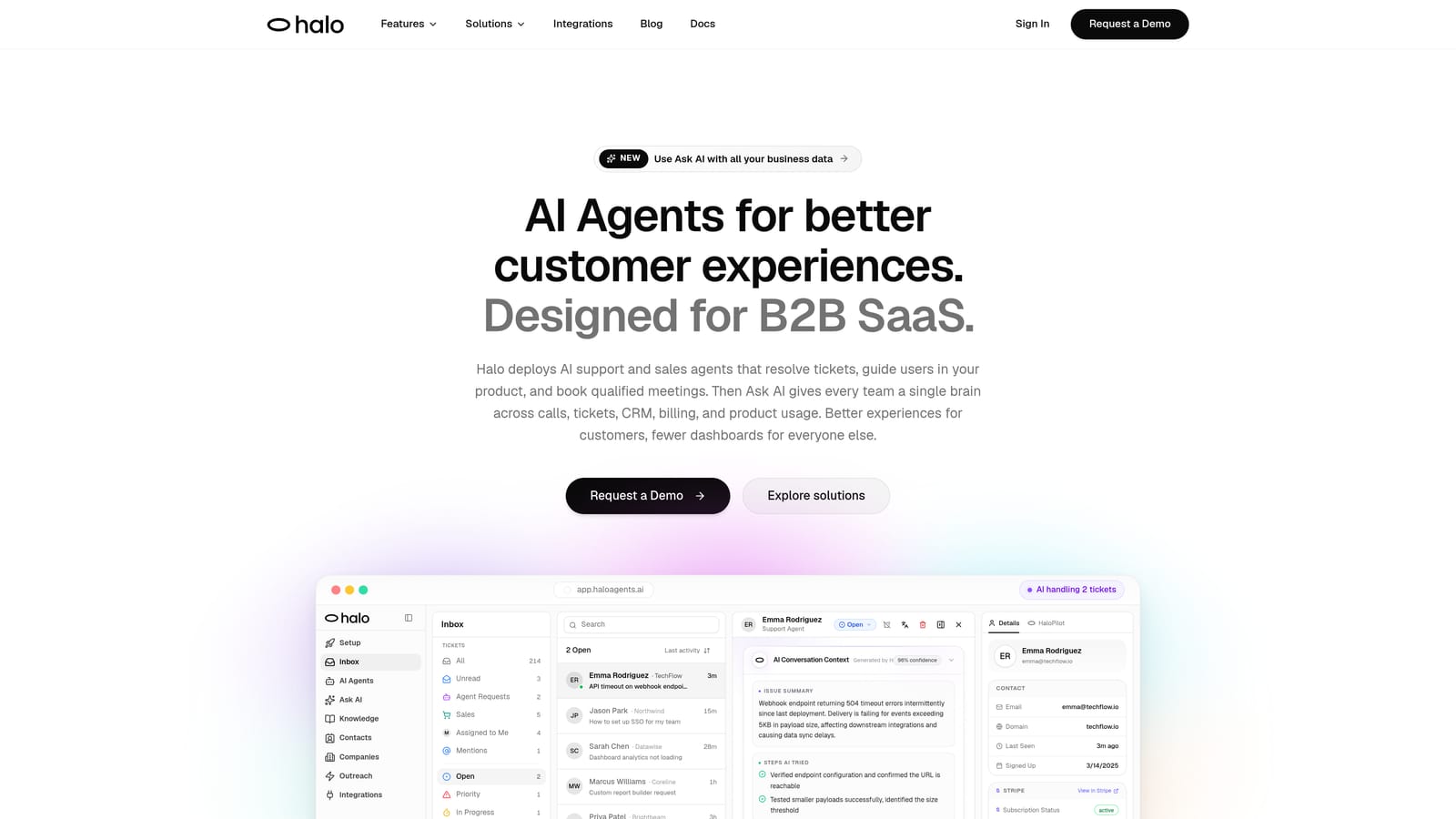
Halo AI is an AI-first customer support platform built from the ground up for B2B SaaS teams, not a legacy helpdesk with AI bolted on.
Where This Tool Shines
Halo's standout capability is its page-aware chat widget. Unlike most AI support tools that only know what's in your knowledge base, Halo's agent can see exactly what page and UI state a user is on, then provide contextual, visual guidance tailored to that specific moment. For SaaS products with complex interfaces, this is a meaningful differentiator.
Beyond ticket resolution, Halo positions support as a strategic function. The smart inbox surfaces customer health signals, revenue intelligence, and anomaly detection, giving your team insights that go well beyond standard ticket metrics. Support stops being a cost center and starts generating business intelligence.
Key Features
Page-Aware Chat Widget: The AI agent sees what the user sees, enabling contextual UI guidance that generic chatbots simply can't provide.
Autonomous Ticket Resolution: Intelligent AI agents resolve tickets independently, with continuous learning from every interaction to improve over time.
Smart Inbox with Business Intelligence: Surfaces customer health signals, revenue intelligence, and anomaly detection directly in your support workflow.
Auto Bug Ticket Creation: Converts support signals into engineering tickets automatically, closing the loop between support and product teams.
Live Agent Handoff: Escalates to human agents with full conversation context preserved, so customers never have to repeat themselves.
Integration Ecosystem: Connects with Linear, Slack, HubSpot, Intercom, Stripe, Zoom, PandaDoc, and Fathom, going well beyond standard helpdesk integrations.
Best For
B2B SaaS teams that want AI to handle routine tickets autonomously while also generating business intelligence from support interactions. Particularly well-suited for product-led growth companies where support and product feedback loops matter.
Pricing
Check haloagents.ai for current pricing details and available plans.
2. Intercom Fin
Best for: Teams already using Intercom who want AI resolution without migrating their stack
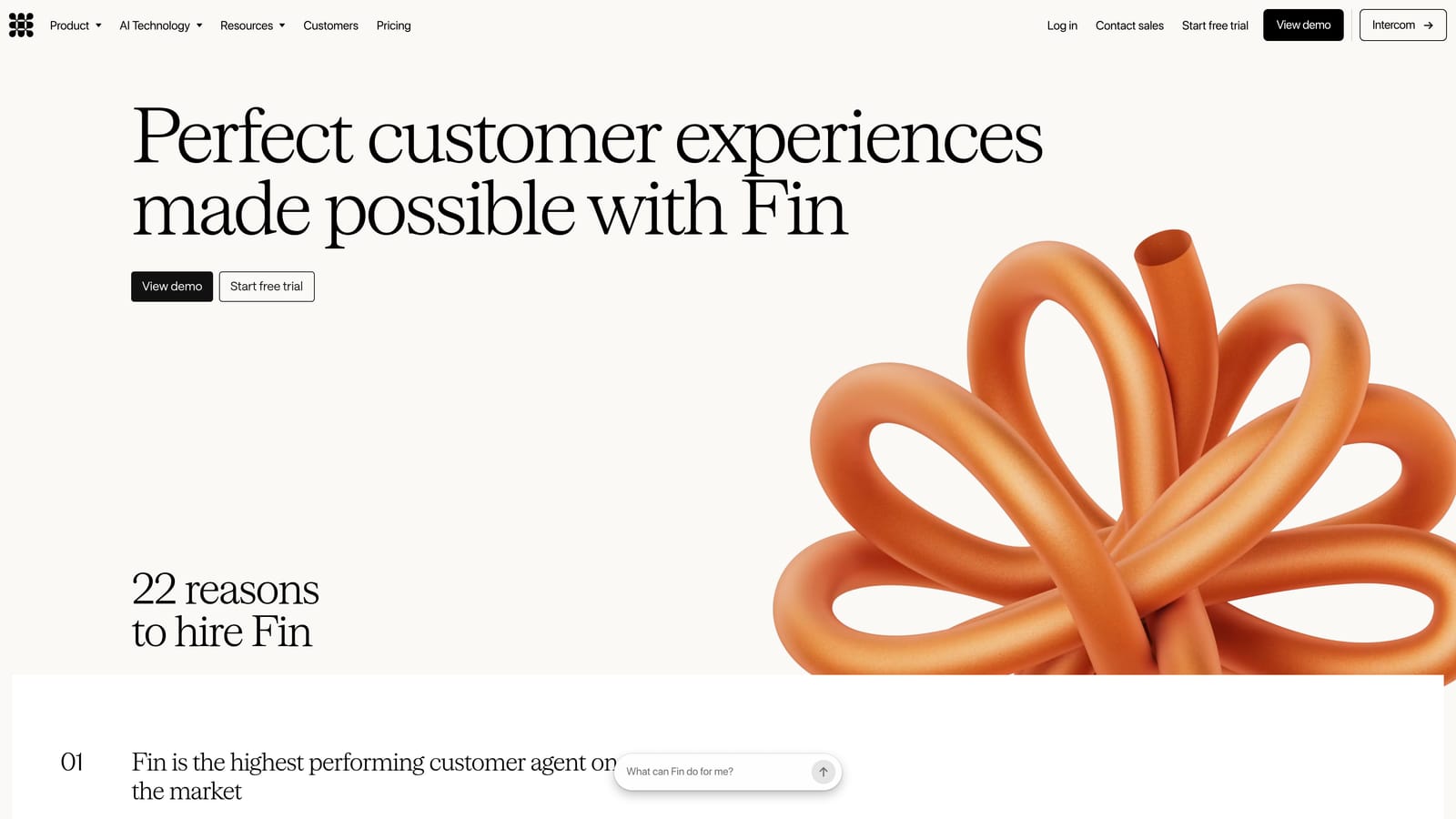
Intercom Fin is Intercom's dedicated AI agent, built natively into the Intercom messenger and inbox ecosystem.
Where This Tool Shines
If your team already lives in Intercom, Fin is the path of least resistance to meaningful AI automation. There's no migration, no new interface to learn, and no integration work required. Fin sits on top of your existing knowledge base and handles multi-turn conversations with reasonable fluency.
The per-resolution pricing model is also worth noting. For teams with predictable support volume, it creates a clear cost-per-outcome relationship that's easier to justify than a flat monthly seat fee. You pay for what actually gets resolved.
Key Features
Native Intercom Integration: Deploys directly within the Intercom messenger, with no migration or parallel tooling required.
Multi-Turn Conversational AI: Handles back-and-forth dialogue trained on your existing knowledge base content.
Per-Resolution Pricing: Charges based on tickets actually resolved by AI, aligning cost directly with value delivered.
Human Handoff within Intercom: Escalates to live agents inside the same inbox, maintaining a seamless customer experience.
Best For
Teams already using Intercom as their primary customer communication platform. Less compelling for teams on different stacks, where the ecosystem lock-in becomes a limitation rather than an advantage.
Pricing
Per-resolution pricing model; check intercom.com for current rates and volume tiers.
3. Zendesk AI
Best for: Large enterprises with existing Zendesk deployments looking to add AI without migration
Zendesk AI layers intelligent automation across the Zendesk Suite, including triage, generative reply suggestions, and automated resolution for common tickets.

Where This Tool Shines
Zendesk's core advantage is familiarity. For enterprises that have spent years building workflows, macros, and integrations inside Zendesk, adding AI features without disrupting that foundation is genuinely valuable. Intent detection, sentiment analysis, and automated routing can meaningfully reduce manual triage work for high-volume teams.
Generative AI reply drafts help agents respond faster without sacrificing quality. For teams handling thousands of tickets per week, even marginal time savings per ticket add up quickly.
Key Features
Intent Detection and Sentiment Analysis: Automatically categorizes and routes incoming tickets based on what customers are saying and how they're feeling.
Generative AI Reply Drafts: Suggests complete responses for agents to review and send, reducing time-to-reply on common issues.
Automated Resolution: Handles simple, repetitive tickets without agent involvement.
Native Suite Integration: All AI features live inside existing Zendesk workflows, requiring no migration or new tooling.
Best For
Large enterprises with established Zendesk deployments where migration cost is prohibitive. Teams evaluating Zendesk from scratch may find AI-first alternatives offer more autonomous resolution capability out of the box.
Pricing
AI features are add-ons to Zendesk Suite plans; check zendesk.com for current tiers and add-on pricing.
4. Freshdesk Freddy AI
Best for: SMBs wanting bundled AI across self-service, agent assistance, and analytics at accessible pricing
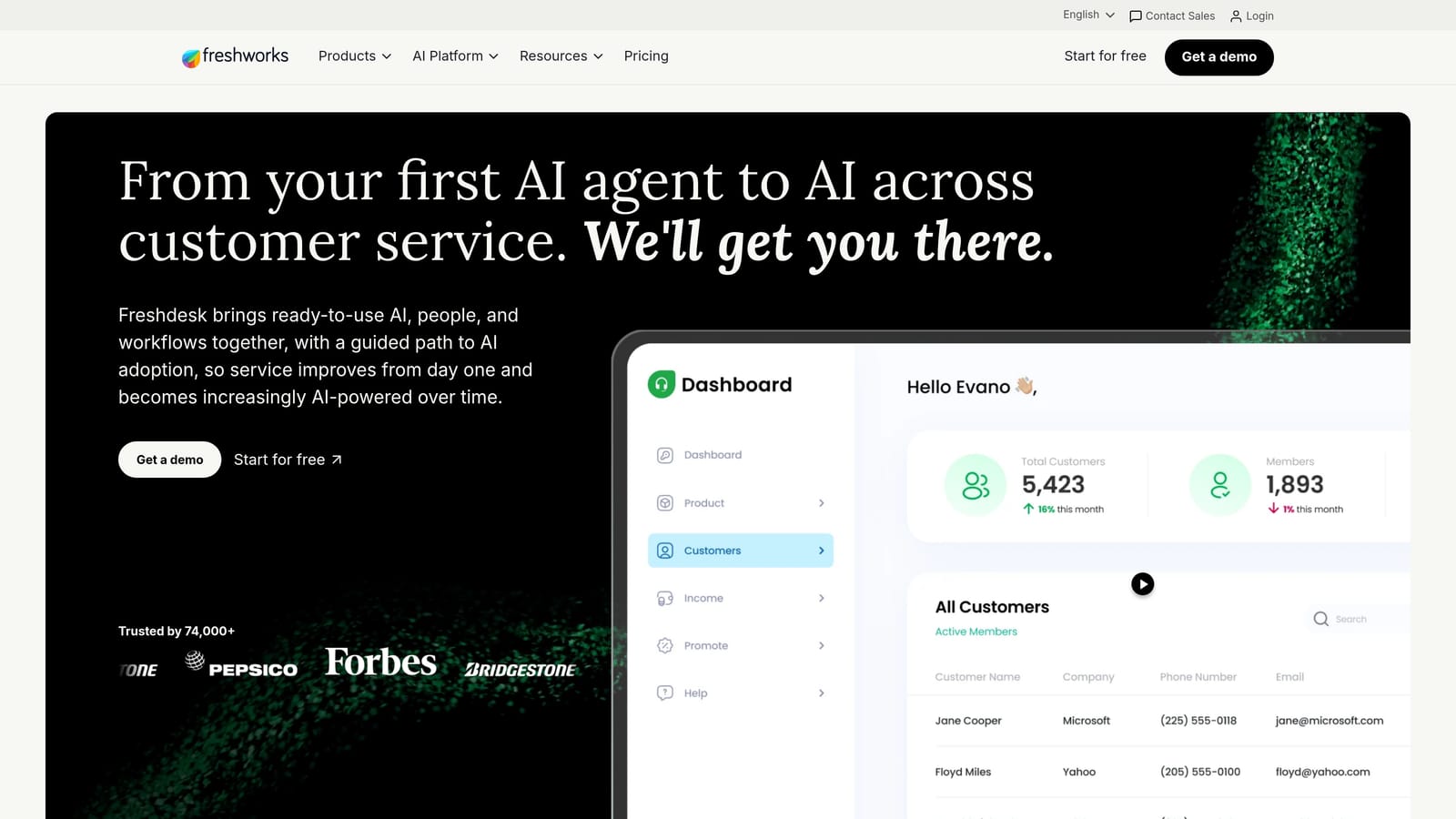
Freshdesk Freddy AI is Freshworks' AI layer across Freshdesk, offering self-service automation, agent assistance, and analytics in a single bundled package.
Where This Tool Shines
Freddy AI covers three distinct functions: self-service deflection (Freddy Self Service), agent productivity (Freddy Copilot), and analytics (Freddy Insights). For SMBs, having all three bundled into existing Freshdesk plans rather than priced as separate add-ons is a meaningful cost advantage over competitors like Zendesk.
Freddy Insights is worth highlighting specifically. Anomaly detection and trend analysis give smaller teams visibility into support patterns that would otherwise require dedicated analytics tooling.
Key Features
Freddy Self Service: Chatbot for deflecting common questions before they reach an agent.
Freddy Copilot: AI-suggested replies and ticket summarization to speed up agent response times.
Freddy Insights: Analytics layer with anomaly detection and trend identification.
Bundled Pricing: AI features included across Freshdesk Growth, Pro, and Enterprise plans rather than priced separately.
Best For
SMBs and mid-market teams that want meaningful AI across self-service, agent assistance, and analytics without paying enterprise-tier pricing. AI depth is solid but less autonomous than purpose-built AI-first platforms for complex B2B SaaS scenarios.
Pricing
Freddy AI features are included in Freshdesk Growth, Pro, and Enterprise plans; check freshworks.com for current pricing.
5. Salesforce Agentforce
Best for: Enterprises where Salesforce is the system of record and CRM context needs to inform every support interaction
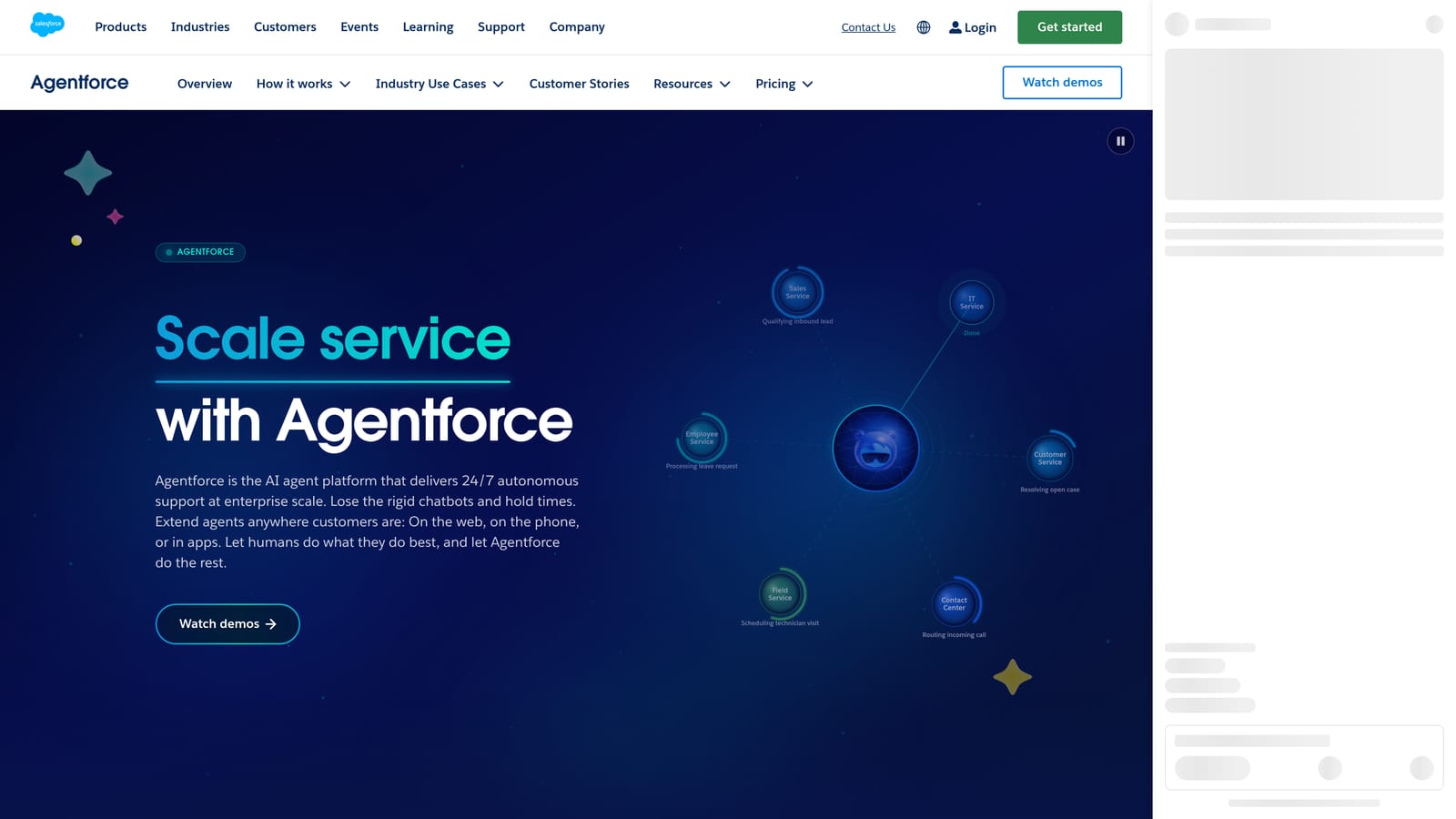
Salesforce Agentforce is Salesforce's autonomous AI agent platform, built on top of the full Salesforce CRM data layer for enterprise-grade customer service automation.
Where This Tool Shines
Agentforce's defining advantage is CRM depth. When an AI agent handles a support ticket, it has access to the customer's full Salesforce history: account value, open opportunities, past interactions, and contract details. That context allows for genuinely personalized responses that reflect business relationships, not just ticket history.
Beyond answering questions, Agentforce can take actions across the Salesforce platform. Updating records, creating cases, triggering workflows. For enterprises where Salesforce orchestrates the entire customer lifecycle, this action-taking capability is a significant differentiator.
Key Features
Full CRM Context: Every AI interaction draws on complete Salesforce customer data, including account history, deal status, and relationship details.
Cross-Platform Actions: AI agents can update Salesforce records, create cases, and trigger workflows autonomously.
Customizable Agent Roles: Configure different AI agents for different support scenarios and customer segments.
Service Cloud Integration: Deep native integration with Salesforce Service Cloud for seamless enterprise workflows.
Best For
Enterprise teams where Salesforce is the primary system of record. The investment required in configuration and licensing makes it less practical for teams without an existing Salesforce commitment.
Pricing
Enterprise-tier pricing; check salesforce.com/agentforce for current rates and licensing details.
6. Tidio Lyro AI
Best for: SMBs and e-commerce teams that need fast deployment without technical complexity
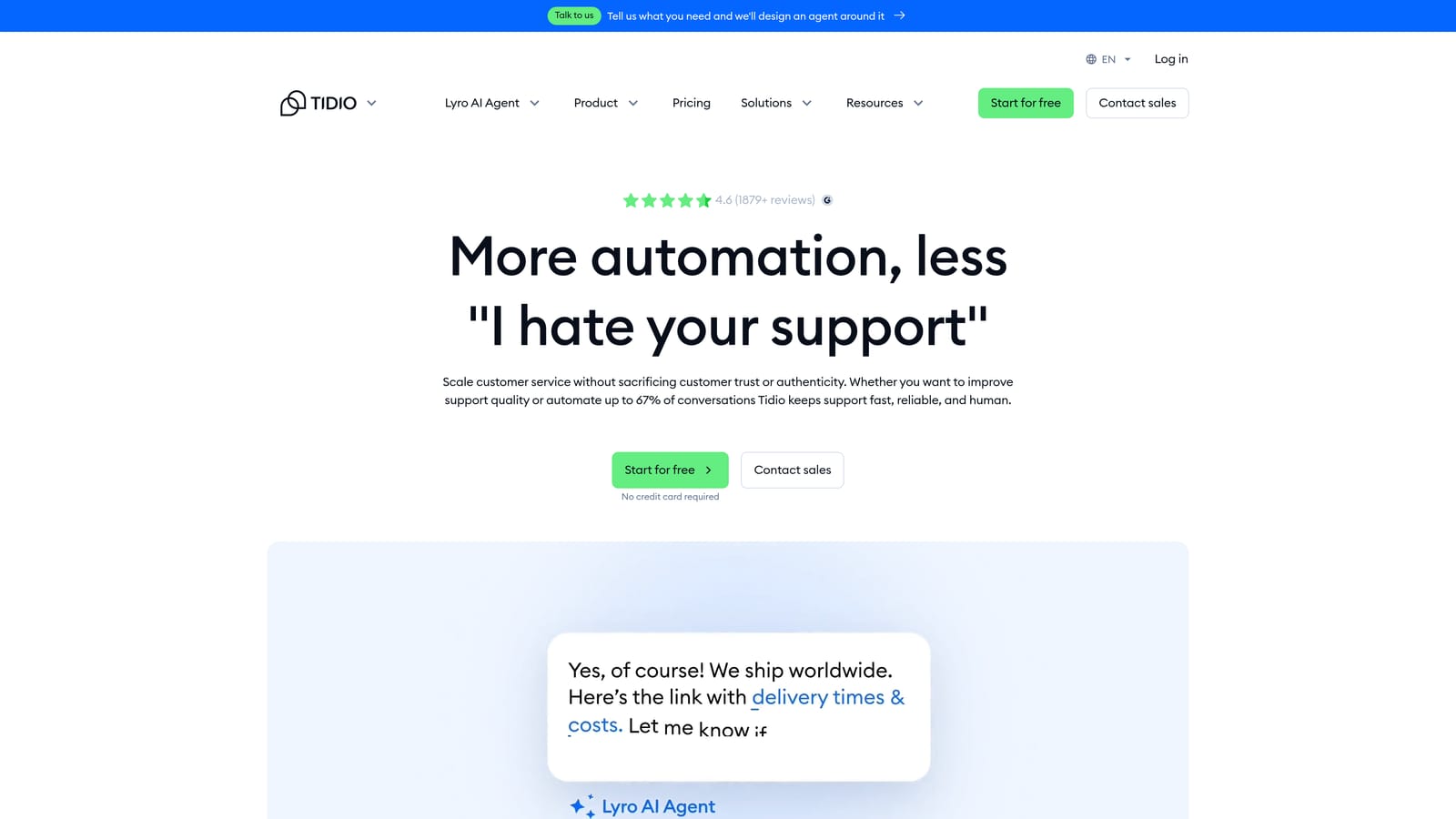
Tidio Lyro AI is a conversational AI designed for fast deployment, primarily serving e-commerce and SMB teams that need automation without dedicated technical resources.
Where This Tool Shines
Speed to value is Lyro's core proposition. Teams can deploy a working AI agent in hours by pointing it at existing FAQ content and website copy, with no complex configuration or integration work required. For small teams without technical resources, that low barrier to entry is genuinely useful.
The live chat fallback is well-implemented. When Lyro reaches the edge of its knowledge, it transitions smoothly to a human agent rather than looping or giving unhelpful responses, which is a common failure mode for simpler chatbot tools.
Key Features
Rapid Deployment: Can be live within hours using existing FAQ and website content as its knowledge base.
Multi-Turn Dialogue: Handles conversational back-and-forth rather than single-question responses.
Live Chat Fallback: Transitions to human agents when AI cannot resolve the issue.
SMB and E-Commerce Integrations: Focused integration set suited to small business and online retail use cases.
Best For
Small e-commerce businesses and SMBs that need basic AI deflection up and running quickly. Less suitable for complex B2B SaaS support scenarios involving multi-step technical troubleshooting or deep product integrations.
Pricing
Lyro AI is available as an add-on to Tidio plans; check tidio.com for current pricing and conversation limits.
7. Help Scout AI
Best for: Teams that prioritize human-sounding support and want AI to assist agents rather than replace them
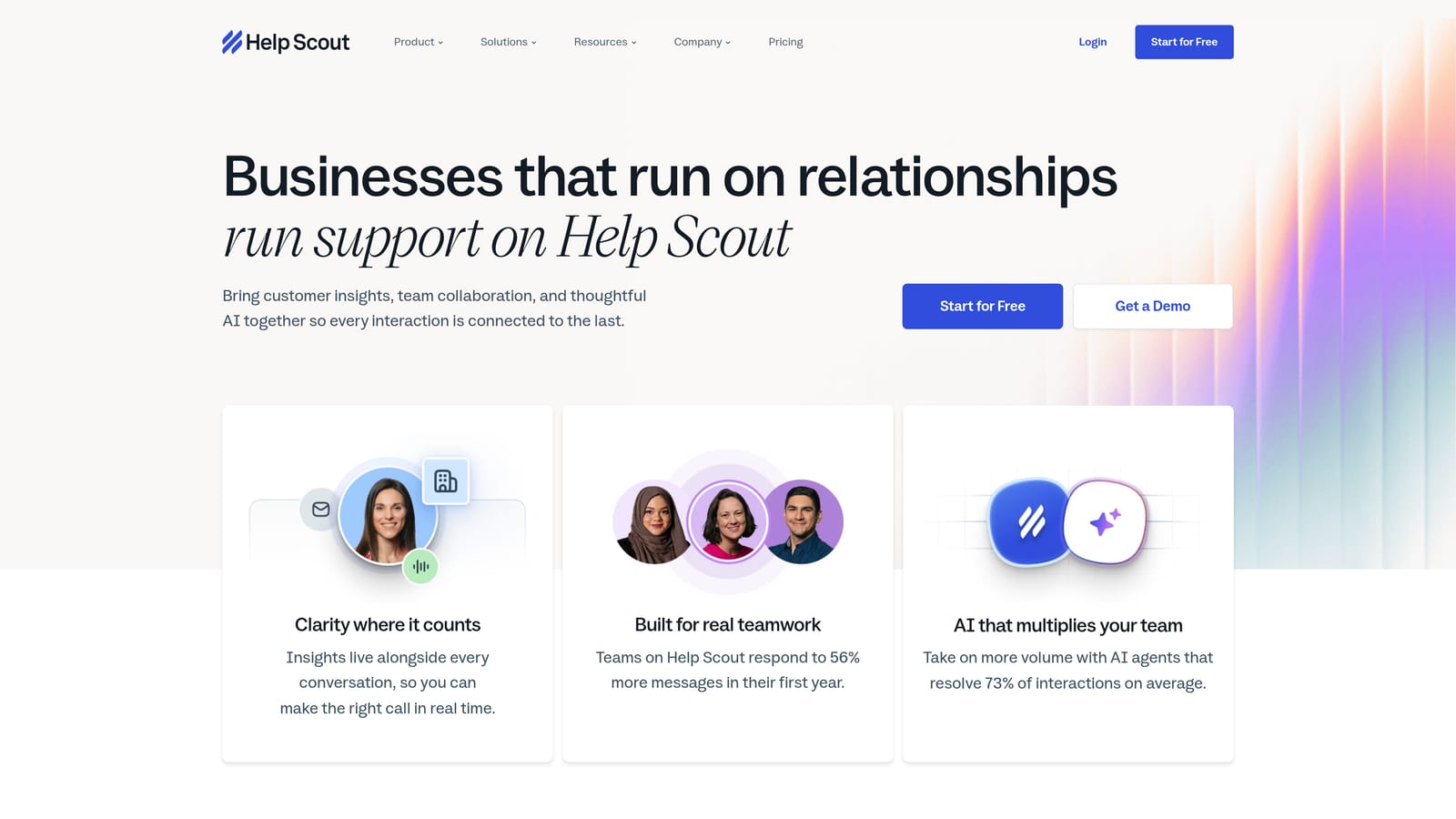
Help Scout AI takes a deliberately different philosophy: AI as a behind-the-scenes tool that makes human agents faster and better, not an autonomous resolver working independently.
Where This Tool Shines
Help Scout has built its reputation on email-based support that feels personal and human. Its AI features are designed to preserve that quality. AI Drafts generates replies for agents to review before sending. AI Summarize condenses long threads into key points. AI Assist rewrites and improves agent-written responses. Every feature keeps a human in the loop.
For teams where brand voice and relationship quality are the primary differentiators, this approach makes sense. The AI accelerates agents without overriding their judgment or producing responses that sound robotic.
Key Features
AI Drafts: Generates complete reply drafts for agent review, reducing writing time while maintaining human oversight.
AI Summarize: Condenses long email threads into key points so agents can get up to speed instantly.
AI Assist: Rewrites and improves agent-written responses for clarity, tone, and completeness.
Human-Voice Preservation: All AI features are designed to support rather than replace the human tone Help Scout users value.
Best For
Teams that handle complex, relationship-driven support where human judgment is essential. Not designed for autonomous ticket resolution, so teams with high volume and straightforward queries may find the AI-augmented model less efficient than AI-first alternatives.
Pricing
AI features are included in Help Scout plans; check helpscout.com for current plan details.
8. Kustomer
Best for: High-volume consumer brands managing complex multi-channel interactions with full customer history context
Kustomer is a CRM-native customer service platform with AI built around a unified customer timeline, designed for teams managing large volumes of consumer interactions across multiple channels.
Where This Tool Shines
Kustomer's unified customer timeline is the foundation everything else is built on. Every conversation, regardless of channel, is contextualized by the customer's full history. AI-powered intent routing and suggested responses draw on that context, making automation feel more relevant than generic chatbot responses.
For high-volume B2C and DTC brands managing email, chat, social, and voice in a single view, the multi-channel consolidation is genuinely valuable. Agents and AI alike work from the same complete picture of each customer.
Key Features
Unified Customer Timeline: Full interaction history across all channels provides context for every AI and human response.
AI Intent Routing: Automatically routes tickets based on detected intent and customer signals.
Automated Workflows: Triggers actions based on customer behavior and support patterns.
Multi-Channel Single View: Email, chat, social, and voice managed in one unified interface.
Best For
High-volume consumer brands and DTC companies with complex multi-channel support needs. Less commonly adopted in pure B2B SaaS contexts. Buyers should also note Kustomer's ownership history when evaluating long-term vendor stability.
Pricing
Check kustomer.com for current pricing; costs can be significant for smaller teams relative to the platform's enterprise positioning.
9. Gorgias
Best for: E-commerce merchants, particularly Shopify-heavy operations, that need AI to take order actions, not just answer questions
Gorgias is a customer service platform purpose-built for e-commerce, with AI agents capable of taking real order actions rather than simply providing information.
Where This Tool Shines
Most AI support tools answer questions. Gorgias's AI agents can process refunds, update shipping addresses, and cancel orders directly. For e-commerce teams where the majority of support tickets are transactional, that action-taking capability dramatically increases the share of tickets that can be fully resolved without human involvement.
The revenue tracking layer is also notable. Gorgias measures support's impact on conversion and retention, giving merchants visibility into how support interactions affect business outcomes, not just resolution rates.
Key Features
Order Action Capability: AI agents can process refunds, update shipping details, and cancel orders directly without human involvement.
Deep E-Commerce Integrations: Native integrations with Shopify, WooCommerce, and Magento as core platform functionality.
Revenue Tracking: Measures support's impact on conversion and customer retention alongside standard ticket metrics.
Automation Rules: Pre-built and customizable automation for common e-commerce support scenarios.
Best For
Shopify merchants and e-commerce brands where the majority of support volume is order-related. Highly specialized for this use case, which also means it's not a fit for B2B SaaS teams with product-focused support needs.
Pricing
Volume-based pricing tied to ticket volume; check gorgias.com for current rates and plan details.
Which Platform Is Right for Your Team?
The right customer service AI platform depends on three things: your existing stack, your team's philosophy on automation, and whether you need AI-first resolution or AI-augmented agents.
Here's a quick-reference guide by use case:
B2B SaaS teams building AI-first support: Halo AI is the strongest option, particularly for teams that want business intelligence and deep product integrations alongside ticket resolution.
Teams already on Intercom: Intercom Fin offers the lowest-friction path to meaningful AI automation without changing your stack.
Enterprise with Salesforce as system of record: Salesforce Agentforce is the natural choice when CRM context needs to inform every interaction.
Large Zendesk deployments: Zendesk AI avoids migration cost while adding meaningful automation to existing workflows.
SMBs on a budget: Freshdesk Freddy AI offers the best value across self-service, agent assistance, and analytics in a single bundled price.
Human-first support philosophy: Help Scout AI keeps humans in the loop while meaningfully accelerating their work.
E-commerce and Shopify merchants: Gorgias for order-action automation, Tidio Lyro for fast SMB deployment.
Your support team shouldn't scale linearly with your customer base. Let AI agents handle routine tickets, guide users through your product, and surface business intelligence while your team focuses on complex issues that need a human touch. See Halo in action and discover how continuous learning transforms every interaction into smarter, faster support.