9 Best Customer Support Automation Software to Buy in 2026
A comprehensive evaluation of nine leading platforms to help you buy customer support automation software in 2026, comparing AI quality, integration depth, deployment ease, and total cost of ownership so SaaS teams and enterprises can identify the right solution for reducing ticket volume without adding headcount.
 Grant CooperFounder14 min read
If you're evaluating customer support automation software, you're likely drowning in options. From AI-first platforms to legacy helpdesks with bolted-on chatbots, the choices are genuinely overwhelming. The difference between tools that reduce ticket volume and those that just add complexity often comes down to architecture, integrations, and how well the AI learns over time.
This list cuts through the noise. We've evaluated nine platforms across key criteria: AI quality and autonomy, integration depth, ease of deployment, escalation handling, and total cost of ownership. Whether you're a SaaS product team replacing a manual support queue or an enterprise scaling without adding headcount, there's a right tool for your situation.
A quick note on transparency: Halo AI (this site's publisher) appears as #1 because it's genuinely built for the use case this article targets. Every other tool is evaluated on its own merits. For broader context, see our guides to automated customer support and AI support platform features.
1. Halo AI
Best for: SaaS product teams wanting AI-first support with built-in business intelligence
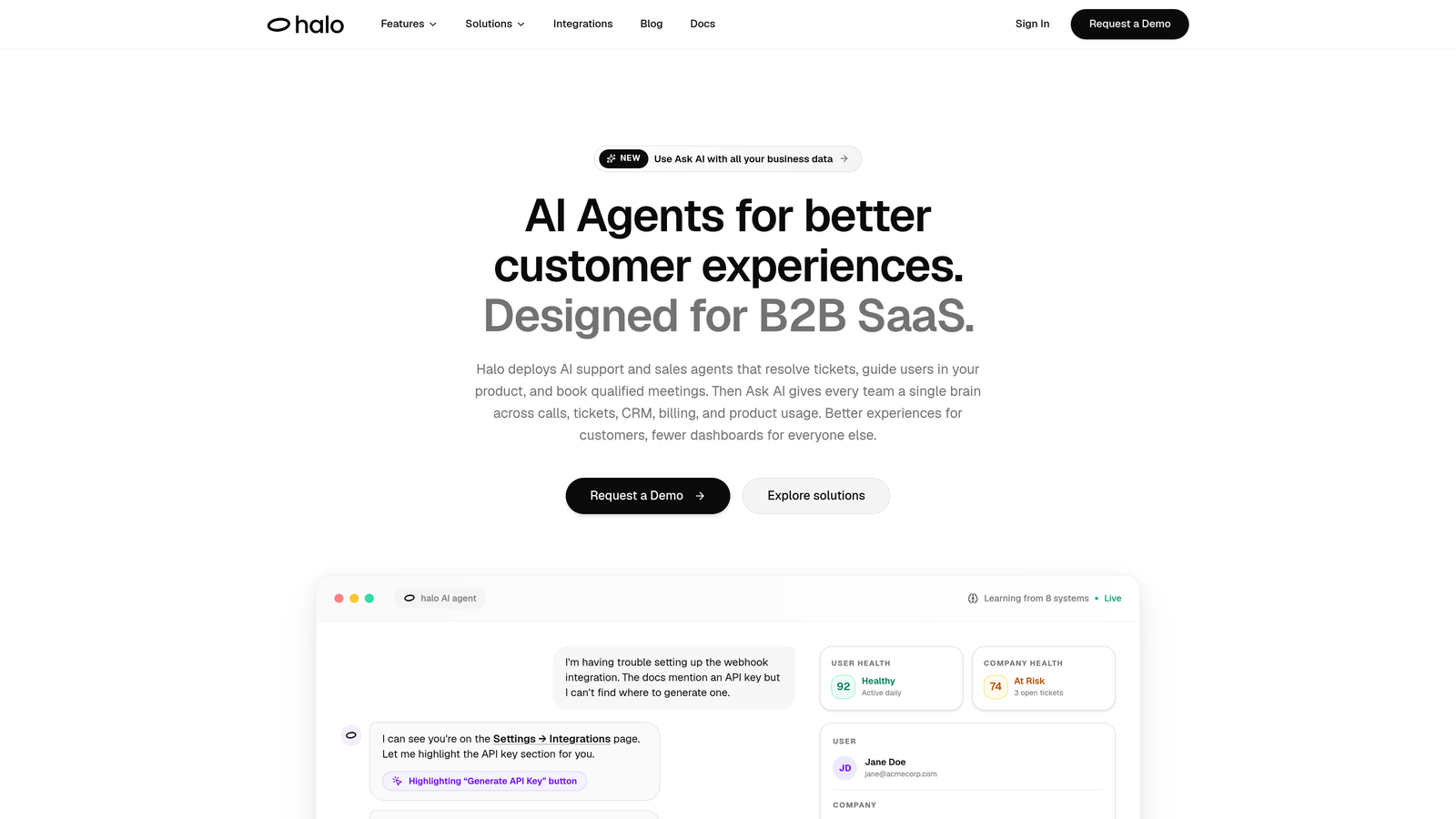
Halo AI is an AI-first customer support platform that deploys intelligent agents to resolve tickets, guide users contextually, and surface business intelligence from every interaction.
Where This Tool Shines
Most support tools know what a user types. Halo AI knows where they are in your product when they type it. The page-aware chat widget gives the AI real context: it can see what the user sees, provide UI-specific guidance, and resolve issues that would otherwise require a human to walk through step by step.
What sets Halo apart from helpdesk-first platforms is that the AI isn't bolted on. It's the core architecture. Every resolved ticket feeds a learning loop that makes future resolutions faster and more accurate. The smart inbox doesn't just organize tickets; it surfaces customer health signals, revenue intelligence, and anomaly detection that your product and success teams can actually act on.
Key Features
Page-Aware Chat Widget: Sees the user's current product context and delivers UI-specific guidance, not generic answers.
Autonomous AI Agents: Resolves tickets end-to-end with continuous learning from every interaction, improving over time without manual retraining.
Smart Inbox with Business Intelligence: Surfaces customer health signals, revenue intelligence, and anomaly detection alongside standard ticket management.
Auto Bug Ticket Creation: Detects and routes bug reports directly to Linear or connected project tools without agent intervention.
Live Agent Handoff: Escalates complex issues to human agents with full conversation context preserved, so nothing gets repeated.
Deep Integration Stack: Connects natively with Linear, Slack, HubSpot, Intercom, Stripe, Zoom, PandaDoc, and Fathom.
Best For
SaaS product teams that want support automation with genuine business intelligence built in. Particularly well-suited to teams currently using Zendesk, Freshdesk, or Intercom who feel the AI layer is an afterthought rather than the foundation. Also strong for teams where bug detection and product feedback loops matter as much as ticket deflection.
Pricing
Contact for pricing; transparent tiered plans are available on the Halo AI website. Worth requesting a demo to map the right tier to your ticket volume and integration needs.
2. Intercom
Best for: Teams wanting a mature AI agent with strong CRM features and outbound messaging
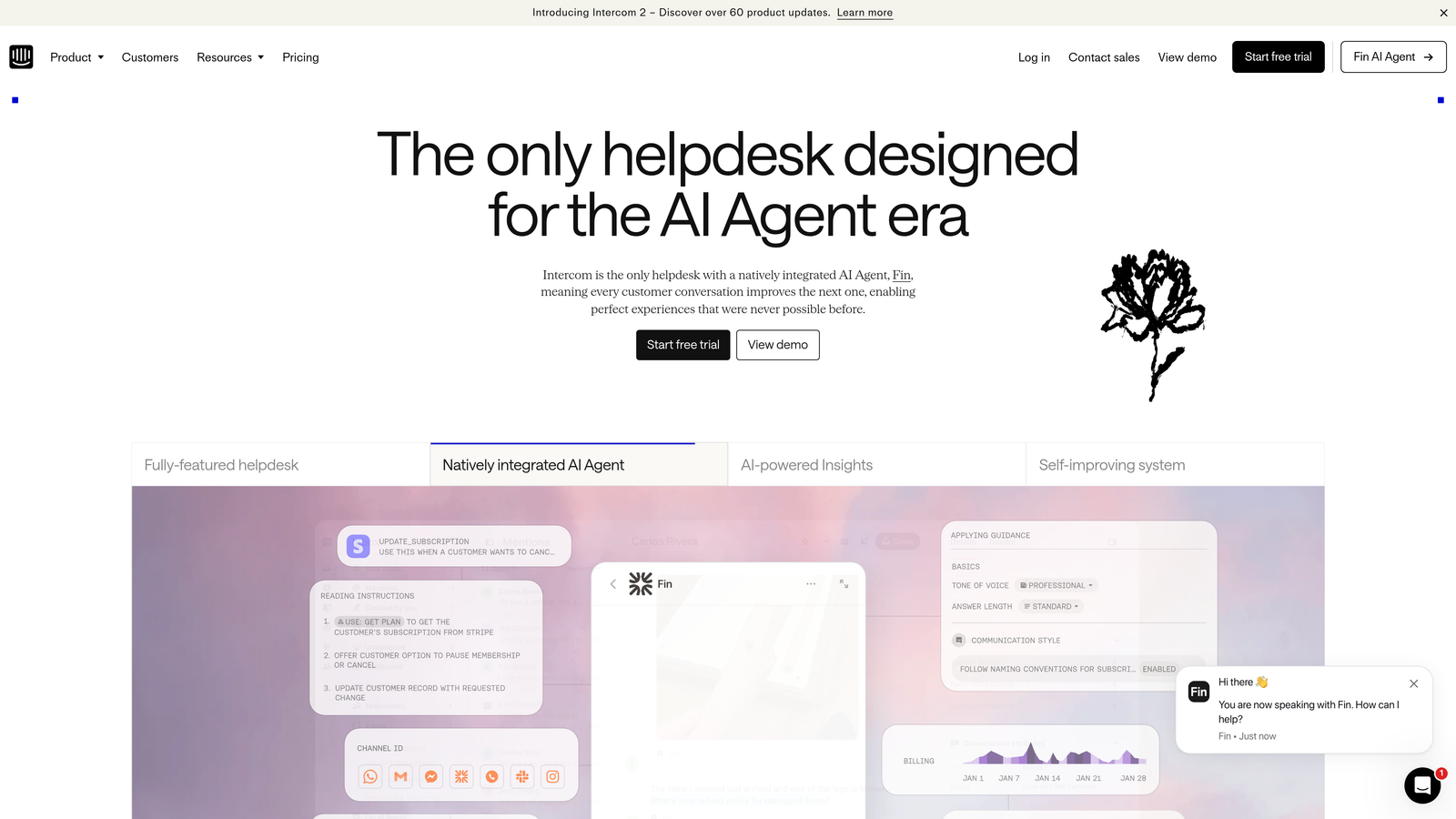
Intercom is a mature customer communications platform featuring Fin, an AI agent built on GPT-4 that handles support queries across chat, email, and help center channels.
Where This Tool Shines
Intercom's Fin AI agent is one of the most capable out-of-the-box AI support agents available. It's trained to resolve common queries using your help center content and can handle multi-step conversations without falling back to a human for routine issues. The quality of resolution is generally strong for teams with well-documented help content.
Beyond support, Intercom bundles product tours, outbound messaging, and CRM-lite features into a single platform. For teams that want support and lifecycle messaging under one roof, this breadth is a genuine advantage. The trade-off is that pricing scales quickly with usage and seat count, which can become a budget concern at higher volumes.
Key Features
Fin AI Agent: GPT-4 powered agent that resolves support queries autonomously across chat, email, and help center channels.
Unified Inbox: Combines AI-handled and human-agent conversations in a single interface with full context.
Product Tours and Outbound Messaging: Extends beyond support into user onboarding and lifecycle communication.
Customer Data Profiles: CRM-lite features that give agents and AI access to user context and history.
Extensive App Marketplace: Large ecosystem of integrations and a robust API for custom connections.
Best For
Growth-stage SaaS teams that want AI support alongside outbound messaging and onboarding in one platform. Less ideal for teams with tight budgets at scale, where per-resolution pricing can add up quickly.
Pricing
Starts at approximately $39/month for base plans; Fin AI usage is billed per resolution at higher volumes. Verify current pricing on the Intercom website as plans change frequently.
3. Zendesk
Best for: Enterprise teams needing complex workflow management, SLAs, and compliance controls
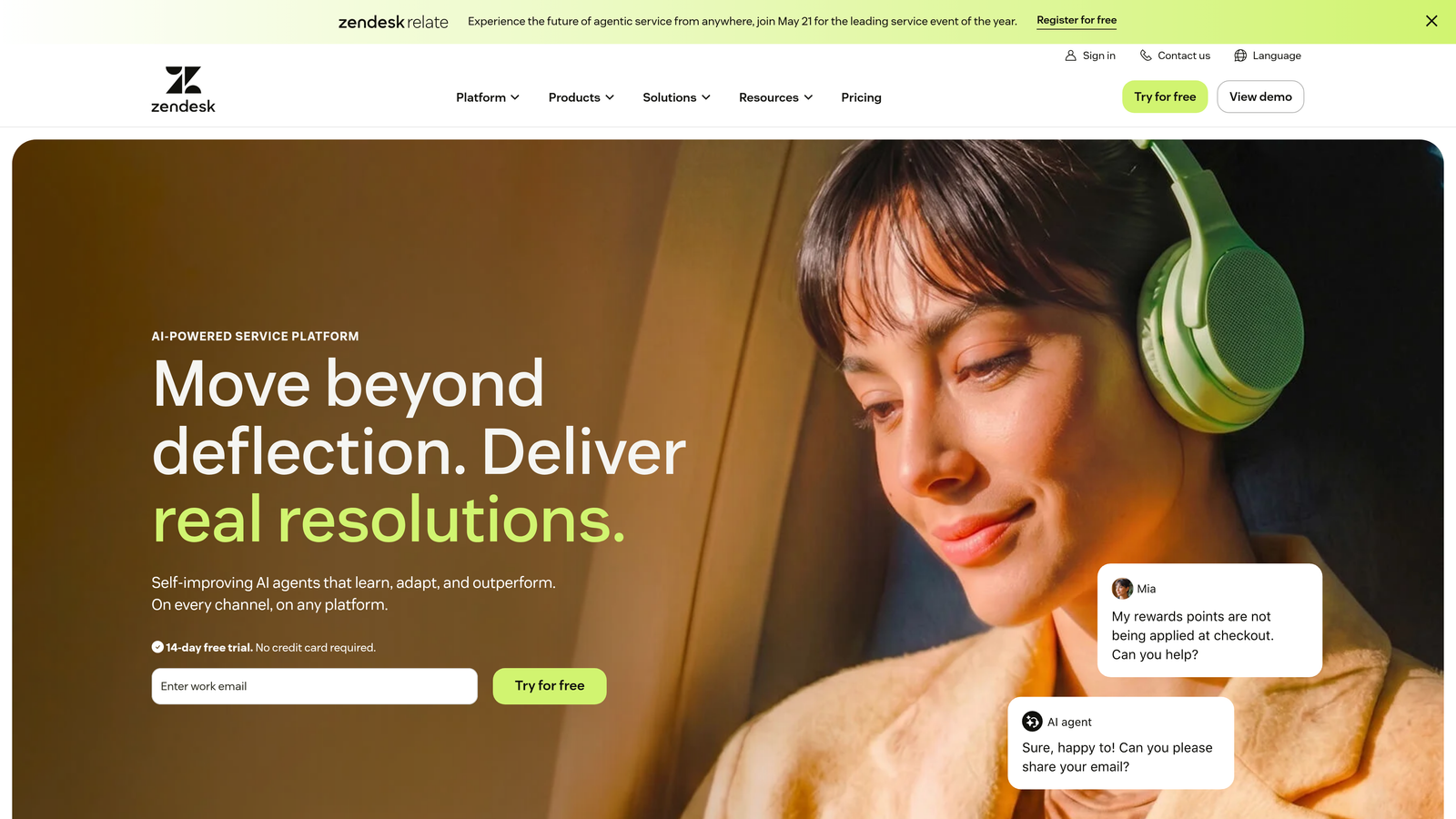
Zendesk is the enterprise-standard helpdesk platform with AI Agents, intelligent triage, and a vast ecosystem of integrations built on decades of ticketing infrastructure.
Where This Tool Shines
Zendesk's strength is workflow depth. No other platform matches its combination of SLA management, routing logic, reporting granularity, and compliance tooling. For enterprise teams with complex support operations, multiple tiers of agents, and strict regulatory requirements, Zendesk provides infrastructure that genuinely scales.
The AI capabilities have improved substantially in recent years. AI Agents handle first-response automation and can resolve common queries, while intelligent triage routes tickets based on intent and sentiment. That said, the AI layer still feels more assistant-oriented than fully autonomous, which matters if ticket deflection rate is your primary metric.
Key Features
AI Agents: Automated first-response and ticket resolution for common query types.
Intelligent Triage: Routes tickets based on detected intent, sentiment, and priority signals.
Advanced SLA Management: Comprehensive reporting and SLA enforcement across teams and channels.
1,000+ Marketplace Integrations: One of the broadest integration ecosystems in customer support software.
Enterprise Compliance Controls: Security certifications, data residency options, and access controls for regulated industries.
Best For
Enterprise support teams with complex routing needs, strict SLAs, and compliance requirements. May be more infrastructure than necessary for smaller teams or those prioritizing autonomous AI resolution over workflow management.
Pricing
Suite plans start at approximately $55/agent/month; AI features are available on higher-tier plans. Enterprise pricing requires a custom quote.
4. Freshdesk
Best for: Teams graduating from email-only support who want affordable, multi-channel helpdesk with AI assistance
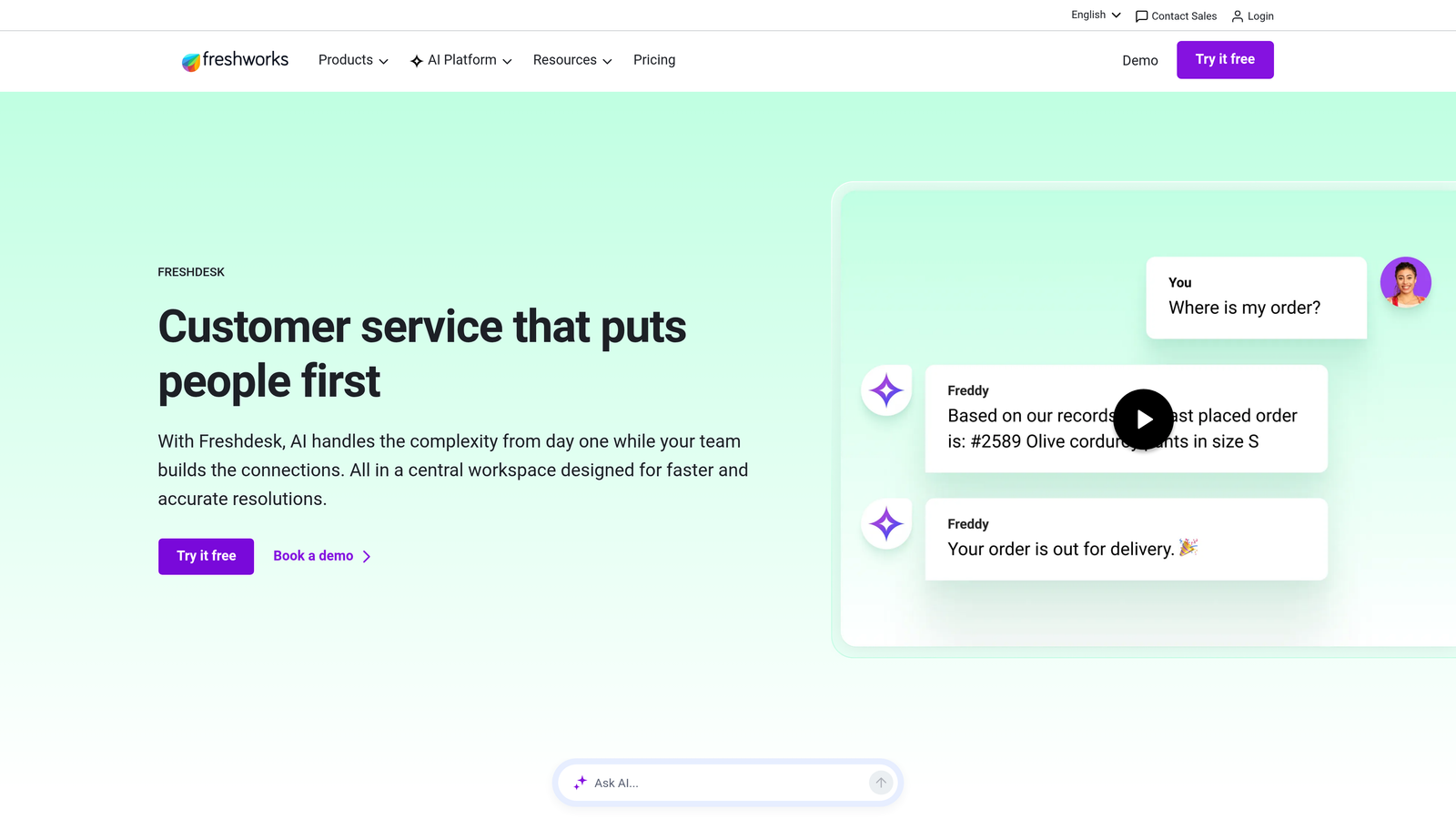
Freshdesk is a helpdesk platform from Freshworks featuring Freddy AI for ticket automation, agent assistance, and self-service, positioned as a more affordable alternative to Zendesk.
Where This Tool Shines
Freshdesk hits a sweet spot for mid-market teams that need more than a shared inbox but aren't ready for enterprise-tier complexity or pricing. Freddy AI covers practical automation needs: auto-tagging incoming tickets, suggesting responses, and flagging similar issues. It's not the most autonomous AI in this list, but it meaningfully reduces repetitive work for agents.
The pricing structure is genuinely accessible, with a free plan for small teams and paid tiers that remain competitive even as you add agents. Freddy Copilot and Freddy Self Service are distinct add-ons, so you can layer in AI capabilities as your needs grow rather than paying for everything upfront.
Key Features
Freddy AI Automation: Auto-tagging, ticket suggestions, and canned response recommendations to reduce agent workload.
Freddy Self Service: Build AI-powered chatbots for customer-facing self-service without code.
Freddy Copilot: Agent productivity assistant for drafting responses and navigating complex issues.
Multi-Channel Support: Handles email, chat, phone, and social from a unified inbox.
Collision Detection: Prevents multiple agents from working the same ticket simultaneously.
Best For
Teams moving beyond email-only support, particularly those who find Zendesk's pricing prohibitive. Good for companies that want to introduce AI assistance gradually without committing to a fully autonomous architecture.
Pricing
Free plan available for small teams; paid plans start at approximately $15/agent/month. Freddy AI features are available as add-ons on higher tiers.
5. Tidio
Best for: E-commerce and small business teams wanting fast AI chatbot deployment with minimal setup
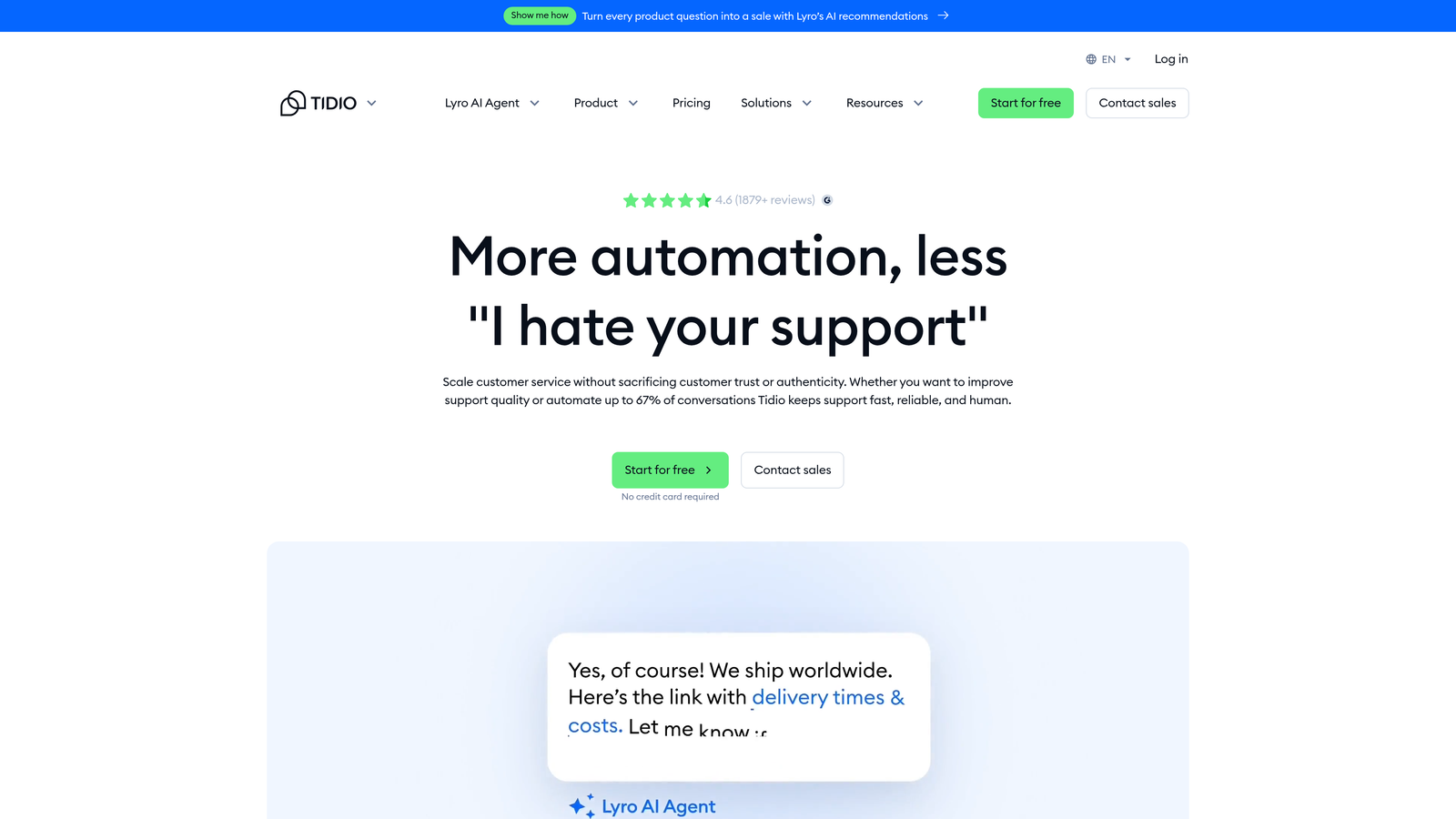
Tidio is a customer service platform built around Lyro, an AI chatbot that handles common questions using your existing content, popular with e-commerce and small business teams.
Where This Tool Shines
Tidio's primary advantage is speed to value. You can have Lyro trained on your FAQ content and deployed on your site in a matter of hours, not weeks. For e-commerce teams dealing with repetitive questions about orders, shipping, and returns, this is a genuine time-saver that doesn't require technical resources to set up.
The Shopify and WooCommerce integrations are particularly well-executed, giving Lyro access to order data so it can answer customer-specific questions rather than just generic FAQ responses. The visual automation flow builder also lets non-technical teams create custom conversation paths without writing a line of code.
Key Features
Lyro AI Chatbot: Trained directly on your FAQ and help content to answer common questions autonomously.
No-Code Deployment: Pre-built templates and a visual builder mean setup requires no technical resources.
E-Commerce Integrations: Native Shopify and WooCommerce connections with order data access.
Live Chat Fallback: Seamlessly routes to a human agent when Lyro cannot resolve the query.
Visual Automation Builder: Drag-and-drop flow builder for custom conversation paths and triggers.
Best For
E-commerce teams and SMBs with high volumes of repetitive, content-answerable questions. Less suited for complex B2B SaaS workflows, multi-step technical troubleshooting, or teams that need deep CRM and project tool integrations.
Pricing
Free plan available; Lyro AI plans start at approximately $29/month, scaling with conversation volume.
6. Drift (Salesloft)
Best for: Revenue teams blending support, lead qualification, and sales conversations in one interface
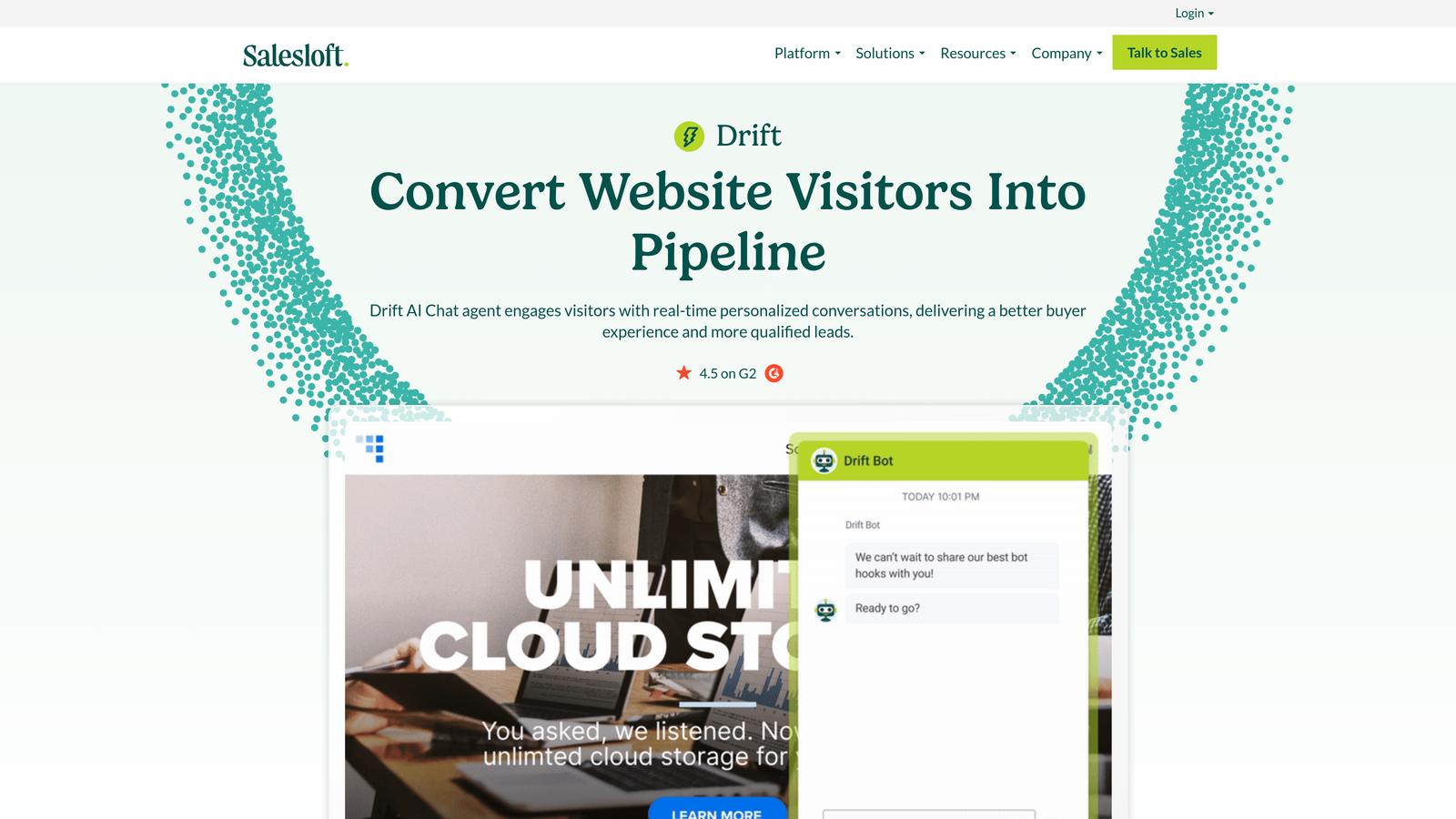
Drift is a conversational AI platform now part of Salesloft, designed for revenue teams that want to blend support, qualification, and sales conversations in a single AI-powered interface.
Where This Tool Shines
Drift occupies a unique position in this list: it's not purely a support tool. Its AI chatbot is designed to detect buyer intent and route conversations accordingly, whether that means answering a support question, qualifying a lead, or booking a meeting with a sales rep. For teams where the line between support and sales is deliberately blurry, this is a strong fit.
The Salesforce and HubSpot integrations are deep and well-maintained, and the account-based targeting lets you serve different conversation experiences to known prospects versus existing customers. Since the Salesloft acquisition, the product has leaned further into revenue team use cases, which means pure support teams may find it more than they need.
Key Features
Intent-Aware AI Chatbot: Detects buyer intent and routes conversations to support, sales, or meeting booking accordingly.
CRM Integration: Deep Salesforce and HubSpot integration with real-time data sync.
Meeting Scheduling: Built-in calendar routing connects visitors directly to the right rep.
Revenue Attribution: Conversation intelligence that ties chat interactions to pipeline and revenue outcomes.
Account-Based Targeting: Serves personalized conversation experiences to known accounts and visitors.
Best For
B2B revenue teams that want a single conversational layer for support and sales. Not the right choice for teams focused purely on ticket deflection or those without a sales motion that benefits from chat-based qualification.
Pricing
Enterprise pricing; contact Salesloft for current plans. Pricing is not publicly listed and typically requires a sales conversation.
7. Help Scout
Best for: Teams where relationship quality is the primary metric and AI should assist, not replace, agents
Help Scout is a customer support platform that deliberately keeps humans at the center, using AI to assist agents rather than replace them, built for teams where relationship quality matters most.
Where This Tool Shines
Help Scout's philosophy is refreshingly honest: it's not trying to automate your support team out of existence. The AI features (Summarize, Assist, Drafts) are designed to make agents faster and more effective, not to handle conversations autonomously. For teams in professional services, high-touch SaaS, or any context where a customer expects to talk to a real person, this approach is the right one.
The shared inbox is clean and well-designed, the Docs knowledge base integrates naturally with the support workflow, and the customer profiles give agents the context they need to respond personally. If ticket deflection rate is your primary KPI, Help Scout isn't the right tool. If customer satisfaction and agent experience are the metrics you care about most, it's worth a serious look.
Key Features
AI Summarize: Instantly condenses long conversation threads so agents get context without reading every message.
AI Assist: Drafts replies and suggests tone improvements to help agents respond faster and more effectively.
Shared Inbox: Collision detection and internal notes keep teams aligned without duplicating effort.
Docs Knowledge Base: AI-powered search helps customers self-serve before reaching an agent.
Customer Profiles: Full conversation history and customer data accessible from every ticket.
Best For
High-touch B2B teams, professional services, and any company where personal relationships drive retention. Not the right fit if autonomous ticket resolution and deflection are the primary goals.
Pricing
Starts at approximately $22/user/month. Pricing is transparent and tiered based on team size and feature needs.
8. Kustomer
Best for: High-volume consumer brands needing AI agents with full customer history and order data access
Kustomer is a CRM-native support platform owned by Meta that gives AI agents access to complete customer history, order data, and interaction timelines, built for high-volume consumer support.
Where This Tool Shines
Kustomer's CRM-native architecture is its defining advantage. Unlike platforms where customer data lives in a separate CRM and gets pulled in via integration, Kustomer treats the full customer timeline as the primary object. AI agents can see order history, previous interactions, billing events, and behavioral data all in one place, which dramatically improves the quality and relevance of automated responses.
This depth makes Kustomer particularly powerful for consumer brands dealing with order-related support at scale. The omnichannel coverage is comprehensive, handling email, chat, SMS, social, and voice from a single interface. The trade-off is pricing: Kustomer sits at the enterprise tier, and the cost per user reflects that.
Key Features
CRM-Native Architecture: Full customer timeline view with order, billing, and interaction history as the foundation for every AI interaction.
AI Agents with Data Access: Automated agents that can reference complete customer history to resolve issues accurately.
Omnichannel Coverage: Email, chat, SMS, social, and voice managed from a single unified interface.
Event-Triggered Workflows: Automated workflows triggered by customer events like order status changes or billing failures.
Business Intelligence and CSAT: Built-in reporting on support performance and customer satisfaction.
Best For
High-volume consumer brands, particularly in e-commerce and subscription businesses, where AI agents need access to rich customer and order data to resolve issues autonomously. Enterprise budget required.
Pricing
Enterprise pricing; starts at approximately $89/user/month. Custom quotes available for larger teams.
9. Chatbase
Best for: Teams wanting a fast, affordable GPT-powered chatbot trained on their own documentation
Chatbase is a lightweight, no-code chatbot builder that lets you train a GPT-powered bot on your own documentation, website content, or uploaded files, with minimal setup required.
Where This Tool Shines
Chatbase earns its place on this list through sheer accessibility. If you have a knowledge base, a PDF, or a website, you can have a working GPT-4 chatbot deployed in under an hour. For small teams, early-stage startups, or anyone who needs a basic FAQ bot without the overhead of a full support platform, this is a genuinely useful starting point.
The important caveat is that Chatbase is a chatbot builder, not a support platform. There's no ticketing, no escalation workflows, no SLA management, and no deep integrations with CRM or project tools. Basic analytics cover questions asked and resolution rates, but that's the extent of the intelligence layer. Think of it as a smart FAQ widget rather than a support automation system.
Key Features
Flexible Training Sources: Train on PDFs, URLs, Notion pages, or plain text with no technical setup required.
Embeddable Widget: Deploy on any website with a simple embed code.
GPT-4 Responses: Answers grounded in your uploaded content, reducing hallucination risk.
Basic Analytics: Tracks questions asked and resolution rates to identify content gaps.
API Access: Allows custom integrations for teams with development resources.
Best For
Early-stage startups, small teams, or anyone who needs a fast, affordable FAQ chatbot without full platform complexity. A useful first step, but teams will likely outgrow it as support volume and complexity increase.
Pricing
Free plan available; paid plans start at approximately $19/month, scaling with message volume and chatbot count.
Which Tool Is Right for Your Team?
The right customer support automation software depends on what you're actually optimizing for. Here's a quick guide to cut through the decision fatigue.
If you're a SaaS product team wanting AI-first automation with business intelligence: Halo AI is the strongest fit. Page-aware context, continuous learning, auto bug ticket creation, and revenue intelligence make it purpose-built for this use case in a way that helpdesk-first platforms simply aren't.
If you need enterprise workflow depth with compliance controls: Zendesk remains the industry standard. The AI is improving, and no platform matches its routing and SLA infrastructure for complex enterprise operations.
If you want AI support alongside outbound messaging and onboarding: Intercom's Fin AI agent and ecosystem breadth make it a strong choice for growth-stage SaaS teams managing multiple customer touchpoints.
If you're budget-conscious and graduating from email-only support: Freshdesk offers the best value at the mid-market tier, with AI features you can layer in gradually.
If you run an e-commerce or SMB operation: Tidio's Lyro chatbot and Shopify integrations make it the fastest path to automated FAQ resolution without technical overhead.
If relationship quality is your primary metric: Help Scout's human-centered approach with AI assistance is the right philosophy for high-touch teams.
One principle holds across all of these: support shouldn't scale linearly with your customer base. The best tools in this list let AI agents handle routine tickets, guide users through your product, and surface intelligence while your team focuses on complex issues that genuinely need a human touch.
If the Halo AI approach resonates with your situation, see Halo in action and discover how continuous learning transforms every support interaction into smarter, faster resolution at scale.