9 Best Chatbot vs AI Agent Tools for Customer Service in 2026
This comprehensive guide compares nine customer service platforms across the chatbot vs AI agent spectrum, helping businesses identify the right automation tool based on capability, cost, and scalability. From rule-based chatbots to fully autonomous AI agents, the breakdown covers what each platform actually delivers, who it's designed for, and how it impacts both customer experience and team efficiency.
 Matt PattoliFounder14 min read
The debate between chatbots and AI agents for customer service isn't just semantic. It defines how your support scales, how customers feel, and how much your team can actually accomplish without burning out. Traditional chatbots follow scripts. AI agents reason, act, and learn. But the market is crowded with tools that claim to be one thing and deliver another.
This guide cuts through the noise by comparing nine platforms across the full spectrum: from rule-based chatbots to genuinely autonomous AI agents. Whether you're evaluating your first automation tool or replacing a legacy helpdesk bot, you'll find an honest breakdown of what each platform actually does, who it's built for, and what it costs. We've organized this list from the most capable AI-agent-first platforms down to specialized chatbot tools, so you can quickly identify where on the intelligence spectrum your needs fall.
What Separates a Chatbot from an AI Agent
Before diving into the tools, it's worth anchoring on a distinction that matters enormously for buyers. Rule-based chatbots follow decision trees or keyword triggers. They can't handle novel inputs, and they don't improve over time. Retrieval-augmented chatbots add GPT-style language understanding but remain passive: they answer questions from a knowledge base without taking action. AI agents go further. They reason over context, take multi-step actions (creating tickets, updating CRMs, triggering workflows), and learn from every interaction.
When evaluating any tool in this list, ask three questions: Can it take actions, not just answer? Does it learn from interactions? Can it hand off gracefully to humans? The answers will tell you far more than any vendor's marketing copy.
1. Halo AI
Best for: B2B SaaS teams that want a true AI-agent architecture with page-aware context and business intelligence.
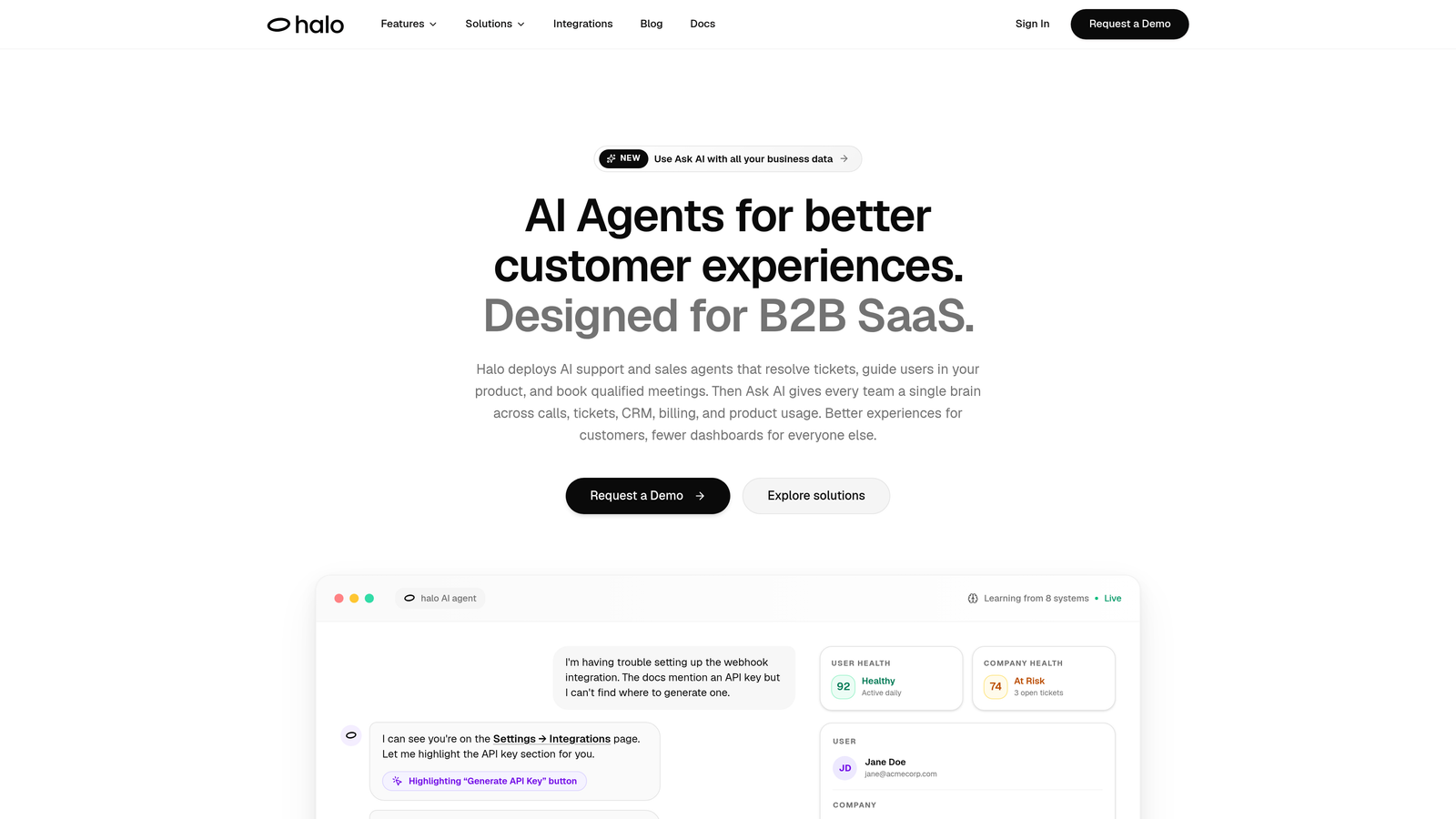
Halo AI is an AI-first customer support platform that deploys autonomous agents to resolve tickets, guide users visually through your product, and surface business intelligence—all while learning from every interaction.
Where This Tool Shines
What genuinely sets Halo apart is page-awareness. The AI agent sees what the user sees in your product UI, enabling it to provide contextual visual guidance rather than generic text answers. That's a meaningful architectural difference from tools that only read a knowledge base and respond.
Beyond resolution, Halo's smart inbox surfaces business intelligence that most support tools ignore entirely: customer health signals, revenue intelligence, and anomaly detection. Your support data becomes a strategic asset, not just a queue to clear.
Key Features
Page-Aware Chat Widget: The agent understands which page or feature a user is on, delivering contextual guidance that matches their exact moment of confusion.
Autonomous Ticket Resolution: AI agents resolve support tickets independently and continuously learn from each resolved interaction to improve future responses.
Auto Bug Ticket Creation: Product issues are automatically identified and routed as bug reports directly to Linear, closing the loop between support and engineering without manual triage.
Smart Inbox with Business Intelligence: Goes beyond deflection metrics to surface customer health signals, revenue intelligence, and anomaly detection across your support data.
Live Agent Handoff: When escalation is needed, full conversation context is preserved so human agents never start cold.
Deep Integrations: Connects natively with Linear, Slack, HubSpot, Intercom, Stripe, Zoom, PandaDoc, and Fathom.
Best For
Product-led B2B SaaS companies that want support automation to do more than deflect tickets. Particularly strong for teams using Linear for engineering, where the auto bug routing creates genuine workflow value. Also well-suited for companies that want support data to inform customer success and revenue decisions.
Pricing
Contact for pricing at haloagents.ai. Custom pricing reflects the platform's enterprise-grade capabilities and integration depth.
2. Intercom Fin
Best for: Teams already on Intercom who want to add autonomous AI resolution without switching platforms.
Intercom Fin is Intercom's AI agent product, built on GPT-4 and trained on your help center content, designed to resolve customer questions autonomously within the Intercom ecosystem.
Where This Tool Shines
Fin's biggest advantage is how naturally it fits into existing Intercom workflows. If your team already lives in Intercom Inbox, Fin adds autonomous resolution without any platform migration. The handoff experience between Fin and human agents is notably smooth, with context preserved throughout.
The consumption-based pricing model is worth noting. You pay per resolution rather than per seat, which can be cost-effective for teams with high ticket volumes but variable complexity.
Key Features
GPT-4 Powered Resolution: Trained on Intercom Articles and custom content sources including PDFs and URLs for accurate, contextual answers.
Seamless Human Handoff: Routes to human agents in Intercom Inbox with full conversation context when Fin can't resolve an issue.
Multi-Source Knowledge Ingestion: Pulls from help center content, uploaded PDFs, and external URLs to build a comprehensive knowledge base.
Consumption-Based Pricing: Charges per resolution rather than per seat, aligning cost directly with value delivered.
Multi-Channel Availability: Operates across web messenger and email channels within the Intercom environment.
Best For
Companies already invested in the Intercom platform who want to add AI resolution without adopting a new tool. Less compelling for teams not on Intercom, since Fin's strengths are deeply tied to that ecosystem.
Pricing
Consumption-based pricing per resolution. Check intercom.com for current rates, as pricing structure evolves frequently.
3. Zendesk AI
Best for: Enterprise teams running Zendesk Suite who want AI layered natively into their existing ticketing workflows.
Zendesk AI is Zendesk's native AI layer that adds intelligent triage, autonomous resolution, macro suggestions, and agent-assist capabilities directly within the Zendesk ticketing environment.
Where This Tool Shines
Zendesk AI's strength is integration depth. Because it's built directly into Zendesk Suite, it has access to your full ticket history, customer data, and existing workflows from day one. There's no data migration, no API setup, and no parallel system to maintain.
The Agent Copilot feature is particularly useful for complex support teams. Suggested replies, ticket summarization, and next-action recommendations reduce the cognitive load on human agents handling escalated issues.
Key Features
Intelligent Triage and Routing: Automatically categorizes and routes tickets based on detected intent and sentiment, reducing manual sorting.
Autonomous Bot Resolution: Handles common queries without agent involvement, with escalation paths when needed.
Agent Copilot: Provides suggested replies, ticket summaries, and recommended next actions to speed up human agent responses.
Deep Native Integration: Works within existing Zendesk Suite workflows, triggers, and reporting without additional configuration.
Enterprise Reporting: Robust analytics on resolution rates, deflection, and AI performance at scale.
Best For
Mid-market to enterprise companies already running Zendesk Suite. If you're not on Zendesk, the switching cost to access these features is substantial. For existing Zendesk customers, it's a natural upgrade path.
Pricing
Included in higher Zendesk Suite tiers. Check zendesk.com for current plan details and which AI features are available at each tier.
4. Freshdesk Freddy AI
Best for: Freshdesk users who want both agent-assist and customer-facing automation from a single, natively integrated AI layer.
Freshdesk Freddy AI is Freshworks' AI layer for Freshdesk, split into Freddy Copilot for agent assistance and Freddy Self Service for customer-facing automation, both natively embedded in the platform.
Where This Tool Shines
Freddy's dual-mode structure is genuinely useful. Most AI support tools focus on one side of the equation: either helping customers self-serve or helping agents work faster. Freddy does both within the same platform, which simplifies the vendor relationship and keeps data unified.
The native Freshdesk integration means setup is straightforward for existing Freshdesk customers. There's no separate bot platform to configure or maintain alongside your ticketing system.
Key Features
Freddy Copilot: Provides agents with suggested replies, ticket summarization, and next-action recommendations to accelerate response times.
Freddy Self Service: Customer-facing bot trained on your knowledge base to handle common queries before they reach the queue.
Native Freshdesk Integration: No separate setup required; works within existing Freshdesk workflows and data structures.
Multilingual Support: Handles customer conversations across multiple languages within the same platform.
Deflection Analytics: Dashboard tracking resolution and deflection rates to measure AI impact over time.
Best For
Growing teams on Freshdesk who want to add AI capabilities without adopting a separate platform. Particularly useful for support teams managing both self-service and agent workflows from a single tool.
Pricing
Available on Growth and higher Freshdesk plans. Check freshworks.com for current pricing and tier availability.
5. Tidio Lyro
Best for: Small to mid-sized e-commerce businesses that want conversational AI without a complex setup process.
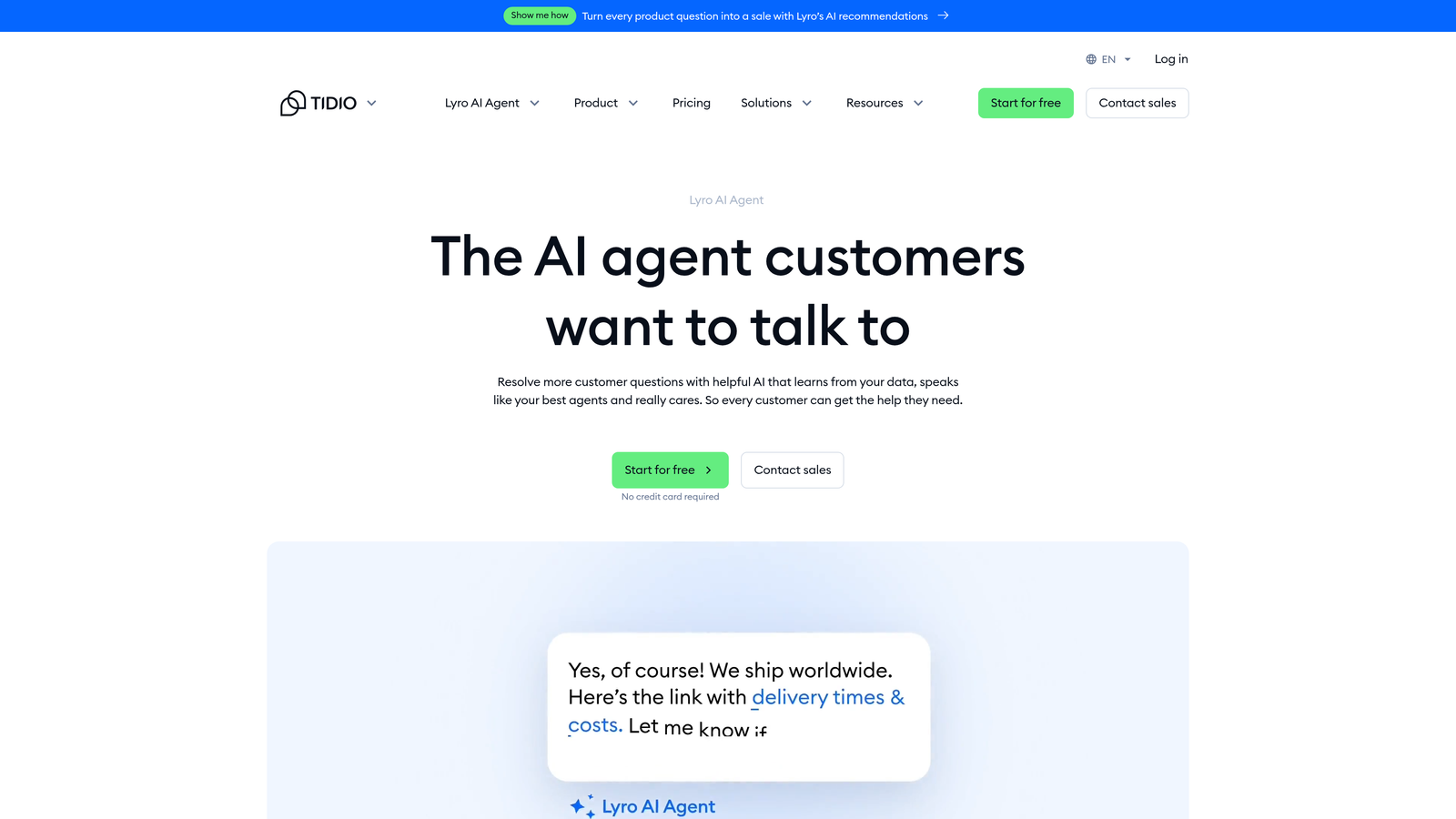
Tidio Lyro is Tidio's conversational AI product, distinct from their rule-based chatbot builder, that handles customer conversations autonomously using your uploaded knowledge base content.
Where This Tool Shines
Lyro's approachability is its defining quality. Powered by Claude from Anthropic, it produces natural, accurate conversations from a relatively simple setup: upload your FAQs or knowledge base, and Lyro starts handling conversations. For smaller teams without dedicated AI implementation resources, that low barrier matters.
The combination of Lyro's conversational AI with Tidio's existing live chat and rule-based automation in a single platform gives e-commerce teams a layered automation stack without juggling multiple tools.
Key Features
Claude-Powered Conversations: Uses Anthropic's Claude model for natural, contextually accurate customer interactions.
Minimal Setup: Learns from uploaded FAQs and knowledge base content with no complex configuration required.
Free Tier Available: Includes a limited number of Lyro conversations per month at no cost, making it accessible for early-stage teams.
Unified Platform: Combines conversational AI with Tidio's live chat and rule-based automation tools in one interface.
E-Commerce Integrations: Native connections to Shopify and WooCommerce for order-related support queries.
Best For
E-commerce businesses, particularly those on Shopify or WooCommerce, that want conversational AI without enterprise complexity or pricing. Less suited for B2B SaaS teams needing deep integrations or action-taking capabilities.
Pricing
Free tier available with limited monthly Lyro conversations. Paid plans start from approximately $39/month. Check tidio.com for current pricing.
6. Drift (Salesloft)
Best for: B2B revenue teams that need to blend sales qualification with support automation in a single chat interface.
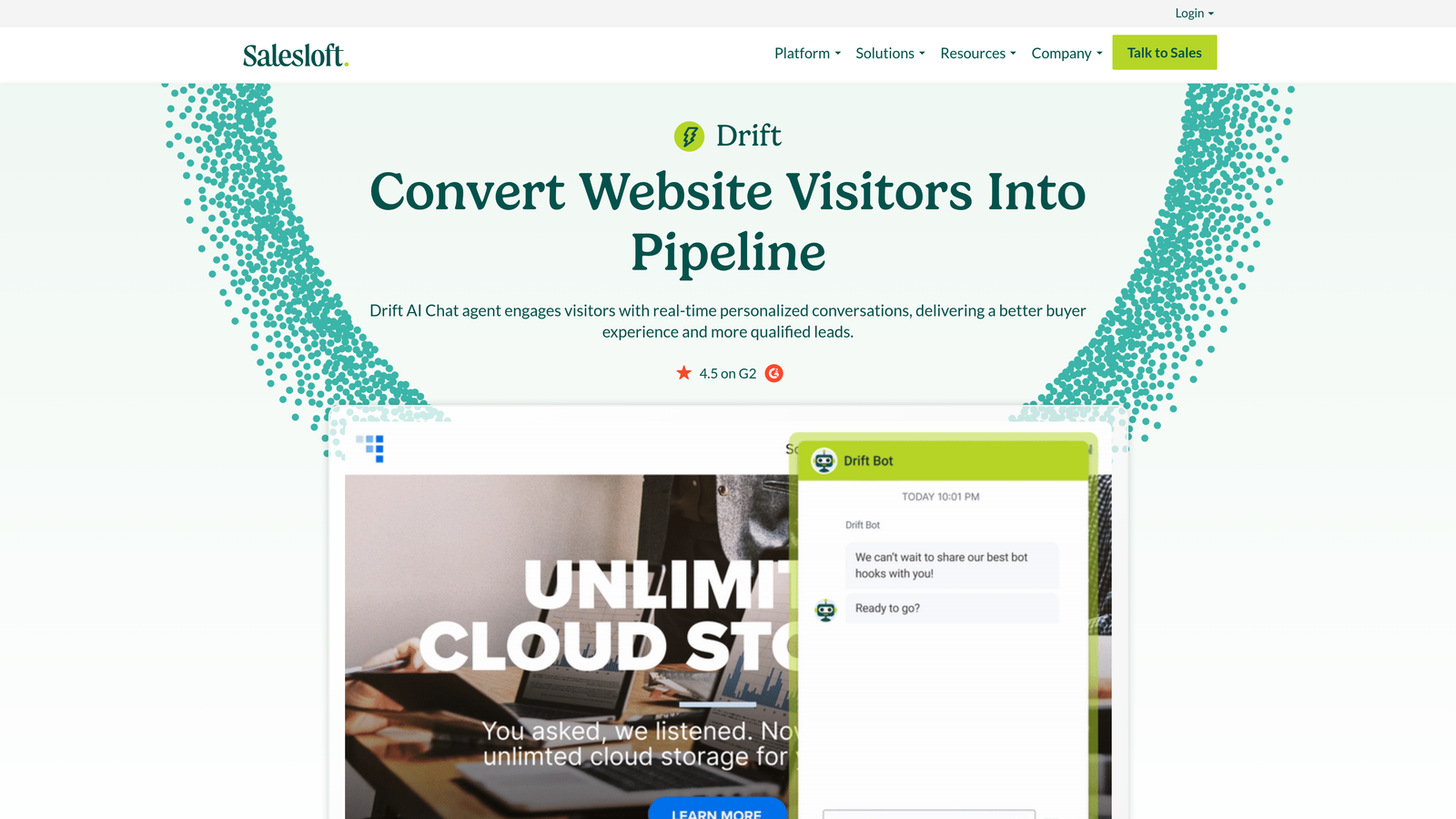
Drift, now operating under Salesloft, serves B2B revenue teams that need to blend sales qualification with support automation in a single conversational interface.
Where This Tool Shines
Drift's positioning has evolved since its Salesloft acquisition, leaning more heavily into revenue team use cases. Its strength is the ability to route a site visitor to sales or support based on detected intent, with CRM context informing that decision in real time. For companies where support and sales overlap on the website, that unified routing is genuinely valuable.
The Bionic Chatbots concept, combining AI with human-authored playbooks, gives revenue teams control over how conversations flow while still benefiting from AI-powered intent detection.
Key Features
Intent-Based Routing: AI detects whether a visitor needs sales or support and routes accordingly, reducing misrouted conversations.
Bionic Chatbots: Combines AI capabilities with human-authored playbooks for controlled, on-brand conversation flows.
CRM Integrations: Deep connections to Salesforce and HubSpot bring account-level context into every chat interaction.
Meeting Scheduling: Built-in calendar booking for sales conversations, embedded directly in chat flows.
Account-Based Personalization: Personalizes site experience based on firmographic and account data for known visitors.
Best For
B2B companies where the website serves both sales and support functions, and where routing quality directly affects pipeline. Less suited for pure support automation use cases without a sales motion attached.
Pricing
Premium and Enterprise tiers available. Check drift.com for current pricing details.
7. Chatbase
Best for: Startups and small teams that need a GPT-powered chatbot deployed quickly from existing documentation.
Chatbase is a no-code platform that lets you build and deploy a GPT-powered chatbot trained on your own documents, URLs, or text in minutes, with no engineering required.
Where This Tool Shines
Speed to deployment is Chatbase's headline advantage. You can upload a PDF, paste a URL, or drop in text, and have a functioning chatbot embedded on your website within the same session. For teams that need something live quickly, it's hard to beat.
It's worth being clear about what Chatbase is and isn't. It's a retrieval-augmented Q&A bot, not an AI agent. It answers questions from your content; it doesn't take actions, create tickets, or integrate deeply with your business stack. That's fine for many use cases, but important to understand before you buy.
Key Features
Rapid Training: Ingest PDFs, URLs, text, or Notion pages to train a chatbot in minutes without technical setup.
Embeddable Widget: Drop the chat widget onto any website with a simple embed code.
GPT-4 Responses with Citations: Answers questions with source references, improving transparency and user trust.
Basic Conversation Analytics: Tracks conversation topics and unanswered questions to identify knowledge base gaps.
API Access: Available on higher plans for teams that want to integrate Chatbase responses into custom workflows.
Best For
Early-stage startups, agencies, and small teams that need a fast, affordable way to add FAQ automation to their website. Not designed for complex support workflows, action-taking, or enterprise-scale ticket management.
Pricing
Free tier available. Paid plans start from approximately $19/month. Check chatbase.co for current pricing.
8. Ada
Best for: Enterprise teams that need autonomous resolution at scale with action-taking capabilities and multilingual support.
Ada is an enterprise-grade AI agent platform focused on autonomous resolution at scale, with strong multilingual support, action-taking via API integrations, and detailed resolution rate analytics.
Where This Tool Shines
Ada's emphasis on Automated Resolution Rate as a core performance metric reflects a mature approach to measuring AI support value. Rather than tracking deflection (a metric that can be gamed by blocking escalation paths), Ada focuses on whether issues are actually resolved, which aligns better with real customer outcomes.
The action-oriented architecture is also worth noting. Ada can perform tasks via API, not just answer questions. That puts it firmly in AI agent territory rather than enhanced chatbot, which matters for teams whose support workflows involve account lookups, order management, or CRM updates.
Key Features
Action-Taking via API: Goes beyond Q&A to perform tasks like account lookups, order updates, and workflow triggers through API integrations.
No-Code Bot Builder: Enterprise teams can configure and update the AI without engineering involvement for most changes.
Multilingual Support: Handles conversations across 50+ languages, making it viable for global support operations.
Automated Resolution Rate Metric: Core analytics focus on actual issue resolution rather than just deflection volume.
Omnichannel Deployment: Available across web, mobile, SMS, and social messaging channels from a single platform.
Best For
Larger enterprises with global customer bases, complex support workflows, and a need for genuine action-taking capabilities. The enterprise pricing and implementation complexity make it less accessible for smaller teams.
Pricing
Enterprise custom pricing. Check ada.cx for details and to request a demo.
9. ManyChat
Best for: E-commerce and DTC brands automating customer conversations on Instagram, WhatsApp, and Facebook Messenger.
ManyChat is the leading platform for automating customer conversations on social messaging channels, with a visual flow builder and growing AI features layered on top.
Where This Tool Shines
If your customers reach you through Instagram DMs, WhatsApp, or Facebook Messenger, ManyChat is the category leader. The visual flow builder is genuinely best-in-class for building automated conversation sequences on these channels, and the e-commerce integrations make order updates and cart recovery flows straightforward to configure.
ManyChat is primarily a flow-builder with AI intent detection added to improve routing. It's not designed for complex support ticketing or deep enterprise integrations. But for social commerce and DTC brands where messaging channel engagement drives revenue, it's a focused, effective tool.
Key Features
Visual Flow Builder: Drag-and-drop interface for building conversation flows on Instagram, WhatsApp, and Facebook Messenger.
AI Intent Detection: Identifies what a customer is asking to trigger the most relevant automation flow.
E-Commerce Integrations: Connects to Shopify for order status updates, cart recovery, and post-purchase sequences.
Broadcast Messaging: Enables proactive outreach to subscribers across connected messaging channels.
Free Plan Available: Basic automation accessible without a paid subscription, making it easy to start.
Best For
E-commerce, DTC, and creator economy brands that rely on social messaging channels for customer engagement and sales. Not the right fit for B2B SaaS teams needing ticket management, deep integrations, or complex support workflows.
Pricing
Free plan available. Pro plan starts from approximately $15/month. Check manychat.com for current pricing.
Choosing the Right Tool for Your Situation
The honest answer is that the best tool depends almost entirely on where you are today and what you actually need automation to do. Here's a quick framework to orient your decision.
If you're a B2B SaaS company that wants true AI-agent capabilities: Halo AI and Ada are the strongest options. Halo's page-aware context and business intelligence layer make it particularly compelling for product-led growth companies. Ada suits global enterprises with complex multilingual requirements.
If you're already on a major helpdesk platform: Zendesk AI and Freshdesk Freddy AI are the path of least resistance. You get AI capabilities without platform migration, and the native integration depth is hard to replicate with third-party tools.
If you're on Intercom and want autonomous resolution: Fin is the obvious first step. The consumption-based pricing and seamless handoff make it a natural extension of an existing Intercom investment.
If you're an e-commerce brand on social channels: ManyChat for messaging automation and Tidio Lyro for website chat cover most of what you need at accessible price points.
If you need something live this week with minimal setup: Chatbase gets you from zero to deployed faster than any other tool on this list. Just be clear-eyed that you're getting a Q&A bot, not an AI agent.
If your support and sales motions are intertwined: Drift's intent-based routing and CRM integrations serve revenue teams in ways that pure support tools don't.
The broader shift happening across all of these tools is worth naming: the market is moving from chatbots that deflect to AI agents that resolve. Deflection metrics measure how many customers you kept away from a human. Resolution metrics measure how many problems you actually solved. That distinction shapes everything from how you evaluate these tools to how you measure their success.
Your support team shouldn't scale linearly with your customer base. Let AI agents handle routine tickets, guide users through your product, and surface business intelligence while your team focuses on complex issues that need a human touch. See Halo in action and discover how continuous learning transforms every interaction into smarter, faster support.