9 Best Cloud-Based Support Automation Tools in 2026
This guide ranks the 9 best cloud based support automation tools available in 2026, evaluating each platform on AI maturity, integration depth, and B2B scalability. Whether you're a lean startup or a growing SaaS company, it cuts through the noise to match your team with the right automation solution — starting with Halo AI and covering every strong contender in the space.
 Matt PattoliFounder15 min read
Cloud-based support automation has moved from a nice-to-have to a competitive necessity. B2B teams are under pressure to resolve tickets faster, reduce headcount costs, and still deliver experiences that retain customers — all without rebuilding their entire support stack.
The tools in this list represent the strongest options available in 2026 for teams that want to automate meaningfully, not just deflect tickets into a void. We've evaluated platforms based on AI maturity, integration depth, scalability for B2B use cases, and how well they fit teams already using helpdesks like Zendesk, Freshdesk, or Intercom.
Whether you're a lean startup looking to punch above your weight or a scaling SaaS company trying to get ahead of support volume, there's a tool here that fits. Halo AI leads the list because it's purpose-built for this use case, but every platform here earned its spot.
1. Halo AI
Best for: AI-first SaaS teams that want autonomous ticket resolution with deep product and business context.
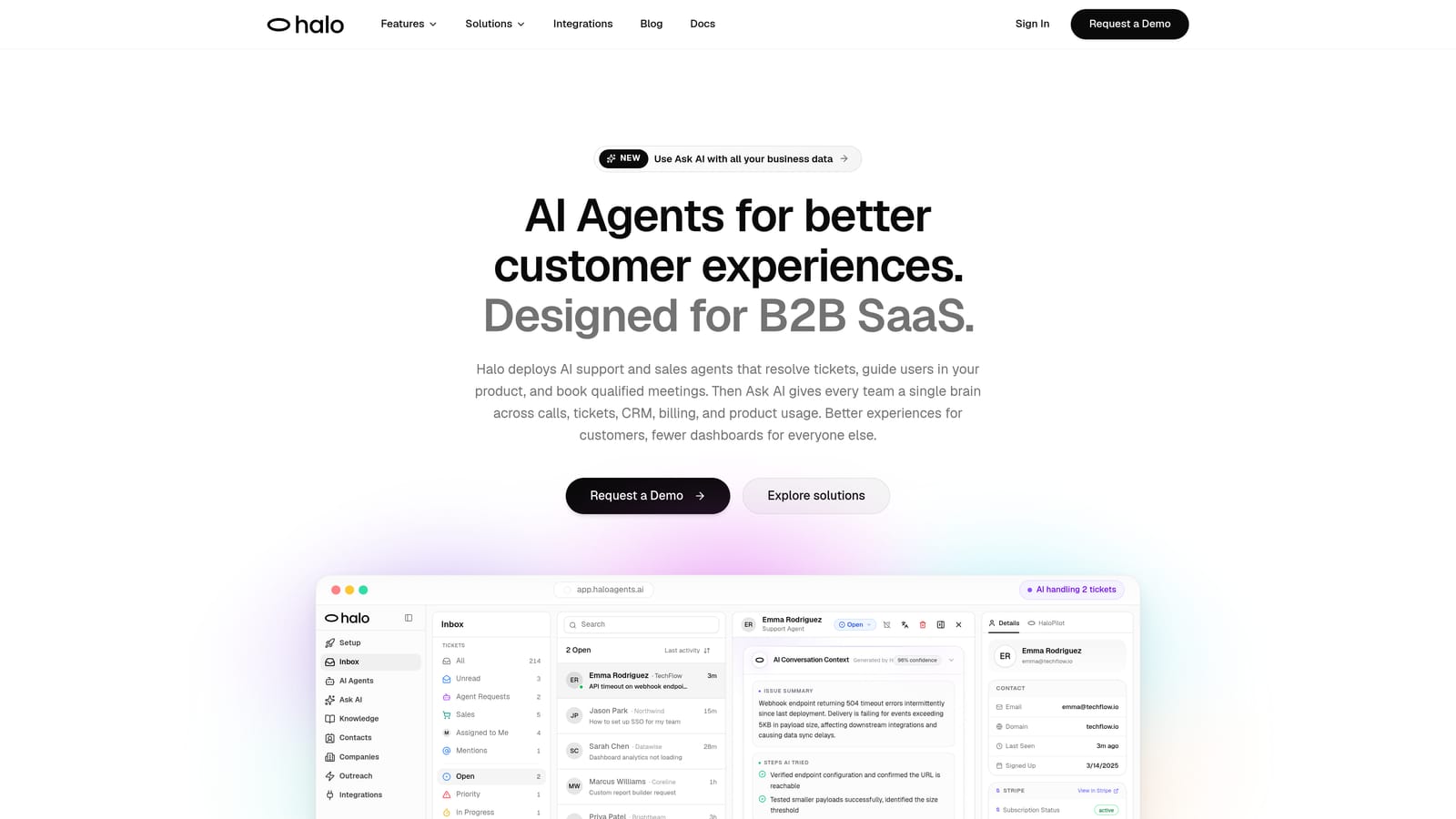
Halo AI is an AI-first customer support platform that deploys intelligent agents to resolve tickets, guide users through your product, auto-create bug reports, and surface business intelligence — all while learning from every interaction.
Where This Tool Shines
What separates Halo AI from most tools on this list is its architecture. Rather than layering AI onto an existing helpdesk, Halo was built AI-first from the ground up. That distinction matters because the automation logic is coherent throughout — there's no legacy ticketing system fighting against the intelligence layer.
The page-aware chat widget is particularly notable. The AI can see what a user is looking at inside your product when they initiate a conversation, enabling contextual guidance rather than generic scripted responses. For SaaS products with complex interfaces, this changes the quality of automated support meaningfully.
Key Features
Page-Aware Context: The chat widget understands where users are in your product, enabling guidance that's specific to their current screen rather than generic FAQ responses.
Autonomous Ticket Resolution with Escalation: AI agents resolve tickets end-to-end and escalate complex issues to live agents with full conversation context preserved.
Smart Inbox with Business Intelligence: Surfaces customer health signals, anomaly detection, and revenue intelligence from support interactions, turning support data into strategic insight.
Auto Bug Ticket Creation: Automatically generates structured bug reports from support conversations and routes them to your engineering workflow.
Deep Integration Stack: Connects to Linear, Slack, HubSpot, Intercom, Stripe, Zoom, PandaDoc, and Fathom — not just your helpdesk, but your entire business stack.
Continuous Learning: Improves from every resolved interaction, meaning the system gets smarter the more it handles.
Best For
Halo AI is the strongest fit for SaaS product teams that want AI agents doing real work, not just routing tickets. If your support team is drowning in repetitive queries, you're losing bug signal in your inbox, or you want support data to inform customer success and product decisions, this is the platform to evaluate first.
Pricing
Contact for pricing. You can book a demo directly at haloagents.ai/demo to see the platform in action and discuss a plan that fits your team size and use case.
2. Intercom
Best for: Mid-market SaaS teams wanting a unified platform for support, onboarding, and proactive messaging.
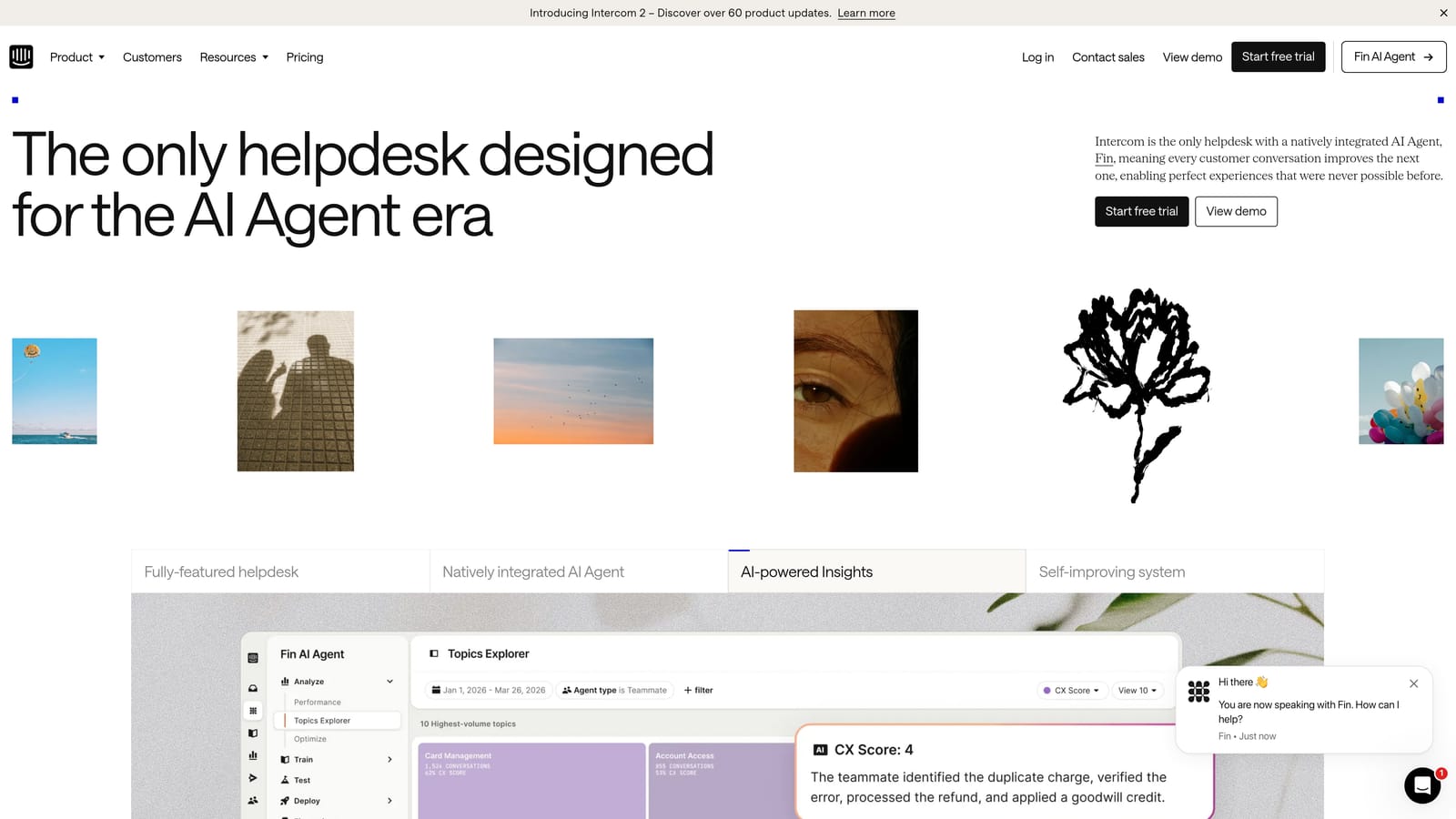
Intercom is an all-in-one customer messaging platform featuring Fin, its AI agent built on large language models, alongside live chat, proactive messaging, and a mature integration ecosystem.
Where This Tool Shines
Intercom's strength is breadth. It covers support, onboarding messages, and proactive campaigns from a single platform, which means teams can manage the entire customer communication lifecycle without switching tools. Fin, the AI agent, handles conversational ticket resolution without human intervention and has matured considerably as a standalone resolution engine.
For teams that want support and product messaging unified, Intercom remains one of the most complete platforms on the market. The integration marketplace is extensive, and the shared inbox tooling for human agents is polished and well-designed.
Key Features
Fin AI Agent: Handles conversational ticket resolution using large language models, reducing human intervention on common queries.
In-App Messaging and Proactive Campaigns: Trigger contextual messages based on user behavior, bridging support and product engagement.
Shared Inbox with AI Assist: Human agents get AI-generated suggestions and workflow automation to speed up manual responses.
Extensive Integration Marketplace: Connects with hundreds of third-party tools across CRM, billing, analytics, and more.
Unified Support, Onboarding, and Marketing: One platform manages multiple communication use cases without requiring separate tools.
Best For
Intercom is well-suited to mid-market SaaS companies that want one platform handling support, onboarding sequences, and proactive messaging. Teams that have already invested in Intercom's ecosystem will find the AI additions a natural extension rather than a separate adoption.
Pricing
Starts at approximately $39/seat/month. Fin AI usage is billed per resolution, so costs scale with automation volume. Verify current pricing at intercom.com before budgeting.
3. Zendesk
Best for: Enterprise teams that need robust SLA management, compliance tooling, and omnichannel support at scale.
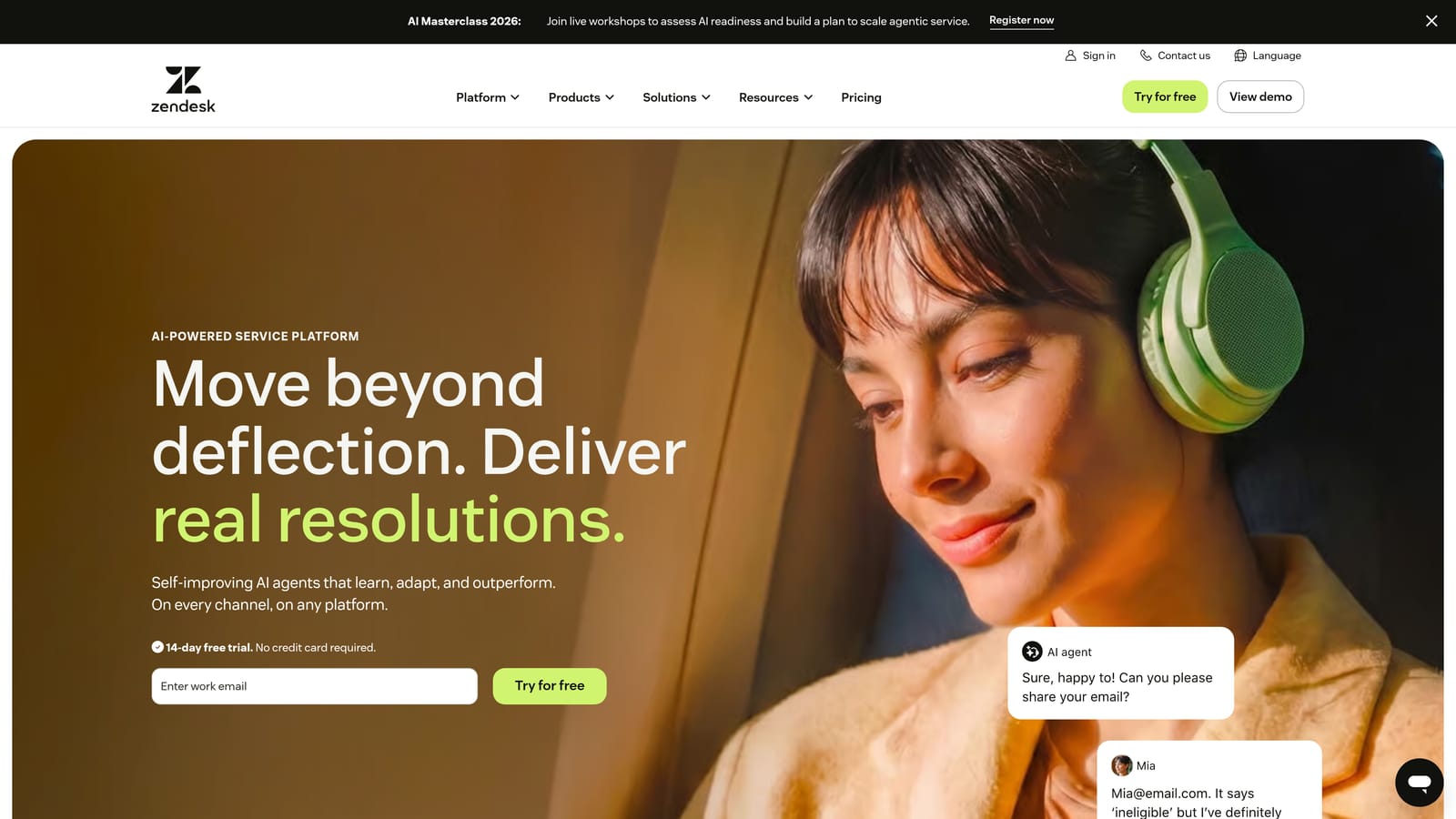
Zendesk is the category-defining enterprise helpdesk, now with Zendesk AI layered on top, offering intelligent triage, AI agents, and suggested responses built into one of the most established ticketing platforms in the market.
Where This Tool Shines
Zendesk's core advantage is maturity. The platform has been refined over many years of enterprise deployments, and its SLA management, compliance features, and reporting capabilities are among the most robust available. For large teams managing complex support operations, that foundation is hard to replicate.
The AI layer adds intelligent triage, auto-routing, and AI-generated suggested responses on top of that foundation. It's worth noting that this is AI bolted onto an existing architecture rather than built AI-first, which can affect how coherently the automation logic flows. But for teams already deeply embedded in Zendesk, the AI additions represent a meaningful upgrade without platform migration.
Key Features
Zendesk AI Suite: Intelligent triage, auto-routing, AI agents, and suggested responses integrated across the ticketing workflow.
Enterprise SLA Management: Sophisticated SLA policies, escalation rules, and compliance tooling built for large-scale operations.
Omnichannel Coverage: Email, chat, voice, social, and messaging channels unified in a single platform.
Large Integration Marketplace: Extensive third-party app ecosystem with hundreds of pre-built connectors.
Advanced Reporting and Analytics: Customizable dashboards and reporting that go deep on support performance metrics.
Best For
Zendesk is the right call for enterprise teams with complex support operations, strict compliance requirements, and significant existing investment in the platform. If you're already running Zendesk, the AI add-ons are worth evaluating before considering a full platform migration.
Pricing
Suite plans start at approximately $55/agent/month. AI features are available on higher-tier plans. Current pricing at zendesk.com should be confirmed before purchasing.
4. Freshdesk
Best for: Growing teams that want structured helpdesk workflows and AI automation at an accessible price point.
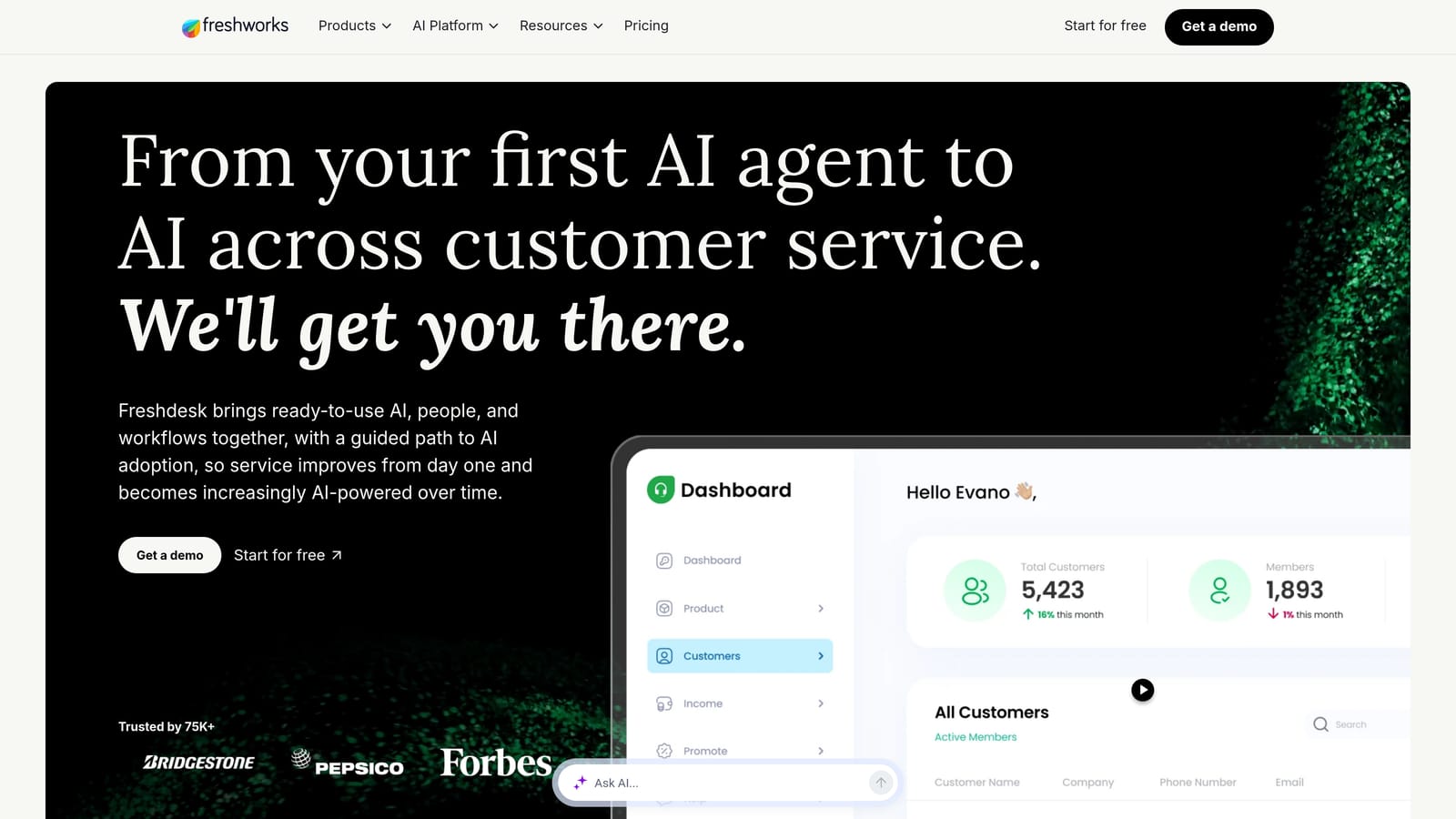
Freshdesk is a cloud-based helpdesk from Freshworks with Freddy AI built in, offering auto-resolution, suggested replies, and sentiment analysis at a price point that makes it genuinely accessible for teams that aren't enterprise-sized.
Where This Tool Shines
Freshdesk hits a sweet spot between capability and cost. Freddy AI handles automated ticket resolution and agent assistance without requiring the budget that Zendesk or Intercom demand. For teams new to structured helpdesk workflows, Freshdesk's onboarding is relatively smooth and the feature set covers the fundamentals well.
The Freddy Self Service component is worth highlighting: it powers an AI-driven knowledge base and self-service portal that can deflect common queries before they become tickets. Combined with omnichannel coverage, Freshdesk punches above its price point for teams in the growth stage.
Key Features
Freddy AI for Resolution and Agent Assist: Automates ticket resolution for common queries and surfaces suggestions for human agents handling complex ones.
Freddy Self Service: AI-powered knowledge base and self-service portal to deflect tickets before they enter the queue.
Omnichannel Support: Email, chat, phone, and social channels managed from a unified inbox.
Workflow Automation: Scenario automations and SLA policies that handle repetitive routing and escalation logic.
Accessible Pricing: One of the more competitive price points among platforms with genuine AI capabilities.
Best For
Freshdesk is the strongest fit for growing B2B teams that want real AI automation without enterprise-level pricing. It's particularly well-suited to teams that are formalizing their support operations for the first time and want a platform that can scale with them.
Pricing
Free plan available. Paid plans start at approximately $15/agent/month. Freddy AI features are on higher-tier plans. Confirm current pricing at freshdesk.com.
5. Tidio
Best for: Smaller teams and e-commerce businesses that need fast deployment and conversational AI without heavy technical setup.
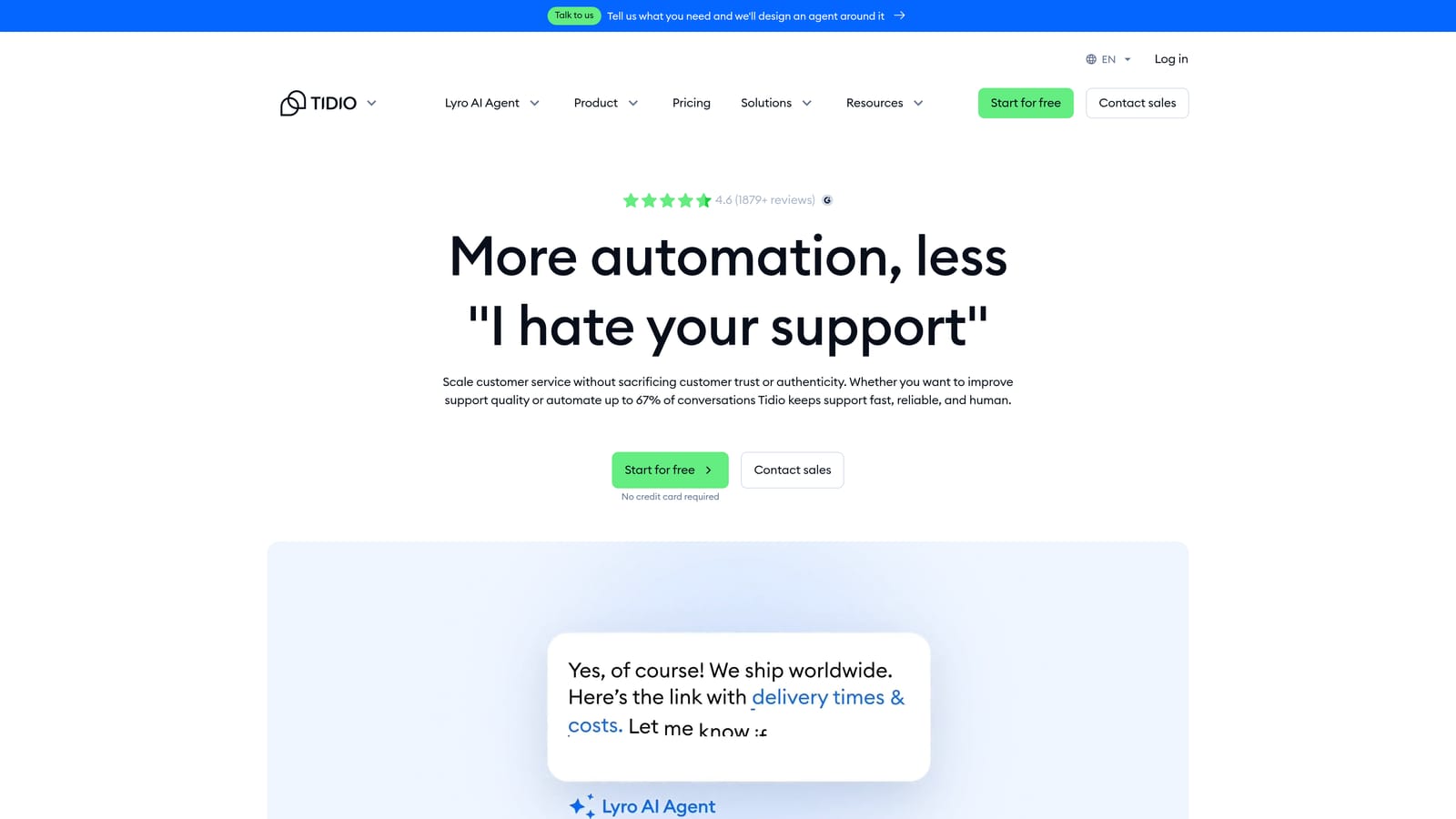
Tidio is a lightweight cloud support platform combining live chat and Lyro AI, a conversational chatbot designed to resolve common questions autonomously, with fast setup and accessible pricing.
Where This Tool Shines
Tidio's defining characteristic is speed to value. Most teams can get Lyro AI handling real conversations within hours of setup, not weeks. For smaller teams that don't have dedicated technical resources to configure complex automation platforms, that matters a great deal.
Lyro resolves queries conversationally without human handoff, and the visual chatbot builder makes it possible to create custom automation flows without writing code. It's not the deepest platform on this list, but for the use cases it targets, it delivers quickly and reliably.
Key Features
Lyro AI: Conversational chatbot that handles common queries autonomously without requiring human intervention.
Visual Chatbot Builder: Drag-and-drop interface for building custom automation flows without technical expertise.
Live Chat with AI Assist: Human agents can take over conversations with AI-generated response suggestions ready to use.
E-Commerce and CRM Integrations: Connects with Shopify, HubSpot, and other common platforms for teams with e-commerce or CRM workflows.
Minimal Technical Setup: Designed for fast deployment with a low barrier to entry for non-technical teams.
Best For
Tidio is best suited for smaller teams, early-stage companies, and e-commerce businesses that want conversational AI running quickly without a lengthy implementation process. It's less suited to complex B2B SaaS environments with deep integration requirements.
Pricing
Free plan available. Lyro AI starts at approximately $29/month and scales with conversation volume. Check tidio.com for current plan details.
6. Drift
Best for: B2B companies where support and sales conversations overlap and intent-based routing matters.
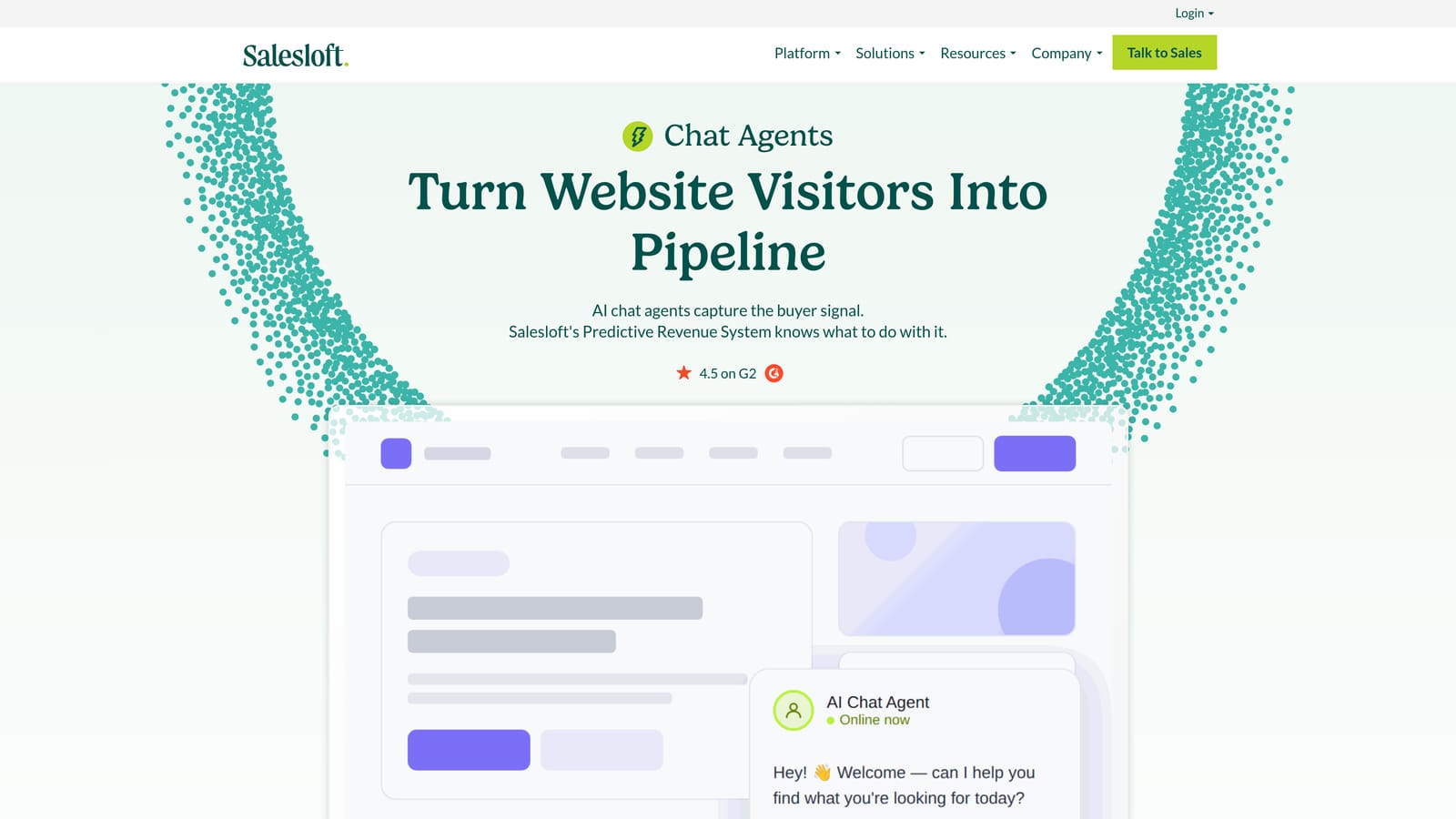
Drift is a conversational platform that bridges support and sales, using AI to detect conversation intent and route users to the right team, making it particularly strong for B2B environments where a support question can quickly become a revenue conversation.
Where This Tool Shines
Drift occupies a unique position on this list because it was never purely a support tool. Its AI-powered intent detection identifies whether an inbound conversation is a support issue, a sales inquiry, or something in between, then routes accordingly. For B2B teams where the line between support and sales is genuinely blurry, this is a meaningful capability that most pure-play helpdesks don't offer.
The Playbooks system lets teams build automated conversation flows based on visitor behavior and segment, which works well for companies with complex buyer journeys. Meeting booking integrated directly into chat is a practical feature for teams that want to move from conversation to calendar without friction.
Key Features
AI Intent Detection: Identifies whether conversations are support, sales, or mixed-intent and routes them to the right team or automation flow.
Playbooks: Automated conversation flows triggered by visitor behavior and segment, customizable without heavy technical work.
Integrated Meeting Booking: Routes qualified conversations directly to calendar booking within the chat interface.
CRM Integrations: Deep connections with Salesforce and HubSpot for full pipeline context during support and sales conversations.
Real-Time Notifications and Live Takeover: Alerts human agents when high-value conversations are in progress, with seamless takeover capability.
Best For
Drift is best suited to B2B companies with account-based sales motions where support and revenue conversations frequently intersect. It's less suited to teams looking purely for ticket resolution automation without a sales component.
Pricing
Enterprise pricing model; contact Drift sales for current rates. Pricing is not publicly listed at a standard tier structure.
7. Help Scout
Best for: Teams where relationship quality is a brand differentiator and AI should augment agents, not replace them.
Help Scout is a cloud helpdesk built around a human-first support philosophy, with AI Summarize and AI Assist features that help agents respond faster without removing the human relationship at the center of every interaction.
Where This Tool Shines
Help Scout's philosophy is worth stating clearly: AI here is an augmentation tool, not an autonomous resolution engine. If your brand is built on the quality of human relationships with customers, and you've deliberately chosen not to automate away those interactions, Help Scout gives you AI efficiency gains without compromising that positioning.
The AI Summarize feature is particularly practical for teams managing long email threads. Rather than an agent reading through a 20-message chain to understand context, AI Summarize condenses it into a quick brief. AI Assist handles reply drafting and editing suggestions, cutting response time without cutting the human out of the loop.
Key Features
AI Summarize: Condenses long email threads into concise context briefs, so agents can get up to speed on complex conversations quickly.
AI Assist: Drafts replies and suggests edits for human agents, speeding up response time while keeping a human in control.
Shared Inbox with Collision Detection: Prevents two agents from responding to the same conversation simultaneously.
Docs Knowledge Base: Built-in knowledge base with AI-powered search that customers can use for self-service.
Email-Native Interface: Designed to feel familiar to customers receiving responses, reinforcing the human relationship rather than the support software.
Best For
Help Scout is the right fit for teams where the human support experience is a deliberate brand choice, not a gap to automate away. Professional services, high-touch B2B relationships, and customer success teams often find this balance exactly right.
Pricing
From approximately $20/user/month, with AI features included on current plans. Verify current pricing at helpscout.com.
8. Zoho Desk
Best for: Teams already operating in the Zoho ecosystem who want native AI without adding a separate platform.
Zoho Desk is a cloud helpdesk deeply integrated with the Zoho ecosystem, featuring Zia AI for sentiment analysis, anomaly detection, and suggested responses, with pricing that makes it one of the stronger value propositions on this list.
Where This Tool Shines
The Zoho ecosystem advantage is real. If your team is already running Zoho CRM, Zoho Analytics, or other Zoho products, the native data sharing between those tools and Zoho Desk is genuinely seamless in a way that third-party integrations rarely match. Zia AI pulls from that connected data to deliver smarter suggestions and more accurate anomaly detection.
The Blueprint workflow automation engine is worth noting for teams with multi-step support processes. It allows you to define structured workflows with conditional logic, approvals, and escalations, which is more sophisticated than basic SLA rules and useful for teams handling complex B2B support scenarios.
Key Features
Zia AI: Handles sentiment analysis, auto-tagging, anomaly detection, and suggested responses informed by customer history and context.
Native Zoho Ecosystem Integration: Seamless data sharing with Zoho CRM, Zoho Analytics, and other Zoho products without middleware.
Blueprint Workflow Automation: Multi-step workflow builder with conditional logic, approvals, and escalations for complex support processes.
Omnichannel Coverage: Email, chat, phone, social, and web forms handled from a unified interface.
Competitive Pricing: Strong value relative to the feature set, particularly for teams already paying for Zoho subscriptions.
Best For
Zoho Desk is the obvious choice for teams already invested in the Zoho ecosystem. It's also worth considering for budget-conscious teams that want AI-assisted support with solid omnichannel coverage without paying enterprise-tier prices.
Pricing
Free plan for up to 3 agents. Paid plans from approximately $14/agent/month. Confirm current pricing at zoho.com/desk.
9. Kustomer
Best for: High-volume support teams where full customer history context drives resolution quality and efficiency.
Kustomer is a CRM-native cloud support platform that treats every ticket as a CRM event, meaning AI automation is powered by full customer history rather than just the current conversation.
Where This Tool Shines
Kustomer's architectural difference from standard helpdesks is meaningful in practice. When an agent opens a conversation, they see the full customer timeline: every previous interaction, purchase history, subscription status, and prior resolution. AI routing and auto-resolution are informed by that history, which improves both accuracy and the quality of the customer experience.
For high-volume teams where context is the difference between a good and a poor resolution, this CRM-native approach reduces the time agents spend hunting for background information and improves the consistency of automated responses. It's a more complex platform to implement, but the payoff for the right team profile is substantial.
Key Features
CRM-Native Architecture: Full customer timeline visible in every support conversation, including purchase history, prior tickets, and subscription data.
AI Routing and Auto-Resolution: Automation logic informed by customer history, not just the current ticket's content.
Unified Omnichannel Timeline: Email, chat, SMS, social, and voice interactions displayed in a single chronological customer view.
Workflow Automation with Proactive Outreach: Business rules that can trigger proactive customer communication based on data signals.
Lifetime Value and Support Impact Reporting: Deep reporting that connects support performance to customer revenue metrics.
Best For
Kustomer is best suited to high-volume B2B and B2C teams where customer history is central to resolution quality and where support performance needs to be connected to revenue and retention metrics. It's a more complex and expensive platform, so the fit needs to be clear before committing.
Pricing
From approximately $89/user/month. Enterprise pricing available for larger deployments. Confirm current pricing at kustomer.com.
Which Tool Is Right for Your Team
The right choice depends less on feature lists and more on where your team is right now and where you're trying to go. Here's a quick map to help you narrow it down.
AI-first SaaS teams: Halo AI is built for exactly this use case. Page-aware context, autonomous resolution, bug ticket creation, and business intelligence from support data make it the strongest fit for product teams that want AI doing real work across the entire support workflow.
Enterprise teams already on Zendesk: Before migrating, evaluate the Zendesk AI add-ons. The SLA management and compliance infrastructure is hard to replicate, and the AI layer has matured enough to deliver meaningful automation without a platform change.
All-in-one messaging and support: Intercom remains the most complete platform for teams that want support, onboarding, and proactive messaging unified. Fin AI handles a meaningful share of resolution volume, and the integration ecosystem is extensive.
Budget-conscious growing teams: Freshdesk or Tidio. Freshdesk for teams formalizing structured helpdesk workflows; Tidio for teams that need fast deployment and simpler automation without a large technical investment.
Zoho ecosystem teams: Zoho Desk. The native integration advantage is real and the pricing is competitive. Don't pay for a separate platform when native works this well.
CRM-native support at scale: Kustomer. If full customer history context is central to your resolution quality and you're running high volume, the architecture justifies the price.
Human-first support with AI efficiency: Help Scout. If the human relationship is a deliberate brand choice, Help Scout gives you AI speed gains without removing agents from the conversation.
Support and sales overlap: Drift. For B2B teams where inbound conversations frequently cross the support-to-sales boundary, intent detection and Playbooks make Drift the natural fit.
Your support team shouldn't scale linearly with your customer base. Let AI agents handle routine tickets, guide users through your product, and surface business intelligence while your team focuses on complex issues that need a human touch. See Halo in action and discover how continuous learning transforms every interaction into smarter, faster support.