9 Best Context-Aware Chatbot Platforms for Smarter Support in 2026
Context-aware chatbot platforms go beyond keyword matching by incorporating user identity, browsing behavior, account data, and conversation history to deliver personalized, relevant support responses. This guide evaluates the 9 best platforms in 2026 based on contextual depth, AI sophistication, integrations, and pricing—helping SaaS startups and enterprise teams find the right solution to dramatically improve customer support outcomes.
 Matt PattoliFounder13 min read
Most chatbots frustrate users for a simple reason: they have no idea who they're talking to. They don't know what page the user is on, what they've tried before, or what their account looks like. They just pattern-match keywords and return generic FAQ answers.
Context-aware chatbots work differently. They understand who the user is, what they're currently viewing, their conversation history, account data, and prior interactions, then use all of that to deliver relevant, personalized responses that actually resolve issues. The gap in experience between a context-blind chatbot and a context-aware one is enormous.
This list covers the top context-aware chatbot platforms available in 2026, evaluated on depth of contextual understanding, integration ecosystem, AI sophistication, ease of deployment, and pricing transparency. Whether you're running a lean SaaS support team or managing enterprise-scale customer operations, you'll find the right fit here. If you're thinking through your broader customer support automation strategy or evaluating an AI conversation platform, these tools represent the current state of the art.
1. Halo AI
Best for: SaaS and B2B teams that need page-aware, UI-level contextual support with business intelligence built in.
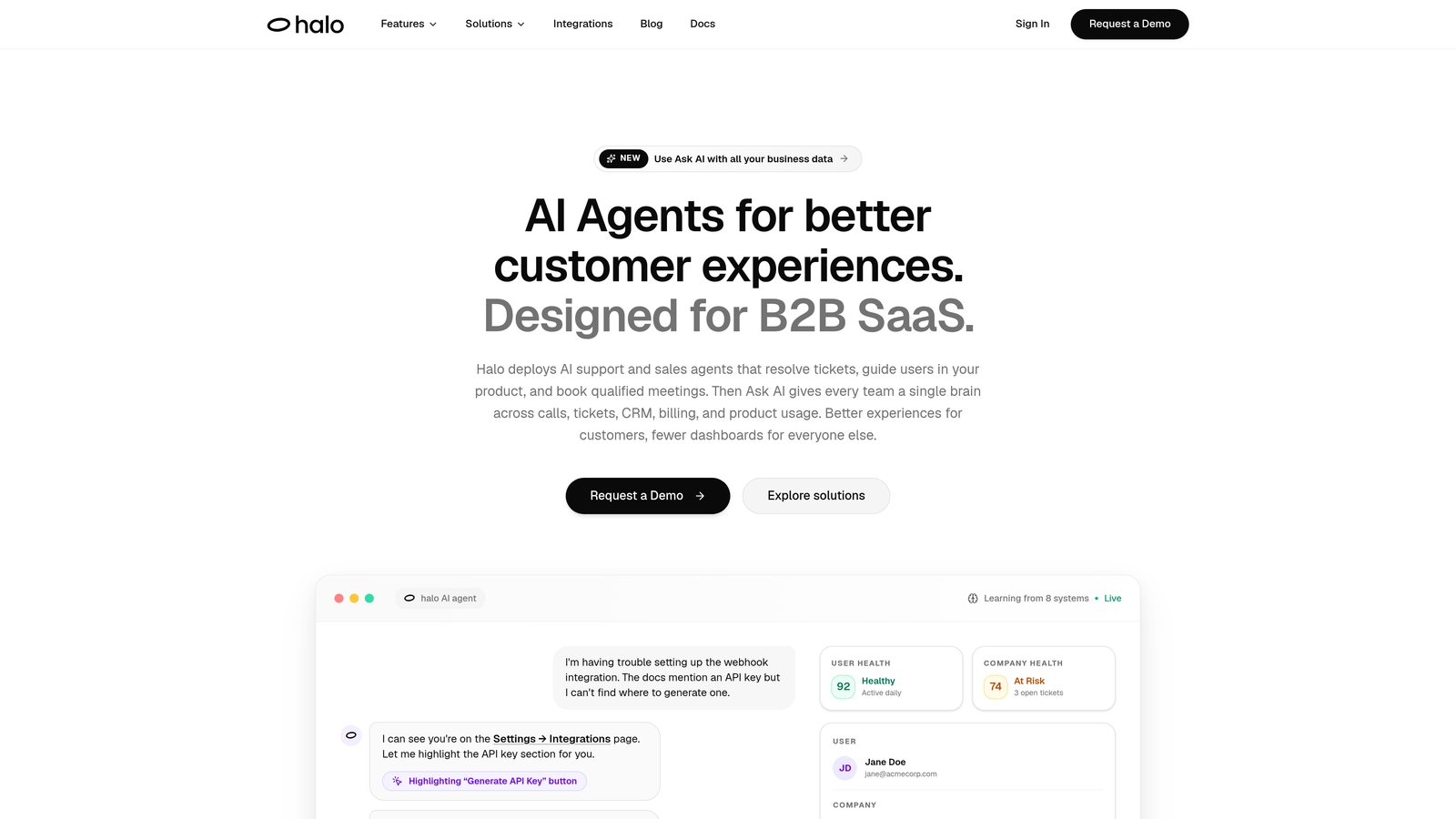
Halo AI is an AI-first customer support platform built around the idea that context should go deeper than conversation history.
Where This Tool Shines
Most platforms know what URL a user is on. Halo AI knows what they're actually looking at: the specific UI elements, the state of the interface, and what they're trying to do at that moment. This page-aware capability is a genuine technical differentiator, enabling guidance at the UI element level rather than just the page level.
Beyond resolving tickets, Halo surfaces business intelligence from support conversations, detecting anomalies, flagging customer health signals, and feeding revenue intelligence back to your team. It's not just a support tool; it's a signal layer across your entire customer base.
Key Features
Page-Aware Chat Widget: Sees exactly what the user sees at the UI level, enabling precise visual guidance through your product rather than generic step descriptions.
Continuous Learning: Every resolved interaction improves the AI's future responses, compounding accuracy over time without manual retraining.
Auto Bug Ticket Creation: Automatically identifies and logs bug reports from support conversations directly into your issue tracker, reducing engineering noise.
Smart Inbox with Business Intelligence: Goes beyond ticket management to surface anomaly detection, customer health signals, and revenue-relevant patterns from support data.
Deep Integration Ecosystem: Connects natively with Linear, Slack, HubSpot, Intercom, Stripe, Zoom, PandaDoc, and Fathom, pulling business system context into every interaction.
Best For
Product-led SaaS companies and B2B teams that want more than ticket deflection. Halo is particularly strong for teams whose support conversations contain valuable product and revenue signals they're currently not capturing, and for those frustrated by bolt-on AI features in their existing helpdesk.
Pricing
Contact for pricing. Given the enterprise-grade feature depth and integration breadth, this is best suited for teams ready to invest in AI-first support infrastructure.
2. Intercom Fin
Best for: Teams already on Intercom who want AI resolution without adding another platform to their stack.
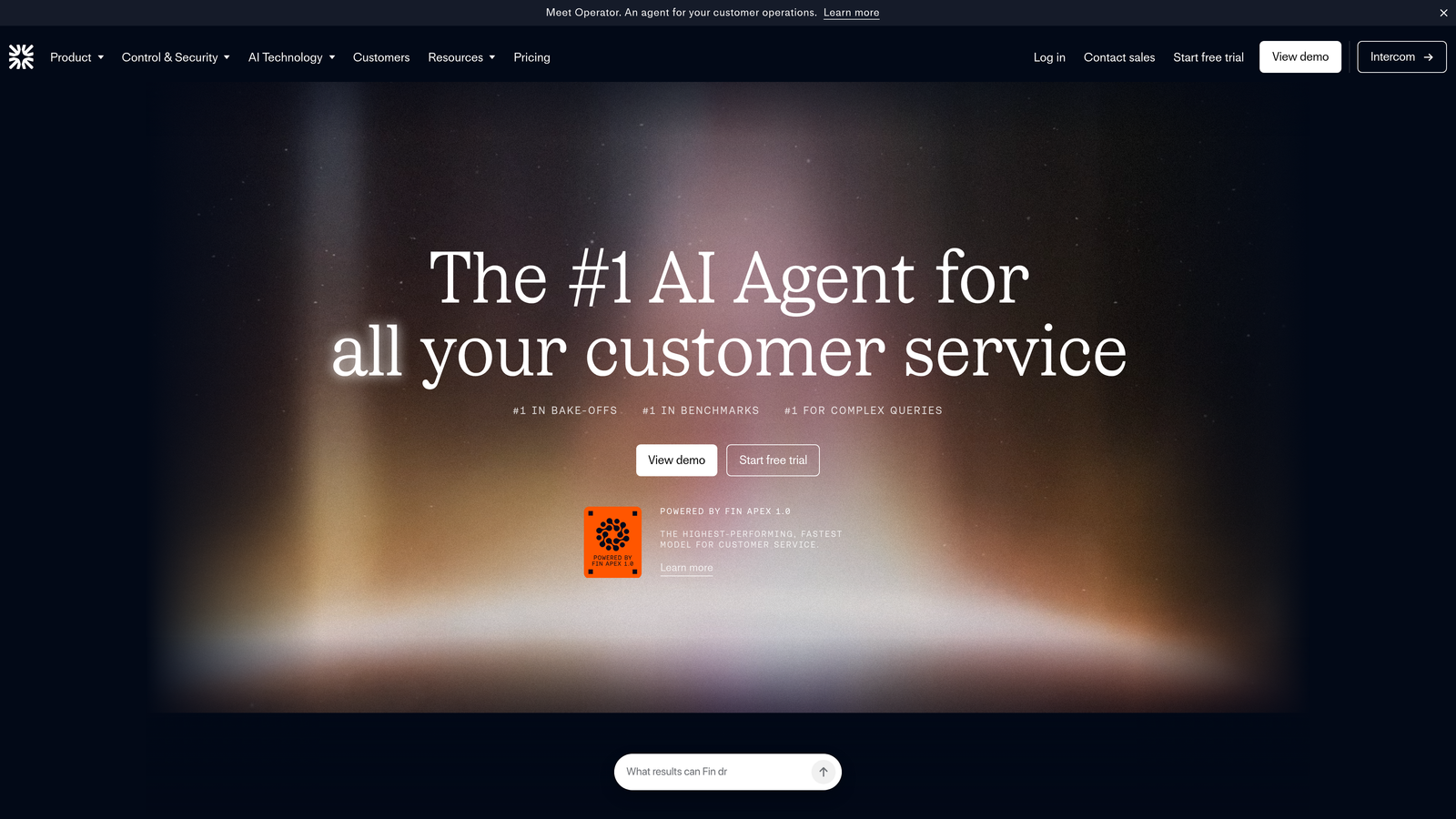
Intercom Fin is Intercom's native AI agent, built directly on top of the platform's rich customer data layer.
Where This Tool Shines
Fin's biggest advantage is that it lives inside Intercom natively. It has immediate access to customer profiles, full conversation history, help center content, and any custom data sources you've connected, without any integration work required. For existing Intercom users, this dramatically reduces time-to-value.
The handoff experience is also notably smooth. When Fin escalates to a human agent, it passes the full conversation context automatically, so agents never have to ask customers to repeat themselves.
Key Features
Native Customer Profile Access: Pulls from Intercom's existing customer data and conversation history to personalize every response.
Multi-Source Answers: Draws from help center articles, past conversations, and custom data sources simultaneously.
Multi-Language Support: Handles customer queries across dozens of languages without separate configuration.
Customizable Behavior Rules: Lets you define tone, topic scope, and escalation triggers to match your brand and support policies.
Context-Preserving Handoff: Transfers full conversation context to human agents, eliminating the frustrating repeat-your-problem experience.
Best For
Mid-market and enterprise teams already invested in Intercom's ecosystem. If you're using Intercom for CRM and messaging, Fin is the lowest-friction path to AI-powered resolution.
Pricing
Per-resolution pricing starting at $0.99 per resolution. Costs scale with volume, so high-traffic teams should model expected resolution counts carefully before committing.
3. Ada
Best for: Enterprise teams needing deep backend system integrations across complex, multi-channel support operations.
Ada is an enterprise-grade AI agent platform designed to connect support conversations with the systems that hold the answers.
Where This Tool Shines
Ada's strength is in backend integration depth. It connects to Salesforce, Shopify, order management systems, and other back-office tools to pull real account and transaction data into conversations. This means the AI can answer questions like "where is my order?" or "what's my current plan?" with actual data, not just templated responses.
The omnichannel deployment capability is also mature, covering web, mobile, social, and messaging apps from a single configuration layer.
Key Features
Deep Backend Integrations: Connects to Salesforce, Shopify, and other enterprise systems to ground responses in real customer and transaction data.
Omnichannel Deployment: Deploys consistently across web, mobile, social, and messaging channels without rebuilding flows for each.
50+ Language Support: Handles global customer bases with broad multilingual capability out of the box.
No-Code Conversation Builder: Enables non-technical teams to build and iterate on conversation flows with an analytics dashboard for optimization.
Automated Resolution Measurement: Tracks and reports on automated resolution rates to demonstrate ROI to stakeholders.
Best For
Enterprise organizations with complex support operations, multiple backend systems, and global customer bases that need a platform capable of handling that complexity at scale.
Pricing
Custom enterprise pricing. Contact Ada directly for a quote based on your volume and deployment requirements.
4. Zendesk AI Agents
Best for: Teams already running Zendesk who want to add contextual AI automation without migrating their helpdesk.
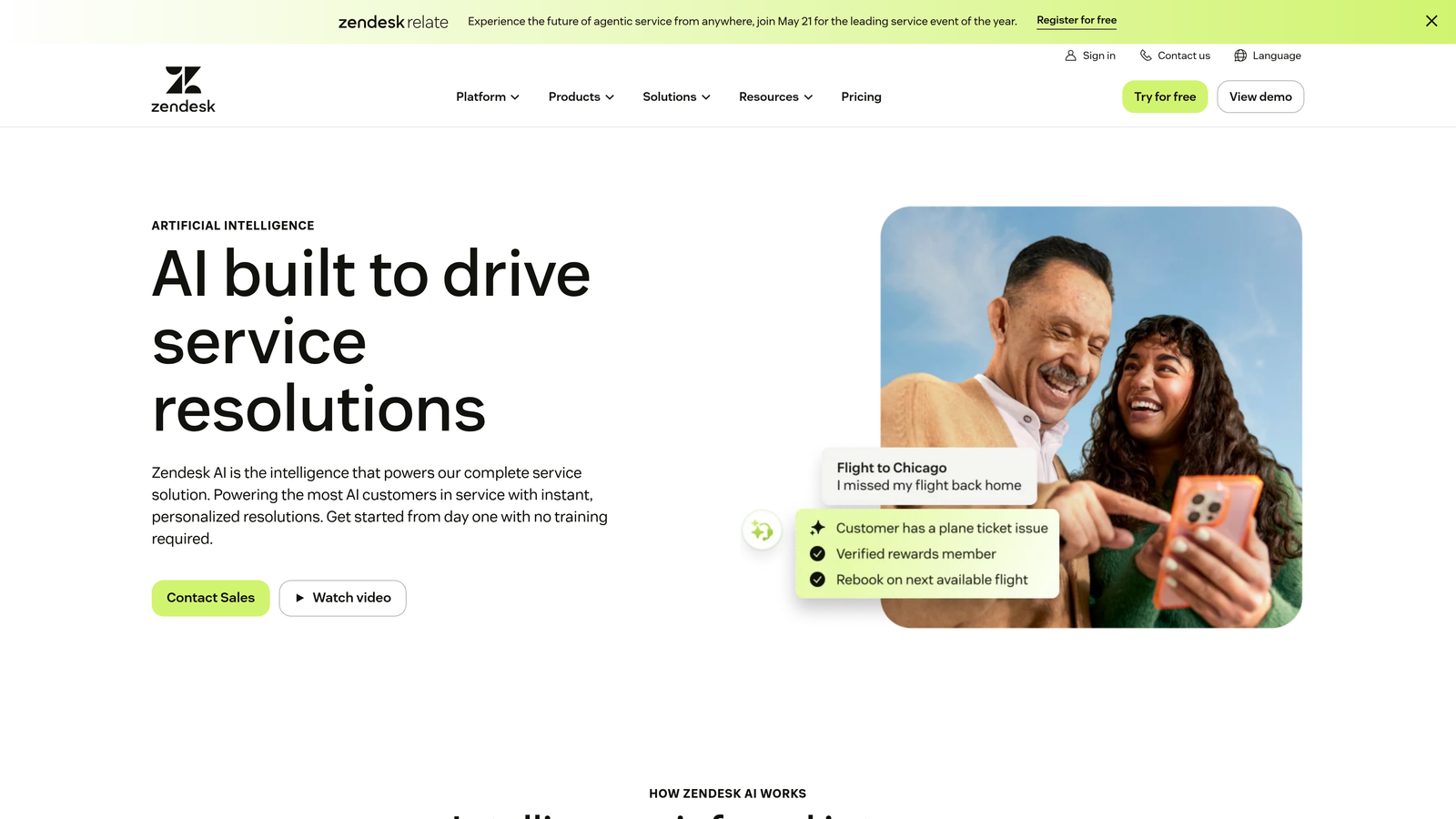
Zendesk AI Agents are natively embedded within the Zendesk platform, leveraging its full data layer for contextual automated support.
Where This Tool Shines
Zendesk AI Agents benefit from years of accumulated ticket data and customer attributes already living in the platform. The AI is pre-trained on industry-specific customer service intents, which means it arrives with a baseline understanding of common support scenarios rather than starting from scratch.
The generative AI reply capability grounds responses in your actual knowledge base content, reducing hallucination risk and keeping answers accurate to your specific product and policies.
Key Features
Industry-Specific Pre-Training: Arrives with built-in understanding of common customer service intents, reducing cold-start configuration time.
Full Ticket History Access: Draws on complete Zendesk ticket history and customer attributes to personalize responses.
Knowledge-Grounded Generative Replies: Generates responses anchored in your help center content, not general AI knowledge.
Intelligent Triage and Routing: Classifies tickets by intent, sentiment, and language to route them appropriately before a human ever touches them.
Omnichannel Coverage: Works consistently across email, chat, messaging, and social channels within the Zendesk environment.
Best For
Organizations with significant Zendesk investment and large existing ticket databases. The more historical data you have in Zendesk, the more contextual value the AI can extract from it.
Pricing
Included in Zendesk Suite plans; advanced AI features available as an add-on. Pricing varies by tier, so review the current Zendesk pricing page for specifics.
5. Freshdesk Freddy AI
Best for: Teams using the Freshworks suite who want unified context across CRM, marketing, and support in one AI layer.
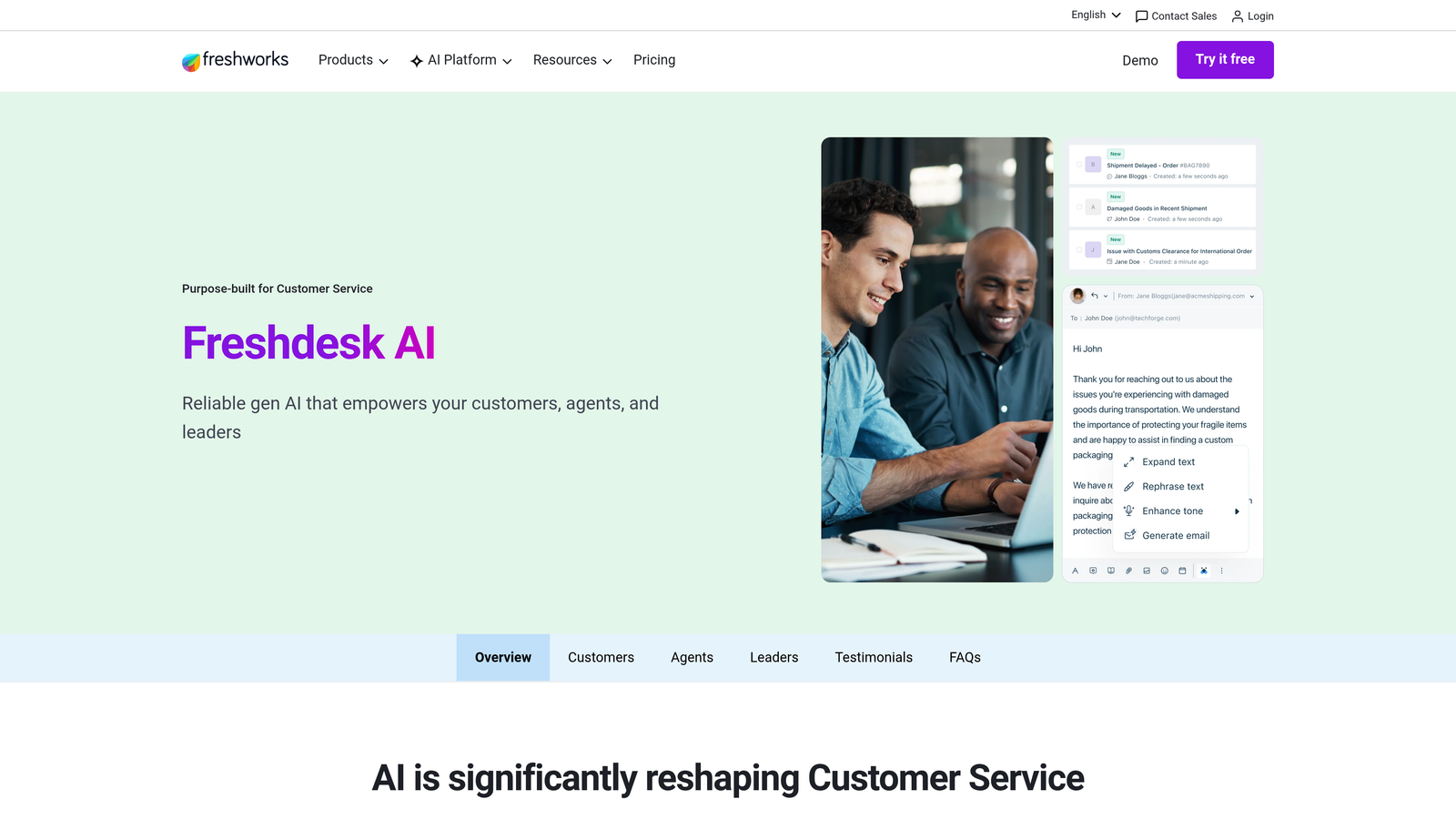
Freshdesk Freddy AI is Freshworks' AI engine that spans the entire Freshworks product family, not just the helpdesk.
Where This Tool Shines
Freddy's cross-suite context is its defining advantage. Because Freshworks offers CRM, marketing automation, and ITSM alongside Freshdesk, Freddy can pull unified customer data from all of those systems into a single support interaction. A support agent or AI bot can see the full customer relationship, not just the open ticket.
The agent assist features are also practical and well-implemented, offering canned response suggestions and AI-drafted replies that are grounded in ticket context and past resolutions rather than generic templates.
Key Features
Cross-Suite Unified Context: Pulls data from Freshworks CRM, marketing, and ITSM tools to give a complete customer picture in every interaction.
Auto-Triage: Automatically classifies tickets by priority, type, and group, reducing manual sorting overhead.
Context-Aware Response Suggestions: Suggests replies based on the specific ticket content and how similar issues were resolved historically.
Thank You Detector and Spam Filter: Reduces ticket noise by automatically identifying and handling non-actionable messages.
Agent Assist: Provides real-time suggestions and canned response recommendations to human agents handling complex cases.
Best For
Companies already using multiple Freshworks products who want to unify their customer data under a single AI layer. Also a strong choice for teams that want solid AI features without enterprise-level pricing.
Pricing
Freddy AI is included in Pro and Enterprise plans, starting at $49 per agent per month. Check current Freshworks pricing for the most up-to-date tier details.
6. Cognigy
Best for: Enterprises needing sophisticated voice and digital channel support with advanced session memory and complex multi-turn conversation management.
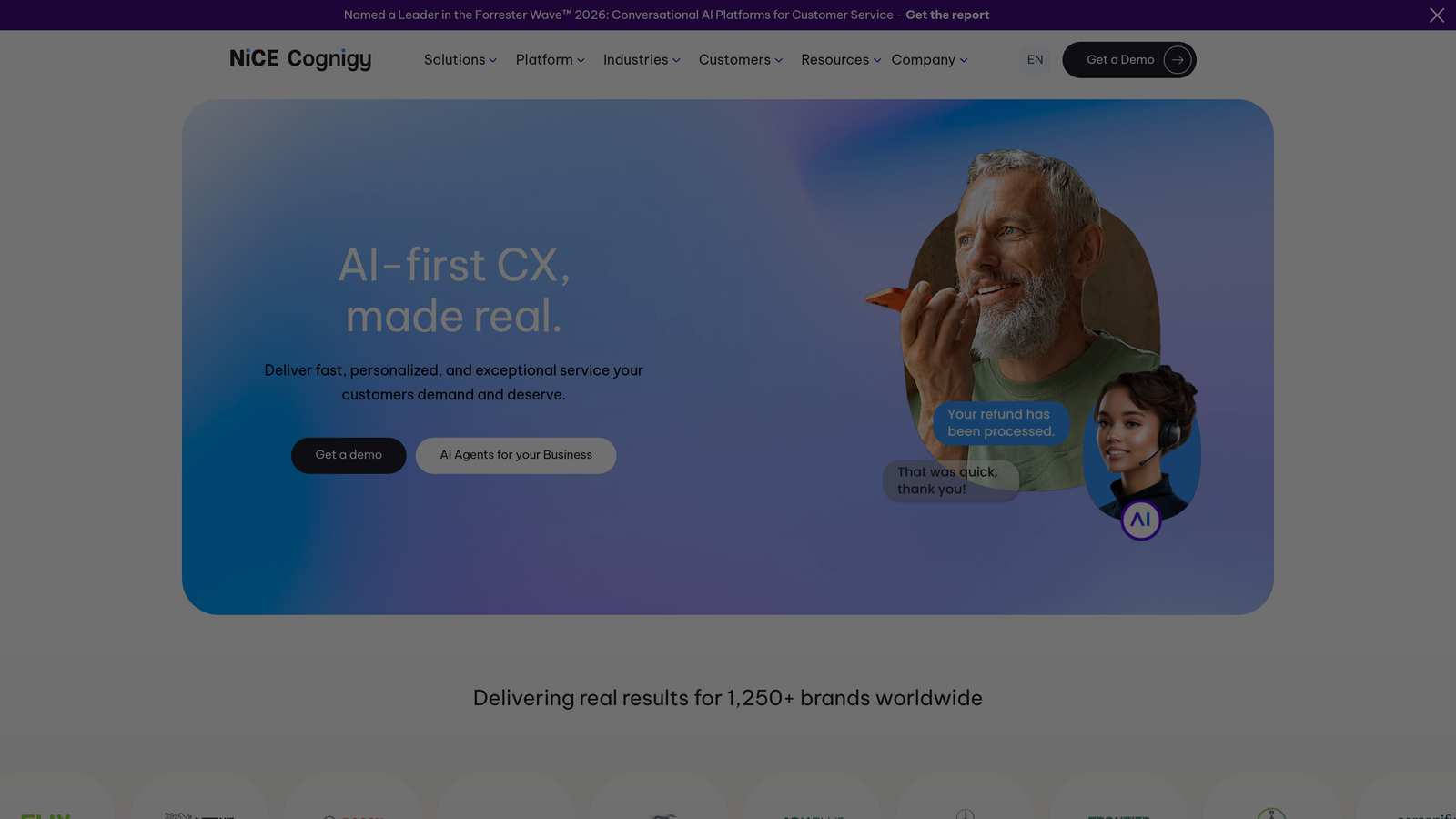
Cognigy is an enterprise conversational AI platform built for organizations where conversation complexity and compliance requirements are both high.
Where This Tool Shines
Cognigy handles voice and digital channels from a single platform, which is rare. Most conversational AI tools are built for chat and treat voice as an afterthought. Cognigy treats them as equals, with consistent context management across both modalities.
The session memory and context management capabilities are particularly mature, making it well-suited for multi-turn conversations where the AI needs to track multiple variables, conditions, and customer states across a long interaction.
Key Features
Unified Voice and Digital Channels: Manages voice and chat from a single platform with consistent context handling across both.
Advanced Session Memory: Maintains and manages complex context variables across multi-turn, long-form conversations.
Low-Code Flow Builder: Enables conversation design with CRM and ERP connectors without requiring deep development resources.
Real-Time Agent Assist: Provides live, contextual suggestions to human agents during active conversations.
Enterprise Security and Compliance: Carries certifications relevant to regulated industries, including finance and healthcare.
Best For
Large enterprises in regulated industries or those with significant voice support operations. Particularly strong for organizations in banking, insurance, healthcare, and telco where compliance and multi-turn complexity are non-negotiable.
Pricing
Custom enterprise pricing. Contact Cognigy directly for a quote based on your channel mix and usage requirements.
7. Kustomer
Best for: E-commerce and D2C brands that need a CRM-powered support platform with complete customer interaction history across every channel.
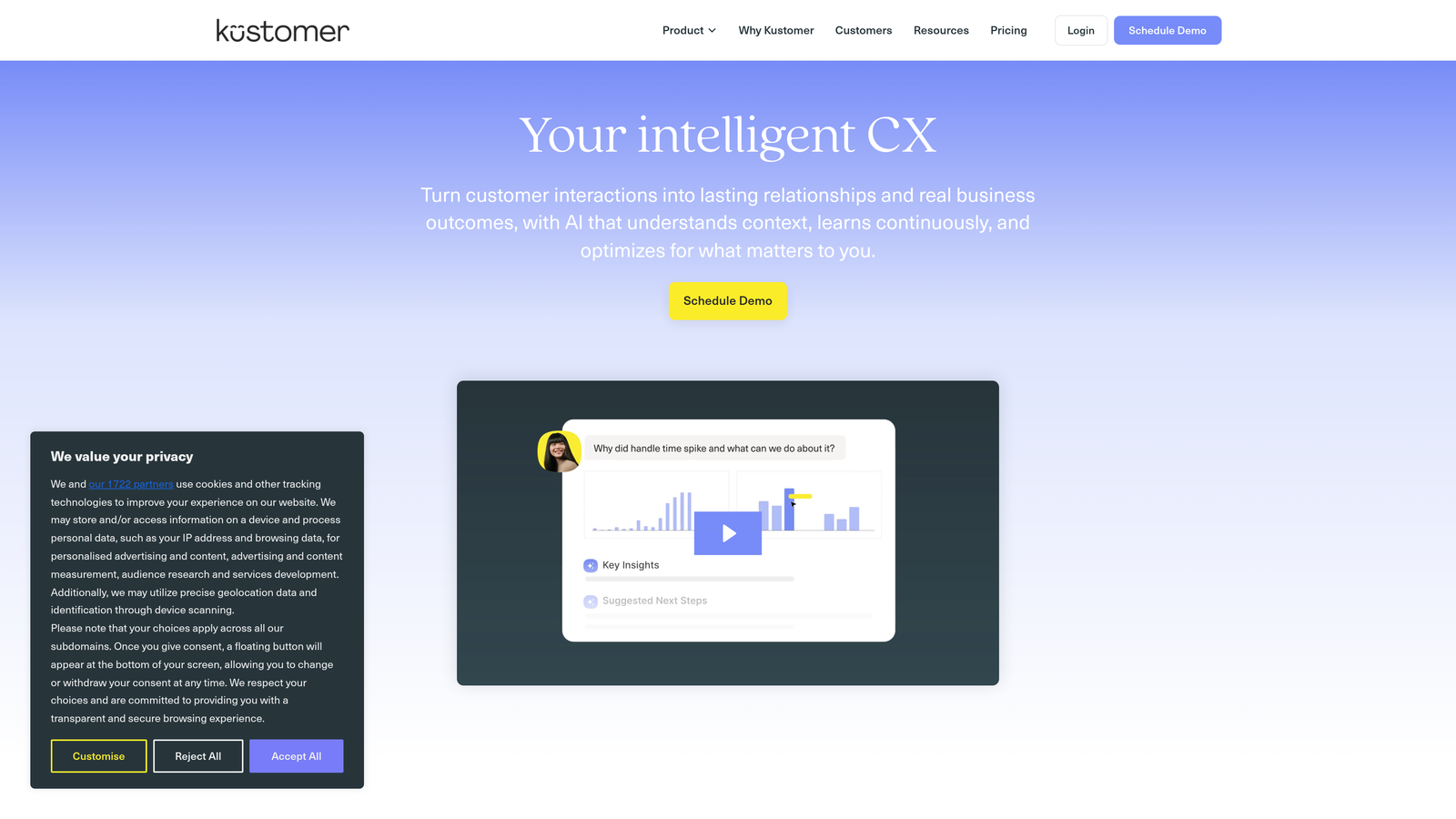
Kustomer is a CRM-first customer service platform where the AI's contextual power comes directly from its timeline-based customer data model.
Where This Tool Shines
Kustomer's unified customer timeline is genuinely differentiated. Every interaction, order, subscription event, and channel touchpoint is consolidated into a single chronological view. When the AI responds to a query, it's drawing from that complete history, not just the current conversation thread.
The proactive messaging capability is also worth noting. Kustomer can trigger outreach based on customer behavior and events, which means support can become proactive rather than purely reactive.
Key Features
Unified Customer Timeline: Consolidates all interactions, orders, and events across every channel into a single chronological customer record.
Context-Rich AI Classification and Routing: Uses full customer history to classify, route, and suggest responses more accurately than ticket-only systems.
Built-In CRM: Tracks orders, subscriptions, and customer activity natively without requiring a separate CRM integration.
Proactive Messaging: Triggers outbound messages based on customer behavior signals and lifecycle events.
E-Commerce Integrations: Strong native integrations with Shopify and other e-commerce platforms for order and fulfillment context.
Best For
E-commerce, D2C, and subscription businesses where order history and customer lifetime context are central to every support interaction. Less suited to pure B2B SaaS where the CRM model differs significantly.
Pricing
Enterprise plan starts at $89 per user per month. Given the built-in CRM capability, teams replacing a separate CRM and helpdesk may find the combined cost competitive.
8. Botpress
Best for: Developer teams and technical builders who need maximum flexibility in context management, custom variables, and AI pipeline design.
Botpress is a developer-centric conversational AI platform that gives technical teams low-level control over how context is captured, stored, and used.
Where This Tool Shines
Botpress gives developers the ability to define custom context variables precisely and manage session memory at a granular level. Combined with retrieval-augmented generation (RAG) for knowledge base queries, it enables highly bespoke conversational AI that behaves exactly as designed rather than as a black-box system decides.
The combination of a visual flow builder and direct code-level customization means technical teams aren't constrained by what the UI exposes. If you need it, you can build it.
Key Features
Custom Context Variables: Define and manage your own context variables and session memory structures with full developer control.
RAG-Powered Knowledge Base: Uses retrieval-augmented generation to ground AI responses in your documentation with high accuracy.
Visual Flow Builder Plus Code Access: Combines a no-code interface for flow design with code-level customization for complex logic.
External Context via API: Pulls data from external systems via API into conversation context, enabling dynamic personalization from any source.
Free Tier Available: Offers a generous free tier for prototyping and smaller deployments before committing to paid plans.
Best For
Engineering-led teams, agencies building custom chatbot solutions, and companies with unique context requirements that off-the-shelf platforms can't accommodate. Less suited to non-technical teams who need a no-code-first experience.
Pricing
Free tier available; paid plans start at $79 per month. The free tier is genuinely useful for evaluation and early-stage builds.
9. Tidio
Best for: Small businesses and e-commerce stores that need accessible, behavior-aware chat and AI support without enterprise complexity or pricing.
Tidio is a live chat and AI chatbot platform that uses real-time visitor behavior to deliver contextual support at a price point accessible to smaller teams.
Where This Tool Shines
Tidio's visitor behavior tracking gives small businesses a form of contextual awareness that was previously only available in enterprise tools. Knowing that a visitor has been on the pricing page for three minutes, viewed two product pages, and has items in their cart is genuinely useful context for initiating a proactive conversation.
Lyro, Tidio's AI chatbot, is trained on your own content and handles contextual responses well for common support scenarios, making it a strong fit for businesses that don't have a dedicated support team but still want to deliver a responsive experience.
Key Features
Visitor Behavior Tracking: Monitors pages viewed, time on site, and cart contents to provide real-time session context for chat interactions.
Lyro AI Chatbot: Trained on your content to deliver contextual responses to common queries without manual flow building.
Live Visitor List: Shows active visitors with their current session context, enabling proactive outreach at the right moment.
Native E-Commerce Integrations: Connects directly with Shopify, WordPress, and WooCommerce for order and product context.
Visual Chatbot Builder: Pre-built templates and a drag-and-drop builder make setup fast for non-technical users.
Best For
Small to mid-sized e-commerce businesses, Shopify stores, and WordPress sites that want behavior-aware chat without the complexity or cost of enterprise platforms. Not designed for complex B2B support operations at scale.
Pricing
Free plan available; AI features through Lyro start at $29 per month. The free plan is functional enough to evaluate the platform meaningfully before upgrading.
Choosing the Right Context-Aware Platform for Your Team
The platforms on this list aren't all competing for the same buyer. The right choice depends heavily on where your context actually lives and what you need to do with it.
If you're a SaaS or B2B team that wants AI-first architecture with page-level context, business intelligence from support data, and deep integrations across your entire business stack, Halo AI is built specifically for that use case. It goes beyond ticket deflection into genuine product intelligence.
If you're already embedded in a major helpdesk ecosystem, the native AI options are worth evaluating first. Intercom Fin, Zendesk AI Agents, and Freshdesk Freddy AI all benefit from existing customer data and reduce integration complexity significantly. The tradeoff is that you're working within the constraints of that platform's data model and roadmap.
For enterprise teams with voice channels, compliance requirements, or complex multi-turn conversation needs, Cognigy stands out. For e-commerce and D2C brands where order and interaction history define the customer relationship, Kustomer's timeline model is particularly strong. Developer teams who need maximum control over context design will find Botpress gives them flexibility that higher-level platforms don't. And for smaller businesses that want meaningful context awareness without enterprise overhead, Tidio delivers real value at an accessible price point.
The deeper question to ask before choosing is: what type of context matters most for your support interactions? Conversational memory, customer account data, real-time session behavior, business system data, and knowledge base grounding are all distinct capabilities. The best platforms in 2026 are those that can access multiple context types simultaneously and act on them intelligently.
Your support team shouldn't scale linearly with your customer base. Let AI agents handle routine tickets, guide users through your product, and surface business intelligence while your team focuses on complex issues that need a human touch. See Halo in action and discover how continuous learning transforms every interaction into smarter, faster support.