9 Best Context-Aware Chatbot Software Tools for B2B Support in 2026
Context-aware chatbot software solves a critical B2B support problem by reading user behavior, account data, and conversation history to deliver relevant responses instead of generic replies. This guide evaluates the 9 best platforms in 2026 for B2B SaaS teams, comparing each tool's contextual depth, integration capabilities, scalability, and ability to balance automated resolution with seamless human handoff.
 Grant CooperFounder13 min read
Most chatbots fail not because they lack answers, but because they lack context. They respond to what a user typed without knowing what page they're on, what plan they're using, or what they were doing 30 seconds ago. The result: generic responses that frustrate users and push tickets to human agents anyway.
Context-aware chatbot software changes that equation. These tools read the situation — current page, user history, account data, conversation thread — and respond accordingly. For B2B SaaS teams managing complex products and high-value customers, that difference is significant. A customer mid-workflow in your product deserves a response that meets them where they are, not a canned reply that ignores everything they just did.
Here are the top context-aware chatbot platforms available in 2026, evaluated on depth of contextual awareness, integration capabilities, B2B scalability, and how well they support both automated resolution and human handoff.
1. Halo AI
Best for: B2B SaaS teams wanting AI-first support with page-aware context and business intelligence
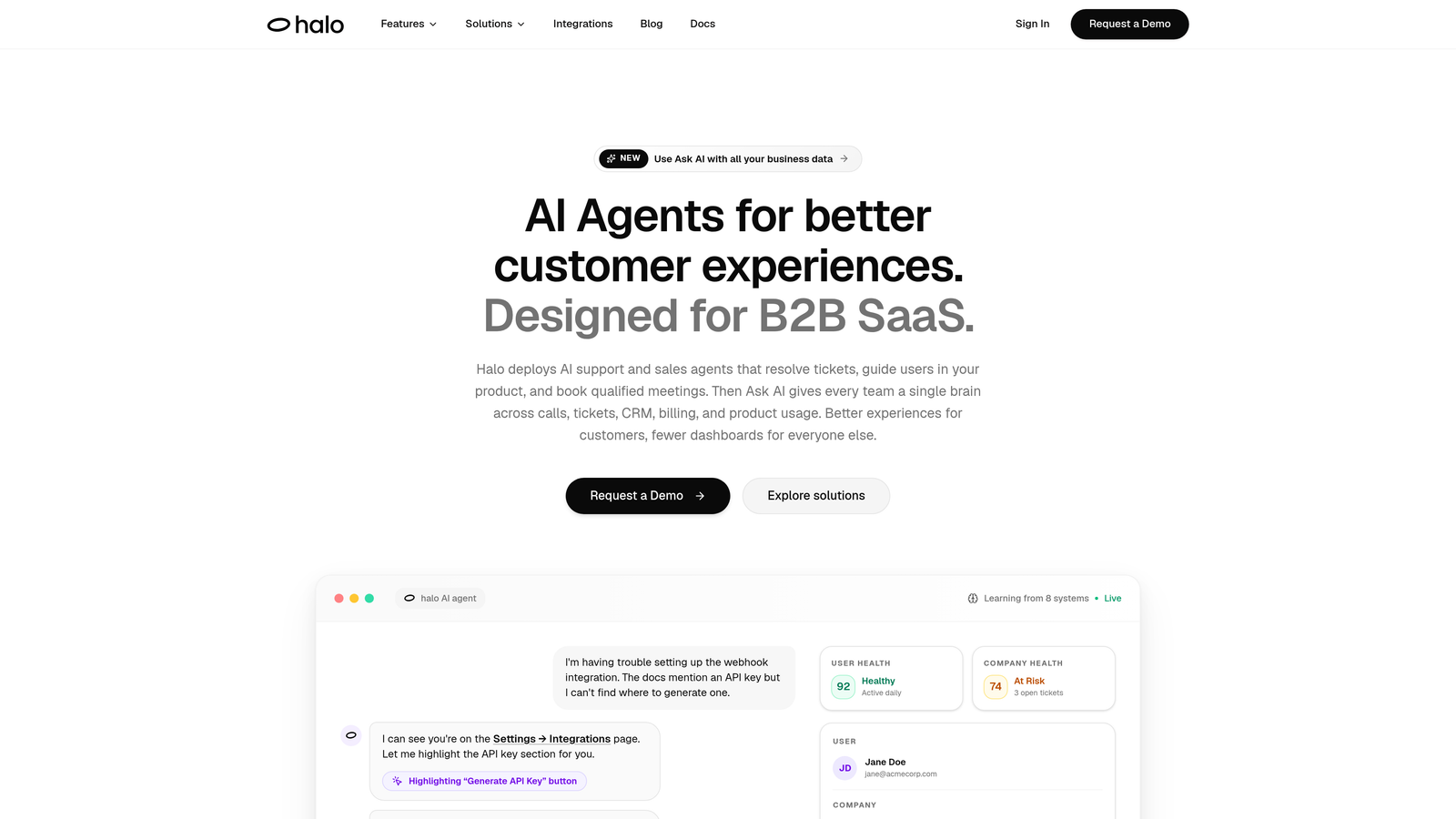
Halo AI is an AI-first customer support platform with a page-aware chat widget, intelligent ticket resolution, and deep integrations across the modern SaaS stack.
Where This Tool Shines
What separates Halo from most chatbot platforms is its page-context engine. Rather than responding to a message in isolation, Halo's chat widget understands what page the user is currently on and can provide visual UI guidance — essentially seeing what the user sees. This is particularly valuable for complex SaaS products where the same question means something entirely different depending on where in the product it's asked.
Beyond resolution, Halo operates as a business intelligence layer. Its smart inbox surfaces customer health signals, revenue anomalies, and support trends — giving support and product teams visibility that goes well beyond ticket counts. It also continuously learns from every resolved interaction, so the system gets measurably smarter over time without manual retraining.
Key Features
Page-Aware Context Engine: Understands the user's current page and product state to deliver precise, situation-specific responses and visual guidance.
Continuous Learning: Improves from every resolved interaction automatically, so accuracy compounds over time without manual intervention.
Auto Bug Ticket Creation: Detects issues from support conversations and automatically creates bug tickets routed to Linear or your preferred issue tracker.
Smart Inbox with Business Intelligence: Surfaces customer health signals, revenue anomalies, and support trends directly in the inbox view.
Live Agent Handoff: Escalates to human agents with full conversation context preserved — no re-explaining required from the customer.
Deep Integration Stack: Connects natively with Slack, HubSpot, Intercom, Stripe, Zoom, PandaDoc, Fathom, and Linear.
Best For
B2B SaaS companies that want an AI-first support architecture rather than a bolt-on to an existing helpdesk. Particularly strong for product teams that want support intelligence feeding back into their roadmap and engineering workflows. Teams that have outgrown basic chatbots and need a platform that scales in capability, not just volume.
Pricing
Custom pricing. Contact the team for a demo at haloagents.ai.
2. Intercom Fin
Best for: Teams already using Intercom who want AI resolution without switching platforms
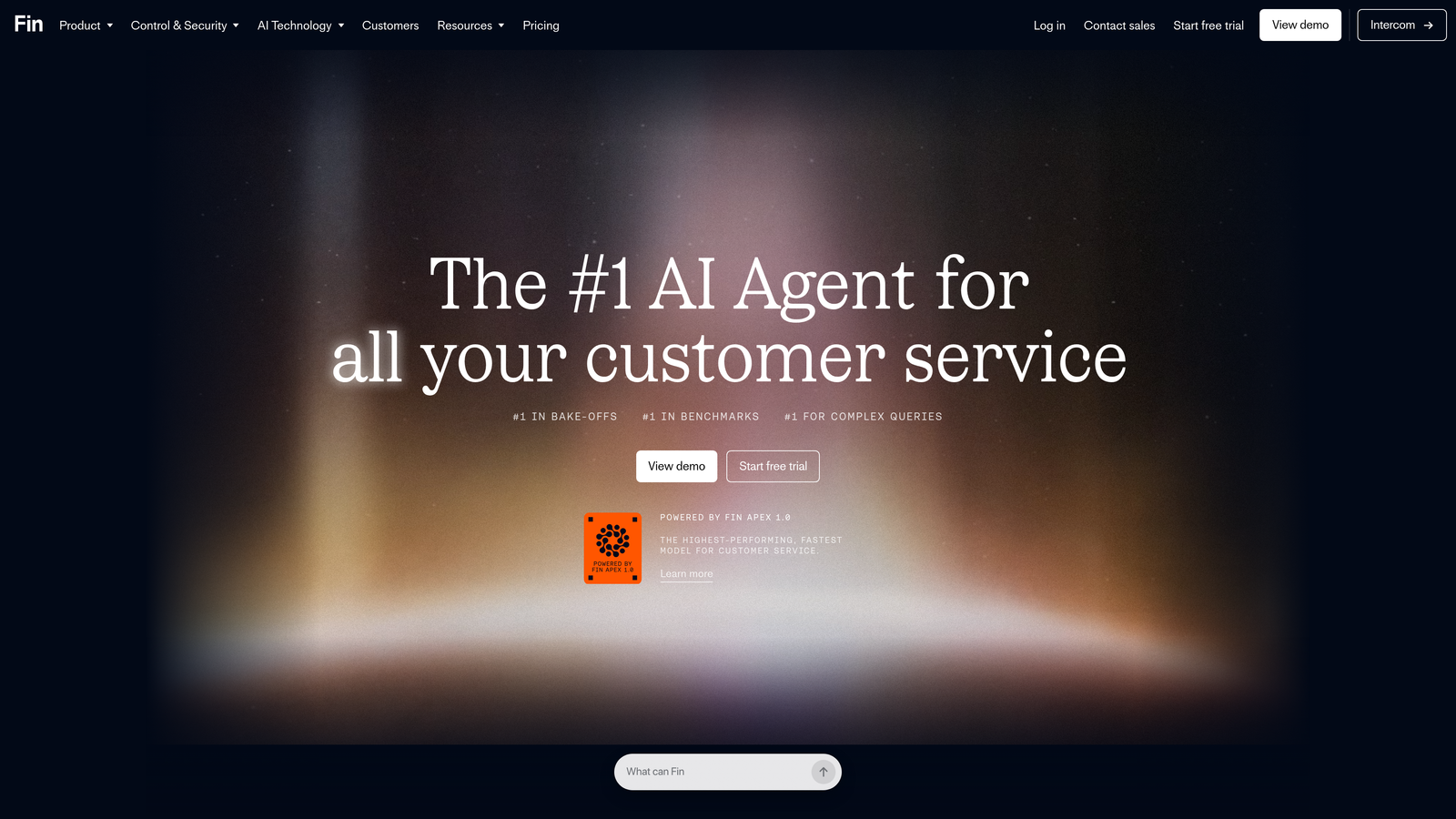
Intercom Fin is Intercom's LLM-powered AI agent that resolves support queries using conversation history, user attributes, and help center content as context.
Where This Tool Shines
Fin's biggest strength is how deeply it integrates with the Intercom platform. If your team already lives in Intercom, Fin requires minimal setup — it trains on your existing help center content automatically and uses conversation history and user attributes to contextualize responses. The quality of AI resolution is strong, and the escalation path to human agents is seamless within the same interface.
The per-resolution pricing model is worth noting. It aligns costs with value delivered, which is appealing in theory, but can become unpredictable at high support volumes. Teams should model their expected resolution rates carefully before committing.
Key Features
Conversation History Context: Uses full conversation history and user attributes to inform responses, not just the current message.
Automatic Help Center Training: Ingests your existing help center content without manual configuration.
Seamless Human Escalation: Hands off to live agents within the Intercom interface without losing conversation context.
Per-Resolution Pricing: You pay for successful resolutions, aligning cost with outcome.
Platform Integration: Works natively within the Intercom ecosystem, minimizing setup friction for existing customers.
Best For
Support teams already operating on Intercom who want to add AI resolution without migrating platforms. Less compelling as a standalone choice for teams not already invested in the Intercom ecosystem.
Pricing
Per-resolution pricing model. Check intercom.com for current rates, as pricing is subject to change.
3. Zendesk AI
Best for: Organizations with Zendesk as their primary system of record for support
Zendesk AI is Zendesk's AI suite built into the platform, using ticket history, customer data, and knowledge base content to automate and assist with support resolution.
Where This Tool Shines
Zendesk AI draws context from the full breadth of what Zendesk knows about a customer: their complete ticket history, account data, and any knowledge base content you've built. For teams where Zendesk is the definitive system of record, this creates a rich contextual foundation. The AI triage and intent detection capabilities help route and prioritize tickets before a human ever touches them.
The Agent Copilot feature is particularly useful for assisted workflows, suggesting responses and surfacing relevant articles for agents handling complex cases. The tradeoff is that Zendesk AI's context is largely bounded by what lives inside Zendesk — it doesn't pull in signals from outside the platform as fluidly as AI-first alternatives.
Key Features
Full Ticket History Context: Draws on the complete Zendesk customer record and ticket history for every interaction.
AI Triage and Intent Detection: Automatically categorizes and prioritizes incoming tickets before agent assignment.
Agent Copilot: Assists human agents with suggested responses and relevant knowledge base surfacing.
Knowledge Base Self-Service: Deflects tickets by surfacing relevant help articles contextually.
Add-On Availability: Available as an add-on to existing Zendesk plans, so no platform migration required.
Best For
Teams deeply embedded in the Zendesk ecosystem who want AI capabilities without switching platforms. Not ideal for organizations looking to pull in context from a broader set of external tools and data sources.
Pricing
Add-on to existing Zendesk plans; pricing varies by tier. Verify current rates at zendesk.com.
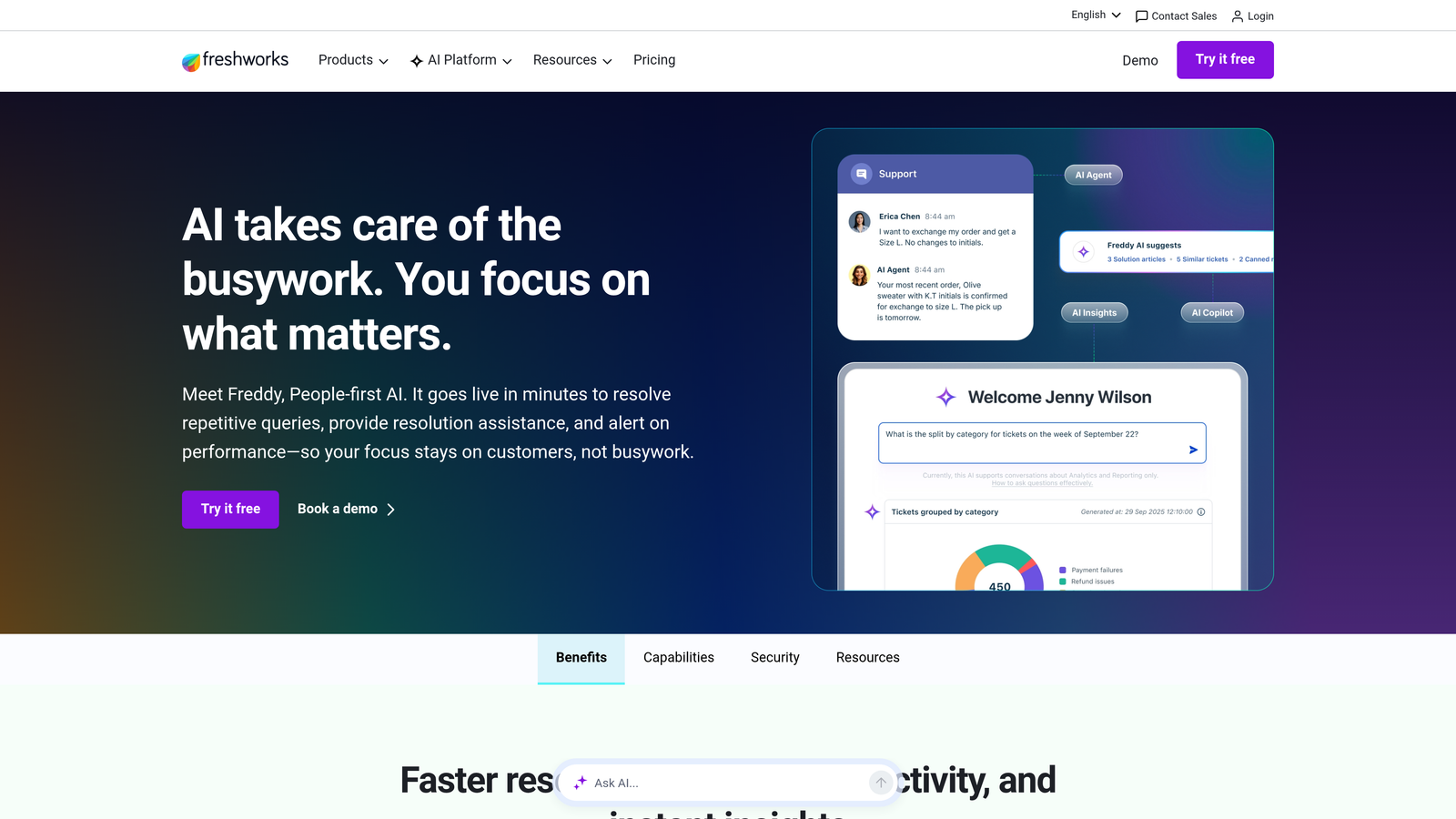
4. Freshdesk Freddy AI
Best for: Teams using the Freshworks suite who want AI across support and CRM in one ecosystem
Freshdesk Freddy AI is Freshworks' AI layer that spans support and CRM, combining customer and ticket context for both self-service automation and agent assistance.
Where This Tool Shines
Freddy's most compelling capability is what happens when you're using Freshworks products together. Combined CRM and support context means the AI knows not just the ticket history, but the broader customer relationship — deal stage, account health, past interactions across channels. For B2B teams managing long-term customer relationships, that combined view can meaningfully improve response quality.
Freddy splits into two functional modes: Freddy Self Service handles customer-facing automation, while Freddy Copilot assists agents in real time. The multilingual support capability is a practical advantage for teams supporting international customer bases.
Key Features
Freddy Self Service: Customer-facing AI resolution that handles common queries without agent involvement.
Freddy Copilot: Real-time agent assistance with suggested responses and contextual information surfacing.
Combined CRM and Support Context: Pulls from both support ticket history and CRM data when using Freshworks products together.
Multilingual Support: Handles conversations in multiple languages without separate configuration.
Tiered Pricing: Included in higher Freshworks plans, making it cost-effective for teams already on the platform.
Best For
Companies already using or considering the broader Freshworks suite. The value compounds significantly when support and CRM data are both in the Freshworks ecosystem. Less compelling as a standalone option outside that context.
Pricing
Included in higher Freshworks tiers. Check freshworks.com for current plan details.
5. Ada
Best for: Large enterprises needing action-based AI that resolves requests, not just answers questions
Ada is a no-code enterprise AI automation platform that goes beyond answering questions — it takes action by connecting to backend systems to resolve complex customer requests.
Where This Tool Shines
Ada's defining characteristic is its action-based architecture. Where most chatbots retrieve and present information, Ada can actually do things: check order status, update account information, process requests. This shifts the platform from a Q&A tool to a genuine resolution engine for complex self-service scenarios. For enterprise companies with sophisticated customer workflows, this distinction matters enormously.
The no-code builder makes it accessible to non-technical teams, which is notable at the enterprise tier where many comparable platforms require developer resources for every change. Ada also offers strong governance and customization controls, which matter for larger organizations with compliance requirements.
Key Features
Action-Based Resolution: Connects to backend systems to actually complete tasks — not just surface information.
No-Code Bot Builder: Enables non-technical teams to build and modify AI workflows without engineering support.
Deep API Integrations: Connects to backend systems for real-time data retrieval and action execution.
Multi-Channel Deployment: Operates across web, mobile, and messaging channels from a single configuration.
Enterprise Governance Controls: Customization and compliance controls suited for large organizations with strict requirements.
Best For
Large enterprises with complex self-service requirements and high support volumes. Particularly strong for companies where customers frequently need to take action — not just get information — through the support interface.
Pricing
Enterprise pricing, custom. Contact Ada directly at ada.cx for a quote.
6. Drift (Salesloft)
Best for: B2B teams where support and sales conversations overlap and account context is critical
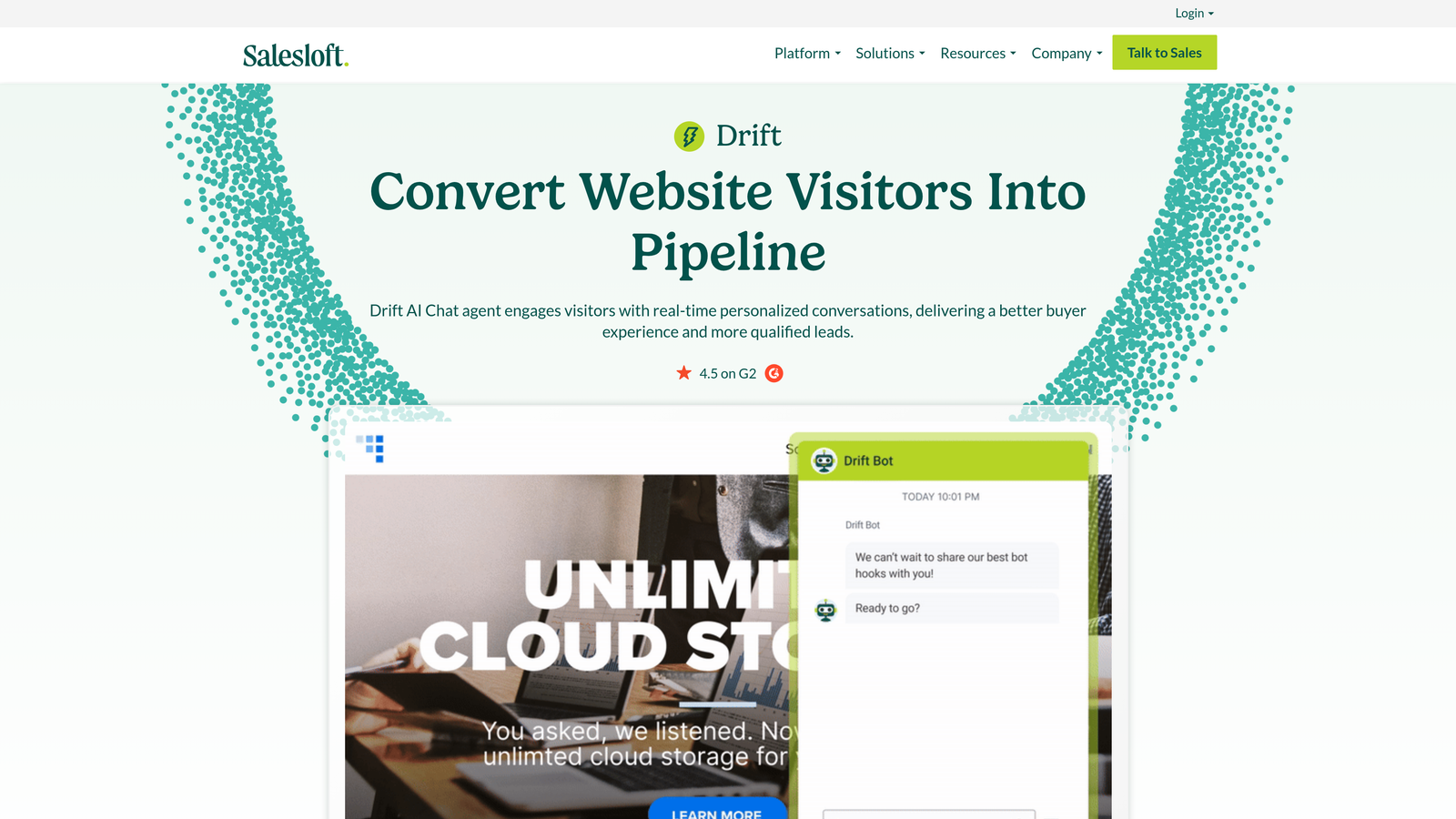
Drift is a conversational AI platform now integrated with Salesloft, using account-level and intent-based context to serve both support and sales conversations in B2B environments.
Where This Tool Shines
Drift's context model is distinct from pure support platforms. Rather than drawing primarily on ticket history, Drift pulls account-level data from CRM and intent signals to inform how it engages visitors. This makes it particularly effective in B2B scenarios where knowing a visitor's company, deal stage, or behavioral intent changes how they should be routed and responded to.
The integration with Salesloft's revenue intelligence layer adds another dimension for teams using both platforms. If your support function sits adjacent to sales and customer success, Drift's blended context model can serve multiple teams simultaneously. That said, it's less optimized for deep technical support resolution than dedicated support-first platforms.
Key Features
Account-Level CRM Context: Pulls company and deal data from CRM to inform routing and response quality.
Intent-Based Engagement: Uses behavioral signals to trigger proactive conversations at the right moment.
Tier and Behavior-Based Routing: Routes conversations based on account tier, industry, or behavioral patterns.
Salesloft Revenue Intelligence Integration: Connects conversational data with revenue intelligence for sales and CS alignment.
Conversational Landing Pages: Enables proactive engagement on high-intent pages rather than waiting for a user to initiate.
Best For
B2B companies where the line between support, sales, and customer success is blurry. Teams using Salesloft for revenue operations will get the most value from the integrated context model.
Pricing
Enterprise pricing, custom. Contact Salesloft or visit drift.com for current pricing information.
7. Tidio
Best for: Smaller B2B teams wanting functional context-awareness at accessible price points
Tidio is a lightweight, affordable chatbot and live chat platform with AI capabilities built on Claude, offering visitor behavior tracking and contextual automation for smaller teams.
Where This Tool Shines
Tidio occupies a practical middle ground: more context-aware than basic rule-based chatbots, but far more accessible than enterprise platforms in terms of both pricing and setup complexity. Lyro, its AI chatbot built on Claude, handles conversational resolution with reasonable quality, while the visitor behavior and page tracking features provide a layer of contextual awareness that helps the bot respond more relevantly.
The combination of live chat and AI chatbot in a single platform reduces tool sprawl for smaller teams. Setup is genuinely straightforward — no heavy technical requirements or lengthy implementation timelines. The free tier makes it easy to evaluate before committing to a paid plan.
Key Features
Lyro AI (Built on Claude): Conversational AI resolution with solid language understanding for common support queries.
Visitor Behavior and Page Tracking: Tracks what pages visitors are on and how they're behaving to inform chatbot responses.
Live Chat and AI in One Platform: Combines human chat and automated AI responses without requiring separate tools.
Simple Setup: Designed for teams without dedicated technical resources or long implementation timelines.
Free Tier Available: Allows evaluation before any financial commitment, with paid plans at accessible price points.
Best For
Smaller B2B teams or early-stage SaaS companies that need functional AI support with contextual awareness but aren't ready for enterprise platform investments. Also a solid option for teams testing AI support capabilities before scaling up.
Pricing
Free tier available. Lyro AI plans start at affordable monthly rates. Check tidio.com for current pricing.
8. Kore.ai
Best for: Enterprises with technical resources to build sophisticated, multi-channel AI agents from scratch
Kore.ai is an enterprise Experience Optimization (XO) Platform for building sophisticated, multi-channel AI agents with advanced dialogue management and deep contextual awareness.
Where This Tool Shines
Kore.ai is built for organizations that need to architect complex AI agent experiences rather than deploy a pre-built solution. Its dialogue management system handles multi-turn conversations with genuine sophistication, retaining context across extended interactions in ways that simpler platforms struggle with. The platform supports deployment across voice, web, messaging, and email from a single configuration, which matters for enterprises managing support across multiple channels.
Pre-built industry-specific templates reduce some of the implementation burden, but Kore.ai still requires meaningful technical investment to implement and customize. This is a platform for organizations with dedicated AI or engineering resources, not teams looking for a quick deployment.
Key Features
Advanced Dialogue Management: Retains and uses context across multi-turn, extended conversations with high accuracy.
Multi-Channel Deployment: Single configuration deploys across voice, web, messaging, and email channels.
Industry-Specific Templates: Pre-built AI agent templates for common industry use cases to accelerate development.
Strong NLP and Intent Recognition: Robust natural language processing for accurate intent classification across diverse query types.
High Customization Ceiling: Deep configurability for organizations with complex, unique requirements.
Best For
Large enterprises with dedicated AI or engineering teams who need to build highly customized, multi-channel AI agents. Not a fit for teams seeking rapid deployment or those without technical implementation resources.
Pricing
Enterprise pricing, custom. Contact Kore.ai at kore.ai for a quote.
9. Forethought
Best for: High-volume support teams focused on AI-powered triage, routing, and deflection
Forethought is an AI platform focused on support operations, using ticket and conversation context to triage, route, and deflect support requests before a human agent needs to intervene.
Where This Tool Shines
Forethought takes a different angle than most platforms on this list. Rather than leading with a customer-facing chat widget, its primary value is in the operational layer: reading ticket context to predict intent and urgency, routing to the right agent or queue, and surfacing relevant articles to deflect tickets before they're assigned. For high-volume support operations, this triage intelligence can meaningfully reduce the load on human agents.
The integrations with Zendesk, Salesforce Service Cloud, and Freshdesk make it a natural fit for teams already using those platforms who want to add an AI intelligence layer without replacing their existing helpdesk infrastructure.
Key Features
AI Triage: Reads ticket context to predict intent and urgency, enabling smarter prioritization before human review.
Intelligent Routing: Routes tickets to the right agent or queue based on content and context analysis.
Contextual Self-Service Deflection: Surfaces relevant help articles based on ticket content to resolve issues before agent assignment.
Helpdesk Integrations: Native integration with Zendesk, Salesforce Service Cloud, and Freshdesk.
Operations Analytics: Provides analytics on deflection rates, resolution patterns, and support trends.
Best For
High-volume B2B support teams using Zendesk, Salesforce, or Freshdesk who want to add AI intelligence to their triage and routing workflows. Particularly strong for teams where ticket volume has outpaced agent capacity and operational efficiency is the primary concern.
Pricing
Custom pricing. Contact Forethought at forethought.ai for a quote.
Which Tool Is Right for Your Team
The right platform depends heavily on where you sit in the market and what "context-aware" means for your specific use case.
If you're a B2B SaaS team that wants an AI-first architecture with genuine page-level context, business intelligence, and continuous learning built in from day one, Halo AI is the strongest starting point. It's built for exactly this use case and doesn't require you to retrofit AI onto an existing helpdesk.
For teams already embedded in a specific ecosystem, the native AI options are compelling. Intercom Fin works well if Intercom is your conversation platform of record. Zendesk AI and Freshdesk Freddy AI are strong choices when those platforms hold your primary customer data — the context they can draw on within their own ecosystems is genuinely deep.
If enterprise scale and action-based resolution are your priorities, Ada is purpose-built for complex self-service at high volumes. For organizations with technical resources and multi-channel requirements, Kore.ai offers the highest customization ceiling. Forethought stands out specifically for high-volume teams where triage and routing efficiency is the primary pain point.
Drift makes the most sense when your support and sales motions overlap and account-level context matters as much as ticket history. And for smaller teams testing the waters, Tidio offers a practical, affordable entry point without the complexity of enterprise platforms.
The common thread across all of these: generic chatbots that ignore context are losing ground fast. The question isn't whether to adopt context-aware AI for support — it's which platform fits your stack, your team, and the complexity of your customer relationships.
Your support team shouldn't scale linearly with your customer base. Let AI agents handle routine tickets, guide users through your product, and surface business intelligence while your team focuses on complex issues that need a human touch. See Halo in action and discover how continuous learning transforms every interaction into smarter, faster support.