9 Best Conversational AI Platforms for Customer Support in 2026
This guide evaluates the 9 best conversational AI platforms for support teams in 2026, comparing each on autonomous resolution capability, integration depth, ease of deployment, and fit for B2B SaaS environments. Whether you run a lean startup support team or an enterprise-scale operation, it identifies the right platform for your specific situation.
 Matt PattoliFounder14 min read
Customer support teams are under more pressure than ever. Ticket volumes climb, customer expectations rise, and headcount budgets stay flat. The good news is that conversational AI platforms have moved well beyond basic chatbots: today's solutions resolve tickets autonomously, guide users through complex workflows, hand off to live agents seamlessly, and surface business intelligence that goes far beyond "how many tickets did we close?"
This guide covers the best conversational AI platforms purpose-built for support teams in 2026. We evaluated each tool on resolution capability, integration depth, ease of deployment, scalability, and how well it fits B2B SaaS environments specifically. Whether you're running a lean support team at a Series A startup or managing enterprise-scale ticket queues, there's a platform here that fits your situation.
1. Halo AI
Best for: B2B SaaS teams wanting an AI-first support platform with deep integrations and business intelligence
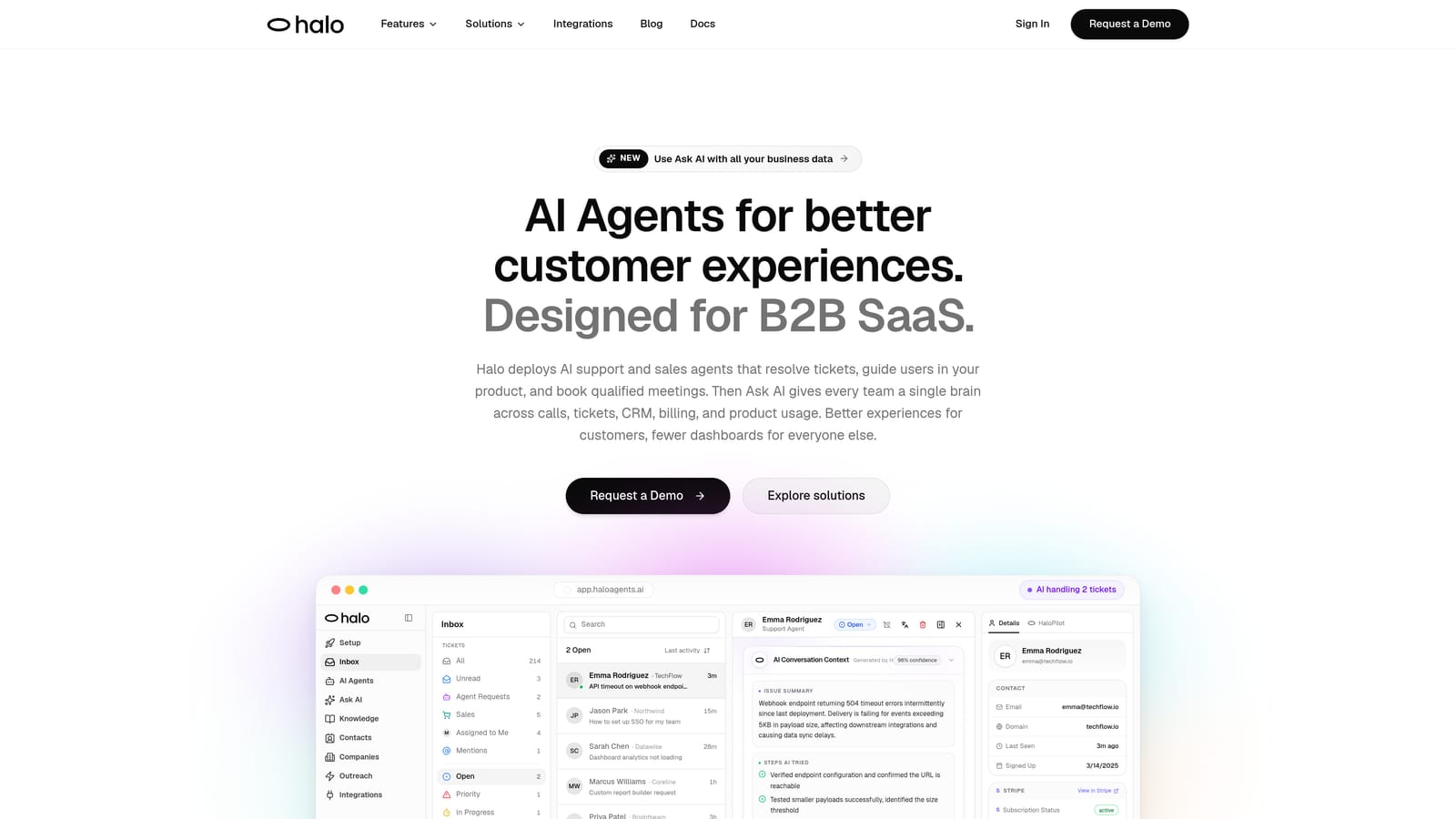
Halo AI is an AI-first customer support platform built specifically for B2B SaaS teams, deploying intelligent agents that resolve tickets, guide users, and surface actionable business intelligence.
Where This Tool Shines
What separates Halo from most tools on this list is its architecture. It wasn't built as a bolt-on to an existing helpdesk — it was designed AI-first from the ground up. That means tighter learning loops, more flexible context awareness, and a platform that genuinely improves with every interaction rather than simply routing queries to static knowledge base articles.
The page-aware chat widget is a standout capability. Halo's AI can see what the user is looking at and provide contextual visual guidance in real time — the difference between telling a user "click the settings icon" and actually showing them exactly where it is. For SaaS products with complex workflows, this is a meaningful upgrade over generic chatbot responses.
Key Features
Page-Aware Chat Widget: The AI sees what users see and delivers contextual visual guidance based on their current location in your product.
Autonomous Ticket Resolution: AI agents resolve support tickets independently, with continuous learning from every interaction to improve accuracy over time.
Auto Bug Ticket Creation: Halo automatically identifies and routes bug reports directly to Linear, removing manual triage from your engineering workflow.
Smart Inbox with Business Intelligence: The inbox surfaces customer health signals, churn indicators, and anomaly detection — turning support data into product and CS intelligence.
Live Agent Handoff: Complex issues escalate seamlessly to human agents with full conversation context preserved.
Deep Integration Stack: Native connections to Slack, HubSpot, Intercom, Stripe, Zoom, PandaDoc, and Fathom — not shallow webhooks, but meaningful data exchange across your full business stack.
Best For
Halo is an ideal fit for B2B SaaS teams at Series A and beyond that want AI to do more than deflect tickets. If your support data should be informing your product roadmap, customer success strategy, and churn prevention efforts, Halo's business intelligence layer makes that possible without additional tooling.
Pricing
Pricing is not publicly listed. Contact Halo AI directly for a custom quote based on your team size and usage requirements.
2. Intercom (Fin AI Agent)
Best for: Teams already using Intercom who want AI resolution without switching platforms
Intercom Fin is Intercom's native AI agent, resolving customer conversations directly within the Intercom messenger using generative AI trained on your existing help center content.
Where This Tool Shines
Fin's biggest advantage is zero additional deployment friction for existing Intercom customers. If your team already lives in Intercom, Fin activates within your existing messenger without migrating data, rebuilding workflows, or retraining your team on a new interface. That time-to-value argument is genuinely compelling for teams that don't have the bandwidth for a platform migration.
The GPT-powered resolution quality is solid, particularly for teams with well-maintained help center content. Fin pulls answers directly from your existing articles, which means the quality of your documentation directly influences the quality of AI responses — a double-edged sword worth keeping in mind during setup.
Key Features
GPT-Powered Resolution: Fin uses generative AI to resolve conversations directly within the Intercom messenger without requiring rule-based configuration.
Help Center Integration: Pulls answers from your existing Intercom articles and custom content sources, making your documentation investment work harder.
Smooth Human Handoff: When Fin can't resolve an issue, it escalates to a human agent with full conversation context intact.
Per-Resolution Pricing: Some tiers offer a pay-per-resolution model, which can make cost predictable for teams with variable ticket volumes.
Native Deployment: No separate platform to manage — Fin lives entirely within your existing Intercom workspace.
Best For
Existing Intercom customers who want to add AI resolution capability without a platform change. Less compelling for teams not already on Intercom, where the full Intercom subscription cost becomes a factor in the decision.
Pricing
Fin is available as an add-on to Intercom plans. Per-resolution pricing is available on certain tiers. Contact Intercom for current plan details.
3. Zendesk AI
Best for: Large enterprises already deeply invested in the Zendesk Suite ecosystem
Zendesk AI spans intelligent triage, AI agents for self-service, and Copilot for agent assistance — all layered into the Zendesk Suite enterprise platform.
Where This Tool Shines
Zendesk AI's strength is breadth. The platform covers the full support workflow: intelligent triage routes and prioritizes incoming tickets using intent, sentiment, and language detection; AI agents handle self-service resolution; and Zendesk Copilot assists human agents with real-time suggestions during live conversations. For enterprise teams that need AI across every layer of their support operation, Zendesk delivers without requiring a separate vendor.
The tradeoff is that these AI capabilities are add-ons layered onto existing Zendesk Suite plans rather than native to the core architecture. Teams already paying for Zendesk Suite will find the AI additions accessible, but the overall cost structure can become significant at scale.
Key Features
Intelligent Triage: Automatically detects intent, sentiment, and language to route and prioritize tickets before they reach an agent.
AI Agents for Self-Service: Autonomous resolution for common queries, reducing ticket volume reaching human agents.
Zendesk Copilot: Real-time suggestions and response drafts for human agents during active conversations.
Enterprise Integration Ecosystem: Broad connectivity with enterprise tools across CRM, ERP, and business intelligence categories.
Suite-Native Deployment: AI features activate within the existing Zendesk environment, preserving existing workflows and agent training.
Best For
Enterprise support operations already running on Zendesk Suite that want to add AI capabilities incrementally without platform migration. Less cost-effective for teams starting fresh who aren't already committed to the Zendesk ecosystem.
Pricing
AI features are add-ons to Zendesk Suite plans. Enterprise pricing varies significantly by tier and usage. Contact Zendesk for current add-on pricing.
4. Freshdesk Freddy AI
Best for: SMBs and growing teams wanting AI-powered support at accessible price points
Freshdesk Freddy AI is Freshworks' AI layer for Freshdesk, covering customer-facing self-service, agent copilot assistance, and analytics — at price points designed for SMB budgets.
Where This Tool Shines
Freddy AI's three-layer approach covers the support workflow comprehensively without requiring enterprise-level investment. Self Service handles customer-facing deflection, Copilot assists agents in real time, and Insights surfaces analytics that help managers understand what's working. For SMBs that need AI across the full support stack but can't justify enterprise pricing, Freddy AI is one of the more complete offerings at this price tier.
The tight integration with Freshdesk's ticketing workflows means setup is relatively low-friction for existing Freshdesk customers. The SMB-friendly pricing structure also makes it easier to start small and expand as your support operation grows.
Key Features
Freddy Self Service: Customer-facing AI bot that deflects common queries before they reach your support queue.
Freddy Copilot: Real-time response suggestions and draft assistance for human agents during active tickets.
Freddy Insights: AI-powered analytics and reporting to surface patterns, trends, and performance metrics across your support operation.
Growth Plan Availability: AI add-ons accessible from Freshdesk's Growth plan tier, not locked behind enterprise pricing.
Freshdesk Workflow Integration: AI features operate natively within existing Freshdesk ticketing and automation workflows.
Best For
SMBs and mid-market teams using Freshdesk who want to add AI capabilities without moving to a new platform or absorbing enterprise-level costs. Also a solid choice for teams new to AI-assisted support who want a lower-risk entry point.
Pricing
Freddy AI add-ons are available on Freshdesk Growth plans and above. SMB-accessible pricing; check Freshworks for current plan details.
5. Drift (Salesloft)
Best for: B2B teams where support conversations frequently overlap with sales and revenue opportunities
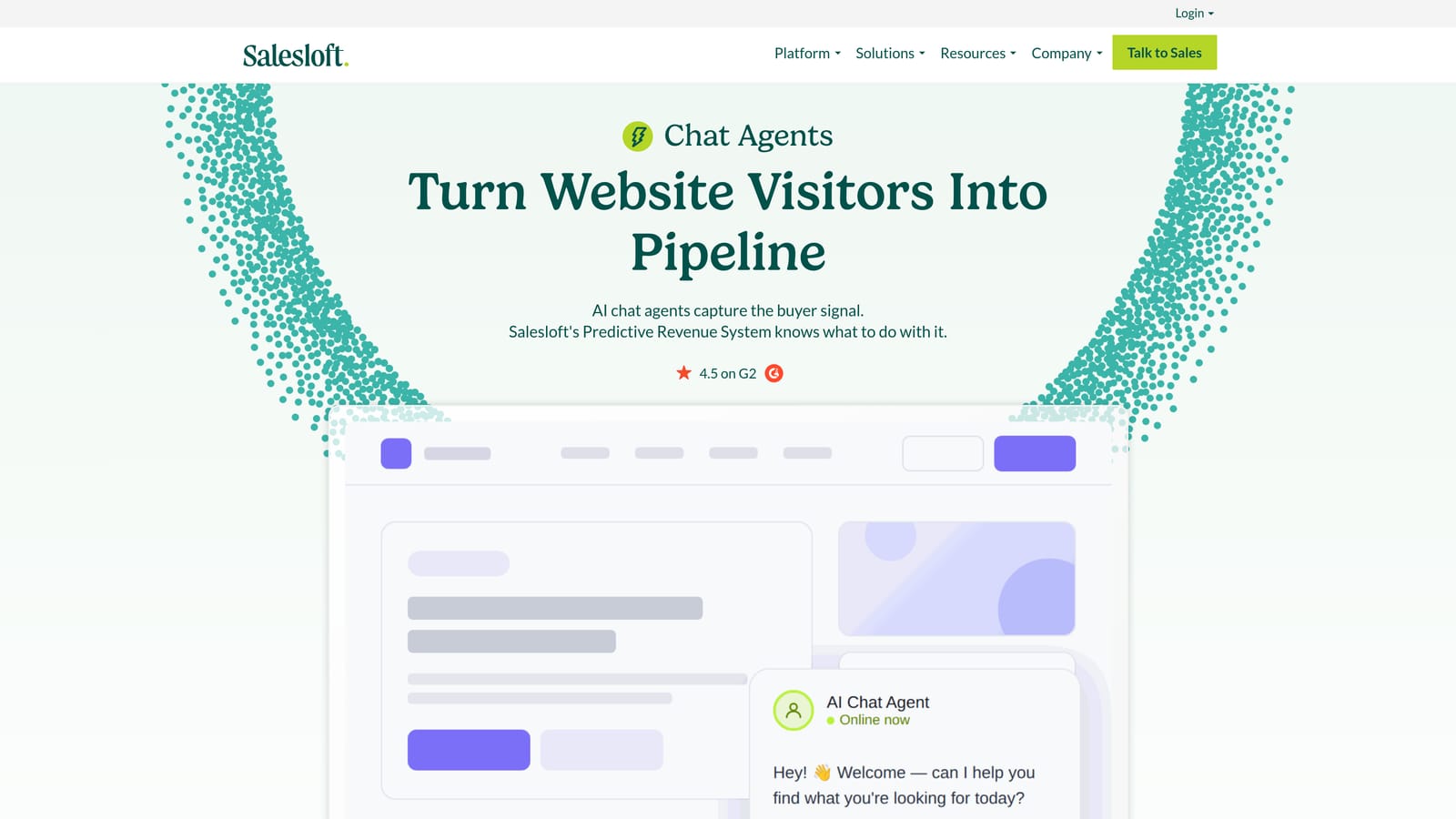
Drift, now part of Salesloft, blends conversational AI across marketing, sales, and support — making it a strong fit for B2B teams where the line between support and revenue is intentionally blurred.
Where This Tool Shines
Most support platforms treat support as a cost center to be optimized. Drift's positioning is different: support conversations are revenue opportunities, and the platform is built to capture them. Account-based routing connects website visitors and inbound conversations to the right team based on company data, while AI-powered meeting booking lets conversations convert to pipeline without human intervention.
The Salesloft acquisition has deepened the revenue intelligence layer, giving teams visibility into how support interactions connect to broader account health and sales engagement. For B2B teams with a strong revenue-from-support mandate, that context is genuinely valuable.
Key Features
Cross-Functional Conversational AI: AI spans support, sales, and marketing touchpoints within a single platform rather than siloing each function.
Account-Based Routing: Matches inbound conversations to the right team or individual based on account data and intent signals.
AI-Powered Meeting Booking: Converts conversations to booked meetings without requiring a human to intervene in the handoff.
Revenue Intelligence: Support interaction data feeds into broader account health and revenue engagement analytics via the Salesloft integration.
Salesloft Platform Integration: Access to Salesloft's broader revenue engagement toolset for teams that want unified sales and support data.
Best For
B2B teams, particularly in sales-led organizations, where support conversations frequently become upsell, renewal, or expansion opportunities. Less suited for pure support operations that don't need the sales and marketing overlay.
Pricing
Enterprise-focused pricing. Contact Drift/Salesloft directly for current plan details.
6. Ada
Best for: Enterprise brands needing action-oriented AI with multilingual support across global markets
Ada is a no-code AI agent builder targeting enterprise brands that need conversational AI capable of executing actions, not just answering questions, across multiple languages and channels.
Where This Tool Shines
Ada's differentiator is action depth. Where many conversational AI tools are fundamentally sophisticated FAQ engines, Ada's AI agents can process transactions, update customer accounts, and execute multi-step workflows autonomously. For industries like fintech, retail, and global SaaS where support often means doing something rather than explaining something, that capability gap matters significantly.
The no-code agent builder makes it accessible to non-technical teams despite the enterprise positioning. Multilingual support across a broad range of languages also makes Ada a natural fit for organizations with global customer bases who need consistent AI quality across markets.
Key Features
Action-Oriented AI: Agents can process refunds, update account information, and execute transactions — not just surface answers from a knowledge base.
No-Code Agent Builder: Non-technical teams can build, configure, and iterate on AI agents without engineering support.
Multilingual Support: Broad language coverage for global customer bases requiring consistent AI quality across markets.
Omnichannel Deployment: Deploys across web, mobile, and messaging platforms from a single configuration.
Enterprise Security and Compliance: Built-in controls for data privacy, security, and regulatory compliance requirements at enterprise scale.
Best For
Enterprise brands in retail, fintech, and global SaaS that need AI to execute actions, not just answer questions. Particularly strong for organizations with multilingual support requirements or complex self-service transaction workflows.
Pricing
Enterprise pricing. Contact Ada directly for a custom quote.
7. Tidio
Best for: SMBs, e-commerce brands, and early-stage SaaS teams wanting fast AI deployment on a limited budget
Tidio combines live chat with Lyro AI in a package designed for quick deployment, making it a popular choice for teams that need working AI support without a complex implementation project.
Where This Tool Shines
Tidio's appeal is speed and accessibility. The platform is built for teams that want to go from sign-up to live AI support in hours rather than weeks. The visual flow builder requires no technical skills, the free tier lets small teams get started without a budget commitment, and the Shopify integration makes it a natural fit for e-commerce brands already on that platform.
Lyro AI handles conversational responses within the chat widget, covering common queries automatically while the live chat layer manages anything that needs a human. It's a pragmatic hybrid approach that works well for teams not yet ready to commit to a fully autonomous AI resolution model.
Key Features
Lyro AI: Conversational AI layer that handles automated responses for common customer queries within the chat interface.
Visual Flow Builder: No-code bot customization using a drag-and-drop interface accessible to non-technical team members.
Live Chat and AI Hybrid: Seamlessly blends AI-handled conversations with live agent availability in a single platform.
Shopify and E-Commerce Integrations: Native connections to Shopify and other e-commerce platforms for order and customer data context.
Free Tier: A functional free plan available for small teams testing AI-assisted support before committing to paid plans.
Best For
SMBs, e-commerce brands, and early-stage SaaS teams that prioritize speed of deployment and affordability over deep customization or enterprise-grade analytics. Also a good starting point for teams new to AI-assisted support who want to learn before scaling.
Pricing
Free tier available. Paid plans start at SMB-accessible price points. Check Tidio's website for current plan details.
8. Kustomer
Best for: High-volume support operations that need full customer context embedded in every AI and agent interaction
Kustomer is a CRM-native support platform with AI embedded in a unified customer timeline, giving agents and AI alike complete context on every interaction, order, and conversation history.
Where This Tool Shines
Kustomer's core insight is that better support requires better context. Most support platforms treat each ticket as an isolated event. Kustomer's unified customer timeline aggregates every conversation, order, subscription event, and interaction into a single view — and AI operates within that context rather than alongside it. The result is AI and agent responses that reflect the full customer relationship, not just the current ticket.
This makes Kustomer particularly strong for high-touch support models where customer history genuinely changes how you respond. Subscription businesses, high-value B2C brands, and any operation where "who is this customer?" matters as much as "what are they asking?" will find the CRM-native approach valuable.
Key Features
Unified Customer Timeline: Combines CRM data, order history, and support interactions into a single chronological view for agents and AI.
Context-Aware AI: AI operates within the full customer context rather than treating each conversation as a standalone event.
Automation Workflows: High-volume automation for routing, tagging, and resolution workflows across large support operations.
Omnichannel Conversation Management: Handles conversations from email, chat, social, and messaging channels within the unified timeline.
Relationship-Centric Support Model: Designed for support operations where customer lifetime value and relationship context drive response strategy.
Best For
High-volume support teams in subscription businesses, e-commerce, and relationship-heavy B2C contexts where customer history is central to support quality. Less optimized for lean B2B SaaS teams that don't need the full CRM layer.
Pricing
Enterprise pricing. Contact Kustomer directly for current plan details.
9. Forethought (SupportGPT)
Best for: Enterprise teams wanting AI-powered triage, deflection, and agent assist layered onto existing helpdesks
Forethought focuses on AI-powered triage, deflection, and agent assist, with SupportGPT driving generative AI responses and intelligent routing before tickets reach human agents.
Where This Tool Shines
Forethought is built for teams that want to add AI intelligence to their existing helpdesk without replacing it. SupportGPT handles generative AI responses and deflection at the front of the queue, intelligent triage routes what remains to the right agent or team, and Agent Assist provides real-time suggested responses during live handling. The result is AI coverage across the full ticket lifecycle without a platform migration.
The deflection analytics layer is particularly useful for teams trying to measure and optimize self-service rates systematically. Forethought surfaces data on what's being deflected, what's failing to deflect, and where your knowledge base has gaps — making continuous improvement measurable rather than anecdotal.
Key Features
SupportGPT: Generative AI for ticket responses and self-service deflection, powered by large language model technology.
Intelligent Triage and Routing: Automatically routes tickets to the right agent, team, or queue based on intent and content analysis.
Agent Assist: Real-time suggested responses for human agents handling complex or escalated tickets.
Deflection Analytics: Detailed reporting on self-service performance, deflection rates, and knowledge base gap identification.
Helpdesk Integrations: Native integrations with Zendesk, Salesforce Service Cloud, and ServiceNow for teams committed to those platforms.
Best For
Enterprise support teams on Zendesk, Salesforce, or ServiceNow that want to add AI triage, deflection, and agent assist without replacing their core helpdesk. Strong for operations where measuring and improving deflection rates is a primary business objective.
Pricing
Enterprise pricing. Contact Forethought directly for current plan details.
Which Platform Is Right for Your Team?
The right conversational AI platform depends heavily on three factors: your existing stack, your company stage, and what you actually need AI to do. Here's a quick decision guide.
For B2B SaaS teams wanting an AI-first approach: Halo AI is the strongest fit. The combination of page-aware guidance, autonomous resolution, auto bug ticket creation, and business intelligence analytics is purpose-built for SaaS support operations. It's the only platform on this list that turns support data into product and CS intelligence as a core feature rather than an afterthought.
For teams already on Intercom or Zendesk: Fin AI Agent and Zendesk AI respectively offer the lowest-friction path to AI-assisted support. If platform migration isn't on the table, these add-ons deliver meaningful capability without disrupting existing workflows.
For SMBs and early-stage teams on tight budgets: Tidio and Freshdesk Freddy AI offer the most accessible entry points. Tidio's free tier and Freddy's Growth plan availability mean you can start building AI support capability without a large upfront commitment.
For enterprise brands needing action-oriented AI across global markets: Ada's no-code agent builder and multilingual support make it a strong contender, particularly for organizations in fintech, retail, or global SaaS where AI needs to execute transactions, not just answer questions.
For teams where support and revenue are intentionally connected: Drift's cross-functional AI and revenue intelligence layer make it the natural choice for B2B organizations where support conversations regularly become pipeline opportunities.
Your support team shouldn't scale linearly with your customer base. Let AI agents handle routine tickets, guide users through your product, and surface business intelligence while your team focuses on complex issues that need a human touch. See Halo in action and discover how continuous learning transforms every interaction into smarter, faster support.