9 Best Conversational Support Platforms in 2026
This guide ranks the 9 best conversational support platforms of 2026, evaluating each on AI autonomy, context-awareness, integration depth, and live agent handoff quality. Whether you run a lean SaaS support team or manage enterprise-scale ticket volume, it cuts through the noise to match you with the right platform.
 Matt PattoliFounder13 min read
Customer expectations have shifted dramatically. People want answers in the moment, not a ticket number and a 48-hour wait. Conversational support platforms meet users where they are, resolving issues through AI-driven chat, intelligent agents, and seamless human handoff.
But not all platforms are built the same. Some bolt AI onto legacy helpdesk infrastructure. Others are built AI-first from the ground up. That distinction matters more than most buyers realize when they're evaluating tools.
This list covers the best conversational support platforms available in 2026, evaluated on AI autonomy, context-awareness, integration depth, live agent handoff quality, and business intelligence beyond basic ticketing. Whether you're running a lean SaaS support team or managing enterprise-scale ticket volume, there's a platform here that fits.
1. Halo AI
Best for: B2B SaaS teams that want AI-first support with product context and business intelligence
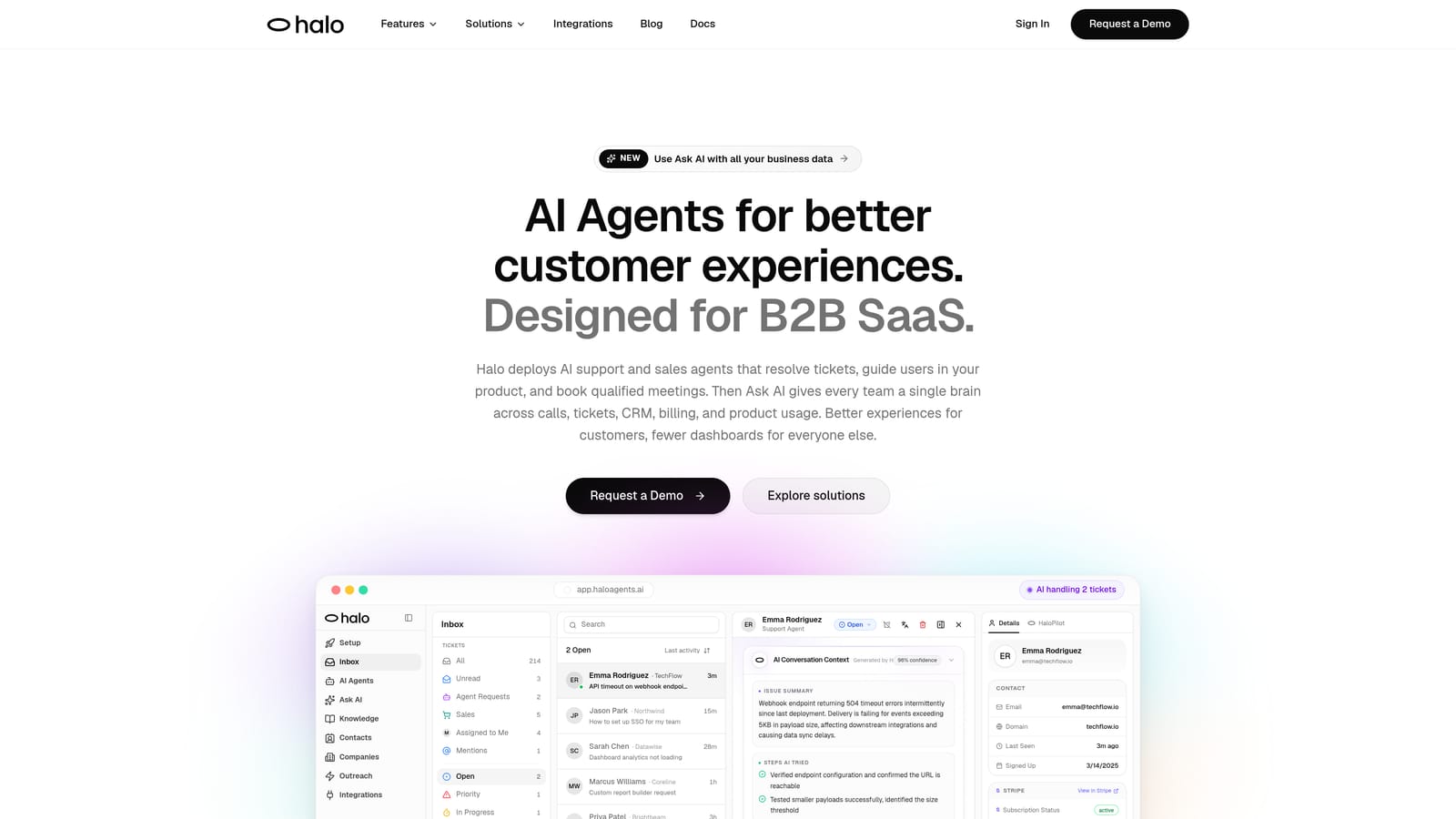
Halo AI is an AI-first conversational support platform built specifically for B2B SaaS teams who want genuine automation, not just assisted ticketing.
Where This Tool Shines
What separates Halo from most platforms on this list is its architecture. Rather than layering AI onto an existing helpdesk, Halo was built AI-first, meaning every interaction is designed around autonomous resolution from the start. The platform deploys intelligent agents that understand the user's current product context, guide them visually through your UI, and resolve tickets without needing a human in the loop for routine issues.
Beyond ticket resolution, Halo surfaces business intelligence that most support tools ignore entirely. Its smart inbox doesn't just organize conversations; it flags churn risk signals, revenue anomalies, and customer health indicators, giving support teams visibility into business impact, not just queue volume.
Key Features
Page-Aware AI Agents: The AI understands which page and product state a user is on, enabling contextual guidance and visual UI walkthroughs without requiring the user to describe their screen.
Smart Inbox with Business Intelligence: Surfaces customer health signals, churn risk indicators, and revenue anomalies directly within the support workflow.
Auto Bug Ticket Creation: Converts support conversations into structured bug reports automatically, pushing them into Linear and connected engineering tools without manual effort.
Live Agent Handoff: When escalation is needed, full conversation context passes through to the human agent seamlessly, so customers never have to repeat themselves.
Deep Integration Ecosystem: Connects to Slack, HubSpot, Stripe, Zoom, Linear, PandaDoc, Fathom, and Intercom, linking support data to your entire business stack.
Continuous Learning Architecture: Every resolved interaction improves the system's resolution quality over time, compounding value the longer you use it.
Best For
Halo is the strongest fit for B2B SaaS product and support teams that want more than a chat widget. If your team is looking to deflect routine tickets autonomously, connect support signals to revenue data, and avoid scaling headcount linearly with customer growth, this is the platform built for that outcome.
Pricing
Contact for pricing. See haloagents.ai for current plans and to book a demo.
2. Intercom
Best for: SaaS teams wanting an all-in-one messaging platform with mature AI and proactive onboarding tools
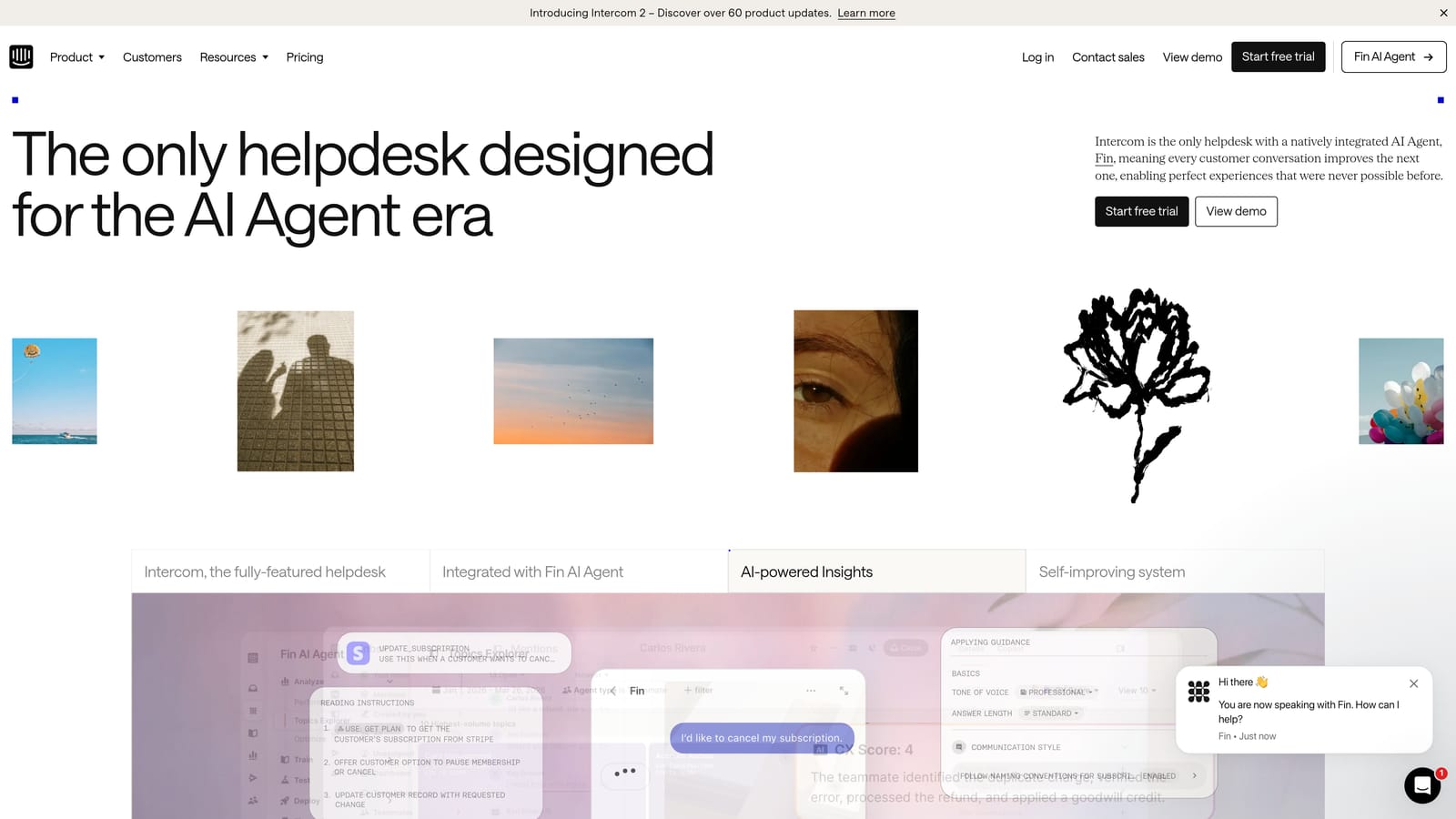
Intercom is a mature, widely adopted customer messaging platform combining AI-powered ticket resolution with proactive messaging and product tour capabilities.
Where This Tool Shines
Intercom's Fin AI agent, built on large language models, handles a meaningful portion of incoming support queries autonomously before escalating to human agents. For teams already embedded in the Intercom ecosystem, the platform offers a coherent experience across support, onboarding, and proactive engagement in a single tool.
The Messenger SDK gives product teams flexibility to embed chat across web and mobile surfaces, and the integration library covers most of the common SaaS stack. Pricing has historically been a friction point for smaller teams, but for mid-market SaaS companies, the breadth of capability often justifies the investment.
Key Features
Fin AI Agent: Autonomous ticket resolution using large language models, handling common queries without human involvement.
Proactive Messaging and Product Tours: Trigger contextual messages and guided tours based on user behavior for onboarding and feature adoption.
Messenger SDK: Embeddable chat for web and mobile with customizable UI.
AI-Assisted Reply Suggestions: Helps human agents draft faster responses within the inbox.
Strong Integration Library: Connects with Salesforce, HubSpot, Stripe, Slack, and hundreds of other tools.
Best For
Teams already running on Intercom for lifecycle messaging who want to consolidate support into the same platform. Also well-suited to SaaS companies that prioritize proactive onboarding alongside reactive support.
Pricing
Starts at approximately $39/seat/month. Verify current pricing at intercom.com/pricing.
3. Zendesk
Best for: Enterprise support teams needing omnichannel infrastructure with a large app ecosystem
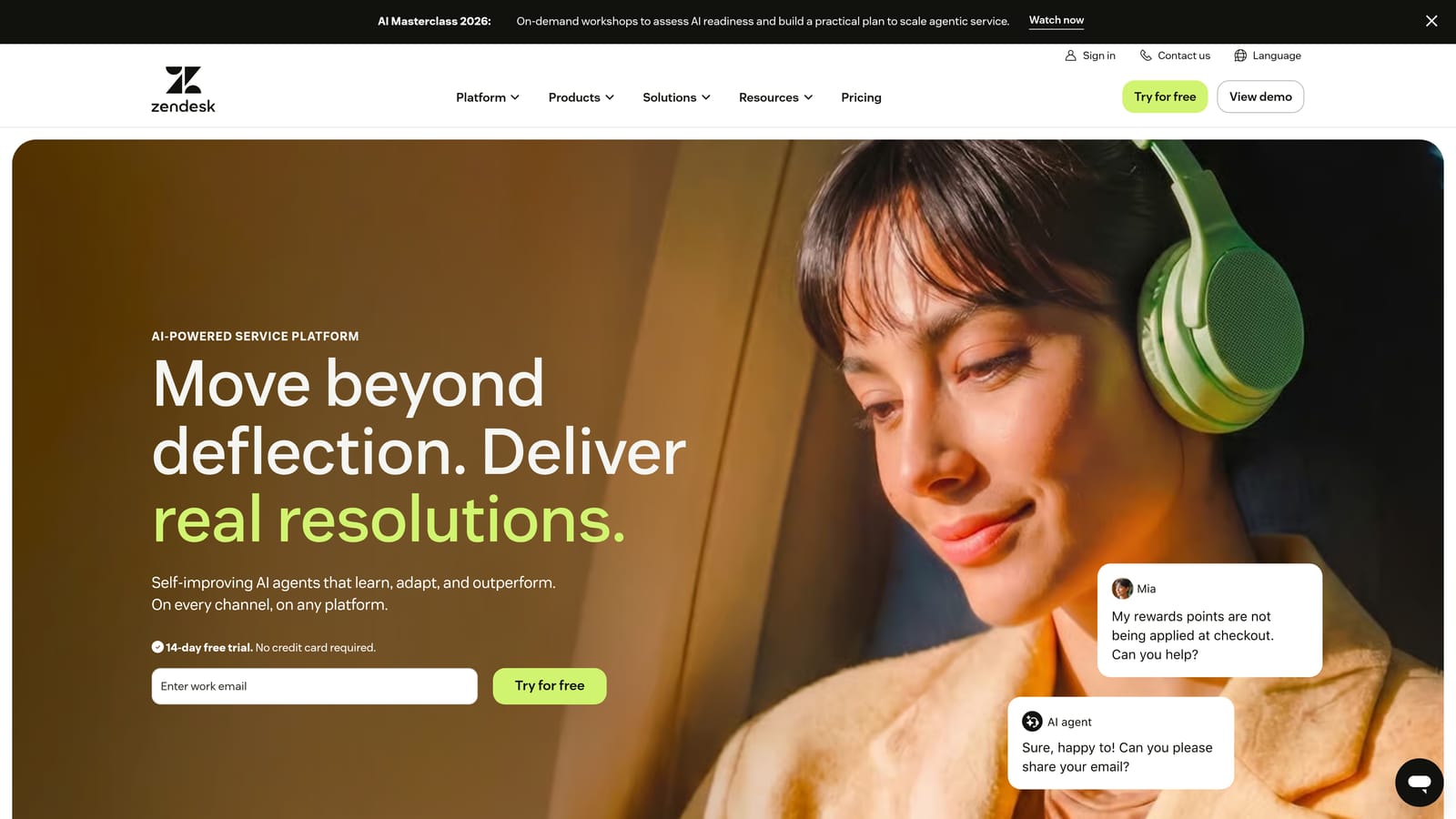
Zendesk is the enterprise-grade helpdesk standard, now with an AI layer for intent detection, ticket summarization, and automated routing built on top of its omnichannel infrastructure.
Where This Tool Shines
Zendesk's scale and maturity are its biggest advantages. With over a thousand marketplace integrations and a deeply configurable routing and SLA management system, it handles complex enterprise support operations that lighter tools can't accommodate. The platform has expanded its AI capabilities significantly, incorporating intent detection, macro suggestions, and conversation summarization into the core product.
That said, Zendesk can feel heavyweight for smaller teams. Its strength is in organizations with dedicated support operations staff who can configure and manage the platform properly. For lean SaaS teams, the setup overhead may outweigh the benefits.
Key Features
Zendesk AI: Covers ticket intent detection, automated macro suggestions, and conversation summarization to speed up agent workflows.
Sunshine Conversations: Omnichannel messaging layer connecting email, chat, SMS, social, and voice into a unified inbox.
1,000+ App Marketplace: Extensive integration library covering virtually every business tool category.
Advanced Routing and SLA Management: Sophisticated rules engine for directing tickets to the right team with enforceable service level agreements.
Robust Reporting and Analytics: Detailed performance dashboards and exportable data for support operations analysis.
Best For
Enterprise support teams and organizations with dedicated support operations staff managing high ticket volumes across multiple channels. Less ideal for lean SaaS teams that want quick deployment and minimal configuration overhead.
Pricing
Suite plans start at approximately $55/agent/month. Verify current pricing at zendesk.com/pricing.
4. Freshdesk
Best for: SMB teams scaling beyond email support with competitive pricing and a functional free tier
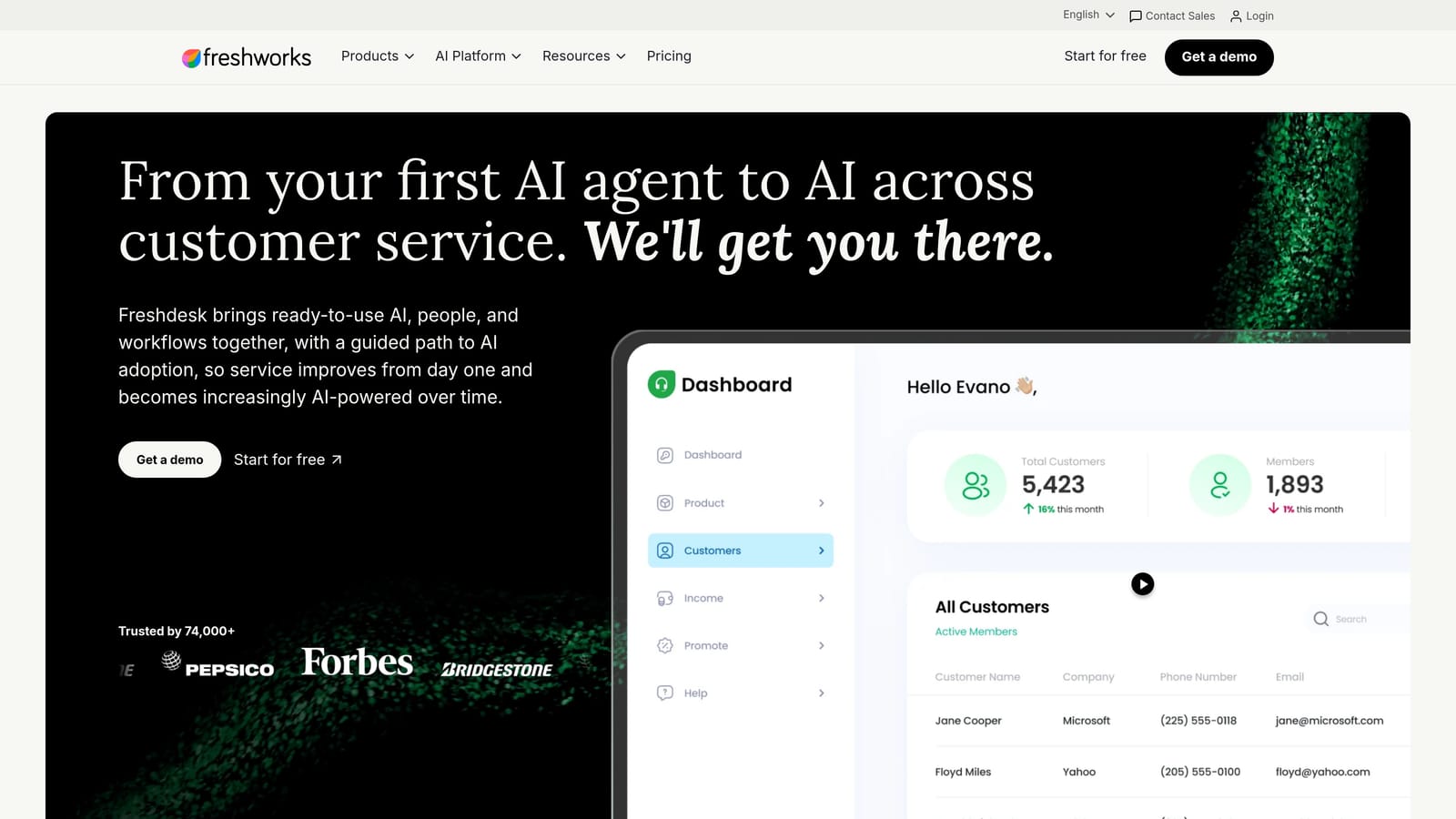
Freshdesk is an omnichannel support platform from Freshworks with Freddy AI for ticket automation and accessible pricing that makes it a popular entry point for growing teams.
Where This Tool Shines
Freshdesk's value proposition centers on breadth at a reasonable price point. Freddy AI covers the core automation use cases: ticket summarization, suggested replies, and sentiment analysis, without requiring a premium tier to access. The free tier is genuinely functional for small teams, making it an easy way to graduate from email-only support without a significant financial commitment.
Freshchat, Freshdesk's conversational messaging component, handles real-time chat across web and mobile. The platform covers email, chat, phone, and social in a single view, which is more channel coverage than many tools at this price range offer.
Key Features
Freddy AI: Handles ticket summarization, suggested replies, and sentiment analysis across the inbox.
Freshchat: Real-time conversational messaging for web and mobile surfaces.
Omnichannel Coverage: Email, chat, phone, and social media unified in one platform.
Free Tier: Core features available at no cost for small teams just getting started.
Marketplace Integrations: Connects with popular SaaS tools including Slack, Salesforce, and HubSpot.
Best For
SMB teams transitioning from email-only support, early-stage SaaS companies that need omnichannel coverage without enterprise pricing, and organizations evaluating support tooling before committing to a larger platform.
Pricing
Free tier available; paid plans start at approximately $15/agent/month. Verify current pricing at freshworks.com/freshdesk/pricing.
5. Drift (Salesloft)
Best for: B2B revenue teams where support conversations and sales pipeline overlap
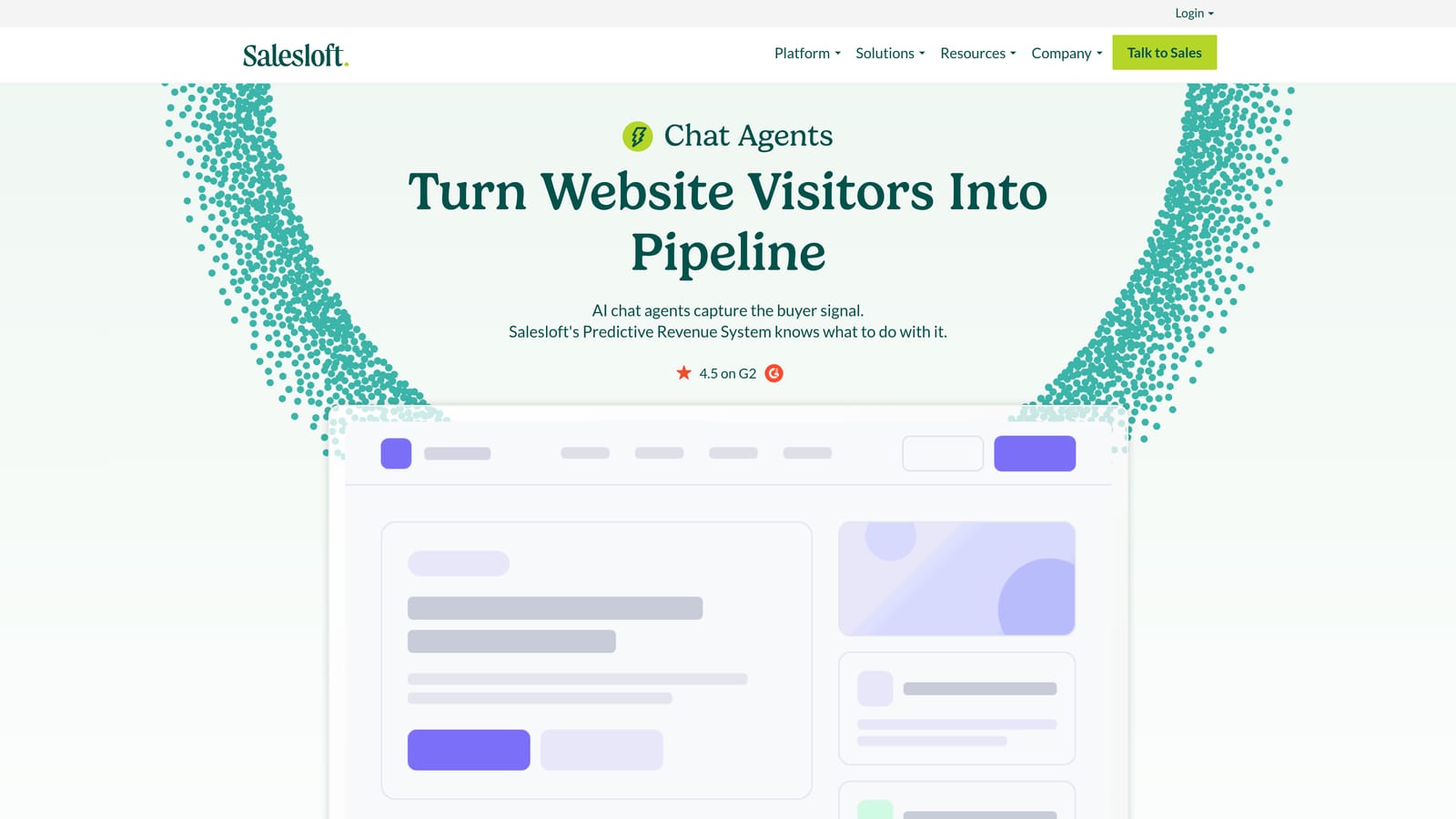
Drift, now part of Salesloft, is a conversational platform with strong roots in revenue generation and intent-based routing that distinguishes high-value sales prospects from routine support users.
Where This Tool Shines
Drift's differentiation lies in its intent-based routing engine. Rather than treating all incoming conversations the same, it identifies whether a visitor is a sales prospect or a support user and routes accordingly, triggering different playbooks and real-time notifications for high-value engagement. For B2B teams where the line between sales and support is blurry, this intelligence is genuinely useful.
The platform's conversational playbooks allow teams to build automated flows for common support and sales scenarios without engineering resources. Meeting scheduling built directly into chat flows reduces friction in the handoff from conversation to booked call.
Key Features
Intent-Based Routing: Distinguishes sales prospects from support users and routes conversations accordingly.
Conversational Playbooks: Automated conversation flows for both support and sales scenarios without code.
Real-Time Notifications: Alerts sales reps when high-value visitors are active on the site.
CRM Integrations: Native connections to Salesforce and HubSpot for full pipeline context.
Meeting Scheduling: Calendar booking built directly into chat flows for seamless prospect handoff.
Best For
B2B revenue teams where support and sales conversations overlap significantly. Less well-suited to pure support teams that don't need sales pipeline integration or intent-based visitor segmentation.
Pricing
Contact for pricing. Verify current options at drift.com/pricing.
6. HubSpot Service Hub
Best for: Organizations already running on HubSpot CRM that want native support without data sync overhead
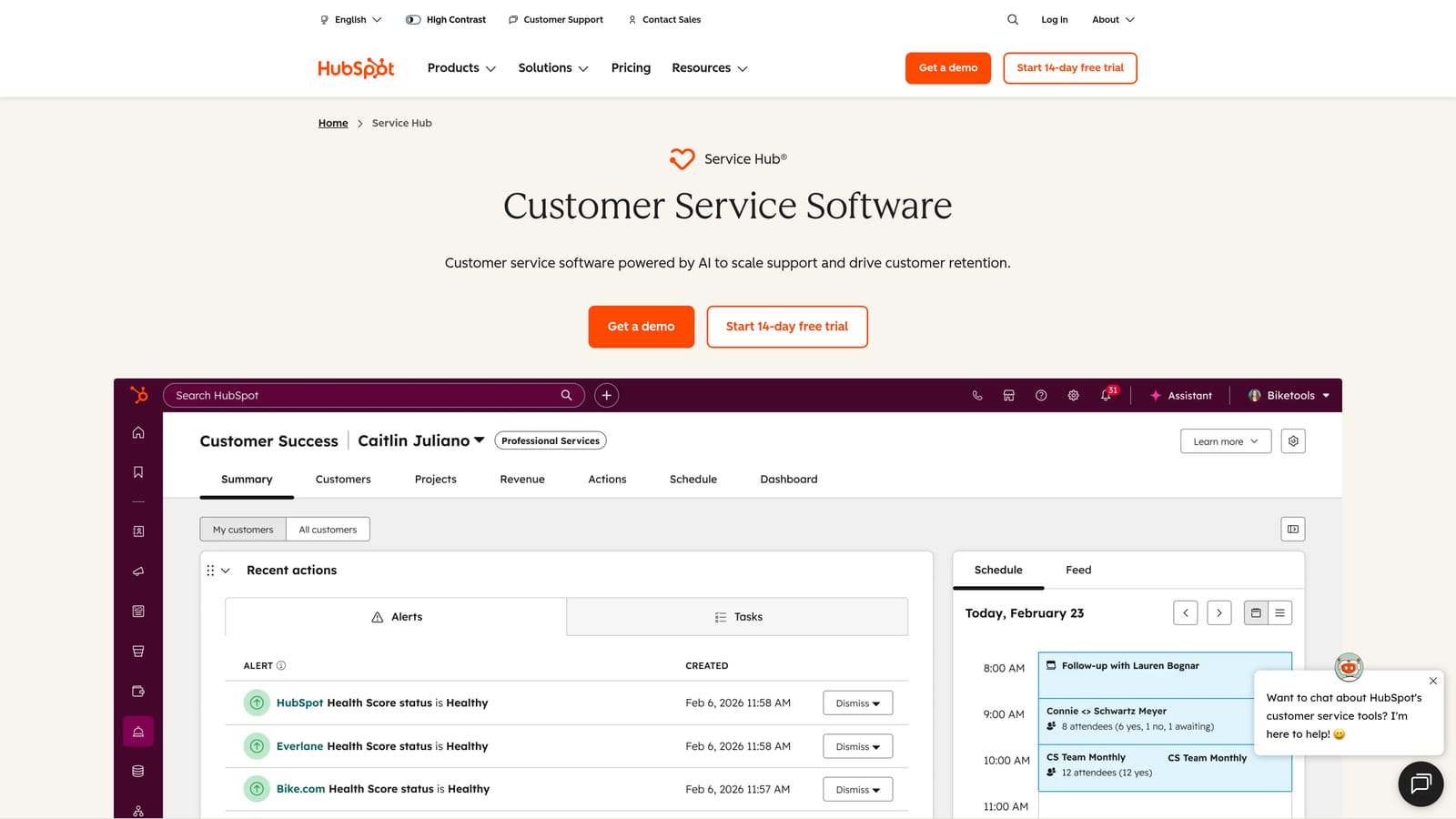
HubSpot Service Hub is HubSpot's native customer service layer, giving support teams full CRM context in every conversation without any separate data synchronization required.
Where This Tool Shines
The core advantage of Service Hub is context. Because it lives natively inside HubSpot, every support conversation carries the full weight of the CRM: contact history, deal stage, lifecycle status, and previous interactions. For teams already running marketing and sales on HubSpot, adding Service Hub eliminates the data fragmentation that plagues multi-tool support stacks.
The AI content assistant helps agents draft replies faster, and the customer feedback tools (NPS, CSAT, CES) feed directly into contact records, creating a closed loop between support outcomes and customer health data. As a standalone support tool outside the HubSpot ecosystem, it's less compelling.
Key Features
Native CRM Context: Every conversation surfaces full contact and deal history from HubSpot without any sync configuration.
Conversations Inbox: Unified inbox with live chat, email, and chatbot builder in a single view.
Ticket Pipeline Management: Visual pipeline for tracking support issues from open to resolution.
Customer Feedback Surveys: NPS, CSAT, and CES tools that write results back to contact records.
AI Content Assistant: Helps agents draft replies and knowledge base articles faster.
Best For
Organizations running their entire customer lifecycle on HubSpot who want to extend that infrastructure to support without introducing a separate tool or managing data synchronization.
Pricing
Free tools available; paid Service Hub starts at approximately $15/seat/month. Verify current pricing at hubspot.com/pricing.
7. Tidio
Best for: E-commerce businesses and small teams wanting fast, no-code deployment with AI automation
Tidio is a lightweight conversational support tool with Lyro AI for automated resolution and strong e-commerce integrations designed for fast deployment with minimal technical overhead.
Where This Tool Shines
Tidio's strength is simplicity and speed. Teams without dedicated support engineers can have a functional AI-assisted chat experience running in a matter of hours, not weeks. The Lyro AI chatbot handles common customer queries automatically, and the no-code setup means non-technical teams aren't blocked waiting for developer time.
The e-commerce integration story is particularly strong. Native connections to Shopify, WooCommerce, and BigCommerce mean product data, order history, and customer context flow into support conversations without custom development. For direct-to-consumer brands and small e-commerce operations, this is a meaningful time saver.
Key Features
Lyro AI: Automated chatbot for resolving common customer queries without human involvement.
No-Code Setup: Fast deployment designed for teams without technical support resources.
E-Commerce Integrations: Native connections to Shopify, WooCommerce, and BigCommerce.
Live Chat with Mobile App: Agents can manage conversations from desktop or mobile.
Free Tier: Core live chat and basic automation available at no cost.
Best For
E-commerce businesses, small teams, and early-stage companies that need a fast, affordable conversational support setup. Less suited to complex B2B SaaS workflows that require deep product context or multi-system orchestration.
Pricing
Free tier available; paid plans start at approximately $29/month. Verify current pricing at tidio.com/pricing.
8. Kustomer
Best for: High-volume consumer support teams needing a unified customer timeline across all channels
Kustomer is a CRM-native conversational support platform built for high-volume consumer support, featuring a unified customer timeline view and strong omnichannel routing.
Where This Tool Shines
Kustomer's defining feature is its timeline view: every customer interaction, regardless of channel, is unified into a single chronological record. For support teams handling customers who switch between email, chat, SMS, and social within the same issue, this eliminates the context-switching and repetition that frustrates both agents and customers.
The platform's custom objects capability allows teams to model complex data structures beyond standard contact fields, which is useful for businesses with non-standard customer data models. AI features cover suggested replies, sentiment detection, and intelligent routing to reduce manual triage overhead.
Key Features
Timeline View: All customer interactions unified chronologically in a single record regardless of channel.
Omnichannel Routing: Email, chat, SMS, social, and voice routing through a single platform.
AI Assistance: Suggested replies, sentiment detection, and intelligent routing to streamline agent workflows.
Workflow Automation: Automates repetitive support tasks and routing rules without developer involvement.
Custom Objects: Flexible data modeling for businesses with complex customer data structures.
Best For
High-volume consumer support teams managing customers across many channels simultaneously. Strong fit for retail, subscription consumer products, and marketplace businesses. Less common in pure B2B SaaS contexts where ticket volume patterns differ.
Pricing
Starts at approximately $89/agent/month. Verify current pricing at kustomer.com/pricing.
9. Gladly
Best for: Consumer brands where long-term customer relationships and channel continuity drive retention
Gladly is a people-centric support platform that replaces ticket numbers with a continuous conversation model, keeping full channel history in one thread regardless of how customers switch between channels.
Where This Tool Shines
Gladly's philosophy is fundamentally different from ticket-based platforms. Rather than organizing support around issue tickets, it organizes everything around the person. There are no ticket numbers. Every interaction a customer has ever had, across every channel, lives in a single continuous thread. For brands where relationship quality drives retention, this model creates a meaningfully different customer experience.
Sidekick AI handles customer self-service, deflecting routine queries before they reach a human agent. The task management and productivity tools help agents stay organized across the full customer relationship, not just the current issue.
Key Features
Person-Centric Model: No ticket numbers; conversations organized around the customer, with full history regardless of channel switches.
Single Thread Across Channels: Voice, email, chat, SMS, and social interactions unified in one continuous conversation view.
Sidekick AI: Self-service AI for customers to resolve common issues before reaching a human agent.
Task Management: Agent productivity tools for managing follow-ups and proactive outreach.
Omnichannel in One View: Voice, email, chat, SMS, and social all accessible from a single agent interface.
Best For
Consumer-facing brands in retail, hospitality, and subscription commerce where customer relationship quality is a competitive differentiator. Less common in B2B SaaS environments where ticket-based workflows are the norm.
Pricing
Contact for pricing. Verify current options at gladly.com/pricing.
Which Platform Fits Your Team?
The right choice depends heavily on where you sit in the market and what you're actually trying to solve. Here's a quick way to think through it.
For B2B SaaS teams wanting AI-first autonomy: Halo AI is the strongest fit. Its page-aware agents, business intelligence layer, and continuous learning architecture are purpose-built for SaaS support at scale, without requiring you to bolt AI onto a legacy helpdesk.
For teams already on HubSpot or Intercom: Service Hub and Intercom are natural extensions of infrastructure you've already invested in. Both have expanded their AI capabilities meaningfully and offer coherent experiences within their respective ecosystems.
For enterprise teams with complex routing needs: Zendesk's depth and integration marketplace are hard to match. The configuration overhead is real, but so is the capability ceiling.
For SMBs and e-commerce brands: Freshdesk and Tidio offer the best combination of affordability, fast deployment, and sufficient AI automation for teams that aren't running complex B2B workflows.
For consumer brands prioritizing relationship continuity: Gladly and Kustomer both take a customer-centric rather than ticket-centric approach, which resonates in retail and high-touch consumer support contexts.
One thing worth emphasizing as you evaluate: the distinction between AI-assisted and AI-autonomous matters more than most platform demos reveal. AI-assisted tools give your agents suggestions. AI-autonomous platforms resolve issues without your agents needing to act at all. If your goal is to scale support without scaling headcount, you need the latter.
Your support team shouldn't grow linearly with your customer base. See Halo in action and discover how continuous learning transforms every interaction into smarter, faster support, with AI agents handling routine tickets, guiding users through your product, and surfacing business intelligence while your team focuses on the complex issues that genuinely need a human touch.