9 Best Cross-Platform Support Automation Tools in 2026
Cross platform support automation helps B2B teams unify email, chat, social, and in-app channels into a single, automated workflow — eliminating ticket gaps and reducing agent context-switching. This guide breaks down the 9 best tools available in 2026, covering what each does best, who it's built for, and what it costs.
 Grant CooperFounder14 min read
Managing customer support across email, chat, social, and in-app channels is one of the biggest operational challenges for scaling B2B teams. When each channel runs on separate tooling, tickets fall through gaps, response times suffer, and your agents spend more time context-switching than actually solving problems.
Cross-platform support automation changes that equation. The right tool connects your channels, automates repetitive resolution workflows, and gives your team a unified view of every customer interaction — regardless of where it started.
This guide covers nine tools that genuinely tackle cross-platform automation, from AI-first agents that learn and adapt to established helpdesk platforms with broad channel coverage. Whether you're evaluating your first automation layer or replacing a legacy system that's hit its ceiling, you'll find a clear breakdown of what each tool does best, who it's built for, and what it costs.
1. Halo AI
Best for: B2B SaaS teams that want AI-first support automation with deep product and stack integration.
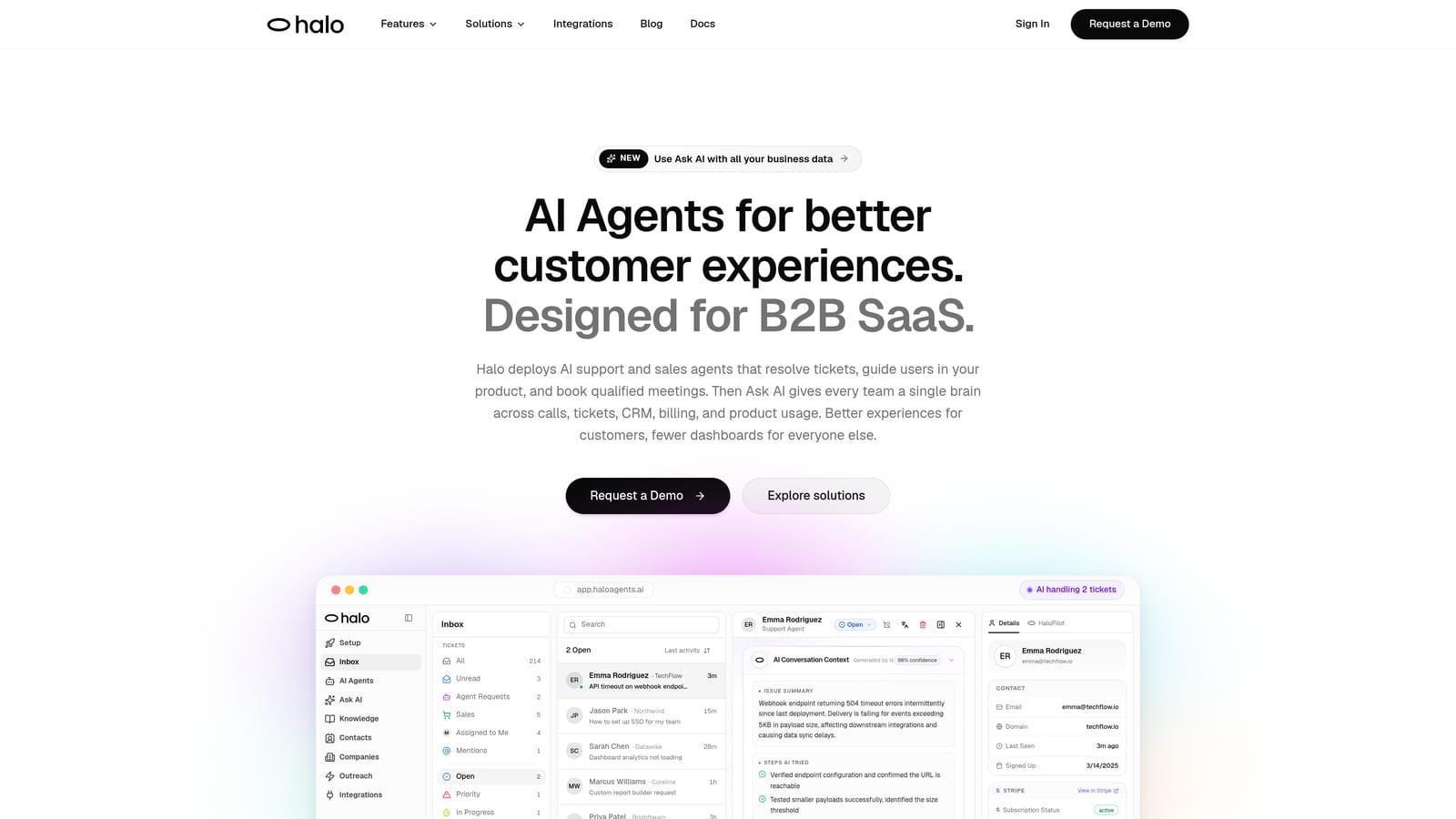
Halo AI is an AI-native customer support platform that deploys intelligent agents to resolve tickets, guide users through your product with page-aware context, and surface business intelligence signals — all while continuously learning from every interaction.
Where This Tool Shines
Most support tools add AI as a layer on top of an existing helpdesk architecture. Halo is built AI-first, which means the intelligence isn't a feature you toggle on — it's the foundation. The platform's page-aware chat widget is a standout capability: the AI agent can see what page a user is on and what state the interface is in, enabling it to provide contextually precise guidance rather than generic answers pulled from a knowledge base.
Beyond resolving tickets, Halo connects to your broader business stack. When a user reports a bug, Halo can automatically create a structured ticket in Linear. The smart inbox surfaces customer health signals and revenue intelligence alongside support data, giving teams visibility that goes well beyond standard support metrics.
Key Features
Page-Aware AI Agent: The AI sees what the user sees — current page, UI state — and delivers contextually relevant guidance including visual walkthroughs.
Continuous Learning: Every resolved and escalated interaction feeds back into the model, so the system gets smarter with every ticket.
Auto Bug Ticket Creation: Bug reports from users are automatically converted into structured tickets routed to Linear, closing the loop between support and engineering.
Smart Inbox with Business Intelligence: Customer health signals, revenue intelligence, and anomaly detection surface directly in the support inbox — not just support KPIs.
Live Agent Handoff: Complex issues escalate gracefully to human agents, with full conversation context preserved.
Deep Integration Stack: Connects to Linear, Slack, HubSpot, Intercom, Stripe, Zoom, PandaDoc, and Fathom out of the box.
Best For
Halo is best suited for B2B SaaS product teams and customer success operations that want AI handling routine ticket resolution autonomously, not just suggesting replies for agents to send. It's a strong fit for teams that have outgrown bolt-on AI features in Zendesk, Freshdesk, or Intercom and want a platform where intelligence is the architecture, not the add-on.
Pricing
Pricing is available on request and is demo-gated. Contact Halo directly through the website to get a custom quote based on your team's needs and volume.
2. Intercom
Best for: Mid-market and growth-stage teams that want omnichannel messaging with AI resolution layered on top.
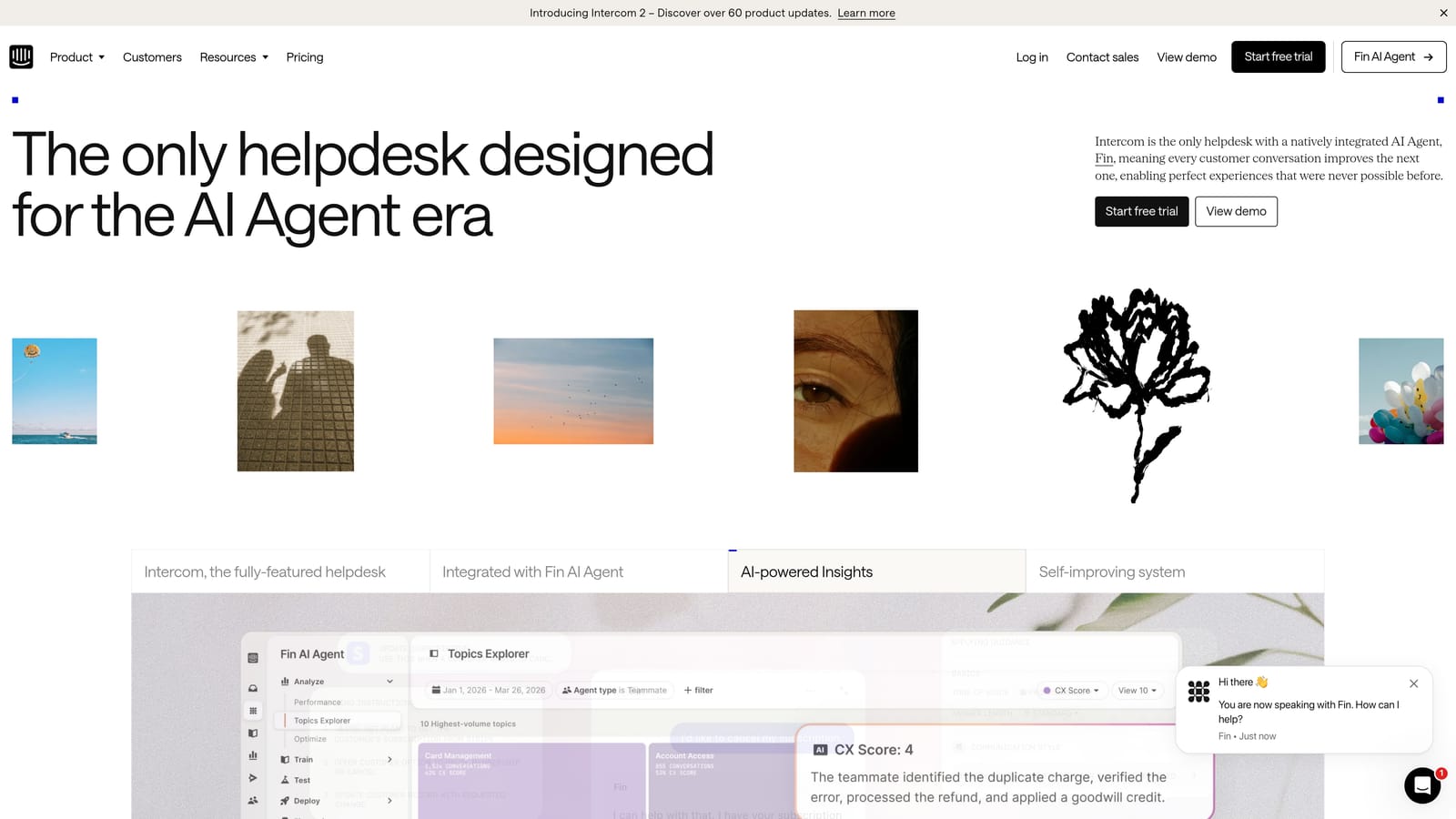
Intercom is a mature omnichannel customer messaging platform with Fin, its AI agent, layered on top of a well-established shared inbox and messenger product.
Where This Tool Shines
Intercom has spent years building out its messenger infrastructure, and the result is a platform that handles web chat, email, mobile, and in-app messaging with genuine polish. Fin AI agent, trained on your help center content, can resolve a meaningful portion of incoming conversations autonomously — and the handoff to human agents when it can't is smooth.
The platform also doubles as a product engagement tool. Product tours and onboarding flows sit alongside support conversations, which makes Intercom particularly appealing for SaaS teams that want to consolidate customer communication and onboarding into a single platform rather than stitching together separate tools.
Key Features
Fin AI Agent: Trained on your help center content to handle autonomous resolution across channels without requiring manual rule-building.
Omnichannel Coverage: Web chat, email, mobile, and in-app messaging from a unified workspace.
Product Tours and Onboarding Flows: In-app guidance tools that extend Intercom's value beyond reactive support.
Conversation Analytics: Robust reporting on resolution rates, response times, and CSAT across channels.
Best For
Intercom suits SaaS companies that want a single platform for support, onboarding, and proactive messaging. It's especially strong for teams already invested in the Intercom ecosystem. Worth noting: Halo AI integrates with Intercom, so teams can layer Halo's intelligence on top of existing Intercom workflows rather than replacing the whole stack.
Pricing
Tiered seat-based pricing with additional resolution-based fees for Fin AI usage. Pricing changes periodically — see intercom.com for current rates.
3. Zendesk
Best for: Enterprise teams that need broad channel coverage, deep customization, and a large integration ecosystem.
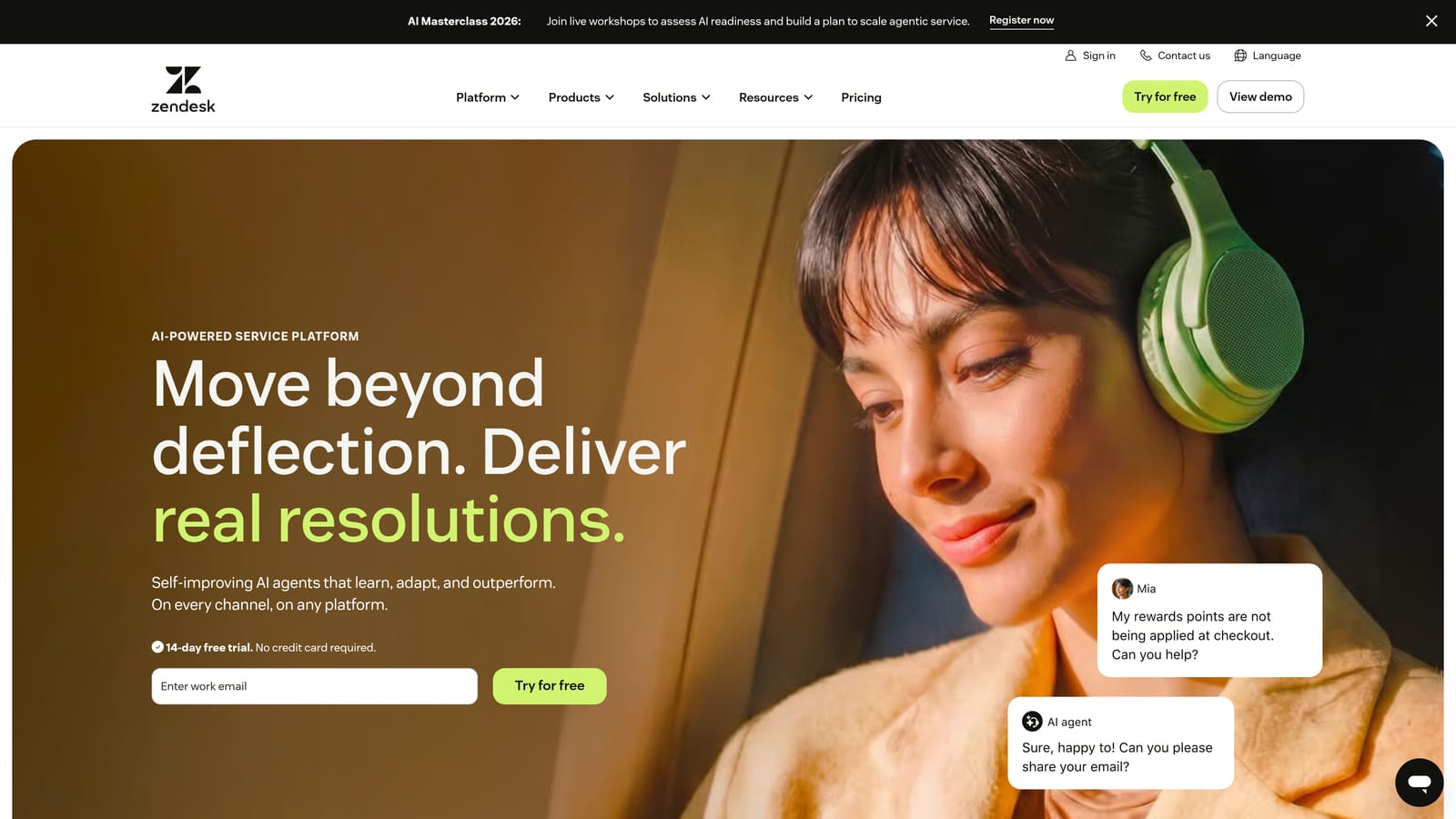
Zendesk is the market-leading helpdesk platform with comprehensive channel support, a vast app marketplace, and AI capabilities via Zendesk AI.
Where This Tool Shines
Zendesk's strength is breadth. Email, live chat, voice, social, and SMS all funnel into a single workspace, and the platform's routing and SLA management capabilities are among the most configurable in the market. For enterprises with complex support operations and multiple teams, that configurability is genuinely valuable.
The app marketplace is another major asset. With hundreds of integrations available, Zendesk can slot into almost any existing tech stack. The tradeoff is that this flexibility comes with complexity: Zendesk implementations often require dedicated admin resources, and the total cost of ownership can climb quickly as you add AI features and integrations as separate line items.
Key Features
Channel Coverage: Email, live chat, voice, social media, and SMS all managed from one platform.
Zendesk AI: Intelligent triage, suggested replies, and an agent copilot to accelerate human agent workflows.
App Marketplace: Extensive library of pre-built integrations for CRM, billing, analytics, and development tools.
Advanced Routing and SLA Management: Highly configurable rules for conversation routing, escalation, and compliance tracking.
Best For
Zendesk is best suited for larger enterprise teams with complex support workflows, multiple channels, and the administrative bandwidth to configure and maintain the platform. Teams looking for a simpler, AI-first alternative often evaluate Halo AI as an upgrade path away from Zendesk's complexity.
Pricing
Suite plans with published per-seat pricing; Zendesk AI features are sold as add-ons with separate costs. See zendesk.com for current rates.
4. Freshdesk
Best for: SMB and mid-market teams that want omnichannel helpdesk features at a lower price point than Zendesk.
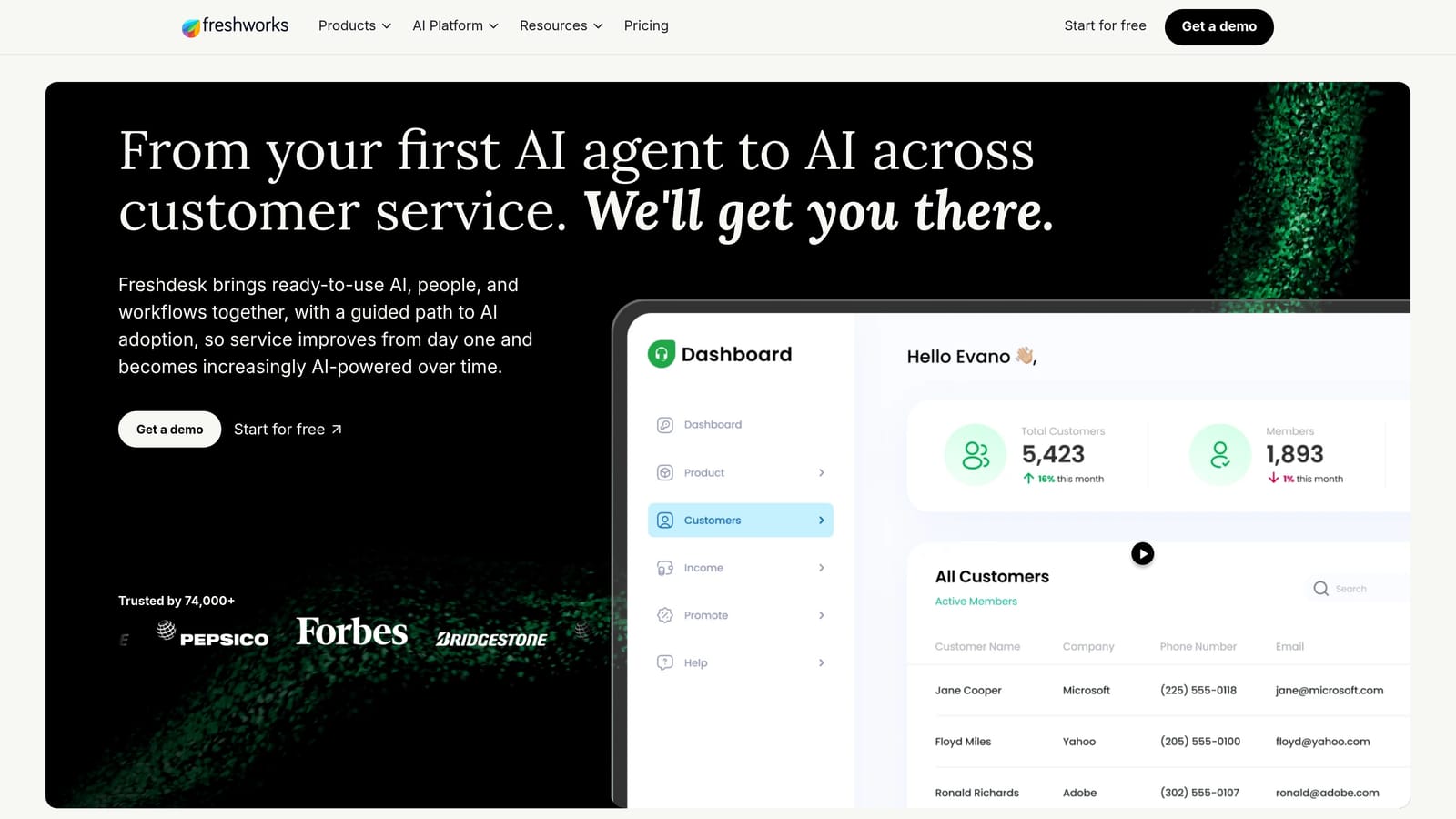
Freshdesk is a cost-competitive omnichannel helpdesk with Freddy AI built in, popular with teams looking for Zendesk-comparable functionality without the enterprise price tag.
Where This Tool Shines
Freshdesk delivers solid omnichannel coverage — email, chat, phone, and social — at a price point that makes it accessible to teams that can't justify Zendesk's cost structure. Freddy AI handles auto-triage, suggested replies, and self-service chatbot flows without requiring a separate AI add-on purchase, which simplifies both the budget conversation and the implementation.
The free tier is a genuine differentiator for small teams. It's limited in scope but functional enough to get a team off spreadsheets and shared inboxes without any upfront commitment. As teams grow, the paid tiers scale reasonably, though Freshdesk's automation depth doesn't quite match Zendesk at the high end.
Key Features
Freddy AI: Built-in AI for auto-triage, suggested replies, and a self-service chatbot — included in paid plans rather than sold separately.
Omnichannel Suite: Unified inbox across email, chat, phone, and social channels.
Free Tier: A functional free plan for small teams, with no time limit.
Freddy Self Service: Chatbot builder for deflecting common queries before they reach agents.
Best For
Freshdesk is a strong fit for SMB and mid-market teams that need omnichannel coverage and basic AI automation without enterprise-level budgets or implementation complexity. It's also a sensible starting point for teams that expect to outgrow it and want to evaluate AI-first alternatives like Halo AI as they scale.
Pricing
Free tier available for unlimited agents with limited features; paid plans scale by agent count and feature set. See freshdesk.com for current plan details.
5. Tidio
Best for: Smaller teams that want fast deployment of AI-powered live chat and chatbot automation.
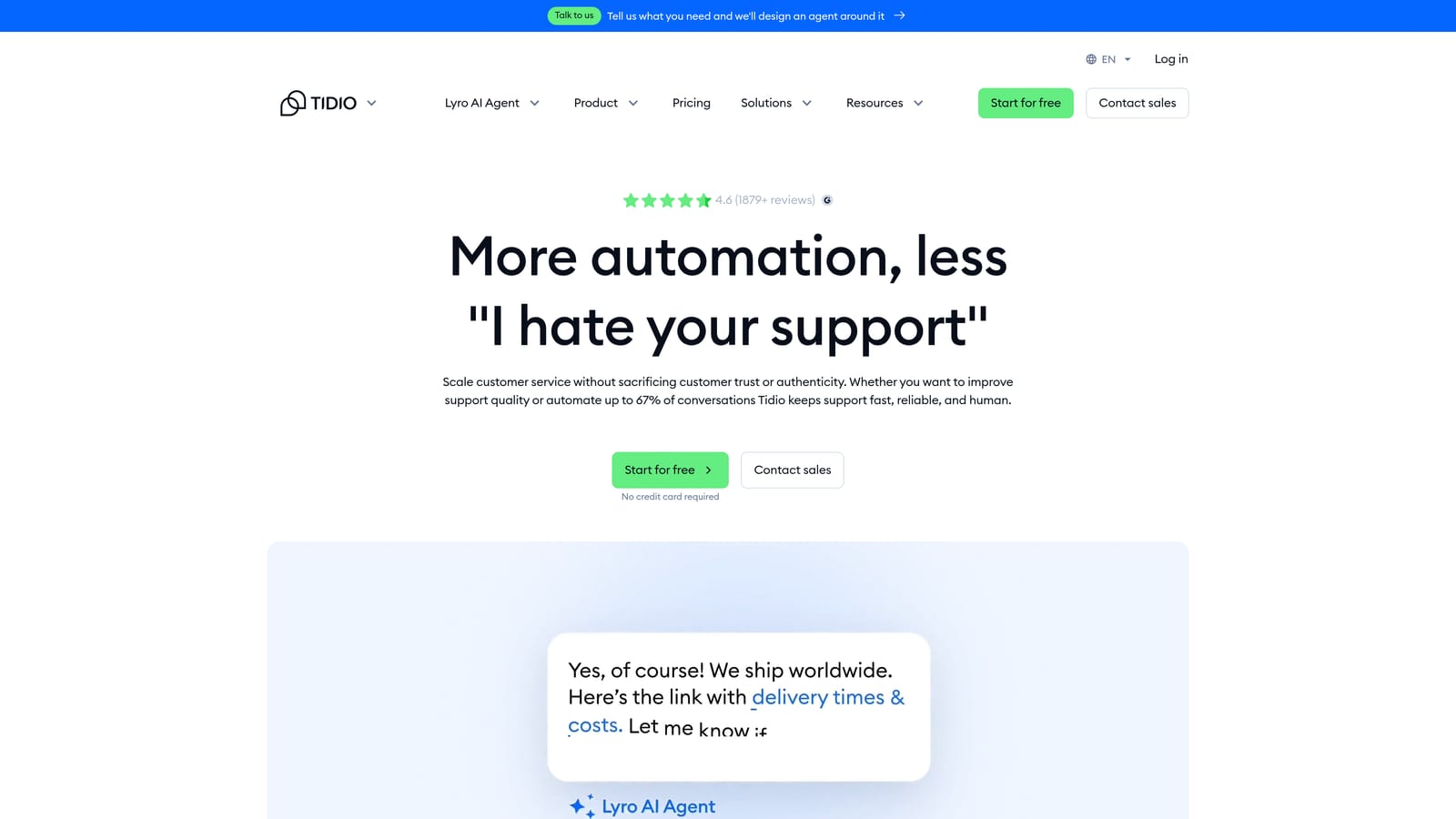
Tidio is a lightweight live chat and AI chatbot platform with Lyro AI for automated conversational support, designed for fast deployment across web and messaging channels.
Where This Tool Shines
Tidio's core advantage is speed to value. Teams can typically get a functioning chatbot live in under an hour, which is a meaningful differentiator for companies that need to reduce support load quickly without a lengthy implementation project. Lyro AI handles conversational support autonomously across common query types, and the visual flow builder makes it straightforward to customize automation paths without engineering involvement.
The platform integrates with web chat, email, and Facebook Messenger, which covers the primary channels for many smaller businesses and early-stage SaaS teams. It's lighter on enterprise features like voice, SMS, or deep CRM integration, but for teams whose support volume doesn't yet justify a full helpdesk, that simplicity is often the point.
Key Features
Lyro AI: Conversational AI agent that handles automated support across common query types without requiring manual rule configuration.
Visual Flow Builder: Drag-and-drop interface for building custom chatbot automation paths.
Fast Setup: Typically live in under an hour, with minimal technical configuration required.
Channel Coverage: Web chat, email, and Facebook Messenger integrations.
Best For
Tidio is best suited for smaller teams, early-stage SaaS companies, and e-commerce businesses that want a quick, accessible entry point into AI-powered support automation without committing to a full helpdesk platform.
Pricing
Free tier available; paid plans at accessible price points that scale with usage. See tidio.com for current plan details.
6. Gorgias
Best for: E-commerce brands, particularly Shopify merchants, that need support automation tied directly to order and customer data.
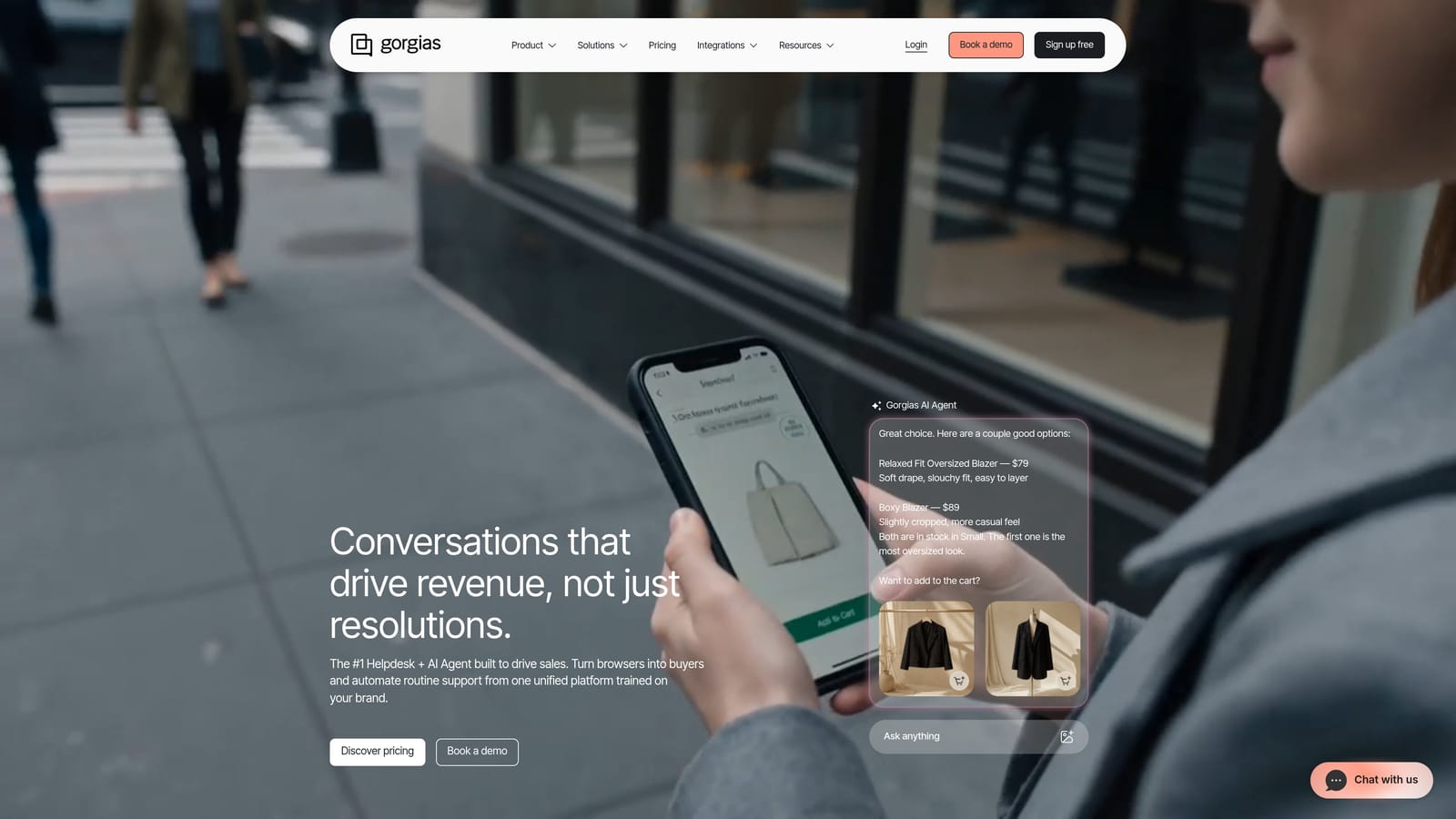
Gorgias is a support platform purpose-built for e-commerce brands, with deep Shopify integration and revenue-focused automation across email, chat, and social channels.
Where This Tool Shines
Gorgias solves a specific problem that generic helpdesks handle awkwardly: e-commerce support requires order context. When an agent opens a ticket in Gorgias, they see the customer's order history, shipping status, and purchase data pulled directly from Shopify, WooCommerce, or Magento — without switching tabs or copying order numbers. That context allows automation rules to handle common queries like order status, returns, and shipping updates without any agent involvement.
The social channel coverage is also notably strong. Instagram, Facebook, Twitter/X, and SMS are all managed from the same workspace as email and chat, which matters for e-commerce brands where customer inquiries arrive via DMs and comments as often as through formal support channels.
Key Features
Deep E-Commerce Integration: Shopify, WooCommerce, and Magento data surfaces directly inside tickets — orders, returns, shipping status, and customer history.
Automation Rules: Pre-built and customizable rules for common e-commerce queries, enabling automated resolution without agent involvement.
Broad Social Coverage: Email, chat, Instagram, Facebook, Twitter/X, and SMS managed from a unified workspace.
Volume-Based Pricing: Priced by ticket volume rather than seats, which aligns costs with actual support load.
Best For
Gorgias is the clear choice for e-commerce brands with significant Shopify or WooCommerce volume. It's less suited for pure B2B SaaS teams whose support workflows don't revolve around order data.
Pricing
Priced by ticket volume rather than agent seats — a model that scales differently from most helpdesks. See gorgias.com for current tier details.
7. Help Scout
Best for: Teams that prioritize a clean, human-first agent experience with lightweight AI assistance.
Help Scout is a shared inbox platform built around simplicity and agent experience, with Beacon for in-app chat and AI features for faster response workflows.
Where This Tool Shines
Help Scout's defining characteristic is its UX philosophy. Where Zendesk and Freshdesk optimize for configurability, Help Scout optimizes for clarity. The shared inbox is clean, low-friction, and fast to onboard — agents can be productive in hours rather than days. For teams that have dealt with the cognitive overhead of dense helpdesk interfaces, that simplicity is a genuine quality-of-life improvement.
Beacon, Help Scout's in-app chat and help widget, extends the platform into the product experience without requiring a separate tool. AI Drafts and AI Summarize accelerate agent workflows without replacing the human in the loop — which aligns with Help Scout's positioning as a platform that enhances agent effectiveness rather than automating agents out of the equation.
Key Features
Shared Inbox: Clean, low-friction collaborative inbox designed for fast agent onboarding and minimal cognitive overhead.
Beacon: In-app chat and help widget that connects the product experience to support without additional tooling.
AI Drafts and AI Summarize: AI-assisted features that speed up agent response workflows without fully automating resolution.
Docs: Built-in knowledge base for self-service content, integrated with Beacon.
Best For
Help Scout is ideal for teams that want a simple, well-designed shared inbox with light AI assistance rather than full autonomous resolution. It's a strong fit for companies where human touch is a deliberate part of the support experience.
Pricing
Per-seat pricing at a mid-range price point. See helpscout.com for current plan details.
8. Kustomer
Best for: High-volume consumer support teams that need a unified customer timeline across all interactions and data sources.
Kustomer is a CRM-native omnichannel platform that unifies all customer interactions, order data, and support history into a single timeline view — built for teams managing complex customer histories at scale.
Where This Tool Shines
Kustomer's central concept is the customer timeline: a single record that aggregates every interaction, purchase, support ticket, and data point from connected systems. For high-volume consumer support operations where agents frequently need to understand a customer's full history before responding, that unified view eliminates significant context-switching. The platform is designed for teams where the customer relationship is complex and the support volume is high.
Omnichannel coverage is comprehensive: email, chat, voice, social, and SMS all route into the same workspace. AI automation and agent assist features help manage volume, though Kustomer's primary differentiator is the CRM-native data model rather than AI resolution depth.
Key Features
Customer Timeline: All interactions, orders, and connected data unified in a single customer record — the platform's core architectural advantage.
Omnichannel Coverage: Email, chat, voice, social, and SMS managed from a unified agent workspace.
AI Automation and Agent Assist: Automation rules and AI features for managing high-volume queues and accelerating agent workflows.
CRM-Native Data Model: Customer data is a first-class object, not an afterthought — strong fit for teams with rich customer histories.
Best For
Kustomer is best suited for high-volume consumer support operations — subscription businesses, marketplaces, and consumer apps — where agents regularly need full customer context to resolve issues effectively. It's enterprise-oriented in both pricing and implementation complexity.
Pricing
Per-seat pricing at an enterprise-oriented price point. See kustomer.com for current rates.
9. Dixa
Best for: Teams that need intelligent conversation routing across voice and digital channels with built-in quality management.
Dixa is a conversation routing platform with a strong voice-plus-digital channel story, skills-based routing, and built-in quality management tools — all from a unified agent workspace.
Where This Tool Shines
Most omnichannel platforms treat voice as an integration afterthought. Dixa treats voice as a first-class channel alongside email, chat, social, and WhatsApp. The routing engine is data-driven and skills-based, meaning conversations are directed to the right agent based on availability, expertise, and customer data — not just round-robin queue logic. For teams where routing quality directly affects customer satisfaction, that sophistication matters.
The built-in quality management and CSAT measurement tools are another differentiator. Rather than exporting data to a separate QA platform, Dixa surfaces quality insights within the same workspace agents use to handle conversations. That integration makes it easier for team leads to identify coaching opportunities without adding tooling overhead.
Key Features
Intelligent Conversation Routing: Skills-based and data-driven routing across voice, email, chat, social, and WhatsApp — not just basic queue assignment.
First-Class Voice Channel: Voice is built into the platform natively, not bolted on through a third-party integration.
Built-In Quality Management: QA workflows and CSAT measurement integrated directly into the agent workspace.
Unified Agent Workspace: All channels managed from a single interface, with full conversation context regardless of channel origin.
Best For
Dixa is a strong fit for mid-market and enterprise teams that handle significant voice volume alongside digital channels, and where routing intelligence and quality management are operational priorities. It's less suited for teams whose support is primarily asynchronous or text-based.
Pricing
Per-seat pricing in the mid-to-enterprise range. See dixa.com for current plan details.
Which Tool Is Right for Your Team?
The right cross-platform support automation tool depends heavily on where your team is starting from and where you're trying to go. Here's a quick orientation by team type.
AI-first B2B SaaS teams: Halo AI is the strongest fit if you want autonomous ticket resolution, page-aware product guidance, and business intelligence signals — not just faster agent workflows.
Enterprise teams with complex routing needs: Zendesk's configurability and channel breadth make it the default choice, though the total cost of ownership and implementation complexity are real considerations.
E-commerce brands: Gorgias is purpose-built for this use case. If you're on Shopify, it's the clearest choice in the market.
SMB and budget-conscious teams: Freshdesk offers the most Zendesk-comparable feature set at a lower price point. Tidio is the right call if you need something live quickly with minimal setup.
Human-first inbox teams: Help Scout's clean UX and deliberate approach to AI assistance make it the best fit for teams where agent experience and human touch are non-negotiable.
Voice-plus-digital operations: Dixa's routing engine and native voice support make it the strongest option for teams where call handling is a significant part of the support mix.
High-volume consumer support: Kustomer's customer timeline and CRM-native architecture are purpose-built for this scenario.
Mid-market teams in the Intercom ecosystem: Intercom remains a strong choice, and it integrates with Halo AI for teams that want to layer more intelligent automation on top of existing Intercom workflows.
Your support team shouldn't scale linearly with your customer base. Let AI agents handle routine tickets, guide users through your product, and surface business intelligence while your team focuses on complex issues that need a human touch. See Halo in action and discover how continuous learning transforms every interaction into smarter, faster support.