9 Best Tools to Stop Customer Issues From Getting Lost Between Platforms in 2026
Discover the 9 best tools for preventing customer issues lost between tools like Zendesk, Slack, and Linear, so billing complaints, bug reports, and churn signals never slip through the cracks. This guide evaluates each solution based on integration depth, cross-platform context preservation, and AI capabilities to help growing B2B support teams stop fragmentation from costing them revenue and customer relationships.
 Grant CooperFounder14 min read
When your support team juggles Zendesk tickets, Slack threads, Linear bug reports, and CRM notes, customer issues inevitably slip through the cracks. A billing complaint lands in email but never reaches the product team. A bug report gets logged in chat but never makes it to your issue tracker. A churning customer sends signals across three platforms that no single person ever sees in full.
The cost isn't just inefficiency. It's lost revenue, frustrated customers, and a support team that spends more time searching for context than actually solving problems.
The tools in this list tackle this fragmentation problem from different angles: some unify your support channels, others connect your entire operational stack, and a few use AI to ensure nothing falls through the gaps. We evaluated each based on integration depth, context preservation across platforms, AI capabilities, and how effectively each prevents the lost issue problem that plagues growing B2B teams.
1. Halo AI
Best for: B2B teams that need AI agents connecting support, engineering, and CRM in one unified system
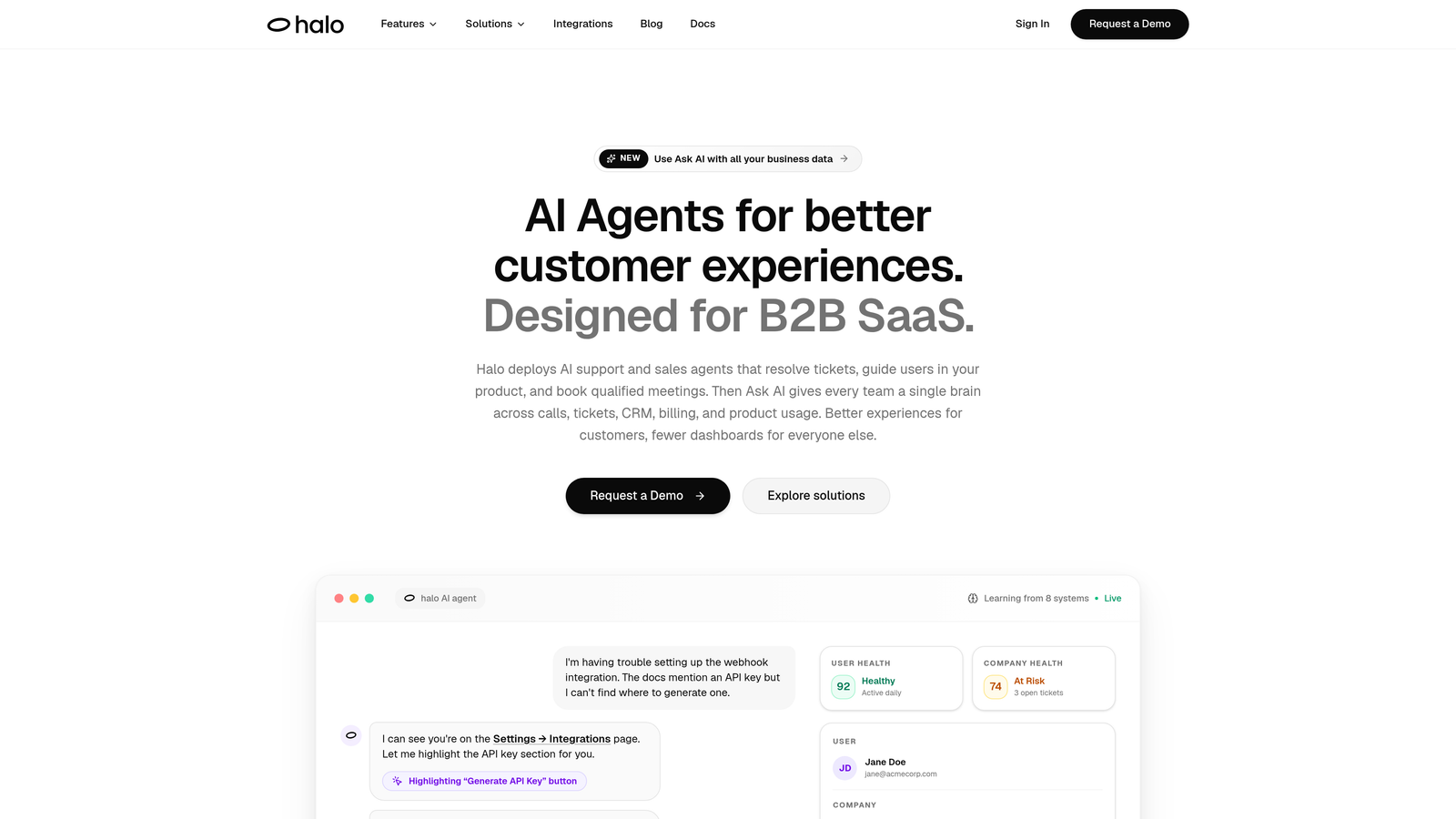
Halo AI is an AI-first customer support platform that connects your entire business stack so customer issues never get lost between systems.
Where This Tool Shines
Most helpdesks were built to manage tickets within a single system. Halo AI was built differently: its AI agents operate across your entire stack, pulling context from Linear, Slack, HubSpot, Stripe, Intercom, and more to resolve issues with full situational awareness. When an agent responds to a billing complaint, it already knows the customer's subscription status, recent interactions, and open engineering tickets.
The auto bug ticket creation feature is particularly valuable for teams where engineering issues regularly get lost in translation. When Halo's AI detects a technical problem in a support conversation, it automatically creates a structured bug report in Linear, complete with context, without anyone having to manually bridge that gap. The page-aware chat widget adds another layer: it sees what the user sees, enabling visual guidance rather than generic instructions.
Key Features
Cross-Platform AI Agents: Resolve tickets with full context drawn from every connected tool in your stack, not just the helpdesk.
Auto Bug Ticket Creation: Automatically generates structured Linear tickets when engineering issues are detected in support conversations.
Page-Aware Chat Widget: Understands the user's current page and UI state to deliver precise, contextual guidance rather than generic responses.
Smart Inbox with Business Intelligence: Surfaces customer health signals, anomaly detection, and revenue intelligence alongside standard support metrics.
Native Integrations: Connects directly with Linear, Slack, HubSpot, Intercom, Stripe, Zoom, PandaDoc, and Fathom out of the box.
Best For
Product-led SaaS companies and B2B teams whose customer issues span multiple tools and teams. Particularly strong for organizations where the gap between support and engineering causes recurring delays, and for teams that want business intelligence from their support data, not just ticket counts.
Pricing
Contact Halo AI for pricing. Given the platform's AI-native architecture and deep integration capabilities, pricing is tailored to team size and stack complexity.
2. Zendesk
Best for: Enterprise support teams needing a proven omnichannel helpdesk with extensive third-party integrations
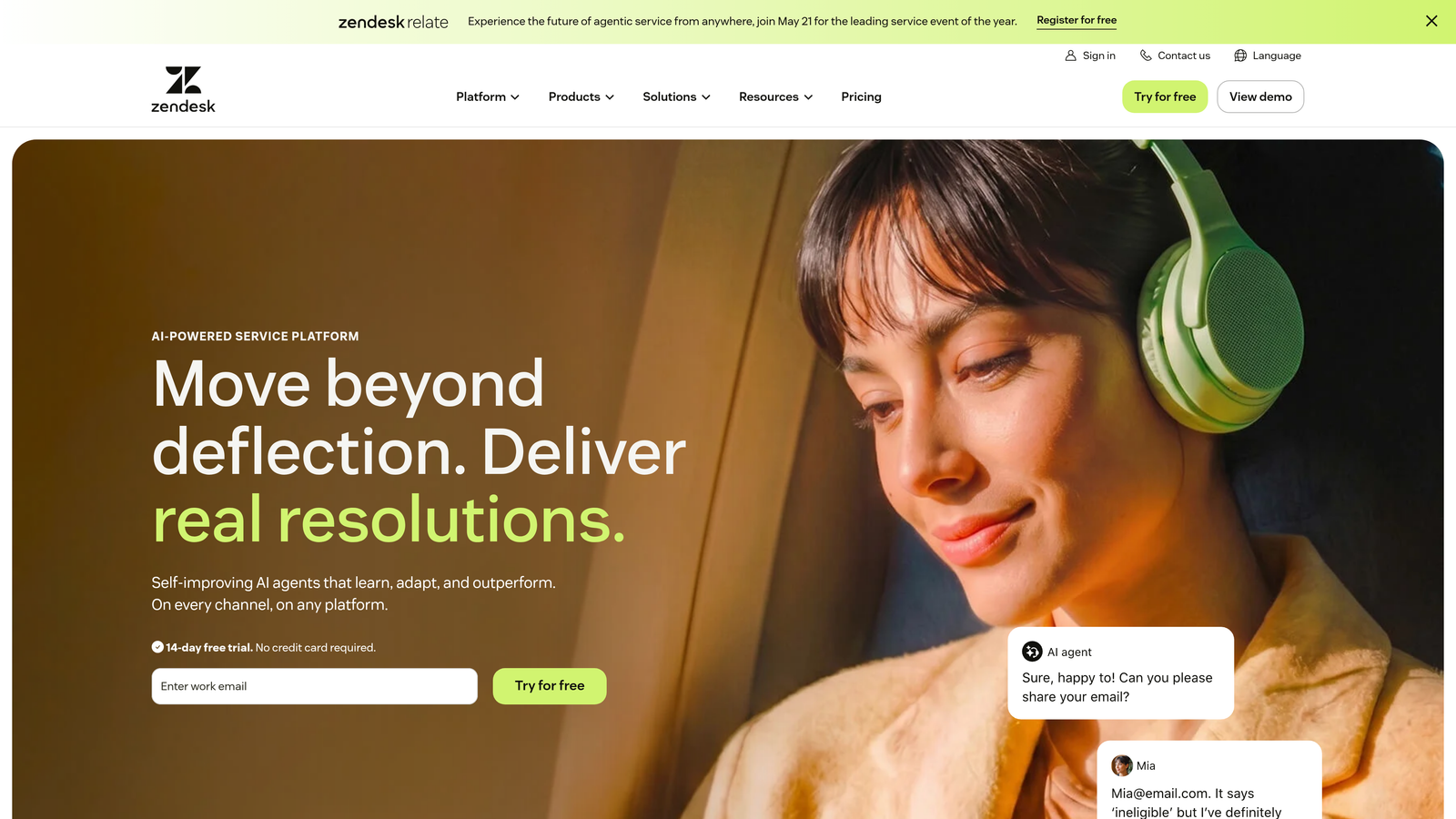
Zendesk is the industry-leading helpdesk platform with a massive integration marketplace and robust omnichannel capabilities built for scale.
Where This Tool Shines
Zendesk's greatest strength is its sheer breadth. With over 1,500 marketplace integrations, it connects to nearly every tool in a modern SaaS stack. For teams already invested in Zendesk, the platform can serve as the central hub that pulls in context from adjacent systems, reducing the fragmentation problem through integration rather than replacement.
The tradeoff is that Zendesk is fundamentally a ticket management system with integrations layered on top. Context flows into Zendesk, but it doesn't always flow back out to engineering tools or CRMs automatically. Teams often need custom workflows or third-party automation tools to close that loop fully.
Key Features
1,500+ Marketplace Integrations: Connect virtually any tool in your stack through the Zendesk App Marketplace.
Omnichannel Support: Manage email, chat, phone, social, and messaging channels from a unified agent workspace.
Advanced Routing and SLAs: Sophisticated ticket routing rules, escalation workflows, and SLA management for complex support operations.
AI Answer Bot and Agent Assist: Automated deflection and in-ticket AI suggestions to speed up agent responses.
Reporting and Analytics: Comprehensive dashboards for tracking team performance, ticket volume, and resolution metrics.
Best For
Mid-market to enterprise teams with dedicated support operations, complex routing needs, and existing Zendesk investments. Less ideal for teams that need deep bidirectional sync with engineering tools without significant configuration effort.
Pricing
Support Team plans start at $19/agent/month. Suite plans (which include omnichannel capabilities) start at $55/agent/month, with higher tiers for enterprise features.
3. Intercom
Best for: Product-led SaaS companies wanting in-app conversational support with AI-powered automation
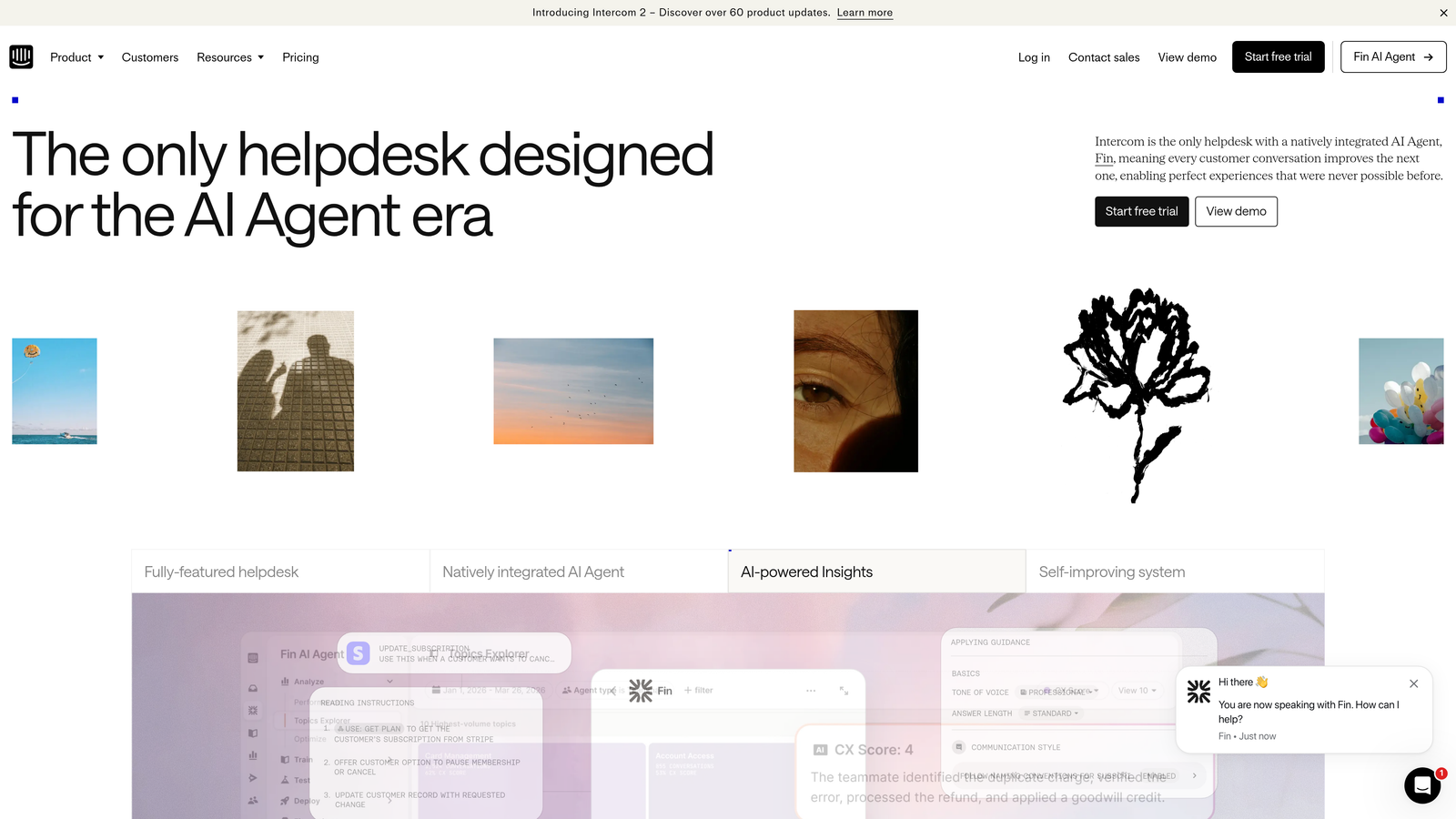
Intercom is a conversational support platform that combines an in-app messenger, help center, and AI-powered Fin agent for seamless customer engagement.
Where This Tool Shines
Intercom excels at meeting customers where they are: inside your product. The in-app messenger creates a direct channel for support that captures context automatically, since Intercom knows who the user is, what plan they're on, and what they've been doing in the product. This makes it harder for issues to go unlogged in the first place.
The Fin AI agent is genuinely capable for automated resolution, drawing on your help center content to answer common questions without agent involvement. Where Intercom is weaker is in the handoff to engineering: getting a conversation from Intercom into Linear or a bug tracker still requires manual effort or third-party automation.
Key Features
Fin AI Agent: Resolves tickets automatically using help center content, with configurable escalation paths for complex issues.
In-App Messenger: Contextual chat widget with product tours, onboarding flows, and proactive messaging capabilities.
Unified Inbox: Consolidates chat, email, and social channels into a single agent workspace.
Custom Bots and Workflow Builder: Visual automation builder for routing, triage, and response workflows without code.
Tool Integrations: Native connections to Salesforce, Jira, Slack, and other common SaaS tools.
Best For
SaaS companies with a product-led growth motion that want in-app support tightly coupled with onboarding and engagement. Strong for teams prioritizing customer communication quality; less suited for organizations needing deep engineering-side integration.
Pricing
Essential plans start at $39/seat/month. Fin AI is priced per resolution, making costs variable based on automation volume. Higher tiers unlock advanced features and customization.
4. Freshdesk
Best for: Growing teams wanting omnichannel helpdesk with a free tier and native Freshworks ecosystem integration
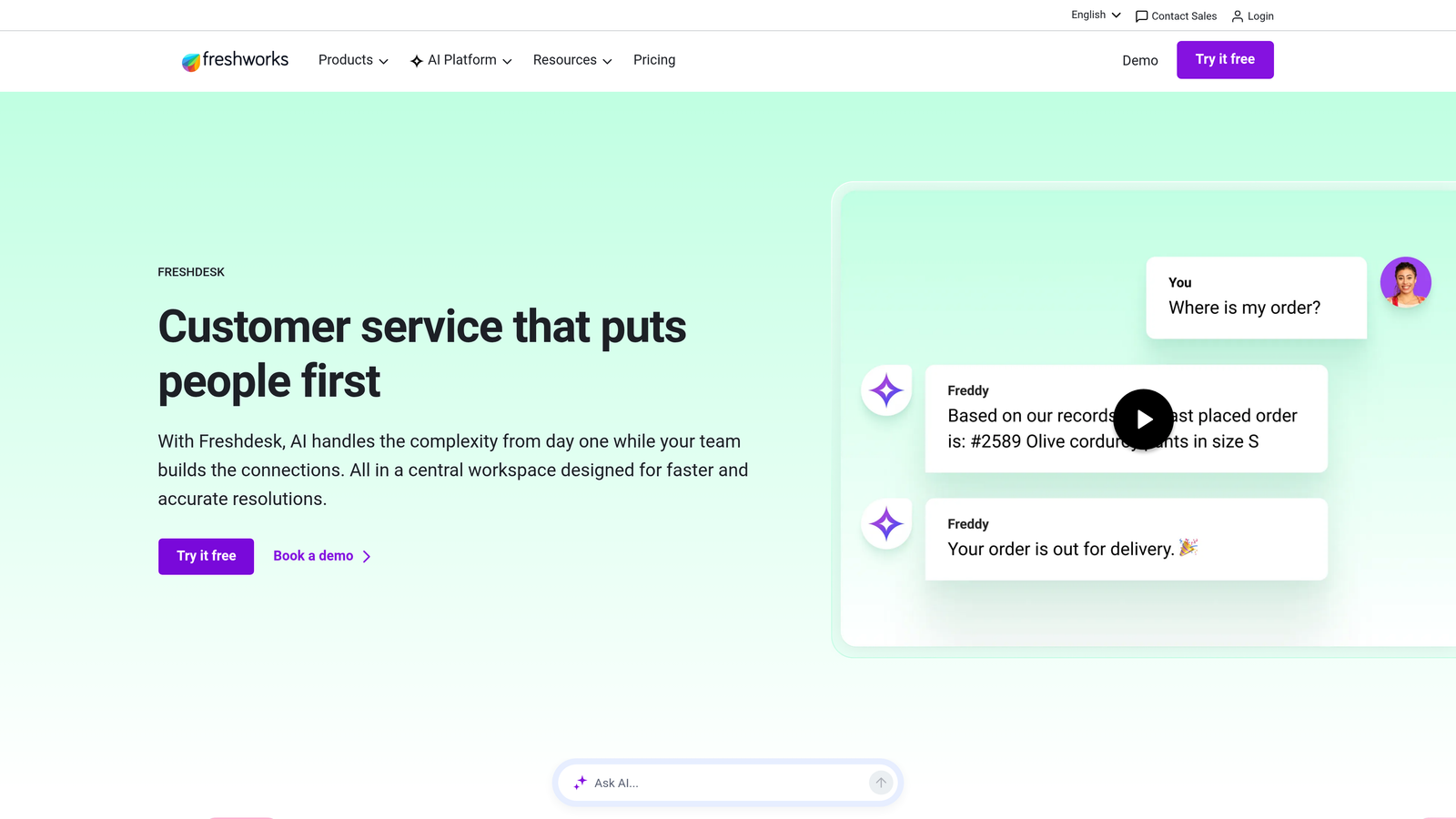
Freshdesk is an omnichannel helpdesk from Freshworks offering AI-powered triage and seamless connection to the broader Freshworks CRM and ITSM ecosystem.
Where This Tool Shines
Freshdesk's value proposition centers on affordability and ecosystem cohesion. If your team already uses Freshsales for CRM or Freshservice for IT, the native integration between these tools creates a connected view of the customer that reduces context loss significantly. A support ticket can surface CRM history and IT service records without any custom integration work.
Freddy AI, Freshdesk's built-in AI layer, handles auto-triage and suggested responses reasonably well for a platform at this price point. The free tier makes it accessible for smaller teams who need basic omnichannel coverage without a budget commitment.
Key Features
Freddy AI: Automated ticket triage, classification, and suggested responses to reduce manual agent workload.
Omnichannel Support: Unified inbox for email, phone, chat, social media, and messaging platforms.
Freshworks Ecosystem Integration: Native, deep connections with Freshsales CRM, Freshservice ITSM, and Freshchat.
Collaboration Tools: Shared ticket ownership, linked tickets, and internal notes for cross-team coordination.
Free Tier: Functional free plan for small teams getting started with structured support.
Best For
Small to mid-size teams that want omnichannel ticketing without enterprise pricing, particularly those already in the Freshworks ecosystem. Less compelling for teams whose stack centers on tools outside the Freshworks suite.
Pricing
Free plan available for unlimited agents with basic features. Paid plans start at $15/agent/month, with higher tiers unlocking automation, AI features, and advanced analytics.
5. Unthread
Best for: B2B teams whose customer support conversations happen primarily in Slack channels
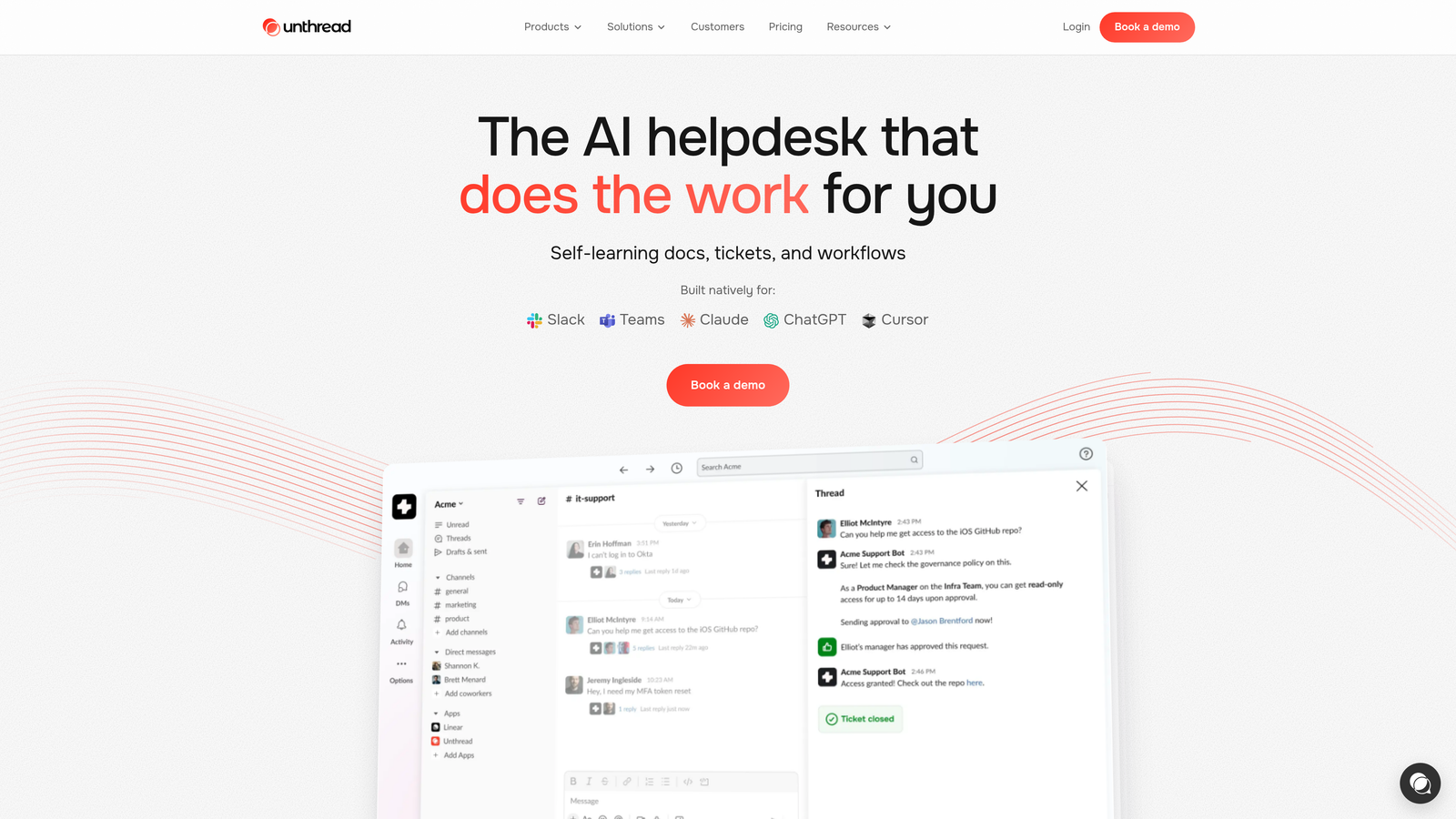
Unthread is a Slack-native support tool that converts Slack messages into trackable tickets with SLA management, ensuring requests don't get buried in channel noise.
Where This Tool Shines
For B2B companies running customer support through Slack Connect channels, Unthread solves a very specific and painful problem: Slack conversations are terrible at tracking accountability. Messages get buried, threads go stale, and there's no native SLA enforcement. Unthread adds a structured ticketing layer on top of Slack without forcing customers or agents to leave the interface they already use.
The integration with Linear, Jira, and GitHub is particularly useful for bridging the support-to-engineering gap. When a customer reports a bug in a Slack channel, Unthread can route that into an engineering work item without any copy-pasting or context loss in translation.
Key Features
Slack-Native Ticket Creation: Automatically converts Slack messages into tracked support tickets with assignees and status tracking.
SLA Tracking in Slack: Enforces response time commitments and sends escalation alerts directly within Slack.
Engineering Integrations: Connects with Linear, Jira, and GitHub to route issues into development workflows.
Analytics Dashboard: Tracks response times, resolution rates, and team performance metrics.
Slack Connect Support: Works with external Slack Connect channels for B2B customer relationships.
Best For
B2B SaaS teams that manage customer relationships through Slack Connect and need accountability without migrating to a traditional helpdesk. Ideal for companies with 10-100 person support operations where Slack is the primary communication layer.
Pricing
Free plan available. Paid plans start at $50/month, with higher tiers unlocking additional integrations and advanced analytics features.
6. Syncly
Best for: Product and CX teams that need to surface hidden issues and sentiment trends across fragmented feedback sources
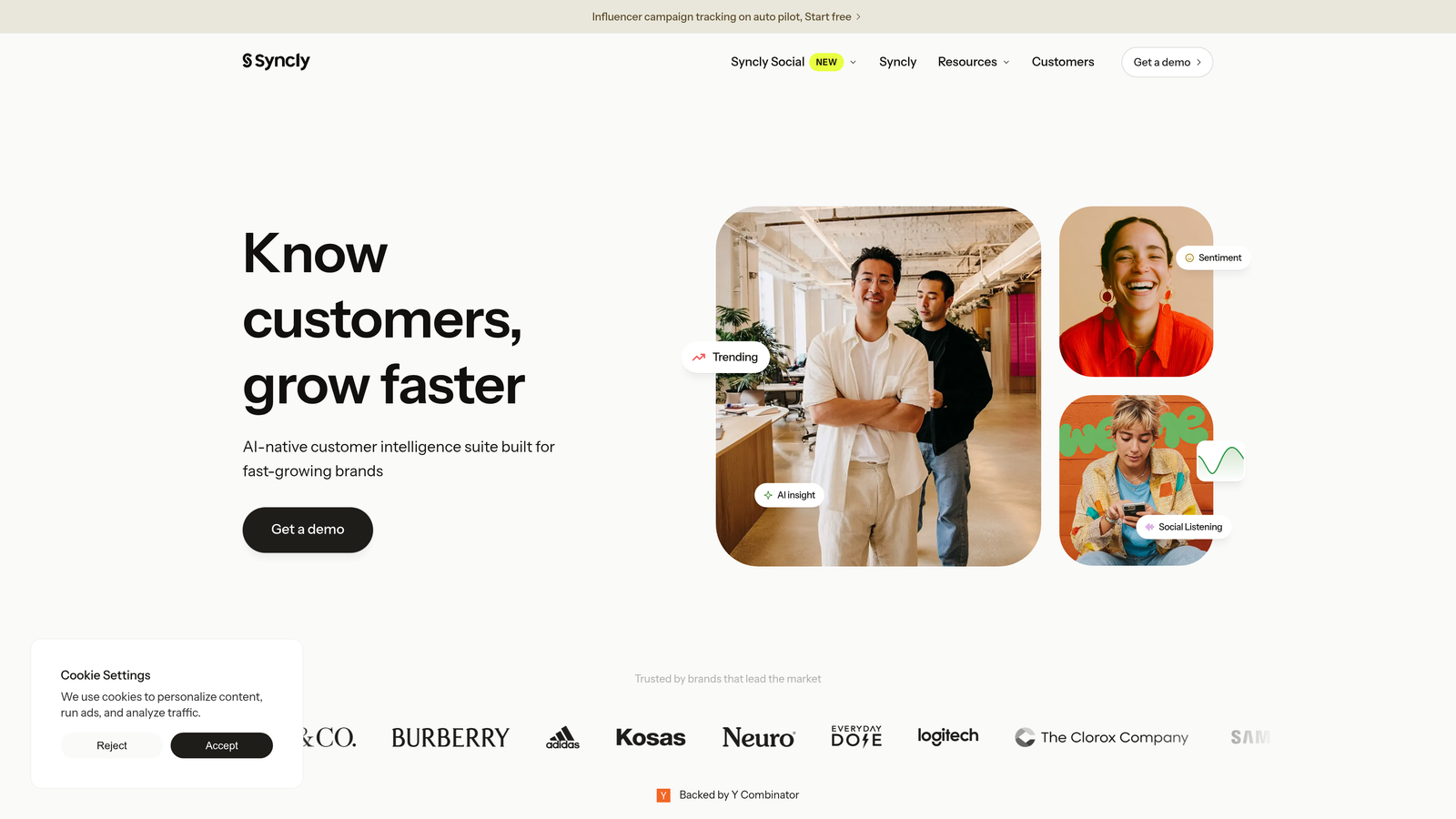
Syncly is an AI-powered customer feedback intelligence platform that aggregates signals from support tickets, reviews, surveys, and chat to surface hidden issues before they become crises.
Where This Tool Shines
Syncly addresses a different dimension of the lost issue problem: not just routing, but visibility. Customer issues often aren't lost because no one logged them. They're lost because the signal is spread thin across dozens of sources, and no single person has the bandwidth to synthesize it. Syncly's AI does that synthesis automatically, identifying emerging negative trends that might not be visible in any single channel.
This makes Syncly particularly valuable for product teams that need to understand what customers are struggling with across all touchpoints, not just what support tickets were formally filed. Real-time alerts for emerging negative sentiment give teams a chance to act before a trend becomes a churn driver.
Key Features
AI Sentiment Analysis: Processes feedback across multiple sources simultaneously to identify emotional trends and pain points.
Automatic Topic Categorization: Groups related issues and detects emerging themes without manual tagging.
Multi-Source Integrations: Connects with Zendesk, Intercom, Slack, G2, and other feedback channels.
Real-Time Trend Alerts: Notifies teams when negative sentiment around a specific topic is accelerating.
Product and CX Dashboard: Prioritized view of issues for teams making roadmap and experience decisions.
Best For
Product managers and CX leaders at growth-stage SaaS companies who need to understand the full picture of customer pain across channels. Complements (rather than replaces) a helpdesk by adding intelligence on top of existing support data.
Pricing
Contact Syncly for pricing. A free trial is available to explore the platform before committing.
7. DevRev
Best for: Engineering-led companies that want support tickets and product development in a single unified system
DevRev is a purpose-built platform that unifies customer support and product development, eliminating the gap where issues get lost between support and engineering teams.
Where This Tool Shines
DevRev takes a structurally different approach to the fragmentation problem: instead of integrating separate systems, it eliminates the separation entirely. Customer conversations and engineering work items live in the same platform, linked at the data level. When a customer reports a bug, it can be directly connected to the code change that fixes it, with full traceability from complaint to resolution.
The Trail feature is a standout: it tracks the complete lifecycle of an issue from initial customer report through engineering resolution, giving support teams visibility into where their escalations actually land. For companies where the support-to-engineering handoff is a chronic pain point, this is a compelling architectural solution.
Key Features
Unified Support and Engineering: Customer conversations and development work items exist in the same system with direct linking.
Turing AI Bot: Automated customer responses powered by AI, with escalation paths to human agents.
Conversation-to-Code Linking: Connects customer reports directly to the code changes and engineering work addressing them.
Built-In Product Analytics: Ties support interaction data to product usage analytics for richer context.
Trail Feature: Tracks the full lifecycle of an issue from customer report through engineering resolution.
Best For
Engineering-forward SaaS companies where product and support teams are tightly coupled and the cost of context loss between them is high. Less suited for companies with large, specialized support operations that need deep helpdesk customization.
Pricing
Free tier available. Pro plans start at $19.99/user/month, making it accessible for smaller teams evaluating the unified approach.
8. Zapier
Best for: Teams that want to connect their existing tools without replacing them, using custom automation workflows
Zapier is a no-code automation platform connecting 7,000+ apps, enabling teams to build custom workflows that route customer issues between tools without overhauling their stack.
Where This Tool Shines
Zapier is the connective tissue approach to the fragmentation problem. Rather than replacing any tool, it builds bridges between them. A new Zendesk ticket can automatically create a Linear issue, notify a Slack channel, and update a HubSpot contact record, all without any code and without anyone manually carrying information between systems.
The platform's flexibility is its core strength and its core limitation. Zapier can solve almost any routing or context-sharing problem, but it requires someone to design and maintain those workflows. For teams with complex, evolving support operations, Zapier automations can become a maintenance burden over time. It works best as a complement to a primary support tool rather than a standalone solution.
Key Features
7,000+ App Integrations: Connect virtually any combination of tools in your stack with multi-step automated workflows.
Conditional Logic and Filters: Route issues intelligently based on content, source, priority, or customer attributes.
Tables and Interfaces: Build lightweight tracking dashboards and internal tools without leaving Zapier.
AI-Powered Automation: Natural language Zap creation and AI-suggested automations for faster workflow building.
Paths Feature: Branching workflows that handle different issue types with different routing logic in a single Zap.
Best For
Teams with a well-established tool stack that need to reduce manual handoffs between systems without committing to a new platform. Strong for operations teams comfortable with workflow design; less ideal as a primary support solution for customer-facing interactions.
Pricing
Free plan includes 100 tasks per month. Paid plans start at $19.99/month, with higher tiers unlocking more tasks, multi-step Zaps, and premium app connections.
9. Thena
Best for: B2B customer success teams managing enterprise relationships through Slack with AI-powered request detection
Thena is an AI-powered B2B customer engagement platform that detects customer requests across Slack, email, and web channels, then routes them to the right team automatically.
Where This Tool Shines
Thena and Unthread occupy similar territory, but Thena leans more heavily into AI-driven request detection and customer health intelligence. Where Unthread focuses on turning Slack messages into tickets, Thena focuses on understanding the full picture of a customer relationship: tracking interaction patterns, scoring health, and surfacing at-risk accounts before they escalate.
The AI request detection is genuinely useful for enterprise B2B teams where customer conversations are high-value and high-stakes. Thena identifies requests in Slack channels without requiring manual tagging or thread management, reducing the cognitive load on customer success managers who are already juggling many accounts.
Key Features
AI Request Detection: Automatically identifies customer requests in Slack channels without requiring manual tagging or thread marking.
Unified Customer View: Consolidates interactions across Slack, email, and web into a single customer profile.
CRM and Helpdesk Integration: Routes escalations to connected CRMs and helpdesks for structured follow-up.
Customer Health Scoring: Generates health scores based on interaction patterns and engagement signals.
Performance Analytics: Tracks response times, request volume, and team performance across customer accounts.
Best For
Enterprise B2B companies with high-touch customer success models where customer relationships are managed through Slack Connect. Strong for teams that want health scoring and proactive risk detection alongside reactive support management.
Pricing
Contact Thena for pricing. The platform is positioned for enterprise B2B teams, so pricing reflects the high-touch customer success use case.
Which Tool Is Right for Your Team
The right answer depends on where your fragmentation problem actually lives. Different tools solve different dimensions of the lost issue challenge, and the best choice is the one that targets your specific weak point.
For AI-native unified support across your entire stack: Halo AI is the strongest choice for teams whose issues span helpdesk, engineering, CRM, and everything in between. Its AI agents maintain context across all connected tools, auto-create bug tickets, and surface business intelligence that goes well beyond standard support metrics.
For enterprise omnichannel ticketing: Zendesk remains the benchmark for large support operations that need proven reliability, deep customization, and a massive integration marketplace.
For in-app conversational support: Intercom is the natural fit for product-led SaaS companies that want support tightly woven into the product experience.
For budget-conscious omnichannel coverage: Freshdesk delivers solid omnichannel capabilities at a price point that works for growing teams, especially those already in the Freshworks ecosystem.
For Slack-native support: Unthread works well for teams that want lightweight structure without leaving Slack; Thena adds AI health scoring and enterprise relationship intelligence on top of that foundation.
For surfacing hidden feedback trends: Syncly is the right complement for product and CX teams that need intelligence across fragmented feedback sources, not just ticket management.
For closing the support-to-engineering gap structurally: DevRev's unified architecture makes it compelling for engineering-led companies where that handoff is the core problem.
For connecting existing tools without replacing them: Zapier is the flexible glue layer that can bridge almost any combination of tools with custom routing logic.
Your support team shouldn't scale linearly with your customer base. Let AI agents handle routine tickets, guide users through your product, and surface business intelligence while your team focuses on complex issues that need a human touch. See Halo in action and discover how continuous learning transforms every interaction into smarter, faster support.